National Disaster Management Centre
Overview
The National Disaster Management Centre is established in terms of Section 8 of the Disaster Management Act, 2002 (Act No 57 of 2002) (DMA). The National Centre functions as an institution within the public service and forms part of, and functions within, a department of state (DCOG) for which the Minister is responsible. The objective of the National Centre is to promote an integrated and co-ordinated system of disaster management, with special emphasis on prevention and mitigation, by national, provincial and municipal organs of state, statutory functionaries, other role-players involved in disaster management and coimmunities’ National Centre is also responsible for the administration of the Fire Brigade Services Act, 1987 (Act No 99 of 1987) (FBSA)Within the South African environment, disaster management is a shared responsibility which must be fostered through partnerships between the various stakeholders and co-operative relationships between the different spheres of government, the private sector and civil society.
Furthermore, disaster management is an intergovernmental process, with each sphere of government playing a unique role and performing a specific set of responsibilities in the process. The DMA makes provision for the establishment of Disaster Management Centres across all spheres of government.The general powers and duties of the Nation Centre are stipulated in Section 15 of the DMA and this includes the following:must specialise in issues concerning disasters and disaster management:may act as an advisory and consultative body on issues concerning disasters and disaster management must promote the recruitment, training and participation of volunteers in disaster management;must promote disaster management capacity building, training and education throughout the Republic, including in schools, and, to the extent that it may be appropriate. in other southern African states;Section 6 of the DMA stipulates that the Minister must prescribe a national disaster management framework.
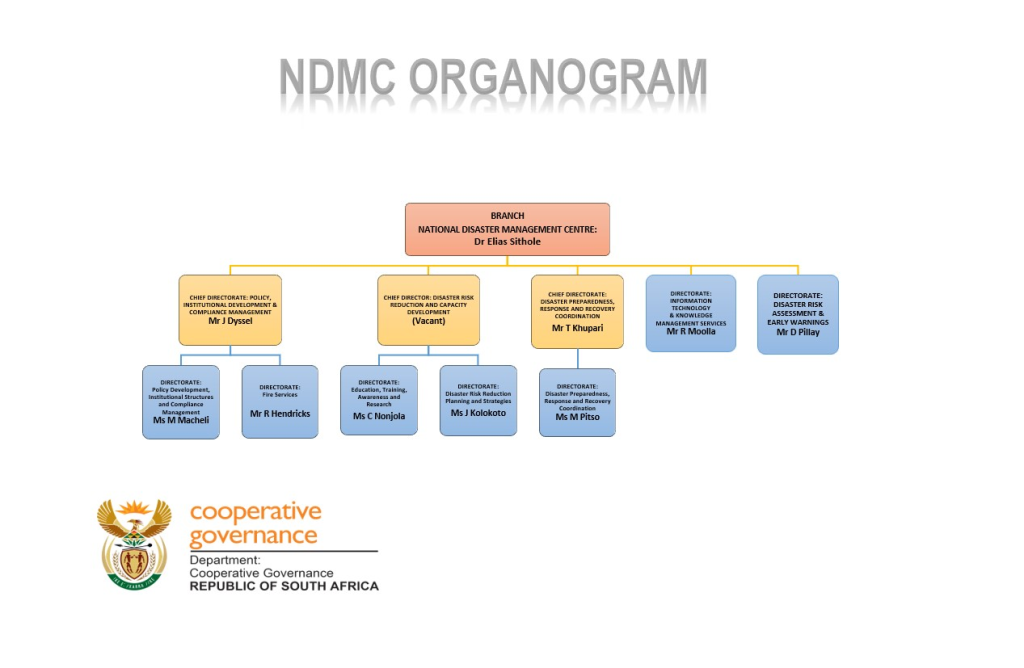
The national disaster management framework is the legal instrument specified by the Act to address such needs for consistency across multiple interest groups, by providing ‘a coherent, transparent and inclusive policy on disaster management appropriate for the Republic as a whole’ in terms of Section 7(1) of the DMA. The national disaster management framework comprises four key performance areas (KPAs) and three supportive enablers required to achieve the objectives set out in the KPAs. The KPAs and enablers are informed by specified objectives and, as required by the Act, key performance indicators (KPIs) to guide and monitor progress. In addition, each KPA and enabler concludes with a list of guidelines that will be disseminated by the NDMC to support the implementation of the framework in all three spheres of government. The diagram below depicts the interface between the four KPAs and how the three Enablers: The FBSA is administered by the Directorate Fire Services. The primary objective of this Directorate is to oversee, manage and provide oversight in the efficient implementation of the FBSA, and other related policies and strategies on fire services nationally. This Directorate provide secretariat services to the Fire Brigade Board.
Vision
An integrated system of Disaster Management and Fire Services.
Mission
To coordinate system of Disaster Management and Fire Services, through: Developing and implementing appropriate policies and regulatory frameworks. Promoting a culture of risk avoidance by creating enabling mechanisms for stakeholder participation. Monitoring and evaluation of disaster management programmes across the spheres of government. Strengthening cooperation amongst stakeholders in disaster management. Inform and direct SA’s disaster management efforts to achieve the priorities of Regional and International Frameworks.
About Us
NOTES ON THE HISTORY OF THE DISASTER MANAGEMENT INSTITUTE OF SOUTHERN AFRICA (DMISA)
The Disaster Management Institute of Southern Africa (DMISA) aims to advance the discipline and create learning and networking opportunities. DMISA, which was founded in 1985, has engaged with the South African National Disaster Management Centre (NDMC) on various occasions. Regular meetings between DMISA leadership and the NDMC ensures a constant flow of information from functionaries in all spheres of government, directly to the NDMC, cutting red tape and improving cooperation and understanding. DMISA is a self-governing body committed to standardization, and hosts the biggest annual Disaster Risk Management conference in Africa, routinely attracting more than 350 delegates.
In partnership with the NDMC, DMISA plays an important role in furthering the interests of DRM practitioners in South Africa and in the Southern Africa region as a whole. DMISA has kept pace with global changes since its inception, and has undergone several name changes and considerable constitutional reforms in recent years. Founded in April 1985 as the Civil Defence Association of South Africa, it has contributed significantly to South Africa’s legislative reform in DRM through inputs of its members and structures.
When the institute was established, civil defence services were rendered according to the provisions of the Civil Defence Act (Act 67 of 1977) and the Fund Raising Act of 1978. However, it became increasingly apparent that civil defence and protection had to change to keep abreast with international approaches to disasters and how they were managed. The International Decade for Natural Disaster Reduction (IDNDR), introduced by the United Nations (UN) during the 1990s, was a clear call for the world to shift the focus away from reactive disaster responses onto disaster prevention and preparedness and building resilience through developmental initiatives. The changes within the Institute reflected the changes in thinking and approach among practitioners in the field, as well as a move away from military influence towards a reaffirmation of the principles of civilian control and democracy.
DMISA organised a study tour to Europe and the United Kingdom in 1990, which contributed significantly to a paradigm shift from civil defence and protection to disaster management in South Africa. Coming at the end of the apartheid era, the tour was accepted by the UN in Geneva. As a result, the UN Disaster Management Training Programme (UNDP), developed by the UN Disaster Relief Organization (UNDRO), was introduced to South Africa, leading in 1996 to a partnership with Technikon SA to offer Certificate Courses in Disaster Management based on the UNDP modules. The courses were jointly accredited and certified by Cranfield University in the UK; the University of Wisconsin in the USA; and the then Civil Protection Association.
The changing face of DMISA:
Source: Reid, 2006
PROFESSIONAL BODY STATUS
The introduction of additional membership categories linked to qualifications and experience heralded the start of another transformation process for DMISA. This has resulted in the recognition by SAQA (South African Qualifications Authority) of DMISA as the professional body for Disaster Management in South Africa from 18 February 2015 (SAQA professional body ID 940), and the registration of four professional designations with SAQA:
- Disaster Management Technician (DMT) – SAQA designation ID 760
- Disaster Management Associate (DMA) – SAQA designation ID 761
- Disaster Management Practitioner (DMPc) – SAQA designation ID 762
- Disaster Management Professional (PrDM) – SAQA designation ID 593
DMISA administers the four designations and regularly reports to SAQA on governance matters.
CONCLUSION
DMISA is the non-profit professional association for Disaster Management in Southern Africa and the SAQA-recognised professional body for Disaster Management in South Africa and remains committed to providing learning, networking and alignment opportunities for its members in support of the Disaster Management community of practice with the ultimate goal of reducing disaster risk and disaster impact and building capacity, resilience and agility within society.
This article written by Peter Mokoto, Pat Reid and Johan Minnie in August 2006 and updated by Johan MInnie in August 2019 and January 2023.
SA Profile
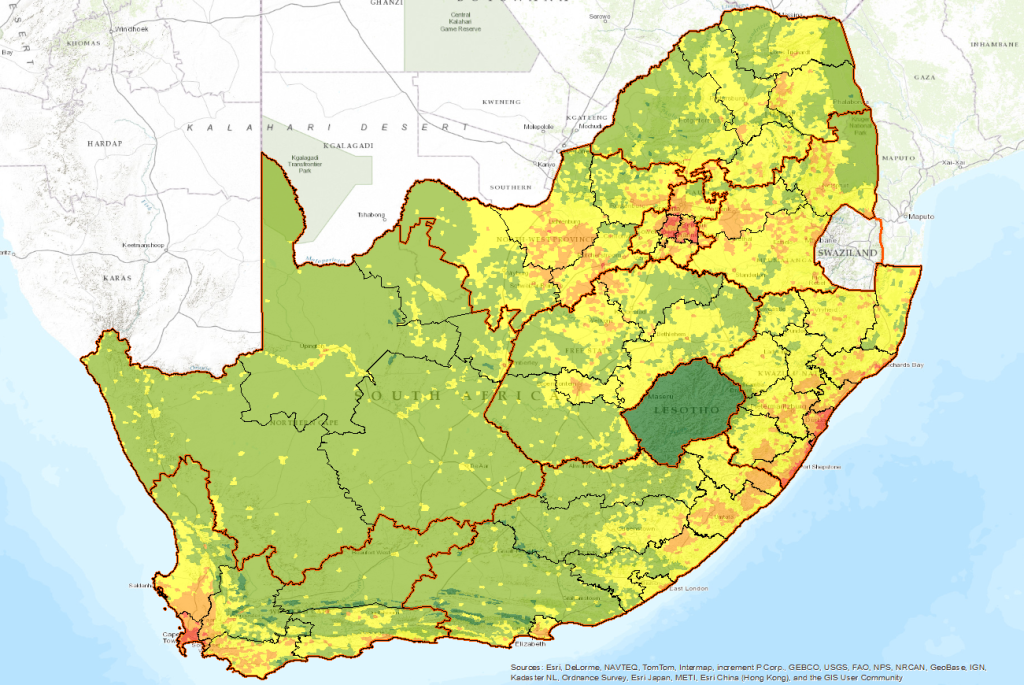
South Africa faces increasing levels of disaster risk. It is exposed to a wide range of weather hazards, including drought, cyclones and severe storms that can trigger widespread hardship and devastation. In addition, South Africa’s extensive coastline and proximity to shipping routes present numerous marine and coastal threats. Similarly, our shared borders with six southern African neighbours present both natural and human-induced cross-boundary risks, as well as humanitarian assistance obligations in times of emergency
In addition to these natural and human-induced threats and despite ongoing progress to extend essential services to poor urban and rural communities, large numbers of people live in conditions of chronic disaster vulnerability – in underserved, ecologically fragile or marginal areas – where they face recurrent natural and other threats that range from drought to repeated informal settlement fires.
Severe floods in Cape Town’s historically disadvantaged Cape Flats in June 1994 profiled the urgency for legislative reform in the field of disaster risk management, stimulating a consultative process which resulted in Green and White Papers on Disaster Management. These important discussion and policy documents afforded opportunity for consultation with multiple stakeholder groups and provided the platform for development of draft legislation in 2000 that was consistent with emerging international trends in disaster risk reduction.
EarlyWarning
- Media Release 23 June 2025Uploaded by lindisizwem@ndmc.gov.za on 2025-06-23
- Seasonal Profile Spring 2025Uploaded by lindisizwem@ndmc.gov.za on 2025-09-16
- Media Release 23 June 2025Uploaded by lindisizwem@ndmc.gov.za on 2025-06-23
- Seasonal Profile Spring 2025Uploaded by lindisizwem@ndmc.gov.za on 2025-09-16