Samoa National Action Plan for Disaster Risk Management
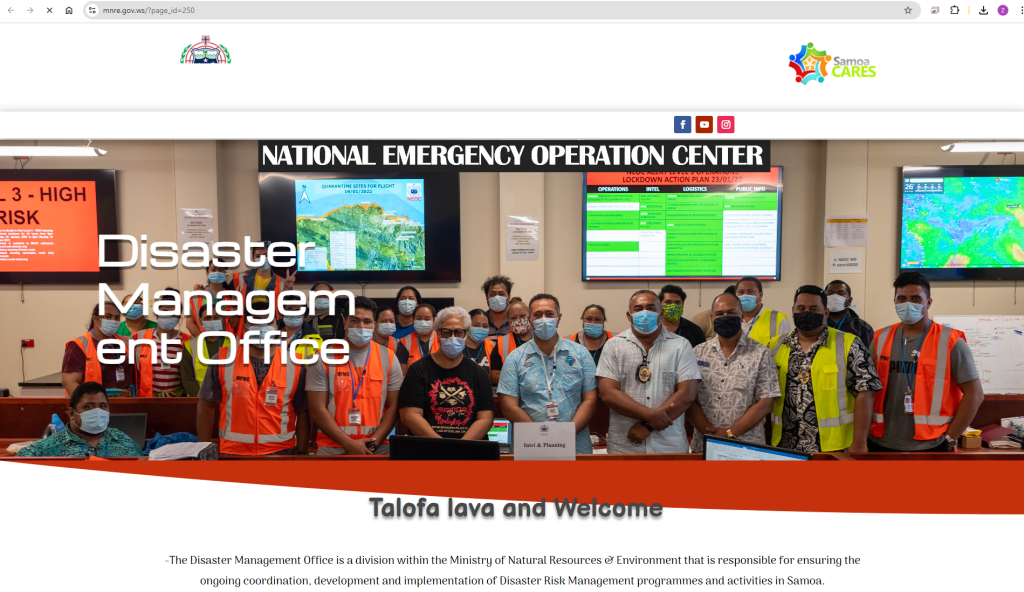
-The Disaster Management Office is a division within the Ministry of Natural Resources Environment that is responsible for ensuring the
ongoing coordination, development and implementation of Disaster Risk Management programmes and activities in Samoa.
-We believe that information sharing helps reduce the harmful effects of any natural disaster to our people and environment. This webpage
provides another means of disseminating information about our role through Disaster Risk Management.
-Our staff is situated at the National Emergency Operations Centre (NEOC) in Tuana’imato and our Disaster Risk Reduction (DRR) team is
located within the Meteorology Compound – Mulinu’u.
DISASTER MANAGEMENT SECTION
The Disaster Management section focuses to provide an overall assurance of effective coordination and
management of programmes to prepare for, respond to and recover from natural and human induced disasters.
Its functions include the following:
. Lead the implementation of the Preparedness, Response and Early Recovery components of the National Disaster Management Framework.
. Facilitation of national response agencies, associate member agencies of DAC, schools, stakeholders and partners, sectors in developing, maintenance
and testing of disaster management/response plans.
. Establish and maintain communications systems to strengthen emergency response coordination and for early warning dissemination.
. Maintain communication with all agencies, partners and sectors before, during and after a disaster.
. Promote, initiate and support recovery activities by government ministries, sectors and other agencies that build resilience to future disasters and
ensure that measures to strengthen preparedness for response are incorporated as a requirement of recovery programming and implementation.
. Monitor and evaluate progress of implementation and effectiveness of disaster management programmes at all levels.
COMMUNITY DISASTER PREPAREDNESS SECTION
The Disaster Management Office in partnership with other governmental authorities and local NGOs has
provided a unified system to approach DRR in the Samoan communities. CDCRM aims to encourage villages to
take responsibility for their own protection on the threat of disasters. Its main activities include:
. Facilitating a community driven process to identify the hazards and risks villages are exposed to and to identify and implement actions to mitigate
these risks and lessen the impacts of future events
. Organizing villages into disaster committees and response teams, ensuring teams are trained and prepared for collective action.
. Organizing a community profiling process to generate sufficient and accurate information; arranging necessary technical support to village committees;
and
. Targeting the most vulnerable based gender, age, disabilities, socio-economic status, and ensuring their needs and capacities are integrated into the
village planning process.
DISASTER RISK REDUCTION
The Disaster Risk Reduction is one of the sections under the Disaster Management Office with its primary
objective in ensuring effective coordination and management of programmes that reduces the risk of being
adversely affected by natural and human induced disasters. The roles and responsibilities of the Disaster Risk
Reduction Section in accordance with the Disaster Emergency Management Act 2007 includes;
. Conduct hazards assessment and vulnerability analysis which determines appropriate prevention and or mitigation, preparedness and response
measures.
. Assist technical Ministries to Design structural (hard solutions) and or non-structural (soft solutions) to prevent and mitigate risks for all high risk areas
in consultation with relevant experts.
. Coordinate the planning and execution of the national DRM platform and as well as identifying capability building needs for staff and sectors in relation
to risk reduction and coordinate relevant training programs.
. Promote, initiate and support recovery activities by sectors, agencies and community that build resilience to future disasters and ensure that risk
reduction measures are incorporated as a requirement of recovery programming and implementation.
. Monitor and evaluate progress of implementation and effectiveness of risk reduction measures at all levels.
Samoa is highly vulnerable to both natural and human-induced hazards due to its geographic location, volcanic origins, and status as a Small Island Developing State (SIDS). While these characteristics contribute to Samoa’s natural beauty, they also expose the country to significant disaster risks, including earthquakes, tsunamis, cyclones, and anthropogenic hazards.
The National Action Plan (NAP) for Disaster Risk Management serves as an operational framework to support the implementation of the National Disaster Management Plan (NDMP) 2017–2020. It provides practical, day-to-day guidance for disaster risk management (DRM) operations and establishes a Monitoring, Evaluation, and Learning (MEL) framework to assess performance and strengthen accountability within the Disaster Management Office (DMO).
The NAP was developed following a comprehensive review of the NDMP 2011–2015 and the DRM NAP 2011–2016, informed by stakeholder consultations involving DMO staff and key agencies, including the Ministry of Natural Resources and Environment (MNRE). Initiated in 2016, the development process focused on identifying implementation gaps and addressing operational challenges identified in previous DRM frameworks.
Strategically, the NAP aligns with national development and legislative priorities, including the Strategy for the Development of Samoa (SDS), the National Environment Sector Plan (NESP), and the Disaster and Emergency Management Act (2007). It also reflects Samoa’s commitments to global and regional frameworks, notably the Sendai Framework for Disaster Risk Reduction, the SAMOA Pathway, and the United Nations Sustainable Development Goals (SDGs). Lessons learned from major disasters—particularly the 2009 tsunami and Tropical Cyclone Evan (2012)—have significantly informed the NAP, highlighting both institutional strengths and areas requiring improvement.
A central focus of the NAP is the mainstreaming of disaster risk management across all sectors. Fourteen sectors are identified, including education, health, infrastructure, environment, finance, and tourism. The NAP addresses all phases of DRM and emphasizes integrating risk considerations into sectoral planning, implementation, monitoring, and evaluation. This approach promotes shared responsibility among government agencies, civil society, communities, the private sector, and development partners, recognizing that effective DRM requires coordinated and sustained collaboration across all stakeholders.