National Emergency Management System
26 أكتوبر، 2015
PACDA ( https://cdaa.gov.om ) Role in National Emergency Management System
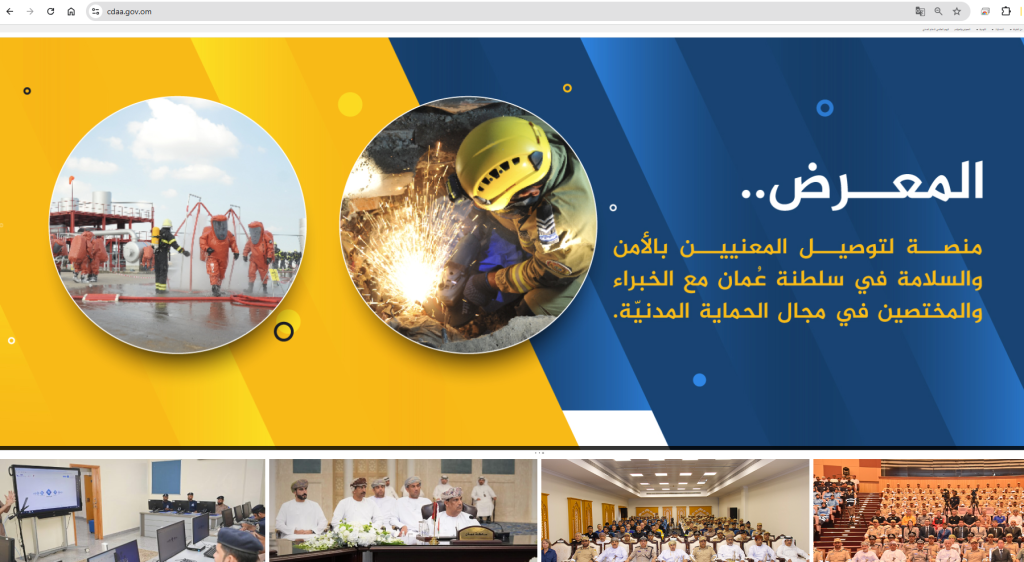
PACDA is an active part of the National Emergency Management System and is responsible for managing and coordinating two of the eight sectors; putting the sector’s plan into effect; proposing amendments and/or updates; coordinating national efforts to respond to the calls for help; mobilizing all the resources of PACDA, sector components, and other supporting bodies (including civil society organizations, volunteer teams, and the private sector), under the procedures specified in the sector’s plan, as well as providing support to other sectors. The two sectors are:
Search & Rescue Operations Sector:
 It is concerned with the response to search and rescue operations (urban, land, surface water, marine, and air).
- Sector Components
The Sultan of Oman’s Armed Forces (SOAF), the Royal Oman Police (ROP), the Public Authority for Civil Defence and Ambulance (PACDA), Ministry of Regional Municipalities and Water Resources, Ministry of Environment & Climate Affairs (MECA), Muscat Municipality, Dhofar Municipality, National Ferries Company (NFC), and the national system sectors as supporting bodies.
- Responsibilities
- Ensure planning, preparedness, capacity building, and instant and effective response in search and rescue operations.
- Ensure the security and safety of field response teams, preserve the venue of the incident, and minimize the impact in cooperation with all other sectors and concerned bodies.
- Build national capacity in terms of dealing with the plan of search and rescue operations.
- SOAF will provide adequate personnel support to assist in search, rescue, and evacuation operations by land, sea, and air.
- Create and update a database for the sector.
- Coordinate the sector’s operations with the National Council on Emergency Management and other bodies to ensure effective workflow in the sector.
- The Royal Air Force of Oman (RAFO) will manage the country’s air space, in coordination with the Public Authority for Civil Aviation (PACA), to facilitate search and rescue operations, as well as enhancing the capacity of land, air, and sea operations to be effective, flexible, and unified.
- Specify the extent and type of regional and international assistance and coordinate the procurement of that assistance with the Chairman of the National Committee for Civil Defence, in accordance with the applicable mechanism.
- Specify the extent of support from the concerned bodies of the private sector and NGOs.
- All sector bodies must develop and update their plans of supporting operations to support response in search and rescue operations during emergencies.
- All sector bodies must provide all the help, in their respective specialties, to achieve effective response.
- SOAF will provide helicopters and military cargo aircraft for search, rescue, and evacuation activities at the venue of the incident.
Hazardous Substance Incident Response Sector:
 This sector is concerned with the incidents of hazardous substances and addresses the resulting damage.
- Sector Components
The Royal Oman Police (ROP), the Sultan of Oman’s Armed Forces (SOAF), the Public Authority for Civil Defence and Ambulance (PACDA), Ministry of Environment & Climate Affairs (MECA), Ministry of Agriculture and Fisheries (MAF), Ministry of Oil and Gas (MOG), Sultan Qaboos University (SQU), the Public Establishment for Industrial Estates (PEIE), Oman Environmental Services Holding Co. (BE’AH), the Public Authority for Electricity & Water (PAEW), and any other bodies that can be engaged.
- Responsibilities
- Ensure planning, preparedness, and resource mobilization for instant and effective response to hazardous substance incidents.
- Build national capacity in terms of dealing with hazardous substance incidents.
- Evaluate procedures and identify capabilities and resources.
- Ensure the security and safety of field response teams, preserve the venue of the incident, and minimize the impact in cooperation with other sectors and concerned bodies.
- Coordinate and follow up on the sector’s activities with the National Council on Emergency Management and other bodies to ensure effective workflow in the sector.
- The Hazardous Substance Team of ROP will be responsible for responding to hazardous substance incidents, in cooperation with SOAF and other concerned bodies of the sector.
- Develop and update a detailed plan of mutual support and local, regional, and international cooperation in this respect.
- Take all necessary measures to ensure effective intervention by containing, cordoning off, and clearing the affected sites in accordance with the procedures stated in the sector’s plan.
- The services of SOAF will be responsible for the medical dealing with the injuries and deaths resulting from hazardous substance incidents, in cooperation with the medical response sector.
- The Medical Services of SOAF will work to build national capacity in medical response to hazardous substance incidents, by forming, training, qualifying, and equipping specialist teams (involving the Ministry of Health, Medical Services, ROP Ambulance Unit, and the University Hospital) for effective medical intervention in this kind of incidents.
- Specify the extent and type of foreign assistance, in accordance with the directives of the Chairman of the National Committee for Civil Defence in this respect.
- Request support from the concerned bodies of the private sector and NGOs.
- All sector components must provide all the necessary help, within their respective capabilities, to achieve effective and quick response to contain the situation.
- Sector’s participating bodies will develop, update, and put into effect the emergency management plans to support the response to hazardous substance incidents.
- Coordinate with concerned bodies about banning food exports from regions affected by nuclear radiation.
- Create and update a database of resources and capabilities.
Report Response and Incident/Crisis Management:
This is aimed at providing quick and effective response to incidents and manage the sectors of search and rescue operations and hazardous substance incident response. PACDA has prepared the locations concerned with these aspects with the necessary equipment and systems.
- Emergency Management Center
This center manages major incidents and exceptional crises involving both sectors. The center has a cellular room with communications equipment and plans to deal with different incidents and crises, as well as a computerized database of the capabilities of the sectors’ members and other bodies engaged by PACDA in different incidents.
- Media Center
This center addresses the issues relevant to PACDA’s work, responds transparently, gives a clear image of the work of field teams, and issues warning messages to nationals and expatriates, in coordination with the concerned bodies during incidents and crises. It also supervises and runs PACDA’s social media pages (Facebook and Twitter).
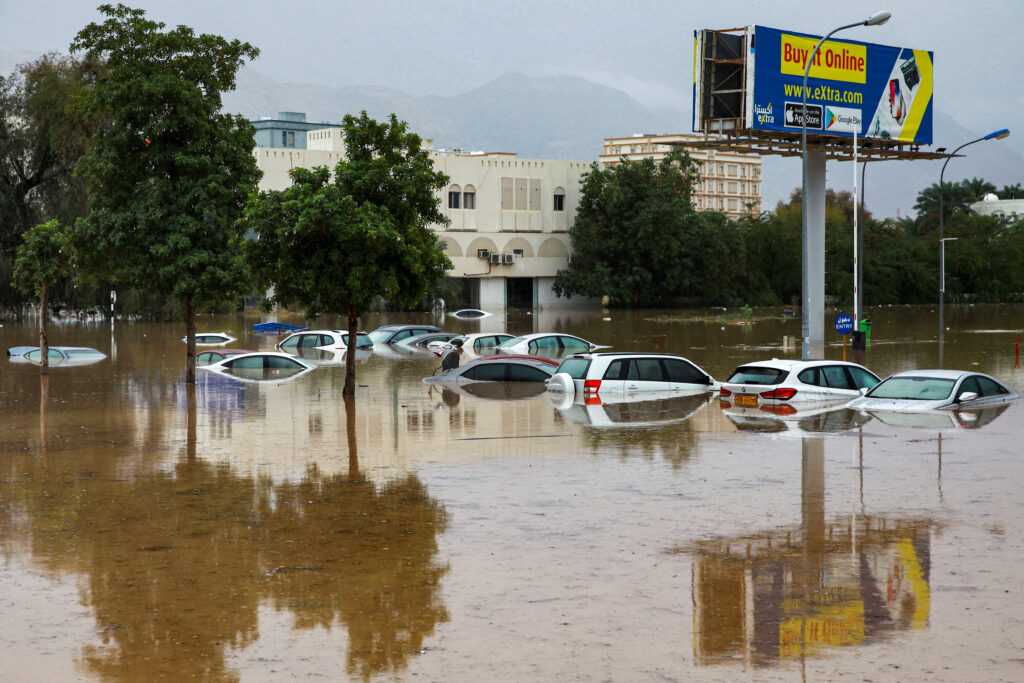
The Sultanate of Oman is highly vulnerable to climate change. Recent experiences with Cyclone Gonu in 2007, Phet in 2010 and Mekunu 2018, show the potential impact of extreme climatic events on urban areas, with a high loss of life, destruction of infrastructure and economic damage.
Cyclone Shaheen strikes parts of Oman and Iran
Residents urged to evacuate coastal areas and authorities delay flights to and from Oman’s capital Muscat.

Published On 3 Oct 20213 Oct 2021 Updated: 3 Oct 2021 08:54 PM (GMT)Updated: 3 Oct 2021 08:54 PM (GMT)
Ferocious winds, heavy rain as Cyclone Shaheen hits Oman
Tropical Cyclone Shaheen slammed into Oman with ferocious winds and heavy rain, flooding streets, prompting evacuations.

By News Agencies
Published On 4 Oct 20214 Oct 2021
Tropical Cyclone Shaheen slammed into Oman on Sunday with ferocious winds and heavy rain, flooding streets, prompting evacuations from coastal areas and delaying flights to and from the capital, Muscat.
The death toll from the cyclone rose to five on Monday while other fishermen from Iran remained missing as the storm moved further inland into Oman and weakened.
Authorities in Oman said they found the body of a man who disappeared when floodwaters swept him away from his vehicle.
On Sunday, as the storm made landfall, they said a child similarly drowned and two people died in a landslide.
In Iran, state television said rescuers found the body of one of five fishermen who went missing off Pasabandar, a fishing village near the border with Pakistan.
Earlier on Sunday, Iranian Deputy Parliament Speaker Ali Nikzad said he feared as many as six fishermen had been killed because of the cyclone.
Omani state television broadcast images of flooded roadways and valleys as the storm churned deeper into the sultanate, its outer edges reaching the neighbouring United Arab Emirates which has issued warnings to residents that the storm was coming.
Building Resilience to Extreme Weather Events in Oman
- –
Oman launches an early warning system to address natural disasters

© UNESCO
Last update:20 April 2023
The Sultanate of Oman launched a National Multi Hazard Early Warning System (NMHEWS) on 23 March. This system, implemented with the technical support of the Intergovernmental Oceanographic Commission of UNESCO, was designed to respond to natural hazards, including tsunamis, cyclones and flash floods.
The system is the result of a collaboration between IOC-UNESCO and Oman that began in 2009. It will support monitoring, data processing and Standard Operating Procedures, as well as training of personnel and the operation of sea-level stations. Since 2010, IOC-UNESCO and the Omani government have also been collaborating in the development of a Tsunami Early Warning System as part of the over-all multi-hazard early warning system.

Collaboration between Oman and IOC-UNESCO included training of personnel. © IOC-UNESCO/ Fauzi Fauzi
Vladimir Ryabinin, Executive Secretary of IOC-UNESCO, pointed out that one of the conclusions of the 3rd UN World Conference on Disaster Risk Reduction, which closed just a few days before in Sendai, Japan, was that multi-hazard early warning systems such as this one should be the mainstream approach in dealing with natural disasters and with risk associated with human activities.
“Multi-hazard systems allow us to address multiple coastal zone risks efficiently,” he continued, “and Oman is now a proud operator of one of the most modern among such systems. This cooperation project, on the setup of the warning system, has also been very special for IOC. On behalf of UNESCO and its IOC, let me wish you all a very successful and sustainable operation of the System, for benefit of people of Oman and the whole region. We look forwarding to our continuing cooperation.”
the Government of Oman through is now inviting neighboring countries to share data to improve the management risks related to tsunamis and tropical cyclones in the region.
The launch of the system coincided with a two-day scientific regional conference (on 22-23 March), followed by the 10th Session of the Intergovernmental Coordination Group for the Indian Ocean Tsunami Warning and Mitigation System (ICG/IOTWS-X) on 24-26 March, which will bring together representatives of over 20 of the countries in the region.
The regional conference entitled Reducing Tsunami Risk in the Western Indian Ocean will cover, in particular, the history of Makran tsunamis, natural hazard assessment in the region, and the functions of the newly implemented warning system.

Launch of the National Multi Hazard Early Warning System in Muscat, Oman, on 23 March 2015. © IOC-UNESCO/ Bernardo Aliaga
The Makran Subduction Zone, an active boundary between tectonic plates, is believed to pose a tsunami hazard in the western Indian Ocean, but the nature of this hazard is still poorly understood. The plate-boundary thrust in the eastern part of the zone produced an earthquake and associated tsunami in 1945. A smaller tsunami occurred in the same region much more recently, in September 2013, in conjunction with the formation of an ephemeral island off the coast of Pakistan. Oman is also subject to far-field tsunamis from the Sunda Trench, as well as tropical cyclones and flash floods.
https://climateknowledgeportal.worldbank.org/country/oman/natural-disasters-historical
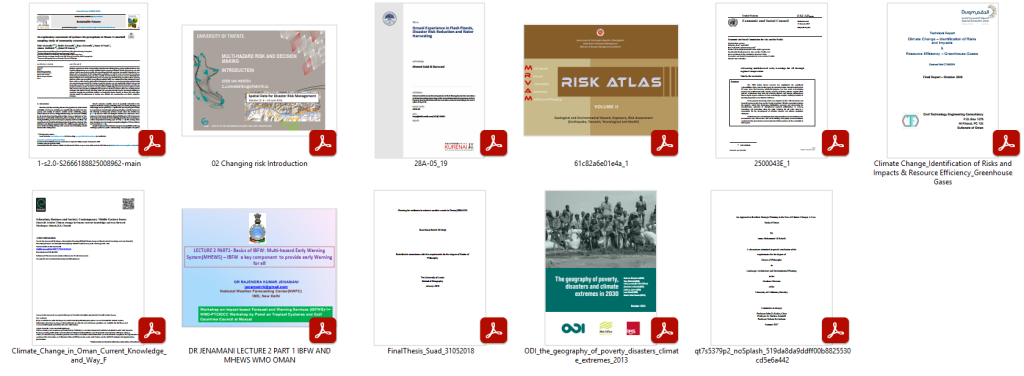
Download documents from …………..
https://drive.google.com/drive/folders/1Px7L8K0VTJIqK_cth-3d5MSRRnQ6hlT1?usp=drive_link