Riesgos climáticos y vulnerabilidades de Argentina

Climate risk and vulnerabilities of Argentina
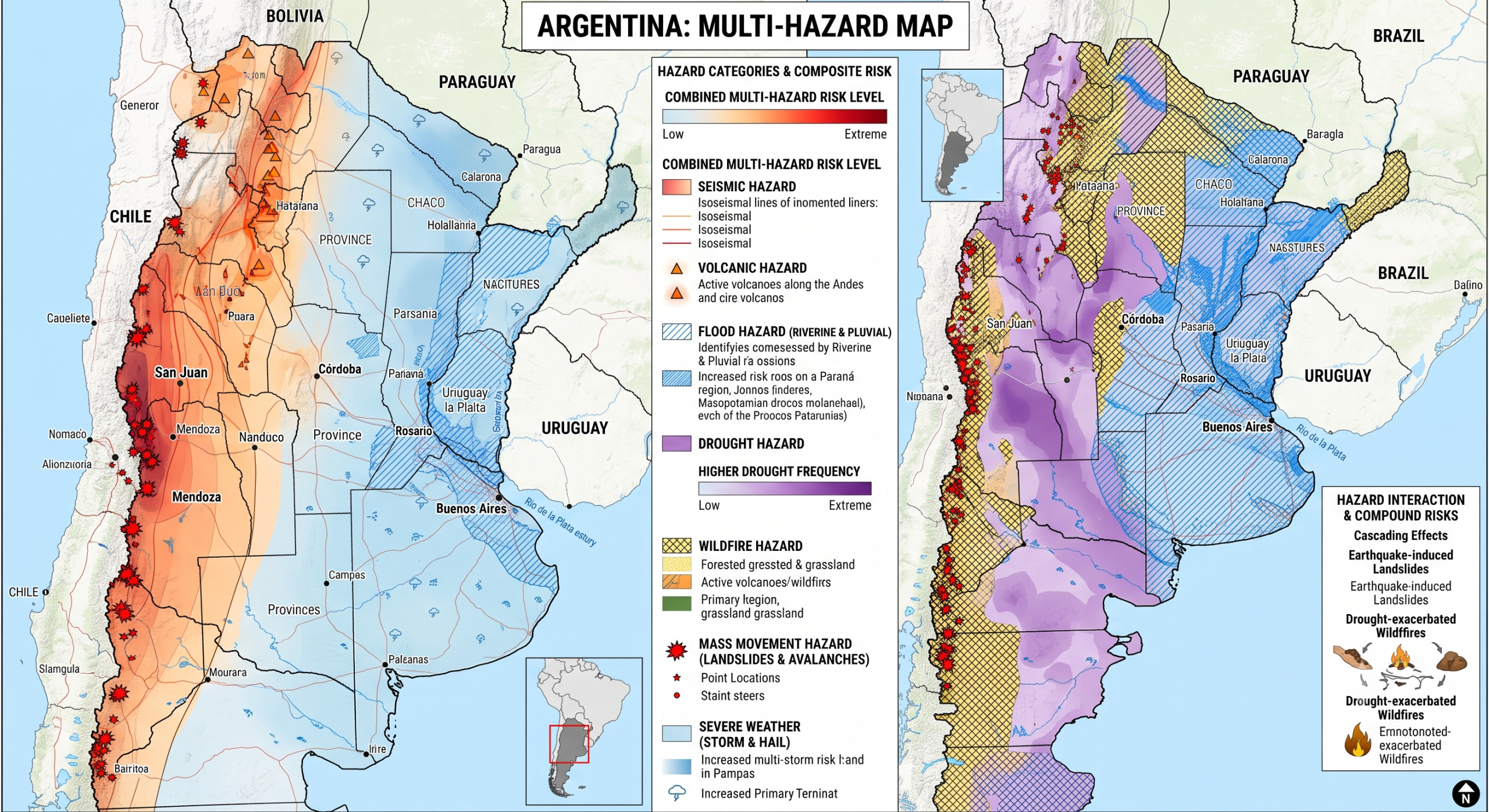
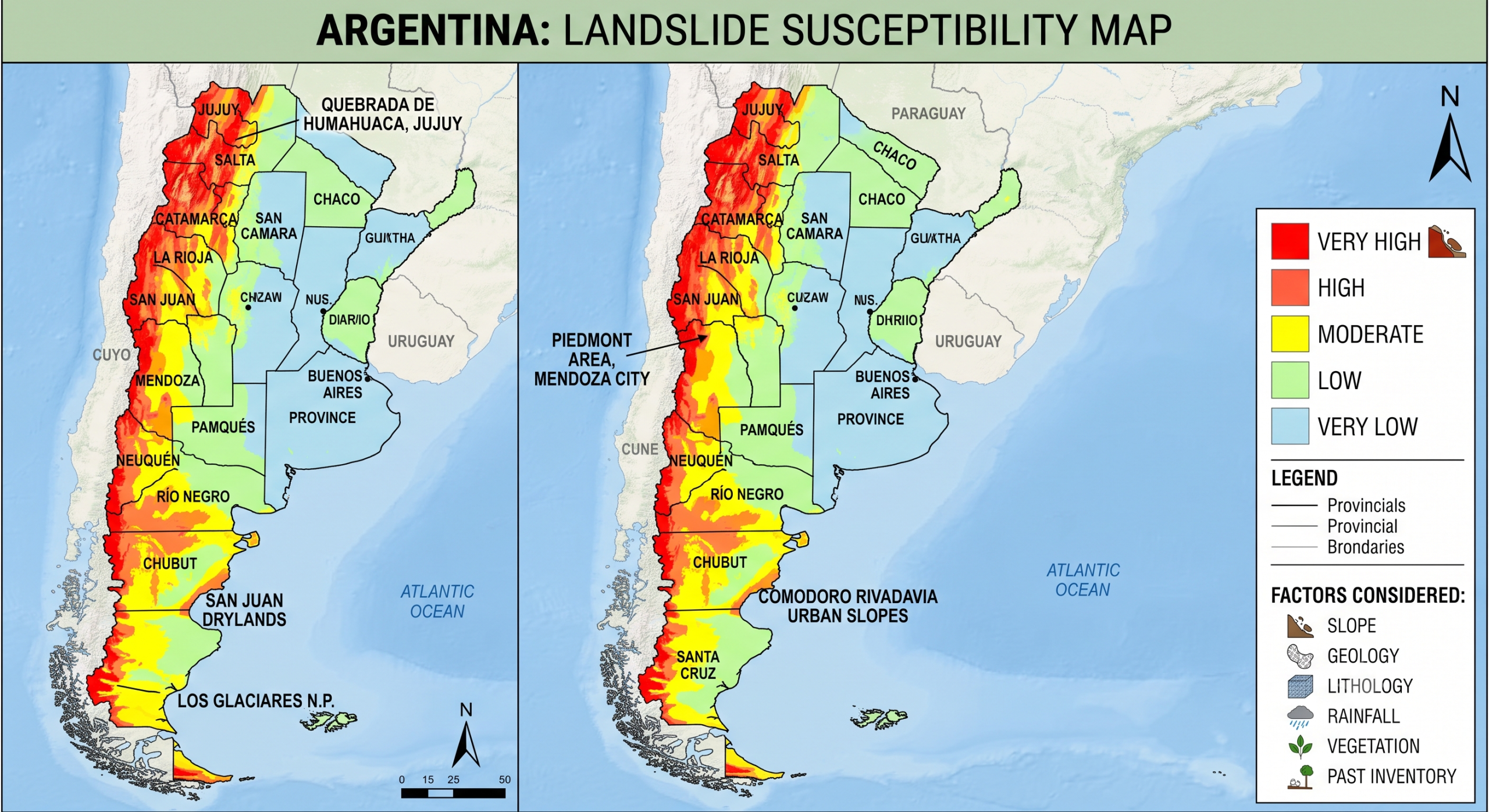
Argentina is exposed to a diverse climate and multi-hazard risk profile because of its large territory, varied climatic zones, long Atlantic coastline, Andean mountain system, extensive river basins, agricultural dependence, urban concentration, and exposure to both hydrometeorological and geophysical hazards. Key risks include floods, droughts, heatwaves, wildfires, severe storms, landslides, avalanches, coastal erosion, riverine flooding, earthquakes, volcanic hazards, and climate-sensitive health risks. Argentina’s National Disaster Risk Reduction Plan 2025–2029 explicitly includes hydrometeorological hazards, mass movements, volcanoes, earthquakes, fires, and droughts as priority risk themes. (Argentina)

Argentina is highly vulnerable to climate change and multi-hazard risks due to its exposure to floods, droughts, heatwaves, wildfires, severe storms, landslides, avalanches, coastal erosion, earthquakes, and volcanic hazards. Climate change is intensifying these risks through rising temperatures, changes in rainfall patterns, more frequent extreme precipitation, longer dry spells, water stress, glacier and snowpack decline in Andean regions, increased wildfire conditions, and higher risks to agriculture, water resources, health, transport, energy, ecosystems, and urban settlements. Floods are among the most recurrent and damaging hazards, while droughts create major impacts on agriculture, livestock, hydropower, water supply, food prices, and rural livelihoods. Strengthening multi-hazard early warning systems, drought-risk management, flood forecasting, climate-resilient agriculture, watershed management, wildfire preparedness, resilient infrastructure, coastal adaptation, and shock-responsive social protection is essential to protect Argentina’s development gains.
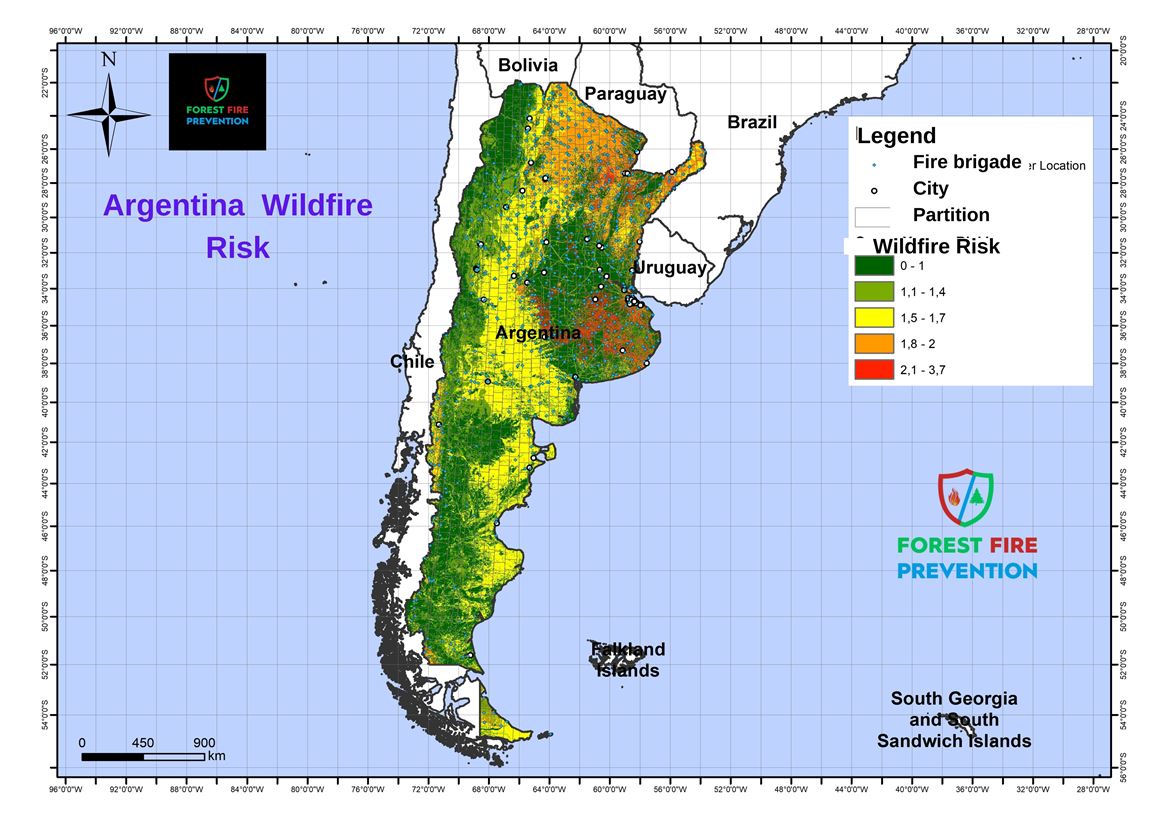
1. Multi-hazard exposure
Argentina’s hazard profile combines climate-related hazards and geophysical risks. Floods, droughts, heatwaves, wildfires, intense rainfall, storms, landslides, avalanches, coastal flooding, earthquakes, and volcanic risks affect different regions of the country. The World Bank Climate Change Knowledge Portal notes that Argentina has experienced multiple natural hazards, including floods, and provides a climate-risk country profile for decision-makers. (Climate Change Knowledge Portal)
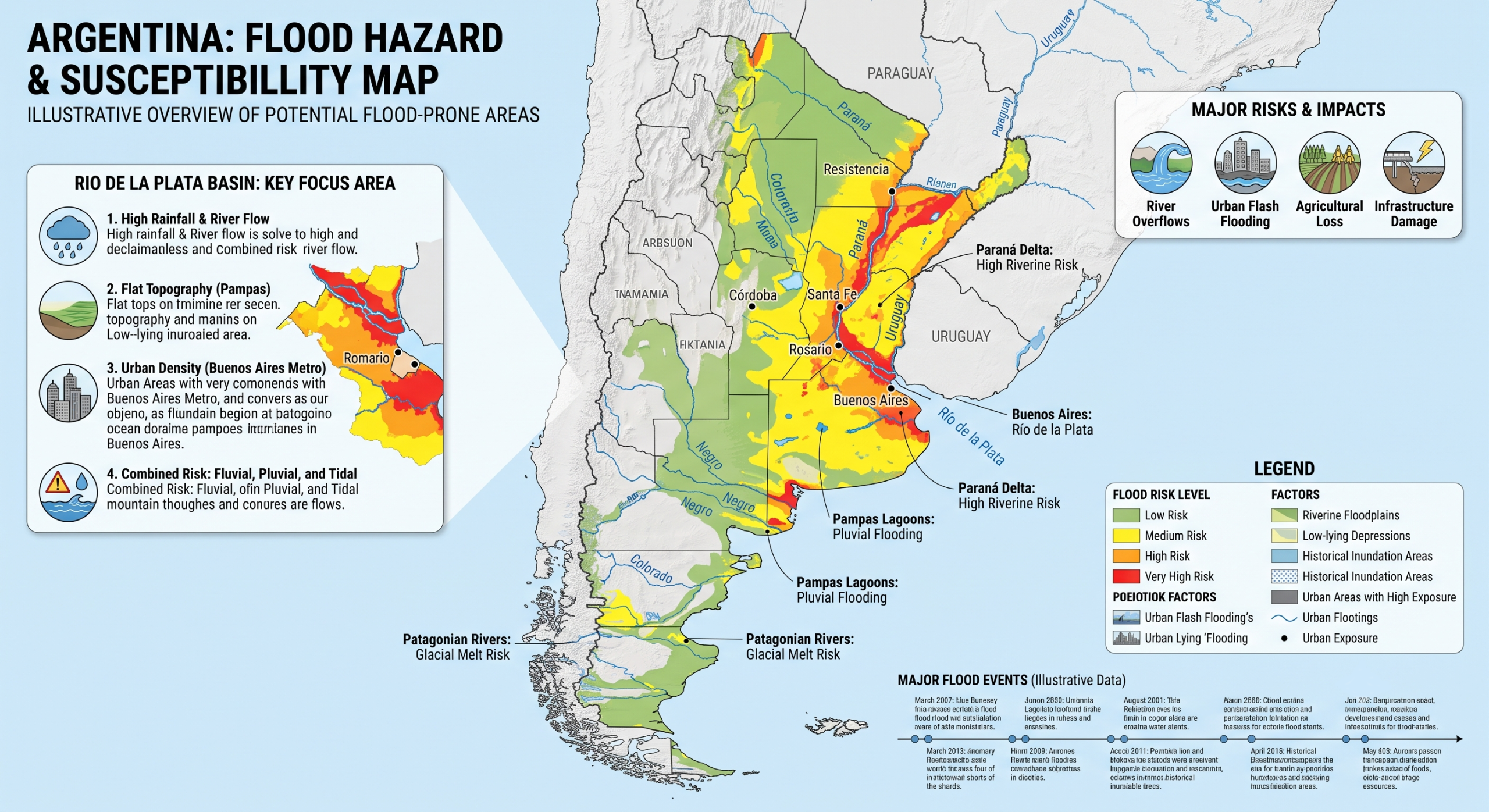
Flood risk is one of Argentina’s most important recurrent hazards. Argentina’s National Adaptation Plan reports that maximum daily precipitation has increased across much of the country, contributing to more frequent urban floods; from 1958 to 2021, the most impactful urban floods caused around 800 deaths and affected approximately 14.5 million people.
2. Climate change as a risk multiplier
Climate change is expected to increase Argentina’s exposure to compound and cascading risks. The National Adaptation Plan notes that compound extreme events are becoming more likely globally, including heatwaves and droughts occurring simultaneously, fire-conducive conditions involving heat, drought, and wind, and flooding caused by storm surge combined with extreme precipitation.
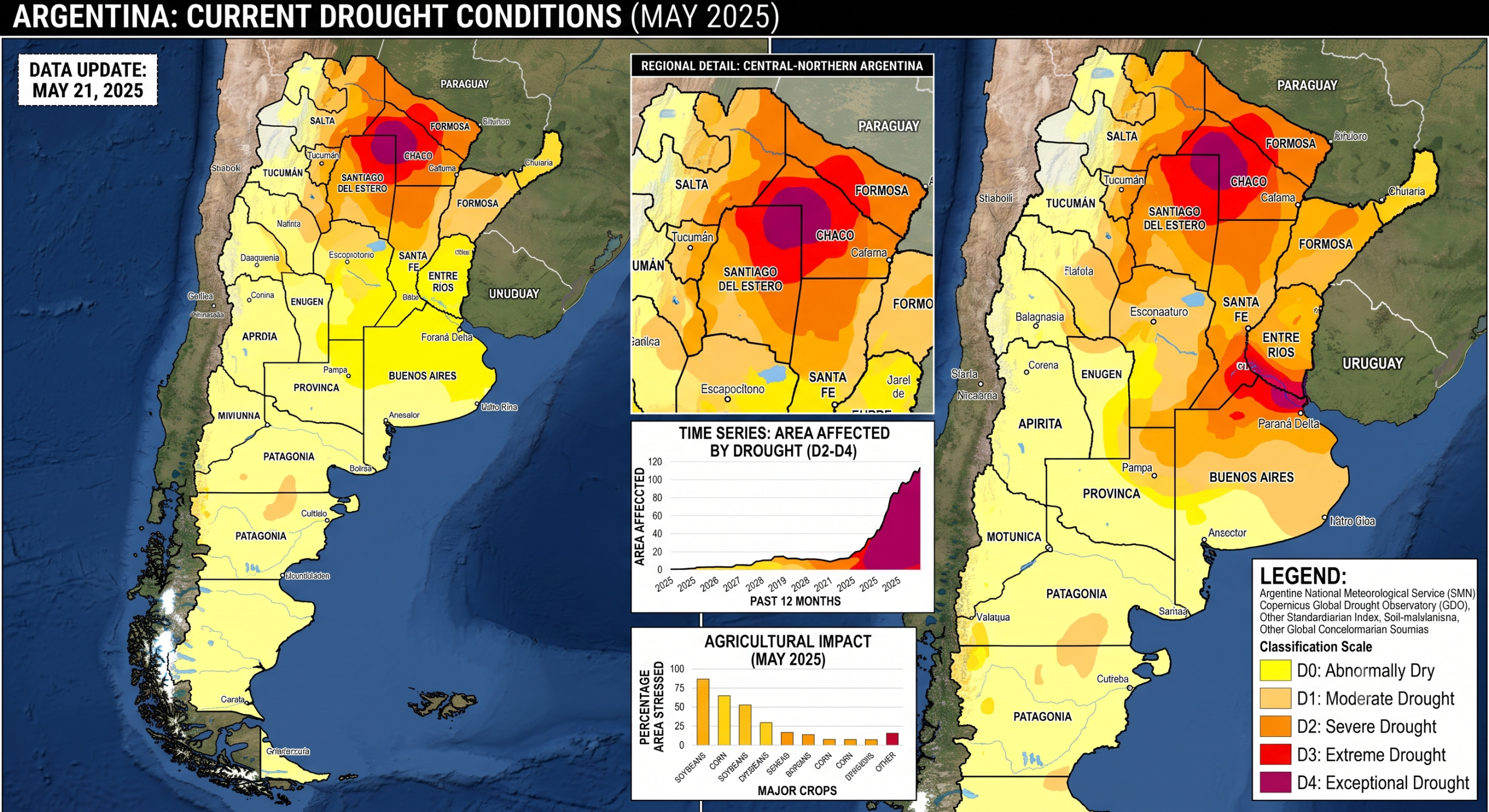
This is particularly important for Argentina because climate shocks can affect several systems at once: agriculture, transport, water supply, health services, energy demand, trade logistics, and public finance. For example, extreme rainfall can generate urban flooding and road damage, while drought can reduce agricultural output, affect river navigation, increase wildfire risk, and reduce water availability.

3. Key vulnerabilities
Flood and urban drainage vulnerability:
Urban flooding is a major risk in Argentina, especially where intense rainfall overlaps with inadequate drainage, exposed settlements, land-use change, and infrastructure not designed for current or future rainfall extremes. The National Adaptation Plan links more frequent urban floods to both increased extreme precipitation and inappropriate land use and occupation in exposed areas.
Drought and water stress:
Drought is a critical threat for Argentina, particularly in Cuyo, the northwest, the Pampas, Patagonia, and other water-stressed areas. The National Adaptation Plan identifies droughts as the most characteristic threat in much of the Cuyo region and projects that droughts will increase in frequency, length, and intensity, with greater water deficit.
Agriculture and livestock vulnerability:
Argentina’s agriculture, livestock, forestry, fisheries, and native forests are highly climate-sensitive. The National Adaptation Plan includes adaptation measures for agriculture, livestock, forestry, fishing, and native forests, including soil conservation, production diversification, agroforestry, fisheries climate-risk management, integrated agroecosystem management, and deforestation reduction.
Transport and connectivity risk:
Extreme rainfall, snow, avalanches, floods, and road damage can disrupt physical connectivity and movement of people, services, and supplies. Argentina’s National Adaptation Plan identifies risks to trafficability and physical connectivity due to flooding or damage to roads and highways caused by extreme events.
Health vulnerability:
Climate change creates health risks through heatwaves, cold extremes, floods, droughts, waterborne diseases, vector-borne diseases, zoonotic diseases, and disruption of health services during emergencies. Argentina’s National Adaptation Plan includes measures to strengthen health-sector capacity for extreme temperatures, floods, droughts, vector-borne diseases, zoonotic diseases, seasonal diseases, and climate-health surveillance.
Coastal and delta vulnerability:
Argentina’s coastal areas and river deltas face risks from coastal erosion, storm surge, flooding, and sea-level-related pressures. The National Adaptation Plan includes measures for integrated coastal management and identifies coastal erosion as a climate-related pressure; it also includes adaptation planning for the Paraná River Delta.
4. Sector-specific risk summary
| Sector | Main climate and hazard risks |
|---|---|
| Agriculture and livestock | Drought, heat stress, rainfall variability, floods, pests, soil degradation, wildfire risk |
| Water resources | Drought, snowpack and glacier changes, river-flow variability, water-supply stress |
| Urban settlements | Pluvial flooding, drainage failure, heatwaves, infrastructure disruption |
| Transport and logistics | Road damage, floods, avalanches, landslides, disrupted river navigation |
| Health | Heat stress, flood-related disease, drought-related water and food insecurity, vector-borne diseases |
| Energy | Hydropower variability, heat-driven demand, infrastructure exposure |
| Coastal zones and deltas | Coastal erosion, storm surge, sea-level pressure, riverine flooding |
| Ecosystems and forests | Wildfires, drought stress, biodiversity loss, wetland degradation, deforestation pressure |
5. Social vulnerability
The most vulnerable groups include low-income urban households, informal settlements, rural communities, smallholder and family farmers, Indigenous communities, outdoor workers, elderly people, children, people with chronic illnesses, people with disabilities, and communities dependent on climate-sensitive livelihoods. Health-sector adaptation measures in Argentina’s National Adaptation Plan specifically emphasize vulnerable populations, including children, older persons, people with chronic diseases, and people exposed to occupational hazards.
6. Priority resilience needs
Argentina’s resilience agenda should prioritize multi-hazard early warning systems, flood forecasting, drought monitoring, wildfire preparedness, climate-resilient agriculture, water-resource management, urban drainage improvement, resilient transport infrastructure, coastal-zone management, health-sector preparedness, climate-risk-informed land-use planning, disaster risk financing, and shock-responsive social protection.
The country’s National Disaster Risk Reduction Plan 2025–2029 focuses on understanding disaster risk, strengthening governance, improving preparedness and response, and promoting resilient recovery, rehabilitation, and reconstruction. (Argentina)
Secretaría Ejecutiva del Sistema Nacional de Gestión Integral de Riesgo. https://oavv.segemar.gob.ar/sinagir/

NATIONAL SYSTEM FOR INTEGRAL RISK MANAGEMENT
AND CIVIL PROTECTION (SINAGIR)
- Law No. 27,287, enacted in 2016, creates the National System for Comprehensive Risk Management and Civil Protection (SINAGIR), which aims to integrate actions and coordinate the functioning of the agencies of the National Government, the Provincial Governments, the Autonomous City of Buenos Aires and Municipal Governments, Non-Governmental Organizations and civil society, to strengthen and optimize actions aimed at risk reduction, crisis management and recovery.
- This law materializes the efforts and consensus necessary for the State to design a disaster risk reduction and civil protection policy centered on a modern regulatory framework, representing the paradigm shift that began to develop in the world from the elaboration of the Hyogo 2005-2015 and Sendai 2015-2030 frameworks for action.
- Subsequently, in 2025, through Decree 225/2025, the Federal Emergency Agency (AFE) was created. Its purpose is to respond to disaster situations and coordinate the support and deployment of available resources for carrying out tasks, activities, and actions related to preparedness, prevention, immediate response, and post-crisis recovery. It will also coordinate actions aimed at resolving extraordinary situations or emergencies that occur within the national territory and will be responsible for coordinating the National System for Comprehensive Risk Management (SINAGIR).
- SINAGIR is made up of the National Council for Comprehensive Risk Management and Civil Protection and the Federal Council for Comprehensive Risk Management and Civil Protection.
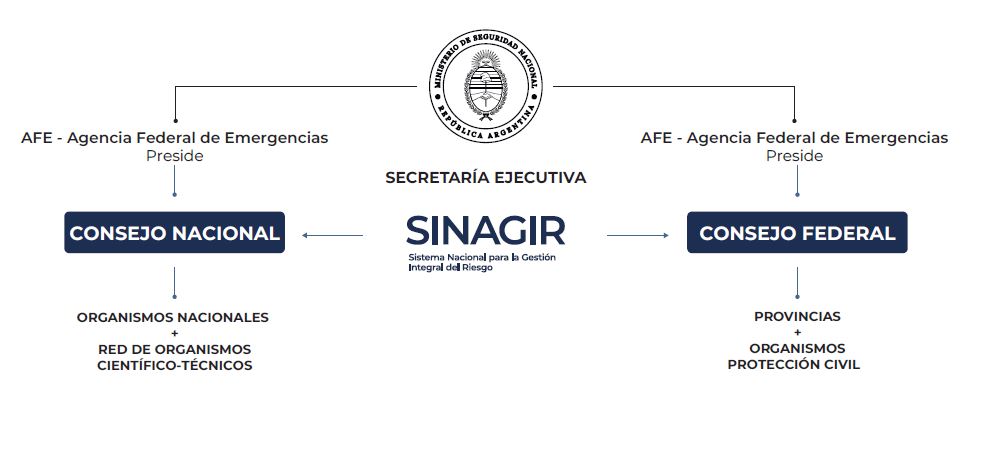
- The National Council is the highest decision-making, coordination, and management body for the resources of the National State. Its purpose is to design, propose, and implement public policies for comprehensive risk management. It is composed of: the Presidency of the Nation; the Chief of the Cabinet of Ministers; and all Ministries and Decentralized Agencies of the National State, including SEGEMAR.
- In turn, Law No. 27,287 creates the Network of Scientific-Technical Organizations for Comprehensive Risk Management (RED GIRCYT), which aims to meet the specific information requirements of both Councils, as well as link and make available to them the capacities, knowledge and information developed in the scientific and technical field, channeling efforts and optimizing the use of resources.
- It is made up of the National Scientific and Technological Public Bodies of the Interinstitutional Council of Science and Technology, public and private universities, and other institutions and bodies recognized in the academic field.
- During 2017, the various participating agencies of the National Council of SINAGIR developed the National Disaster Risk Reduction Plan (PNRRD 2018-2023). The PNRRD is a public policy tool that includes objectives and goals intended to define the guidelines for policies related to Comprehensive Disaster Risk Management (CDR) and the basic principles that must be developed for the implementation of programs and actions aimed at reducing existing risks, ensuring better safety conditions for the population, and protecting economic, social, environmental, and cultural assets.
- During 2023 and 2024, a new National Plan for Disaster Risk Reduction (PNRRD 2025-2029) was developed to continue the process and update the activities carried out by the various technical commissions.
- SEGEMAR, within the framework of SINAGIR, has coordinated the Volcanic Hazards table of the National Plan for Disaster Risk Reduction (PNRRD 2018-2023) and is the coordinator of the activities of the Gircyt Network related to volcanic activity in the country, as the highest reference body of the national state in matters of evaluation and study of volcanic hazards.
For more information, we invite you to visit the official SINAGIR website.
Argentina to create unified Federal Emergency Agency
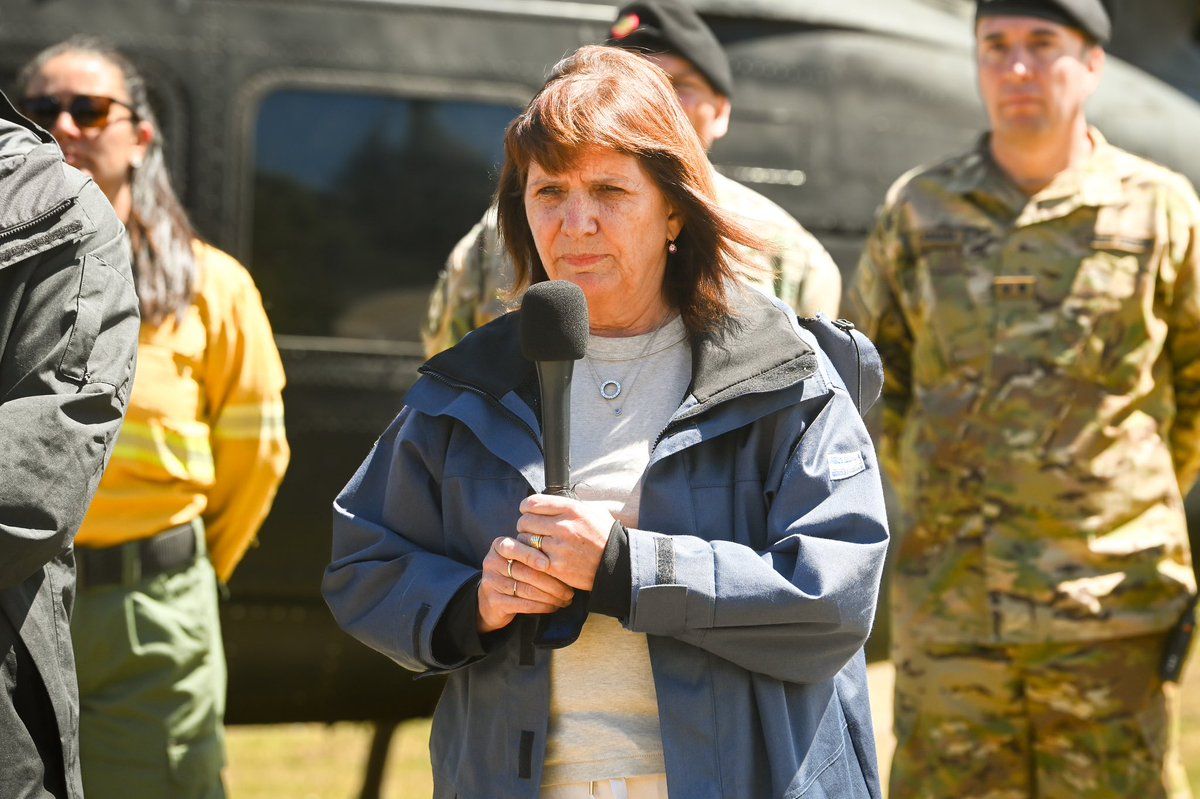
The Argentine Government announced Tuesday the creation of a Federal Emergency Agency to coordinate relief against major disasters such as fires and floods. There are 12 State structures overlapping in cases of emergencies, which “generates disorder,” explained Security Minister Patricia Bullrich from El Bolsón, where she was overseeing the wildfire fighting efforts alongside Defense Minister Luis Petri.
“Currently there are 12 State structures that fight emergencies, it is an overlapping that generates disorder…. Through an emergency [DNU] decree, we are going to create the Federal Agency of Emergencies that will have verticality in the management of funds and structures that today are dispersed in several ministries,” she elaborated.
Bullrich also pledged to be relentless against those who caused the arson outbreaks and thanked firefighters and neighbors who have been helping put down the flames.
In addition, the minister regretted that “130 houses have been burned, people have been left without their homes,” and even one El Bolsón resident died in the crisis.
Meanwhile, Petri concurred that the fires had been man-caused and advocated for the punishment of those responsible. “It was malicious, it was premeditated, we believe that these intentional fires have to end and, for that, we are sending a bill [to Congress] to raise the penalties, to prevent those who commit this type of havoc from quickly recovering their freedom, so that they have to pay for it with jail.”
He also pointed out that the new entity would “allow an efficient and real-time response in each of the emergencies that occur throughout the national territory.”
Together with Petri, “we evaluated the impact of the fire, the state of the firefighting operation, and the joint work strategies to mitigate the damages,” Río Negro Governor Alberto Weretilneck explained.
The weather Tuesday favored the extinguishing tasks Tuesday in the Province of Río Negro but the fire was overall still active and spreading erratically as air operations were limited due to strong gusty winds. The province is also facing a fire in the Nahuel Huapi National Park, where active outbreaks since last December have consumed more than 10,200 hectares.
Since December 2024, Argentine Patagonia has been facing forest fires that have also seriously affected the provinces of Neuquén and Chubut. In Neuquén, the Lanín National Park is suffering from a fire in the Magdalena Valley, active since January 2025, which consumed approximately 5,000 hectares. In the town of Epuyén, in the province of Chubut, a fire that started in January devastated approximately 3,500 hectares, affecting native forests and homes. Although part of the fire has been contained, there are still active outbreaks difficult to tackle.
Heading the new agency will be a representative from the National Government in the Federal Council for Integral Risk Management and Civil Protection, which includes representatives of all the jurisdictions of the country.

National System for Comprehensive Risk Management We integrate and coordinate the actions of all agencies for risk reduction, management and recovery in the face of emergencies and disasters.
National System for Comprehensive Risk Management. We integrate and coordinate the actions of all agencies for risk reduction, management, and recovery in the face of emergencies and disasters.
Sistema Nacional para la Gestión Integral del Riesgo Integramos y articulamos las acciones de todos los organismos para la reducción de riesgos, manejo y recuperación frente a emergencias y desastres.
¿Qué es el Sinagir?
Prevención
Recomendaciones para el cuidado de la población y el ambiente ante eventos adversos.
PNRRD 2025-2029
Este plan orienta las políticas públicas en materia de gestión integral del riesgo..
Cooperación Internacional
Qué es el SINAME
Noticias
El Ministerio de Seguridad Nacional comenzó a pagar a los inscriptos el suplemento único para la reconstrucción en Bahía Blanca
Donación de la Embajada de EEUU para Fortalecer la Lucha contra Incendios Forestales y de Interfase.
Impulsamos el fortalecimiento del Sistema Nacional de Alerta y Monitoreo de Emergencias junto con el INDEC
Reunimos al Consejo Regional SINAGIR Patagonia
National Plan for Disaster Risk Reduction 2025-2029
National Plan for Disaster Risk Reduction 2025-2029
Prevent
Disaster risks with the aim of protecting people, communities and the environment.
Improve
Preparing for adverse events and building community resilience.
Plan
Public policies aimed at comprehensive risk management and establishing goals and objectives until 2029.
Strengthen
The National System for Comprehensive Risk Management and Civil Protection.
What is it?
The National Disaster Risk Reduction Plan (PNRRD) 2025-2029 of the Argentine Republic guides public policies on comprehensive risk management. It outlines the goals and objectives of programs, as well as actions aimed at reducing existing risks in order to protect people and their property. Its formulation involves the identification, analysis, and management of the causal factors of emergencies and disasters, with the objective of reducing exposure to hazards, decreasing the vulnerability of the population, and improving preparedness for adverse events. It establishes the multi-year strategic guidelines and goals that govern the National System for Comprehensive Risk Management and Civil Protection (SINAGIR), created by Law No. 27,287.
How is it made?
The formulation of the National Disaster Risk Reduction and Management Plan (PNRRD) 2025-2029 is the result of a technical and participatory process. The technical development was carried out through inter-institutional collaboration among the Technical Commissions of the National System for Comprehensive Risk Management (SINAGIR), which serve as a forum for exchange and coordination among agencies involved in comprehensive risk management. A total of 10 commissions are comprised of the following:
- Areas of government
- Scientific and technical organizations.
- Universities.
- Civil society organizations.
- Business sector entities.
Priorities of the PNRRD 2025-2029
1
Understanding disaster risk.
The expected result by 2029: The Argentine Republic presents a structure for understanding the possible risks, their potential impacts and how to reduce them in a prospective and interdisciplinary manner.2
Strengthen governance of disaster risk management.
The expected result by 2029: The Argentine Republic presents an institutional structure for SINAGIR coordination of the different sectors, as well as the active participation of its members for an efficient and effective GIRD.3
Increase disaster preparedness in order to provide an effective response.
Expected result by 2029: The Argentine Republic promotes the strengthening of capacities for emergency preparedness and response in a coordinated manner with all members of SINAGIR, the regions, their provinces and municipalities.4
Recovery, rehabilitation and resilient reconstruction.
Expected result by 2029: The Argentine Republic promotes recovery, rehabilitation and reconstruction processes focused on resilience.
Download: PNRRD 2025-2029 Presentation Document
Axes
The following are the thematic areas that will make up the 2025-2029 Plan.
Hydrometeorological Threats
Mass movement
Volcanoes
Earthquakes
Technological Threats
Fires
Droughts
Economy
Download: PNRRD 2025-2029 Presentation Document
Download: PNRRD 2018-2023 Presentation Document

BACKGROUND
Argentina is the eighth largest country in the world by land area. Its territory spans diverse climatic and ecological zones, from the Andes mountains to the Atlantic coast, with subtropical areas in the north and extremely cold regions in the south. As a result, diverse territories and people in Argentina are exposed to different hazards depending upon their location, including floods, storms, tornados, fires, drought, volcanic eruptions, and earthquakes.
There are many causes of floods in Argentina, including heavy rains, increased river flows, coastal storms, and rapid snowmelt in the mountains. Flood events cause fatalities, damage to housing and infrastructure, and other health impacts.
Disaster management in Argentina falls under the Directorate of Civil Protection. The country’s National Plan for Disaster Risk Reduction 2018-2023 defines policies and basic principles for public and private sector organizations to reduce the risk of disasters.
INFORM RISK INDEX (2022)
Hazard and exposure: 2.6 | Vulnerability: 2.8 | Lack of coping capacity: 3.5 | Total: 2.9 (low) | Rank: 119
HAZARDS COVERED BY ANTICIPATION
Flash floods | Riverine floods
EXPERIENCE ON ANTICIPATION
- Since 2019 the Argentine Red Cross Society has been working to establish FbF systems. The National Society has begun to develop a flood EAP and a feasibility study is currently underway to determine which, if any, other hazards will be addressed.
Read more about projects, resources, activations and working groups below.
Read more
PROJECTS
Implementing the FbF Mechanism in Argentina
In 2019, the Argentine Red Cross Society started setting up an FbF mechanism in the country. A feasibility study is in progress, alliances for action are being strengthened, and the National Society …Learn moreNews
BlogApril 09, 2021
Fortalecimiento de la colaboración entre los Servicios Meteorológicos Nacionales y el sector humanitario para la implementación de acciones …
El Servicio Meteorológico Nacional de Argentina se convierte en miembro de Anticipation Hub y firma un convenio con la Cruz Roja ArgentinaLearn more
BlogApril 09, 2021
Strengthening partnerships between National Meteorological Services and humanitarian actors to enable anticipatory action in Argentina
The Argentinian National Meteorological Service becomes a partner of the Anticipation Hub and signs an MoU with the Argentina Red Cross
Gestión del riesgo de inundaciones en la Argentina: Un camino gradual hacia un enfoque integrado
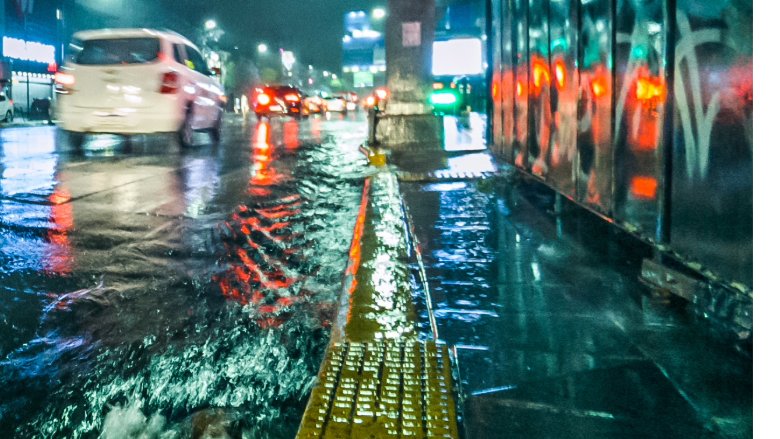
A lo largo de tres décadas, el Banco Mundial ha ayudado a la Argentina a implementar proyectos de gestión del riesgo de inundaciones —que han sido eficaces y han tenido resultados satisfactorios—, a mejorar la infraestructura, a reducir la vulnerabilidad y a hallar un equilibrio entre las soluciones verdes (basadas en la naturaleza) y las grises (infraestructura tradicional). En la actualidad, las personas están aprendiendo a convivir con el agua en lugar de combatirla. Desde 1992 los proyectos del Banco Mundial en la Argentina han permitido que más de 6 millones de personas cuenten con una mejor protección contra las inundaciones.
Durante varias décadas de trabajo, el Banco Mundial ha reunido historias de personas que se beneficiaron de los diversos proyectos que se llevaron adelante para lidiar con las inundaciones en la Argentina. Estas historias se presentan en el video “Inundaciones en la Argentina: 20 años de trabajo”.
“No, acá estamos mucho mejor, si allá era horrible. Vivíamos en la costa de la calle. No teníamos nada, estábamos arriba del zanjón ese. Encima era un peligro también los días de lluvia porque eso quedaba todo… agua [todo se inundaba] … Sí, mucho mejor porque allá les teníamos encerrados, no salían [los niños] a ningún lado. Acá por lo menos tienen su cancha, que se divierten, que juegan, que andan…”.
– Ramona Lopez, que se benefició con el Proyecto de Prevención de Inundaciones y Drenaje Urbano
“Ahora podemos tomar cursos sobre qué hacer ante fenómenos meteorológicos extremos, podemos mejorar nuestras habilidades, etc. Ahora vemos las mejoras, y las personas [del barrio] participan más. Creo que es importante ser socorrista del barrio para que, en caso de emergencia, podamos evacuar”.
– Yolanda Meza, residente y socorrista del Barrio Cildáñez, en la ciudad de Buenos Aires, que se benefició con el Proyecto de Apoyo a la Gestión del Riesgo de Inundaciones en la Ciudad Autónoma de Buenos Aires.
6 millonesLos proyectos del Banco Mundial en la Argentina han permitido que más de 6 millones de personas cuenten con una mejor protección contra las inundaciones.
Desafío
Las inundaciones son una de las amenazas climáticas más frecuentes de la Argentina y representan un importante desafío de desarrollo, que tiene impactos ambientales y socioeconómicos considerables. Las inundaciones provocadas por el fenómeno de El Niño-Oscilación del Sur de 1991-92 causaron pérdidas económicas por un valor de USD 905 millones en todo el país (en especial, en las ciudades ubicadas a orillas del río Paraná y en las provincias del norte). Esta crisis aceleró la elaboración de una estrategia a largo plazo para reducir los riesgos y mitigar los efectos de las inundaciones en la Argentina a través de medidas estructurales y no estructurales.
La Argentina se basa principalmente en infraestructura gris tradicional (como canales de drenaje revestidos y defensas de hormigón) para reducir la probabilidad de inundaciones. Por lo general, las iniciativas de implementación se concentran en el ámbito municipal y no se coordinan con las autoridades en los tramos superiores e inferiores de los ríos para mitigar el riesgo de inundaciones de manera integral. Faltan planes de gestión integrada de las cuencas que abarquen aspectos como áreas de riesgo hidrológico y ampliación de los servicios hídricos. Las políticas se han concentrado, ante todo, en reducir la exposición a los peligros y no tanto en determinar de qué forma una planificación espacial cuidadosa puede reducir los riesgos y cómo puede atenuarse la vulnerabilidad de las comunidades.
A pesar de los avances logrados desde la década de 1990, a la fecha alrededor del 28 % de los argentinos todavía viven en zonas propensas a sufrir inundaciones. Muchas personas afectadas por el riesgo de inundaciones podrían caer en la pobreza, ya que gran parte de ellas pertenecen a grupos sociales vulnerables. El Banco Mundial realizó un Diagnóstico de Seguridad Hídrica para la Argentina, que incluyó datos exhaustivos sobre el riesgo de inundaciones, sus impactos, la mitigación y las oportunidades de adaptación. El Banco Mundial utiliza los resultados para interactuar con los clientes y remarcar la importancia de reducir los riesgos de inundaciones y promover el uso de enfoques innovadores en la implementación de los proyectos.
Enfoque
El enfoque del Banco Mundial para apoyar la gestión del riesgo de inundaciones en la Argentina ha cambiado significativamente desde la década de 1980. De la estrategia reactiva que se concentraba, en especial, en la rehabilitación de la infraestructura dañada se pasó gradualmente a la prevención, al desarrollo de infraestructura gris (en particular, defensas) y a la reubicación de comunidades para proteger a las poblaciones vulnerables (a partir de las importantes inundaciones que se produjeron en la década de 1980 y que devastaron centros urbanos ubicados a orillas de los ríos de la cuenca del Plata).
En los últimos tiempos, se ha comenzado a utilizar un enfoque más integral basado en la adaptación al cambio climático y la resiliencia. Con este nuevo enfoque se analizan las oportunidades que existen de incluir infraestructura verde y soluciones basadas en la naturaleza aprovechando los procesos naturales y los servicios de los ecosistemas con el objetivo de mejorar la retención de agua y reducir los caudales máximos mediante estrategias como la ampliación de los cauces fluviales y la creación de humedales, parques lineales, jardines pluviales y cubiertas ecológicas. Los proyectos financiados a través de préstamos del Banco Internacional de Reconstrucción y Fomento (BIRF) han apoyado el desarrollo de herramientas técnicas y análisis en la cuenca fluvial para lograr una gestión integral de las principales cuencas argentinas. Estas medidas tenían por objeto mejorar las capacidades normativas, institucionales y regulatorias a fin de gestionar de forma eficiente los riesgos de inundaciones, reducir la vulnerabilidad de las comunidades mediante sistemas de alerta temprana de inundaciones y apoyar programas destinados a grupos específicos (incluidas las mujeres, para reducir las brechas de género).
En los primeros años de la década de 2020, los proyectos del Banco Mundial en la Argentina impulsaron nuevas innovaciones en un enfoque integrado: combinar la infraestructura gris y la verde y fortalecer, al mismo tiempo, las capacidades del Gobierno para gestionar el riesgo de inundaciones de manera eficaz. Este enfoque es prometedor para reducir los impactos de las inundaciones y los costos de inversión, y para ofrecer beneficios en varios aspectos, ya que se pasaría del paradigma de considerar al agua como un riesgo y una molestia al de convivir con ella y reconocer su valor económico, social y ambiental cuando se la gestiona como corresponde.
Resultados
En las últimas cuatro décadas, la Argentina ha realizado importantes avances en el abordaje de los desafíos que se presentan luego de las inundaciones. Alrededor de 3,2 millones de personas se beneficiaron con las obras realizadas en el marco de los proyectos de rehabilitación ante inundaciones, de protección contra las inundaciones y de emergencia como respuesta a las inundaciones causadas por El Niño (entre 1992 y 2006). Estos proyectos se concentraron en reconstruir y rehabilitar infraestructura esencial, en reubicar a las poblaciones de menores ingresos en áreas con menos riesgos de inundación y en fortalecer las defensas contra inundaciones para proteger las provincias del noroeste y del litoral en la cuenca del Paraná, importantes desde el punto de vista económico.
Las iniciativas para mitigar las inundaciones han apoyado la construcción de sistemas de defensa contra inundaciones reforzados, así como de mejores redes de drenaje. Algunos ejemplos destacados son la construcción de sistemas de drenaje en las áreas metropolitanas de Resistencia y de Gobernador Virasoro a través del Proyecto de Prevención de Inundaciones y Drenaje Urbano, que incluyó obras para aumentar la capacidad de drenaje en las cuencas de los arroyos Cildáñez, Maldonado y Vega, y que benefició a alrededor de 3 millones de personas, e intervenciones de drenaje urbano para proteger a 40 000 beneficiarios en la municipalidad de Yerba Buena en 2014.
La Argentina también ha mejorado la preparación frente a inundaciones, y ha puesto el énfasis en la gestión y en medidas no estructurales. El Banco Mundial ha ayudado a la Argentina a elaborar y modernizar las actuales estrategias de gestión del riesgo de inundaciones y los planes maestros de drenaje en todo el país mediante el sistema de alerta temprana establecido en virtud del Proyecto de Apoyo a la Gestión del Riesgo de Inundaciones en la Ciudad Autónoma de Buenos Aires. Este proyecto se concentró, en especial, en la elaboración de una nueva estrategia hídrica para la ciudad, con algo más de 3 millones de beneficiarios directos, y para junio de 2023 había logrado reducir los riesgos de inundaciones para alrededor de 47 000 personas en comunidades vulnerables. Esta estrategia incluyó varias actividades de comunicación y educación, como la capacitación de docentes de escuelas públicas primarias y secundarias y la preparación de materiales educativos sobre temas relacionados; la instalación del Centro Vivencial, un espacio para la comunicación, la educación y la participación ciudadana, y la recopilación de datos desagregados por género sobre los impactos de las inundaciones y los roles.
La Argentina también ha integrado la prevención del riesgo de inundaciones en los planes de gestión y en la planificación del uso de la tierra para las provincias de Santa Fe, Chaco, Corrientes y Entre Ríos (de conformidad con el Proyecto de Prevención de Inundaciones y Drenaje Urbano), con lo que se beneficiaron directamente alrededor de 3,5 millones de personas, que quedaron menos expuestas al riesgo de inundación; alrededor de 6 millones de personas se beneficiaron indirectamente, ya que hubo menos perturbaciones económicas, entre otros factores.
Contribución del Grupo Banco Mundial
Desde 1992, el Banco Mundial ha otorgado más de USD 2000 millones en financiamiento del BIRF a través de nueve proyectos para abordar las inundaciones en la Argentina.
Asociados
Las autoridades nacionales y locales, incluido el Ministerio de Obras Públicas a nivel nacional; las provincias de Buenos Aires, Chaco, Corrientes y Santa Fe, y la Ciudad Autónoma de Buenos Aires son quienes han implementado mayormente las intervenciones relacionadas con inundaciones.
El Gobierno de la ciudad de Buenos Aires se ha asociado con el de la ciudad de Copenhague para mejorar la gestión del agua en zonas urbanas. El programa C40 Cities brindó apoyo adicional para mejorar la resiliencia urbana. La Alianza Mundial para la Seguridad Hídrica y el Saneamiento y el Fondo Mundial para la Reducción de los Desastres y la Recuperación, ambos del Banco Mundial, llevan adelante, junto con el Gobierno de Japón, acciones complementarias de fortalecimiento de la capacidad e intervenciones innovadoras (como soluciones basadas en la naturaleza). Varios funcionarios de la Argentina realizaron viajes de estudio a Japón (en concreto, a Tokio) y a los Países Bajos financiados por los respectivos Gobiernos.
De cara al futuro
Desde 2023, la ciudad de Buenos Aires ha adoptado una estrategia progresiva de gestión del agua para adaptarse al cambio climático mejorando el valor agregado que tiene ese recurso en el desarrollo económico, social y ambiental de la ciudad. Este enfoque se está implementando en forma gradual mediante la introducción de infraestructura verde en la ciudad, que incorpora el agua en la visión que tiene la ciudad de un desarrollo urbano integrado. El Proyecto de Apoyo a la Gestión del Riesgo de Inundaciones en la Ciudad Autónoma de Buenos Aires ha ayudado a esta transformación al apoyar la implementación de soluciones basadas en la naturaleza, como la construcción de un área de retención temporal (reservorio) en el Parque Indoamericano, un humedal urbano que ayuda a regular los niveles del agua en el arroyo Cildáñez cuando se producen lluvias muy intensas. Esta intervención incluye un recorrido didáctico de 1,5 km, cuyo objetivo es generar más conciencia sobre la importancia de preservar los espacios verdes dentro de las áreas urbanas. El mobiliario urbano ha aumentado el valor agregado para el ocio, y el área se ha convertido en un lugar popular para realizar actividades de observación de aves.
Estos enfoques innovadores se están aplicando cada vez más en todo el país: el Banco Mundial tiene la intención, en el marco del Proyecto de Infraestructura Resiliente al Clima para la Gestión del Riesgo de Inundaciones Urbanas, de impulsar la incorporación de soluciones verdes que complementen la infraestructura gris para mitigar el riesgo de inundaciones en áreas urbanas. Las intervenciones en virtud de este proyecto incluyen la creación de un parque lineal, mejoras en los canales de drenaje, jardines pluviales y corredores verdes a fin de aumentar la retención de agua y gestionar la reducción del caudal máximo en distintas ciudades del norte argentino. La agenda de aprendizaje del enfoque programático de varias etapas permite preparar proyectos innovadores e implementar las mejores prácticas durante las etapas posteriores en otras regiones del país. Además, estos enfoques innovadores previstos, que apoyan el crecimiento verde e inclusivo, están relacionados con la estrategia climática del Banco Mundial: crear un “planeta habitable” mediante la promoción del desarrollo sostenible, la protección de las poblaciones vulnerables y la reducción del impacto del cambio climático en la región.
……………………………………………………………………………………………………………………….
a gestión del riesgo de desastres (GRD) en Argentina se estructura actualmente bajo un marco normativo y operativo que busca la transición de una respuesta reactiva hacia una gestión integral y preventiva.
Estructura y Planificación Actual (2025-2026)
- Marco Normativo: El eje central es el Sistema Nacional para la Gestión Integral del Riesgo y la Protección Civil (SINAGIR), creado por la Ley 27.287, que integra el trabajo de organismos nacionales, provinciales y municipales.
- Plan Nacional (PNRRD 2025-2029): Se ha desarrollado un nuevo Plan Nacional para la Reducción del Riesgo de Desastres para el periodo 2025-2029, que actualiza las metas de prevención, manejo de crisis y recuperación post-desastre.
- Herramientas Tecnológicas: Se utiliza el SINAME (Sistema Nacional de Alerta y Monitoreo de Emergencias) para el seguimiento en tiempo real de amenazas. OBSERVATORIO ARGENTINO DE VIGILANCIA VOLCÁNICA
Principales Amenazas y Desafíos en 2026
A inicios de 2026, la gestión se ha concentrado en eventos climáticos extremos:
- Incendios Forestales: El SINAGIR mantiene alertas activas (niveles de Alerta y Aviso) en provincias como Mendoza, Neuquén, La Pampa y Río Negro durante febrero de 2026.
- Inundaciones y Sequías: Siguen siendo los riesgos con mayor impacto económico. Se trabaja en integrar herramientas de largo plazo como el Sistema de Información sobre Sequías para el Sur de Sudamérica (SISSA).
- Sismicidad: En provincias como San Juan, se proyecta la ampliación de programas de evacuación y preparación para 2026.
Críticas y Situación Operativa
A pesar de la existencia del Plan 2025-2029, existen reportes sobre una brecha entre la planificación y la ejecución, con reclamos sociales por una activación más ágil del SINAGIR y mayor transparencia en la asignación de recursos extraordinarios para emergencias.
El Plan Nacional para la Reducción del Riesgo de Desastres (PNRRD) 2025-2029 de la República Argentina orienta las políticas públicas en materia de gestión integral del riesgo. Contempla las metas y los objetivos de los programas, así como las acciones tendientes a reducir los riesgos existentes con la finalidad de proteger a las personas y a sus bienes. Su formulación implica la identificación, el análisis y la gestión de los factores causales de las emergencias y desastres, con el objetivo de reducir el grado de exposición a las amenazas, disminuir la vulnerabilidad de la población y mejorar la preparación ante los eventos adversos. Establece los lineamientos estratégicos y metas de carácter plurianual que rigen el Sistema Nacional para la Gestión Integral del Riesgo y la Protección Civil (SINAGIR) creado por la Ley N° 27.287.
¿Cómo se elabora?
La formulación del PNRRD 2025-2029 es el resultado de un proceso técnico y participativo. La elaboración técnica se desarrolló a partir de una articulación interinstitucional de la Comisiones Técnicas del SINAGIR, las cuales constituyen un espacio de intercambio y coordinación entre organismos implicados en la gestión integral del riesgo. Se encuentran conformadas un total de 10 comisiones en las que intervienen:
- Áreas de gobierno
- Organismos científico-técnicos.
- Universidades.
- Organizaciones de la sociedad civil.
- Entidades del sector empresario.
Prioridades del PNRRD 2025-2029
1 Comprender el riesgo de desastres.
El resultado esperado a 2029: La República Argentina presenta una estructura de comprensión de los posibles riesgos, sus potenciales impactos y la manera de reducirlos de forma prospectiva e interdisciplinaria.
2 Fortalecer la gobernanza de la gestión del riesgo de desastres.
El resultado esperado a 2029: La República Argentina presenta una estructura institucional de coordinación SINAGIR de los diferentes sectores, así como de la participación activa de sus integrantes para una eficiente y efectiva GIRD.
3 Aumentar la preparación para casos de desastre a fin de dar una respuesta eficaz.
El resultado esperado a 2029: La República Argentina promueve el fortalecimiento de las capacidades para la preparación y la respuesta a emergencias de manera coordinada con todos los integrantes del SINAGIR, las regiones, sus provincias y municipios.
4 Recuperación, rehabilitación y reconstrucción resiliente.
El resultado esperado a 2029: La República Argentina promueve procesos de recuperación, rehabilitación y reconstrucción enfocado en la resiliencia.
Agentina Pictures
Mar 8, 2025 Argentina Flood

At least 10 people have died as a result of floods in the southern part of the province of Buenos Aires, the newspaper La Nacion reported, citing local authorities.
Earlier, the mayor of Bahia Blanca Federico Susbieles said that the flood had killed 6 people and displaced over 1,000. At the time, the mayor did not rule out that the number of victims could increase due to the scale of the natural disaster.
According to authorities, so far 400 mm of rainfall have fallen in the affected area, which is a historical maximum for the city. Defense Minister Luis Petry, Security Minister Patricia Bullrich and Buenos Aires Province Governor Axel Kichiloff arrived in Bahía Blanca. The federal government has pledged 10 billion pesos ($9 million) in flood relief.

People row kayaks on flooded streets in the city of Bahia Blanca, in the province of Buenos Aires [Juan Sebastian Lobos/Reuters]
27 March 2025
Consecutive extreme heat and flooding events in Argentina highlight the risk of managing increasingly frequent and intense hazards in a warming climate
Source(s): World Weather AttributionUpload your content

Wirestock Creators/Shutterstock
Between 1980 and 2020, floods were the most frequent natural hazard, affecting more than 14 million people across Argentina.
On 7 March, 2025, Bahía Blanca, Argentina, experienced an unprecedented rainfall event with over 300 mm of rain in just 8 hours, nearly half of the city’s annual average. This extreme event, the heaviest in the city’s recorded history (1956-present), was caused by a cold front reaching the area after several days of hot, humid weather. A week earlier, Bahía Blanca had already received more than 80 mm of rain, which may have contributed to soil saturation before the flooding. A larger region, including the capital Buenos Aires, had been experiencing extreme heat since mid-February, with temperatures exceeding 40°C in northern Argentina, southern Brazil, Paraguay, and Uruguay. Between 19 February and 8 March 2025, 61 cities in central-north Argentina recorded heatwave conditions.
The extreme rainfall on March 7th affected over 300,000 people, with 16 reported deaths, 1,400 being displaced (A24, 2025) and two persons still missing (La Nación, 2025). The damage estimated in the city amounts to 400 million USD (Ámbito, 2025). At the same time, heat alerts were issued in 15 provinces, with record temperatures in the north (Buenos Aires Herald, 2025, SMN Argentina via X). Buenos Aires faced blackouts and traffic disruptions affecting hundreds of thousands due to peak energy demand (Global Times, 2025, AP News, 2025). While no data on heat-related mortality is available at the time of writing, past events have shown increased mortality risks associated with events like this (Chesini et al., 2019; Chesini et al., 2021, Pinotti et al., 2024).
To assess to what extent human-induced climate change altered the likelihood and intensity of the heavy precipitation leading to the severe flooding, as well as the extreme heat researchers from Argentina, Kenya, the Netherlands, Sweden, Denmark, Mexico, the United States and the UK undertook an attribution study for the extreme rainfall in the most affected region, that coincides with the area where flood warnings were in place (Fig. 1a), as well as for the extreme seasonal heat in the wider area (Fig. 1b). For this larger region we further calculate the heat index, a combination of high temperatures and humidity to assess the role of climate change in the heatwave directly preceding the extreme rainfall (Fig. 1c). In Argentina, the impacted areas were affected by rainfall that occurred intermittently between 1-7 March. We therefore studied changes in the wettest 7-day period over the study region. The heat was especially intense in February and March, but early hot spells since January resulted in the entire season being exceptionally warm which is important for understanding the overall impacts, so we focus on the summer season (December to March) for the temporal definition of the heat event.
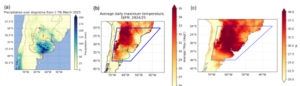
Figure: (a): 7-day accumulated rainfall during 1-7 March 2025, based on MSWEP data. The study region is highlighted in red. The scatter plots show the rainfall accumulations for the same period from 25 weather stations by the National Weather Services (NWS). (b) The average of daily maximum temperature during 1 Dec 2025 -18 March 2025, based on MSWX dataset. The study region (SouthEast South America domain or the SES domain) is highlighted in blue. (c) Average Heat index (HI) during 15 Feb-7 March, 2025, based on ERA5 dataset. The blue highlight shows the SES domain.
Main findings
- In Northern Argentina, including the Buenos Aires province and CABA, intensified and more frequent extreme heat and heavy rainfall events as well as simultaneous or sequential extremes like heat-heavy rainfall or hot-dry events heighten the risk of compounding hydrometeorological hazards. CABA’s aging population, urban development, and high population density increase both exposure and vulnerability to these hazards.
- Almost 50% of the urban population is employed in the informal economy and a large proportion of the urban livelihoods are sensitive to climate shocks e.g. due to employment disruption and exposure to heat.
- Based on gridded reanalysis products, we find that the extreme heat event is relatively rare, expected to occur in today’s climate about once every 50 to 100 years. However, in a 1.3°C cooler climate, extreme heat such as observed in the summer 2024/25 would have been virtually impossible. When repeating the analysis for the shorter hot and humid heat wave directly preceding the rainfall event, we find a similarly large role of human-induced climate change.
- Climate models also show that climate change is making such temperatures much more frequent and intense. However, the increase in the models is smaller than in reanalysis products and thus likely underestimating the effect of climate change. Nevertheless, looking at the future, models show a very strong trend that increases with future warming, rendering such an event a common occurrence in a 2.6°C warmer climate compared to pre-industrial.
- The influence of climate change on the rainfall event is much less clear. While all of the 35 available weather stations in the area show an increase in the intensity of heavy rainfall of between 7-30% associated with global warming of 1.3°C, this is not represented in any of the available gridded reanalysis products which show on average a decreasing trend.
- Climate models are largely in agreement with the station data and on average show an increase in the likelihood and intensity of heavy rainfall such as observed in early March. A similar increase in most, but not all, models is seen for an additional 1.3°C warming, representing a 2.6°C climate.
- Station data and model data both show an increasing trend in extreme rainfall with rising temperatures, which is also what is expected for rainfall events of this kind in a warming climate. Thus, it is likely that climate change increased the likelihood and intensity of the heavy rainfall. However as station data and gridded data do not agree on the sign of the trend we cannot reconcile the two and make a conclusive statement.
- These consecutive events highlight the broader challenges of managing increasingly frequent and intense hazards in the province, where vulnerabilities are shaped by urbanization, infrastructure inadequacies, and social inequalities.
- As extreme weather events become more common, it is important to keep investing in early warning systems, climate-smart urban planning, and preparedness that takes multiple hazards into account. For instance, creating more green and blue spaces can help reduce heat in cities, provide relief during hot weather, and lower the risk of flooding-all of which can be done even in crowded urban areas.
For any comments, please contact: zmsajjad@gmail.com