Forecast-based Early Warning Early Action Protocol development guidelines
The copyright © 2026 Z M Sajjadul Islam, Advisor, Multi-Hazard Early Warning System Design and Implementation Center (MHEWC – www.mhewc.org ). All rights reserved. Any material quoted, reproduced, adapted, or extracted from this proposal must be properly cited and attributed to the author. Please call at +8801711979179, Email: zmsajjad@gmail.com
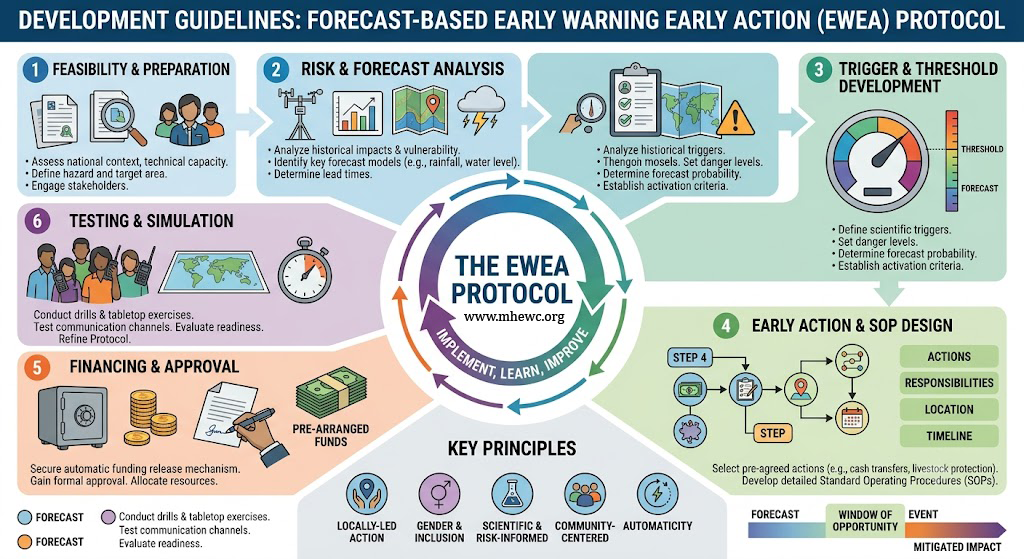
Early Warning-Based Early Action Protocol Development Guidelines
A strong Early Warning based Early Action Protocol should connect credible forecasts + impact-based triggers + pre-agreed financing + community-centred action + clear institutional accountability. The aim is to act before disaster impact, reducing loss of life, livelihoods, assets, and public service disruption.
An Early Action Protocol (EAP) is a pre-agreed operational plan that defines when to act, where to act, who will act, what action will be taken, and how funds/resources will be released before a hazard becomes a disaster. It should be aligned with the four EW4ALL pillars: risk knowledge, monitoring/forecasting, warning dissemination, and preparedness/response capacity WMO Early Warnings for All.
1. Define The Protocol Scope
Start by clearly defining:
| Item | Guiding Questions |
|---|---|
| Hazard | Flood, cyclone, drought, heatwave, landslide, storm surge, cold wave, etc. |
| Geographic area | Which districts, municipalities, river basins, coastlines, camps, or vulnerable communities? |
| Lead time | How many hours, days, weeks, or months before impact can action realistically begin? |
| Target population | Who is most at risk: women, children, elderly, persons with disabilities, farmers, fishers, informal workers, displaced people? |
| Institutional owner | Which agency leads activation, coordination, financing, and reporting? |
2. Conduct Risk And Impact Analysis
The protocol should be based on evidence, not only hazard probability. Analyze:
Historical disaster records and past impact patterns.
Exposure of people, settlements, infrastructure, livelihoods, agriculture, livestock, health facilities, schools, markets, and transport routes.
Vulnerability by sex, age, disability, poverty, livelihood, displacement status, and location.
Seasonal calendars, livelihood calendars, crop calendars, migration patterns, and service-access constraints.
Priority impact scenarios: loss of life, displacement, crop loss, livestock death, water contamination, disease outbreak, road isolation, market disruption.
3. Establish Forecast And Trigger Mechanism
A strong EAP must define the trigger that activates early action. Forecast-based financing models usually combine risk analysis, vulnerability data, past impacts, and weather forecasts to define pre-agreed thresholds IFRC DREF Anticipatory Pillar.
Trigger design should include:
| Component | Example |
|---|---|
| Forecast source | Meteorological agency, hydrological model, satellite rainfall, river gauge, drought index |
| Threshold | River level above danger mark, rainfall above percentile, cyclone landfall probability, SPI drought level |
| Probability | Example: 60-80% likelihood of severe impact |
| Lead time | 72 hours for cyclone, 5 days for flood, 1-3 months for drought |
| Impact threshold | Expected number of affected households, crop area at risk, livestock mortality risk |
| Activation authority | National EOC, NDMO, Red Crescent/Red Cross, local government, technical task force |
The trigger should be simple enough for operational use but scientifically defensible.
4. Select No-Regret Early Actions
Early actions must be feasible within the available lead time and must reduce likely impact. The IFRC defines early actions as pre-agreed activities designed to save lives and livelihoods once a hazard is forecast IFRC Early Warning Early Action.
Examples:
| Hazard | Possible Early Actions |
|---|---|
| Cyclone/storm surge | Evacuation support, transport for elderly/persons with disabilities, shelter readiness, securing roofs, pre-positioning WASH kits |
| Flood | Cash transfer, livestock relocation, boat readiness, safe water storage, protection of documents/assets |
| Drought | Livestock feed support, water trucking, drought-tolerant seeds, crop advisories, veterinary support |
| Heatwave | Cooling centres, public health alerts, drinking water points, work-hour adjustment advisories |
| Landslide | Evacuation of high-risk slopes, road closure alerts, community watch teams, emergency shelter activation |
Prioritize actions that are timely, practical, locally accepted, gender-sensitive, disability-inclusive, and financially realistic.
5. Define Roles And Responsibilities
The EAP should include a clear institutional responsibility matrix.
| Function | Responsible Actor |
|---|---|
| Forecast monitoring | Meteorological/hydrological agency |
| Risk analysis | DRM authority, technical agencies, universities |
| Trigger confirmation | Technical working group |
| Activation decision | NDMO/EOC/authorized protocol body |
| Community communication | Local government, volunteers, community leaders, media |
| Early action implementation | Sector departments, NGOs, Red Cross/Red Crescent, local committees |
| Fund release | Finance unit, anticipatory action fund, donor mechanism |
| Monitoring and reporting | M&E team, local authorities, independent observers |
6. Prepare Financing Arrangements
An EAP must identify how money, goods, staff, transport, and logistics will be available before the event. IFRC’s anticipatory financing model provides preapproved funding, readiness activities, pre-positioned stocks, and automatic release once triggers are met IFRC Practical Information on DREF Anticipatory Pillar.
Budget categories should include: Annual readiness cost. Pre-positioning cost. Activation/early action cost. Transport and logistics. Communication and warning dissemination. Volunteer/staff mobilization. Monitoring, evaluation, accountability, and learning. Contingency and administrative cost.
7. Develop The Activation SOP
The protocol should include a step-by-step activation process: Forecast received and monitored. Technical agency verifies threshold. Trigger committee confirms activation. Lead agency issues activation notice. Funds/resources are released. Local government and partners mobilize. Communities receive warnings and assistance. Early actions are completed before impact. Monitoring starts immediately. After-action review is conducted.
8. Ensure Last-Mile Warning And Community Engagement
No EAP is effective unless communities understand the warning and trust the action. Include: Local language messages. Multiple channels: SMS, radio, mosque/temple/church announcements, social media, sirens, volunteers, flags, community meetings. Tailored messaging for women, elderly people, persons with disabilities, children, fishers, farmers, and displaced populations. Feedback channels and complaint mechanisms. Community validation of triggers and proposed actions.
9. Monitoring, Evaluation, Accountability And Learning
The EAP should track whether early action was timely, useful, inclusive, and cost-effective.
Key indicators:
| Area | Sample Indicator |
|---|---|
| Timeliness | Funds released within agreed time after trigger |
| Reach | Number of households receiving support before impact |
| Inclusion | % of women-headed households, persons with disabilities, elderly, and marginalized groups reached |
| Effectiveness | Reduction in loss of assets, livestock, crops, illness, displacement, or mortality |
| Forecast performance | Was the trigger accurate? Was there a false alarm or missed event? |
| Community satisfaction | % of people reporting the action was useful and timely |
10. Recommended EAP Structure
A full protocol may follow this structure: Executive summary Hazard and geographic scope Risk, vulnerability, and impact analysis Forecast sources and trigger methodology Early action package Targeting and beneficiary selection criteria Institutional roles and coordination mechanism Activation SOP and decision flow Financing and budget Logistics and procurement plan Communication and community engagement plan Gender, disability, protection, and inclusion measures Monitoring, evaluation, accountability, and learning plan Readiness and simulation plan Annexes: maps, contact lists, trigger tables, templates, message scripts, budget sheets
Early Warning-Based Early Action Protocol Development Guidelines in Detail
- Introduction
An Early Warning-Based Early Action Protocol, commonly referred to as an Early Action Protocol (EAP), Early Warning–Early Action Protocol, Forecast-Based Action Protocol, or Anticipatory Action Plan, is a pre-agreed operational arrangement that converts credible forecasts and early warning information into timely, financed, targeted, and accountable actions before a hazardous event causes its most severe impacts.
Anticipatory action is undertaken ahead of a predicted hazardous event to prevent or reduce impacts on lives, livelihoods, assets, essential services, and humanitarian needs. Its defining features are:
- pre-agreed forecasts and trigger thresholds;
- pre-agreed actions;
- clearly assigned institutional responsibilities;
- pre-identified geographic areas and population groups;
- pre-arranged financing; and
- implementation before the hazard impact, or before its most acute consequences are felt.
An EAP therefore closes the operational gap between “warning issued” and “protective action taken.” It establishes, in advance:
What hazard is expected, where and when it may occur, how severe its impacts may be, who and what are at risk, what actions must be taken, who will implement them, and how the actions will be financed.
Under the IFRC anticipatory-financing model, an EAP is a formal hazard-specific plan that identifies the actions to be undertaken when an agreed forecast trigger is reached. It normally includes readiness activities, pre-positioning arrangements, and pre-agreed actions to protect lives and livelihoods.
- Purpose of an Early Action Protocol
The principal purpose of an EAP is to ensure that early warnings result in rapid, organized, evidence-based, and adequately financed action rather than remaining solely as meteorological or technical information.
A well-designed protocol should:
- Translate hazard forecasts into likely human, livelihood, infrastructure, environmental, and service-delivery impacts.
- establish objective thresholds for readiness, pre-activation, and full activation;
- identify practical actions that can be completed within the forecast lead time;
- ensure that funding is released immediately when triggers are reached;
- clarify responsibilities among government agencies, humanitarian organizations, technical institutions, local authorities, communities, and service providers;
- prioritize highly exposed and vulnerable populations;
- reduce avoidable mortality, displacement, livelihood losses, asset damage, service disruption, and humanitarian needs;
- strengthen coordination and avoid duplication;
- provide accountability, monitoring, learning, and protocol-revision arrangements; and
- complement-not replace-long-term disaster risk reduction, climate adaptation, preparedness, social protection, and emergency response systems.
- Distinction Between an EAP and Related Plans
3.1 Early Warning System
An early warning system detects, monitors, forecasts, and communicates information about a hazard and its potential impacts.
3.2 Early Action Protocol
An EAP specifies what will happen after defined warning or forecast conditions are reached but before severe impacts occur. It connects warning information to decisions, funding, people, logistics, and actions.
3.3 Contingency Plan
A contingency plan covers broader preparedness and emergency-response arrangements. It may include actions before, during, and after a disaster. An EAP is generally more specific, trigger-based, time-bound, and focused on the pre-impact window.
3.4 Standard Operating Procedure
An SOP explains how a specific institution or team will perform an assigned task. The EAP is the overarching multi-actor protocol, while SOPs provide detailed operational instructions for individual actions.
3.5 Emergency Response Plan
An emergency response plan is usually activated when impacts are occurring or have already occurred. An EAP is designed to operate earlier, although early action and emergency response may overlap during rapidly developing or slow-onset crises.
- Core Building Blocks
A credible EAP should be constructed around three indispensable building blocks:
4.1 Risk information, forecasts, and triggers
Reliable hazard, exposure, vulnerability, impact, and forecast information must be available to determine when and where action is required.
4.2 Pre-agreed actions and delivery arrangements
Actions must be selected, budgeted, assigned, and operationally prepared before the forecast trigger is reached.
4.3 Pre-arranged financing
Funding must be guaranteed or reserved in advance and released according to the trigger without lengthy post-warning approval procedures.
These building blocks should be supported by:
- enabling laws and policies;
- institutional coordination;
- technical capacity;
- community participation;
- logistics and procurement readiness;
- data-sharing arrangements;
- monitoring, evaluation, accountability, and learning;
- safeguarding and protection measures; and
- regular testing and revision.
- Guiding Principles
5.1 People-centered and locally led
At-risk communities should participate in risk analysis, trigger interpretation, action selection, targeting, communication, implementation, monitoring, and evaluation. Local knowledge should be combined with scientific information.
5.2 Risk-informed and impact-based
Activation should not depend solely on the predicted physical magnitude of a hazard. It should also consider exposure, vulnerability, coping capacity, likely impacts, population movement, critical infrastructure, livelihood sensitivity, and access constraints.
5.3 Pre-agreed and rules-based
Triggers, responsibilities, actions, budgets, geographic priorities, targeting criteria, and decision-making authorities should be agreed before the hazard season.
5.4 Timely and operationally feasible
Every action must be achievable within the usable lead time. An action that requires ten days to organize cannot be assigned to a trigger that provides only three days of warning.
5.5 No-regret or low-regret
Priority should be given to actions that provide meaningful protective or preparedness benefits even when the predicted event is less severe than expected.
5.6 Inclusive and protective
The protocol should address differential risks faced by women, children, older people, persons with disabilities, displaced people, marginalized ethnic or social groups, informal workers, remote communities, and people with limited access to communication or services.
5.7 Do-no-harm
Actions must not increase protection risks, social tensions, exclusion, indebtedness, environmental degradation, market disruption, or conflict over assistance.
5.8 Multi-sectoral and coordinated
Meteorological, hydrological, agricultural, health, disaster management, social protection, finance, infrastructure, education, livestock, WASH, telecommunications, local-government, humanitarian, and community institutions should operate under one coordinated arrangement.
5.9 Accountable and transparent
Trigger decisions, fund releases, targeting, procurement, delivery, complaints, and results should be documented and open to review.
5.10 Adaptive and evidence-driven
The protocol should be updated following simulations, activations, false alarms, missed events, technological changes, new risk information, and community feedback.
Locally led planning and advance coordination improve the relevance, acceptance, and practical delivery of anticipatory action.
- Institutional Arrangements for Protocol Development
6.1 Establish a Steering Committee
A national or subnational steering committee should provide policy direction, institutional authorization, resource mobilization, and approval.
Possible membership includes:
- national disaster management authority;
- national meteorological and hydrological services;
- relevant line ministries;
- ministry of finance or planning;
- local-government representatives;
- humanitarian coordination bodies;
- Red Cross or Red Crescent National Society;
- UN agencies;
- NGOs and civil-society organizations;
- research and academic institutions;
- private-sector and telecommunications providers;
- organizations of persons with disabilities;
- women’s organizations;
- community representatives; and
- donors or financing partners.
6.2 Form a Technical Working Group
The Technical Working Group should lead the technical development of the EAP. It may include specialists in:
- meteorology and climatology;
- hydrology and oceanography;
- agriculture and food security;
- public health and epidemiology;
- disaster risk analysis;
- GIS and remote sensing;
- impact-based forecasting;
- social protection;
- gender, protection, disability, and inclusion;
- humanitarian operations;
- logistics and supply-chain management;
- cash and voucher assistance;
- monitoring and evaluation;
- communications; and
- public finance and disaster risk financing.
6.3 Establish a Trigger or Scientific Committee
This committee should be responsible for:
- monitoring observations and forecasts;
- checking whether thresholds have been reached;
- documenting forecast confidence;
- recommending pre-activation or activation;
- recording decisions;
- managing forecast disagreement; and
- advising on trigger revision.
National experience demonstrates the value of separating scientific monitoring and trigger advice from the operational working group responsible for selecting actors, locations, and actions.
6.4 Designate an Activation Authority
The protocol must name the institution and position authorized to:
- declare readiness;
- approve pre-activation;
- declare full activation;
- authorize fund release;
- communicate the decision; and
- approve exceptional deviations from the protocol.
Alternative authority should be specified in case the primary decision-maker is unavailable.
- Protocol Development Process
Phase 1: Inception and Scoping
Step 1: Define the protocol objective
The protocol should specify:
- the hazard or hazard combination;
- geographic coverage;
- sectors covered;
- intended population;
- implementing institutions;
- financing mechanism;
- expected duration of validity; and
- relationship with existing national and local plans.
Step 2: Review the enabling environment
Review:
- disaster-management legislation;
- standing orders and emergency procedures;
- national and local DRR strategies;
- climate-change policies;
- meteorological and hydrological mandates;
- social-protection programmes;
- public-finance rules;
- contingency plans;
- humanitarian coordination arrangements;
- data-sharing policies;
- emergency procurement regulations; and
- existing anticipatory-action initiatives.
Step 3: Map stakeholders and capacities
The mapping should identify:
- forecast producers;
- forecast interpreters;
- warning authorities;
- decision-makers;
- funding authorities;
- operational agencies;
- local implementing partners;
- communication providers;
- suppliers and financial-service providers;
- community organizations; and
- monitoring and evaluation institutions.
A responsibility matrix should specify which organization is Responsible, Accountable, Consulted, and Informed-RACI-for each protocol function.
- Hazard and Risk Prioritization
Not every hazard is equally suitable for anticipatory action. Initial prioritization should examine:
- frequency and seasonality;
- historical mortality and displacement;
- livelihood and economic losses;
- predictability;
- available forecast lead time;
- forecast skill and reliability;
- geographic concentration;
- existence of actionable thresholds;
- availability of feasible early actions;
- institutional capacity;
- population vulnerability;
- financing potential; and
- the likelihood of compound or cascading impacts.
A prioritization matrix may assign each criterion a score from 1 to 5.
Criterion | Weight | Hazard score | Weighted score |
Humanitarian impact | 20% | 5 | 1.00 |
Forecastability | 20% | 4 | 0.80 |
Available lead time | 15% | 4 | 0.60 |
Early-action feasibility | 20% | 5 | 1.00 |
Data availability | 10% | 3 | 0.30 |
Institutional capacity | 10% | 3 | 0.30 |
Financing feasibility | 5% | 4 | 0.20 |
Total | 100% | 4.20/5 |
FAO guidance recommends ranking disaster risks, assessing available warning information, identifying intervention opportunities through a crisis timeline, and prioritizing actions before preparing the anticipatory-action plan.
- Comprehensive Risk Analysis
9.1 Hazard analysis
Compile information on:
- magnitude and intensity;
- frequency and return period;
- duration;
- spatial extent;
- onset speed;
- seasonality;
- historical tracks or affected zones;
- associated secondary hazards;
- threshold exceedances; and
- climate variability and climate-change influence.
Examples include:
- flood depth, river discharge, duration, and velocity;
- cyclone wind speed, track, landfall location, storm surge, and rainfall;
- drought rainfall anomaly, soil moisture, vegetation condition, crop-water deficit, and food-price trends;
- heatwave maximum temperature, minimum nighttime temperature, humidity, heat index, and duration;
- landslide rainfall threshold, antecedent soil moisture, terrain, and slope instability.
9.2 Exposure analysis
Map exposed:
- population;
- settlements;
- schools;
- health facilities;
- roads and bridges;
- water and sanitation systems;
- electricity and telecommunications;
- markets and storage facilities;
- crops and livestock;
- fisheries;
- industrial and commercial assets;
- environmental resources;
- cultural heritage; and
- displacement sites.
9.3 Vulnerability analysis
The assessment should consider:
- poverty;
- housing quality;
- disability;
- age and gender;
- livelihood dependence;
- food insecurity;
- health status;
- social exclusion;
- remoteness;
- access to transport;
- access to shelters;
- communication access;
- documentation status;
- protection risks;
- debt;
- livestock ownership;
- land tenure; and
- institutional service capacity.
9.4 Capacity analysis
Assess:
- community preparedness;
- local volunteers;
- evacuation capacity;
- shelter availability;
- emergency stocks;
- transport;
- communications;
- health services;
- financial-service providers;
- government safety-net systems;
- local suppliers; and
- emergency coordination structures.
9.5 Historical impact database
Develop a georeferenced database linking past hazard characteristics to observed impacts. Data may include:
- deaths and injuries;
- houses damaged;
- hectares of crops affected;
- livestock losses;
- school and health-facility disruption;
- road closures;
- displacement;
- market interruption;
- water contamination;
- disease outbreaks;
- relief requirements; and
- direct and indirect economic losses.
The trigger-development process should combine detailed risk analysis, previous disaster impacts, vulnerability information, and forecast information.
- Assessment of Forecasts and Early Warning Information
The protocol should document every forecast or indicator that may contribute to activation.
10.1 Forecast inventory
For each product, record:
- producer;
- model or observation system;
- variable;
- geographic resolution;
- update frequency;
- forecast horizon;
- accessibility;
- format;
- historical archive;
- verification status;
- uncertainty information; and
- responsible interpreter.
10.2 Forecast sources
Potential sources include:
- National Meteorological and Hydrological Services;
- river and flood-forecasting centres;
- regional climate centres;
- regional specialized meteorological centres;
- global numerical weather prediction systems;
- weather radar;
- satellite Earth observation;
- lightning-detection networks;
- automated weather and hydrological stations;
- ocean buoys and tide gauges;
- agricultural and vegetation-monitoring platforms;
- health-surveillance systems;
- market and food-security monitoring;
- community-based observations; and
- impact-reporting platforms.
10.3 Forecast skill assessment
Forecasts should be tested against historical events using, where possible:
- probability of detection;
- false-alarm ratio;
- missed-event ratio;
- critical success index;
- bias;
- reliability;
- discrimination;
- root-mean-square error;
- lead-time stability;
- geographic accuracy; and
- impact-prediction performance.
For binary activation:
Trigger design should explicitly balance:
- the consequences of activating unnecessarily; and
- the consequences of failing to activate before a severe event.
10.4 Forecast hierarchy
The protocol should define which source is authoritative and how other sources will be used for confirmation.
Example hierarchy:
- official national forecast or warning;
- nationally approved impact-based forecast;
- regional specialized forecast;
- global ensemble guidance;
- satellite, radar, and ground observations;
- local reports and community observations.
10.5 Forecast disagreement procedure
The EAP should explain what happens when:
- national and global models disagree;
- forecast confidence falls;
- the predicted track shifts;
- data transmission fails;
- the official warning is delayed;
- observations show rapid intensification; or
- a secondary hazard becomes dominant.
- Crisis Timeline and Lead-Time Analysis
A crisis timeline identifies the progression from the earliest risk signal to peak impact and recovery.
For each hazard, identify:
- seasonal risk outlook;
- medium-range forecast;
- early indication of abnormal conditions;
- watch stage;
- alert stage;
- warning stage;
- predicted impact;
- hazard onset;
- peak humanitarian impact; and
- post-impact response.
The timeline should then identify operational windows for:
- preparedness;
- procurement;
- beneficiary verification;
- cash registration;
- stock movement;
- early-warning dissemination;
- livestock relocation;
- evacuation;
- protection of water sources;
- reinforcement of structures;
- pre-positioning medical supplies;
- crop or asset protection; and
- anticipatory cash transfer.
Usable lead time
The nominal forecast horizon is not always the operational lead time.
For example, a five-day forecast may provide only two usable days if trigger verification, approval, financing, procurement, and mobilization require three days.
- Trigger Development
12.1 Definition
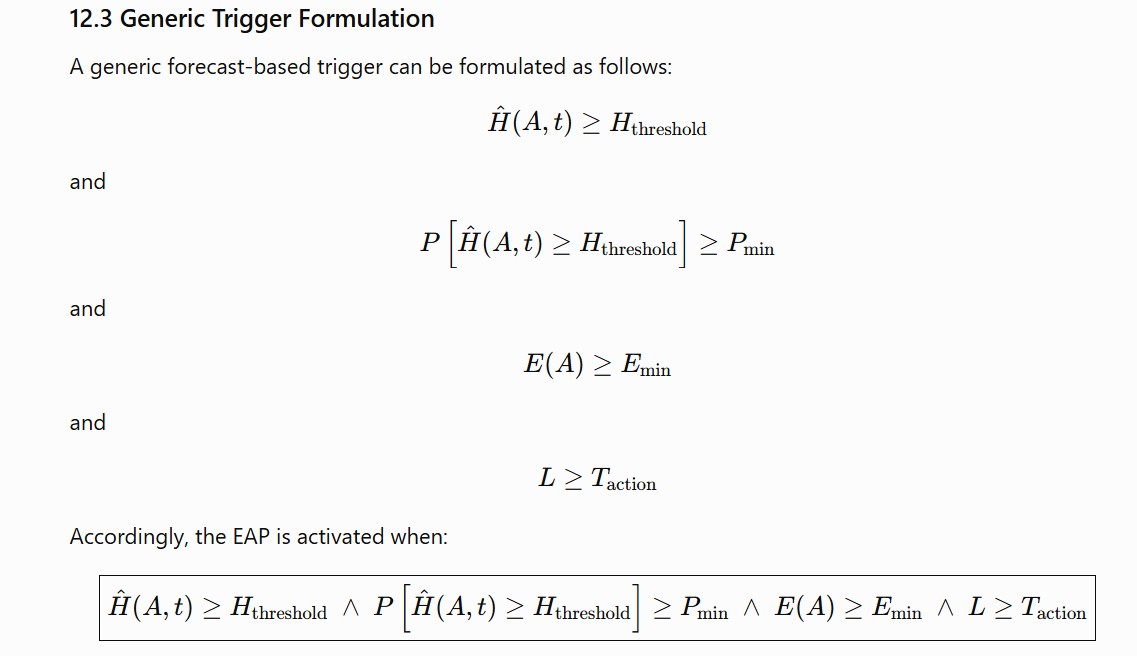
A trigger is a pre-agreed decision rule that initiates readiness, pre-activation, fund release, or early-action implementation when specified forecast or risk conditions are reached.
Triggers should answer:
- What variable will be monitored?
- Which forecast or observation will be authoritative?
- What threshold must be reached?
- What probability or confidence is required?
- What geographic area must be affected?
- What minimum level of exposure or impact is required?
- What lead time must remain?
- Who verifies the trigger?
- Who approves activation?
- How quickly must the decision be communicated?
12.2 Types of triggers
- Hazard-based trigger
Based on the predicted physical intensity of the hazard.
Example:
Activate when forecast river discharge exceeds 15,000 m³/s with at least a 60 per cent probability.
- Impact-based trigger
Based on expected consequences.
Example:
Activate when modelling indicates at least a 60 per cent probability that 20,000 people will experience flood depths exceeding one metre.
- Composite trigger
Combines several indicators.
Example:
- forecast rainfall exceeds threshold;
- upstream river level exceeds threshold;
- soil moisture is above threshold;
- exposed population exceeds threshold; and
- forecast confidence is sufficient.
- Sequential trigger
Uses different thresholds at different lead times.
For example:
- Seasonal readiness trigger: elevated probability of above-normal rainfall;
- pre-activation trigger: high likelihood of extreme rainfall within seven days;
- activation trigger: river or impact threshold expected within three days;
- confirmation trigger: observations show rapid threshold approach.
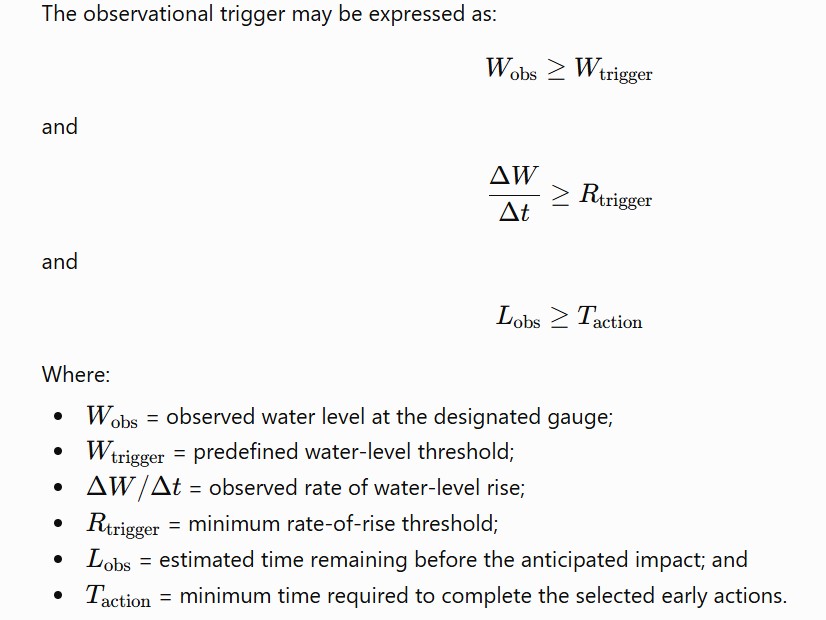
- Observational trigger
Used when reliable forecast lead time is limited.
Example:
Activate when upstream water level exceeds a specified gauge level and continues rising at a defined rate.
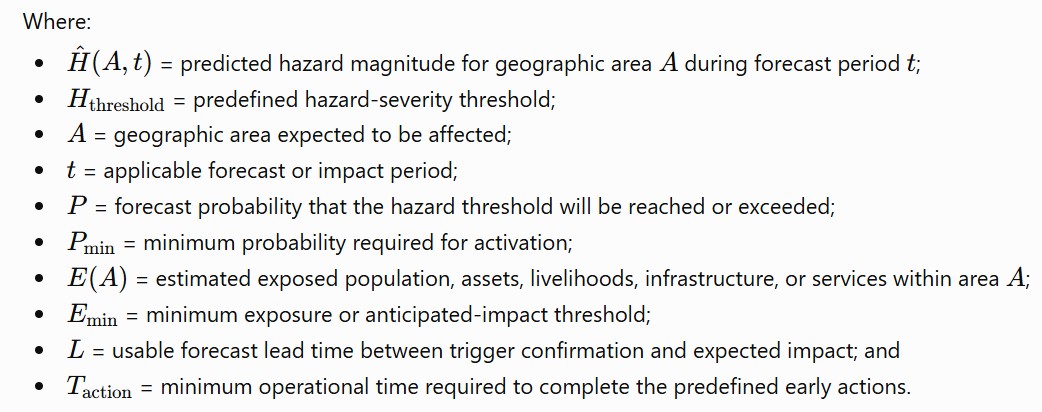
12.3 Generic trigger formulation
12.4 Trigger levels
A robust protocol should normally include several decision levels.
Level | Meaning | Typical decision |
Level 0 | Normal conditions | Routine monitoring |
Level 1 | Seasonal or emerging risk | Readiness review |
Level 2 | Elevated probability | Pre-activation and standby |
Level 3 | Threshold reached | Fund release and full early action |
Level 4 | Impact occurring | Transition to emergency response |
Stand-down | Threat reduced or shifted | Suspend, redirect, or close activation |
12.5 Trigger validation
The proposed trigger should be hindcast against historical data to determine:
- how often it would have activated;
- how many severe events it would have detected;
- how many events it would have missed;
- how many false activations would have occurred;
- whether activation would have occurred early enough;
- which locations would have been selected;
- whether proposed actions would have remained feasible; and
- the financial implications of repeated activation.
Sensitivity analysis should test alternative thresholds and probability levels.
12.6 Trigger failure and exceptional activation
The EAP should include a procedure for:
- data outage;
- model failure;
- rapid-onset escalation;
- unprecedented events outside the historical range;
- conflicting forecasts;
- trigger reached too late;
- hazard track shifting after activation; and
- credible expert evidence of imminent severe impact despite formal trigger failure.
Exceptional activation should require documented scientific and operational justification.
- Identification and Selection of Early Actions
Early actions should be selected through participatory analysis involving technical agencies, sector specialists, local institutions, operational organizations, and at-risk communities.
13.1 Impact–action pathway
For every expected impact, identify the mechanism through which an action would reduce that impact.
Forecast impact | Impact mechanism | Early action | Expected result |
Livestock mortality | Animals exposed to cold and feed shortage | Distribute feed and veterinary supplies | Reduced livestock loss |
Flood displacement | Households lack transport and cash | Provide anticipatory cash and evacuation support | Earlier safe movement |
Water contamination | Wells likely to be inundated | Protect wells and pre-position treatment supplies | Safer drinking water |
Heat-related illness | High exposure among older people and outdoor workers | Cooling centres, outreach, water, adjusted working hours | Reduced heat illness |
Crop loss | Harvest-ready crops exposed to cyclone or flood | Support early harvesting and storage | Reduced crop damage |
13.2 Action-selection criteria
Every proposed action should be assessed against:
- relevance to forecast impacts;
- evidence of effectiveness;
- feasibility within available lead time;
- community acceptance;
- implementation capacity;
- cost-effectiveness;
- supply and market availability;
- inclusion and protection;
- environmental implications;
- conflict sensitivity;
- legal and policy acceptability;
- scalability;
- coordination with existing systems;
- potential benefits if the event does not materialize; and
- ability to monitor completion and results.
13.3 Categories of action
Readiness actions
Conducted before activation to maintain operational capacity:
- update contact lists;
- validate beneficiary databases;
- renew supplier agreements;
- test communications;
- inspect warehouses;
- train volunteers;
- conduct simulations;
- check vehicles;
- update forecast dashboards;
- refresh financial-service-provider agreements; and
- verify stocks.
Pre-activation actions
Initiated when risk rises but the full trigger has not yet been reached:
- place staff and volunteers on standby;
- issue preliminary advisories;
- initiate beneficiary confirmation;
- move stocks closer to risk areas;
- begin procurement;
- check shelters;
- prepare transport;
- coordinate local authorities; and
- activate intensified forecast monitoring.
Activation actions
Implemented once the main trigger is reached:
- distribute cash or vouchers;
- evacuate people and livestock;
- disseminate targeted impact-based warnings;
- protect water sources;
- pre-position health and WASH supplies;
- reinforce shelters and critical infrastructure;
- support early harvesting;
- move productive assets;
- distribute livestock feed;
- provide cooling, heating, or protective supplies; and
- activate shock-responsive social protection.
Transition actions
Implemented when the hazard occurs or the anticipatory window closes:
- hand over to emergency-response structures;
- update needs assessments;
- reconcile expenditure;
- identify residual gaps;
- maintain protection monitoring; and
- document early-action results.
- Early Action Prioritization Matrix
Actions may be scored from 1 to 5 against weighted criteria.
Criterion | Suggested weight |
Potential to reduce mortality and severe harm | 20% |
Feasibility within lead time | 20% |
Evidence of effectiveness | 15% |
Relevance to priority impacts | 15% |
Operational capacity | 10% |
Inclusion and protection | 10% |
Cost-effectiveness | 5% |
No-regret value | 5% |
Actions receiving a low score for feasibility, protection, or lead-time compatibility should not be included, even when they appear desirable in principle.
- Geographic Targeting
The protocol should establish how affected areas will be selected after trigger activation.
15.1 Geographic targeting criteria
Possible criteria include:
- predicted hazard intensity;
- probability of threshold exceedance;
- forecast impact;
- exposed population;
- vulnerability score;
- historical losses;
- poverty and food insecurity;
- accessibility;
- shelter or service gaps;
- concentration of critical infrastructure;
- livelihood sensitivity; and
- presence or absence of other assistance.
15.2 Dynamic targeting
The protocol should allow geographic priorities to change as forecasts evolve. Initial targeting may use broad forecast zones, followed by more precise district, catchment, municipality, union, ward, or community selection.
15.3 Prioritization formula
A geographic priority score may be calculated as:
Where:
- = priority score for area ;
- = forecast hazard or impact score;
- = exposure score;
- = vulnerability score;
- = capacity-deficit score;
- = agreed weighting.
The method, indicators, normalization, weights, data sources, and limitations should be documented transparently.
- Household and Individual Targeting
Targeting criteria should be agreed before activation and adjusted to the hazard and action.
Possible priority groups include:
- households in forecast high-impact zones;
- female-headed households;
- households with persons with disabilities;
- older people living alone;
- pregnant and lactating women;
- households with young children;
- chronically ill people;
- displaced or undocumented households;
- landless and extremely poor households;
- smallholder farmers;
- livestock-dependent households;
- fishing communities;
- outdoor workers;
- households lacking safe shelter;
- people in institutions;
- socially isolated populations; and
- communities with limited warning access.
The protocol should define:
- data sources;
- eligibility criteria;
- verification procedures;
- data-protection arrangements;
- replacement and appeals procedures;
- mechanisms for inclusion of newly affected people;
- prevention of duplication; and
- complaints and feedback channels.
Pre-registration and periodic verification of beneficiary data can be especially important where the forecast-to-impact lead time is short.
- Operational Delivery Arrangements
For every action, the protocol should specify:
- responsible organization;
- supporting organizations;
- geographic area;
- target population;
- start time;
- completion deadline;
- staffing requirement;
- procurement method;
- logistics route;
- transport;
- supplier;
- financial-service provider;
- distribution modality;
- communication method;
- safeguarding arrangements;
- monitoring method;
- budget;
- reporting requirement; and
- contingency or backup arrangement.
Sample action matrix
Trigger stage | Action | Lead agency | Supporting actors | Location | Completion deadline | Budget source |
Readiness | Validate beneficiary lists | Social protection agency | Local government, NGOs | Priority districts | Before hazard season | Readiness fund |
Pre-activation | Move stocks to forward warehouse | Disaster authority | Logistics partners | Forecast risk zone | Within 24 hours | Preparedness allocation |
Activation | Transfer anticipatory cash | Social protection agency | Financial provider | Selected communities | Within 48 hours | Pre-arranged AA fund |
Activation | Evacuate high-risk households | Local government | Volunteers, police, transport providers | Extreme-risk areas | Before impact | Emergency allocation |
- Standard Operating Procedures
Separate SOPs should be prepared for major protocol functions.
Recommended SOPs include:
- forecast monitoring;
- trigger verification;
- activation approval;
- fund release;
- financial delegation;
- procurement;
- stock release;
- beneficiary selection;
- anticipatory cash transfer;
- warning dissemination;
- evacuation;
- shelter activation;
- volunteer mobilization;
- transport and fleet deployment;
- protection and safeguarding;
- data management;
- media communication;
- monitoring;
- transition to response; and
- after-action review.
Each SOP should state:
- purpose;
- scope;
- responsible personnel;
- required inputs;
- sequential steps;
- deadlines;
- forms and templates;
- approval authority;
- escalation process;
- records to be retained; and
- backup procedure.
- Warning Communication and Community Engagement
The EAP should contain a dedicated warning and risk-communication plan.
19.1 Warning-message content
Messages should explain:
- the hazard;
- affected area;
- expected timing;
- likely severity;
- anticipated impacts;
- confidence and uncertainty;
- actions people should take;
- available assistance;
- where to obtain updates; and
- who issued the warning.
19.2 Communication channels
Use redundant channels such as:
- cell broadcast;
- SMS;
- mobile applications;
- radio and television;
- social media;
- sirens;
- public-address systems;
- community volunteers;
- religious and community institutions;
- schools and health facilities;
- hotline services;
- local-language voice messages;
- sign-language interpretation;
- accessible digital formats; and
- door-to-door notification.
19.3 Message levels
Pre-agree messages for:
- awareness;
- watch;
- readiness;
- pre-activation;
- activation;
- immediate protective action;
- forecast revision;
- stand-down; and
- transition to response.
Warnings should be consistent across institutions to prevent contradiction, rumor, distrust, or warning fatigue.
- Pre-Arranged Financing
Financing should be treated as an integral component of the protocol rather than an annex added after actions are selected.
Anticipatory financing must be available quickly once a trigger is reached, avoiding delays created by post-warning resource mobilization and approval.
20.1 Financing categories
- Development costs
Resources for:
- risk analysis;
- trigger development;
- consultation;
- protocol drafting;
- testing;
- system development; and
- approval.
- Readiness costs
Recurring expenditures for:
- staff;
- training;
- simulations;
- database maintenance;
- supplier agreements;
- equipment testing;
- community engagement;
- forecast monitoring; and
- updating the protocol.
- Pre-positioning costs
Resources for:
- procurement of stock;
- storage;
- transport arrangements;
- equipment;
- communication materials; and
- forward warehousing.
- Activation costs
Funds for implementing the actual early actions once the trigger is reached.
- Monitoring and learning costs
Resources for:
- real-time monitoring;
- post-distribution monitoring;
- impact evaluation;
- audit;
- after-action review; and
- protocol revision.
20.2 Potential financing sources
- national contingency funds;
- disaster-management funds;
- ministry emergency allocations;
- shock-responsive social-protection budgets;
- local-government funds;
- humanitarian pooled funds;
- IFRC-DREF anticipatory financing;
- CERF anticipatory financing;
- donor agreements;
- insurance-linked mechanisms;
- contingency credit;
- private-sector partnerships; and
- agency-specific emergency reserves.
Under the IFRC model, full EAPs may include pre-positioning, annual readiness, and pre-agreed early-action activities, with approved financing available for a defined validity period.
20.3 Financial protocol
The financial annex should identify:
- funding source;
- maximum activation amount;
- trigger-to-release process;
- authorized signatories;
- account arrangements;
- transfer mechanism;
- procurement thresholds;
- eligible and ineligible expenditures;
- reallocation authority;
- reporting deadlines;
- audit requirements;
- treatment of unspent funds;
- foreign-exchange risks; and
- arrangements for multiple activations.
- Logistics, Procurement, and Supply-Chain Readiness
The protocol should establish:
- framework agreements with suppliers;
- emergency procurement procedures;
- stock levels;
- warehouse locations;
- release authority;
- transport arrangements;
- customs procedures;
- fuel availability;
- cold-chain requirements;
- contingency suppliers;
- last-mile distribution arrangements;
- security considerations;
- inventory tracking; and
- reverse logistics.
Supplier capacity should be reassessed before each hazard season. The protocol should not assume that items, vehicles, mobile-money agents, or transport routes will remain available during a regional emergency.
- Cash and Voucher Assistance
Where anticipatory cash is selected, the protocol should include:
- transfer objective;
- transfer value;
- payment frequency;
- recipient criteria;
- registration requirements;
- financial-service provider;
- data-sharing agreement;
- payment authentication;
- account-access risks;
- market assessment;
- liquidity assessment;
- protection risks;
- complaints mechanism;
- failed-payment procedure;
- reconciliation process; and
- post-distribution monitoring.
Transfer values should reflect the intended protective outcome-for example, evacuation transport, food stocks, livestock feed, temporary accommodation, water storage, or early harvesting-rather than using a generic emergency cash amount without analysis.
- Gender, Protection, Disability, and Social Inclusion
The protocol should identify how risks and early-action benefits differ across population groups.
Minimum provisions should include:
- sex-, age-, and disability-disaggregated data;
- accessible warning formats;
- consultation with marginalized groups;
- safe distribution locations;
- measures against sexual exploitation and abuse;
- child safeguarding;
- confidential complaints mechanisms;
- support for people requiring assisted evacuation;
- replacement documentation procedures;
- measures to prevent exclusion from digital payments;
- protection of personal data; and
- referral pathways for protection, health, and psychosocial services.
Actions should be reviewed for unintended effects. For example, evacuation without livestock arrangements may cause livestock-dependent households to refuse to leave, while digital cash may exclude people without identification, phones, connectivity, or accessible accounts.
- Environmental and Conflict-Sensitivity Screening
Each action should be screened for:
- waste generation;
- water-resource pressure;
- deforestation;
- unsuitable disposal of materials;
- damage to sensitive ecosystems;
- market distortion;
- conflict over targeting;
- unequal resource distribution;
- land-tenure disputes;
- movement through insecure areas; and
- risks to humanitarian neutrality or staff safety.
Mitigation measures should be included in the action SOP and budget.
- Activation Decision Process
A standard activation sequence may be:
- Technical agencies monitor observations and forecasts.
- The trigger committee compares information with the trigger matrix.
- The committee documents whether the threshold has been reached.
- A trigger notification is issued to the activation authority.
- The activation authority approves the relevant stage.
- The finance institution releases the pre-arranged allocation.
- Implementing agencies receive activation instructions.
- Local authorities and communities are notified.
- Actions commence according to the agreed timeline.
- Progress is reported through a common operational dashboard.
- Forecast changes are reviewed continuously.
- The system transitions to response or stand-down.
A “Who–Where–What” matrix can be used to link the technical trigger decision with specific actors, geographic areas, and pre-agreed actions.
- Monitoring, Evaluation, Accountability, and Learning
26.1 Readiness monitoring
Indicators may include:
- percentage of staff trained;
- supplier agreements valid;
- beneficiary lists updated;
- stocks available;
- trigger data accessible;
- communication systems tested;
- simulation completed;
- local plans updated;
- financing confirmed; and
- SOPs approved.
26.2 Activation monitoring
Track:
- trigger time;
- decision time;
- fund-release time;
- implementation start time;
- people reached;
- geographic coverage;
- actions completed;
- expenditure;
- delivery delays;
- inclusion gaps;
- complaints;
- protection incidents;
- forecast changes; and
- transition to response.
26.3 Outcome monitoring
Assess whether actions:
- reduced mortality or injury;
- enabled earlier evacuation;
- protected food consumption;
- reduced livestock or crop loss;
- protected household assets;
- maintained water access;
- reduced negative coping;
- prevented service interruption;
- reduced displacement;
- reduced emergency-assistance requirements; and
- improved dignity and decision-making.
26.4 Forecast and trigger evaluation
After each activation or near miss, assess:
- forecast accuracy;
- timing;
- geographic accuracy;
- trigger suitability;
- false activation;
- missed activation;
- trigger communication;
- usability of forecast information; and
- need for threshold revision.
26.5 After-Action Review
The review should be conducted after:
- an activation;
- a near activation;
- a false alarm;
- a severe event that did not trigger;
- an annual simulation; and
- major institutional or forecasting changes.
The review should include communities, local implementers, technical agencies, financing institutions, and independent evaluators. National protocols may also provide for third-party review and formal updating after activation.
- Testing and Simulation
Before approval, the EAP should undergo:
27.1 Tabletop exercise
Participants discuss a simulated forecast and walk through the trigger, decision, financing, communication, and implementation process.
27.2 Functional exercise
Specific systems are tested, such as:
- trigger monitoring;
- emergency fund release;
- bulk SMS;
- beneficiary registration;
- mobile-money transfer;
- stock release; or
- local coordination.
27.3 Full simulation
A realistic multi-agency exercise tests:
- forecast receipt;
- trigger verification;
- activation;
- financing;
- local deployment;
- community communication;
- action delivery;
- monitoring; and
- stand-down or response transition.
27.4 Stress testing
Test scenarios such as:
- forecast received during a public holiday;
- communications failure;
- simultaneous hazards;
- multiple districts triggered;
- supplier failure;
- insufficient funds;
- road blockage;
- staff absence;
- mobile-money outage;
- forecast reversal; and
- repeated activation during one season.
- Validation and Approval
A formal technical review should determine whether the protocol demonstrates:
- adequate risk analysis;
- credible forecast skill;
- objective and replicable triggers;
- sufficient usable lead time;
- evidence-based actions;
- operational feasibility;
- community participation;
- realistic targeting;
- confirmed financing;
- clear institutional roles;
- protection and inclusion safeguards;
- functioning procurement and logistics;
- monitoring and evaluation arrangements;
- data-protection compliance;
- successful testing; and
- alignment with national policies and emergency structures.
Approval may require endorsement by:
- the technical working group;
- national forecasting authority;
- disaster management authority;
- ministry of finance;
- relevant line ministries;
- humanitarian coordination body;
- funding institution; and
- local authorities.
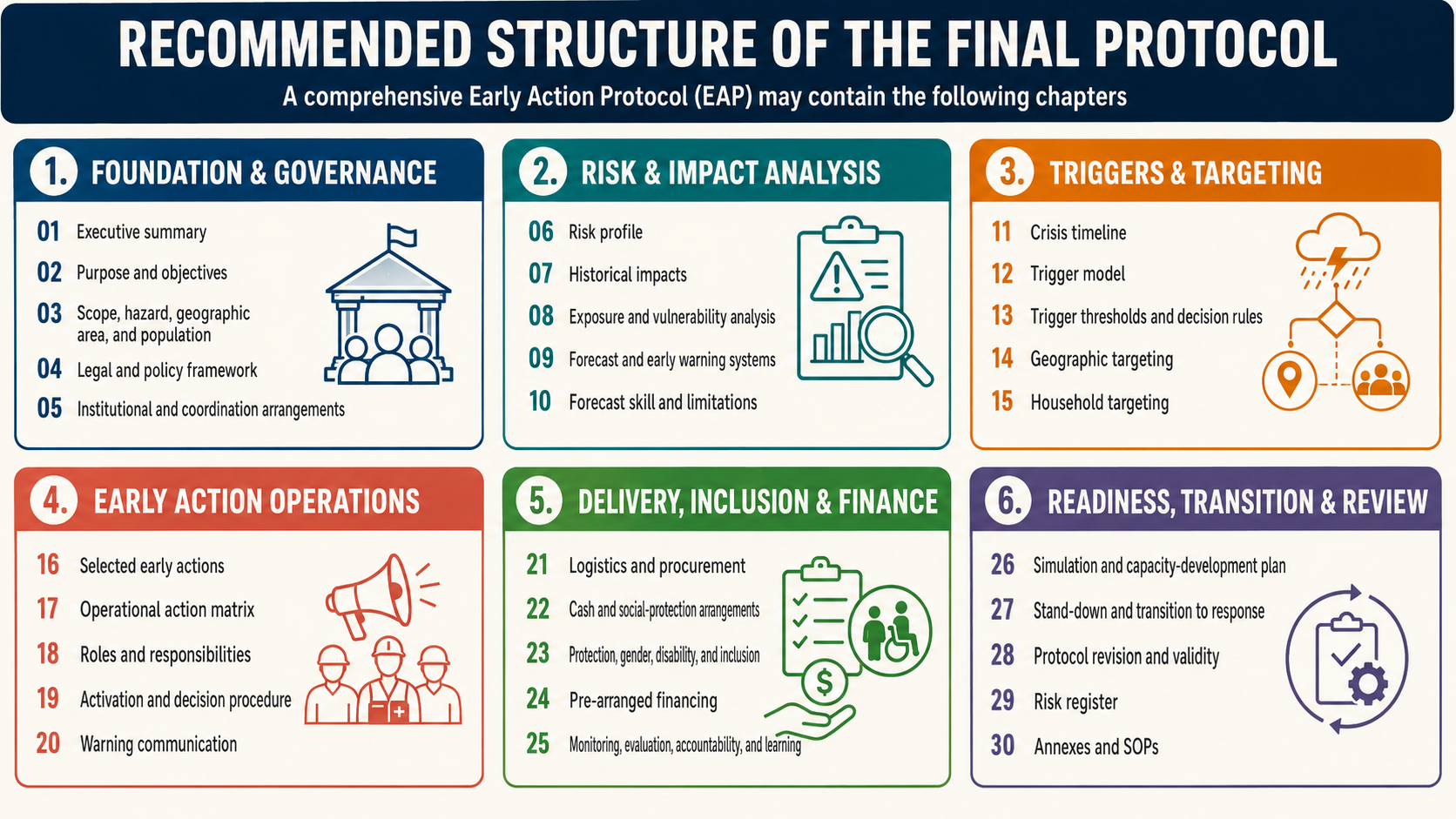
- Recommended Structure of the Final Protocol
A comprehensive EAP may contain the following chapters:
- Executive summary
- Purpose and objectives
- Scope, hazard, geographic area, and population
- Legal and policy framework
- Institutional and coordination arrangements
- Risk profile
- Historical impacts
- Exposure and vulnerability analysis
- Forecast and early warning systems
- Forecast skill and limitations
- Crisis timeline
- Trigger model
- Trigger thresholds and decision rules
- Geographic targeting
- Household targeting
- Selected early actions
- Operational action matrix
- Roles and responsibilities
- Activation and decision procedure
- Warning communication
- Logistics and procurement
- Cash and social-protection arrangements
- Protection, gender, disability, and inclusion
- Pre-arranged financing
- Monitoring, evaluation, accountability, and learning
- Simulation and capacity-development plan
- Stand-down and transition to response
- Protocol revision and validity
- Risk register
- Annexes and SOPs
- Essential Annexes
Recommended annexes include:
- trigger matrix;
- hazard and impact maps;
- historical-event database;
- forecast-product inventory;
- forecast verification results;
- crisis timeline;
- action-selection analysis;
- Who–Where–What matrix;
- RACI matrix;
- contact directory;
- activation flowchart;
- financing flowchart;
- detailed budget;
- procurement plan;
- supplier list;
- stock inventory;
- beneficiary-targeting criteria;
- data-protection protocol;
- communication templates;
- warning messages;
- cash-transfer SOP;
- evacuation SOP;
- monitoring forms;
- complaints and feedback procedure;
- simulation plan;
- activation report template;
- after-action review template; and
- revision history.
- Illustrative Multi-Stage Trigger–Action Matrix
Stage | Forecast or indicator | Decision | Illustrative actions |
Seasonal readiness | Elevated seasonal probability | Initiate readiness | Update lists, train staff, inspect stocks, renew agreements |
Early watch | Hazard development detected | Intensify monitoring | Convene technical group, alert local focal points |
Pre-activation | Probability and impact indicators increasing | Begin preparatory actions | Mobilize staff, verify recipients, move stocks |
Activation | Pre-agreed hazard/impact threshold reached | Release funds and implement | Cash, evacuation, asset protection, public warning |
Impact stage | Hazard occurring | Transition to response | Rescue, relief, rapid assessment, protection services |
Stand-down | Forecast threat reduced or shifted | Suspend or redirect | Inform communities, secure stocks, document costs |
Review | Event or activation completed | Learn and revise | Evaluate trigger, actions, outcomes, and protocol |
- Common Weaknesses to Avoid
32.1 Trigger based only on a national warning category
Official warning categories may be designed for general public safety rather than for a specific anticipatory action. The protocol should determine whether the warning category provides sufficient lead time, geographic precision, and impact relevance.
32.2 Excessive dependence on deterministic forecasts
A single forecast scenario may conceal uncertainty. Ensemble probabilities and multiple observations should be considered where available.
32.3 Action list without operational analysis
Listing “distribute cash,” “evacuate people,” or “protect livestock” is insufficient without specifying recipients, value, quantity, implementing authority, lead time, supplier, delivery mechanism, and financing.
32.4 Actions that cannot be completed in time
Complex procurement, infrastructure construction, or large-scale registration may be unsuitable for short-lead hazards unless completed as readiness activities.
32.5 Unfunded protocol
A protocol without pre-arranged finance remains a preparedness document rather than a functional anticipatory-action mechanism.
32.6 Unclear activation authority
Protocols frequently fail when technical agencies identify the trigger but no institution has explicit authority to declare activation or release funds.
32.7 Static beneficiary lists
Population movement, displacement, births, deaths, poverty changes, and livelihood changes can make old lists inaccurate or exclusionary.
32.8 Failure to plan for false alarms
The protocol should explain how stakeholders will communicate and account for an activation when the predicted impact does not materialize.
32.9 Failure to learn from missed events
A severe event that does not activate the protocol must be investigated as seriously as an unnecessary activation.
32.10 Limited community participation
Actions designed only by national institutions may not address local constraints, livelihood priorities, protection risks, or warning-access barriers.
- Quality-Control Checklist
Before approval, confirm that the EAP can answer yes to the following:
Risk and forecast
- Is the hazard sufficiently predictable?
- Are forecast sources authoritative and accessible?
- Has forecast skill been tested?
- Are uncertainties documented?
- Are historical impacts georeferenced?
- Are exposure and vulnerability included?
Trigger
- Is the trigger objective and measurable?
- Can independent users reproduce the decision?
- Is the threshold linked to expected impacts?
- Is the geographic targeting method clear?
- Does the trigger provide enough usable lead time?
- Are false alarms and misses considered?
- Is there an exceptional activation procedure?
Actions
- Are actions linked to specific anticipated impacts?
- Can they be completed before impact?
- Are they accepted by communities?
- Are responsible organizations capable?
- Are protection and environmental risks managed?
- Are quantities, transfer values, and delivery mechanisms specified?
Finance
- Is funding contractually or administratively pre-arranged?
- Can it be released immediately?
- Are readiness and activation costs covered?
- Are eligible expenditures and reporting rules clear?
- Can the mechanism support repeated activation?
Operations
- Are roles and responsibilities explicit?
- Are SOPs complete?
- Are suppliers and financial providers contracted?
- Are local structures included?
- Are communication systems redundant?
- Has the protocol been simulated?
Accountability and learning
- Are community feedback mechanisms operational?
- Are monitoring indicators defined?
- Is an after-action review mandatory?
- Is there a protocol-revision schedule?
- Are data-protection and safeguarding requirements included?
- Recommended Review Cycle
The EAP should be reviewed:
- before every hazard season;
- after every activation;
- after any false alarm or missed event;
- following major changes in forecast systems;
- following institutional restructuring;
- when financing arrangements change;
- after significant changes in exposure or vulnerability;
- after major infrastructure development;
- following changes in national policy or legislation; and
- at the end of the protocol’s formal validity period.
A version-control register should document:
- date;
- amendment;
- reason;
- evidence;
- approving authority; and
- effective date.
- Conclusion
An effective Early Warning-Based Early Action Protocol is not merely a list of activities to be implemented before a disaster. It is a scientifically grounded, institutionally authorized, operationally tested, socially inclusive, and pre-financed decision system.
Its central operational chain is:
The protocol is successful only when every part of this chain functions within the available lead time. The most technically accurate forecast will not reduce disaster losses unless institutions know what to do, communities understand and trust the warning, resources are immediately available, and protective actions reach the right people and places before impact.
The copyright © 2026 Z M Sajjadul Islam, Advisor, Multi-Hazard Early Warning System Design and Implementation Center (MHEWC – www.mhewc.org ). All rights reserved. Any material quoted, reproduced, adapted, or extracted from this proposal must be properly cited and attributed to the author. Please call at +8801711979179, Email: zmsajjad@gmail.com