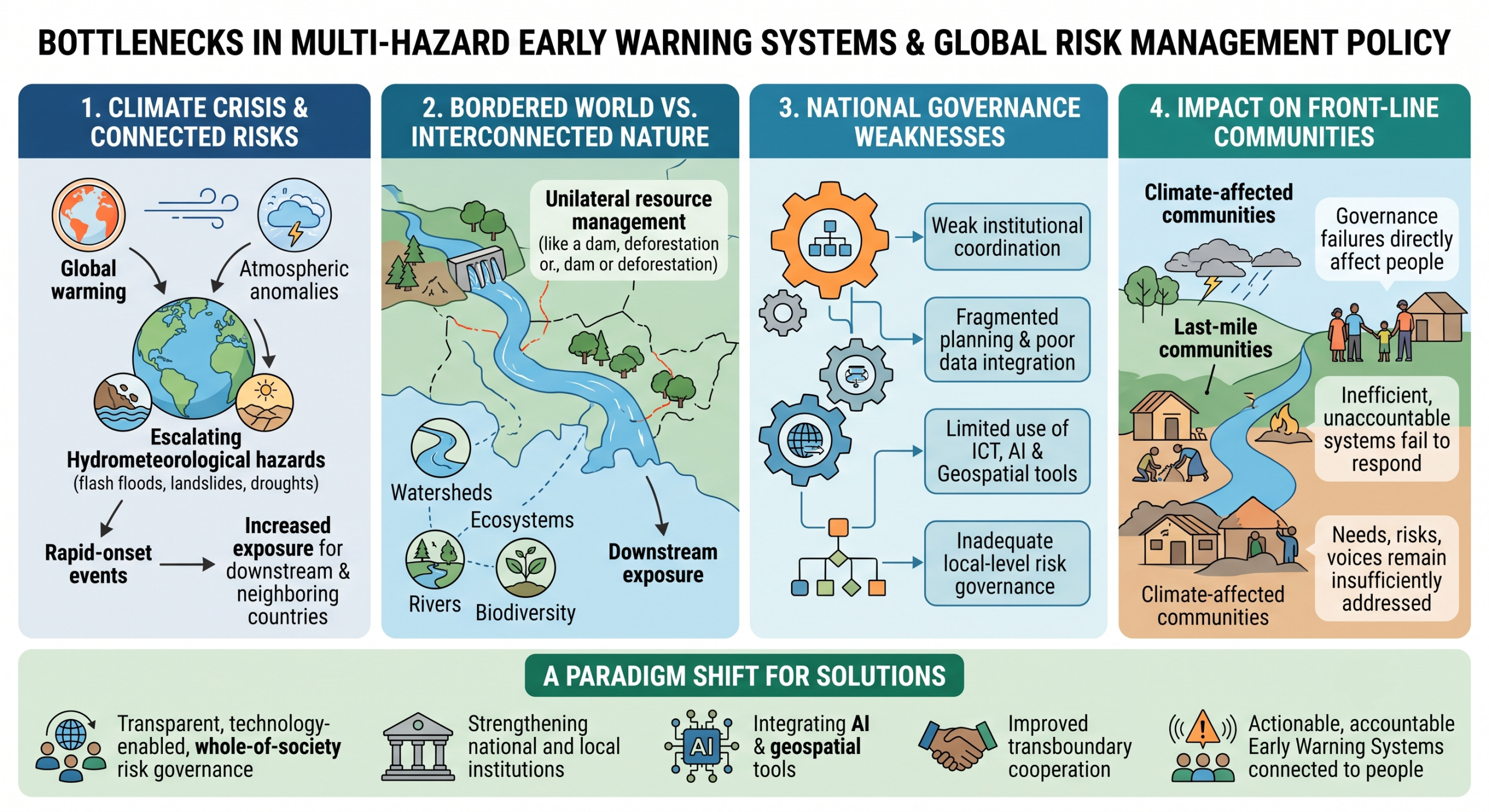
Global Policy and Strategy for Multi-Hazard Risk Management and Governance…
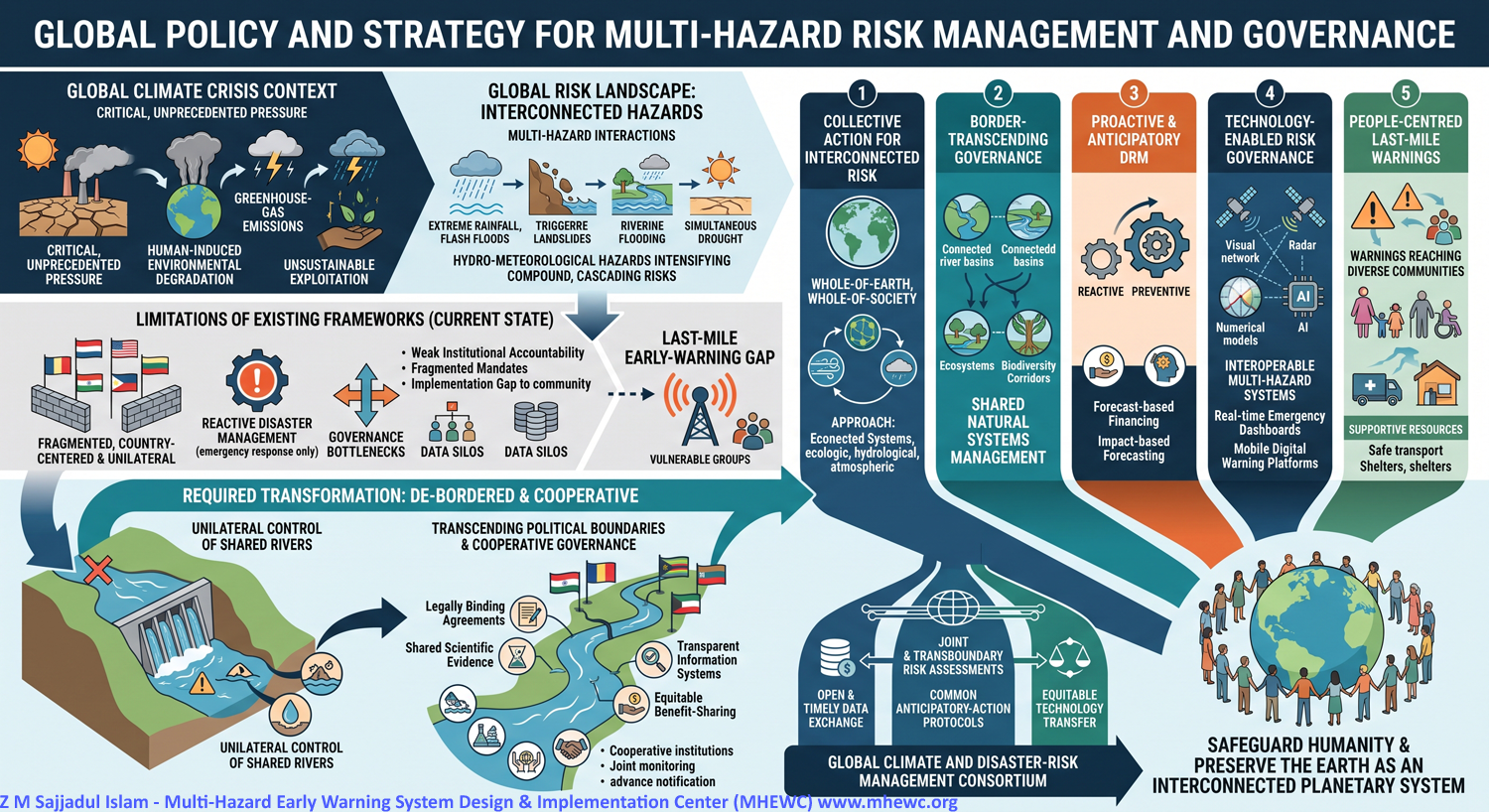
Informed Climate Action: Framework, Approaches and Actionable Strategies
Climate catastrophe is a ticking time bomb, and time is running out.
Barriers to Last-Mile Early Warning Dissemination and Risk Communication in African Countries
Bottlenecks and Challenges in Global Risk Management Frameworks, Cohesive Policies, Integrated Planning, and Ground-Level Action ( Z M Sajjadul Islam, Advisor, MHEWC ) – Copyright Protected
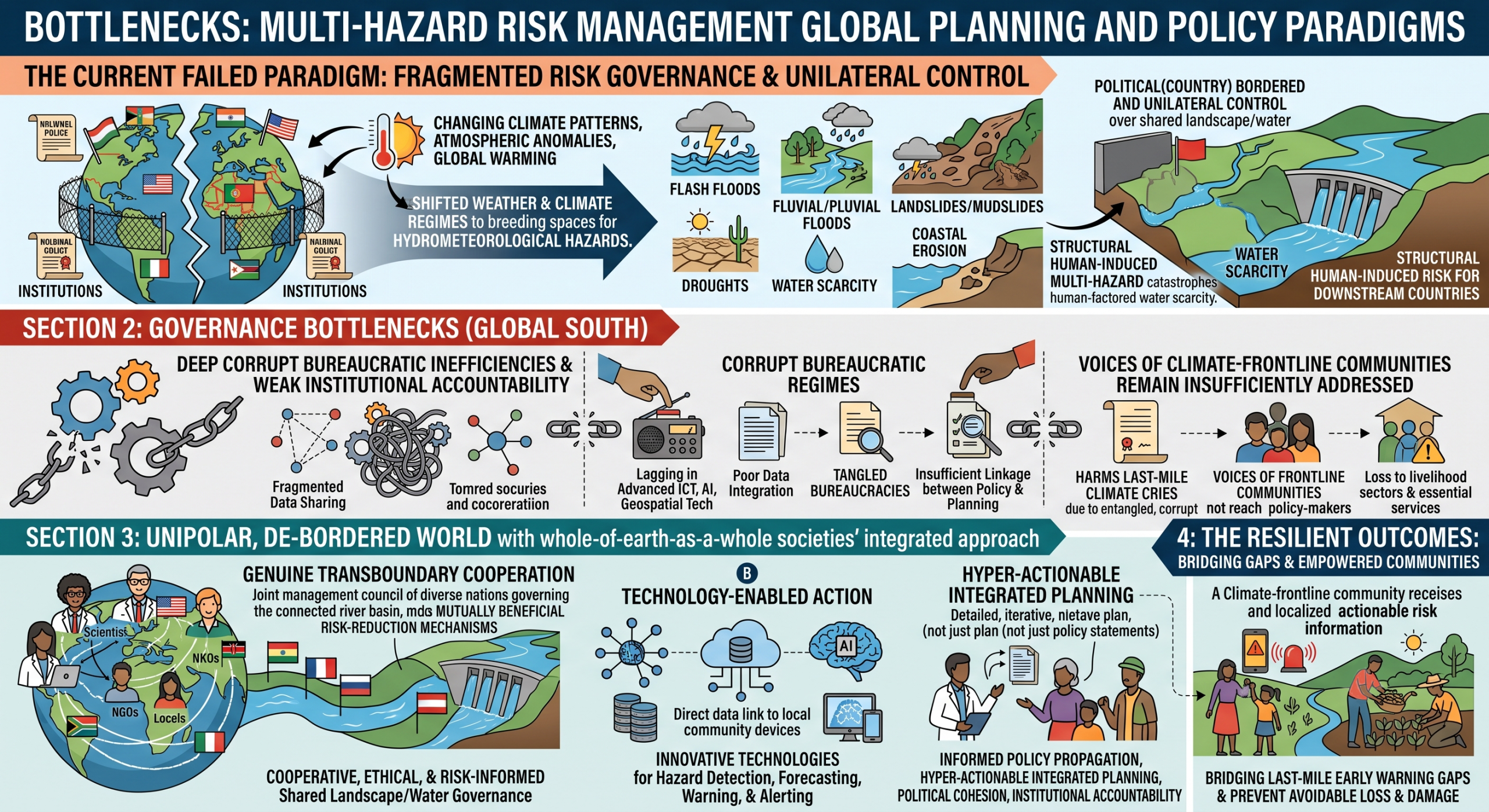
The way the changing climate has contributed to global warming, atmospheric anomalies, and shifts in weather and climate regimes has created hydro-meteorological hazard-breeding spaces, meaning the entire globe is now on the brink of climate catastrophes, and cohesive policy and programmatic actions are now imminent. We should act now for the whole-the-earth-as-a-whole-of-societies framework, approaches, cross-border partnership, and integrated actionable interventions.
Climate catastrophes are now pointing out the clear pathway of a unipolar, de-bordered world with ‘whole-of-earth-as-a-whole societies’ integrated approach to combat the climate catastrophes at an extensive level. We must refrain from exerting political (country-bordered) and unilateral control over common & shared landscape processes; we need to abolish international boundaries(!!) that, through the structural controls of natural resources, surface water bodies/ecosystems, and biodiversity, create potential structural (human-induced) flooding, landslide & drought risks to downstream nations/communities.
The world is mostly terrain, with land-based risks; we need to abolish international boundaries that impose structural controls on natural resources, surface water bodies/ecosystems, biodiversity, and the vulnerabilities associated with hydrometeorological, geomorphological, and geological hazard triggers. The country’s political borders created unilateral control over shared landscape resources, impacting and harming downstream countries. This political border-resource control paradigm now creates human-induced multi-hazard catastrophes beyond immense climate-induced triggers in neighboring and downstream countries, leading to hydrometeorological hazards and disasters at a severe and colossal level (flash flooding & human-induced water scarcity in downstream landscapes).
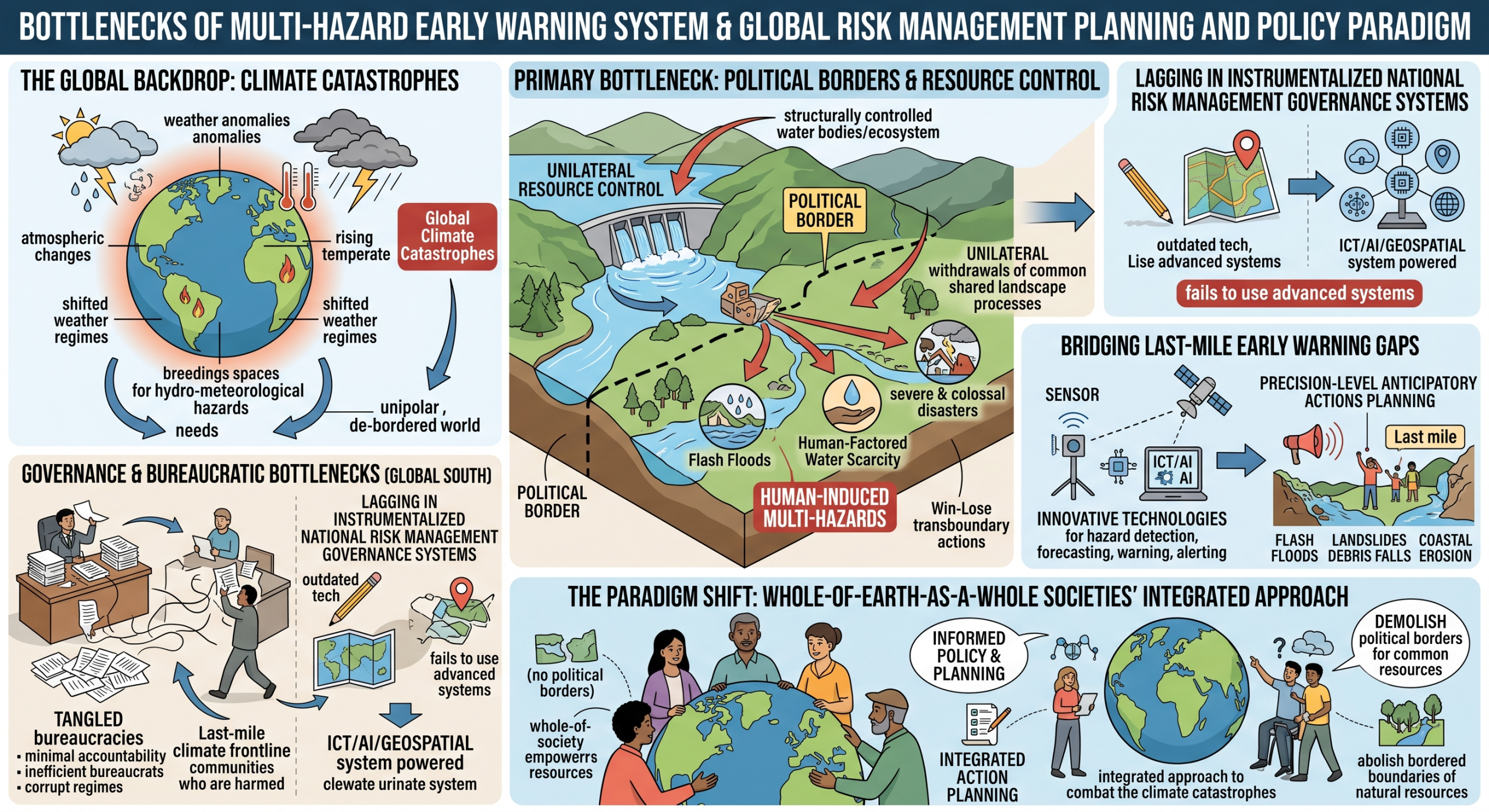
The erratic hydrometeorological hazardous events create rapid-onset hazards, such as flash floods, fluvial and pluvial floods, landslides, mudslides, debris falls, droughts, and coastal erosion. Under no circumstances can transboundary win-win action reduce risks for downstream and neighboring countries.
Tackling the longer-term climate catastrophe at the country level, encompassing policy propagation, informed and hyper-actionable integrated planning process now far beyond the holistic and realistic actions from a holistic environment/empowered whole-of-society, whole-open-ended and politico-broader cohesion and accountability to the last-mile, still counties are far lagging in an instrumentalized national risk management governance system with the latest ICT/AI/Geospatial system powered.
What challenges persist in this serious backdrop? The Global South countries are still suffering from tangled bureaucracies, entrenched traditional risk governance systems, limited fiscal budgetary allocations for efforts on structural risk reduction, and minimal accountability to avert human suffering; it’s hindering a paradigm shift toward robust & technology-driven disaster risk management (DRM) governance mechanisms that ensure transparency and accountability to the last mile and the climate frontline. Unfortunately, the tangled bureaucracies hardly listen to last-mile climate cries, and they can hardly be held accountable for handling the climate crisis at scale in a pro-people, pro-frontline way.
The neighboring countries still need to create a level playing field for establishing technical diplomacy at the expert level beyond the political settlement/negotiation of the persistent transboundary dispute, and technical-institutional linkages amongst the bordering countries to initiate this de facto diplomacy and to resolve the issues at the end-to-end level and institutional level.
Given this critical human-induced and unethical political intention driven by the powerful neighboring countries, who continue to build up water control structures for unilateral withdrawals of transboundary shared water and biodiversity resources, and created tremendous hydrological, geomorphological, geological and landscape risk and vulnerabilities to lower riparian landscape and any given torrential rainfall and huge runoff (with already reserved water) extensively triggered downstream tsunami with colossal and catastrophic flooding events to almost all elements of livelihood sustaining productive sectors as well as means of livelihood as a whole. Therefore, we need to dismantle political borders and prevent countries from controlling shared landscapes and natural resources to mitigate human- and country-induced multi-hazards that cause loss and damage.
Access to atmospheric observation and satellite data, tailored forecasting products and services, regional climate outlook forums, and WMO Regional Climate Centres and data hubs remains insufficient to support countries in developing high-precision forecasting models. These regional mechanisms are not yet consistently providing the reanalysis datasets, weather charts, meteorological-station observations, Essential Climate Variables (ECVs), and other critical parameters required to predict rapidly evolving weather conditions and climate anomalies.
It is therefore imperative to strengthen transboundary neighbor-country-level regional data sharing and forecasting support while investing in innovative technologies for hazard detection, monitoring, forecasting, warning dissemination, alerting, and precision-level anticipatory action planning and implementation. Such measures are essential to close persistent last-mile early-warning gaps and ensure that timely, actionable information reaches exposed institutions and communities.
The most urgent and necessary solution is to establish a “whole-of-Earth, whole-of-society” integrated approach, functioning as a de facto global disaster risk management consortium. This framework should simplify the complexities of intergovernmental collaboration, establish a de-bordered and rules-based mechanism for sharing data, knowledge, technology, finance, and other critical resources, and create a level playing field for transboundary technical cooperation and coordinated action.
It should also promote enabling and responsive bureaucratic processes at the national level, strengthen intergovernmental and interinstitutional coordination, and foster comprehensive, cohesive, and context-sensitive partnerships that are inclusive, equitable, technically credible, and operationally actionable.
Guided by risk-informed policies, integrated planning, “shared intergovernmental accountability, mutual responsibility, and coordinated implementation”, this approach would enable each transboundary government, regional institutions, scientific and technical bodies, development partners, the private sector, civil society, and at-risk communities to act collectively. It would provide a unified platform for addressing interconnected climate and disaster risks, facilitating the unrestricted exchange of critical risk information, accelerating anticipatory and early action, strengthening resilience, and confronting increasingly complex, transboundary, and potentially catastrophic climate impacts.