Mongolia

Multi-hazard Early Warning System Design & Implementation Center (MHEWC): A Global Platform for Multi-Hazard Early Warning Systems (MHEWS)-Supporting the Global South

Created with Sketch.

Climate and Multi-hazard risk and vulnerabilities 

1. Multi-hazard exposure

Mongolia’s disaster-risk profile is distinct because it is dominated by compound climate extremes rather than tropical cyclones or coastal hazards. The country faces severe winters, hot and dry summers, drought, dzud, strong winds, dust storms, wildfires, flash floods, river flooding, and pasture degradation. The World Bank and ADB climate risk profile for Mongolia highlights the country’s exposure to warming, drought, flood risk, rangeland stress, and climate-sensitive livelihoods. (Asian Development Bank)

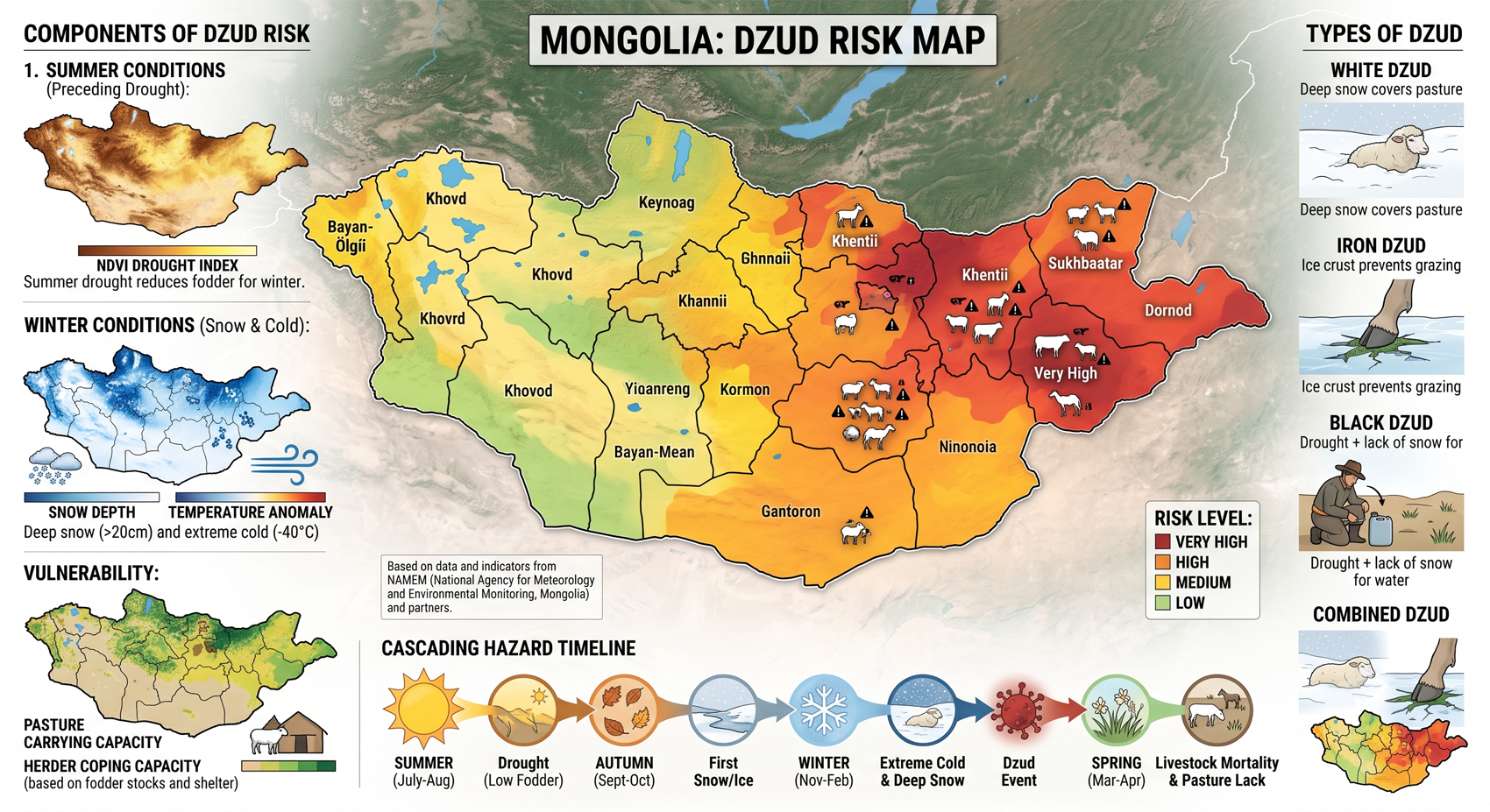
The most distinctive hazard is dzud, a severe winter disaster that often follows summer drought. During a dzud, deep snow, ice crusting, extreme cold, and poor pasture conditions prevent livestock from grazing, leading to mass livestock mortality and severe livelihood losses for herder households. AP reported that the 2024 dzud killed more than 7.1 million livestock, more than one-tenth of Mongolia’s livestock population, severely affecting herders and the national economy. (AP News)

Mongolia is highly vulnerable to climate change and multi-hazard risks due to its landlocked continental climate, extreme seasonal temperature variability, arid and semi-arid ecosystems, dependence on livestock herding, pasture degradation, water scarcity, desertification, rapid urbanization, and exposure to recurrent dzud, droughts, snowstorms, dust storms, floods, wildfires, extreme cold, heatwaves, and land degradation. Mongolia’s National Emergency Management Agency identifies recurring hazards such as dzud, heavy snow and ice cover, strong winds and storms, floods, wildfires, and droughts as risks affecting livelihoods, the economy, and sustainable development. (greensoft.mn)

Mongolia is highly exposed and vulnerable to climate change and multi-hazard risks due to its harsh continental climate, arid and semi-arid ecosystems, dependence on livestock herding, degraded pasturelands, water scarcity, rural remoteness, and growing urban pressures. The country faces recurrent risks from dzud, droughts, extreme cold, heavy snowfall, snowstorms, dust storms, floods, flash floods, wildfires, heatwaves, desertification, pasture degradation, and livestock disease. Climate change is intensifying these vulnerabilities through rising temperatures, more frequent droughts, harsher winter disasters, reduced pasture productivity, water stress, land degradation, and growing risks to herder livelihoods, food security, public health, infrastructure, ecosystems, and rural resilience. Strengthening multi-hazard early warning systems, dzud and drought forecasting, impact-based forecasting, rangeland restoration, climate-resilient livestock systems, water security, disaster risk financing, livestock insurance, shock-responsive social protection, and locally led adaptation is essential to reduce losses and protect Mongolia’s development gains.
2. Climate change as a risk multiplier

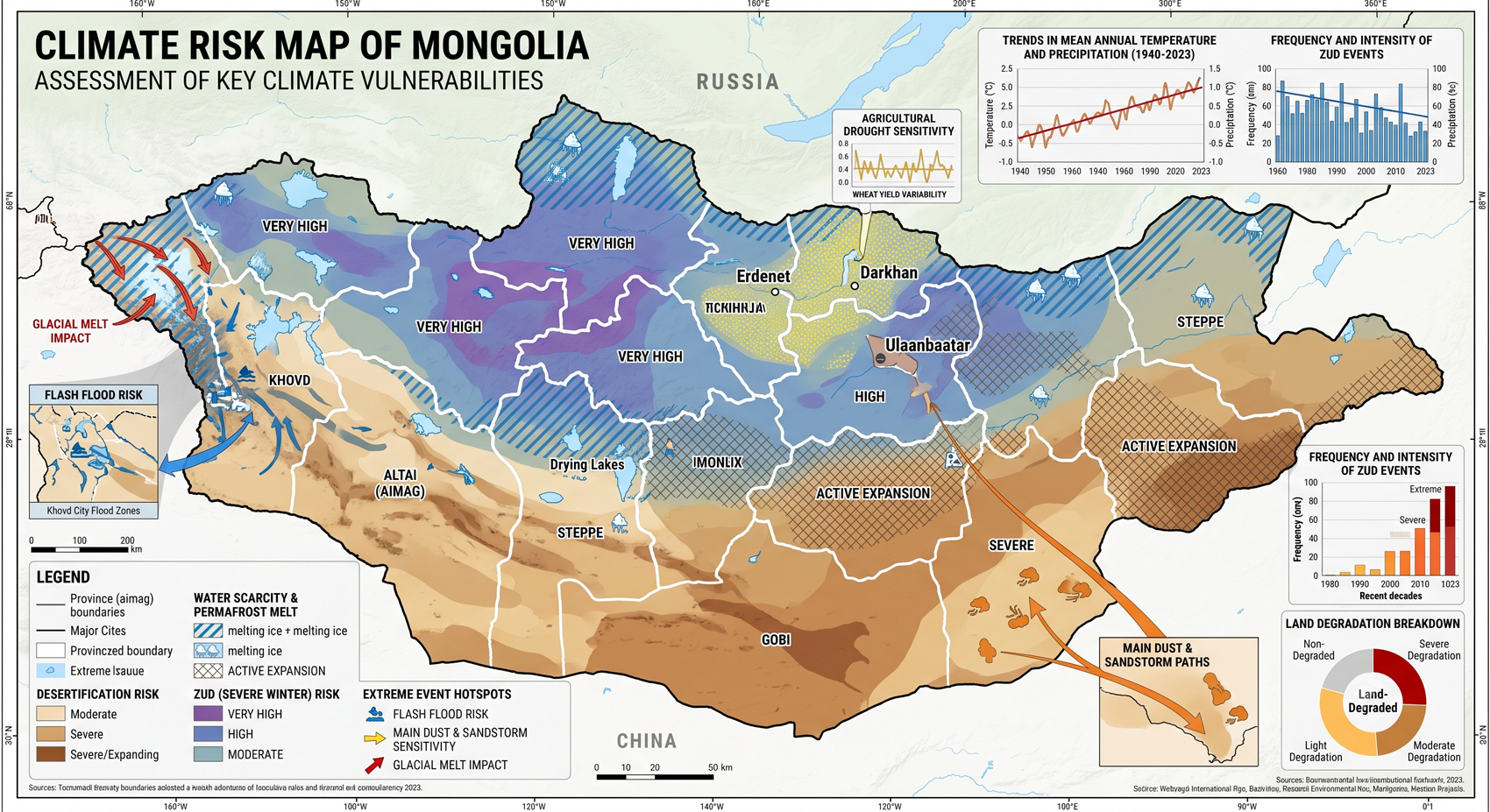
Climate change is intensifying Mongolia’s already harsh natural conditions. Rising temperatures, longer and more frequent droughts, reduced soil moisture, variable precipitation, degraded pasture, and heavier winter snow events increase the likelihood of compound disasters such as drought followed by dzud. Mongolia’s 2025 National Adaptation Plan focuses on strengthening resilience against climate change, weather-related disasters, and associated vulnerability. (UNFCCC)

Climate change also increases the risk of desertification and land degradation. UNDP reports that around 77% of Mongolia’s land is classified as degraded, driven by overgrazing, climate change, and unsustainable pasture practices. This degradation directly threatens herders, livestock productivity, biodiversity, and rural livelihoods. (UNDP)

3. Dzud, drought, and herder livelihood vulnerability

The most critical vulnerability in Mongolia is the dependence of rural households on pastoral livestock systems. Herders are exposed to drought, pasture decline, livestock disease, water scarcity, harsh winters, and market shocks. When drought reduces summer pasture and hay availability, animals enter winter undernourished; if heavy snow and ice follow, dzud mortality rises sharply.

UNDP’s rural resilience work in Mongolia focuses on climate-vulnerable herder communities in provinces such as Khovd, Zavkhan, Dornod, and Sukhbaatar, covering steppe, desert steppe, mountain, mountain steppe, and forest steppe zones. (Adaptation UNDP) These areas illustrate how climate exposure varies across Mongolia’s ecological zones but consistently threatens livestock-based livelihoods.
4. Water scarcity and desertification vulnerability

Water security is a major climate-risk issue for Mongolia, particularly in the Gobi, steppe, and dryland regions. Water demand is increasing due to urbanization, mining, agriculture, livestock production, and economic development, while climate change and groundwater depletion are increasing pressure on available resources. OECD notes that Mongolia faces growing water-resource pressure because of rising demand, climate change, and groundwater depletion. (OECD)

Desertification and pasture degradation increase exposure to dust storms, reduced forage availability, livestock stress, biodiversity loss, and rural poverty. These risks are especially serious for herder households with limited alternative income sources and weak access to water, fodder, veterinary services, insurance, and markets.

5. Flood, wildfire, and urban vulnerability

Although Mongolia is often associated with drought and dzud, it also faces flood and wildfire risks. Intense rainfall can trigger flash floods, especially in dry catchments, urban drainage systems, and settlements located near river channels or low-lying areas. Floods can damage roads, bridges, housing, schools, health facilities, water systems, and urban infrastructure.

Wildfire risk is also significant, particularly during dry and windy periods. Grassland and forest fires can damage pasture, forests, settlements, livestock shelters, and rural livelihoods. Strong winds and dust storms can disrupt transport, damage infrastructure, reduce air quality, and create health risks.

Ulaanbaatar and other urban areas face a different risk profile, including flash flooding, heat stress, air pollution, infrastructure congestion, and informal settlement vulnerability. Migration from rural areas after livestock losses can increase pressure on urban housing, services, employment, water, sanitation, and health systems.

6. Sector-specific vulnerability summary

SectorMain climate and multi-hazard risks
Livestock and herdingDzud, drought, pasture degradation, water scarcity, livestock disease, fodder shortage
Pasture and rangelandsDesertification, overgrazing, soil erosion, reduced vegetation cover, biodiversity loss
Water resourcesGroundwater depletion, drought, rising demand, declining recharge, mining and urban water stress
AgricultureDrought, frost, short growing seasons, rainfall variability, crop failure, soil moisture decline
Urban settlementsFlash floods, heat stress, air pollution, infrastructure pressure, rural-to-urban migration
Transport infrastructureSnowstorms, floods, dust storms, road disruption, isolation of remote communities
HealthExtreme cold, heat stress, air pollution, dust exposure, livestock-related disease risks
Public finance and economyLivestock losses, emergency relief costs, rural poverty, insurance and recovery financing needs

7. Social vulnerability

The most vulnerable groups include herder households, small livestock owners, women-headed households, children, older persons, people with disabilities, remote rural communities, poor urban households, informal ger-area residents, and households dependent on climate-sensitive livestock and natural resources.

Vulnerability is highest where climate exposure overlaps with poor access to water, fodder, veterinary services, roads, early warning, insurance, savings, social protection, and alternative income sources. Dzud can rapidly push herder households into debt, asset loss, migration, and poverty, particularly when livestock mortality is high and recovery takes several years.

8. Priority resilience needs

Mongolia’s resilience agenda should prioritize multi-hazard early warning systems, dzud risk forecasting, drought monitoring, impact-based forecasting, pasture-risk mapping, climate-resilient livestock systems, fodder reserves, water security, rangeland restoration, livestock insurance, wildfire preparedness, flood-risk management, shock-responsive social protection, disaster risk financing, and locally led adaptation.

A practical resilience package for Mongolia should include:

Priority areaKey actions
Early warning and anticipatory actionDzud, drought, snowstorm, flood, wildfire, dust storm, and heat-risk warnings with last-mile communication
Dzud risk reductionSeasonal risk forecasting, fodder and hay reserves, livestock shelters, veterinary support, emergency cash assistance
Pasture and rangeland resilienceRotational grazing, pasture-user groups, rangeland restoration, carrying-capacity management
Water securityGroundwater monitoring, protected wells, water harvesting, drought contingency planning, efficient water use
Livelihood diversificationSupport for alternative income, value-chain development, insurance, savings groups, market access
Urban resilienceFlood drainage, heat-risk planning, ger-area upgrading, air-quality improvement, resilient basic services
Disaster risk financingIndex-based livestock insurance, contingency funds, forecast-based financing, scalable social protection
Climate-risk governanceUnified climate-disaster databases, risk-informed planning, local capacity building, community preparedness


Mongolia: Detailed Climate, Multi-Hazard Disaster-Risk and Vulnerability Profile


Detailed Mongolia Climate, Multi-Hazard Disaster Risk and Vulnerability Profile

1. Executive risk overview

Mongolia is a vast, landlocked and highly elevated country characterized by an extreme continental climate, low and highly variable precipitation, extensive grasslands, mountain systems, forest-steppe ecosystems and the arid Gobi region. Its climate ranges from long, intensely cold winters to short, hot summers, with annual mean temperatures varying from approximately −10°C to +6°C. Annual precipitation ranges from below 50 millimetres in parts of the southern Altai and Gobi to more than 400 millimetres in high mountains, with about 85% falling during the warmer months.

Mongolia’s disaster risk is shaped by the interaction of:

  • rapid warming and increasing climatic variability;
  • drought–dzud compound events;
  • pasture degradation and high livestock pressure;
  • water scarcity and dependence on groundwater;
  • urban concentration in Ulaanbaatar;
  • poverty and limited livelihood diversification among pastoral households;
  • ageing or insufficient flood, drainage, observation and emergency-management infrastructure;
  • earthquake exposure in expanding urban centres;
  • environmental degradation associated with mining, settlement expansion and unsustainable land use.

The country is exposed to droughts, dzuds, floods, flash floods, extreme cold, heavy snowfall, blizzards, heatwaves, severe winds, dust and sandstorms, forest and steppe fires, earthquakes, landslides, rockfalls, permafrost degradation, glacier retreat, livestock disease, water pollution and technological hazards. ADB describes Mongolia as one of the world’s more disaster-prone countries and estimates that around 90% of its territory faces high or moderate dzud risk.

The most damaging risk pathway is often a compound sequence:

Dry summer and pasture failure → inadequate hay and fodder → weakened livestock → heavy snow or freezing rain → inaccessible pasture → mass livestock mortality → household debt and food insecurity → distress migration to urban ger areas → greater exposure to flood, air pollution, unemployment and inadequate services.

The 2023–2024 dzud demonstrated the scale of this systemic risk. By July 2024, approximately 8.1 million livestock had died—about 12.5% of the national herd—and nearly 5,000 herder households had reportedly lost all their livestock.

2. Climate characteristics

2.1 Extreme continental climate

Mongolia’s climate is controlled by its inland location, high elevation, distance from oceans and seasonal influence of the Siberian High. This produces:

Climatic characteristicRisk implication
Long, cold and dry wintersExtreme cold, snowstorms, frozen infrastructure and dzud
Short, warm-to-hot summersHeat stress, high evaporation, wildfire and drought
Low annual precipitationChronic water scarcity and fragile pasture productivity
High rainfall variabilityUncertain crop production and pastoral carrying capacity
Strong windsDust storms, soil erosion, wildfire spread and transport disruption
Large daily and seasonal temperature rangesStress on people, livestock, roads, buildings and utility systems
Concentrated summer rainfallFlash flooding, erosion and urban drainage overload
Extensive snow and seasonal freezingSpring melt floods and ice-related infrastructure damage

The mountain and northern forest-steppe zones are relatively wetter, whereas the southern and southeastern regions are extremely dry. Surface-water networks are denser in northern and western mountain regions, while much of the south, centre and southeast has limited permanent surface water.

2.2 Observed climate change

Mongolia is warming substantially faster than the global average. National climate reporting indicates that annual mean temperature increased by approximately 2.46°C between 1940 and 2022. Warming has been particularly strong in winter, at around 3.2°C, compared with approximately 1.6°C during summer. Ulaanbaatar, Khuvsgul and Sukhbaatar have recorded warming approaching 3.4°C.

Although national annual precipitation has shown a slight overall increase, the distribution and effectiveness of precipitation are changing:

  • dry periods are becoming longer;
  • central Mongolia has experienced a 10–30% declining precipitation trend;
  • cold-season precipitation increased by about 19% between 1940 and 2022;
  • warm-season precipitation has shown little increase or a slight decline;
  • light, persistent rainfall is becoming less frequent;
  • heavy rainfall events are becoming relatively more important.

Climate- and weather-related disasters have reportedly doubled in frequency and magnitude over the last two decades.

2.3 Future climate projections

Mongolia’s 2025 NDC 3.0, drawing on CMIP6 and IPCC Sixth Assessment findings, projects additional national warming of:

PeriodProjected additional warming
Around 20300.7–1.4°C
Around 20501.1–2.9°C
Around 20801.2–6.5°C

Winter precipitation could increase by approximately 9–55% by 2080, potentially producing deeper snowpacks and more severe snow-related dzud conditions. Summer rainfall totals may remain relatively stable nationally, but longer consecutive dry periods, higher temperatures and greater evapotranspiration are expected to intensify agricultural drought, water stress and land degradation. Heatwaves are projected to become longer, while cold days decline; this does not eliminate winter disaster risk because snowfall, ice crust formation, abrupt weather changes and livestock exposure remain critical.

By 2050, drought frequency is projected to increase by approximately 5–45%, while dzud frequency may increase by around 5–40%, depending on location and climate scenario.

3. Principal multi-hazard risk profile

The risk levels below are a qualitative national synthesis. Actual risk varies considerably by aimag, soum, season, livelihood system and infrastructure condition.

HazardNational riskPrincipal exposure and consequences
Drought and aridificationVery highPasture failure, livestock stress, crop losses, water shortages, wildfire and dust
Dzud and extreme winterVery highLivestock mortality, livelihood collapse, food insecurity, debt and migration
River and flash floodingHighUlaanbaatar, aimag centres, river valleys, roads, bridges and informal settlements
Severe wind, blizzard and dust stormHighHerders, transport, livestock, power systems, soil and public health
Forest and steppe fireHighNorthern forests, eastern steppe, settlements, pasture and biodiversity
Water scarcityVery high and increasingSouthern Gobi, Ulaanbaatar, mining zones, livestock and irrigation
Land degradation and desertificationVery highNational pasture economy, ecosystems, rural livelihoods and dust generation
HeatwaveModerate–high and increasingOutdoor workers, livestock, crops, urban populations and water demand
EarthquakeHigh-impact, lower-frequencyUlaanbaatar and other urban centres, buildings, lifelines and industry
Glacier and permafrost degradationHigh in affected regionsWestern and northern mountains, water systems, slope stability and infrastructure
Landslide, rockfall and debris flowLocalized–moderateMountain corridors, settlements, roads and river valleys
Livestock disease and zoonotic hazardsHigh systemic relevancePastoral households, food systems, trade and public health
Industrial, mining and pollution hazardsLocalized but potentially severeWater bodies, mining settlements, workers, tailings and downstream communities

4. Drought, aridification and heat stress

Drought is one of Mongolia’s most consequential hazards because the national livestock economy depends heavily on natural pasture productivity. Drought reduces pasture biomass, limits drinking water, lowers livestock body condition and restricts hay and fodder preparation before winter. A drought that may appear manageable during summer can therefore become catastrophic when followed by heavy snow, ice crust or extreme winter cold.

Approximately 43.4% of Mongolia is classified as arid and 45.5% as semi-arid. By 2030, arid and semi-arid zones are projected to expand, while humid and moderately humid zones contract.

Major drought drivers include:

  • declining or poorly distributed warm-season precipitation;
  • higher evapotranspiration;
  • extreme heat and strong winds;
  • excessive grazing pressure near settlements and water points;
  • insufficient rotational or reserve pasture;
  • declining surface-water availability;
  • groundwater abstraction;
  • soil erosion and vegetation degradation.

Drought risk is particularly serious in the Gobi, desert-steppe, central steppe and eastern grasslands. However, drought can also affect northern agricultural areas when spring and summer rainfall is delayed.

Heatwaves compound drought impacts by increasing livestock water requirements, suppressing plant growth, reducing labour productivity and increasing fire danger. Outdoor workers in construction, agriculture, transport and road maintenance are increasingly exposed to heat, severe storms and rapid weather transitions.

5. Dzud and extreme-winter disaster risk

5.1 Nature of dzud

Dzud is not merely a cold-weather event. It is a compound pastoral disaster in which livestock cannot obtain sufficient feed and water because of drought, snow depth, ice crust, extreme cold or combinations of these conditions.

Major dzud forms include:

Dzud typeCharacteristics
White dzudDeep snow prevents livestock from reaching pasture
Iron or ice dzudRain, thaw and refreezing create an impenetrable ice layer
Black dzudInsufficient snow and water availability during winter
Cold dzudProlonged extreme temperatures and wind chill
Combined dzudDrought followed by snow, ice, wind and severe cold
Hoof dzudExcessive livestock concentration destroys or exhausts accessible pasture

The consequences extend far beyond livestock mortality. Dzud can cause household asset depletion, indebtedness, school interruption, malnutrition, mental stress, increased unpaid care burdens, loss of breeding stock, animal disease, market disruption and rural-to-urban migration. UNDRR recognizes that dzud can generate unemployment, poverty and migration, placing additional pressure on urban infrastructure and social services.

5.2 Recent severity

The 2023–2024 event followed dry summer conditions and unusually heavy snowfall. Livestock mortality rose from hundreds of thousands in February 2024 to approximately 8.1 million by July. Many households lost most or all of their livestock, undermining their income, food supply, savings and capacity to recover before the next winter.

5.3 Structural dzud vulnerabilities

Dzud risk is intensified by:

  • large livestock populations relative to pasture carrying capacity;
  • inadequate household fodder reserves;
  • limited access to winter shelters and protected camps;
  • concentration around wells and settlements;
  • insufficient livestock insurance or delayed payouts;
  • lack of affordable credit restructuring following losses;
  • incomplete integration of weather, snow, pasture, livestock-body-condition and market information;
  • poor road access to remote households;
  • weak veterinary and carcass-disposal capacity during mass mortality;
  • limited livelihood alternatives for small herders.

6. Flood and flash-flood risk

Mongolia experiences three main flood processes:

  1. Spring snow- and ice-melt flooding;
  2. Summer river flooding caused by prolonged or intense rainfall;
  3. Localized flash flooding generated by short-duration heavy rain over steep, dry or urbanized catchments.

Floods cause average annual losses estimated at approximately US$24 million. Peak rainfall, snowmelt and changing glacier conditions may further intensify summer flood hazards.

Ulaanbaatar

Ulaanbaatar represents Mongolia’s largest concentration of people, buildings, roads, utilities and economic activity. Flood risk has grown because of:

  • settlement in floodplains, ravines and drainage corridors;
  • rapid expansion of ger districts;
  • inadequate stormwater drainage;
  • obstruction or encroachment of natural channels;
  • erosion and sediment accumulation;
  • insufficient maintenance of flood embankments;
  • high exposure of roads, bridges, substations and heating systems;
  • limited household-level preparedness.

Historical records show that flood occurrence around Ulaanbaatar increased considerably after 2000, while the city’s population and built-up area expanded dramatically beyond the conditions for which older flood-protection infrastructure was designed.

Floodwater also mobilizes solid waste, sewage, mining pollutants and contaminated sediments, creating secondary public-health and water-quality risks. Monitoring has identified pollution concerns in the Tuul, Orkhon, Kherlen and mining-affected river systems, particularly following floods.

7. Severe storms, blizzards, dust storms and strong winds

Mongolia’s steppe and desert-steppe regions are naturally windy, with average annual wind speeds commonly around 4–6 metres per second. Severe wind events can develop rapidly and affect enormous areas.

Major consequences include:

  • loss of visibility and vehicle accidents;
  • road, rail and aviation disruption;
  • exposure and death of herders and livestock;
  • roof and power-line damage;
  • accelerated topsoil erosion;
  • displacement of sand and dust;
  • rapid wildfire propagation;
  • interruption of emergency access and supply chains.

Dust storms are driven by drought, strong winds, sparse vegetation, soil disturbance, overgrazing and desertification. Dust affects respiratory and cardiovascular health, damages crops, reduces visibility and can cross international borders into China, the Korean Peninsula and the wider East Asian region.

Blizzards and spring snowstorms are especially dangerous because herders may be moving livestock, newborn animals are vulnerable and roads to remote communities can become impassable within hours.

8. Forest and steppe fires

Wildfires occur in both northern forest zones and extensive grassland regions. Fire danger rises during dry, windy spring and autumn periods, particularly where snow has melted but new vegetation has not fully emerged.

Key fire-risk areas include:

  • Khentii and eastern forest-steppe;
  • Selenge and Bulgan;
  • Khuvsgul;
  • Dornod and Sukhbaatar grasslands;
  • protected areas and border regions;
  • pasture and forest zones near settlements and transport corridors.

Climate change, drying, harmful insects and vegetation stress are increasing forest vulnerability. Mongolia’s NDC reports that the combined impact of forest fires and harmful insects could increase two- to ninefold relative to baseline levels during this century.

Fire risk is intensified by limited access to remote areas, delayed detection, strong winds, insufficient water sources, inadequate specialized equipment and the need to coordinate local volunteers, NEMA, forest authorities, border services and neighbouring countries.

9. Water scarcity and hydrological vulnerability

Water scarcity is one of Mongolia’s most important slow-onset and systemic risks. Water is unevenly distributed: more than 78% of water sources are located in the northern and western regions, whereas southern Mongolia has much lower rainfall and fewer permanent surface-water systems. Despite groundwater constituting a small share of total national water resources, approximately 70–90% of water consumption is estimated to depend on groundwater.

Water demand may exceed available supply by 2040 or earlier. High-risk areas include:

  • Ulaanbaatar;
  • the Southern Gobi mining and industrial region;
  • rapidly developing aimag and soum centres;
  • livestock-concentration areas;
  • irrigated agricultural zones;
  • planned industrial, energy and urban-development corridors.

Approximately 40% of Mongolia’s economy relies on water-intensive activities such as mining, agriculture and manufacturing. Growing demand, aquifer depletion, pollution and climate change therefore create macroeconomic as well as humanitarian risks.

Between 2007 and 2017, national reporting indicates that approximately 16% of rivers, 21.8% of springs and 28% of lakes and ponds dried up or disappeared. River flow has also declined over recent decades, although trends vary by basin and year.

Competition between mining companies, herders, urban users, ecosystems and agricultural producers is likely to intensify, particularly in the Gobi.

10. Land degradation, desertification and pasture vulnerability

Pastureland is the foundation of Mongolia’s pastoral economy, but degradation is widespread. A national pasture assessment cited in Mongolia’s NDC found that nearly 70% of pastureland had experienced changes in plant composition relative to reference conditions. Approximately 22.4% of monitored areas were moderately degraded, 17.9% severely degraded and 11% extremely degraded.

Drivers include:

  • high livestock numbers and grazing concentration;
  • reduced herd mobility;
  • abandonment or obstruction of traditional migration routes;
  • degradation around water points and settlements;
  • drought and heat;
  • mining and infrastructure development;
  • vehicle tracks and soil disturbance;
  • weak enforcement of pasture carrying capacity;
  • insufficient coordination among neighbouring soums.

Pasture degradation lowers forage quality, increases bare ground, promotes wind erosion and dust storms, reduces soil moisture retention and increases vulnerability to both drought and flash flooding.

Crop-producing areas also face soil erosion. Approximately 926,400 hectares of agricultural land have reportedly been affected by different degrees of erosion, with more than half showing severe erosion conditions.

11. Glacier retreat, permafrost thaw and ecosystem change

Mongolia’s western mountains contain glaciers and permanent snowfields, while permafrost is widespread in northern and high-elevation areas. National assessments indicate that glacier area declined by approximately 37% over the last seven decades. Permafrost area has declined by approximately one-third over the last 50 years.

Consequences include:

  • altered seasonal river flow;
  • short-term increases followed by long-term declines in meltwater;
  • loss of water-storage functions;
  • slope instability, rockfall and erosion;
  • damage to roads, buildings and pipelines founded on thaw-sensitive ground;
  • wetland and lake changes;
  • stress on cold-adapted ecosystems;
  • increased fire susceptibility in drying forests.

Western aimags such as Bayan-Ölgii, Khovd and Uvs are particularly sensitive to glacier and high-mountain hydrological change. Khuvsgul and other northern permafrost regions face risks to ecosystems, transport corridors and settlement infrastructure.

12. Earthquake risk

Although climate-related disasters occur more frequently, earthquakes represent a potentially catastrophic, low-frequency risk. Mongolia contains several active fault systems, while Ulaanbaatar has experienced rapid urban expansion and increasing concentration of critical infrastructure.

ADB disaster-risk-financing analysis estimates direct earthquake losses of approximately US$717 million for a 50-year return-period event and around US$2.8 billion for a 500-year return-period event.

Major vulnerabilities include:

  • older apartment blocks and public buildings;
  • variable compliance with seismic design standards;
  • informal and ger-area construction;
  • dependence on centralized heating and power networks;
  • limited redundancy in bridges, hospitals and emergency facilities;
  • winter conditions that could make post-earthquake evacuation and sheltering extremely difficult;
  • potential fire, chemical-release and utility-failure cascades.

Earthquake preparedness must therefore be integrated with winter contingency planning, urban search and rescue, emergency shelter, hospital continuity and lifeline-restoration arrangements.

13. Regional risk hotspots

The following is a regional synthesis based on Mongolia’s climate gradients, settlement patterns and sectoral exposure.

RegionDominant hazards and vulnerabilities
Ulaanbaatar and surrounding Töv regionRiver and flash flooding, earthquake, air pollution, water shortage, heat, drainage failure, ger-area vulnerability and critical-infrastructure concentration
Northern forest-steppe: Khuvsgul, Selenge, Bulgan and northern KhentiiForest fire, flood, heavy snow, dzud, permafrost thaw, forest pests, river pollution and infrastructure instability
Central Khangai: Arkhangai, Övörkhangai, Bayankhongor and ZavkhanDrought–dzud cycles, pasture degradation, severe winter, flash flood, livestock mortality and remote-access constraints
Western Altai and Great Lakes region: Bayan-Ölgii, Khovd and UvsGlacier retreat, permafrost change, severe cold, snowstorms, flash floods, rockfall, lake and wetland change
Eastern steppe: Dornod, Sukhbaatar and eastern KhentiiDrought, steppe fire, high winds, dust storms, pasture degradation and livestock exposure
Southern Gobi: Ömnögovi, Dornogovi, Dundgovi and GovisümberExtreme water scarcity, heat, drought, dust storms, flash floods, groundwater depletion and mining–community water competition
Northern agricultural beltVariable rainfall, crop drought, frost, hail, soil erosion, flood and wildfire
Remote soums nationallyWeak road access, limited observation coverage, delayed emergency response, shortages of technical personnel and last-mile warning constraints

14. Sectoral vulnerabilities

14.1 Livestock and pastoral livelihoods

Livestock production is the sector most directly exposed to climate variability. Small and medium herders have limited financial reserves, are often indebted and may lack transport, winter shelters, reserve pasture and sufficient feed.

Repeated dzuds can produce a downward poverty cycle:

Livestock loss → reduced income and food → borrowing or distress sale → smaller breeding herd → reduced ability to prepare fodder → greater vulnerability to the next shock.

Approximately 30% of pastoralists are reported to live in poverty, making them highly susceptible to livestock and pasture losses.

14.2 Crop agriculture

Crop farming is concentrated mainly in northern and central areas. Vulnerabilities include:

  • short growing seasons;
  • late and early frost;
  • rainfall variability;
  • drought and heat;
  • hail and intense rainfall;
  • wind erosion;
  • declining soil fertility;
  • limited irrigation water;
  • pest and disease changes.

A longer growing season may create localized opportunities, but these benefits are likely to be outweighed by drought, water stress and extreme-event damage.

14.3 Urban settlements

Urban risk is concentrated in Ulaanbaatar but is growing in aimag centres. Vulnerability is intensified by settlement in hazard-prone locations, limited drainage, inadequate infrastructure, poverty, air pollution and dependence on centralized energy and heating.

Rural households displaced by dzud frequently move to peri-urban ger areas, transferring climate risk from the steppe into an urban context where they may face insecure employment, inadequate water and sanitation, flood exposure and severe winter air pollution.

14.4 Health and nutrition

Climate-sensitive health risks include:

  • respiratory and cardiovascular illness;
  • heat stress;
  • cold injury and frostbite;
  • smoke and dust exposure;
  • contaminated drinking water after floods;
  • food insecurity following livestock loss;
  • zoonotic and vector-borne diseases;
  • mental-health impacts after livelihood collapse.

Children, pregnant women, older people, persons with disabilities and low-income ger-area residents face disproportionate risks. UNICEF identifies flooding, dzud, drought, glacier melt and rising temperatures as interconnected threats to children’s education, health and nutrition.

14.5 Education

Dzud and severe storms can:

  • isolate rural schools and dormitories;
  • prevent children from travelling;
  • require children to assist with livestock survival;
  • reduce household capacity to pay education costs;
  • disrupt school heating, food and water supplies;
  • contribute to permanent migration and school transfer.

Flooding and air pollution also interrupt urban education and affect attendance and learning.

14.6 Mining, industry and energy

Mining is economically important but highly water-dependent. Principal risks include:

  • groundwater depletion;
  • competition with herders and communities;
  • flood damage to mines and transport corridors;
  • tailings or chemical releases;
  • dust exposure;
  • extreme cold affecting machinery and workers;
  • rail and road disruption;
  • dependence on cross-border commodity routes.

Coal-dependent electricity and heating systems also create climate, pollution and continuity risks. Mongolia’s NDC reports that approximately 90% of electricity supplied to the national network comes from coal-fired thermal power plants, making energy transition both a mitigation and resilience issue.

14.7 Transport and critical infrastructure

Roads, bridges, railways, power lines, heating networks and telecommunications are exposed to:

  • freeze–thaw cycles;
  • permafrost settlement;
  • floods and erosion;
  • snow blockage;
  • strong winds and icing;
  • dust and reduced visibility;
  • earthquake damage;
  • remote maintenance constraints.

The large national territory and sparse population make redundancy, maintenance and emergency logistics expensive.

14.8 Ecosystems and biodiversity

Grasslands, forests, wetlands, lakes, mountain habitats and desert ecosystems are affected by drying, fire, pasture pressure, mining, pollution and changing temperature regimes. National reporting identifies 110 fauna species and 192 flora species as critically endangered or endangered.

15. Social and institutional vulnerability

The principal vulnerable groups include:

  • livestock-dependent households with small herds;
  • households with high debt and limited fodder reserves;
  • women responsible for livestock processing, water, food and household care;
  • children in remote pastoral communities;
  • older people and persons with disabilities;
  • low-income households in urban ger areas;
  • informal workers and outdoor labourers;
  • ethnic-minority and remote border communities;
  • households that recently lost livestock and migrated to cities.

Gender differences are important. Women may carry increased unpaid workloads during drought and dzud, have less control over major livestock assets, experience reduced access to credit or mobility and face greater care responsibilities when schools, health facilities or water supplies are disrupted. Men may face elevated exposure while searching for livestock, travelling during storms or undertaking dangerous emergency work. Climate adaptation therefore requires gender-responsive risk assessments rather than treating pastoral households as homogeneous units.

16. Disaster-risk governance and early-warning capacity

Mongolia has made progress in disaster governance and loss-and-damage information management. The National Emergency Management Agency collects and manages data on both large and small hazardous events, with local first responders and government agencies contributing information on direct and indirect losses. These records support seasonal preparedness, disaster-risk assessment and contingency planning.

Mongolia’s NDC 3.0 identifies several priority improvements:

  • a centralized disaster-risk information platform and database;
  • stronger impact-based forecasting;
  • expanded supercomputing and forecasting capability;
  • ten additional hydrological monitoring stations;
  • integrated real-time public alerting;
  • nationwide and city-level rapid warning systems;
  • a national weather-radar network;
  • flood-protection master plans for major cities;
  • updated meteorological, hydrological and engineering design standards.

However, important operational gaps remain or are implied by these planned investments:

  • insufficient observation density over a vast territory;
  • limited weather-radar coverage;
  • gaps in flash-flood and urban rainfall monitoring;
  • incomplete integration of drought, pasture, snow, livestock, veterinary and market data;
  • inconsistent data interoperability between agencies;
  • inadequate impact-based forecast thresholds;
  • last-mile communication challenges for mobile herders;
  • limited local technical staff and maintenance budgets;
  • fragmented risk financing and anticipatory-action triggers;
  • insufficient urban land-use enforcement;
  • weak integration of earthquake, climate and technological risk into a common operational platform.

17. Priority actions for strengthening resilience

17.1 Develop an integrated multi-hazard early-warning system

Mongolia requires an end-to-end system linking:

Observation → data integration → forecasting → impact modelling → decision support → warning authorization → multi-channel dissemination → anticipatory action → response monitoring → post-event learning.

The system should integrate meteorological, hydrological, pasture, livestock, snow, soil-moisture, wildfire, earthquake, health, infrastructure and socioeconomic information.

17.2 Establish a national drought–dzud impact-based forecasting system

The system should combine:

  • seasonal climate outlooks;
  • rainfall and temperature anomalies;
  • satellite pasture productivity;
  • soil moisture and vegetation indices;
  • snow depth and snow-water equivalent;
  • ice-crust detection;
  • livestock number and body condition;
  • hay and fodder availability;
  • well and water-point status;
  • household debt and poverty;
  • road accessibility;
  • market prices and veterinary surveillance.

Forecasts should trigger pre-agreed actions such as fodder distribution, livestock offtake, cash assistance, insurance payments, veterinary deployment, reserve-pasture access and transport support.

17.3 Strengthen urban flood resilience

Priority interventions include high-resolution flood modelling, rainfall radar, automatic rain gauges, channel restoration, drainage upgrading, floodplain zoning, solid-waste control, bridge-capacity assessment and community warning systems in ger areas.

17.4 Improve national water security

Required measures include aquifer accounting, metering, water-demand management, managed aquifer recharge, wastewater reuse, pollution control, ecosystem protection and transparent allocation among mining, communities, livestock and agriculture. The OECD notes that Mongolia has a strong policy framework but a fragmented institutional landscape, making implementation and cross-sector coordination critical.

17.5 Restore pasture and manage livestock carrying capacity

Pasture-user agreements, rotational grazing, reserve pasture, protected migration corridors, improved water-point planning, fodder systems and incentives for herd quality rather than herd quantity are central to reducing drought and dzud risk.

17.6 Strengthen wildfire and dust-storm monitoring

Satellite fire detection should be combined with automatic weather stations, lightning data, fuel-moisture indices, local reporting, UAV reconnaissance and transboundary information exchange.

17.7 Reduce earthquake vulnerability

Mongolia should prioritize seismic microzonation, structural assessment of schools and hospitals, retrofitting, lifeline redundancy, urban search-and-rescue capacity, winter shelter planning and earthquake drills.

17.8 Expand disaster-risk financing

A layered framework should include:

  • household and livestock insurance;
  • contingency budgets;
  • local emergency reserves;
  • forecast-based financing;
  • shock-responsive social protection;
  • contingent credit;
  • sovereign risk-transfer instruments;
  • recovery financing linked to resilient reconstruction.

17.9 Protect vulnerable groups

Warnings and anticipatory-action plans should be accessible to mobile herders, women, children, older persons, persons with disabilities, ethnic minorities and households without smartphones or stable connectivity.

18. Overall risk outlook

Mongolia’s disaster risk is likely to become more complex rather than simply warmer. Winter temperatures may rise, but higher winter precipitation, unstable freeze–thaw conditions and ice formation could maintain or intensify dzud risk. Summers are expected to become hotter and drier, worsening drought, pasture degradation, water scarcity, wildfire and dust storms. At the same time, concentrated rainfall, snowmelt and expanding urban exposure will increase flood losses.

The greatest national threat is therefore not one individual hazard. It is the interaction of climate extremes, ecosystem degradation, pastoral dependence, water scarcity, urban concentration and limited household financial resilience.

Mongolia’s strongest strategic opportunity is to connect its existing disaster-loss database, meteorological and hydrological services, livestock and pasture monitoring, remote sensing, emergency-management structures and social-protection systems within a unified, impact-based and anticipatory multi-hazard risk-management framework. Its 2025 NDC 3.0 and National Adaptation Plan provide a substantive policy foundation, but implementation will require sustained technical capacity, interoperable data systems, local institutional strengthening and predictable financing.


National Emergency Management Agency (Mongolian: Онцгой байдлын ерөнхий газар, romanizedOntsgoi Baidlyn yerönkhii gazar) https://nema.gov.mn/

The National Emergency Management Agency (Mongolian: Онцгой байдлын ерөнхий газар, romanized: Ontsgoi Baidlyn yerönkhii gazar) or NEMA (ОБЕГ, OBYeG) is a paramilitary government agency overseeing emergency services in Mongolia. It was established with the duty to conduct nationwide post-disaster activities. Similar to the Russian Ministry of Emergency Situations in its mandate, it is responsible for developing environmental legislation as well as managing the fallout from natural disasters and conducting rescue work.[

The Civil Defense Directorate of the Mongolian Armed Forces is the main executive body responsible for implementing civil defense measures, functioning under the direct authority of the Minister of Defense.


POLICY FRAMEWORKS

State Policy on Disaster Protection

National Security Concept of Mongolia

The Basis of the Defense Policy of Mongolia

National Framework in Strengthening Disaster Protection Capacity

National Programme on Community Participatory Disaster Risk Reduction

National Plan for Prevention and Rescue of Population, Animals and Properties from Disaster, Disaster Response and Early Warning

The mid-term Strategy for implementing Sendai Framework for Disaster Risk Reduction in Mongolia

NATIONAL EMERGENCY MANAGEMENT AGENCY (NEMA) Монгол Улсын Засгийн газрын тохируулагч агентлаг ОНЦГОЙ БАЙДЛЫН ЕРӨНХИЙ ГАЗАР

THE GOVERNMENT OF MONGOLIA http://en.nema.gov.mn
OUR VISION

The vision of Emergency Management Organization of Mongolia will be a leading organization that is trustworthy and capable at region national and international level.

OUR DUTY

Our duty is to implement laws, regulations and state policies on disaster protection, to organize and manage disaster protection activities both at national and local level and to provide professional management.

NEMA FUNCTION

  1. Strengthen the legal environment of disaster protection, improve policy coordination, and develop partnership and cooperation on disaster risk reduction at national, regional and international level.
  2. Develop and strengthen a disaster risk management system and introduce science and innovation in disaster protection activities.
  3. Strengthen the management leadership of the organization and human resource development, and capacity building.
  4. Ensure disaster prevention measures as a universal activity, increase community disaster awareness and ensure public participation in disaster risk reduction.
  5. Strengthen professional management on disaster protection, enhance the preparedness of equipment and techniques, strengthen capacity of search and rescue, response and recovery operations in disaster sites.
  6. Ensure the fire safety, strengthen fire fighting system and improve the preparedness of techniques through fire prevention and state control.
  7. Deliver state reserve activities with management and coordination; strengthen disaster response  through efficient humanitarian assistance coordination and recovery.
  8. Increase disaster budget, financing, logistics and investment and introduce new technologies in disaster protection.
  9. Conduct monitoring and evaluation, and internal audit and increase the outcome and productivity in disaster protection.

MISSION

The mission of Emergency Management Organization of Mongolia is to ensure national security, state social and economic sustainable development, and safe enjoyable life conditions for the People of Mongolia through protecting and preventing the population and their property, ecosystem, cultural value and historical monuments from potential hazards, reducing disaster risks, ensuring public participation in disaster management activities, expanding multilateral cooperation as well as developing disaster research.

LAW ON DISASTER PROTECTION

Law on Disaster Protection regulates the process to organize the disaster protection activities in a timely and effective manner, as well as to regulate relations related to the Emergency Management Organization of Mongolia, and management system, organization and operation of disaster protection activities.

Law on Disaster Protection regulates coordination of the involvement of Emergency Management Organization of Mongolia, National Council on Disaster Risk Reduction, State Emergency Commission, State Services of Disaster Protection, State and Local Authorities, enterprises, private entities and civil society in the framework of disaster prevention, preparedness, disaster risk reduction, search and rescue, response and recovery activities, as well as to implement state control on disaster protection.

LAW ON FIRE SAFETY

Law on Fire Safety regulates the process of obligation and duty as well as mandates of local authorities, private enterprises and entities and individuals on providing the fire safety.

Law on Fire Safety organizes nationwide fire fighting and fire prevention activities. 

LAW ON STATE RESERVE

Law on State Reserve regulates the process for stocking state reserve items, storage, transportation and renewal of the emergency stockpiles.

Law in State Reserve reinforces the law implementation through the state reserve branches for stockpiling, storing and restocking state reserve items in accordance with approved location, list, quantity and disposing of them by a decision of the Government.

POLICY FRAMEWORKS

State Policy on Disaster Protection

National Security Concept of Mongolia

The Basis of the Defense Policy of Mongolia

National Framework in Strengthening Disaster Protection Capacity

National Programme on Community Participatory Disaster Risk Reduction

National Plan for Prevention and Rescue of Population, Animals and Properties from Disaster, Disaster Response and Early Warning

The mid-term Strategy for implementing Sendai Framework for Disaster Risk Reduction in Mongolia

Coalition for Disaster Resilient of infrastructure (CDRI) 2025

The unique geographical, social, and economic conditions of Mongolia create particular disaster risk challenges. Annually, natural hazards such as dzud (severe winter disasters), heavy snow and ice cover, strong winds and storms, floods, wildfires, and droughts occur, adversely affecting the livelihoods of the population, the national economy, and sustainable development. In addition, Mongolia is located in a highly seismically active region in Central Asia, with earthquake frequency increasing in recent years. Therefore, reducing disaster risks and strengthening disaster resilience are considered as key priorities in the Government policies and actions to enhance Mongolia’s overall resilience.

At the 2019 United Nations Climate Action Summit, the Prime Minister of India initiated the establishment of the Coalition for Disaster Resilient of infrastructure (CDRI). The coalition currently comprises 47 member countries, including Mongolia. The goal of the CDRI is “systematically supporting the development infrastructure that is resilient to future disasters and climate change, in alignment with the Paris Agreement on climate change, the Sendai framework for Disaster Risk Reduction, and the UN Sustainable Development Goals.”
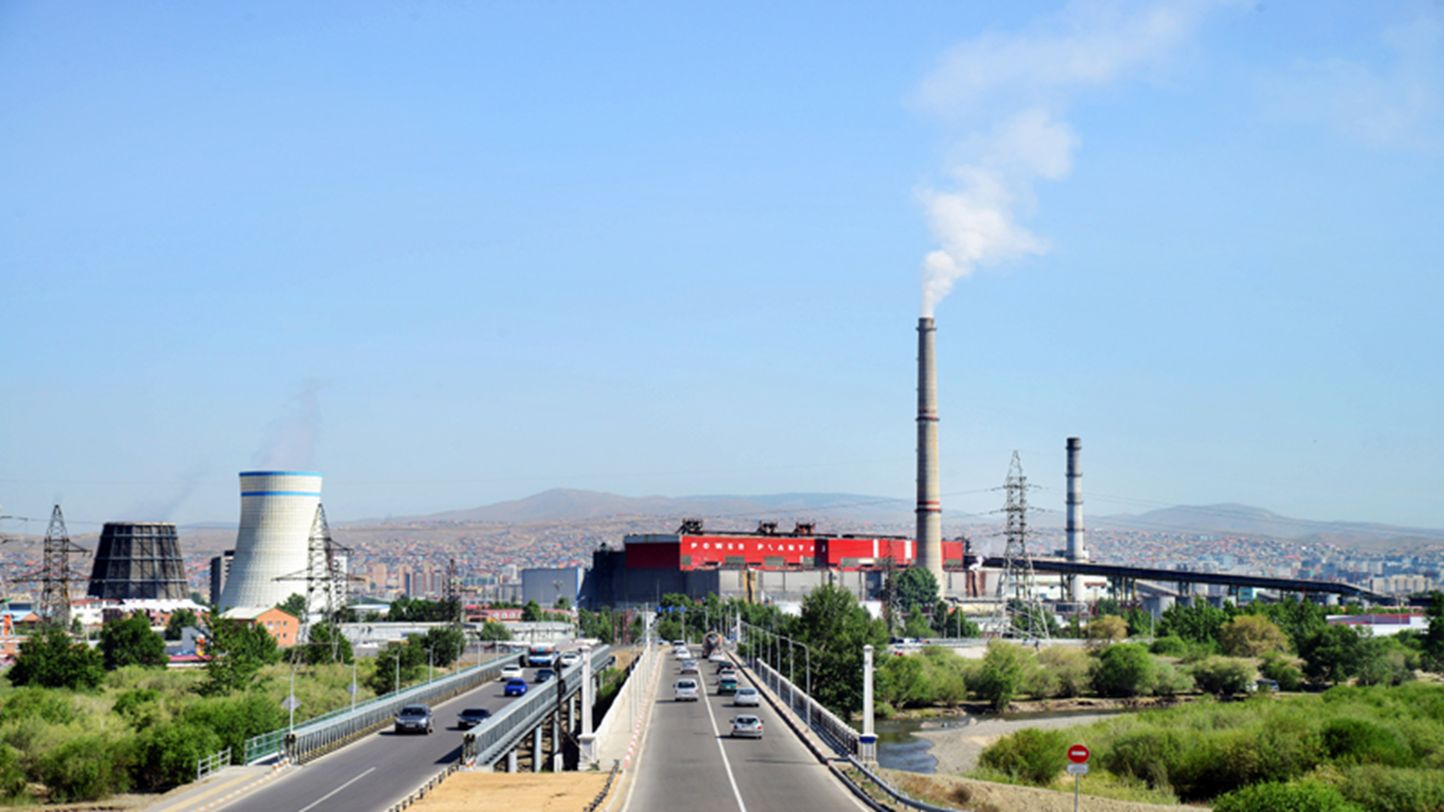
Mongolia’s accession to the CDRI demonstrates the Government’s recognition that disaster risk reduction is a fundamental to sustainable development and highlights the country’s commitment to high-level leadership and attention in developing disaster resilient infrastructure.

 This international scientific conference is convened to address Mongolia’s evolving disaster risk challenges amid rapid socio-economic development and urbanization, where government initiatives to enhance urban disaster resilience, improve infrastructure standards, and foster public-private partnerships face significant implementation challenges. The conference aims to bring together distinguished researchers, academic institutions, and technical experts to facilitate scientific discourse, exchange cutting-edge research findings, and develop evidence-based solutions for disaster risk reduction and resilience building in Mongolia’s unique geographical and developmental context.

Click here to register

OBJECTIVES OF THE CONFERENCE

  • To increase the involvement of scientific institutions, researchers, and scholars in enhancing disaster-resilient infrastructure, reducing disaster risk, and strengthening disaster resilience.
  • To learn from the experiences and practices of other countries in developing and reinforcing disaster-resilient infrastructure.
  • To foster collaboration among science and technology institutions, providing researchers and scholars with opportunities to share knowledge, skills, and experience.
  • To support policymakers in the infrastructure sector with science- and risk-based decision-making.

EXPECTED OUTCOMES

The following outcomes are expected from this scientific conference:

  • The conference will produce a set of recommendations on enhancing the role and engagement of the scientific community in building and strengthening disaster-resilient infrastructure, as well as methodologies for science-based policymaking and decision-making.
  • Knowledge and understanding will be strengthened among policymakers, stakeholders, and local authorities regarding the planning and implementation of disaster-resilient infrastructure in both existing and newly planned cities.
  • Participants will share knowledge and experiences on the impacts of natural and human-induced disasters on infrastructure, approaches to risk reduction, and strategies for improving preparedness, thereby enhancing collaboration among stakeholders.

Click here to register

MAIN DISCUSSION TOPICS

  • Partnerships for disaster risk reduction and disaster risk governance
  • Programs and planning for critical infrastructure (transport, health, energy, communications, etc.)
  • Disaster risk assessment and methodologies for critical infrastructure
  • International standards, norms, and regulations on disaster-resilient infrastructure, and good practices in their localization
  • Infrastructure risk based on geospatial information
  • Knowledge-sharing on disaster-resilient infrastructure / ensuring coordination among stakeholders
  • Nature-based solutions for building disaster-resilient infrastructure
  • Using data, technology, and innovation in disaster-resilient urban planning, infrastructure, and disaster response
  • Today’s investments for building a more disaster-resilient tomorrow
  • Approaches to strengthening infrastructure capacity at the local level to build disaster-resilient cities
  • Sharing disaster resilience databases, technology, and innovation (good practices implemented by different countries)

SCOPE OF PARTICIPANTS AND REGISTRATION PERIOD

The conference is open to international and domestic scholars, researchers, government policy-makers, and specialists working in the fields of disaster risk reduction and infrastructure resilience.

Methodology, Tools, and Guidelines  on Impact-Based Forecasting (IBF)

The mid-term Strategy for implementing Sendai Framework for Disaster Risk Reduction in Mongolia

1) Methodology, Tools, Guidelines, and Implementation of Impact-Based Forecasting (IBF) for Mongolia. Full document in this link https://www.mhewc.org/ibf/

2) Methodology, Tools, and Guidelines on Forecast-Based Financing (FBF) for Mongolian Context (https://www.mhewc.org/fbf/)

Download Risk Assessment Documents.

Useful Documents on Mongolia Climate , Multi-hazard, Dzud ,and other hydrometeorological hazards

Download Useful Documents on Mongolia Climate , Multi-hazard, Dzud ,and other hydrometeorological hazards from Google Drive

https://drive.google.com/drive/folders/1vY7WV0sUMh92PjOiXQoN-8emRC3QMueB?usp=drive_link