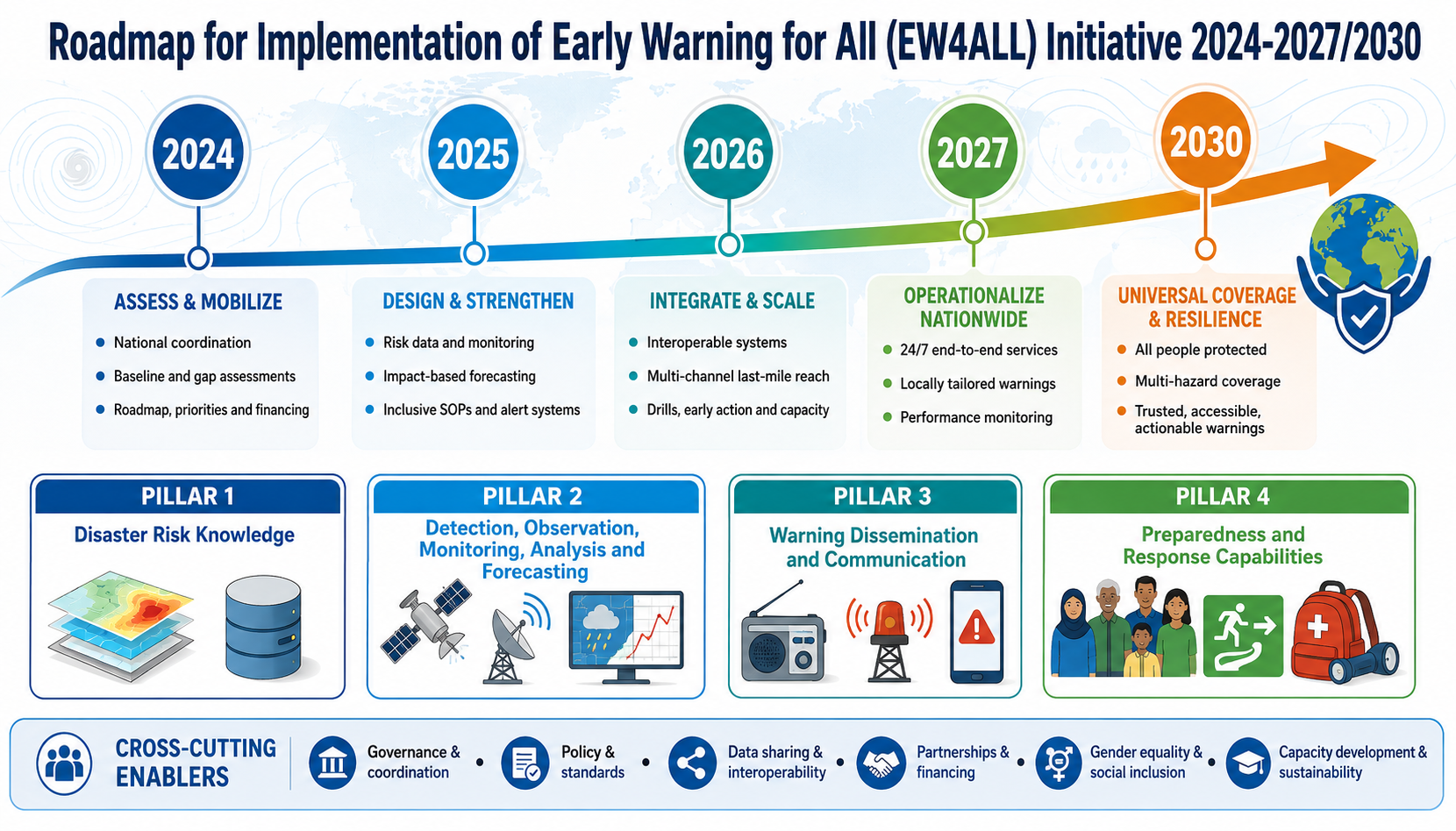
Contents
1.2 Goals and Objectives EW4ALL. 8
1.4 Rationale of National Multi-hazard Early Warning Center (NMHEWC) installation. 10
1.5 SoDMA/NDMO EW4ALL initiative. 11
2.0 Somalian multi-hazard, disaster phenomena & climate change trend. 12
2.1 Somalian current climate projection: 15
2.2 Climate trends, impacts, and Stressors. 15
3.0 Pillar Specific Goal, Outcome, and Workplan. 17
3.1.1 Pillar 1 Gap Identification on Disaster Risk Knowledge. 18
3.1.2 Step forward to close the gap of Pillar 1 Disaster Risk Knowledge. 23
3.1.3 Proposed key actions for closing the indicated gaps: Disaster Risk Knowledge. 23
3.1.4 The Roadmap Ahead for Pillar 1: Improved Disaster Risk Knowledge Management System… 29
3.1.5 Work Plan for Pillar 1. 34
3.2 Roadmap Pillar 2: Observation, monitoring, analysis, and forecasting. 36
3.2.1 Pillar 2 Gap Identification: Observation, monitoring, analysis, and forecasting. 37
3.2.3 Proposed Roadmap for Pillar 2 : Observation, monitoring, analysis, and forecasting. 47
3.2.4 Work Plan for Pillar 2 : Observation, monitoring, analysis, and forecasting. 53
3.3 Roadmap Pillar 3: Warning dissemination and communication. 57
3.3.2 Proposed essential action for closing Pillar 3 gaps. 59
3.3.3 The roadmap for Pillar 3 : Enhancing effective dissemination and communication. 64
3.3.4 Workplan Pillar 3 : Warning dissemination and communication. 68
3.4 Roadmap Pillar 4: Preparedness and response capabilities. 72
3.4.1 Indicative Gaps on Pillar 4 -Preparedness and response capabilities. 72
3.4.2 Roadmap outlined actions for closing the Gaps on Pillar 4 by 2027 and beyond. 75
3.4.3 Roadmap ahead for Pillar 4 by 2027 and beyond. 79
3.4.4 Work Plan for Pillar 4 (Preparedness, timely responses and early actions) 83
4.0 Monitoring & Evaluation Plan of EW4ALL Pillars. 87
5.0 Concluding summary & Recommendations. 98
Acronym
AA | Anticipatory Action |
AM | Amplitude Modulation |
AMM | Africa Media Monitor |
APIs | Application programming interfaces |
ARC | African Risk Capacity |
AWD | Acute Watery Diarrhea |
AWS | automated weather station |
BCPs | Business Continuity Plans |
CAP | Common Alerting Protocol |
CB | Cell-Broadcast |
CBDRM | Community-Based Disaster Risk Management |
CBO | Community-based organization |
CBS | Central Bank of Somalia |
CCA | Climate Change Adaptation |
CCM | Convention on Cluster Munitions |
CIMA | International Centre for Environmental Monitoring |
CPC | Civil Protection Committee |
CREWS | Climate Risk and Early Warning Systems |
CRVA | climate risk and vulnerability assessments |
CSO | Civil Services Organization |
DDMT | Disaster Management Team |
DFID | Department for International Development, Government of the United Kingdom |
DINA | Drought Impact and Needs Assessment |
DM | Disaster Management |
DMA | Disaster Management Agency |
DMC | Disaster Management Committee |
DRM | Disaster Risk Management |
DRMCG | Disaster Risk Management Coordination Group |
DRR | Disaster Risk Reduction |
DTM | Displacement Tracking Matrix |
DTS | Disaster Tracking System |
EOC | Emergency Operation Centre |
ETT | Emergency Tracking Tools |
EW | Early Warning |
EW4ALL | Early warning for all |
FAO | Food and Agriculture Organization |
FEWSNET | Famine Early Warning Systems Network |
FGS | Federal Government of Somalia |
FM | Frequency Modulation |
FSNAU | Food Security and Nutrition Analysis Unit |
GDP | Gross domestic product |
GIS | geographic information system |
GMAS | Global Multi-hazard alert system |
GPS | The Global Positioning System |
GSM | Global System Mobile |
GTOS | Global Terrestrial Observing System |
HC | Humanitarian Coordinator |
HCT | Humanitarian Country Team |
HPC | High-performance Computer |
ICPAC | IGAD Climate Prediction and Applications Centre |
ICS | Incident Command System |
ICT | Information and Communications Technology |
IDP | Internally Displaced Person |
IDRR | International Day for Disaster Reduction |
IFAD | International Fund for Agricultural Development |
IFRC | International Federation of Red Cross and Red Crescent Societies |
IGAD | Intergovernmental Authority on Development |
IGADD | Intergovernmental Authority on Drought and Development |
LITK | local, indigenous and traditional knowledge |
ILK | Indigenous and local knowledge |
INGO | International Non Government Organization |
IOM | International Organization for Migration |
IPCC | Intergovernmental Panel on Climate Change |
ITCZ | Inter-Tropical Convergence Zone |
ITU | International Telecommunication Union |
L & D | Loss and Damage |
LB-SMS | Location-based SMS |
LCG-DER | local coordination group on disaster emergency response |
LNHAs | Local National Humanitarian Actors |
LNNGOs | Local and National NGOs |
MoEWR | Ministry of Energy & Water Resources |
MoHADM | Ministry of Humanitarian Affairs and Disaster Management |
MTR | Midterm Review |
NAPA | National Adaptation Plan of Action |
NCA | National Community Authority |
NDMF | National Disaster Management Fund |
NDMO | National Disaster Management Agency |
NDRMC | National Disaster Risk Management Council |
NDVI | Normalized Difference Vegetation Index |
NMHEWC | National Emergency Operations Centre |
NGO | Non-Government Organization |
NMHEWC | National Multi-Hazard Early Warning Centre |
NMHSs | National Meteorological and Hydrological Services |
NSO | National Statistical Office |
OCHA | Office for the Coordination of Humanitarian Affairs |
OI | Officer In-charge |
OPM | Office of the Prime Minister |
PDNA | post-disaster loss, damage, and needs assessment |
Q&A | Questions and answers |
RPDNA | Rapid Post-Disaster Needs Assessment |
RS | Remote Sensing |
RMC | Regional Meteorological Center |
RSMCs | Regional Specialist Meteorological Center |
SADD | sex, age, disability disaggregated data |
SDG | Sustainable Development Goals |
SDRMCG | Somalia Disaster Risk Management Coordination Group |
SFDRR | Sendai Framework on Disaster Risk Reduction |
SMS | Short Message Service |
SNDMP | Somalia National Disaster Management Policy |
SNDP | Somalia National Development Plan |
SODMA | Somalia Disaster Management Agency (NDMO) |
SOP | Standard Operating Procedure |
SRCS | Somalia Red Crescent Society |
SWALIM | Somalia Water and Land Information Management |
SWALIM | Somalia Water and Land Information Management |
TWG | Technical Working Group |
UAV | Unmanned Aerial Vehicle |
UHF | Ultra-high frequency |
UN | United Nations |
UNCCA | United Nations Convention against Corruption |
UNCDF | UN Capital Development Fund |
UNDP | United Nations Development Programme |
UNDRR | United Nations Office for Disaster Risk Reduction |
UNFPA | United Nations Population Fund |
UNHCR | United Nations High Commissioner for Refugees |
UNICEF | United nations international children’s emergency fund |
UNRCO | United Nations Resident Coordinator Office |
UNV | UN Volunteers |
VAC | Vulnerability Assessment Committee |
VHF | Very high frequency |
WASH | Water, sanitation and hygiene |
WFP | UN World Food Programme |
WHO | World Health Organization |
WMO | World Meteorological Organization |
Executive Summary
Early Warnings for All (EW4ALL) a global initiative to ensure that everyone on Earth is protected by early warnings by 2027 is being fast-tracked into action on the ground. The UN Secretary-General released an action plan for this initiative in November 2022, emphasizing the urgent need to support the most vulnerable first.
The United Nations Development Program (UNDP) supported the Somalia Disaster Management Agency (SoDMA) /National Disaster Management Organization(NDMO) in facilitating the design and drafting of a Roadmap for implementing the Early Warning for All (EW4ALL) Initiative in Somalia.
While governments play a crucial role in driving action on early warning services for their citizens, adopting a “whole-of-society” approach that involves all stakeholders, including civil society and the private sector, can better strengthen and sustain early warning services.
It’s equally important to recognize that disasters and climate change affect people differently based on gender, age, and other factors. Therefore, an intersectional approach is required to ensure that the early warning services are inclusive, responsive, and equitable. By involving all sectors of society and taking an intersectional approach, early warning services can be more effective in protecting vulnerable populations from the impacts of disasters and climate change.
As these events become increasingly frequent and intense, efforts to build resilience and coping capacities are crucial. Climate change is also a major driver of conflict in Somalia, for example, as declining groundwater levels drive up water prices and increase the likelihood of conflict over water and access to livelihoods. Multi-hazard early warning systems (MHEWS) linked to early actions are key to Somalia’s efforts to manage risks, enhance adaptation, and build resilience.
The National Multi-Hazard Early Warning Centre (NMHEWC) was established to provide adequate and timely warnings of possible risks posed by hazards. However, the country lacks a robust early warning system infrastructure that enables policy and institutional environments for the dissemination of warnings.
In this context, the SoDMA/NDMO calls for the national Rollout of the Early Warnings for All (EW4All) initiative, finalizing the gap analysis, and agreeing on a roadmap to consolidate and extend the coverage of MHEWS, empowering and enabling early action by individuals and communities, especially those most in need.
1.0 Introduction: EW4ALL
Somalia’s increasing exposure to climate- and weather-related hazards requires risk-informed tools that can translate climate information into climate-proof planning, stronger disaster risk management (DRM) governance, and end-to-end early warning services. In practical terms, this means strengthening the institutional and technical capacities to generate and use thematic forecasts, weather warnings, and public alerting that enable government, communities, and partners to anticipate, prepare for, respond to, and recover from extreme events.
Somalia is already experiencing significant loss and damage from human-induced climate change, with hydrometeorological hazards recurrently disrupting the country’s productive base particularly agriculture and livestock. Agriculture (including livestock) is identified as Somalia’s largest employer and second-largest commodity export sector. Nearly one-fourth of the population are agropastoralists, with smallholder farming accounting for approximately 80% of total crop production and 70% of marketed produce. More than 60% of the population depends on livestock, which contributes approximately 40% to national GDP.
Losses and damages arise from rapid-onset events such as floods, heatwaves, and storms as well as protracted droughts and slow-onset climatic shifts. Direct economic loss and damage to Somalia’s agriculture sector between 2000 and 2021 is estimated at US$5.68 billion, of which about half US$2.84 billion could be attributable to climate change (equivalent to an average of 5% of agricultural GDP over the period). This implies average climate-attributable livestock and crop loss and damage of about US$129 million per year.
Somalia’s recent history also demonstrates how climate extremes can trigger cascading systemic impacts. From 2008 to 2011, drought conditions in the Horn of Africa contributed to heightened and persistent food insecurity; combined with conflict, low incomes, rising commodity prices, marginalization, and constrained humanitarian access, these shocks are estimated to have pushed 17% of the population in southern and central Somalia into famine conditions.
At the macro-fiscal level, the scale of shocks is substantial. Average direct economic impacts from droughts and floods are estimated at 7.9% of GDP between 2000 and 2021 (excluding the 2010 drought event), with about 3.3% of GDP plausibly attributable to climate change. Including the 2010/2011 drought, which led to estimated economic damages of over US$4 billion, climate-attributable losses rise to 8.4% of GDP. Over the same period, climate-attributable direct losses and damages are estimated to equal 86% of government revenues on average (excluding the 2010 drought event), underscoring the imperative for anticipatory risk management and resilience investment.
Against this backdrop, Somalia intends EW4All to function as a centre of excellence for operationalizing sustainable development through evidence-based, risk-informed decision-making supporting policymakers with actionable information for planning, budgeting, and project implementation, and strengthening national risk finance policy and advocacy to better access global risk finance mechanisms.
The EW4All Roadmap (2024-2027 and beyond) sets out the pathway to implement the EW4All pillars and evolve a people-centred multi-hazard early warning system (MHEWS) that links hazard monitoring and forecasting to warning dissemination and risk-informed early action, thereby strengthening DRM/DRR and climate change adaptation outcomes. This requires an enabling environment through a clear law or policy framework, fit-for-purpose institutional arrangements, and well-defined roles and standard operating procedures that ensure a seamless workflow from monitoring and forecasting to public alerting and early action.
Early warning systems are a proven, cost-effective measure: global evidence indicates they save lives, reduce economic losses, and can deliver nearly a tenfold return on investment yet major gaps persist, particularly in translating warnings into risk-informed early action at scale.
1.1 Vision EW4ALL
The National EW4ALL roadmap envisions that by 2027, all Somali people will be protected by a robust, government-led multi-hazard early warning system.
1.2 Principles EW4ALL
The following principles underpin Somalia’s Roadmap for EW4ALL Implementation and reflect the spirit of disaster risk governance for Somalia. The core principles serve as the basis of the EW4ALL Initiative and guide the implementation of critical functions of the country’s National Multi-Hazard Early Warning System (NMHEWS).
Accountability : All government and non-governmental parties should be held accountable for the early warning information and predictions they produce.
Credibility : Early warning information and analysis must come from credible sources and earn the trust and confidence of their users.
Do no harm : All parties shall endeavor not to cause damage or suffering due to their actions regarding DRM/early warning.
Ethical : DRM/early warning operations and decision-making shall always be guided by ethics and values that accept and respect the primacy of human life and human dignity.
Impartiality : Early warning information, analysis, and decisions should be based on objective data without bias, prejudice, discrimination, or a preference to benefit one group or community.
Leaving no one behind : EWS shall address the concerns, needs, and inclusion of the most vulnerable social groups, including women, youth, children, people with disability, and the elderly.
Neutrality : Early warning information, analysis, and decisions do not take sides and shall be conducted regardless of the political, faith, identities, or social background of the people or communities under the coverage of EWS.
People-centered and community-oriented : EWS should seek to preserve and include local and ‘traditional’ perspectives and Indigenous knowledge to strengthen community ownership. It should be developed in collaboration with the end-users, and the disaster-affected people shall communicate and understand its impacts. It needs to be more people-oriented with a focus on last-mile outreach.
Transparency :EWS should be transparent, allowing public access to early warning data and knowledge products. Both at federal and regional levels, EWS should be located within government structures and operate within a clear legal framework, with the spirit of accessing the information as a credible source for public benefit.
1.2 Goals and Objectives EW4ALL
Early Warnings for All (EW4All) is structured around four pillars that together constitute an effective, people-centered, end-to-end Multi-Hazard Early Warning System (MHEWS). The overarching purpose of this Roadmap is to identify Somalia’s current gaps across the four EW4All pillars and to define practical measures to close those gaps, strengthening national systems so that early warnings consistently translate into timely, risk-informed early action, particularly for the most vulnerable.
Accordingly, the Roadmap aims to achieve the following objectives:
- Improve disaster risk knowledge and management (Pillar 1 – led by UNDRR)
- Strengthen risk knowledge and risk governance capacities of national institutions, sector stakeholders, and frontline communities.
- Enhance institutional capacity for multi-hazard risk assessment, including improved methodologies, staffing, and coordination mechanisms.
- Establish or strengthen a national risk repository and associated risk data standards, governance protocols, and interoperability arrangements.
- Improve access to, and use of, risk data and tools to develop impact-based early warning products and decision-support information services that connect hazards to likely consequences.
- Improve detection, observation, monitoring, analysis, and forecasting (Pillar 2 – led by WMO)
- Expand Somalia’s access to improved weather and climate observation data and strengthen the observation network to better support forecasting and impact analysis.
- Improve access to and use of global and regional forecasting products (e.g., from Global Producing Centres, Regional Specialized Meteorological Centres, and relevant regional climate services) to strengthen national forecasting performance.
- Formulate and implement national hydrometeorological plans, strategies, and (where required) enabling legislation for hydromet observation, data management, and acquisition of Essential Climate Variables (ECVs).
- Strengthen systems for data calibration, quality control, collation, archiving, and attribution to support credible forecasting and verification.
- Enhance the National Multi-Hazard Early Warning Centre (NMHEWC) with improved capability in innovative forecasting, nowcasting, and prediction (including hazard-specific modelling and operational workflows).
- Improve warning dissemination and communication (Pillar 3 – led by ITU)
- Strengthen national and sub-national capacities across the risk communication value chain, including translation of forecasts into clear, actionable, localized warnings.
- Establish and operationalize common alerting arrangements (message standards, approval workflows, alert levels, and redundancy protocols) to enable consistent public warning issuance.
- Strengthen the operational coordination and interoperability among NMHS/NMHEWC, SoDMA/NDMO, sector institutions, local stakeholders, and community systems to deliver a people-centred warning system that reaches last-mile populations through appropriate channels and formats.
- Strengthen preparedness and response capabilities (Pillar 4 – led by IFRC/FAO/SRCS)
- Enhance the disaster preparedness and response capacity of SoDMA/NDMO, local government authorities, local non-state actors, and communities to ensure warnings lead to timely, protective action.
- Strengthen institutional and community instructional capacity in DRM, DRR, and resilience-building, including drills, simulation exercises, and the integration of early action protocols into local planning and service delivery.
- Improve coordination mechanisms and operational readiness (roles, SOPs, triggers, resources, and surge arrangements) to support anticipatory action and rapid response aligned with warning levels.
1.4 Rationale of National Multi-hazard Early Warning Center (NMHEWC) installation
The National Multi-Hazard Early Warning Center (NMHEWC) was established in 2019 pursuant to an executive order issued by the Office of the Prime Minister (OPM) and is led by a joint inter-ministerial committee comprising the OPM and the Ministry of Humanitarian Affairs and Disaster Management (MoHADM). The Center was created to provide a single, nationally recognized platform to coordinate and lead major emergency responses and to ensure that responses to future disasters and emergencies are coordinated, timely, and efficient. Its broader intent is to strengthen institutional capacity across government for holistic disaster risk management, including preparedness, response coordination, and early action.
SoDMA/NDMO is entrusted with executing the NMHEWC’s operational modality and functions under the governance and strategic direction of the Honorable Prime Minister. Positioning the NMHEWC under the auspices of the OPM is intended to strengthen its convening authority and leadership across all ministries and agencies with DRM responsibilities, and to improve coordination with Federal Member States (FMS) as well as with UN agencies, development partners, and humanitarian actors.
The NMHEWC’s rationale is further reinforced by the current operational landscape in Somalia, where emergency response and DRM actions are frequently implemented through ad-hoc, parallel, or fragmented mechanisms across state institutions and non-state actors. The NMHEWC provides the institutional anchor to synchronize and harmonize government-led emergency management with humanitarian and DRM actions undertaken by UN agencies, INGOs, NGOs, and CSOs. In this role, SoDMA/NDMO serves as the pivotal networking and coordination node bringing together key representatives from federal and member state institutions, donor communities, UN agencies, INGOs/NGOs, civil society organizations, private sector actors, and financial institutions to establish a more coherent and effective model for national emergency management and early warning-early action coordination.
1.5 SoDMA/NDMO EW4ALL initiative
On October 15, 2023, H.E., the President of the Federal Republic of Somalia, nominated the Somalia Disaster Management Agency (SoDMA) as the right national focal institution to lead the EW4All initiative at the national level.
In collaboration with the UNDP Somalia country office, the EW4ALL initiative is now operationalized under the leadership of SoDMA. The National Multi-Hazard Early Warning Center (NMHEWC) is already operational under SoDMA, positioning the institution as the most effective way to continue coordinating the scaling-up of the EW4All Initiative into action at the national level.
On November 15 – 16, 2023, SoDMA held a national consultation to launch Early Warnings for All (EW4All) in partnership with the United Nations Resident Coordinator Office (UNRCO) and the United Nations Country Team (UNCT) and in technical cooperation with UNDRR, World Meteorological Office (WMO), and International Telecommunication Union (ITU) as global co-leads for the Secretary-General’s EW4All initiative.
Affirming Somalia’s commitment to the objectives and spirit of EW4All, national government stakeholders, in partnership with UN country teams led by UNDP, came forward to articulate priorities and gaps to be addressed across the four EWS pillars.
On June 9-10, 2024, a workshop was held in Mogadishu to finalize the gap analysis and develop a national roadmap for implementing the Early Warning for All (EW4ALL) Initiative in Somalia, marking the rollout of the initiative.
The Roadmap for Early Warning for All (EW4ALL) builds on the country’s existing National Multi-Hazard Early Warning System (NMHEWS) and is concurrent with Somalia’s commitment to the Sendai Framework for Disaster Risk Reduction (2015-2030).
Critically, the Roadmap development process has been accompanied by a systematic reform initiative to align it with Article 3, paragraph 6, and Article 7, paragraph 2, of Law 17/2016, which establishes the Somali Disaster Management Agency (SoDMA). These Articles state the clear responsibility of SODMA to gather information and report on disasters and the risks facing the country, and to send out early warnings in collaboration with organizations inside and outside the country working on these activities. This is a positive step towards elevating the portfolio of SODMA, strengthening the Agency’s role by creating a functioning National Multi-Hazard Early Warning System. It will also provide the agency with an extended mandate to effectively coordinate DRM endeavors with multiple stakeholders, including regional and Federal Member State (FMS) government bodies, representatives of civil society organizations, and National Red Crescent Societies. The arrangement of this Roadmap also expects to promote local community participation and raise public awareness about disaster risk reduction and management. It is hoped that this Roadmap will foster the development of robust collaborations among key early warning stakeholders and establish a coordination mechanism that brings together the EW4ALL Pillar leads and relevant stakeholders.
The roadmap is also expected to facilitate the implementation of the EW4ALL Initiative in Somalia and enhance coordination, accountability, and enforcement of inter-jurisdictional and regional early warning systems and initiatives.
The critical undertaking here is for the Government of Somalia to develop a national EW4All Roadmap 2024-2027, with support from the UN agencies and global EW4All Pillar leads.
2.0 Somalian multi-hazard, disaster phenomena & climate change trend
Somalia’s natural and human geography is strongly shaped by its harsh climate and high exposure to hydrometeorological hazards. The country lies at the eastern extremity of the Sahel belt and is predominantly arid to semi-arid, with large areas receiving under 200 mm of rainfall annually, while totals are higher in parts of the northern highlands and southern regions. Mean daily maximum temperatures exceed 30°C across much of the country, moderating in higher-elevation northern areas and in some coastal locations influenced by offshore currents.
This climatic baseline, combined with high rainfall variability, drives recurrent drought and flood risk. Riverine flooding is concentrated along the Juba and Shabelle river systems in southern Somalia, while flash flooding is more common in the north along ephemeral watercourses. Recent seasons illustrate the compounding nature of extremes drought conditions linked to poor rainy-season performance can be rapidly followed by severe flooding during subsequent rainfall events, intensifying humanitarian needs and eroding coping capacity.
Climate risk is closely intertwined with poverty and vulnerability in Somalia, affecting livelihoods, food security, displacement patterns, and access to basic services. Climate variability and extremes can widen inequities and deepen vulnerability particularly where households are highly dependent on climate-sensitive livelihoods and where insecurity limits mobility, service delivery, and humanitarian reach. These dynamics make Somalia’s risk profile “systems-based”: hazards translate into impacts through exposure (settlements, farms, grazing areas, river corridors), sensitivity (water scarcity, degraded rangelands, fragile services), and limited adaptive capacity (poverty, displacement, constrained access to finance and services).
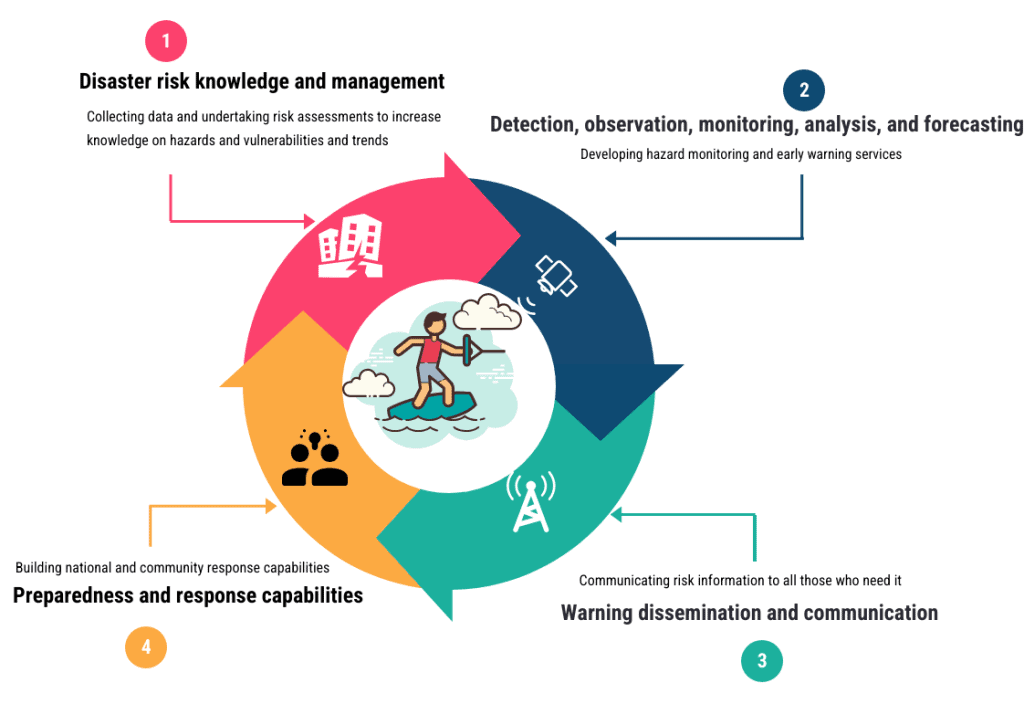
Figure 1: Early Warning for All (EW4ALL) objective
1. Download the full EW4ALL Roadmap document in PDF Format
2. Download full EW4ALL Roadmap documents in MS Word Format