Transcending political boundaries through binding transboundary governance and debordered shared-resource management to combat the climate crisis & multi-hazards.
[ The copyright © 2026 Z M Sajjadul Islam, Advisor, Multi-Hazard Early Warning System Design and Implementation Center (MHEWC – www.mhewc.org ). All rights reserved. Any material quoted, reproduced, adapted, or extracted from this proposal must be properly cited and attributed to the author. Please call at +8801711979179, Email: zmsajjad@gmail.com ]
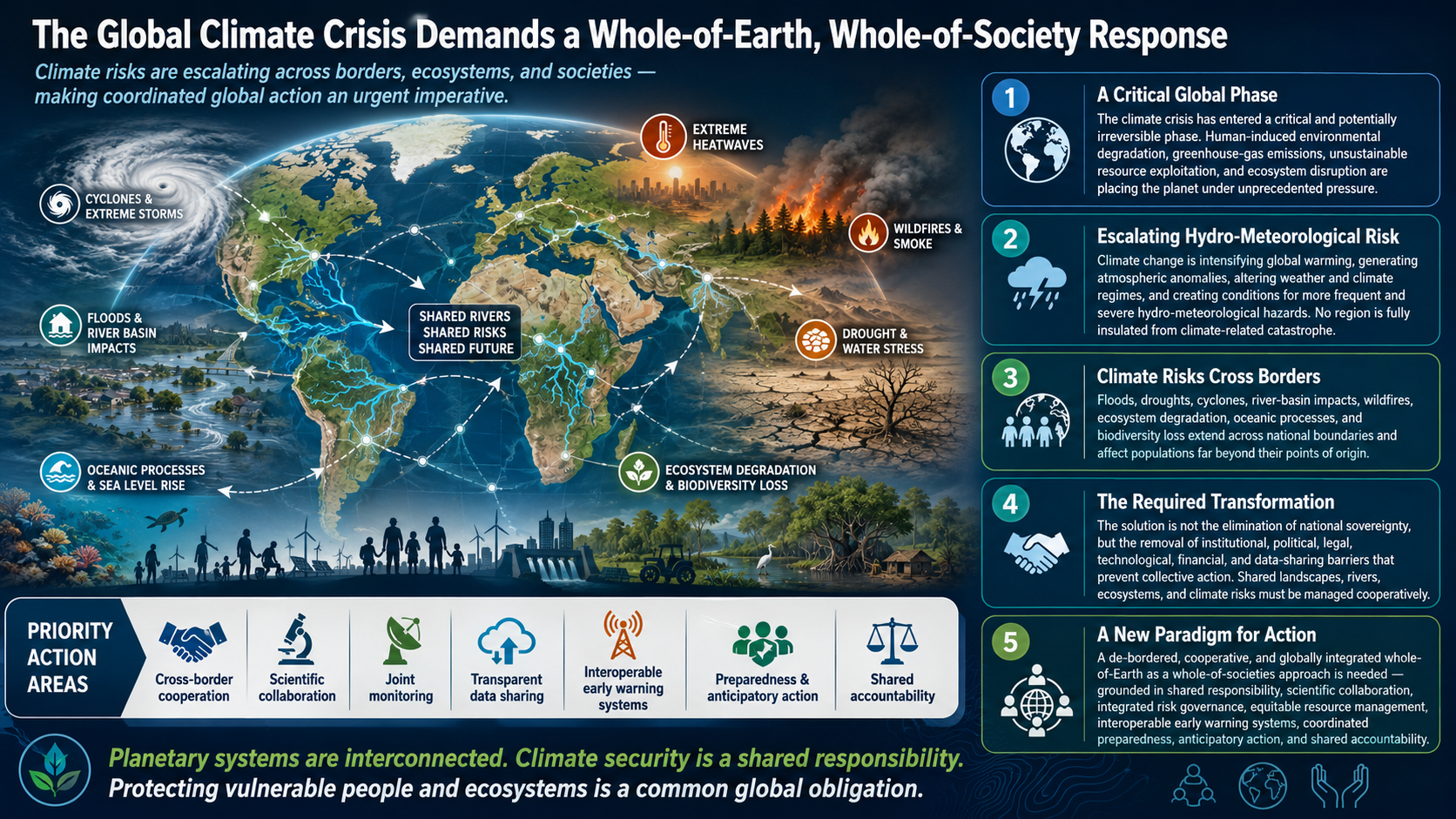
The global climate crisis has entered a critical and potentially irreversible phase. Human-induced environmental degradation, greenhouse-gas emissions, unsustainable resource exploitation, and ecosystem disruption have placed the planet under unprecedented pressure. Climate change is intensifying global warming, generating atmospheric anomalies, altering established weather and climate regimes, and creating increasingly favorable conditions for the formation and escalation of hydro-meteorological hazards. As a result, no region is entirely insulated from the growing risk of climate-related catastrophe. Coordinated policy, institutional, financial, technological, and programmatic action is therefore no longer optional; it is an urgent global imperative. The scale and interconnected nature of the crisis demand a “whole-of-Earth and whole-of-society” framework based on shared responsibility, cross-border cooperation, scientific collaboration, integrated risk governance, and coordinated action across countries, sectors, institutions, and communities.
Climate risks do not respect political boundaries. Floods, droughts, cyclones, atmospheric systems, river basins, ecosystems, biodiversity corridors, wildfires, oceanic processes, and environmental degradation frequently extend across national territories and affect populations far beyond their points of origin. Increasingly severe climate catastrophes demonstrate the need to move beyond fragmented, country-centered, and unilateral approaches toward a more integrated and border-transcending system of global climate-risk governance. Political boundaries must not be used to justify unilateral control over shared natural systems, transboundary rivers, watersheds, forests, wetlands, ecosystems, biodiversity, and other common environmental resources. Decisions affecting these interconnected systems can generate or intensify human-induced flooding, water scarcity, drought, landslides, ecosystem degradation, displacement, livelihood loss, and food insecurity in downstream or neighboring countries and communities.
The required transformation is not the literal elimination of national sovereignty, but the removal of institutional, political, legal, technological, financial, and data-sharing barriers that prevent collective action. Countries must manage shared landscapes, river basins, ecosystems, atmospheric processes, and climate risks through cooperative governance, equitable resource management, transparent information exchange, joint monitoring, interoperable early warning systems, coordinated preparedness, anticipatory action, and shared accountability. A new paradigm is therefore required: a de-bordered, cooperative, and globally integrated “whole-of-Earth as a whole-of-societies” approach capable of addressing the global risk landscape through collective action. Such a paradigm should recognize planetary systems as interconnected, climate security as a shared responsibility, and the protection of vulnerable populations and ecosystems as a common global obligation. To safeguard the survival of humanity and preserve the Earth as an interconnected planetary system, the following strategic advisories must be urgently considered and translated into coordinated policy, institutional, financial, and programmatic action:
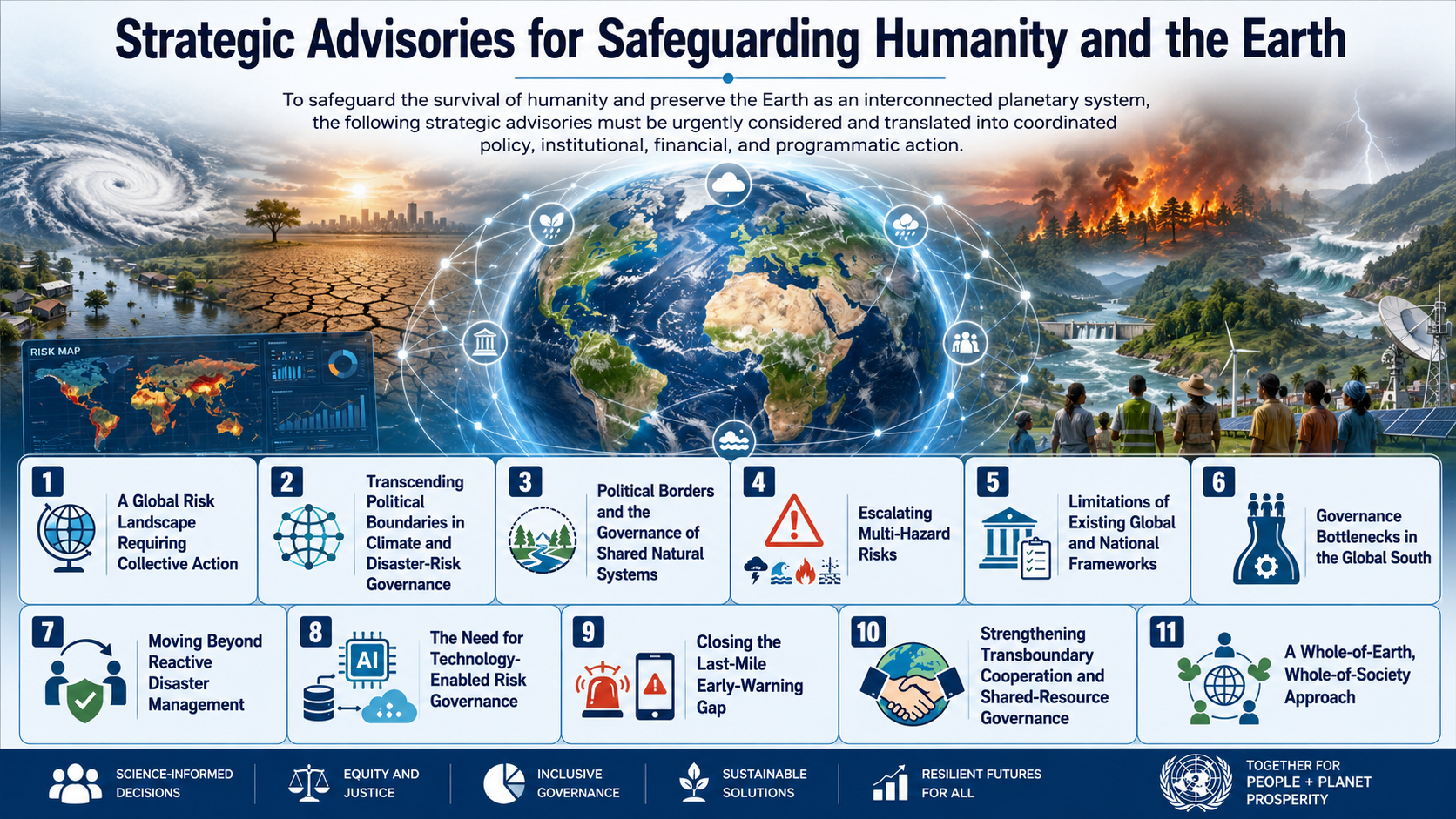
1) A Global Risk Landscape Requiring Collective Action:
Climate change is intensifying global warming, disrupting atmospheric processes, and altering established weather and climate regimes. These changes are creating increasingly complex hazard-generating environments in which extreme rainfall, heatwaves, droughts, floods, landslides, coastal hazards, and other climate-related events interact with environmental degradation, unplanned development, poverty, inequality, and institutional weaknesses.
The entire world is consequently approaching an era of interconnected and potentially catastrophic climate risks. Fragmented national policies, isolated sectoral programmes, and short-term emergency responses are no longer sufficient. Immediate, cohesive, and programmatic action is required through a “whole-of-Earth, whole-of-society” framework that recognises the planet as an interconnected ecological, hydrological, atmospheric, economic, and social system.
This emerging reality demands immediate, cohesive, and coordinated policy, institutional, programmatic, and operational action. Climate and disaster risks can no longer be managed effectively through fragmented, country-centered, sector-specific, or project-based interventions. What is required is a whole-of-earth and whole-of-society approach that recognizes the interconnectedness of atmospheric systems, river basins, ecosystems, landscapes, biodiversity, economies, and human settlements.
Climate-related catastrophes increasingly demonstrate that natural systems do not conform to political boundaries. Atmospheric circulation, river systems, watersheds, ecosystems, sediment flows, biodiversity corridors, drought processes, and geological and geomorphological dynamics extend across national borders. Effective risk governance must therefore transcend narrow political and administrative boundaries and establish stronger mechanisms for transboundary cooperation, shared-resource governance, joint accountability, and collective risk reduction.
2) Transcending Political Boundaries in Climate and Disaster-Risk Governance
The escalating climate crisis demonstrates the need to move beyond narrowly bordered and unilateral approaches to natural-resource governance. Climate systems, river basins, watersheds, ecosystems, biodiversity corridors, mountain systems, aquifers, coastal zones, and atmospheric processes do not conform to political boundaries. Nevertheless, countries continue to exercise unilateral control over shared landscapes and natural resources, often without adequately considering the consequences for neighboring and downstream populations.
The objective should not necessarily be the literal abolition of international boundaries, but the establishment of binding, de-bordered, transboundary governance arrangements for managing shared natural systems. Such arrangements must transcend political divisions through cooperative institutions, enforceable agreements, shared scientific evidence, transparent information systems, and equitable benefit-sharing mechanisms.
Unilateral interventions in shared rivers, wetlands, forests, aquifers, ecosystems, and biodiversity resources can alter natural landscape processes and intensify hydrological, geomorphological, ecological, and geological risks. The construction and operation of dams, embankments, barrages, reservoirs, diversions, and other water-control infrastructure can change river flows, sediment transport, floodplain connectivity, groundwater recharge, ecosystem functions, and downstream water availability.
When such infrastructure is planned, constructed, or operated without effective transboundary consultation, data sharing, and coordinated management, it may generate or intensify serious downstream risks, including:
- a)Severe flooding caused by sudden, excessive, or poorly coordinated water releases;
- b)Prolonged water scarcity and hydrological drought;
- c)Riverbank erosion, channel instability, and disruption of natural sediment flows;
- d)Degradation of wetlands, floodplains, aquatic ecosystems, and other natural protective systems;
- e)Salinity intrusion, habitat destruction, and biodiversity loss;
- f)Disruption of agriculture, fisheries, livestock systems, and other climate-sensitive livelihoods;
- g)Increased food and water insecurity;
- h)Displacement, social tension, and instability; and
- i)Escalating loss and damage among vulnerable downstream populations and climate-frontline communities.
These impacts demonstrate the need for transparent infrastructure planning, coordinated operational protocols, real-time information exchange, downstream-impact assessments, and shared accountability among countries managing transboundary water and landscape systems. These risks become especially severe when extreme rainfall and large volumes of runoff coincide with reservoirs that are already highly impounded. Sudden releases can produce destructive flood surges with catastrophic consequences for settlements, agricultural land, fisheries, infrastructure, productive sectors, and livelihood systems. Political borders should therefore never provide justification for the unilateral control of shared ecological and hydrological systems. Shared landscapes must be governed as interconnected risk systems, with the rights, safety, livelihoods, and environmental security of upstream, downstream, and neighbouring communities receiving equal consideration.
3) Political Borders and the Governance of Shared Natural Systems:
Political borders have frequently enabled unilateral control over shared landscapes, rivers, watersheds, ecosystems, biodiversity resources, and other natural assets. When powerful upstream or neighboring countries construct water-control infrastructure, divert shared water resources, alter river flows, block sediment movement, degrade ecosystems, or exploit biodiversity without adequate consultation, they may intensify risks for downstream countries and communities.
Such interventions can produce or magnify hydrological, geomorphological, geological, environmental, and livelihood vulnerabilities. During periods of extreme rainfall, sudden water releases from reservoirs or water-control structures may aggravate downstream flooding, erosion, sediment deposition, riverbank collapse, and infrastructure damage. Conversely, excessive upstream abstraction or diversion may intensify dry-season water scarcity, agricultural drought, ecosystem degradation, salinity intrusion, and livelihood insecurity in lower-riparian areas.
These risks demonstrate that climate-induced hazards and human-induced structural interventions are increasingly interacting. The resulting disasters cannot always be described as purely natural or climate-driven. In many cases, catastrophic impacts emerge from a combination of hydrometeorological, geological, and politically motivated water-controlling structures to unilaterally control water, ecology, ecosystem, environmental, and biodiversity resources as well. The world needs to establish a de facto system of internationally recognized, open-border natural resource management governance that takes precedence over narrow political or national boundaries in managing transboundary water resources, ecosystems, biodiversity, and other shared natural assets. Such an approach is essential to reduce the mega-risks created by unilateral, country-led, and infrastructure-based control of upstream catchments. When large volumes of water are retained behind dams, barrages, reservoirs, or other control structures during periods of intense rainfall, the sudden opening of sluice gates can rapidly discharge enormous flows downstream. This may cause severe and sometimes catastrophic flooding in neighboring and lower-riparian countries, with extensive consequences for lives, livelihoods, agriculture, settlements, infrastructure, ecosystems, and national economies.
Political borders must not become barriers to responsible, shared natural-environment governance, scientific cooperation, humanitarian action, early-warning communication, real-time hydrological data sharing, or the equitable management of shared natural resources. Upper riparian countries must not and should not construct infrastructure to control those shared transboundary resources; this should be loud and clear to all neighboring countries. Such intentions are suicidal to the climate and human catastrophes
A practical and urgent pathway is to establish legally binding, transparent, and accountable transboundary governance arrangements. Under such mechanisms, shared rivers, watersheds, aquifers, forests, wetlands, ecosystems, biodiversity corridors, and hazard-prone landscapes should be managed as interconnected ecological and hydrological systems rather than as isolated national assets. These arrangements should include joint monitoring, advance notification of reservoir operations and water releases, shared forecasting and early-warning systems, coordinated emergency protocols, environmental-flow safeguards, and enforceable accountability for downstream impacts.
4) Escalating Multi-Hazard Risks :
Erratic and increasingly unstable hydro-meteorological conditions are generating and intensifying a wide spectrum of rapid-onset, slow-onset, compound, and cascading hazards. These include extreme flash floods, riverine and fluvial flooding, pluvial and urban flooding, landslides, mudslides and debris flows, prolonged drought and water scarcity, coastal erosion, storm surges, salinity intrusion, heatwaves, ecosystem degradation, and interconnected multi-hazard disaster events. These hazards increasingly interact across sectors, ecosystems, geographical areas, and administrative boundaries. Intense rainfall, for example, may simultaneously trigger flash floods, landslides, riverbank erosion, infrastructure failure, agricultural losses, water contamination, disease outbreaks, population displacement, and disruption to transport networks, markets, essential services, and local economies. Climate change is therefore not merely increasing the frequency and severity of individual hazards; it is amplifying systemic, compound, cascading, and transboundary risks capable of spreading across economic sectors, ecosystems, supply chains, administrative jurisdictions, and national borders. Under such conditions, no country can effectively manage or reduce disaster risk in isolation. Meaningful and sustainable risk reduction requires equitable and mutually beneficial transboundary cooperation through shared observation and monitoring systems, joint modelling and risk analysis, coordinated operation of reservoirs and other critical infrastructure, interoperable early-warning systems, harmonised anticipatory-action protocols, timely exchange of critical risk information, and responsible governance of shared natural resources. Prolonged drought can similarly generate interconnected and cascading consequences by reducing surface-water availability, depleting groundwater reserves, undermining agricultural and livestock production, intensifying food and energy insecurity, degrading ecosystems, accelerating migration and displacement, and increasing competition over scarce land, water, and other natural resources. These interconnected risks cannot be addressed effectively through fragmented, hazard-specific, or sectorally isolated institutions. They require integrated multi-hazard risk governance, climate-informed and risk-sensitive development planning, ecosystem-based management, institutionalised anticipatory action, coordinated public and private investment, and clearly defined responsibilities across sectors, administrative levels, institutions, and national boundaries.
5) Limitations of Existing Global and National Frameworks:
Global disaster risk reduction and climate-change frameworks have made significant contributions to raising international awareness, shaping policies, strengthening institutions, and promoting technical cooperation. Nevertheless, substantial gaps persist between global commitments, national policy frameworks, subnational planning processes, and implementation at the community and last-mile levels. Many countries have adopted national disaster risk reduction strategies, climate-change policies, National Adaptation Plans, Nationally Determined Contributions, multi-hazard early-warning road maps, contingency plans, and sectoral resilience programmes. However, these instruments are frequently developed and implemented in isolation, inadequately financed, weakly institutionalised, and insufficiently connected to local development priorities and operational action. Persistent weaknesses include fragmented mandates across ministries and agencies, overlapping institutional responsibilities, and inadequate coordination among institutions responsible for climate change, disaster risk management, water resources, agriculture, environment, public health, infrastructure, social protection, finance, planning, and local government. Risk information is often not systematically integrated into development planning, public investment, sectoral programming, or budgetary decision-making.
Additional constraints include limited interoperability among institutional data systems; inadequate sharing of meteorological, hydrological, environmental, climate, exposure, vulnerability, and geospatial information; weak enforcement of policies, legislation, regulations, building codes, and land-use standards; and insufficient authority, financing, staffing, and technical capacity at the local-government level. Investment in disaster prevention, preparedness, anticipatory action, and resilient infrastructure also remains inadequate. Policy implementation is frequently constrained by weak monitoring and evaluation, limited community participation, insufficient inclusion of vulnerable and marginalised groups, and the absence of enforceable institutional accountability for preventable disaster losses and failures to act on available risk information. As a result, many risk-management policies remain aspirational rather than operational. National frameworks may be technically robust and well formulated on paper, yet fail to generate timely, coordinated, adequately financed, measurable, and accountable action at the local and community levels. Closing this implementation gap requires stronger policy coherence, clearly defined institutional responsibilities, integrated planning and budgeting, sustained financing, interoperable information systems, empowered local governments, meaningful community participation, and transparent accountability from the national level to the last mile.
6) Governance Bottlenecks in the Global South:
Many countries across the Global South continue to face complex bureaucratic procedures, entrenched administrative practices, fragmented risk-governance arrangements, and weak institutional accountability. These systemic constraints impede the transition from reactive, response-centred disaster management toward proactive, technology-enabled, people-centred, and anticipatory disaster risk management. Traditional governance systems frequently operate through rigid sectoral and institutional silos. National Meteorological and Hydrological Services may generate forecasts and warnings without effective operational linkages to agriculture, water-resource management, public health, infrastructure, humanitarian action, social protection, finance, planning, or local-government institutions. Similarly, disaster-management authorities may receive hazard information but lack the legal authority, pre-arranged financing, standard operating procedures, sector-specific impact information, or localised risk analysis required to initiate timely anticipatory and early action.
Local governments and frontline institutions often face even greater operational constraints. These may include inadequate staffing, shortages of specialised technical expertise, restricted access to hazard and vulnerability information, outdated equipment, insufficient operational budgets, unreliable emergency communication systems, limited decision-support tools, poor access to real-time forecasts, fragmented command and coordination arrangements, and inadequate authority to mobilise or release resources before disaster impacts occur. As a consequence, the priorities, knowledge, and concerns of last-mile and climate-frontline communities are frequently overlooked in institutional planning and decision-making. Communities may repeatedly experience floods, droughts, landslides, riverbank and coastal erosion, displacement, livelihood disruption, food insecurity, and loss of productive assets without receiving an adequate institutional response or benefiting from sustained measures to reduce underlying risk and vulnerability.
Accountability must therefore remain central to effective climate and disaster-risk governance. Governments and responsible institutions should be held accountable not only for the adequacy of their post-disaster response but also for failures to take reasonable preventive and anticipatory action. This includes failing to act on credible forecasts and risk information, neglecting the maintenance of observation and critical infrastructure, delaying or withholding warnings, restricting the exchange of essential risk data, failing to mobilise available resources, and inadequately protecting communities from foreseeable and preventable hazards. A genuinely people-centred governance system must connect scientific information, institutional authority, financing, operational readiness, and local capacity so that credible warnings consistently trigger timely, coordinated, inclusive, and accountable action.
7) Moving Beyond Reactive Disaster Management
Current disaster risk management systems remain disproportionately focused on emergency response, relief delivery, and post-disaster reconstruction. Although these functions are essential, they do not sufficiently address the structural, environmental, institutional, social, and economic drivers that create and intensify disaster risk. A modern risk-governance system must therefore shift from reactive crisis management toward proactive, preventive, anticipatory, and resilience-oriented approaches. This transition should prioritise risk prevention, anticipatory action, forecast-based financing, impact-based forecasting, climate-resilient development, ecosystem restoration, risk-informed infrastructure, adaptive and shock-responsive social protection, pre-arranged disaster financing, institutional accountability, and locally led resilience building. Achieving this transformation requires governments to systematically integrate climate and disaster risk considerations into national and local development plans, public-investment programmes, sectoral policies, infrastructure standards, land-use regulations, environmental and social assessments, procurement systems, and annual budgeting processes.
Disaster risk management should not remain the exclusive responsibility of a single national disaster-management authority. It must become a shared and institutionalised responsibility across finance ministries, planning commissions, local governments, water-resource agencies, agricultural institutions, health systems, infrastructure authorities, environmental agencies, social-protection institutions, private-sector actors, universities and research organisations, civil society organisations, and community-based institutions. A genuinely integrated risk-governance system should ensure that every sector understands how its policies, investments, and operational decisions may reduce, create, transfer, or compound disaster risk, and is held accountable for acting accordingly.
8) The Need for Technology-Enabled Risk Governance
The increasing complexity, interdependence, and transboundary nature of atmospheric, hydrological, geological, environmental, climatic, and socio-economic risks require countries to establish advanced, integrated, and technology-enabled systems for hazard observation, detection, monitoring, forecasting, warning generation, public alerting, decision support, emergency coordination, and anticipatory action.
Countries therefore need interoperable multi-hazard risk-monitoring and early warning systems that integrate automated weather stations; hydrological, river-level, and groundwater-monitoring networks; weather radar; satellite-based Earth observation; remote sensing; geographic information systems; Internet of Things sensors; artificial intelligence and machine learning; numerical weather prediction; hydrological and flood modelling; drought monitoring; landslide-susceptibility assessment; coastal, storm-surge, and sea-level-rise modelling; exposure, vulnerability, and loss-and-damage databases; impact-based forecasting; mobile and digital warning platforms; geospatial decision-support systems; and real-time emergency operations dashboards.
These technologies should enable national and subnational institutions to continuously collect, integrate, validate, analyze, visualize, and communicate risk information. They should also support evidence-based policy formulation, risk-informed development planning, public investment prioritization, resource allocation, emergency preparedness, anticipatory action, and operational decision-making at the highest levels of government.
However, technology is imperative to drive national and sub-national entities, enabling and equipping them with tool-based decision support systems to inform risk governance at the highest level. Forecasts and warnings must be embedded within clearly defined institutional responsibilities, agreed trigger thresholds, sector-specific impact scenarios, pre-arranged financing mechanisms, standard operating procedures, emergency coordination arrangements, and practical community-level actions. Its value depends on whether technological systems are embedded within an effective risk-governance framework and translated into timely, accountable, and coordinated action. Forecasts, warnings, and risk analyses must therefore be connected to clearly defined institutional mandates and responsibilities, agreed trigger thresholds, sector-specific impact scenarios, pre-arranged and forecast-based financing mechanisms, standard operating procedures, emergency coordination arrangements, contingency plans, evacuation protocols, social-protection mechanisms, and practical community-level preparedness and response actions.
Technology-enabled risk governance can create a level playing ground and leverage interconnectedness among sectors/institutions to work together on a unified platform, while also ensuring interoperability among government agencies, scientific institutions, emergency operations centers, sectoral ministries, local authorities, humanitarian organizations, private-sector service providers, media organizations, and at-risk communities. This requires common data standards, secure information-sharing protocols, institutional data-sharing agreements, integrated communication channels, clearly assigned accountability, and mechanisms for converting scientific and technical information into understandable, accessible, inclusive, and actionable guidance.
Accordingly, technology should not be treated merely as a collection of instruments, sensors, software applications, or digital platforms. It must function as an institutional and operational enabler that strengthens transparency, coordination, accountability, preparedness, anticipatory financing, and risk-informed public decision-making. When appropriately governed and linked to predetermined actions, technology can transform fragmented hazard-monitoring arrangements into a coherent, people-centred, end-to-end multi-hazard early warning and risk-governance system.
An effective warning should clearly communicate:
- a)What hazard is expected;
- b)Where it is likely to occur;
- c)When it is expected to occur;
- d)Who and what may be affected;
- e)How severe the anticipated impacts may be;
- f)What protective actions should be taken;
- g)Which institutions and actors are responsible for taking those actions; and
- h)What financial, technical, logistical, and operational resources are available for implementation.
Without these institutional, financial, operational, and community-level linkages, even technically accurate forecasts may fail to generate timely action or prevent loss of life, livelihood disruption, infrastructure damage, service interruption, and wider economic and social impacts.
9) Closing the Last-Mile Early-Warning Gap
Persistent last-mile gaps remain among the most serious weaknesses in global disaster risk management. Early warnings frequently fail to reach remote, marginalised, informal, mobile, linguistically diverse, and socially excluded populations, particularly those living in areas with limited communication infrastructure or weak institutional coverage.
Even when warnings reach exposed communities, they may not be understandable, trusted, accessible, actionable, or connected to the practical support required for timely protective action. A warning has limited value when people lack safe transport, clearly identified evacuation routes, adequate shelters, livestock-protection arrangements, emergency cash, healthcare services, accessible communication formats, or confidence in the authority issuing the message.
People-centred early-warning systems must therefore connect comprehensive risk knowledge with hazard detection, observation, monitoring, analysis, forecasting, impact assessment, inclusive warning communication, preparedness, response capacity, anticipatory financing, localised action protocols, and continuous community feedback and system improvement.
Warnings should be timely, location-specific, impact-based, multilingual, accessible, and linked to clearly defined protective actions and available resources. They must be designed to reach and support women and girls, children and young people, older persons, persons with disabilities, Indigenous peoples, displaced populations, migrants, informal-settlement residents, mobile livelihood groups, and communities living in remote, climate-frontline, or hazard-prone areas.
Closing the last-mile gap requires more than improving communication technology. It demands trusted institutions, empowered local authorities, inclusive planning, pre-arranged financing, operational preparedness, and sustained engagement with communities as active partners in warning design, dissemination, action, evaluation, and accountability.
10) Strengthening Transboundary Cooperation and Shared-Resource Governance
Transboundary cooperation is no longer optional; it is essential for the effective management of shared rivers, weather systems, ecosystems, droughts, floods, sediment flows, environmental degradation, and interconnected cascading risks.
Neighbouring countries should establish formal and operational mechanisms for:
- a)Real-time sharing of hydrological and meteorological data;
- b)Advance notification of reservoir operations and water releases;
- c)Joint flood, drought, and seasonal forecasting;
- d)Shared hazard, exposure, vulnerability, and risk assessments;
- e)Coordinated emergency-response and contingency protocols;
- f)Integrated river-basin and watershed planning;
- g)Protection of environmental flows;
- h)Joint sediment, wetland, and ecosystem management;
- i)Collaborative assessment of infrastructure and downstream impacts;
- j)Cross-border evacuation, humanitarian assistance, and emergency-access arrangements;
- k)Harmonized early-warning standards, thresholds, and communication protocols; and
- l)Independent monitoring, verification, and reporting of transboundary impacts.
Transboundary agreements should be founded on equity, transparency, scientific evidence, ecological integrity, equitable and reasonable resource use, prevention of significant harm, shared accountability, and the protection of downstream and climate-frontline populations.
The governance of shared natural resources must therefore move beyond unilateral national control toward cooperative and accountable stewardship. No state, regardless of its political, economic, or geographical power, should be permitted to externalize environmental, social, hydrological, or disaster risks onto weaker neighboring or downstream countries and communities.
11) A Whole-of-Earth, Whole-of-Society Approach
The most urgent and necessary response to the escalating climate and disaster-risk crisis is the establishment of a whole-of-Earth, whole-of-society approach to global risk governance. Such an approach would recognise that the Earth functions as an interconnected atmospheric, hydrological, ecological, geological, economic, technological, and social system in which risks are generated, transmitted, and compounded across sectors, ecosystems, administrative jurisdictions, and national borders.
This framework would bring together national and local governments, international and regional organisations, scientific and technical institutions, civil society organisations, community-based groups, the private sector, universities and research institutions, humanitarian agencies, financial institutions, technology providers, and populations directly exposed to climate and disaster risks.
A de facto global climate and disaster-risk management consortium could support:
- Harmonised disaster- and climate-risk management standards;
- Open and timely exchange of climate, hazard, exposure, vulnerability, and impact data;
- Interoperable early-warning and risk-information platforms;
- Joint and transboundary risk assessments;
- Coordinated research, modelling, and technological innovation;
- Equitable technology transfer to vulnerable and low-capacity countries;
- Strengthened regional observation and forecasting centres;
- Common anticipatory-action protocols and trigger mechanisms;
- Global and regional disaster-risk financing and risk-pooling arrangements;
- Independent monitoring, accountability, and review systems;
- Open-access geospatial and decision-support tools; and
- Stronger representation of vulnerable, marginalised, downstream, and climate-frontline communities.
Such a framework must be inclusive, transparent, science-based, equitable, accountable, and operationally connected to local institutions and the last mile. It should not create another layer of complex international bureaucracy. Rather, it should simplify institutional arrangements, reduce fragmentation, connect and strengthen existing global and regional frameworks, clarify responsibilities, harmonise technical systems, improve resource sharing, and accelerate coordinated implementation.
The central purpose of this approach should be to transform fragmented commitments into timely, practical, adequately financed, and accountable action that protects people, livelihoods, ecosystems, infrastructure, and development gains at the scale of the risks now confronting the planet.
12) Priority Actions
To translate this vision into practical and measurable action, the international community, regional institutions, and national governments should prioritise the following measures:
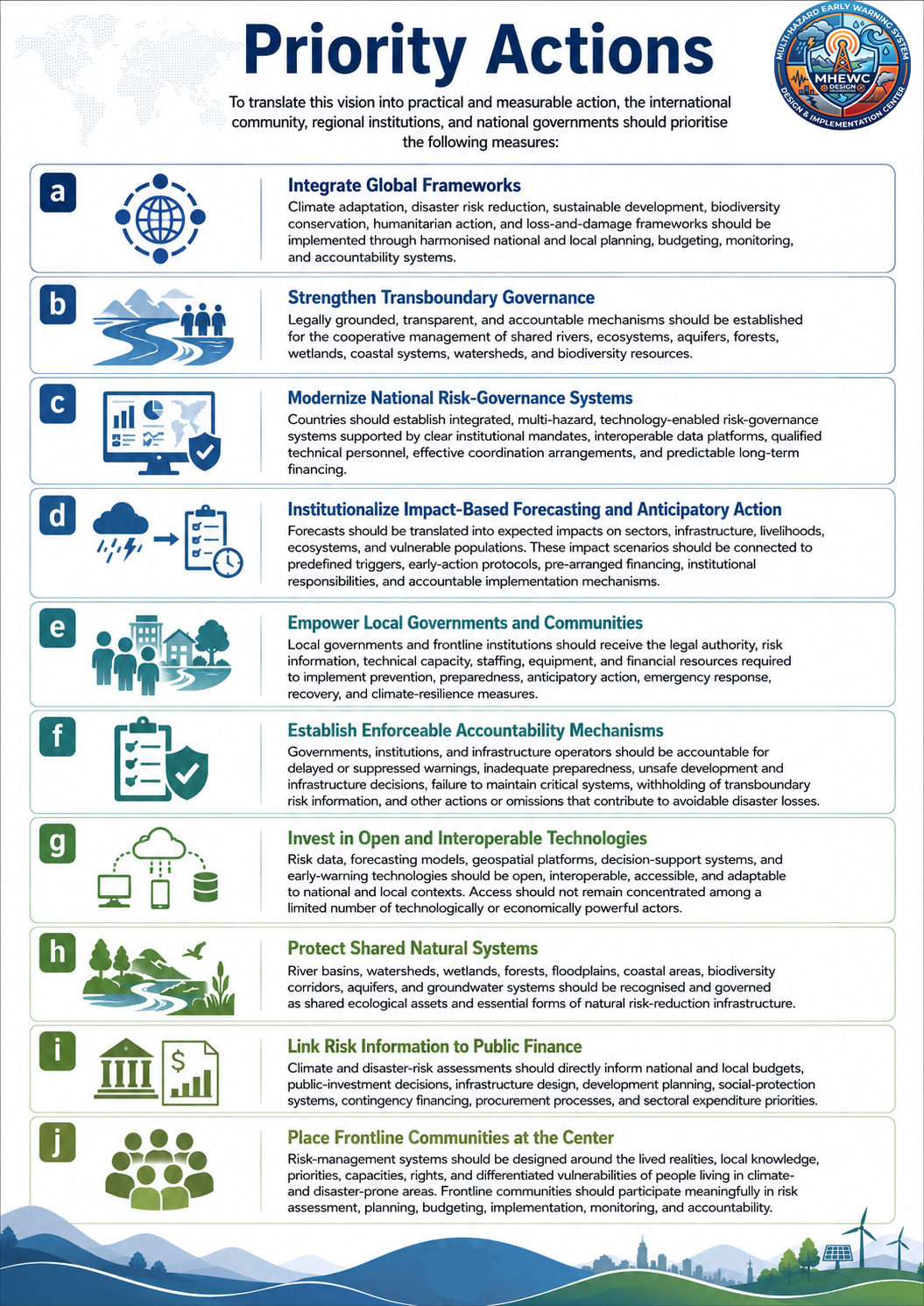
a)Integrate Global Frameworks
Climate adaptation, disaster risk reduction, sustainable development, biodiversity conservation, humanitarian action, and loss-and-damage frameworks should be implemented through harmonised national and local planning, budgeting, monitoring, and accountability systems.
b)Strengthen Transboundary Governance
Legally grounded, transparent, and accountable mechanisms should be established for the cooperative management of shared rivers, ecosystems, aquifers, forests, wetlands, coastal systems, watersheds, and biodiversity resources.
c) Modernize National Risk-Governance Systems
Countries should establish integrated, multi-hazard, technology-enabled risk-governance systems supported by clear institutional mandates, interoperable data platforms, qualified technical personnel, effective coordination arrangements, and predictable long-term financing.
d) Institutionalize Impact-Based Forecasting and Anticipatory Action
Forecasts should be translated into expected impacts on sectors, infrastructure, livelihoods, ecosystems, and vulnerable populations. These impact scenarios should be connected to predefined triggers, early-action protocols, pre-arranged financing, institutional responsibilities, and accountable implementation mechanisms.
e)Empower Local Governments and Communities
Local governments and frontline institutions should receive the legal authority, risk information, technical capacity, staffing, equipment, and financial resources required to implement prevention, preparedness, anticipatory action, emergency response, recovery, and climate-resilience measures.
f)Establish Enforceable Accountability Mechanisms
Governments, institutions, and infrastructure operators should be accountable for delayed or suppressed warnings, inadequate preparedness, unsafe development and infrastructure decisions, failure to maintain critical systems, withholding of transboundary risk information, and other actions or omissions that contribute to avoidable disaster losses.
g)Invest in Open and Interoperable Technologies
Risk data, forecasting models, geospatial platforms, decision-support systems, and early-warning technologies should be open, interoperable, accessible, and adaptable to national and local contexts. Access should not remain concentrated among a limited number of technologically or economically powerful actors.
h)Protect Shared Natural Systems
River basins, watersheds, wetlands, forests, floodplains, coastal areas, biodiversity corridors, aquifers, and groundwater systems should be recognised and governed as shared ecological assets and essential forms of natural risk-reduction infrastructure.
i)Link Risk Information to Public Finance
Climate and disaster-risk assessments should directly inform national and local budgets, public-investment decisions, infrastructure design, development planning, social-protection systems, contingency financing, procurement processes, and sectoral expenditure priorities.
j)Place Frontline Communities at the Center
Risk-management systems should be designed around the lived realities, local knowledge, priorities, capacities, rights, and differentiated vulnerabilities of people living in climate- and disaster-prone areas. Frontline communities should participate meaningfully in risk assessment, planning, budgeting, implementation, monitoring, and accountability.
Conclusion
The accelerating climate crisis is exposing the inadequacy of fragmented political, institutional, and sectoral approaches to disaster risk management. Climate hazards, river systems, atmospheric processes, ecosystems, and cascading risks do not respect political boundaries. Risk governance must therefore become more integrated, transboundary, technologically enabled, accountable, and responsive to frontline communities. The central challenge is not the absence of policies, frameworks, institutions, or technology. The principal challenge is the failure to integrate them into a cohesive system capable of converting scientific knowledge into timely, financed, and accountable ground-level action. The world must move beyond isolated national responses and unilateral control of shared natural systems. It must establish cooperative governance arrangements that protect common resources, prevent the transfer of risk to downstream populations, and ensure that every warning results in meaningful protective action. A whole-of-earth, whole-of-society approach provides a pathway for overcoming fragmented bureaucracies, strengthening shared responsibility, connecting policy with implementation, and building a more equitable and resilient global risk-management system. The urgency is clear: global climate and disaster risks are accelerating, and collective action must accelerate with them.
Way Forward:
MHEWC is committed to supporting the development of policies, strategies, evidence-based solutions, and globally informed Decision Support System (DSS) tools and platforms. MHEWC welcomes collaboration with United Nations entities, national and subnational governments, development partners, research institutions, civil society organizations, private-sector actors, and other relevant stakeholders to strengthen climate risk management, multi-hazard early warning systems, anticipatory action, disaster preparedness, and disaster risk governance.
[ The copyright © 2026 Z M Sajjadul Islam, Advisor, Multi-Hazard Early Warning System Design and Implementation Center (MHEWC – www.mhewc.org ). All rights reserved. Any material quoted, reproduced, adapted, or extracted from this proposal must be properly cited and attributed to the author. Please call at +8801711979179, Email: zmsajjad@gmail.com ]
For collaboration, technical partnerships, and institutional engagement, please contact: Email: zmsajjad@gmail.com WhatsApp: +880 1711 979179