The Technical and Governance Imperative for Modernizing National Climate-Risk Monitoring and Emergency Operations Center Systems
Given the catastrophic implications of the persistent, intensifying, and rapidly evolving climate crisis, countries can no longer rely exclusively on conventional weather-agency-led monitoring systems and aging observation networks. Many existing meteorological and hydrological stations are outdated, spatially inadequate, poorly maintained, or insufficiently integrated to detect rapidly developing and highly localized weather conditions. Although national weather agencies remain central to forecasting and warning services, their conventional observation systems must urgently be modernized through denser monitoring networks, automated weather stations, remote sensing, radar, satellite data, unmanned aerial vehicles, artificial intelligence for hybrid-crowdsourced weather & hazard intelligence gathering, community-based end-to-end observations, and most shophsitcated, AI instrumentalized & sensor based real-time data ingstitons from hybrid surface observation network and data integration, calibattion, collation and provide tailored & output model to all classfied end users, decision makers etc..
One of the most concerning weaknesses of climate-risk early warning systems is the continued prioritization of bureaucratic procedures, institutional control, and political interests over scientific modernization, operational efficiency, and the protection of vulnerable populations. In many least developed and developing countries, public investment continues to favor highly visible physical infrastructure, urban expansion, prestige projects, and other forms of urban development, while climate-sensitive and economically productive sectors, including agriculture, water resources, livestock, fisheries, forestry, public health, and rural livelihoods, remain comparatively neglected.
This imbalance reflects persistent governance structures and elite development perspectives that often reproduce externally influenced, centralized, and inequitable investment models. As a result, escalating climate-induced disasters remain inadequately addressed, despite the growing threat of catastrophic impacts on economies, ecosystems, infrastructure, human security, and sustainable development.
Political leaders must therefore reconsider national expenditure priorities. While legitimate national security requirements cannot be ignored, greater attention and substantially increased investment must be directed toward addressing the expanding climate emergency. Conventional military conflicts unnecessarily intensify geopolitical tensions and should, wherever possible, be resolved through diplomacy, multilateral cooperation, international law, and a rules-based system of peace and security.
Climate-induced disasters and geophysical hazards may generate human casualties, displacement, economic losses, ecosystem destruction, infrastructure damage, and long-term development setbacks on a scale equal to or greater than many conventional conflicts. Climate change is therefore not merely an environmental issue; it represents an escalating global emergency that threatens every component of the Earth system and every dimension of human security.
Such an interconnected crisis cannot be addressed effectively through isolated bilateral arrangements, fragmented national systems, or narrowly defined sectoral interventions. It requires a “whole-of-Earth, whole-of-society” approach based on open scientific cooperation, shared responsibility, transboundary risk governance, regional coordination, and equitable management of interconnected landscapes, river basins, ecosystems, atmospheric systems, biodiversity, and other shared natural resources. This approach should transcend political and administrative barriers while respecting national sovereignty and promoting collective responsibility for planetary safety.
Considering the magnitude of these risks and vulnerabilities, governments must allocate substantial and sustained budgets to establish, modernize, and operationalize Emergency Operations Centers and national or subnational situation rooms. These facilities must be capable of supporting continuous risk monitoring, early warning, emergency coordination, incident management, anticipatory action, rapid decision-making, and effective response to emerging climate and disaster threats.
The Multi-Hazard Early Warning System Design and Implementation Center (MHEWC) seeks to support countries in developing robust, interoperable, and operationally sustainable Emergency Operations Centres through the integration of information and communication technology, artificial intelligence, geographic information systems, unmanned aerial vehicles, automated weather stations, remote sensing, real-time databases, decision-support systems, and hybrid observation and communication technologies.
Accordingly, MHEWC conducts comprehensive EOC assessments to examine physical facilities, operational layouts, system architecture, ICT infrastructure, technical capacity, institutional arrangements, operational readiness, command and coordination mechanisms, staffing structures, data-management systems, communication platforms, standard operating procedures, and linkages with national, subnational, sectoral, and field-level institutions. The assessment provides the evidence required to design and operationalize resilient, technology-enabled, and fit-for-purpose EOCs capable of managing increasingly complex climate and disaster emergencies.
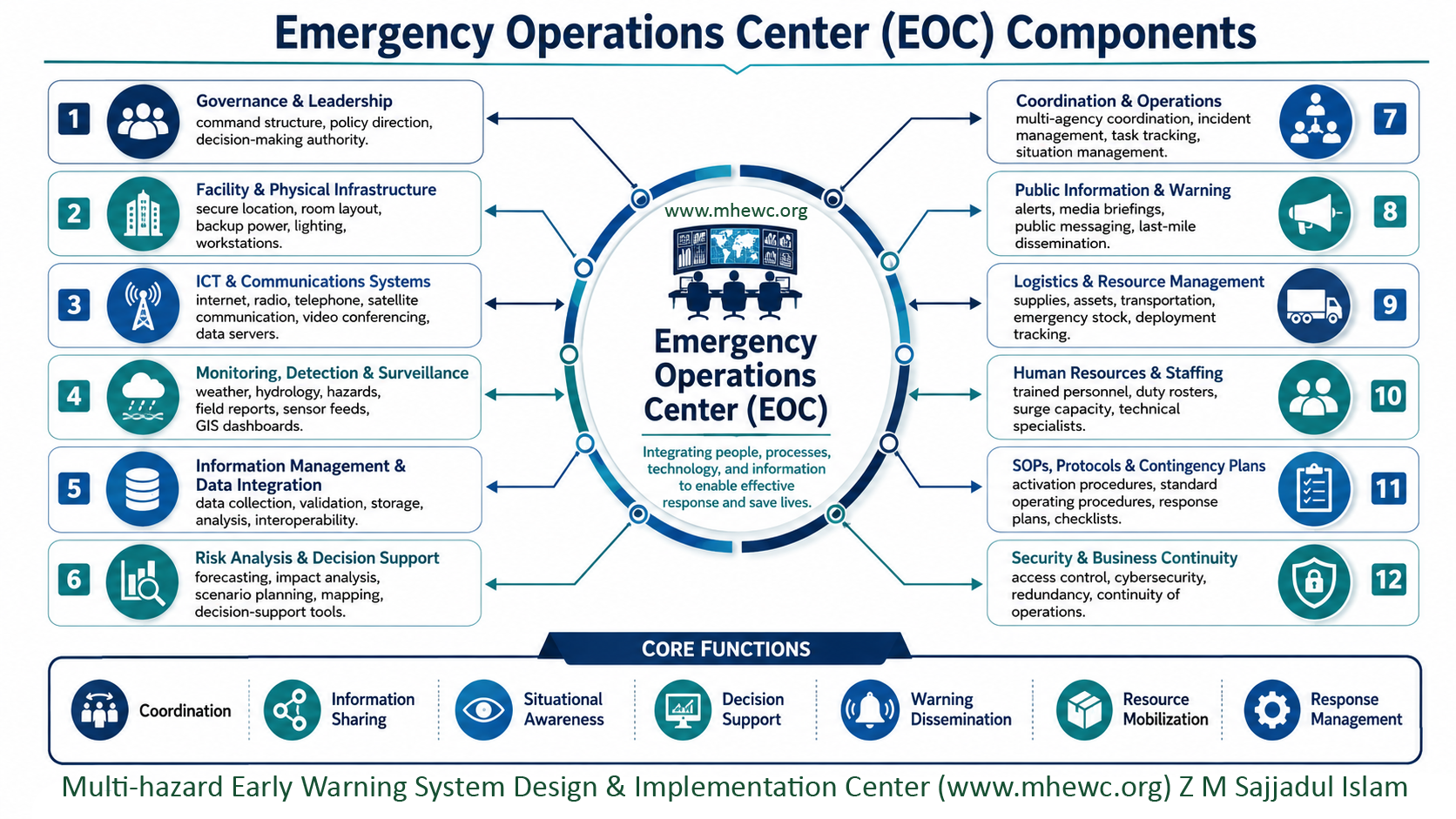
The assessment will cover:
- EOC location, accessibility, physical security, workspace design, and operational layout;
- Command, control, coordination, communication, and information-management arrangements;
- Incident-management and emergency decision-making structures;
- EOC system architecture and technical design;
- ICT infrastructure, servers, computers, displays, dashboards, communication equipment, software platforms, databases, and backup systems;
- Integration with meteorological, hydrological, geological, health, security, humanitarian, and local-government information systems;
- Availability of emergency communication channels, including radio, telephone, satellite communication, mobile communication, email, web-based platforms, and mass-notification systems;
- Operational staffing, duty rosters, surge arrangements, technical support, and round-the-clock operational capacity;
- Standard operating procedures, activation protocols, escalation procedures, incident-action planning, reporting procedures, and deactivation arrangements;
- Capacity for receiving, integrating, validating, analysing, and visualizing field-level information;
- Capacity for processing situation reports, damage information, needs information, resource requests, operational updates, and early warning information;
- Field-level data-ingestion arrangements through mobile applications, survey tools, local government systems, sensors, monitoring stations, emergency responders, community volunteers, and humanitarian partners;
- Interoperability between national, subnational, district, municipal, and field-level emergency coordination systems;
- Data backup, cybersecurity, system redundancy, business continuity, and disaster-recovery arrangements;
- EOC simulation exercises, testing, maintenance, after-action reviews, and continuous improvement mechanisms.
EOC Capacity Assessment Framework
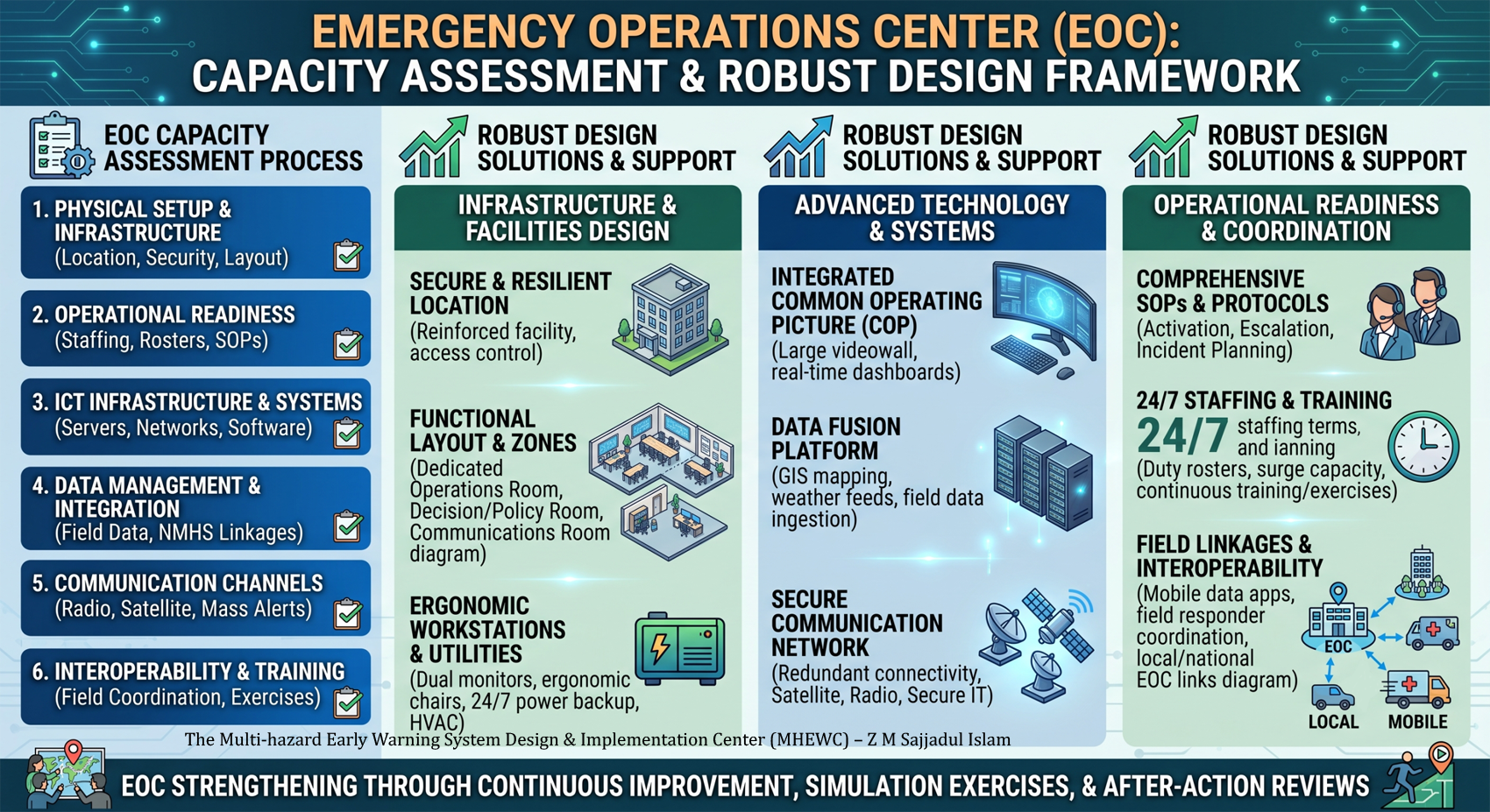
MHEWC defined this framework, organized into five critical pillars of EOC functionality, to ensure a comprehensive evaluation of current capacity and requirements for robust design.
Pillar 1: Existing Facility and Infrastructure (Physical & Technical Design)
This pillar assesses the physical base, required hardware and system architecture, sensor-based data ingestion network, and UAV/AI tools for the EOC to function.
- Location and Accessibility: Is the EOC in a suitable, accessible area, with adequate physical security protocols?
- Physical Layout: Does the workspace design support efficient operations, workflow, and collaboration among different teams?
- System Architecture and Design: Evaluate the overall EOC system architecture and technical design to ensure scalability, reliability, and modern efficiency.
- ICT Infrastructure: Assess the adequacy and robustness of hardware (servers, computers, displays, dashboards), software platforms, databases, and backup systems, and propose fully automated, integrated ICT, AI, Database, Hardware, Software, AI robots, and networking infrastructure.
- Information System Integration: How well do the ICT systems integrate data from external sources (meteorological, hydrological, geological, health, security, humanitarian, local government)?
Pillar 2: Command, Control, and Coordination
This pillar evaluates the leadership and organizational structures required to manage an emergency.
- Command and Decision-Making: Are there clear arrangements for command, control, coordination, communication, and information management?
- Incident Management Structure: Assess the effectiveness of incident-management and emergency decision-making structures.
- Interoperability: Evaluate the ability of the national EOC to coordinate seamlessly with subnational, district, municipal, and field-level emergency systems.
Pillar 3: Information Management and Technology (IM/T)
This pillar is the ‘brain’ of the EOC, examining how information is gathered, processed, analyzed, and disseminated.
- Communication Channels: Verify the availability of diverse, redundant emergency communication channels (radio, telephone, satellite, mobile, email, web-based platforms, mass-notification systems).
- Data Ingestion Arrangements: Assess mechanisms for receiving field data via mobile apps, survey tools, local systems, sensors, responders, volunteers, and humanitarian partners.
- Data Validation and Analysis: Evaluate the capacity to receive, integrate, validate, analyze, and visualize field-level information.
- Processing and Reporting: Review capacity to process key information types: situation reports (SITREPs), damage info, needs info, resource requests, operational updates, and early warning info.
- Resilience and Recovery: Assess data backup, cybersecurity, system redundancy, business continuity, and disaster-recovery arrangements.
Pillar 4: Operations and Processes
This pillar covers the ‘rules of engagement’ – the documented procedures that guide EOC activity.
- Standard Operating Procedures (SOPs): Do formal SOPs exist, and are they understood by staff?
- Activation and Escalation: Evaluate the clarity and functionality of activation protocols and escalation procedures.
- Planning and Deactivation: Review incident-action planning, reporting procedures, and deactivation arrangements.
Pillar 5: Staffing and Personnel
This pillar ensures that qualified people are available and supported to operate the EOC 24/7.
- Staffing Levels: Are there adequate operational staff to maintain round-the-clock (24/7) operational capacity when needed?
- Duty Rosters and Support: Assess the robustness of duty rosters, technical support availability, and surge arrangements during peak demand.
- Testing and Improvement: Evaluate the frequency and quality of EOC simulation exercises, testing, maintenance, after-action reviews, and mechanisms for continuous improvement.
Contact MHEWC
To have a detailed EOC Assessment Framework and Technical Design Concept, please contact:
For EOC institutional assessment, technical design, system architecture, ICT integration, geospatial decision-support systems, emergency communication design, SOP development, training, simulation, and operational-capacity strengthening, please contact:
Z M Sajjadul Islam
Advisor, Multi-Hazard Early Warning System Design & Implementation Center (MHEWC)
Email: zmsajjad@gmail.com
WhatsApp: +88 01711 979179