Early Warning for All (W4ALL) Implementation Barriers, Challenges, and Gaps
© All rights reserved by Z M Sajjadul Islam, Advisor, Multi-Hazard Early Warning System Design and Implementation Center (MHEWC).
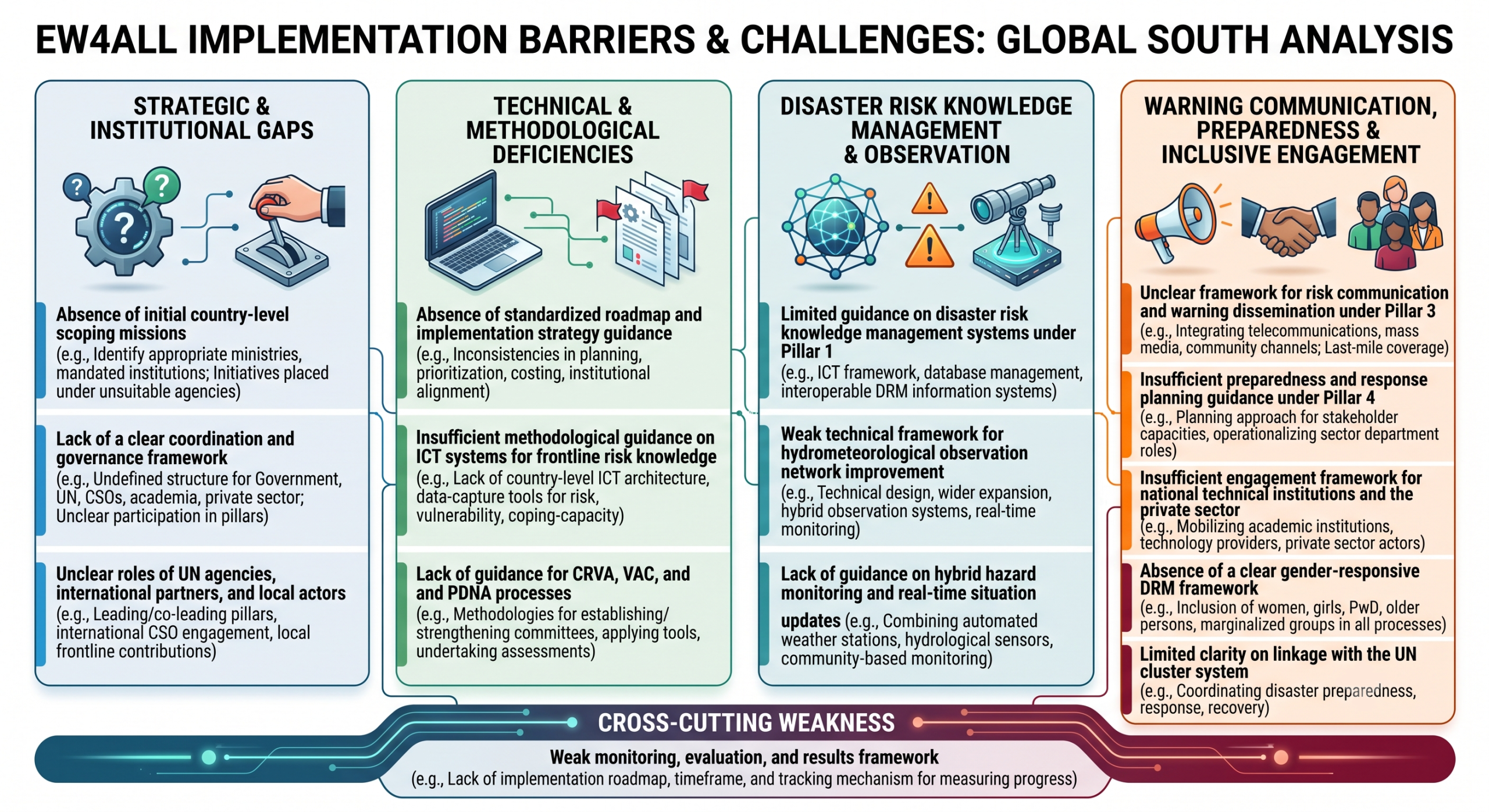
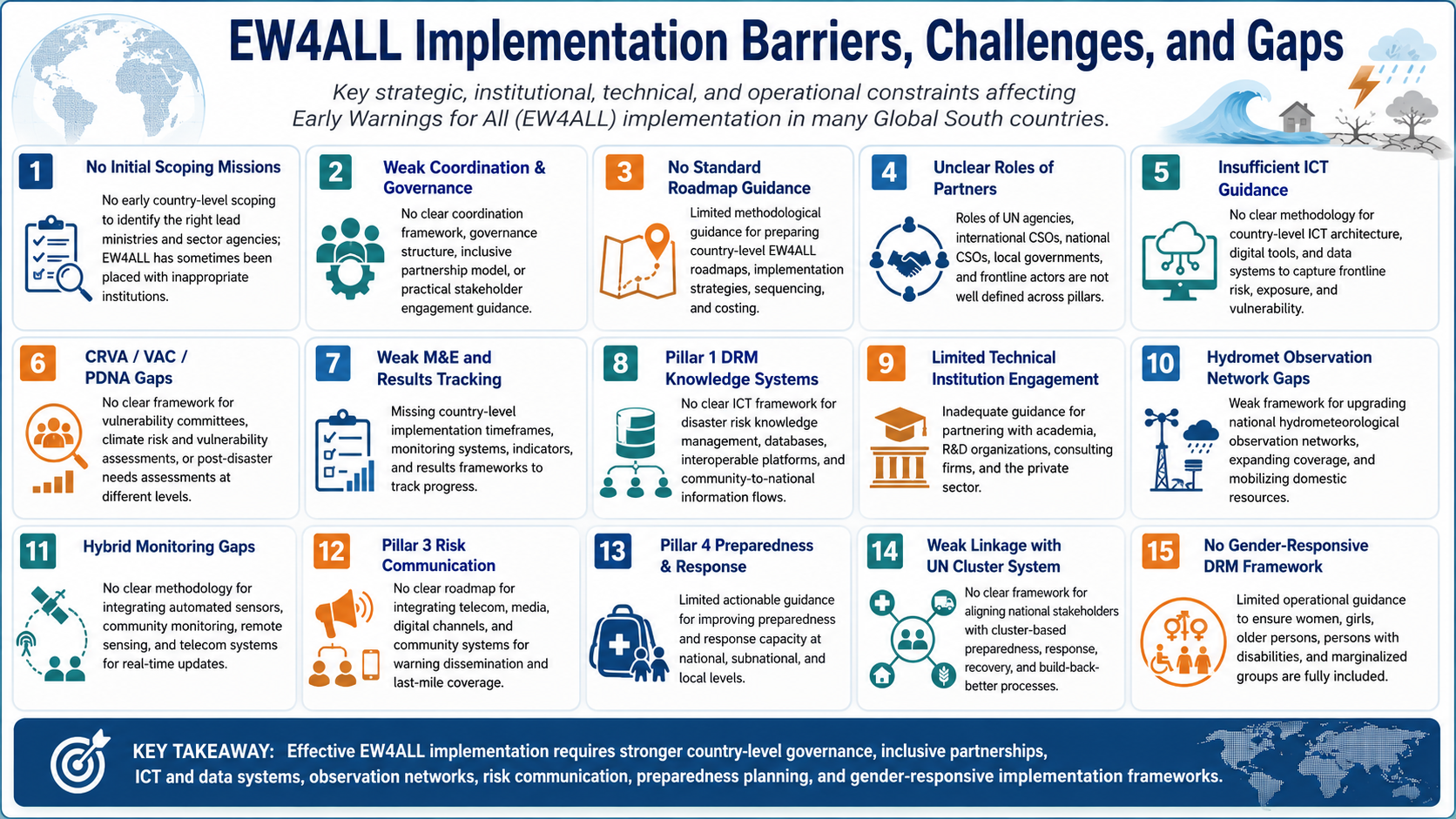
The implementation of Early Warnings for All (EW4ALL) in many Global South countries faces several strategic, institutional, technical, and operational barriers. Key challenges and gaps include the following:
• Absence of initial country-level scoping missions:
In many countries, no comprehensive scoping mission was conducted at the outset with key national actors to identify the most appropriate ministries, sector departments, and mandated institutions to lead or support EW4ALL implementation. As a result, the initiative has, in some cases, been placed under agencies that may not have the required mandate, technical capacity, coordination authority, or sectoral reach to effectively drive the agenda.
• Lack of a clear coordination and governance framework:
EW4ALL does not yet provide a sufficiently clear coordination framework, structural approach, inclusive partnership mechanism, or actionable stakeholder engagement guideline for government agencies, UN entities, civil society organizations, frontline actors, academia, private sector institutions, and community-based organizations. There is also limited clarity on how these actors should participate in and contribute to the implementation of each EW4ALL pillar.
• Absence of standardized roadmap and implementation strategy guidance:
There is no clear framework or methodological guideline for developing country-level EW4ALL roadmaps and implementation strategies. This has resulted in inconsistencies in planning quality, sequencing, prioritization, costing, institutional alignment, and implementation readiness across countries.
• Unclear roles of UN agencies, international partners, and local actors:
There is no well-defined framework outlining how UN agencies should lead or co-lead specific pillars, how international CSOs and technical partners should engage, and how national and local CSOs, local governments, and frontline stakeholders should contribute to pillar-specific roadmap implementation.
• Insufficient methodological guidance on ICT systems for frontline risk knowledge:
EW4ALL lacks clear technical guidance on the required country-level ICT architecture, deployable IT facilities, digital tools, and data-capture instruments needed to collect and manage frontline risk, vulnerability, exposure, and coping-capacity information. This gap continues to impede the transition from traditional risk-management practices to data-driven, real-time, community-informed risk knowledge systems capable of addressing increasingly intense and fast-evolving hazardous weather events.
• Lack of guidance for climate risk and vulnerability assessment (CRVA), Vulnerability Assessment Committee (VAC), and Post-Disaster Damage, Loss, and Needs Assessment (PDNA) processes:
There is no clear roadmap, framework, partnership model, or methodological guideline for establishing or strengthening Vulnerability Assessment Committees, conducting Climate Risk and Vulnerability Assessments, applying CRVA tools, engaging stakeholders, and undertaking Post-Disaster Needs Assessments at local, sub-national, and national levels.
• Weak monitoring, evaluation, and results framework:
Many countries lack a clear EW4ALL implementation roadmap, timeframe, monitoring and evaluation framework, and results-tracking mechanism. This limits the ability to measure progress, identify bottlenecks, assess institutional performance, and track outcomes across the four pillars.
• Limited guidance on disaster risk knowledge management systems under Pillar 1:
There is no clearly proposed ICT framework for disaster risk knowledge management, including data-capture tools, database management systems, interoperable DRM information systems, and open-ended digital platforms to support risk knowledge generation, updating, sharing, and use from national to community levels.
• Insufficient engagement framework for national technical institutions and the private sector:
EW4ALL does not provide sufficient guidance on how sector departments, national academic institutions, research and development organizations, consulting firms, technology providers, and private-sector actors can be formally partnered, coordinated, and mobilized for inclusive and technically robust implementation.
• Weak technical framework for hydrometeorological observation network improvement for Pillar 2:
There is no comprehensive guideline or structural improvement framework for upgrading national hydrometeorological observation networks. Although the UN Systematic Observations Financing Facility provides some financing pathways for observation-system strengthening, there remains limited guidance on technical design, domestic resource mobilization, wider network expansion, hybrid observation systems, hazard-tracking mechanisms, real-time event monitoring, and rapid ground-level impact data collection.
• Lack of guidance on the hazard monitoring hybrid network and real-time situation updates for Pillar 2/3:
EW4ALL does not yet provide a clear methodology for installing, activating, and integrating hybrid observation systems that combine automated weather stations, hydrological sensors, community-based monitoring, remote sensing, telecommunications, and local reporting mechanisms for hazard tracking, real-time event situation updates, and immediate impact information gathering.
• Unclear framework for risk communication and warning dissemination under Pillar 3:
There is no detailed roadmap on how existing telecommunications networks, mass media platforms, community communication systems, and digital channels should be integrated for multi-hazard risk communication, alerting, warning dissemination, and public awareness. Guidance is also limited on how to upgrade risk communication systems for hybrid and last-mile coverage, and how national media outlets should define their roles and responsibilities in supporting Pillar 3 implementation down to the community level.
• Insufficient preparedness and response planning guidance under Pillar 4:
There is no clear framework, guideline, or actionable planning approach for strengthening the preparedness and response capacities of national, sub-national, and local stakeholders. There is also limited guidance on how sector departments should coordinate, partner, and operationalize their respective roles under Pillar 4.
• Limited clarity on linkage with the UN cluster system:
There is no clear framework or guideline on how national stakeholders should participate in, coordinate with, or complement the UN cluster system at the country level, particularly in relation to disaster preparedness, response, recovery, and build-back-better processes.
• Absence of a clear gender-responsive DRM framework:
EW4ALL lacks a comprehensive gender-responsive disaster risk management framework and operational guidelines to ensure that women, girls, persons with disabilities, older persons, and other marginalized groups are meaningfully included in risk knowledge generation, warning communication, preparedness planning, anticipatory action, response, and recovery processes.
MHEWC is pleased to assist UN Agencies, INGOs, and country-level focal agencies in designing and implementing EW4ALL. Email your comments/interests to zmsajjad@gmail.com