African Countries :
Barriers to Last-Mile Early Warning Dissemination and Risk Communication in African Countries :
1.0 Overview of Indicative Barriers :
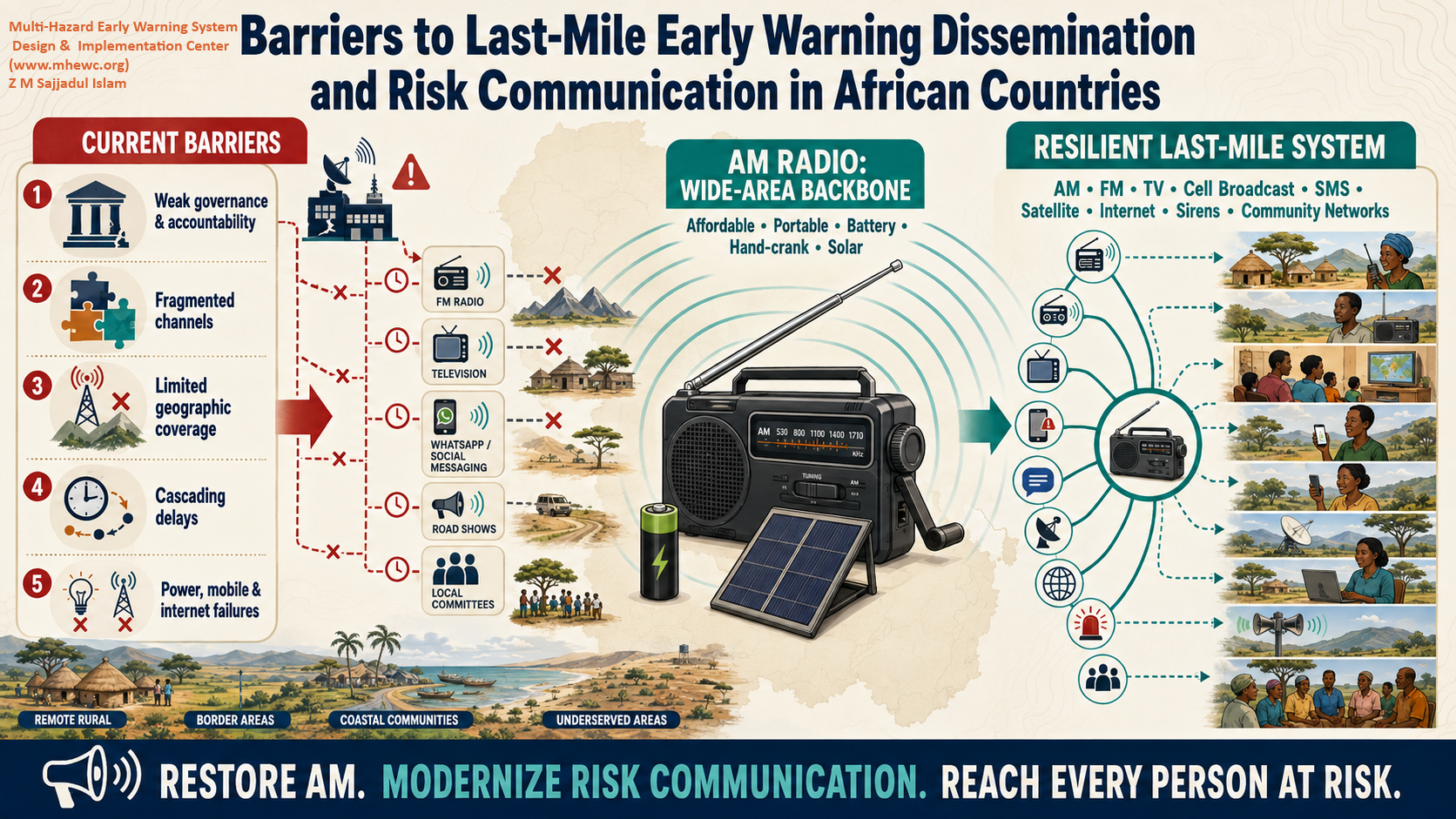
Barriers to modernizing risk communication dissemination channels in many African countries are deeply intertwined with prevailing governance structures, entrenched institutional mindsets, and a lack of accountability, with no one there to hold them accountable for taking the right initiatives. There are a lots of international agencies are working out but we will noticed that there are still no robust level multi-chanel risk communication framework, structural desgin , inslltations and oprational , It does not necessarly demand and dependece in costly technology deplyment, rather having understadablity, acoountability, willineness of goverments technical buracrats to easily implemnt the system so that every corner of the country population be reached out and acccessible to multi-chanel broaccasting and warning system.
In many African countries are deeply knotted with accountability to the affected population of prevailing governance structures, lack of consolidated and cohesive institutional initiatives, limited technical and operational leadership, fragmented responsibilities etc. In many cases, there is no clearly designated authority responsible for ensuring that the necessary modernization initiatives are actually planned, financed, implemented, maintained, and periodically evaluated.
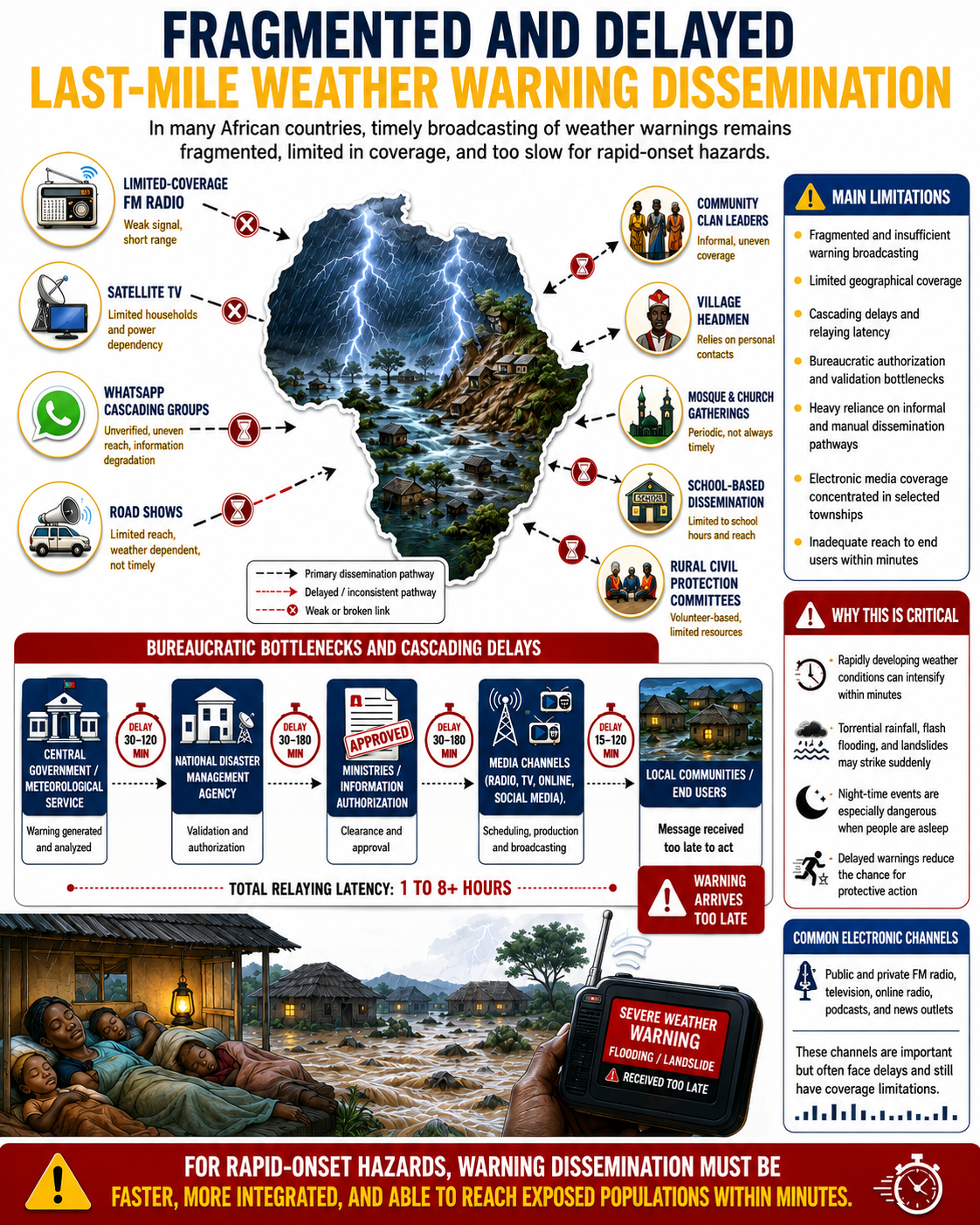
Our observations noted that in many African countries, the most timely broadcasting of weather warnings and alerts is extremely fragmented and insufficient, with limited geographical coverage, and, due to cascading delays, relaying latency, and being inappropriate for reaching end users within minutes. They heavily depend on limited-coverage FM radio, satellite TV, WhatsApp cascading groups, road shows, community-based clan leaders, village headmen, mosque- and church-based gatherings for prayer, school-based warning dissemination, and the civil protection committee (rural level) to call meetings and spread the warning in the localities. Think about the rapidly developing weather conditions- torrential rainfall, flash flooding, landslides- that can trigger in a few minutes and even in the night when people are sleeping!!! The electronic broadcasting channels in Africa are commonly recognized as public and private media, including FM radio, television, online radio, podcasts, and news outlets, and are used to provide last-mile warnings and alerts, but they face cascading delays and latencies due to bureaucratic authorizations and validation issues by the central governments and national disaster mangemnt agencies. However, all those channels have limitations in geographic coverage and in the user groups they select (townships).
The AM Radio (pocket radio with battery, windup, and solar PV-powered) set is free of cost and operational, and the lowest-cost portable option for any individual in the country, particularly for dispersed settlements in hard-to-reach areas. This raises a critical question: why should a proven AM radio for wide-area public-warning capability be withdrawn from operational use?
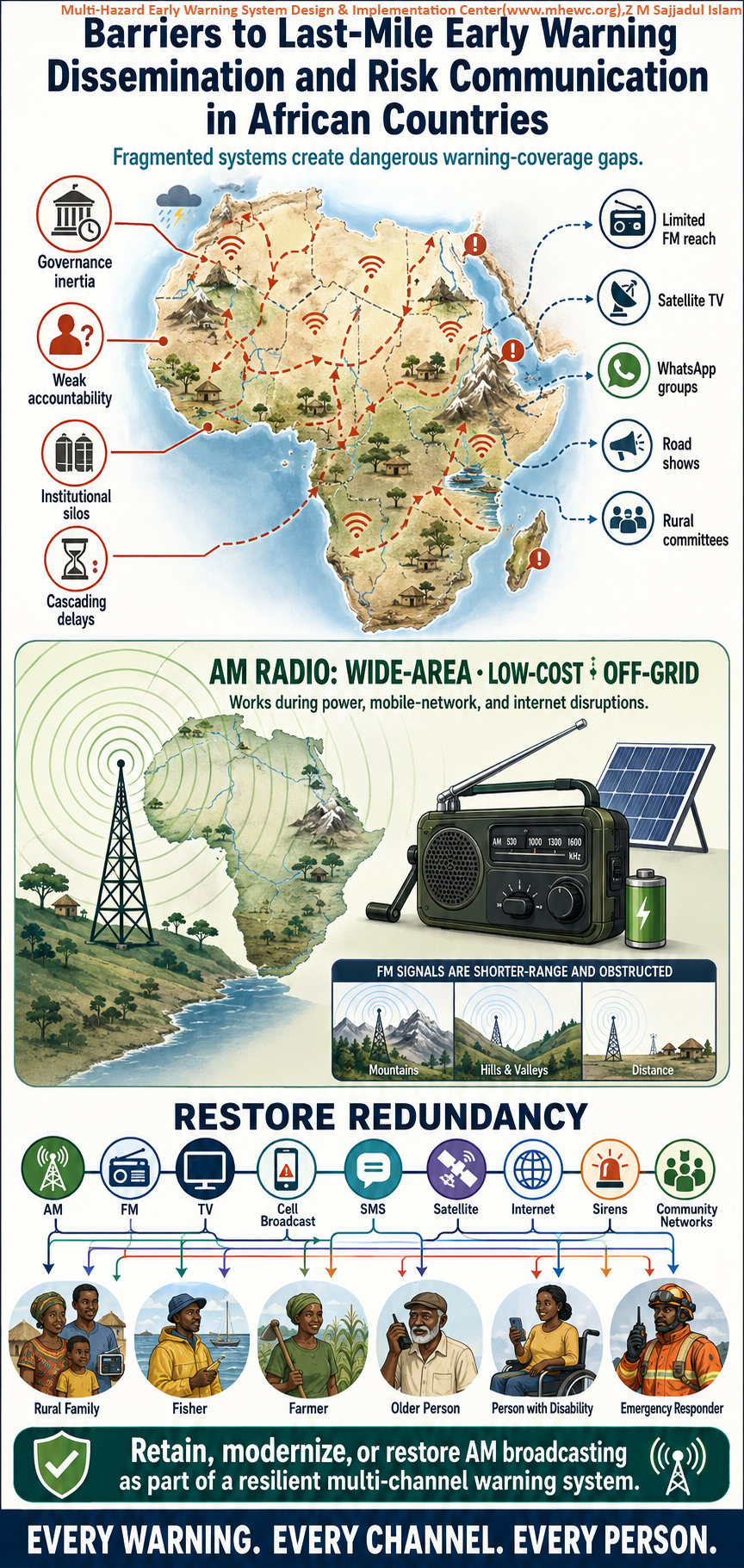
The strategic importance of AM broadcasting for nationwide early warning cannot be overstated. High-power medium-wave transmitters can cover vast geographic areas, while affordable, portable, battery-powered radios enable communities to receive warnings even in remote locations or during disruptions to electricity, mobile networks, and internet services. FM broadcasting remains highly valuable and generally provides superior audio quality; however, its predominantly line-of-sight transmission has a more limited geographic range and can be significantly affected by terrain, physical obstructions, transmitter locations, and network density.
Although AM broadcasting is also subject to interference, fading, and other technical limitations, its elimination could create critical warning-coverage gaps, particularly in remote, rural, border, coastal, and otherwise underserved areas. Governments should therefore retain, modernize, or restore AM broadcasting capacity wherever necessary and strengthen it through strategically located transmitters, repeaters, and retransmission facilities.
AM broadcasting should form part of a redundant, interoperable, and multi-channel warning system that also instantly relays broadcasts via VHF and UHF radio networks/operators, public and private FM radio, television, cell broadcast, SMS, satellite communications, internet-based platforms, sirens, community-based networks, and drone-assisted communication systems for hard-to-reach areas and search-and-rescue operations. Linking these channels through coordinated protocols will help ensure that authoritative and actionable warnings reach every person at risk, including last-mile communities, during routine emergencies as well as catastrophic communication failures. Such a redundant, multi-channel approach is essential to ensure that authoritative warnings reach everyone at risk, including those in the last mile, during both routine emergencies and catastrophic communication failures.
1.1 The technology itself is not prohibitively expensive; rather, the principal barrier is limited government ownership, commitment, and institutional responsibility.
It does not necessarily have to be the barriers of any costly national investment issues for costly technology deployment, but rather only the political mindset and accountability of the government and concerned ministries and policymakers to implement these essential services in a month. Africa is geographically positioned in the tropical and sub-tropical zones, where hydrometeorological rapid-onset events are intensifying amid global climate perturbations, including cyclones, rapidly developing thunderstorms, cloudbursts, torrential rains, hailstorms, damaging winds, etc., resulting in loss of life and assets.
Although numerous international agencies, development partners, and humanitarian organizations have been supporting early warning and risk communication initiatives across the continent, many countries still lack a robust, nationally integrated, multi-channel risk communication and warning dissemination framework, approach, system retrofitting, and operational readiness. Political governments and bureaucrats still need to consider that much of Africa is terrain- and landscape-wise vulnerable, which can trigger disasters with very rapid onset.
Modernizing such systems does not necessarily require dependence on highly sophisticated or prohibitively expensive technologies. In many contexts, the greater requirement is institutional understanding, political commitment, accountability, technical willingness, clear operational responsibility, and effective coordination among government agencies, technical institutions, broadcasters, telecommunications providers, local authorities, and community structures.
Governments and responsible technical institutions should therefore prioritize the establishment of practical, interoperable, redundant, and affordable multi-channel warning dissemination systems capable of reaching populations in every part of the country. This should combine appropriate technologies and communication networks such as radio, television, mobile networks, cell broadcast, SMS, satellite communication, sirens, internet platforms, social media, emergency telecommunications, and community-based dissemination mechanisms so that people in urban, rural, remote, coastal, border, and otherwise underserved locations can reliably receive, understand, and act upon authoritative warnings.
1.2 What is the ground-level reality? What is the existing system in place?
Our observations noted that in many African countries, the most timely broadcasting of weather warnings and alerts is extremely fragmented and insufficient, with limited geographical coverage, and, due to cascading delays, relaying latency, and being inappropriate for reaching end users within minutes. They heavily depend on limited-coverage FM radio, satellite TV, WhatsApp cascading groups, road shows, community-based clan leaders, village headmen, mosque- and church-based gatherings for prayer, school-based warning dissemination, and the civil protection committee (rural level) to call meetings and spread the warning in the localities. Think about the rapidly developing weather conditions- torrential rainfall, flash flooding, landslides- that can trigger in a few minutes and even in the night when people are sleeping!!! The electronic broadcasting channels in Africa are commonly recognized as public and private media, including FM radio, television, online radio, podcasts, and news outlets, and are used to provide last-mile warnings and alerts, but they face cascading delays and latencies due to bureaucratic authorizations and validation issues by the central governments and national disaster management agencies. However, all those channels have limitations in geographic coverage and in the user groups they select (townships).
1.3 Lack of risk communication framework , tangled bureaucracies and siloed approach :
Lack of cohesive central government jurisdiction, mandates, and strides to have a framework to integrate the existing fragmented approach of the Ministry of Communication, national telecom authorities, broadcasters, and media outlets, which are working as silos. The government can easily create a level playing field by creating mandated partnerships and coordination structures, a policy framework, law, and reinforcement in making all relevant actors accountable to render risk communication services for the whole of society responsibilities. MHEWC intended to support all stakeholders in organizing a partnership dialogue, identifying the gaps and barriers, and consolidating the process for operationalizing the system at the end of the day.
Although national circumstances vary considerably across Africa, recurring barriers to the modernization of risk communication and warning-dissemination systems are often deeply connected to prevailing governance arrangements, fragmented institutional responsibilities, entrenched organizational mindsets, inadequate investment, and weak accountability mechanisms. In some cases, there is no clear mechanism for holding the government accountable, and there are no cheap options for wider coverage of broadcast warnings. Therefore, to date, there is a lack of governmental efforts to redefine stakeholder engagement; e.g., the institution needs to be clearly mandated or held accountable for ensuring that an authoritative warning reaches every person at risk in the shortest possible time.
1.4 Structural and governance bottlenecks:
1.4.1 Why are governments not taking serious steps to operationalize the system?
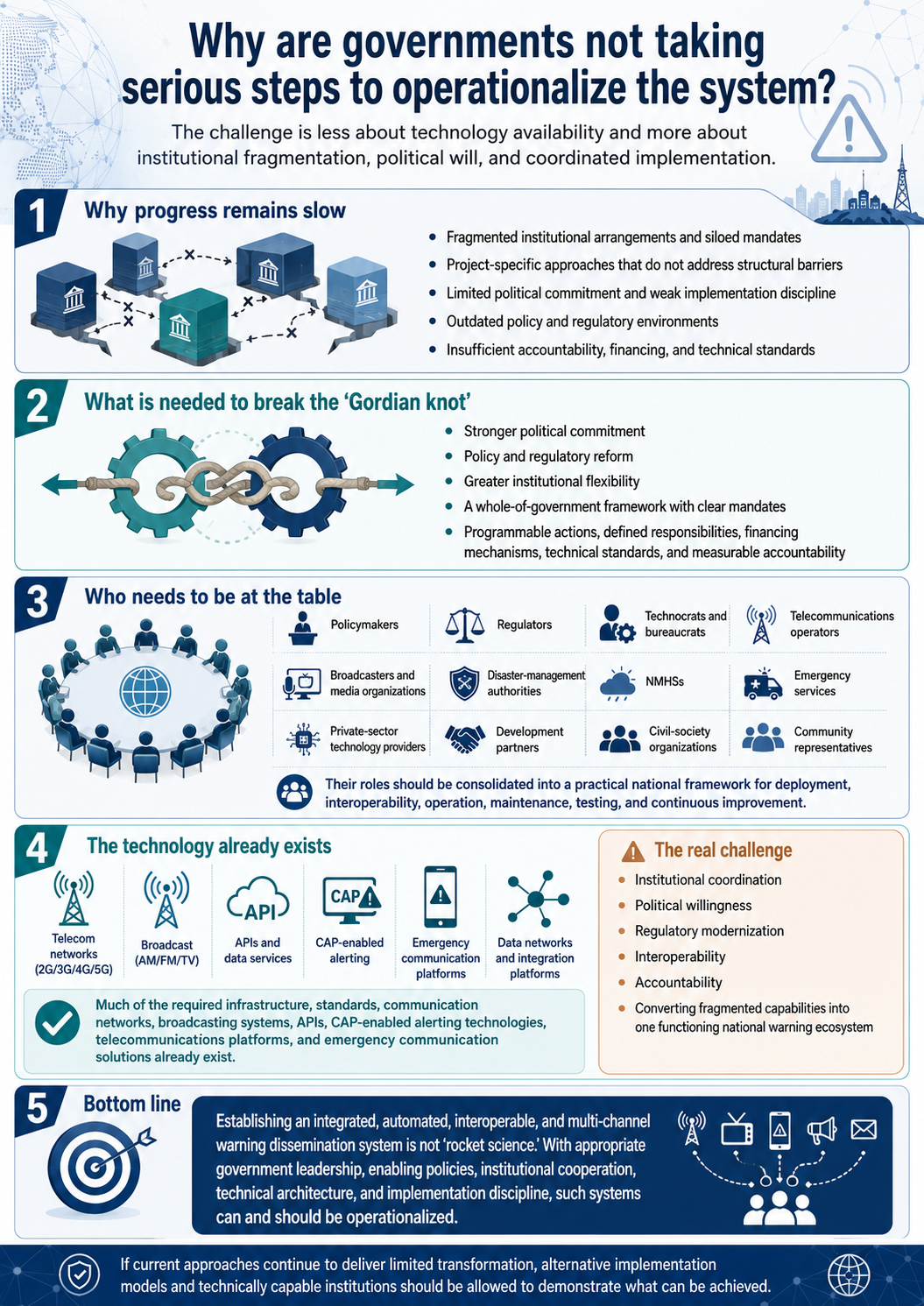
As mentioned above, there is a serious lack of cohesive central government jurisdiction, mandates, and strides to have a framework to integrate the existing fragmented approach of the Ministry of Communication, national telecom authorities, broadcasters, and media outlets, which are working as silos. International agencies and development partners also appear, in many cases, to remain constrained by these fragmented institutional arrangements and project-specific approaches rather than helping governments dismantle the underlying structural barriers. Breaking this institutional “Gordian knot” requires stronger political commitment, policy and regulatory reform, greater institutional flexibility, and a clearly mandated whole-of-government framework supported by programmable actions, defined responsibilities, financing mechanisms, technical standards, and measurable accountability.
What is needed is a coordinated multi-stakeholder implementation mechanism that brings policymakers, regulators, technocrats, bureaucrats, telecommunications operators, broadcasters, media organizations, disaster-management authorities, NMHSs, emergency services, private-sector technology providers, development partners, civil-society organizations, and community representatives to the same table. Their respective roles should then be consolidated into a practical and actionable national framework for system deployment, interoperability, operation, maintenance, testing, and continuous improvement.
The challenge is therefore not primarily that the required technologies are unavailable or technically impossible to deploy. Much of the necessary infrastructure, standards, communication networks, broadcasting systems, APIs, CAP-enabled alerting technologies, telecommunications platforms, and emergency communication solutions already exist. The greater challenge lies in institutional coordination, political willingness, regulatory modernization, interoperability, accountability, and the determination to convert existing fragmented capabilities into one functioning national warning ecosystem.
If existing approaches continue to produce limited transformation, alternative implementation models and technically capable institutions should be given the opportunity to demonstrate what can be achieved. MHEWC maintains that establishing an integrated, automated, interoperable, and multi-channel warning dissemination system. With appropriate government leadership, enabling policies, institutional cooperation, technical architecture, and implementation discipline, such systems can and should be operationalized.
1.4.2 Why has AM Radio (Amplitude Modulation Radio) been taken out???
However, we noticed that AM Radio(Amplitude Modulation Radio) has been taken out in most African countries, knowing that how significant it is to reach every geographical pocket of the country and even beyond. The AM Radio (pocket radio with battery, windup, and solar PV-powered) set is free of cost and operational, and the lowest-cost portable option for any individual in the country, particularly for dispersed settlements in hard-to-reach areas. This raises a critical question: why should a proven, wide-area public-warning capability be withdrawn from operational?
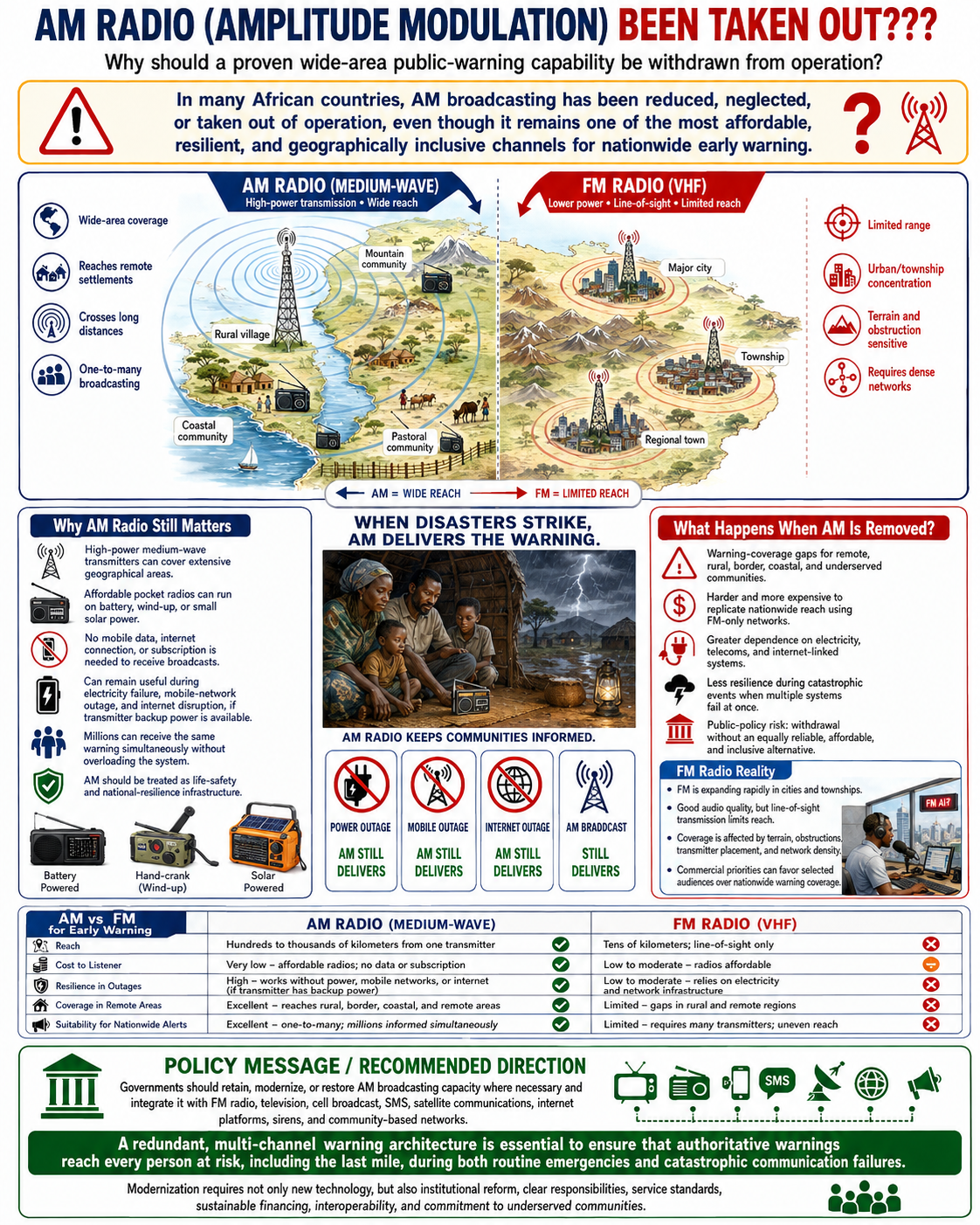
The strategic importance of AM broadcasting for nationwide early warning cannot be overstated. High-power medium-wave transmitters can cover extensive geographical areas, while warnings can be received through affordable, portable, and battery-powered radios even in remote locations and during electricity, mobile-network, or internet disruptions.
In many African countries, AM broadcasting, particularly medium-wave services, has been reduced, neglected, or taken out of operation. This trend deserves urgent examination because AM broadcasting can provide an extensive geographic reach that is difficult or expensive to reproduce through a network consisting exclusively of FM transmitters.
High-power medium-wave AM transmitters can cover large territories, including dispersed settlements and areas located far from major cities. Warnings can be received through relatively inexpensive, portable radios powered by replaceable batteries, rechargeable batteries, hand-crank mechanisms, or small solar panels. Once a receiver has been acquired, listeners generally do not need to pay subscription charges, purchase mobile data, or maintain an internet connection to receive broadcasts.
AM reception can remain available during electricity failures, mobile-network outages, internet disruptions, and other communication breakdowns, provided that the transmitting station has resilient backup power and the receiving population has functioning radios. Unlike mobile networks, conventional broadcasting is a one-to-many service: millions of people can receive the same message simultaneously without overloading the transmission system.
This raises a critical public-policy question: why should a proven wide-area public-warning capability be withdrawn without first demonstrating that an equally reliable, affordable, resilient, and geographically inclusive alternative is operational?
Decisions concerning AM infrastructure should not be based solely on commercial audience trends, audio quality, or the operating costs of high-power transmitters. AM broadcasting used for public warning should be evaluated as part of a country’s life-safety and national-resilience infrastructure. Its social value becomes particularly important during catastrophic events when electricity, telecommunications, roads, and internet services may fail simultaneously.
1.5 Why are FM Radio Broadcasters imposing greater subscription amounts even though it’s limited in the extent of geographical coverage of audiences??
We have noticed that FM radio is rapidly expanding in many African countries, particularly in cities and townships! It sounds good! We understand that FM broadcasting remains subject to some geographical coverage restrictions, and, in addition, it relies on subscriptions among African audiences, although it receives advertising incentives from commercial advertising. Generally, FM provides better audio quality at the frequency periphery; however, its predominant line-of-sight transmission typically has a more limited geographical range and can be significantly affected by terrain, physical obstructions, transmitter locations, and network density.
Although AM broadcasting is not immune to interference, fading, or other technical limitations, eliminating it may create serious warning-coverage gaps, particularly for remote, rural, border, coastal, and underserved communities. Governments should therefore retain, modernize, or restore AM broadcasting capacity where necessary, and other privately running FM radio, television, cell broadcast, SMS, satellite communications, internet platforms, sirens, and community-based networks can easily affiliate and broadcast to the last mile. Such a redundant, multi-channel approach is essential to ensure that authoritative warnings reach every person at risk, including the last mile, during both routine emergencies and catastrophic communication failures. Modernization is therefore not simply a matter of purchasing new technologies. It requires institutional reform, clear operational responsibilities, enforceable service standards, sustainable financing, interoperability, and a commitment to protecting all communities, including people living in remote, rural, coastal, border, mountainous, pastoral, and otherwise underserved areas.
1.6 Fragmented and Delayed Warning Dissemination:
Our observations indicate that weather-warning and emergency-alert dissemination remains fragmented and insufficient in many African countries. Geographic coverage is often uneven, while the transmission of warnings may involve multiple institutional handovers, manual approvals, telephone calls, emails, messaging groups, and administrative clearances. These cascading procedures can create serious delays between the issuance of an official warning and its receipt by communities.
The central government , National Disaster Management Agency, Ministry of Communication, and local governments are fragmented in agreeing on a very easy and one-stop solution to this problem: an integrated broadcasting network and communication system. International agencies are also not giving actionable advice.
Because of the terrain landscape and hydrometeorological multi-hazards (cloud-bursts, torrential rainfall, squally & gusty damaging winds, tornadoes, rapidly developing thunderstorms, hailstorms, tropical storms ) , they are occurring with very sudden onset. The rapidly evolving emergencies(even at midnight), such as flash floods, severe thunderstorms, tropical cyclones, storm surges, landslides, wildfires, or dam-related incidents, can cause life-threatening consequences and catastrophes even with a shorter delay. Now burning questions to policymakers: how can those disintegrated and fragmented, time-delay and latency-induced broadcasting and risk communication systems warn people in a few minutes to evacuate???
1.7 Limitations of the dissemination value chain :
The dissemination chain may depend heavily on limited-coverage FM radio, satellite television, WhatsApp groups, social media, roadshows, and civil-protection committees operating at the local or rural level. Each of these mechanisms has an important role, but none can independently guarantee nationwide, immediate, and inclusive warning coverage.
For example: FM radio can provide excellent audio quality and strong local programming, but its coverage is influenced by transmitter power, terrain, physical obstructions, antenna locations, and the density of the transmission network. Television can reach large audiences but normally requires electricity, reception equipment, and viewers to be watching when an emergency warning is issued. WhatsApp and other social-media platforms depend on smartphones, mobile data, electricity, digital literacy, network availability, and people being connected to the appropriate groups. Information can also be delayed, altered, or circulated without verification. SMS can reach many mobile subscribers, but delivery may be delayed during network congestion, and messages can fail to reach people without active mobile coverage or functioning handsets. Satellite television and satellite communication services can support wide-area dissemination but may remain inaccessible to low-income households and communities without the necessary equipment or reliable power. Roadshows are valuable for public awareness, preparedness education, and community engagement, but they are not suitable as the primary channel for issuing time-critical warnings. Civil-protection committees and community volunteers are essential for translating warnings into local action, but they require reliable upstream communication, training, equipment, financing, and clearly defined operating procedures. Online radio, podcasts, websites, and mobile applications can complement the warning system, but they depend on internet connectivity and are not always designed to interrupt users with urgent alerts. These limitations demonstrate that public and private broadcasters, including radio, television, online platforms, news agencies, and community media, must be treated as interconnected components of an integrated national warning system rather than as separate or informal communication outlets.
1.8 Lack of accountability and limited scope of authority of the district-level local government institutions:
Local authorities often have limited mandates, institutional authority, technical capacity, and financial resources to independently design, establish, and operationalize integrated risk communication and warning dissemination systems. Similar constraints are reported across many local government structures on the African continent, where sub-national institutions frequently depend on enabling policies, infrastructure, financing, and coordination mechanisms established at the central-government level. At the same time, international agencies and development partners may also find themselves constrained by fragmented institutional arrangements and project-specific implementation modalities. In some cases, interventions remain concentrated within individual institutions or sectors rather than addressing the broader structural, regulatory, and coordination barriers that prevent the establishment of an integrated national risk communication architecture. There is therefore an urgent need to strengthen engagement with central governments and encourage greater recognition of the risk communication value chain as a critical component of disaster risk reduction and public safety. A well-functioning risk communication and warning dissemination system can significantly contribute to protecting lives, livelihoods, infrastructure, and property, often through targeted institutional, regulatory, and operational improvements that do not necessarily require disproportionately large investments. Priority should therefore be given to strengthening institutional mandates, coordination mechanisms, interoperability, policy and regulatory arrangements, technical capacity, and incentives for collaboration across national and local authorities, telecommunications regulators and operators, broadcasters, media institutions, emergency services, and other relevant stakeholders. MHEWC can contribute to this process through direct strategic engagement with relevant government authorities, facilitating high-level dialogue, presenting practical system architecture and implementation options, and supporting governments in identifying feasible pathways for strengthening and operationalizing integrated risk communication and multi-channel warning dissemination systems. A slightly stronger formulation could position MHEWC not merely as an advocate, but as a technical implementation partner capable of demonstrating a workable national model
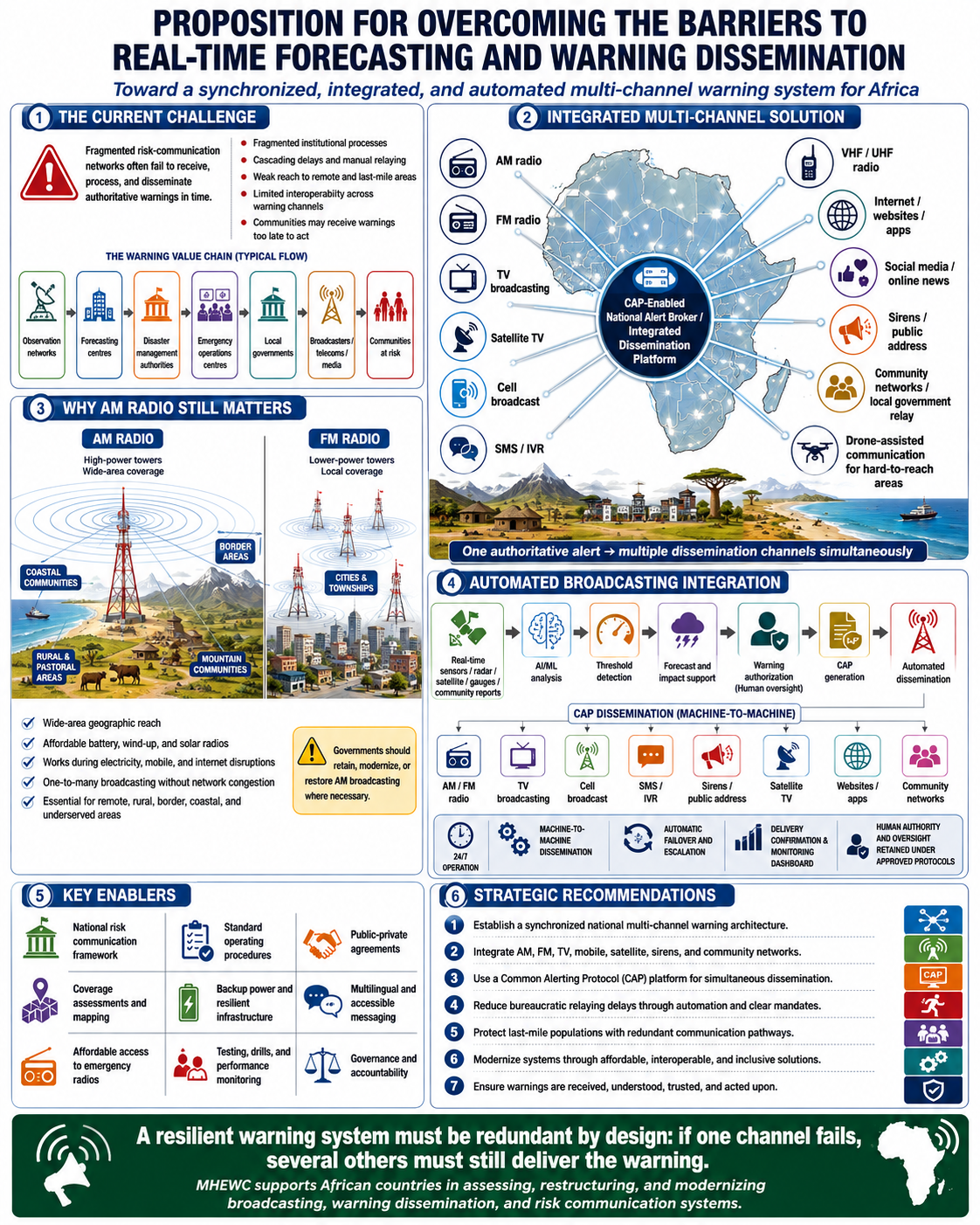
2.0 Proposition for overcoming the barriers to Real-Time Forecasting and Warning Dissemination
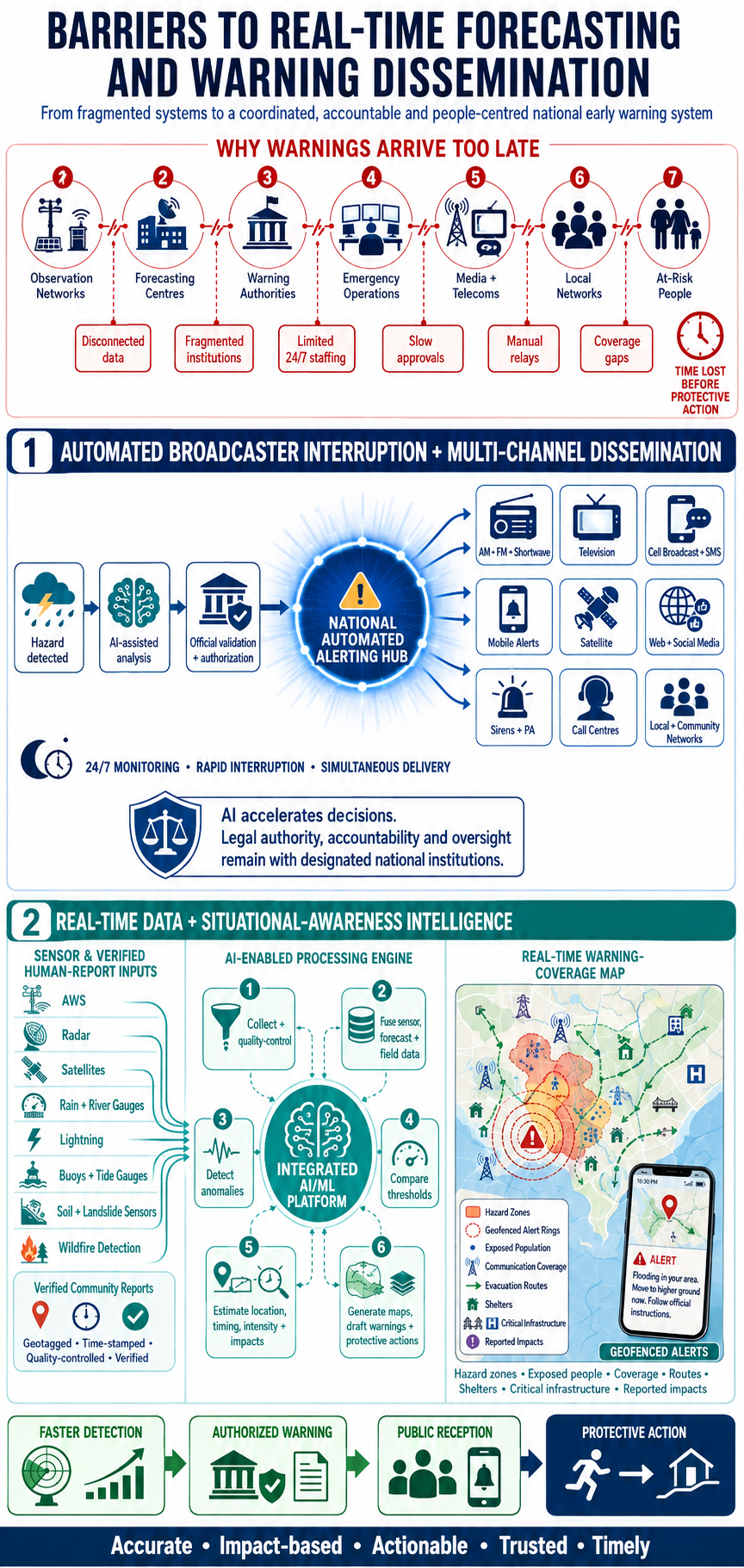
It is not rocket science for African countries to design, develop, deploy, and operationalize a synchronized, integrated multi-channel risk communication and warning dissemination networking system for reaching out to every geographical area, beyond the national boundaries and fishing vessels of the coasts. It is a very easy, less costly, and plug-and-play solution. Due to the lack of this robust networked system, real-time forecasting and warning capabilities remain a major challenge for many national hydrometeorological services and disaster-management authorities of the African countries. National risk-communication networks frequently fail to receive, process, and disseminate authoritative warnings within the limited time available before an emergency occurs. A synchronized, interoperable, and integrated system must therefore be established across the entire warning value chain. This system should connect observation networks, forecasting centres, disaster-management authorities, emergency operations centres, local governments, broadcasters, telecommunications providers, media outlets, community organizations, and at-risk populations through clearly defined standard operating procedures. The objective is to ensure that technically accurate, impact-based, and actionable forecasts and warnings reach exposed populations early enough for people to understand the danger, trust the information, and take appropriate protective action.
Solutions to Overcome the Barriers :
2.1 ) Is the risk communication system upgradation, deployment, and activation costly?
One good imperative for activation of multi-channel broadcasting and dissemination does not require much investment and deployment of sophisticated technologies; rather than retrofitting, synchronizing, and integrating existing multiple tools together with a automated system integration box of all existing facilities e.,g the conventional terrestrial radio system ( AM Radio station, FM radio station, defense/police department running UHF, VHF wireless network ), terrestrial TV broadcasting, Satellite TV, internet based web-TV, internet based web radio, mobile networks, telecommunication operators running system (SMS, cell broadcast, IVR, push message system ) WhatsApp group, internet platforms, automated sirens, social media, electronic and print media, cascading local governments & community-based message relay and transmission mechanism. So far, there is a need for a national risk communication framework, technology/tools integration, standard operating procedures, etc.
2.3) Immediate meeting with government ministry of communication and telecom operators and media outlets: Immediate meeting with central government, sector ministries and national ministry of media and communication to break the ice and untangle the Gordian knots that still pose as barriers to cohesive, participatory and inclusive solution. Identify the bottlenecks of collaboration of private cellphone and PSTN operators with government communication ministries in terms of rendering their CSR responsibilities to government and people of the country, rendering most incentivized warning/alerting services ( SMS, IVR, Cell broadcast, network relay and affiliation with local level risk communication hubs/broadcasters ) services to connecting grassroots level local government actors, NDMA/NDMO duty bearers, CSOs and other organizations who are the frontline DRM services providers.
2.4 ) How can the Multi-hazard Early Warning System Design & Implementation Center (www.mhewc.org) provide the technical solution for overcoming those barriers?
The Multi-Hazard Early Warning System Design & Implementation Center (MHEWC) is offering advisory and technical services for the whole paradigm shift and technical upgradation, developing policy, strategy, mandates, SoP for all government and non-government actors, and the private sector to complement the national integrated multi-channel broadcasting and risk communication system. MHEWC has understood what the bottlenecks and barriers are in the background. MHEWC urging all African countries’ governments, national authorities, sector ministries, stakeholders, and the above-mentioned service providers to have a meeting (physically and virtually), let-us present where you are now on this framework and system deployment, what you need to do next, what would be the least technology cost for proposed action framework and plan for keeping all last-mile people alerted with their own languages in the real-time mannered.
2.5 ) How to develop a new disaster risk management framework and anchor interactive multi-channel dissemination and risk communication network?
MHEWC has frameworks and approaches for African Countries(country-specific) on how easy and affordable technology and tools can facilitate, govern, and automate the entire phases of the disaster risk management system ( Risk knowledge and community awareness raising, multi-hazard preparedness, response, recovery, reconstruction, and building back better). We have the structure, programmatic, and actionable solution for African countries on how to utilize the above proposed multi-channel dissemination and risk communication network for a holistic national risk governance management system.
2.6 ) Installation of end-to-end broadcasting channel:
FM radio stations are now becoming very affordable for the last-mile civil protection committees : The government can explore this option for the installation of a 1kW FM Transmitter for community geographical coverage. The 1 kW FM Transmitter core unit and the basic solid-state models start around $3,000 only; their cost is going down as more upgradation is coming . The community-based disaster management committees/civil protection committees can operate this FM transmission to deliver last-mile national awareness-raising and warning dissemination.
A complete commercial FM radio station package capable of wide coverage (such as a 1kW system reaching up to roughly 100 km under ideal conditions) generally costs between $18,000 and $45,000+ for hardware and equipment, while high-power 10kW setups can exceed $34,000 for the transmitter alone
2.7 ) How to improve risk communication value chain?
One of the barriers to risk communication is that. Expansion of. GSM mobile network. The solution is. And it only gives. Network facility for the. Urban centers. Roadside settlements. And some of the villages. Electricity problem. Another problem for. Expansion of nationwide cell phone network. Considering the limitation. Of National. Telecommunication network. And, uh, limitation of the services. The hard to reach area. Is it still? Not consider. So, national terrestrial broadcast. AM . Television. Terrestrial television.
2.7 a) The AM Radio (pocket radio with battery, windup, and solar PV-powered) set is free of cost and operational, and the lowest-cost portable option for any individual in the country, particularly for dispersed settlements in hard-to-reach areas. This raises a critical question: why should a proven AM radio for wide-area public-warning capability be withdrawn from operational use?
The strategic importance of AM broadcasting for nationwide early warning cannot be overstated. High-power medium-wave transmitters can cover vast geographic areas, while affordable, portable, battery-powered radios enable communities to receive warnings even in remote locations or during disruptions to electricity, mobile networks, and internet services. FM broadcasting remains highly valuable and generally provides superior audio quality; however, its predominantly line-of-sight transmission has a more limited geographic range and can be significantly affected by terrain, physical obstructions, transmitter locations, and network density.
Although AM broadcasting is also subject to interference, fading, and other technical limitations, its elimination could create critical warning-coverage gaps, particularly in remote, rural, border, coastal, and otherwise underserved areas. Governments should therefore retain, modernize, or restore AM broadcasting capacity wherever necessary and strengthen it through strategically located transmitters, repeaters, and retransmission facilities.
AM broadcasting should form part of a redundant, interoperable, and multi-channel warning system that also instantly relays broadcasts via VHF and UHF radio networks/operators, public and private FM radio, television, cell broadcast, SMS, satellite communications, internet-based platforms, sirens, community-based networks, and drone-assisted communication systems for hard-to-reach areas and search-and-rescue operations. Linking these channels through coordinated protocols will help ensure that authoritative and actionable warnings reach every person at risk, including last-mile communities, during routine emergencies as well as catastrophic communication failures. Such a redundant, multi-channel approach is essential to ensure that authoritative warnings reach everyone at risk, including those in the last mile, during both routine emergencies and catastrophic communication failures.
2.7 b) Automated Broadcasting integration and interaction with Multi-Channel Dissemination
Multi-hazard emergencies can develop at any time, including during the late-night and early-morning hours when forecasting offices, broadcasters, and local administrative institutions may be operating with limited personnel. National systems must therefore maintain 24-hour monitoring, forecasting, alerting, and dissemination capabilities.
AI- and machine-learning-assisted systems can continuously analyse meteorological, hydrological, oceanographic, geological, and environmental data; identify predefined danger thresholds; support the preparation of warning messages; and rapidly transmit alerts through an integrated national dissemination platform.
Once a warning has been validated and authorized under established institutional protocols, radio and television systems should be capable of automatically interrupting routine programming to broadcast the urgent message. This process should not be delayed by lengthy administrative approvals or repeated manual communication between institutions.
Official warnings should simultaneously be disseminated through:
- AM, FM, shortwave, and community radio;
- public and private television networks;
- cell broadcast and SMS;
- mobile applications and emergency push notifications;
- satellite communication services;
- websites, social media, and online news platforms;
- sirens and public-address systems;
- emergency call centres; and
- local governments, civil-protection committees, and community-based networks.
AI should function as a decision-support and dissemination-acceleration mechanism. Final warning authority, accountability, and oversight must remain with legally designated national institutions, except where fully automated alerts are permitted under predefined thresholds, with alert-level triggers, validated rules, and formally approved standard operating procedures.
2.7 c) Real-Time Sensor-Based Data Processing and Situational-Awareness Intelligence and Automated national alerting hub and Common Alerting Protocol (CAP):
National warning systems should integrate real-time data from automatic weather stations, weather radar, satellites, rain and river gauges, lightning-detection networks, ocean buoys, tide gauges, soil-moisture sensors, landslide-monitoring instruments, wildfire-detection systems, and other hazard-monitoring technologies. These scientific observations should be supplemented by verified ground-level reports from individuals, trained community volunteers, civil-protection committees, emergency responders, local governments, and other authorized sources. Community-generated reports should be geotagged, time-stamped, quality-controlled, and verified before being incorporated into operational decision-making.
An integrated AI and machine-learning-enabled platform should automatically: collect and quality-control incoming data; and AI to generate CAP, combine sensor observations with satellite, radar, forecasting, and community information; identify rapidly changing or abnormal conditions; compare observations against predefined warning thresholds; estimate the location, timing, intensity, and potential impacts of a hazard; generate maps, forecasts, decision-support products, and draft warning messages; recommend appropriate warning levels and protective actions; and distribute authorized alerts through the integrated risk-communication network.
2.7 d) Automated national alerting hub: A National Automated Alerting Hub processes data from forecasting agencies accessed via API; disaster-management authorities define threshold and role-based protocols, checking standing protocols with emergency operations centers, broadcasters, news outlets, telecommunications providers, and community networks and finally developing automated alerts (If multi-hazards impend at midnight). It should include a national warning-coverage map and a real-time geospatial portal displaying hazard locations, exposed populations, warning areas, communication coverage, evacuation routes, shelters, critical infrastructure, and reported impacts.
The platform should support location-specific and geofenced alerts(automated CAP), enabling warnings to be sent directly to people within threatened areas. Distinctive emergency tones, television and radio interruptions, cell-broadcast messages, mobile push notifications, sirens, and other attention-demanding mechanisms should be used to alert people even during midnight or early-morning emergencies. Such an integrated system would significantly reduce delays between hazard detection, warning authorization, dissemination, public reception, and protective action. It would transform fragmented institutional processes into a coordinated, accountable, and people-centered national early warning system.
2.7 e) Mandating Integrated AM and FM broadcasting for all users:
There is a lack of AM radio systems in Africa that need to be centrally installed. There is an urgent need for the integration of broadcasters (AM, FM, Satellite TV, web Radio, Drone radio, podcasts, etc.). Those channels provide different but complementary advantages. FM broadcasting generally offers better audio quality and is highly effective for urban areas, towns, and local-language programming. However, FM signals are predominantly line-of-sight and normally cover a more limited geographic area. Mountainous terrain, tall buildings, dense vegetation, physical obstructions, transmitter locations, and inadequate network density can create coverage gaps where AM radio is suitable.
Countries should undertake evidence-based coverage assessments to install multiple relaying stations for wider AM services.
2.7 f) National meteorological and hydrological services(NMHS) organizations to play intermittent roles in supporting broadcasters to prepare impact bulletins and warnings at appropriate scale:
We know that, due to geographical, topographical, landscape setting, and soil condition, the hazard turns into a disaster with local context. The national central broadcasts need to disseminate the hazard forecast on a synoptic scale; then, ad hoc NMHS, the local government sector department, and NDMA need to interpret local warnings with the potential impact level, intensity, and frequency for those geographical areas.
2.7 g) Warning Delivery Must Extend Beyond Message Transmission
An effective last-mile warning system is not achieved merely when a message is broadcast. The warning must be: received by people in the threatened area; communicated in languages and formats they understand; accessible to persons with disabilities, older people, children, and people with limited literacy; trusted as authoritative and credible; specific about the location, timing, severity, and expected impacts; clear about what people should do, where they should go, and when they should act; repeated and updated as conditions change; and connected to local preparedness, evacuation, shelter, health, rescue, and humanitarian-response arrangements.
NMHS, disaster-management authorities, broadcasters, telecommunications regulators, mobile-network operators, local governments, humanitarian organizations, community leaders, and civil-society networks must therefore operate through a common warning architecture. The failure of one channel should automatically be compensated for by several others.
2.7 h) Establishing a Redundant Multi-Channel System :
Governments should retain, modernize, or restore AM broadcasting capacity where it is necessary for national warning coverage. AM services should then be integrated with privately and publicly operated FM radio, community radio, television, cell broadcast, SMS, satellite communications, internet platforms, mobile applications, sirens, social media, public-address systems, emergency call centres, and community-based networks.
A modern national warning-dissemination system should include:
- Clear institutional authority and accountability: National legislation, policies, and standard operating procedures should identify who is authorized to issue warnings, who must disseminate them, how quickly each institution must act, and who is accountable when the system fails.
- A Common Alerting Protocol–enabled platform: Authoritative alerts should be produced in a standardized digital format, calculating the time-related factors and changes to be distributed simultaneously to broadcasters e.g, AM, FM, Satellite TV, Web FM Radio, webcast, podcast, mobile-network operators, emergency services(SMS/IVR, Cell broadcast), government agencies, online platforms, and community networks.
- National warning-coverage mapping: Governments should regularly very the performance of the integrated system of AM, FM, television, mobile, satellite, siren, and other channels. Regularly check that the messages are targeting the audience with multilingual messages and understandability for the population; a regular feedback mechanism needs to be installed.
- Resilient communication infrastructure: Broadcasting facilities, transmission towers, emergency operations centres, and telecommunications systems should have backup generators, renewable-energy systems, battery storage, redundant links, spare equipment, and disaster-resistant installations.
- Affordable access to emergency radios: Battery-powered, solar-powered, and wind-up radio receivers should be made available to high-risk households, schools, health facilities, fishing communities, farmers, pastoralists, emergency shelters, community volunteers, and local authorities.
- Formal public-private agreements: Governments should establish binding arrangements with public, private, and community broadcasters so that official warnings are disseminated immediately, consistently, and without commercial barriers.
- Multilingual and accessible messaging: Warnings should be translated into relevant national and local languages and delivered through audio, text, visual, and accessible formats appropriate for different population groups.
- Community relay mechanisms: Local authorities, religious institutions, traditional leaders, volunteers, women’s organizations, youth groups, disability organizations, and civil-protection committees should be equipped to relay and explain warnings where electronic coverage remains limited.
- Testing and performance monitoring: Warning systems should be tested through regular drills and unannounced exercises. Performance should be measured through indicators such as dissemination time, geographic coverage, message accuracy, public understanding, accessibility, and the proportion of people who take appropriate action.
2.g) Strengthening Governance and Accountability :
The largest barrier may not be a lack of technology but the absence of institutional responsibility for end-to-end delivery. A national meteorological service may consider its responsibility complete once it issues a forecast. A disaster-management authority may assume that local governments will distribute the warning. Broadcasters may wait for formal authorization, while local committees may not receive the message until the hazard has already arrived.
This fragmented approach must be replaced by a single coordinated system in which every institution understands its responsibilities, deadlines, escalation procedures, and backup arrangements. Warning-dissemination performance should be subject to independent review, public reporting, parliamentary or regulatory oversight, and corrective action.
Modernization programmes should also avoid focusing exclusively on advanced digital technologies. Smartphones, artificial intelligence, mobile applications, and social-media platforms can significantly improve warning precision and speed, but they cannot replace basic, resilient communication channels for people without electricity, mobile coverage, internet access, or digital devices. Technological modernization must be inclusive and must preserve proven systems that continue to provide strategic public value.
2.8 Technology for Automated Broadcasting Integration with Multi-Channel Warning Dissemination:
Automated broadcasting integration is a critical component of a modern end-to-end early warning system because it enables an authoritative warning generated by the responsible agency to be transmitted simultaneously, rapidly, and consistently across multiple communication channels with minimal manual intervention. The objective is to create a machine-to-machine, interoperable warning dissemination ecosystem capable of operating continuously, including at night, during weekends, and under emergency conditions when normal administrative communication processes may be delayed.
At the centre of the system should be a Common Alerting Protocol (CAP)-enabled Alert Management and Dissemination Platform connected directly with forecasting centres, National Meteorological and Hydrological Services, Disaster Management Authorities, Emergency Operations Centres, telecommunications operators, broadcasters, satellite communication systems, siren networks, internet platforms, and community-level warning infrastructure. Once an authorized warning is issued, the platform should automatically convert the warning into standardized formats and distribute it through predefined channels according to hazard type, severity, urgency, certainty, geographic area, affected population, language, and required protective actions.
2.9) Technological architecture includes the following capabilities:
- CAP-Enabled Alert Origination and Message Broker : A centralized, regional, sub-national, and local alerting platform should receive authorized warnings and encode them in CAP format. The system should function as a message broker, automatically routing each alert to the appropriate broadcasting and communication networks.
- Push Message to target Mobile Network Cell Towers / Base Stations: Authorized CAP warnings are transmitted through the Cell Broadcast infrastructure to selected BTS, eNodeB, or gNodeB coverage cells according to the warning polygon, administrative boundary, or predefined risk zone. This enables location-targeted dissemination to compatible mobile devices within the affected area without requiring individual subscriber telephone numbers.
- Automated Radio and Television Broadcast pausing and giving special weather bulletins : Broadcast automation interfaces should enable emergency messages to pause and pause the scheduled AM, FM, digital radio, terrestrial television, satellite television, and cable programming when predefined warning thresholds are reached. Emergency audio, text crawlers, graphics, maps, and protective-action instructions can then be inserted automatically into ongoing broadcasts.
- Cell Broadcast Integration: Integration with mobile network operators should allow geographically targeted warnings to be transmitted directly to compatible mobile phones through Cell Broadcast Service, without requiring individual telephone numbers or prior subscription. Alerts can be targeted by affected populations under the periphery of cell towers, polygons, administrative boundaries, or predefined risk zones.
- Automated SMS and Messaging Gateway : SMS gateways should provide supplementary dissemination to registered users, government officials, emergency responders, community focal points, institutions, and vulnerable groups. APIs may also connect authorized warnings with messaging and digital communication platforms where operationally appropriate.
- Location-Based Alerting and Geographic Targeting: GIS-enabled dissemination engines should automatically identify populations and infrastructure located within forecast or warning polygons. The system can then activate only those communication channels serving the affected geographic area, reducing unnecessary warning exposure and alert fatigue.
- Satellite-Based Warning Dissemination : Satellite communication should provide a resilient backup where terrestrial telecommunications are unavailable, damaged, congested, or geographically inaccessible. Satellite links can connect national warning centres with regional offices, broadcasters, emergency operation centres, remote communities, maritime users, and isolated infrastructure.
- Automated Siren and Public Address Activation : CAP messages can be integrated with remotely controlled sirens, public-address systems, mosque or community loudspeaker networks, railway stations, ports, airports, industrial facilities, schools, markets, evacuation centres, and other public warning infrastructure. Different tones or prerecorded voice messages may be automatically activated according to the warning category.
- Internet, Website, Mobile Application, and Social Media APIs : Authorized alerts should automatically populate government websites, mobile applications, dashboards, digital signage, RSS/XML feeds, APIs, and approved social media platforms. This prevents agencies from manually re-entering the same warning across multiple systems and reduces dissemination latency.
- IP-Based Broadcast Automation : Broadcasters can receive alerts through secure IP-based interfaces linked directly to newsroom and broadcast automation systems. CAP-to-broadcast converters can automatically transform standardized warning messages into audio announcements, television crawlers, banners, graphics, or emergency programme interruptions.
- Text-to-Speech and Multilingual Warning Generation : Text-to-speech engines can automatically transform CAP warning text into spoken messages for radio, television, telephone systems, sirens, public-address systems, and voice-based community communication. Language libraries should support national and local languages, with prevalidated terminology to minimize ambiguity during emergencies.
- Accessibility Conversion Technologies : Warning platforms should automatically generate formats suitable for persons with disabilities, including text captions, screen-reader-compatible messages, high-contrast visual alerts, audio warnings, simplified language, and, where technically feasible, sign-language-supported broadcast content.
- IoT and Machine-to-Machine Dissemination Interfaces : APIs, MQTT, secure webhooks, message queues, or other machine-to-machine protocols can connect warning platforms with IoT devices, electronic displays, smart poles, transport systems, industrial control systems, schools, hospitals, emergency facilities, and community warning terminals.
- Modular Emergency Drone and Mobile Broadcasting Systems for search and rescue operations in target hard-to-reach areas : UAV-mounted loudspeakers, temporary radio transmitters, portable public-address systems, mobile communication vehicles, and rapidly deployable communication units may extend warning coverage to inaccessible, displaced, isolated, flood-affected, or telecommunications-disrupted communities. Accordingly, search and rescue operations teams can identify the people who are entrapped.
- Redundant Communication Architecture : The system for reducing the dependency on a single telecommunications network. Fibre, microwave, cellular, satellite, VHF/UHF, HF/AM radio, digital radio, internet, and other communication paths should provide redundancy and automatic failover so that warnings continue to flow when one network becomes unavailable.
- Automated Delivery Confirmation and Acknowledgment: Dissemination systems should record whether alerts were successfully transmitted to broadcasters, telecommunications operators, sirens, digital platforms, emergency centers, and designated institutional recipients. Where technically possible, acknowledgments should be returned automatically to the central warning platform.
- Real-Time Dissemination Monitoring Dashboard: Emergency operation centres should be able to monitor which communication channels have received, transmitted, failed, or acknowledged an alert. Dashboards should display dissemination time, channel status, geographic coverage, transmission failures, and unresolved last-mile gaps.
- Automatic Escalation and Failover : If an alert cannot be delivered through the primary dissemination channel within a predefined period, the system should automatically escalate to alternative channels. For example, failure of cellular delivery could trigger satellite, radio, siren, community-network, or emergency mobile-broadcasting mechanisms.
- Cybersecurity, Authentication, and Digital Signature : Because unauthorized warning transmission can create serious consequences, broadcasting integration should include strong authentication, encrypted communication, role-based access, digital signatures, audit logs, system redundancy, intrusion detection, and procedures for preventing false or malicious alert generation.
- 24/7 Automated Operational Capability : The complete dissemination architecture should function continuously and automatically. Once an authorized alert is generated, simultaneous dissemination across radio, television, mobile networks, satellite systems, internet platforms, sirens, emergency telecommunications, and community-level networks should occur within seconds or minutes rather than depending on manual telephone calls, emails, or administrative approval chains.
The ultimate objective is to establish an interoperable machine-to-machine warning broadcasting architecture in which one authoritative alert can trigger multiple dissemination systems simultaneously: Such an architecture significantly reduces warning dissemination latency, minimizes human transmission errors, improves consistency of warning messages, strengthens redundancy, and increases the probability that people at risk receive authoritative and actionable information through at least one functioning communication channel. For a national-scale Automated Broadcasting Integration with Multi-Channel Warning Dissemination System, the technology should be designed around a CAP-enabled central alert broker connected to radio/TV broadcasters, mobile network operators, SMS gateways, sirens, satellite systems, websites/apps, social media, digital signage, emergency operations centres, and community warning infrastructure. CAP is specifically intended to allow one authoritative warning to be disseminated consistently across multiple warning systems.
Summarized Recommendations:
African governments, WMO regional weather forum, Technical institutions, development partners, and MHEWC should undertake comprehensive national assessments of warning generation and dissemination systems. These assessments should examine governance, institutional mandates, transmission latency, system- and human-induced cascading delays, geographic coverage, remoteness, technological interoperability, infrastructure resilience, public accessibility, community trust, and operational accountability, etc., and provide a framework and roadmap for system and process retrofitting.
Since AM broadcasting can close critical warning gaps and reach vast areas of the geographic boundary and beyond, it should be treated as part of national emergency infrastructure and integrated into a modern multi-channel architecture to feed messges to instantly. The objective is not to return to an outdated, single-channel communication model. It is to combine the extensive reach and resilience of radio with the speed, targeting capabilities, and interactive features of contemporary communication technologies. No single dissemination channel can reach every person under every condition except a powerful AM radio station set up and operating as a central broadcaster. A resilient warning system must therefore be redundant by design. If mobile networks fail, radio should remain available. If electricity is interrupted, battery, solar, or wind-up-powered receivers should continue operating. If digital platforms become unavailable, broadcasters, sirens, emergency services, and community networks should carry the message. If one institution is delayed, automatic procedures should activate alternative pathways.
The ultimate measure of an early warning system is not the sophistication of its forecasts or the number of technologies it possesses. Its success is determined by whether every person at risk, including those at the last mile, receives (in the local language), understands, trusts, and acts upon an authoritative warning before the hazard causes avoidable loss of life.
The Multi-Hazard Early Warning System Design and Implementation Center (MHEWC) is exploring research and development on system automation so that an AI-machine learning program will detect hazards from ECV anomalies and the threshold limits of hazard triggers, then generate forecast impact automatically, define warning and CAP alerts, automatically disseminate through the dissemination infrastructure without any human intervention, even at midnight.
The MHEWC is intended to support African countries in assessing, restructuring, and modernizing their national broadcasting, warning dissemination, and risk communication systems. This support may include institutional assessments, communication-coverage audits, AM and FM broadcasting reviews, Common Alerting Protocol integration, multi-channel system design, standard operating procedures, capacity development, and national modernization roadmaps.
The responsibility of MHEWC:
The Multi-Hazard Early Warning System Design and Implementation Center (MHEWC) provides technical support to countries across the Global South to integrate national broadcasting networks, warning dissemination channels, and media outlets into effective last-mile early warning systems.
We welcome the opportunity to engage with African countries through technical discussions and consultations to review, restructure, and strengthen their existing systems. We would be pleased to arrange a remote Teams Meeting to discuss this initiative further.
© All rights reserved by Z M Sajjadul Islam, Advisor, Multi-Hazard Early Warning System Design and Implementation Center (MHEWC).
Contact MHEWC
Z M Sajjadul Islam
Advisor, Multi-Hazard Early Warning System Design & Implementation Center (MHEWC)
Email: zmsajjad@gmail.com
WhatsApp: +88 01711 979179