To:
The Director-General
National Center for Emergency, Crisis and Disaster Management (NCCM)
Libya
Subject: Proposal for Technical Cooperation and Partnership to Strengthen Multi-Hazard Early Warning Systems, Disaster Risk Governance, and Emergency Management Capacities in Libya
Dear Director-General,
Greetings from the Multi-Hazard Early Warning System Development and Implementation Center (MHEWC).
MHEWC is a specialized technical knowledge and solutions platform dedicated to strengthening climate and multi-hazard risk governance, disaster risk management, and the design and operationalization of integrated, end-to-end, people-centered early warning systems. Our technical expertise encompasses institutional capacity assessments, hydro-meteorological observation and monitoring networks, geospatial risk intelligence, ICT- and AI-enabled Decision Support Systems (DSS), impact-based forecasting, anticipatory action, and disaster preparedness, response, and recovery management.
Recognizing the critical importance of strengthening Libya’s national disaster risk management capabilities, MHEWC would welcome the opportunity to establish technical cooperation and a strategic working partnership with the National Center for Emergency, Crisis and Disaster Management (NCCM).
In collaboration with NCCM, relevant national hydro-meteorological institutions, sectoral ministries, local authorities, and other stakeholders, MHEWC is prepared to provide specialized technical assistance in the following priority areas:
- Assessment and Modernization of Hydro-Meteorological Observation and Monitoring Networks
Conduct comprehensive technical diagnostics of existing hydro-meteorological observation stations and monitoring infrastructure, identify institutional and technological gaps, and develop a phased modernization and investment plan. This may include the technical design, installation, calibration, and integration of Automated Weather Stations (AWS), Internet of Things (IoT) sensors, and real-time environmental and hazard-monitoring technologies to strengthen the detection, tracking, and forecasting of potentially hazardous conditions.
- Strengthening Integrated Multi-Hazard Monitoring and Early Warning Capacities
Assess existing monitoring, observation, forecasting, and early warning capabilities and support NCCM and relevant national meteorological and hydrological services in upgrading and integrating observation networks. This includes hybrid weather and hazard-monitoring systems, interoperable sensor networks, real-time data acquisition and transmission, and automated data ingestion into operational Decision Support Systems for multi-hazard monitoring, forecasting, and warning dissemination.
- Modernization and Operationalization of the National Emergency Operations Center (EOC)
Undertake a comprehensive technical and institutional assessment of existing Emergency Operations Center facilities, operational procedures, communication systems, and information management infrastructure. Based on the findings, develop an EOC modernization roadmap and support the technical design, upgrading, and operationalization of an integrated National Emergency Operations Center and Situation Room.
The proposed EOC architecture would incorporate real-time hydro-meteorological observations, IoT-enabled monitoring networks, geospatial risk information, automated hazard tracking, impact-based forecasting, early warning dissemination, anticipatory action advisories, and coordinated emergency response management.
- Development of ICT- and AI-Enabled Emergency Management and Decision Support Applications
Design and develop customized ICT- and AI-enabled applications to support automated hazard identification, real-time monitoring, predictive analytics, impact forecasting, emergency information management, and operational decision-making.
These solutions may include automated data processing, geospatial visualization, scenario-based impact analysis, threshold-based alert generation, emergency resource tracking, incident management, and decision-support workflows. AI-assisted outputs would be subject to appropriate technical validation and oversight by authorized national institutions.
- Transformation of NCCM’s Web Portal into an Integrated Geospatial Decision Support Platform
Provide technical assistance to assess and upgrade NCCM’s existing web-based information systems into an integrated, geospatial, database-driven, and application-enabled Disaster Risk Information and Decision Support System (DRI-DSS).
The platform would support real-time hazard monitoring, climate and multi-hazard risk information management, institutional coordination, preparedness planning, anticipatory action, emergency response, recovery management, and evidence-based decision-making across national and subnational administrative levels.
- Development of National Climate and Multi-Hazard Risk Assessment Frameworks and Risk Information Repositories
Develop standardized methodologies, analytical frameworks, technical tools, and operational guidelines for conducting climate and multi-hazard risk and vulnerability assessments.
Technical assistance would include the preparation of GIS-based hazard, exposure, vulnerability, and risk maps; multi-sectoral risk profiles; climate and disaster risk scenarios; and the establishment of a centralized, interoperable national risk information repository and geospatial database management system.
- Design and Operationalization of End-to-End, People-Centered Multi-Hazard Early Warning Systems
Support NCCM and relevant technical institutions in designing and implementing integrated, end-to-end Multi-Hazard Early Warning Systems (MHEWS), aligned with the four pillars of the Early Warnings for All (EW4All) initiative.
Priority interventions may include:
- Hazard detection, monitoring, weather nowcasting, and forecasting services.
- Impact-Based Forecasting (IBF) and Impact-Based Warning (IBW) systems.
- Forecast-Based Financing (FbF) and anticipatory action mechanisms.
- Development of hazard-specific triggers, Early Action Protocols (EAPs), and anticipatory response plans.
- Common Alerting Protocol (CAP)-enabled warning generation and dissemination.
- DSS-supported emergency preparedness, contingency planning, and response management.
- Development of operational guidelines, Standing Orders on Disaster, and institutional Standard Operating Procedures (SOPs).
- Strengthening last-mile warning communication, community preparedness, and coordinated early action.
- Integration of Climate and Disaster Risk Intelligence into Sectoral and Local Development Planning
Develop GIS-enabled databases, digital planning tools, and sector-specific risk information systems to support national ministries, government departments, municipalities, and local authorities in integrating climate and disaster risk considerations into development planning, public investment, and budgeting processes.
Technical assistance would focus on strengthening Disaster Risk Reduction (DRR), Climate Change Adaptation (CCA), Nature-Based Solutions (NbS), Locally Led Adaptation (LLA), resilient infrastructure planning, and climate-informed sectoral investment strategies.
- Review and Strengthening of Multi-Hazard Preparedness, Emergency Response, and Recovery Plans
Review existing disaster preparedness, emergency response, contingency, and recovery plans at national, regional, municipal, and sectoral levels.
Support the development and upgrading of hazard-specific and multi-hazard operational plans, institutional coordination mechanisms, emergency communication protocols, resource mobilization procedures, and risk-informed recovery strategies consistent with NCCM’s mandate and Libya’s national disaster management priorities.
- Strengthening National-to-Local Disaster Risk Governance and Institutional Capacities
Provide specialized technical assistance to strengthen the institutional, regulatory, organizational, and operational foundations of disaster risk governance.
This may include institutional assessments, capacity development, stakeholder coordination frameworks, interagency information-sharing protocols, technical training, knowledge transfer, and the preparation of phased, costed implementation roadmaps to improve national and local emergency management capabilities.
- Technical Support to Climate Change, Meteorological, Hydrological, and Disaster Management Institutions
Provide targeted technical support to NCCM, relevant climate change institutions, National Meteorological and Hydrological Services (NMHS), and other designated government agencies to strengthen climate information services, weather and climate monitoring, multi-hazard risk assessments, forecasting, early warning operations, climate resilience planning, and institutional technical capacities.
Such cooperation would be tailored to Libya’s institutional requirements, existing technical infrastructure, priority hazards, and national development objectives.
Proposed Way Forward
MHEWC proposes initiating the cooperation through a joint technical consultation with NCCM to identify priority institutional and technological needs, review existing capacities, and determine potential areas for collaboration.
Based on NCCM’s priorities, we would welcome the opportunity to undertake an initial technical scoping and institutional capacity assessment, followed by the preparation of a practical, phased, and costed technical cooperation and implementation roadmap.
Our approach emphasizes national ownership, technology transfer, institutional sustainability, interoperability, and the development of operational systems that connect hazard observation and risk intelligence with timely warnings, informed decisions, and effective anticipatory action.
We would be pleased to arrange a virtual meeting with your technical and management teams at a mutually convenient time to discuss potential collaboration and identify immediate opportunities for technical support.
We look forward to your favorable consideration and the opportunity to contribute to strengthening Libya’s national disaster risk governance, multi-hazard early warning, and emergency management systems.
Yours sincerely,
Z M Sajjadul Islam
Director & Advisor
Multi-Hazard Early Warning System Development and Implementation Center (MHEWC)
Website: https://www.mhewc.org http://www.glocs.org
Email: zmsajjad@gmail.com | sajjad@mhewc.org
Phone & WhatsApp: +88 01711 979179
Climate risk and vulnerabilities of Libya
Libya is highly vulnerable to climate change and multi-hazard risks due to its arid and semi-arid climate, severe water scarcity, dependence on non-renewable groundwater, coastal concentration of people and infrastructure, rapid urban growth, degraded ecosystems, fragile public infrastructure, and governance challenges linked to political fragmentation. The country faces major risks from droughts, water scarcity, extreme heat, flash floods, coastal flooding, sea-level rise, saltwater intrusion, desertification, sand and dust storms, land degradation, agricultural losses, public-health risks, and infrastructure failure.
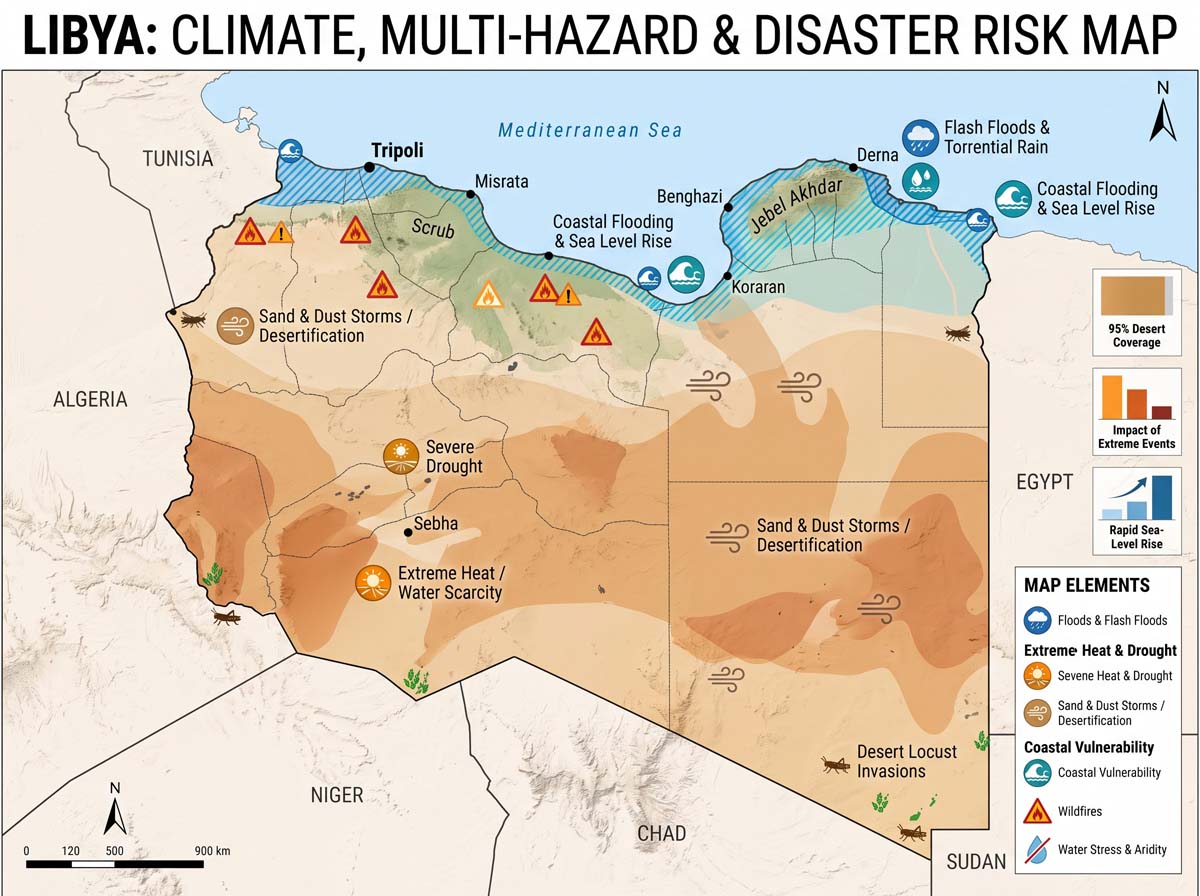
ibya is highly exposed and vulnerable to climate change and multi-hazard risks due to its arid and semi-arid climate, severe water scarcity, dependence on non-renewable groundwater, coastal concentration of people and infrastructure, fragile public services, and conflict-affected institutional capacity. The country faces growing risks from droughts, extreme heat, chronic water scarcity, flash floods, coastal flooding, sea-level rise, saltwater intrusion, desertification, sand and dust storms, land degradation, crop and livestock losses, and climate-sensitive health impacts. Climate change is expected to intensify these vulnerabilities through rising temperatures, rainfall variability, more extreme rainfall events, declining groundwater security, coastal inundation, salinization of aquifers, agricultural stress, infrastructure damage, and increasing pressure on health, livelihoods, food security, water security, and vulnerable communities. Strengthening multi-hazard early warning systems, flash-flood and dam-risk monitoring, drought and groundwater management, climate-resilient agriculture, coastal protection, urban drainage, heat-health planning, disaster risk financing, and locally led preparedness is essential to reduce losses and protect Libya’s development gains.
1. Multi-hazard exposure
Libya’s climate-risk profile is dominated by water extremes: long-term aridity and drought on one side, and destructive flash floods on the other. The World Bank climate profile reports that Libya has only about 98 cubic meters of renewable freshwater resources per person per year, placing it far below the water-scarcity threshold. This makes water scarcity a central national risk for households, agriculture, livestock, cities, industry, and public health. (Climate Change Knowledge Portal)
The country’s hazard profile includes drought, extreme heat, flash floods, coastal flooding, sea-level rise, sand and dust storms, desertification, and localized seismic exposure. Libya’s 2025 climate risk profile presents both rapid-onset hazards and slow-onset climate changes, including rising temperatures, rainfall variability, and coastal risks. (PreventionWeb)
2. Climate change as a risk multiplier
Climate change is expected to intensify Libya’s existing development vulnerabilities by increasing temperatures, worsening water stress, increasing rainfall variability, and raising the risk of extreme rainfall and flash-flood events. In a country where settlements, roads, drainage systems, dams, water networks, health facilities, and coastal infrastructure are already under stress, climate hazards can quickly become cascading crises.
The 2023 Storm Daniel disaster demonstrated the scale of Libya’s compound risk. The World Bank, European Union, and United Nations reported that the catastrophic flooding affected about 1.5 million people, around 22% of Libya’s population, and that recovery and reconstruction needs were estimated at US$1.8 billion. (World Bank)
3. Water scarcity and drought vulnerability
Water scarcity is Libya’s most strategic climate vulnerability. The country is among the most water-scarce in the world, and UNDP identifies water scarcity as one of the greatest emerging threats facing Libya. (UNDP)
Libya’s agricultural and livestock systems rely heavily on scarce and often non-renewable groundwater. UNOPS notes that around 90% of Libya is desert, only about 1% of land is arable, and agricultural and livestock sectors rely almost entirely on non-renewable groundwater resources. (UNOPS)
Key water-related risks include:
| Risk driver | Main impact pathway |
|---|---|
| Groundwater depletion | Reduced long-term water availability for households, farms, livestock, and cities |
| Drought and rainfall decline | Reduced recharge, crop stress, livestock losses, and rural livelihood pressure |
| Saltwater intrusion | Contamination of coastal aquifers and reduced water quality |
| Urban water demand | Rising pressure on already fragile supply systems |
| Infrastructure damage | Disruption to wells, pipelines, reservoirs, pumps, and distribution systems |
4. Flash-flood and storm-risk vulnerability
Although Libya is predominantly arid, intense rainfall can generate destructive flash floods, especially in wadis, coastal catchments, mountainous areas, urban drainage systems, and settlements downstream of dams or embankments. Storm Daniel showed how extreme rainfall, aging infrastructure, poor maintenance, and weak emergency preparedness can combine into catastrophic disaster.
In Derna, heavy rainfall and the failure of upstream dams produced devastating flood flows that destroyed neighborhoods, damaged infrastructure, disrupted services, and caused very large loss of life. The World Bank RDNA describes the 2023 storm and floods as a major climatic and environmental catastrophe for Libya. (World Bank)
Flash-flood risk is especially important for:
| Exposure area | Main vulnerabilities |
|---|---|
| Wadi settlements | Rapid-onset flooding, limited warning time, high casualty risk |
| Urban areas | Poor drainage, blocked channels, weak stormwater infrastructure |
| Dams and reservoirs | Aging structures, maintenance gaps, dam-break risk |
| Roads and bridges | Washouts, isolation of communities, delayed emergency response |
| Health facilities | Service disruption, damaged access roads, emergency overload |
| Water systems | Contamination, pipeline damage, pumping-station failure |
5. Coastal vulnerability and sea-level rise
Libya’s population, cities, ports, roads, public services, energy assets, and economic activities are heavily concentrated along the Mediterranean coast. This creates high exposure to sea-level rise, coastal flooding, erosion, saltwater intrusion, storm surge, and damage to coastal infrastructure.
Coastal cities such as Tripoli, Benghazi, Misrata, Derna, Tobruk, Sirte, Zawiya, and Al Khums face different combinations of coastal flooding, drainage stress, infrastructure exposure, and water-supply vulnerability. Saltwater intrusion is especially important because many coastal communities depend on groundwater systems that are already under pressure.
6. Agriculture, livestock, and food-security vulnerability
Agriculture is highly climate-sensitive in Libya because it depends on scarce water, groundwater pumping, irrigation systems, rainfall variability, soil quality, and functioning supply chains. Drought, heat stress, saline water, sandstorms, pests, floods, and water-infrastructure damage can reduce production and increase dependence on food imports.
Key agricultural vulnerabilities include:
| Sub-sector | Main climate and hazard risks |
|---|---|
| Irrigated farming | Groundwater depletion, salinity, high pumping costs, water scarcity |
| Rainfed agriculture | Rainfall variability, drought, crop failure |
| Livestock | Heat stress, water scarcity, pasture decline, disease risk |
| Coastal farming | Saltwater intrusion, storm flooding, soil salinization |
| Rural livelihoods | Limited alternative income, weak services, fragile markets |
| Food security | Import dependence, price shocks, domestic production losses |
7. Extreme heat, public health, and urban vulnerability
Extreme heat is a growing risk for Libya’s urban and rural populations. Rising temperatures increase heat illness, dehydration, cardiovascular stress, labour-productivity losses, electricity demand, water demand, and pressure on health services.
Urban areas face compound risks from heat, water shortages, poor drainage, flood exposure, damaged infrastructure, and limited public-service reliability. Risks are especially high for low-income households, outdoor workers, older persons, children, people with chronic illness, displaced people, migrants, and communities with limited access to safe water, cooling, health care, and early warning.
8. Desertification, sandstorms, and ecosystem degradation
Libya’s dryland ecosystems are vulnerable to desertification, land degradation, vegetation loss, wind erosion, sand and dust storms, biodiversity decline, and rangeland stress. These risks affect agriculture, livestock, transport, air quality, public health, solar infrastructure, and rural livelihoods.
Sand and dust storms can reduce visibility, disrupt road and air transport, damage equipment, worsen respiratory disease, contaminate water sources, and affect agriculture. Land degradation also reduces natural water retention, increasing runoff and erosion during intense rainfall events.
9. Conflict-sensitive and institutional vulnerability
Libya’s climate vulnerability is intensified by political fragmentation, conflict legacies, weak maintenance of public infrastructure, limited risk-data systems, damaged services, and uneven local capacity. NUPI’s climate, peace, and security analysis notes that Storm Daniel and the Derna disaster exposed severe vulnerability linked to climate hazards, aging infrastructure, and institutional fragmentation. (NUPI)
This means climate adaptation in Libya must be linked with governance strengthening, infrastructure rehabilitation, disaster-risk data systems, local preparedness, transparent reconstruction, and conflict-sensitive service delivery.
10. Sector-specific vulnerability summary
| Sector | Main climate and multi-hazard risks |
|---|---|
| Water resources | Groundwater depletion, drought, salinity intrusion, damaged supply systems, rising demand |
| Agriculture and livestock | Water scarcity, heat stress, drought, salinity, sandstorms, flood damage |
| Urban settlements | Flash floods, drainage failure, heat stress, water shortages, infrastructure fragility |
| Coastal zones | Sea-level rise, coastal flooding, erosion, saltwater intrusion, port and road exposure |
| Health | Heat illness, waterborne disease after floods, respiratory impacts from dust, disrupted services |
| Transport infrastructure | Flooded roads, bridge damage, sandstorm disruption, damaged coastal corridors |
| Energy and industry | Water demand, coastal exposure, heat stress, infrastructure damage |
| Public finance and recovery | High reconstruction needs, emergency response costs, infrastructure rehabilitation |
11. Social vulnerability
The most vulnerable groups include low-income urban households, rural communities, small farmers, pastoralists, coastal communities, displaced people, migrants, women-headed households, children, older persons, people with disabilities, outdoor workers, and communities living in flood-prone wadis, drought-prone drylands, or poorly serviced urban areas.
Vulnerability is highest where climate exposure overlaps with weak housing, limited access to safe water, low savings, fragile infrastructure, limited insurance, poor drainage, weak health services, and limited access to timely warnings and recovery support.
12. Priority resilience needs
Libya’s resilience agenda should prioritize multi-hazard early warning systems, flash-flood forecasting, dam-safety monitoring, drought monitoring, groundwater management, heat-health action planning, coastal inundation warning, climate-resilient agriculture, water-efficient irrigation, resilient drainage, infrastructure rehabilitation, disaster risk financing, and locally led preparedness.
A practical resilience package should include:
| Priority area | Key actions |
|---|---|
| Early warning and anticipatory action | Impact-based warnings for flash floods, drought, heat, sandstorms, coastal flooding, and dam-risk scenarios |
| Flood-risk management | Wadi flood mapping, dam-safety assessment, drainage upgrading, flood-retention areas, evacuation planning |
| Water security | Groundwater monitoring, aquifer protection, desalination where viable, leakage reduction, water-demand management |
| Climate-resilient agriculture | Water-efficient irrigation, drought- and salinity-tolerant crops, livestock water planning, agro-climate advisories |
| Coastal resilience | Sea-level-rise monitoring, salinity-intrusion control, coastal zoning, protection of ports and coastal infrastructure |
| Urban resilience | Stormwater drainage, heat-risk planning, resilient health facilities, safe water and sanitation systems |
| Disaster risk governance | Risk data platforms, local emergency planning, dam and infrastructure maintenance systems |
| Risk financing and recovery | Contingency finance, insurance mechanisms, transparent reconstruction, resilient recovery planning |
The National Center for Emergency, Crisis and Disaster Management
The National Center for Emergency, Crisis and Disaster Management is the body responsible for coordinating and implementing policies and procedures related to emergency, crisis and disaster management in the country. It was established under the supervision of the Libyan Council of Ministers, with the aim of achieving the highest levels of preparedness and readiness to confront any emergency events that may arise in the country.
Emergency, Crisis and Disaster Management
The center assumes the necessary powers to manage all emergencies and crises and mitigate the risks of disasters that may face Libya internally, in cooperation with all relevant parties before, during, and after such events. This is achieved by enhancing coordination, cooperation, and integration between national and international efforts, with the goal of achieving stability in the country.
The National Center for Emergency, Crisis and Disaster Management is a legal entity with independent financial status. It is affiliated with the Council of Ministers and is headquartered in Tripoli. It may establish branches or offices by decision of the Center’s Director General. The Center was established by Resolution No. 1035 of 2007 and reorganized by Cabinet Resolution No. 527 of 2024.
The Center assumes the necessary powers to “manage all emergencies and crises and reduce the risks of disasters” that may confront the Libyan state internally, in cooperation with all relevant parties, before, during, and after their occurrence. This is achieved through coordination, cooperation, and integration between all national and international efforts to achieve national security stability. The Center is managed by a Director General appointed by a Cabinet decision. The Center undertakes multiple tasks, including proposing national policies and strategies, preparing a national risk register, developing national response plans, establishing an information and communications system for emergencies, crises, and disasters, early warning systems, managing the main operations room, forming specialized crisis response teams, developing training and awareness programs, assessing the readiness of various sectors, proposing the declaration and termination of emergency situations, and contributing to post-disaster recovery efforts.
The Center serves as the national link with all regional and international organizations and bodies whose mandate falls within the field of emergencies, crises, and disasters. It also plays a key role in developing legislation, organizing volunteer work, organizing local and international events, and implementing relevant international commitments.
Through these efforts, the Center seeks to build a comprehensive and effective national system for risk management and enhance resilience to various challenges, in cooperation with all relevant government sectors and specialized international organizations.
Emergency, Crisis and Disaster Management
The center assumes the necessary powers to manage all emergencies and crises and mitigate the risks of disasters that may face Libya internally, in cooperation with all relevant parties before, during, and after such events. This is achieved by enhancing coordination, cooperation, and integration between national and international efforts, with the goal of achieving stability in the country.

Download Essential Documents
https://drive.google.com/drive/folders/1vdSIiYpaRdz62HqbTcV3PaDTIJFPD52P?usp=drive_link
