Modernizing National Climate-Risk Intelligence and Emergency Operations Centres: A Technical, Governance, and Climate-Human-Security Imperative
[ The copyright © 2026 Z M Sajjadul Islam, Advisor, Multi-Hazard Early Warning System Design and Implementation Center (MHEWC – www.mhewc.org ). All rights reserved. Any material quoted, reproduced, adapted, or extracted from this proposal must be properly cited and attributed to the author. Please call at +8801711979179, Email: zmsajjad@gmail.com ]
Given the catastrophic consequences of the persistent, intensifying, and rapidly evolving climate crisis, countries can no longer depend exclusively on conventional weather-agency-led monitoring systems and aging observation networks. Many existing meteorological and hydrological stations are outdated, inadequate, incompatible with gridded, geopositional, nested networks for capturing ECVs, and are mostly geographically sparse, poorly maintained, technologically limited, or insufficiently integrated to detect rapidly developing, highly localized, compound weather and multi-hazard conditions. The WMO/UNDP-SOFF/UNEP-led country diagnostic assessment must address those caveats.
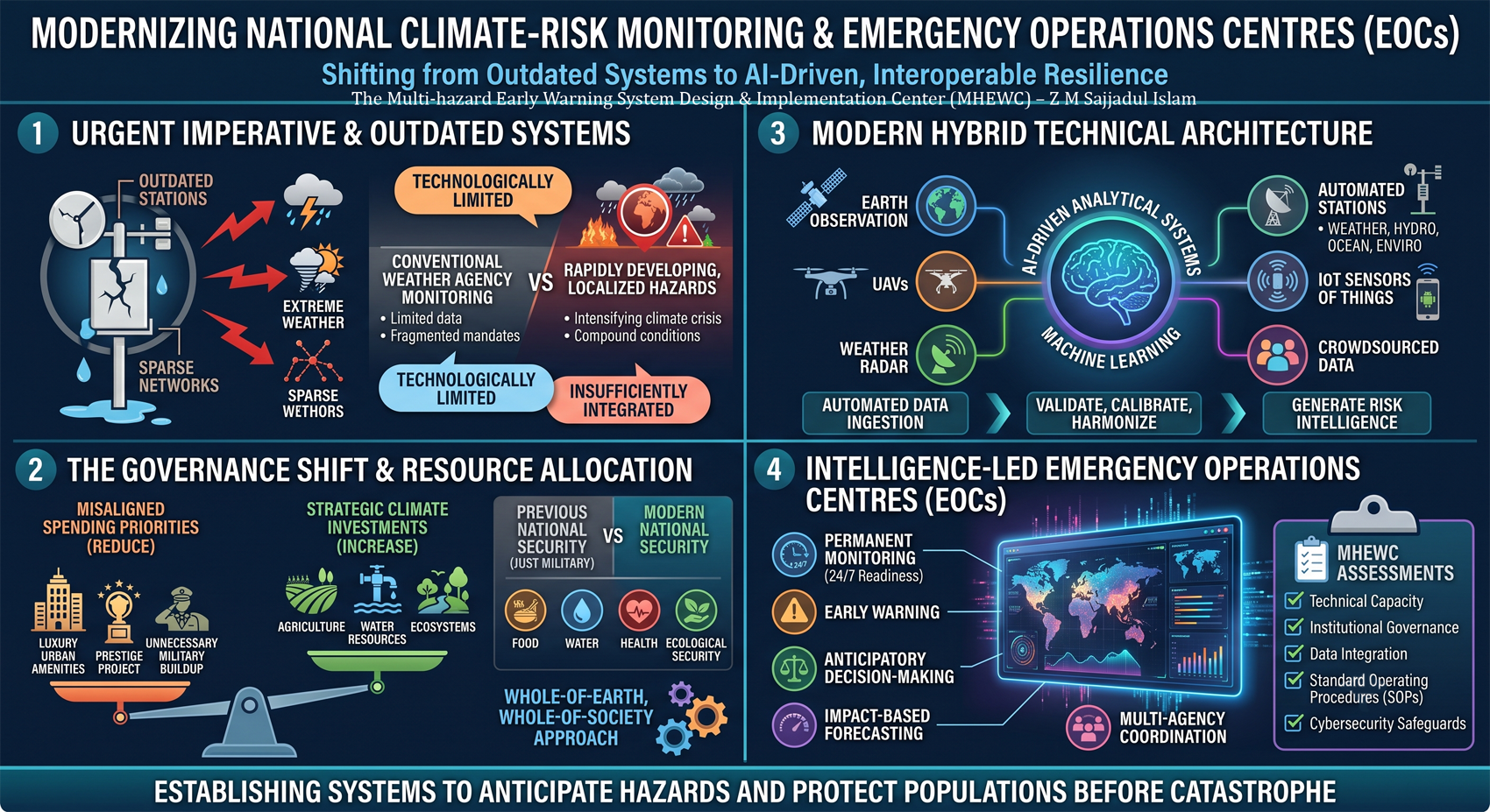
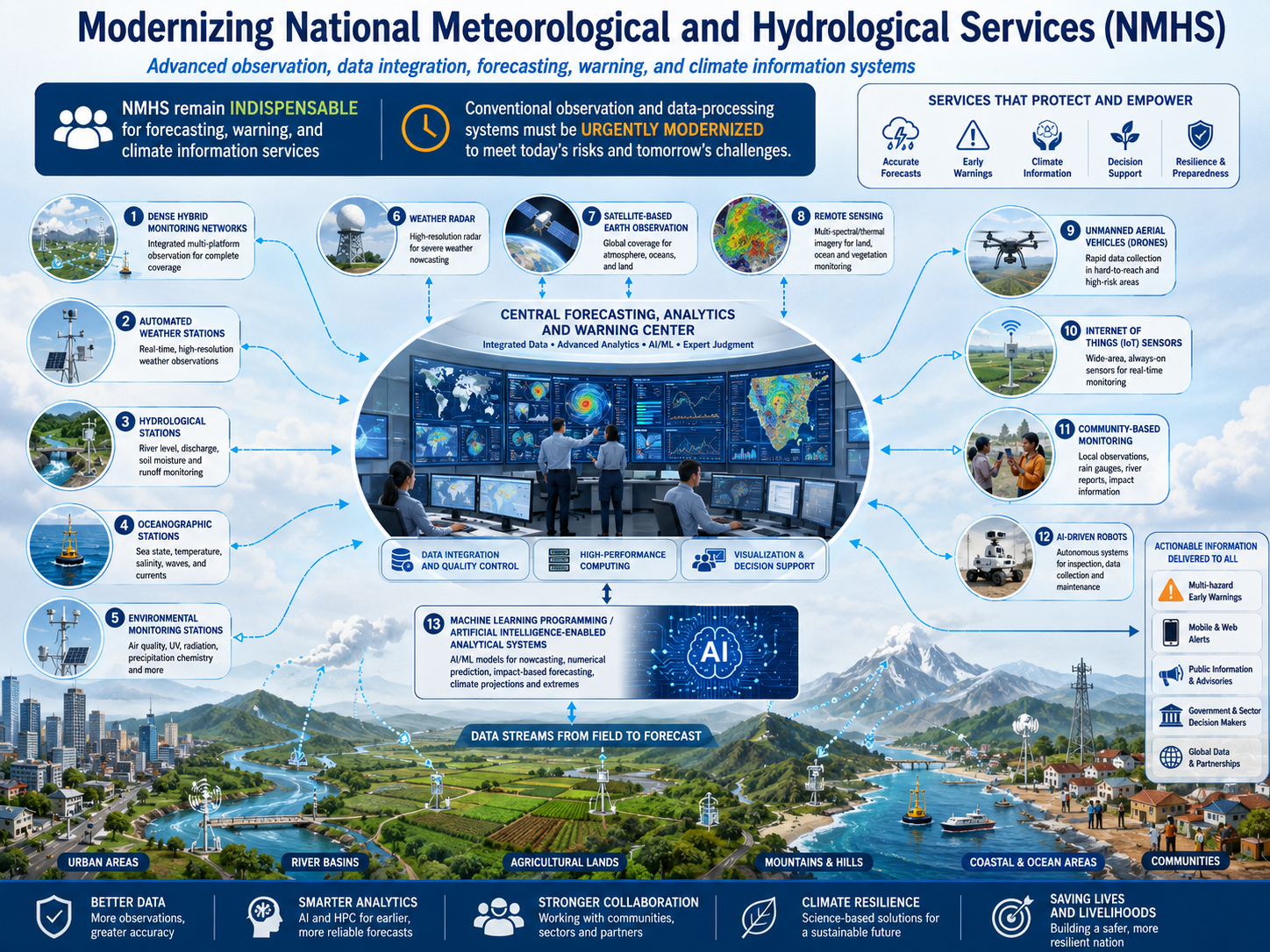
National Meteorological and Hydrological Services (NMHSs) remain indispensable (integrated with met-agency) for weather and climate forecasting, data interpretation, processing, early warning, alerting, and impact-based climate information services. However, their conventional observation and data-processing infrastructure requires urgent modernization. This transformation should include denser, hybrid, and strategically distributed networks of advanced surface sensors; AI-enabled robotic systems for detecting surface and near-surface atmospheric conditions and anomalies; integrated weather-sensing drones; automated meteorological, hydrological, oceanographic, and environmental stations; weather radar; satellite-based Earth observation and remote sensing; unmanned aerial vehicles; Internet of Things sensors; community-based monitoring networks; and machine-learning and AI-powered systems for real-time data integration, analysis, forecasting, and decision support.
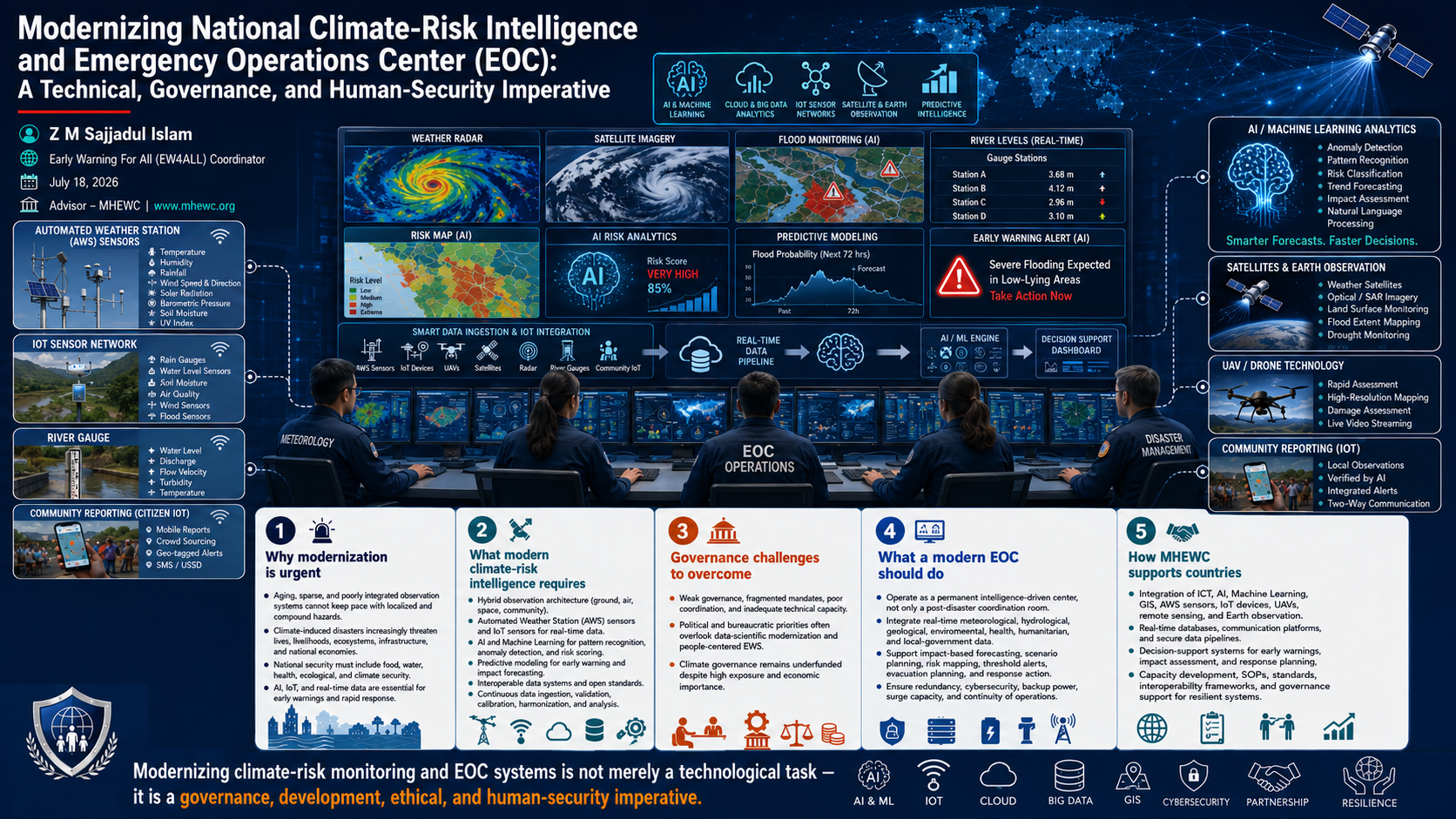
Modern climate-risk monitoring must evolve toward a hybrid, multi-source, and interoperable intelligence architecture capable of integrating authoritative observations with community-generated, crowdsourced, sensor-based, and remotely acquired data. Such systems should support continuous, automated data ingestion from surface observation networks, radar, satellites, UAVs, river gauges, environmental sensors, mobile applications, and field-based reporting mechanisms.
These data streams must be systematically validated, calibrated, harmonized, collated, analyzed, and transformed into reliable risk intelligence. Artificial intelligence, machine learning, geospatial analytics, predictive modeling, and decision-support technologies should be used to identify anomalies, detect rapidly evolving hazards, assess potential impacts, and generate tailored information products for different categories of users, including government decision-makers, emergency managers, sectoral institutions, humanitarian actors, local authorities, businesses, and at-risk communities.
Our observations indicate that a fundamental weakness of many climate-risk management and early warning systems is the persistence of fragmented institutional linkages and weak governance. Sectoral technical teams often lack sufficient knowledge and operational capacity to understand, manage, and maintain the advanced ICT-based instruments and technologies described above. This challenge is compounded by inadequate or poorly contextualized guidance from international agencies, complex and inefficient bureaucratic procedures, excessive institutional control, shortages of skilled technical professionals, limited inter-agency coordination, fragmented implementation, and unclear or overlapping risk-management mandates. Accountability mechanisms are frequently weak, with no institution or responsible authority clearly answerable for failing to fulfill its assigned responsibilities. Consequently, political and institutional interests may be prioritized over scientific modernization, operational effectiveness, interoperability, public transparency, and the protection of vulnerable populations.
In many least developed (LDCs)and developing countries, public expenditure continues to favour highly visible physical infrastructure, rapid urban expansion, luxury-oriented urban development, prestige projects, and costly “white elephant” investments that provide limited social or economic value. In some cases, infrastructure known to be highly exposed to recurring hazards is repeatedly reconstructed or rehabilitated without adequate risk-informed planning, resilient design standards, lifecycle considerations, or long-term mitigation measures. Such practices can perpetuate inefficient spending, political patronage, rent-seeking, and recurring losses, particularly in major transport, communication, and urban development projects. At the same time, substantial public resources are often allocated to unnecessary or disproportionate military expansion, even where diplomacy, regional cooperation, international law, and peaceful conflict resolution could provide more sustainable foundations for national security. Governments also continue to invest heavily in urban amenities that primarily benefit relatively privileged populations, while climate-sensitive and economically productive sectors particularly agriculture, water, health, ecosystems, rural infrastructure, and local livelihoods remain chronically underfunded or entirely neglected. This imbalance intensifies the vulnerability of exposed populations and productive systems, undermines sustainable development, and contributes to climate impacts and loss and damage on a colossal scale.
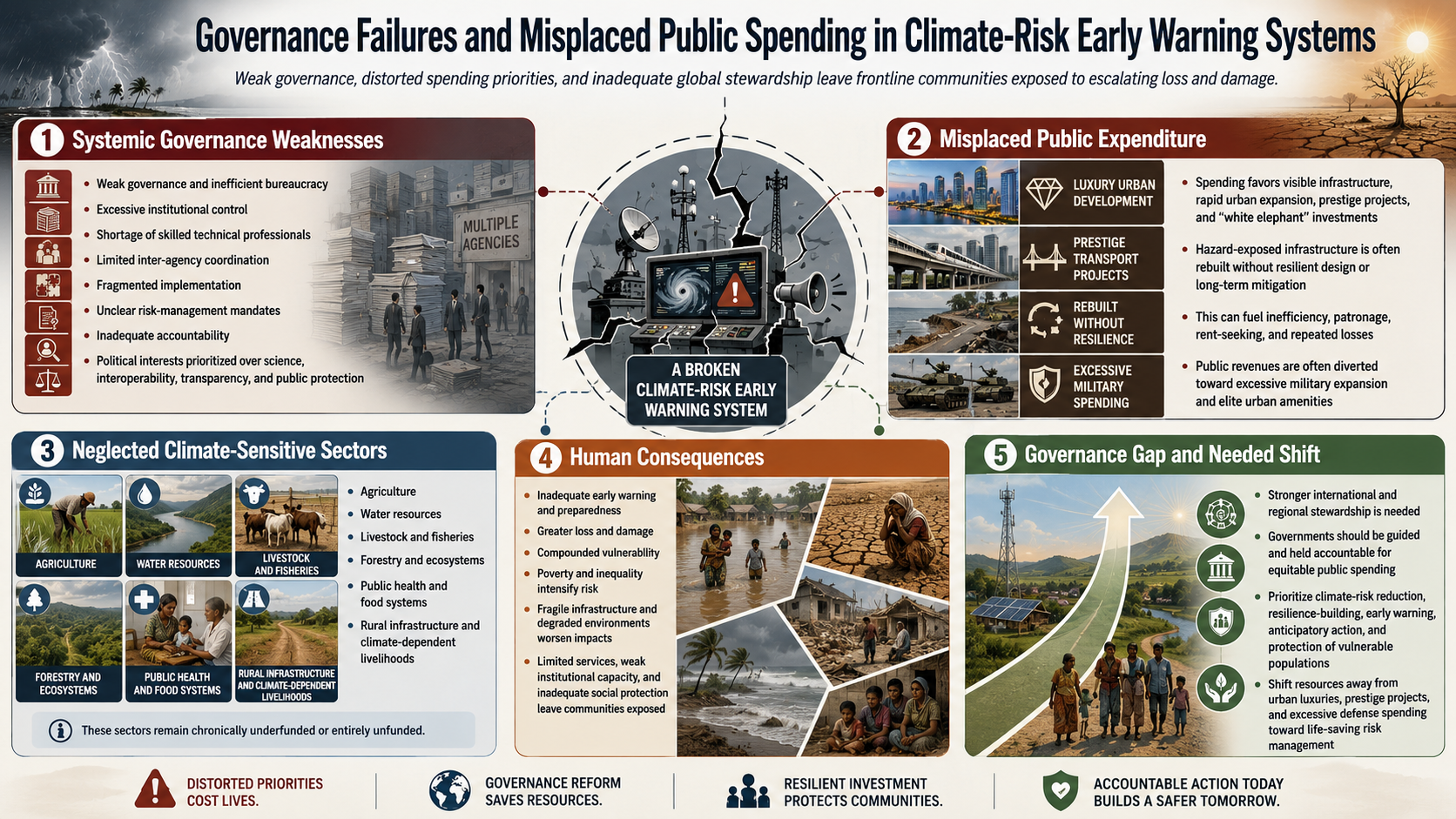
However, political commitment across much of the Global South remains insufficient to climate-proof and modernize risk-monitoring and early warning systems for agriculture, water resources, livestock, fisheries, forestry, public health, ecosystems, food systems, rural infrastructure, and climate-dependent livelihoods. These critical sectors are frequently denied the sustained investment required for risk reduction, resilience building, early warning, anticipatory action, preparedness, and post-disaster recovery. As a result, frontline communities remain inadequately protected and are pushed further into multidimensional and compounded vulnerability. Their exposure is intensified by the interaction of climate hazards with poverty, inequality, fragile infrastructure, environmental degradation, limited access to essential services, weak institutional capacity, and inadequate social protection.
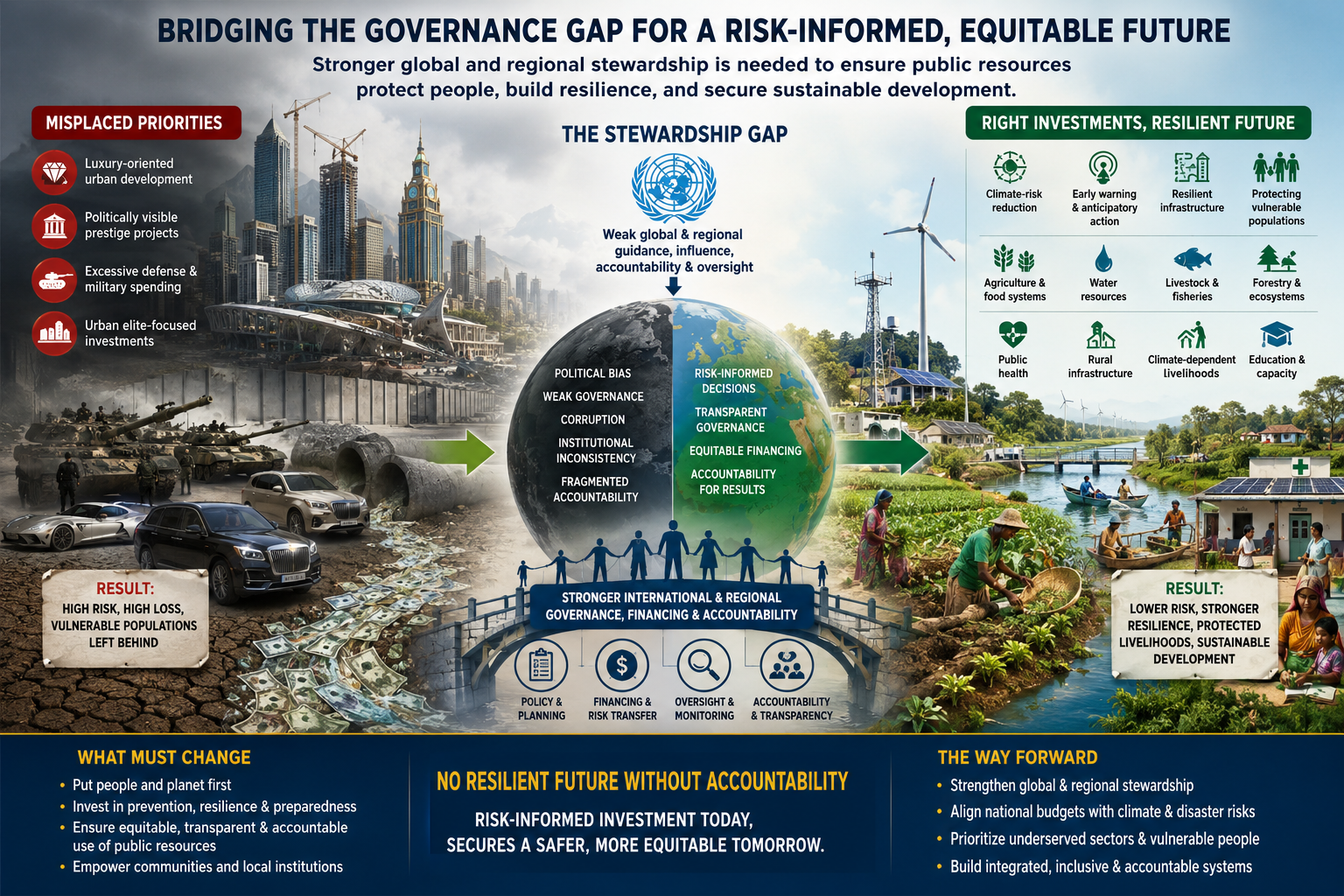
There appears to be a significant gap in global and regional stewardship, including within the United Nations system, in guiding, influencing, and promoting accountability among national governments and entrenched bureaucratic institutions for the equitable and risk-informed allocation of public financial resources. Stronger international and regional governance, oversight, financing, and accountability mechanisms are needed to encourage governments to prioritize climate-risk reduction, resilience building, early warning, anticipatory action, and the protection of vulnerable populations, rather than disproportionately directing public expenditure toward luxury-oriented urban development, politically visible prestige projects, and excessive defense and military-security investments.
Climate-sensitive and economically productive sectors, including agriculture, water resources, livestock, fisheries, forestry, public health, ecosystems, food systems, rural infrastructure, and climate-dependent livelihoods, remain persistently underfunded. This neglect is often reinforced by political and economic bias, weak or corrupt governance, institutional inconsistency, fragmented accountability, and development priorities that disproportionately favor urban elites. In many cases, governments demonstrate limited commitment to addressing the structural drivers of the climate crisis and strengthening disaster risk management systems. Public institutions are rarely held sufficiently accountable for ensuring proportionate budget allocations for climate-risk monitoring, early warning infrastructure, risk reduction, emergency preparedness, and resilient reconstruction. Similarly, inadequate attention is given to decentralized fiscal transfers that would enable local governments and frontline communities to invest directly in resilience building, anticipatory action, preparedness, and locally appropriate risk-management measures.
Yet these neglected sectors and communities are among the most exposed to climate variability, extreme weather events, environmental degradation, ecosystem decline, and disaster-induced economic disruption. Continued underinvestment therefore deepens existing inequalities, weakens food and water security, damages public health and livelihoods, and increases the likelihood that climate-related hazards will escalate into avoidable humanitarian, economic, and development crises. Inadequate investment in their resilience has consequences that extend far beyond the directly affected sectors. It weakens food and water security, damages public health, reduces employment and household income, constrains national productivity, increases poverty and inequality, undermines social stability, and jeopardizes long-term economic development. Global, regional, and national institutions must therefore strengthen fiscal accountability and promote risk-informed public investment frameworks that direct adequate and sustained resources toward climate-vulnerable sectors and frontline communities.
This imbalance reflects persistent governance structures and elite development perspectives that frequently reproduce centralized, externally influenced, and inequitable investment models. Such approaches may privilege politically visible development outputs while overlooking less visible yet strategically essential investments in observation systems, early-warning infrastructure, emergency preparedness, local resilience, anticipatory action, and climate-risk financing. As a result, escalating climate-induced disasters remain insufficiently anticipated and inadequately managed, despite their growing potential to cause catastrophic damage to economies, ecosystems, infrastructure, human security, public institutions, and sustainable development gains.
Political leaders must therefore reconsider national expenditure priorities. Legitimate national security requirements cannot be ignored; however, substantially greater political attention, technical commitment, and financial investment must be directed toward addressing the expanding climate and disaster emergency. National security should be understood not only in military terms but also in relation to food security, water security, health security, ecological security, economic stability, critical infrastructure protection, and the safety of populations exposed to climate and disaster risks.
Conventional military conflicts often intensify geopolitical tensions, divert public resources, and erode developing economies. On the other hand, the climate crisis colossally destroys assets and compounds greater humanitarian and environmental crises. Wherever possible, geopolitical conflicts should be prevented and resolved through diplomacy, multilateral cooperation, international law, peaceful negotiation, and a rules-based international system. But the climate crisis brings greater destruction and longer-term building back better.
By contrast, climate-induced disasters and geophysical hazards cannot be negotiated away. They may cause mass casualties, displacement, livelihood collapse, economic losses, ecosystem degradation, infrastructure failure, fiscal instability, and long-term development setbacks on a scale equal to or greater than that of many conventional conflicts. Climate change is therefore not merely an environmental concern; it constitutes an escalating planetary emergency that threatens every component of the Earth system and every dimension of human security.
This interconnected crisis cannot be addressed effectively through isolated bilateral arrangements, fragmented national systems, institutionally disconnected databases, or narrowly defined sectoral interventions. It requires a “whole-of-Earth, whole-of-society” approach based on scientific openness, shared responsibility, transboundary risk governance, regional cooperation, interoperable information systems, and equitable management of interconnected landscapes, river basins, ecosystems, atmospheric processes, biodiversity, and other shared natural resources. Such an approach must transcend unnecessary political, institutional, and administrative barriers while respecting national sovereignty. It should promote collective responsibility for planetary safety, coordinated management of shared risks, open exchange of essential hazard and climate data, joint observation and forecasting arrangements, and collaborative action across countries, sectors, institutions, and communities.
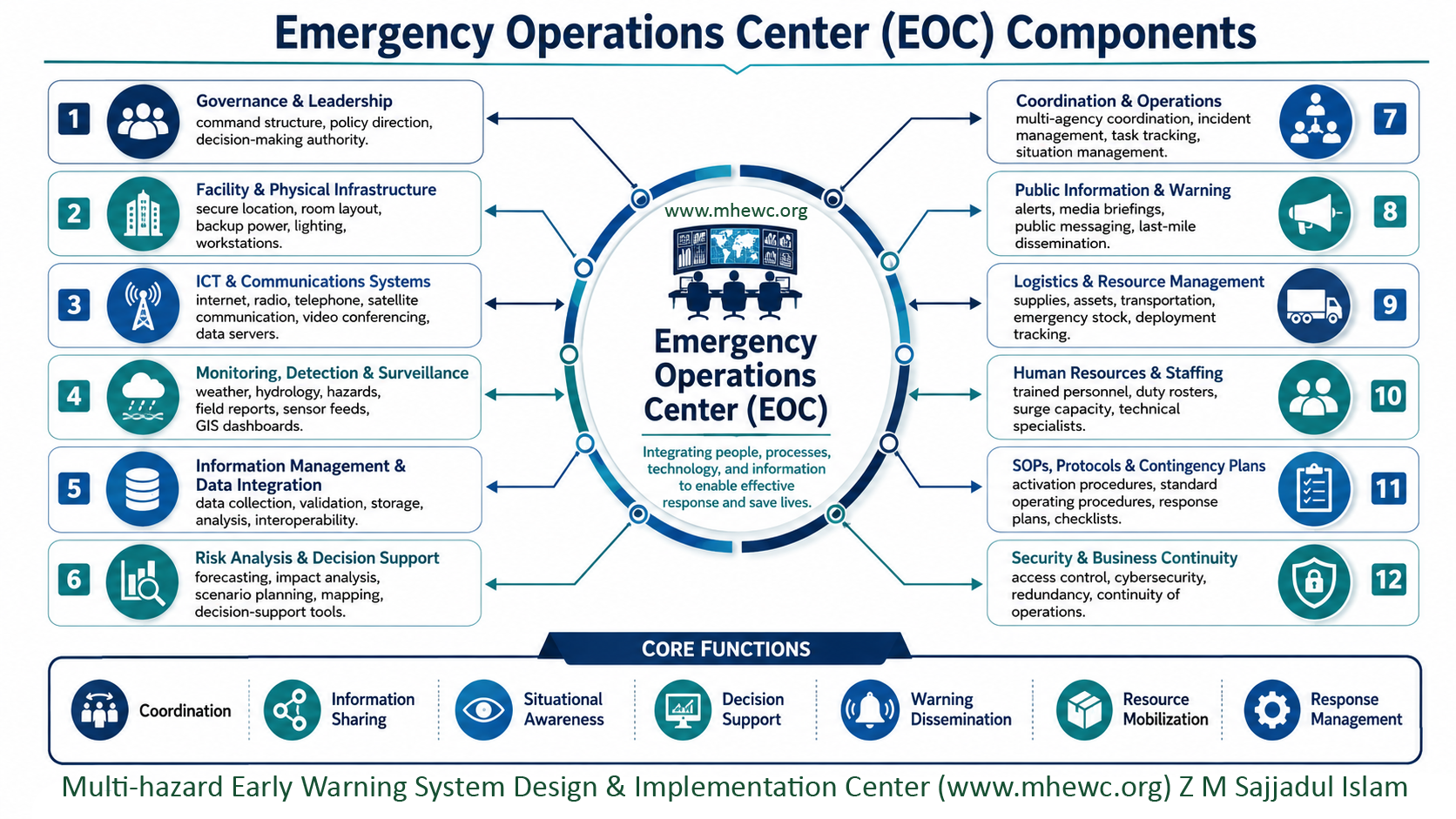
Considering the magnitude of current and emerging risks, governments must allocate substantial, sustained, and predictable budgets to establish, modernize, and operationalize Emergency Operations Centers(EOC) and national or subnational situation rooms. These facilities should not function merely as physical coordination spaces activated after disasters occur. They must operate as permanent, intelligence-driven, technology-enabled centers for continuous monitoring, early warning, anticipatory decision-making, emergency coordination, incident management, resource mobilization, and crisis communication.
Modern EOCs must be capable of receiving, integrating, validating, analyzing, and visualizing real-time information from meteorological, hydrological, geological, environmental, health, security, humanitarian, infrastructure, and local-government systems. They should support impact-based forecasting, scenario development, common operating pictures, risk mapping, threshold-based alerting, multi-agency coordination, emergency logistics, public information management, evacuation planning, anticipatory action, and rapid executive decision-making.
They must also maintain reliable communication with national ministries, local authorities, sectoral agencies, first responders, humanitarian organizations, community institutions, critical-infrastructure operators, and populations at risk. Their operational architecture should incorporate redundancy, cybersecurity, backup power, data continuity, alternative communication channels, surge capacity, business continuity arrangements, and clearly defined protocols for command, control, coordination, communication, and information management.
Barriers to Last-Mile Early Warning Dissemination and Risk Communication in African Countries(click here) :
Barriers to modernization risk communication dissemination channels in many African countries are deeply intertwined with prevailing governance structures and entrenched institutional mindsets, accountability, and no one is there to hold them accountable to do the right initiatives.
Our observations noted that in many African countries, the most timely broadcasting of weather warnings and alerts is extremely fragmented, insufficient, with less geographical coverage, and through cascading delays, relaying latency, and being inappropriate to reach end users in minutes. They heavily depend on limited-coverage FM radio, satellite TV, WhatsApp groups, road shows, and the civil protection committee ( rural level). The warning/alerts broadcasting channels are commonly recognized as public and private broadcasting media, including radio, television, online radio, podcasts, and news outlets, as indispensable components of an integrated last-mile warning system. However, all those channels have limitations in geographic coverage and selected user groups (townships).
However, we noticed that AM Radio(Amplitude Modulation Radio) has been taken out in most African countries, knowing that how significant it is to reach every geographical pocket of the country and even beyond. The AM Radio(pocket radio with battery, winding, solar PV powered) set is the only no-cost and cheapest portable option for any individual in the country. This raises a critical question: why should a proven, wide-area public-warning capability be withdrawn from operational?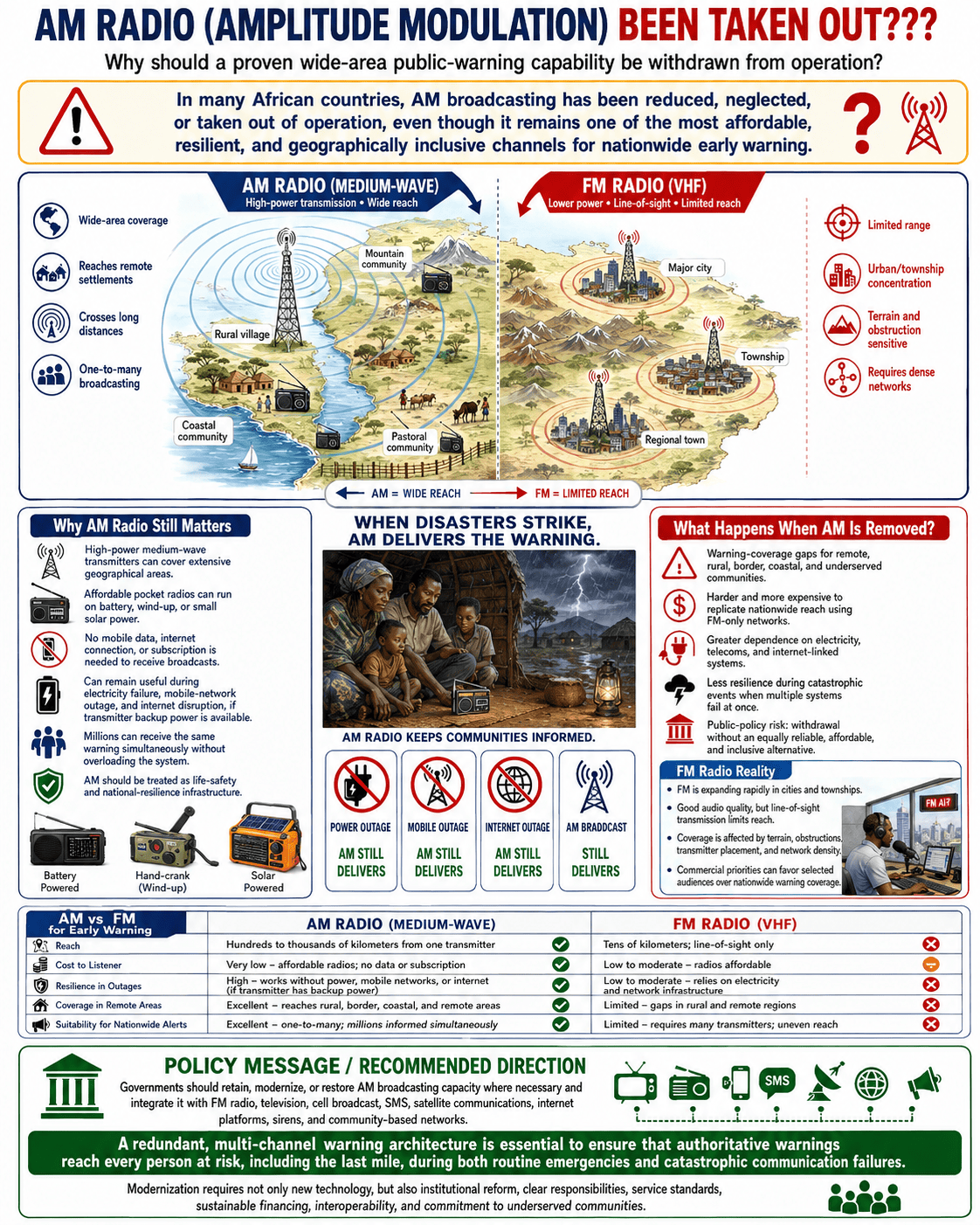
The strategic importance of AM broadcasting for nationwide early warning cannot be overstated. High-power medium-wave transmitters can cover extensive geographical areas, while warnings can be received through affordable, portable, and battery-powered radios even in remote locations and during electricity, mobile-network, or internet disruptions. FM broadcasting remains highly valuable and generally provides better audio quality; however, its predominantly line-of-sight transmission normally has a more limited geographical range and can be significantly affected by terrain, physical obstructions, transmitter locations, and network density.
Although AM broadcasting is not immune to interference, fading, or other technical limitations, eliminating it may create serious warning-coverage gaps, particularly for remote, rural, border, coastal, and underserved communities. Governments should therefore retain, modernize, or restore AM broadcasting capacity where necessary, and other privately running FM radio, television, cell broadcast, SMS, satellite communications, internet platforms, sirens, and community-based networks can easily affiliate and broadcast to the last mile. Such a redundant, multi-channel approach is essential to ensure that authoritative warnings reach every person at risk, including the last mile, during both routine emergencies and catastrophic communication failures.
The responsibility of MHEWC:
The Multi-Hazard Early Warning System Design and Implementation Center (MHEWC) supports countries in developing robust, instrumented, sector-interconnected, and interoperable ICT structures and operational processes, and sensor-driven, data-gating, intelligence-led, and operationally sustainable Emergency Operations Centers. This support incorporates the strategic integration of information and communication technology, artificial intelligence(AI), geographic information systems(GIS) & Remote Sensing (RS), automated and hybrid weather and hydrological stations, crowdsourced data gathering, UAVs, remote sensing, Earth observation data, Internet of Things sensors, real-time databases, communication platforms, decision support systems, and hybrid monitoring technologies.
MHEWC promotes the design of EOCs as integrated components of national multi-hazard early warning systems rather than as isolated emergency facilities. This requires strong institutional governance, legal mandates, inter-agency data-sharing arrangements, common technical standards, interoperable platforms, trained personnel, standard operating procedures, sustainable financing, and effective linkages between national, subnational, local, and community-level institutions.
Accordingly, MHEWC conducts comprehensive technical, institutional, operational, and governance assessments of existing and proposed EOCs. These assessments examine:
The physical location, accessibility, security, layout, and operational functionality of EOC facilities;
System architecture, ICT infrastructure, servers, networks, databases, software, dashboards, display systems, backup arrangements, and cybersecurity safeguards;
Command, control, coordination, communication, and information-management structures;
Technical capacity, staffing arrangements, duty rosters, surge mechanisms, and round-the-clock operational readiness;
Institutional mandates, governance arrangements, inter-agency coordination mechanisms, and accountability structures;
Data acquisition, ingestion, validation, integration, analysis, modeling, visualization, and dissemination processes;
Integration with meteorological, hydrological, geological, environmental, health, humanitarian, security, infrastructure, and local-government systems;
Emergency communication channels, including radio, telephone, mobile networks, satellite communication, digital platforms, mass-notification systems, and community-based dissemination mechanisms;
Standard operating procedures, activation and escalation protocols, incident-action planning, emergency reporting, deactivation procedures, and post-incident review mechanisms;
Operational linkages with national, subnational, sectoral, field-level, and community institutions;
Continuity-of-operations arrangements, power backup, data redundancy, equipment maintenance, technical support, and long-term sustainability; and
The capacity of the EOC to support impact-based forecasting, anticipatory action, evacuation planning, emergency response, recovery coordination, and risk-informed decision-making.
The assessment generates the evidence required to redesign, modernize, and operationalize resilient, interoperable, technology-enabled, and fit-for-purpose Emergency Operations Centers. It also provides a technical foundation for investment planning, institutional reform, system procurement, capacity development, operational standardization, and long-term sustainability.
Ultimately, the modernization of climate-risk monitoring and Emergency Operations Center systems is not simply a technological undertaking. It is a governance, development, ethical, and human-security imperative. Countries must establish systems capable of anticipating hazards, understanding their potential consequences, communicating actionable warnings, coordinating institutions, and protecting populations before climate and disaster risks escalate into avoidable humanitarian and economic catastrophes.
Contact MHEWC
To have a detailed EOC Assessment Framework and Technical Design Concept, please contact:
For EOC institutional assessment, technical design, system architecture, ICT integration, geospatial decision-support systems, emergency communication design, SOP development, training, simulation, and operational-capacity strengthening, please contact:
Z M Sajjadul Islam
Advisor, Multi-Hazard Early Warning System Design & Implementation Center (MHEWC)
Email: zmsajjad@gmail.com
WhatsApp: +88 01711 979179
[ The copyright © 2026 Z M Sajjadul Islam, Advisor, Multi-Hazard Early Warning System Design and Implementation Center (MHEWC – www.mhewc.org ). All rights reserved. Any material quoted, reproduced, adapted, or extracted from this proposal must be properly cited and attributed to the author. Please call at +8801711979179, Email: zmsajjad@gmail.com ]