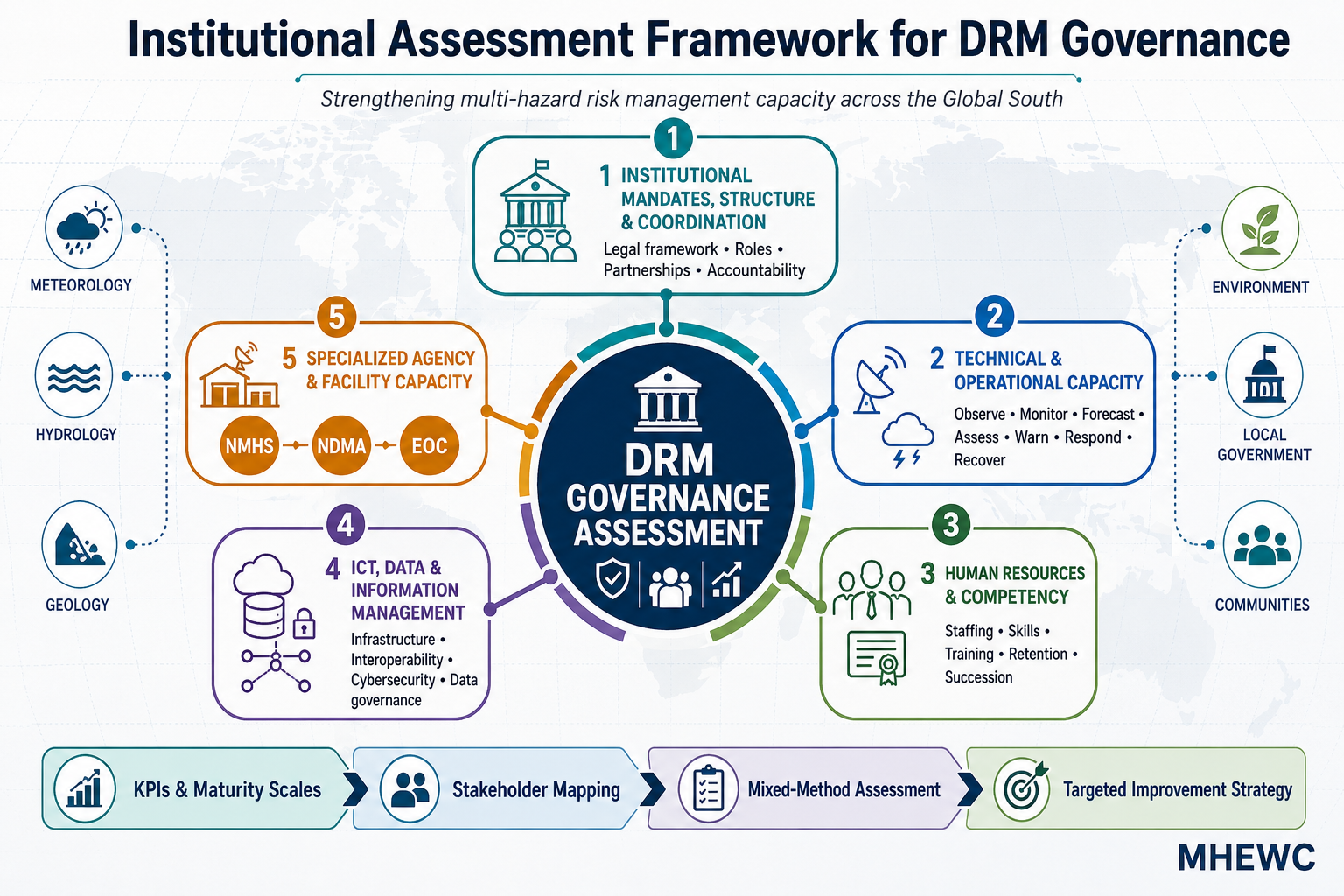
Institutional Assessment Framework – Developed by The Multi-Hazard Early Warning System Design & Implementation Center (MHEWC)
MHEWC conducts institutional assessments to support the establishment and operationalization of robust climate and multi-hazard risk management governance systems (MRMGS).
[ The copyright © 2026 Z M Sajjadul Islam, Advisor, Multi-Hazard Early Warning System Design and Implementation Center (MHEWC – www.mhewc.org ). All rights reserved. Any material quoted, reproduced, adapted, or extracted from this proposal must be properly cited and attributed to the author to avoid legal issues. Please call at +8801711979179, Email: zmsajjad@gmail.com ]
It appears that relevant United Nations entities engaged in climate risk management, including UNDRR, UNDP, UNEP, WFP, FAO, UNITAR, UNESCO, UNOPS, UNICEF, the UN regional commissions, the UNFCCC secretariat, UNHCR and OCHA, alongside donors, do not consistently prioritize comprehensive country-level scoping missions and institutional assessments in least developed countries (LDCs) and other developing countries.
These processes should precede the development of program and project concepts and inform both intervention design and the preparation of project documents (ProDocs). They are essential for identifying appropriate national lead or nodal agencies and determining whether their mandates, technical capacities, inbuilt coordinating mechanisms of sector ministries & departments & authorities align with the requirements of the proposed interventions.
When these assessments are inadequate, projects and programmes may be anchored within institutions that lack the authority, capacity or partnerships needed to lead implementation effectively. This can contribute to institutional fragmentation, overlapping responsibilities and weak national ownership. It can also undermine the effective transfer and application of knowledge and technology, the implementation of policy measures, and the adaptation of programmatic approaches to national and local conditions. Without inclusive stakeholder participation and meaningful frontline engagement in planning, implementation and monitoring, interventions risk remaining disconnected from the needs, priorities and capacities of the communities they are intended to support.
The apparent gap between resources mobilized and demonstrable improvements in frontline resilience therefore warrants closer scrutiny. Success should be assessed through sustained institutional capacity, functioning services, reduced vulnerability and communities’ ability to anticipate, withstand and recover from climate-related hazards. Why do these institutional and implementation shortcomings continue to recur, and how will UN entities and their national partners be held accountable for addressing them and translating investments into measurable, lasting resilience?
Although project steering committees and governing boards may be formally established, their existence alone does not ensure effective leadership, coordination or implementation. These arrangements can remain ineffective when participating institutions lack clearly defined responsibilities, decision-making authority, dedicated resources or accountability for agreed results.
UN entities therefore need to strengthen institutional assessments at the scoping and design stages and play a more effective facilitative role in securing the sustained engagement of relevant ministries, departments and other stakeholders. This requires supporting nationally led arrangements that translate formal representation into meaningful partnerships, shared responsibilities and coordinated implementation across sectors and levels of government.
An institutional diagnostic matters because effective risk management depends on whether institutions can turn risk information into timely, funded, coordinated and accountable action. It establishes who is responsible, who has decision-making authority, what capacities and resources are available, where implementation breaks down, and which changes are needed to protect people, livelihoods and public services.
A country may have hazard maps, forecasting equipment, disaster-management policies and development projects while still experiencing serious gaps in implementation. An institutional diagnostic examines how these assets function together, including the formal rules and everyday practices that influence decisions. It is a foundation for reform, alongside sound risk assessments, political commitment and sustained financing.
This is consistent with the Sendai Framework’s second priority: strengthening disaster risk governance to manage disaster risk. UNDRR identifies leadership, clear responsibilities, coordination, resources, monitoring and accountability as essential elements of a strong governance system.
The diagnostic’s value lies in answering practical questions across the system. Drawing on UNDRR’s guidance on risk assessment and WMO’s approach to assessing early warning capabilities, the following provides a useful structure.
Area to examine | Essential diagnostic questions | Why it matters |
Leadership and institutional mandates | Who leads, who decides, and who implements? Where do responsibilities overlap or remain unassigned? | Establishes stakeholders’ stewardship, partnership, and coordination structures; Creates participatory and inclusive engagement of stakeholders and creates a sense of ownership in DRM & DRR ( prevention, preparedness, warning, response, and recovery functions) |
Coordination and decision-making | How do technical agencies, sector ministries, financial authorities, and local governments exchange information and make joint decisions? Where do approvals stall? | Provide a clear framework of inclusive engagement, partnership, parthersip and coordination framework, Standard Operating Procedures(SOP) , and defined roles and responsibilities in an inclusive and participatory way to resolve delays and conflicting instructions across institutions and levels of government. |
Risk information and data governance | Who maintains climate and multi-hazard, exposure, vulnerability, impacts, loss & Damage datasets? Are they current/real-time, quality-controlled, accessible, and used in decisions? | Establishes a frameworked responsibility for producing and applying credible risk information. |
Technical and operational capacity | Are sufficient qualified staff, equipment, operating procedures, maintenance arrangements and service continuity measures available? | Tests whether institutions can collect, process, and develop tailored risk-informed maps and decision tools, and deliver their assigned functions consistently and deliberately. |
Planning, investment and financing | Do risk assessments influence land use, infrastructure design, sector plans and budgets? Can approved resources reach implementing institutions promptly? | Connects risk knowledge, risk-informed decision-making tools tailored to facilitate and make investment choices and implementation . |
Local authority and inclusive participation | Do local governments have adequate authority and resources? Can communities, women, persons with disabilities and other affected groups influence priorities? | Makes risk management responsive to local conditions and barriers to protection. |
Accountability and institutional incentives | Who reviews performance, explains failures, and follows up on corrective actions? Do incentives encourage prevention and information sharing? | Identifies why agreed responsibilities may remain unfulfilled and how accountability can improve delivery. |
Sustainability and learning | Who will operate systems after project funding ends? Are exercises, disaster reviews and recovery lessons used to update arrangements? | Supports continuity, institutional learning and improvements over time. |
Considering these backdrops, to provide contextual fit and to retrofit the institutional risk management and governance system, MHEWC (www.mhewc.org) designed a comprehensive, multi-dimensional institutional assessment framework to upgrade institutions to a robust level in the climate and multi-hazard risk management governance system (MRMGS).
MRMGS basically encompasses the institutional structures, mandates, technical expertise, partnerships, and operational processes required to understand and manage risk. Its effectiveness depends on how institutions are organized, how responsibilities are assigned and coordinated, and how risk information informs decisions across sectors and administrative levels. Essential components include qualified subject-matter specialists, appropriate ICT infrastructure, and digital governance arrangements that enable reliable, secure and interoperable data and information exchange.
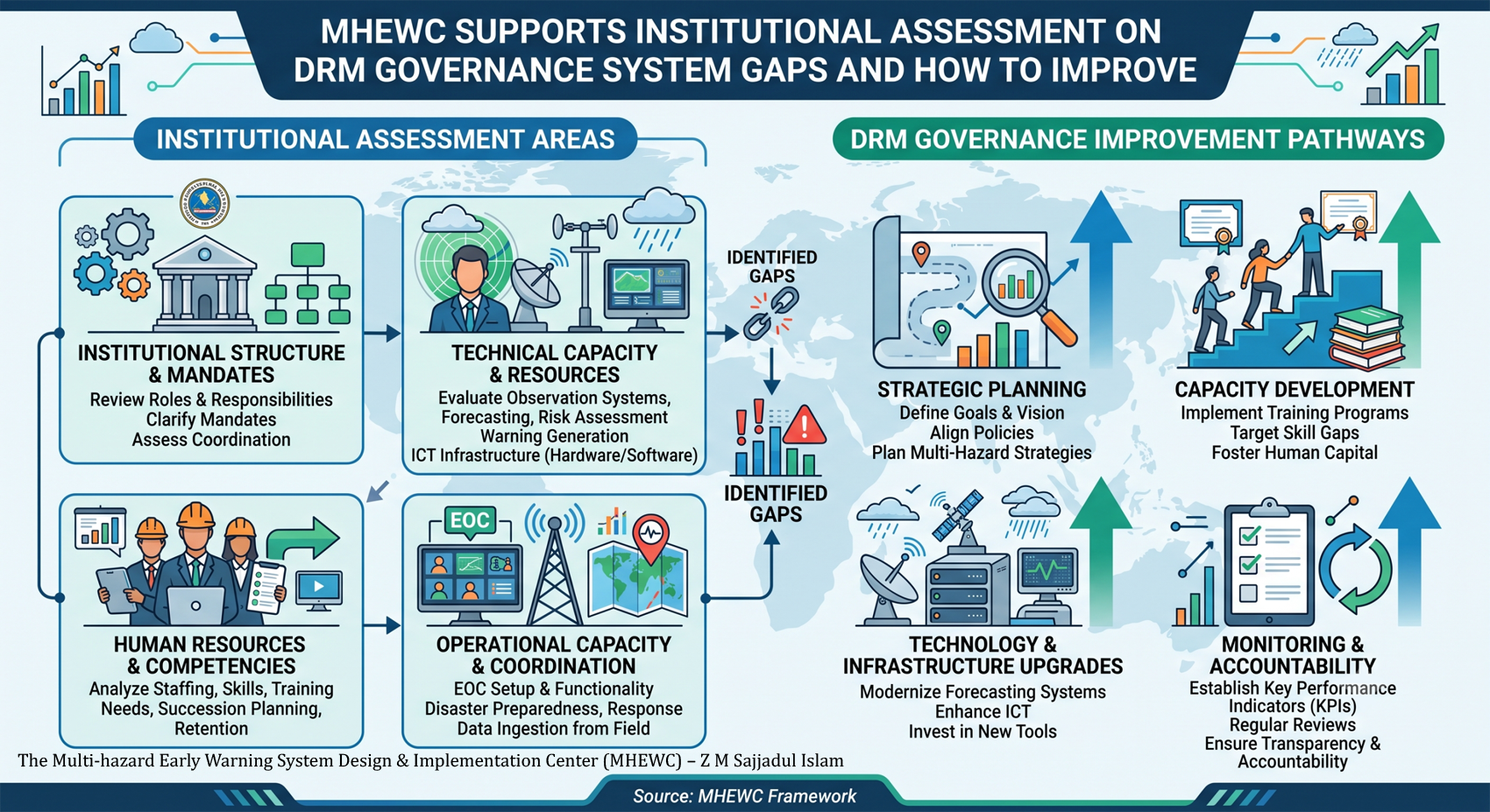
MHEWC conducts comprehensive institutional assessments to examine these components, identify capacity gaps, institutional weaknesses and coordination challenges, institutional governance paradoxes, and recommend practical, context-specific improvements. These assessments review existing mandates, institutional linkages, technical staffing, policies, procedures, partnerships, data-sharing arrangements, and digital capabilities. The findings guide measures to strengthen institutional capacity, accountability, policy coherence, coordination, and operational effectiveness.
MHEWC also provides systems-engineering and technical design support to establish and strengthen MRMGS. This includes defining institutional responsibilities and interfaces; designing data management and risk assessment workflows; developing risk information repositories; and integrating appropriate cutting-edge ICT and AI-enabled analytical and decision-support tools. Particular attention is given to data standards, interoperability, quality assurance, access controls, custodianship and long-term maintenance. The objective is to establish an integrated, data-driven governance system that connects risk information with development planning, public investment, early warning and timely action.
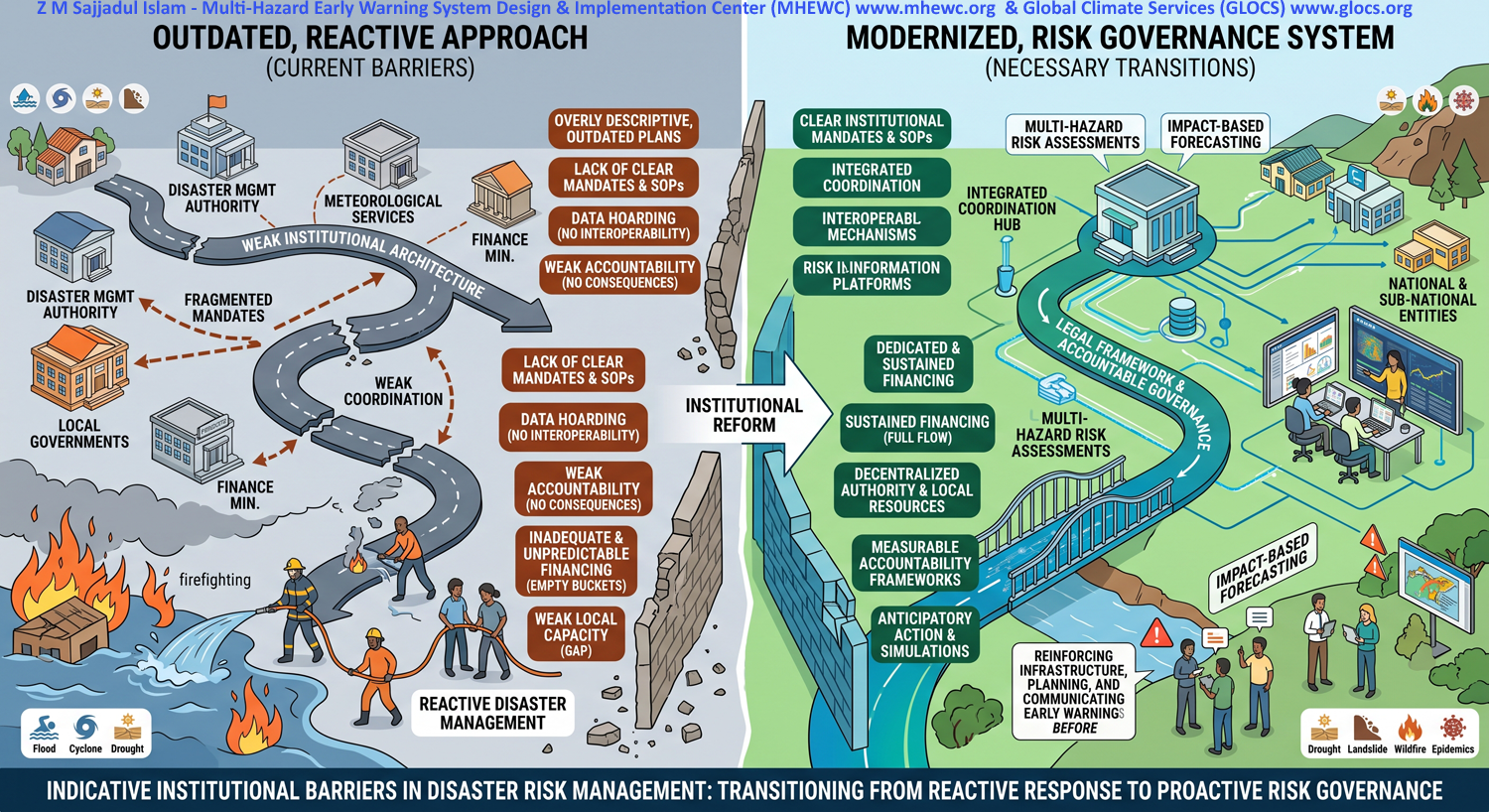
Assessment of Indicative Institutional Barriers in Disaster Risk Management
In many Global South countries, national disaster risk management plans have become outdated, overly descriptive, and operationally weak. They often consist of broad narratives outlining what central, regional, and subnational governments are expected to do, without clearly defining institutional mandates, decision-making authority, operational procedures, coordination arrangements, financing responsibilities, performance indicators, or accountability mechanisms. As a result, these plans provide limited practical guidance for managing rapidly evolving, interconnected, and increasingly severe multi-hazard risks.
Disaster risk management can no longer be treated as a routine administrative function or a primarily reactive emergency-response responsibility. The escalating frequency, intensity, and complexity of floods, cyclones, droughts, landslides, wildfires, heatwaves, epidemics, technological accidents, environmental degradation, and compound hazards increasingly resemble a continuous, nature-driven emergency requiring coordinated national preparedness and sustained operational readiness. These hazards are repeatedly turning into disasters, causing fatalities, displacement, livelihood disruption, infrastructure destruction, ecosystem degradation, economic losses, and extensive climate-related loss and damage.
A central institutional concern is whether exposed landscape systems possess sufficient resilience to absorb, withstand, adapt to, and recover from impending threats. This requires governments to assess the resilience of settlements, river basins, watersheds, agricultural areas, forests, wetlands, coastal zones, transport corridors, industrial areas, critical infrastructure, ecosystems, and essential public-service systems. However, many government institutions continue to operate without comprehensive multi-hazard risk assessments, updated vulnerability databases, resilience benchmarks, scenario-based contingency planning, or measurable standards for determining whether these systems can withstand future shocks.
Government machinery is frequently constrained by fragmented mandates, overlapping responsibilities, weak inter-ministerial coordination, inadequate decentralization, insufficient technical capacity, limited access to risk information, and the absence of interoperable data systems. Disaster-management authorities, meteorological and hydrological services, planning agencies, local governments, infrastructure departments, environmental institutions, humanitarian actors, and security agencies often work through separate administrative structures, databases, reporting systems, and operational procedures. This fragmentation delays decision-making, weakens situational awareness, creates institutional competition, and prevents the development of a unified national risk-management architecture.
Another major barrier is the continued dominance of reactive disaster management. Public institutions frequently mobilize only after hazards have caused visible damage, while insufficient attention is given to prevention, mitigation, preparedness, impact-based forecasting, anticipatory action, resilient infrastructure, ecosystem protection, and risk-informed development planning. Emergency response and relief therefore receive greater political and financial attention than long-term risk reduction, even though preventive investment is generally more effective in reducing future humanitarian and economic losses.
Institutional performance is also undermined by weak accountability. Disaster risk reduction responsibilities are often distributed across numerous ministries and agencies, but there are limited mechanisms for monitoring whether institutions have fulfilled their assigned duties. Plans may identify responsibilities without specifying implementation timelines, budget lines, technical standards, expected outputs, reporting requirements, or consequences for non-performance. This allows risk-reduction commitments to remain aspirational rather than operational.
Inadequate and unpredictable financing further constrains institutional effectiveness. Disaster-management institutions are commonly dependent on annual administrative budgets, emergency allocations, donor-supported projects, or post-disaster appeals. Dedicated and sustained financing for risk assessment, early-warning infrastructure, local preparedness, maintenance of monitoring systems, anticipatory action, resilient reconstruction, and institutional capacity development is often unavailable. Consequently, critical systems remain underfunded, poorly maintained, and unable to operate continuously.
Subnational and local governments face particularly serious limitations. Although national plans frequently assign substantial responsibilities to provincial, district, municipal, and community-level institutions, these entities are rarely provided with adequate financial resources, qualified personnel, equipment, technical guidance, risk information, or decision-making authority. This creates a major gap between centrally developed policies and ground-level implementation. Local authorities are expected to manage disasters but often lack the institutional capability to translate forecasts into timely evacuation, asset protection, emergency assistance, and early action.
Political and bureaucratic factors also impede effective risk governance. Disaster-risk considerations may be subordinated to short-term political interests, prestige infrastructure projects, administrative routines, and development investments that fail to account for future climate and hazard conditions. Institutional resistance to reform, reluctance to share data, centralized decision-making, frequent staff transfers, weak institutional memory, and limited coordination between technical and administrative personnel further reduce operational continuity.
A modern disaster risk management system must therefore move beyond general institutional narratives and establish a legally grounded, operational, technology-enabled, and accountable governance framework. National plans should clearly define who is responsible for each function, what actions must be undertaken, when decisions must be made, what resources are required, how information will be shared, how institutions will coordinate, and how implementation will be monitored.
The assessment needs to investigate the level of modernization of disaster risk governance : updated multi-hazard risk, vulnerability, exposure, and resilience assessments; clearly defined institutional mandates and standard operating procedures; integrated national and subnational coordination mechanisms; interoperable risk-information and emergency-management platforms; impact-based forecasting and anticipatory-action protocols; predefined warning, financing, activation, and response triggers; dedicated and predictable disaster-risk financing; strengthened technical and human-resource capacity; decentralized authority supported by adequate local resources; regular simulation exercises and institutional performance reviews; risk-informed public investment and development planning; and measurable accountability frameworks for national and local institutions.
Effective disaster risk management ultimately depends not only on the existence of policies and plans, but also on whether government institutions possess the authority, capacity, financing, information, technology, coordination arrangements, and accountability systems required to act before hazards become disasters. Institutional reform must therefore be treated as a central component of national resilience, climate adaptation, sustainable development, and the prevention of avoidable loss and damage.
The Assessment of Structural & Technical Capacity
The assessment of the country-level Disaster Risk Management (DRM) governance system examines the institutional capacity and capabilities in technical, operational, human resource, coordination, planning, information management, and accountability required for effective multi-hazard disaster risk management. The intended assessment will cover the following areas:
1. Institutional Structure and Technical Capacity
- Assess the existing institutional structure, mandates, roles, responsibilities, and coordination arrangements of institutions responsible for disaster risk management, meteorological services, hydrological services, geological monitoring, environmental monitoring, and other National Meteorological and Hydrological Services-related functions.
- Review institutional technical capacities for undertaking observation, monitoring, forecasting, risk assessment, warning generation, emergency coordination, disaster preparedness, response, recovery, and reconstruction activities.
- Assess the availability, qualifications, competencies, deployment, and retention of technical human resources required to perform meteorological, hydrological, climate, geospatial, early warning, risk assessment, emergency management, and information and communication technology functions.
- Identify institutional and technical human-resource gaps, including staffing shortages, competency gaps, training needs, succession-planning requirements, and dependence on external technical assistance.
- Conduct an institutional assessment in terms of institutional structure, technical capacity, and technical human resources for handling NMHS jobs,
- Institutional ICT structures, facilities, data system management, hardware, software, and data processing technical capacity
- Institutional ( sector ministry and department ) partnership framework, level stakeholders’ accountability in an integrated approach
- National Disaster Management Agency (NDMA) risk governance capacity, risk and vulnerability assessment capacity,
- EOC setup, system architecture, ICT system Structure, technical, operational, and functional capacity, field-level data ingestion, processing capacity
This is a comprehensive and structured overview of the required scope for an institutional assessment of a Disaster Risk Management (DRM) governance system, particularly concerning Multi-Hazard Early Warning Systems (MHEWS).
To assist in developing the Structured Assessment Framework. This can be used to develop Terms of Reference (ToR), design interview questionnaires, or structure the final assessment report.
Institutional Assessment Framework: DRM Governance & National Multi-hazard Early Warning Center(NMHEWC)
1. Introduction and Objectives
The overarching objective is to support the institutional assessment of the DRM Governance system to identify gaps and develop targeted improvement strategies.
The assessment will examine capacities across multiple dimensions required for effective multi-hazard DRM: Institutional, Technical, Operational, Human Resource, Coordination, Planning, Information Management, and Accountability.
2. Targeted Institutions
The assessment will cover the full range of institutions involved in the climate and multi-hazard risk management governance system (RMGS) , disaster risk management (DRM) value chain, including:
- National disaster management agencies (NDMAs) and equivalent coordinating bodies.
- National meteorological and hydrological services (NMHSs).
- Geological and environmental monitoring agencies.
- Central government institutions responsible for policy, planning, financing and coordination.
- Regional and provincial governments.
- District, subdistrict, municipal and commune-level governments and local authorities, as applicable to the country’s administrative structure.
- Traditional authorities and other relevant community-level institutions.
- Sector ministries, departments and affiliated agencies with responsibilities relevant to climate risk and multi-hazard risk management.
- Emergency Operations Centers (EOCs).
- National Situation Room
3. Core Assessment Pillars
Based on the provided scope, the assessment is structured around five core pillars:
Pillar A: Institutional Mandates, Structure, and Coordination
Legal & Regulatory Framework: Review existing institutional structures, mandates, legal roles, and responsibilities of all DRM and NMHS-related functions.
Coordination Mechanisms: Assess the effectiveness of existing coordination arrangements between DRM bodies, scientific technical agencies (Met, Hydro, Geo, Environment), and other relevant stakeholders.
Partnership & Accountability: Evaluate the institutional partnership framework involving sector ministries and departments. Determine the level of stakeholder accountability within an integrated DRM approach.
Pillar B: Technical and Operational Capacity
End-to-End DRM Cycle: Review technical capacities across the entire spectrum of disaster risk management, specifically: Observation and monitoring; forecasting and trend analysis; risk assessment and vulnerability analysis; warning generation and dissemination; emergency coordination; disaster preparedness and response; recovery and reconstruction activities.
Pillar C: Human Resources and Competency
Staffing & Qualifications: Assess the availability, academic qualifications, and competencies of technical staff required for specialized functions (meteorological, hydrological, climate, geospatial, early warning, risk assessment, emergency management, and ICT).
HR Management: Evaluate the deployment, retention strategies, and succession planning requirements for technical staff.
Gap Analysis: Identify specific human-resource gaps, including staffing shortages, competency mismatches, and specific training needs.
Sustainability: Determine the level of dependence on external technical assistance versus in-house capability.
Pillar D: ICT, Data, and Information Management
Infrastructure: Assess institutional ICT structures, physical facilities, hardware, and software capabilities.
Data Management: Evaluate data system management protocols, data processing technical capacity, and the architecture for handling complex data sets.
Field Data Integration: Specific assessment of capacity for field-level data ingestion and subsequent processing.
Pillar E: Specialized Agency & Facility Focus
1. National Meteorological and Hydrological Services (NMHS)
Specific assessment of institutional structure, technical capacity, and technical human resources dedicated to handling core NMHS mandates.
2. National Disaster Management Agency (NDMA)
Specific focus on the NDMA’s overall risk governance capacity.
Assessment of the NDMA’s specific capacity to conduct risk and vulnerability assessments.
3. Emergency Operations Center (EOC)
Infrastructure: Review of physical setup and system architecture.
ICT: Evaluation of the specific EOC ICT system structure.
Operations: Assessment of the technical, operational, and functional capacity of the EOC to manage emergencies.
Define Steps for Implementation
Develop Key Performance Indicators (KPIs): Convert the bullet points above into measurable indicators (e.g., “Yes/No” metrics for mandates, or maturity scales (1-5) for technical capacities).
Stakeholder Mapping: Identify exactly which individuals in which departments need to be interviewed regarding specific pillars.
Methodology Design: Decide on the mix of methods (e.g., desk review of laws, surveys for HR, technical audits of ICT, and simulation exercises for EOCs).
Draft Terms of Reference (ToR): If engaging consultants, use the structured framework above to define the specific scope of work, deliverables, and timelines.
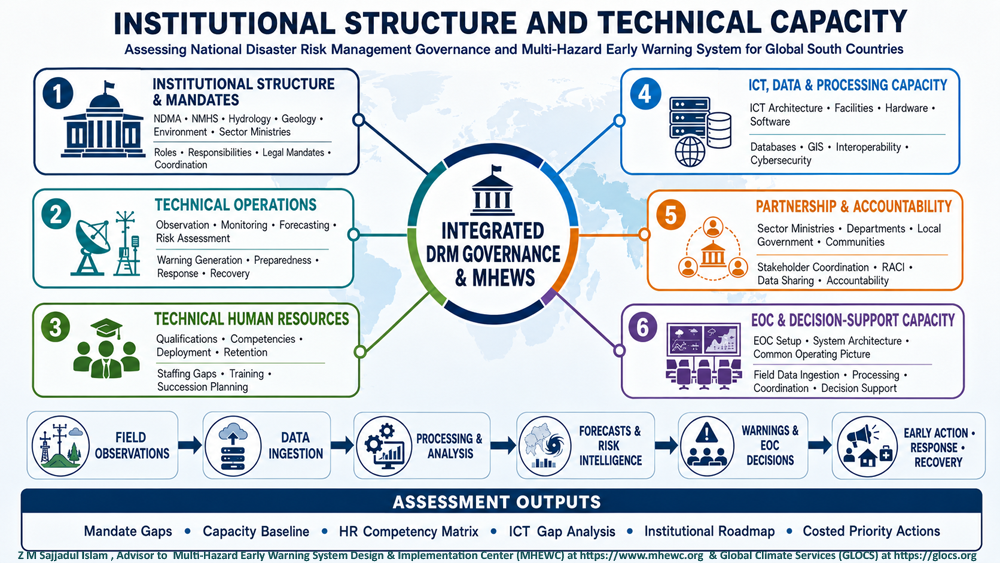
MHEWC support for all aspects of the Disaster Risk Management Governance System Assessment for the Global South Countries:
The assessment of the Disaster Risk Management (DRM) governance system will examine the institutional, technical, operational, human-resource, coordination, planning, information-management, and accountability capacities required for effective multi-hazard disaster risk management. The assessment will cover the following areas:
1. Institutional Structure and Technical Capacity
Assess the existing institutional structure, mandates, roles, responsibilities, and coordination arrangements of institutions responsible for disaster risk management, meteorological services, hydrological services, geological monitoring, environmental monitoring, and other National Meteorological and Hydrological Services-related functions.
Review institutional technical capacities for undertaking observation, monitoring, forecasting, risk assessment, warning generation, emergency coordination, disaster preparedness, response, recovery, and reconstruction activities.
Assess the availability, qualifications, competencies, deployment, and retention of technical human resources required to perform meteorological, hydrological, climate, geospatial, early warning, risk assessment, emergency management, and information and communication technology functions.
Identify institutional and technical human-resource gaps, including staffing shortages, competency gaps, training needs, succession-planning requirements, and dependence on external technical assistance.
2. Institutional ICT Infrastructure and Data-Management Capacity
Assess existing institutional information and communication technology structures, governance arrangements, technical support mechanisms, and ICT management responsibilities.
Review the availability, functionality, adequacy, interoperability, security, and maintenance of ICT facilities, including: Data centres and server infrastructure; Workstations and computing facilities; Communication networks; Internet and intranet connectivity; Cloud-based systems; Data-storage and backup facilities; Cybersecurity systems; Emergency communication equipment; Data-transmission systems; and Power backup and system-redundancy arrangements.
Assess the adequacy and compatibility of institutional hardware, software, databases, analytical platforms, forecasting systems, GIS applications, remote-sensing tools, dashboards, mobile applications, and decision-support systems.
Review institutional capacity for data acquisition, ingestion, validation, processing, analysis, storage, visualization, dissemination, archiving, recovery, and sharing.
Assess data-governance arrangements, including data ownership, standards, quality assurance, metadata management, access rights, confidentiality, interoperability, data-sharing protocols, and institutional responsibilities.
3. Institutional Partnership, Coordination, and Accountability Framework
Assess existing partnership and coordination arrangements among sector ministries, government departments, technical agencies, local governments, emergency services, humanitarian actors, civil society organizations, academic institutions, the private sector, media organizations, and development partners.
Review the effectiveness of horizontal coordination across sectors and vertical coordination between national, provincial, district, municipal, and community levels.
Assess the clarity of institutional mandates, reporting lines, decision-making authority, operational responsibilities, and accountability mechanisms.
Examine the level of stakeholder participation and institutional ownership within an integrated and multi-sectoral DRM governance framework.
Assess the availability and effectiveness of: Memoranda of Understanding (MOU); Inter-agency agreements; partnership and coordination mechanisms; Standard operating procedures; Data-sharing agreements; Emergency coordination protocols; Joint planning mechanisms; Sector working groups; National and local DRM platforms; and Monitoring and accountability frameworks.
Identify institutional overlaps, coordination gaps, fragmented responsibilities, duplication of functions, and areas where accountability remains unclear.
4. National Disaster Management Agency Risk-Governance Capacity
Assess the institutional, legal, policy, strategic, technical, financial, and operational capacity of the National Disaster Management Agency or equivalent authority.
Review the agency’s ability to provide national leadership, policy direction, coordination, oversight, technical guidance, and operational support for disaster risk management.
Assess institutional capacity for: Multi-hazard risk and vulnerability assessment; Exposure and vulnerability analysis; Disaster-risk profiling; Climate-risk assessment; Risk mapping; Disaster-loss and damage data management; Preparedness and contingency planning; Emergency coordination; Early warning and anticipatory action; Recovery and reconstruction planning; Disaster-risk financing; and Monitoring and evaluation.
Review the agency’s capacity to translate risk information into policies, plans, investment decisions, preparedness actions, emergency operations, and resilient recovery programmes.
Assess the availability of technical guidelines, operational manuals, assessment methodologies, planning tools, information systems, and qualified personnel.
5. Existing Operational Structures, ICT and Cloud system, Data center interoperability, operational Capacity of Emergency Operations Centres(EOCs), National Situation Room :
The Emergency Operations Centre assessment will examine its physical setup, system architecture, ICT infrastructure, technical capacity, operational readiness, functional arrangements, and linkages with field-level institutions.
The assessment will cover:
EOC location, accessibility, physical security, workspace design, and operational layout;
Centers Command, control, coordination, communication, and information-management arrangements;
Incident-management and emergency decision-making structures;
EOC system architecture and technical design;
ICT infrastructure, servers, computers, displays, dashboards, communication equipment, software platforms, databases, and backup systems;
Integration with meteorological, hydrological, geological, health, security, humanitarian, and local-government information systems;
Availability of emergency communication channels, including radio, telephone, satellite communication, mobile communication, email, web-based platforms, and mass-notification systems;
Operational staffing, duty rosters, surge arrangements, technical support, and round-the-clock operational capacity;
Standard operating procedures, activation protocols, escalation procedures, incident-action planning, reporting procedures, and deactivation arrangements;
Capacity for receiving, integrating, validating, analysing, and visualizing field-level information;
Capacity for processing situation reports, damage information, needs information, resource requests, operational updates, and early warning information;
Field-level data-ingestion arrangements through mobile applications, survey tools, local government systems, sensors, monitoring stations, emergency responders, community volunteers, and humanitarian partners;
Interoperability between national, subnational, district, municipal, and field-level emergency coordination systems;
Data backup, cybersecurity, system redundancy, business continuity, and disaster-recovery arrangements;
EOC simulation exercises, testing, maintenance, after-action reviews, and continuous improvement mechanisms.
Integrated Disaster Risk Management Planning Capacity
6. Risk-Informed DRM Planning Capacity
- Institutional planning capacity: Assess institutional capacity to develop and implement risk-informed disaster preparedness, emergency response, recovery, reconstruction and resilience plans.
- Evidence-informed planning: Review whether DRM planning draws on hazard assessments; exposure and vulnerability data; climate projections; historical disaster-loss information; multi-hazard risk scenarios; impact-based forecasts; critical infrastructure analysis; community risk assessments; and the social, economic, environmental and gender dimensions of risk.
- Institutional participation and coordination: Assess the participation of sector ministries and departments in national and subnational DRM planning, including mechanisms for coordinating responsibilities, sharing information and aligning priorities across institutions and administrative levels.
- Mainstreaming DRM across sectors: Examine the extent to which DRM is integrated into sectoral plans covering agriculture and food security; water resources; water, sanitation and hygiene (WASH); health; education; transport; energy; housing; urban development; environment; social protection; telecommunications; local government infrastructure and basic service delivery; finance and planning; and critical social and economic infrastructure.
- Alignment with related plans and investments: Assess linkages and coherence between DRM plans, climate change adaptation plans, national and subnational development plans, humanitarian preparedness plans, public investment programmes and local development plans.
- Plan quality, implementation and maintenance: Review the quality, consistency, implementation status, financing arrangements and monitoring systems of preparedness, contingency, response, recovery and reconstruction plans, including mechanisms for periodic review and updating.
- Operational readiness and accountability: Assess whether plans clearly define institutional responsibilities, activation thresholds, implementation timelines, resource requirements, operational procedures, coordination arrangements and accountability mechanisms.
7. ICT Tools and Standing Orders During Emergencies
Review the availability, adequacy, and operational application of Standing Orders on Disaster, emergency directives, contingency procedures, standard operating procedures, and incident-management protocols.
Assess whether institutional standing orders clearly define: Roles and responsibilities; Chains of command; Warning authorization; Emergency activation procedures; Information-reporting requirements; Inter-agency coordination arrangements; Resource-mobilization procedures; Evacuation responsibilities; Search-and-rescue responsibilities; Emergency logistics; Public communication; Damage and needs reporting; and Recovery coordination.
Assess the use of ICT tools for emergency preparedness and operations, including: Emergency dashboards; Decision-support systems; GIS-based common operational pictures; Mobile data-collection applications; Incident-reporting platforms; Resource-tracking systems; Early warning dissemination platforms; Emergency communication systems; Social-media monitoring tools; Situation-reporting systems; Digital contingency plans; and Inter-agency information-sharing platforms.
Examine whether digital tools and standing orders are integrated, regularly tested, updated, understood by responsible institutions, and supported by adequate training and simulation exercises.
Post-Disaster Damage, Loss, and Needs Assessment
8. PDNA Institutional Structure and Stakeholder Engagement
Assess the existing national institutional framework for conducting Post-Disaster Needs Assessments.
Review the roles and responsibilities of the national disaster management authority, planning and finance ministries, sector ministries, national statistical agencies, local governments, technical institutions, humanitarian organizations, civil society, private-sector actors, development partners, and affected communities.
Assess the availability of a designated lead institution, sector-assessment teams, technical working groups, coordination arrangements, reporting structures, and quality-assurance mechanisms.
Review stakeholder engagement throughout the PDNA process, including: Assessment planning; Methodology selection; Data collection; Field verification; Sector analysis; Damage and loss estimation; Recovery-needs identification; Validation; Report preparation; Prioritization; and Recovery planning.
Assess the participation of women, persons with disabilities, older persons, displaced populations, marginalized communities, local authorities, affected households, businesses, and civil society organizations.
9. Institutional Capacity to Conduct PDNA
Assess national and sectoral capacity to plan, coordinate, undertake, validate, and report a comprehensive PDNA.
Review the availability of qualified technical personnel in: Economics; Engineering; Infrastructure; Agriculture; Livelihoods; Social sectors; Environment; Disaster risk reduction; Climate change; Gender and social inclusion; Statistics; GIS and remote sensing; Finance; Recovery planning; and Monitoring and evaluation.
Assess institutional experience in conducting rapid assessments, sector assessments, damage and loss assessments, humanitarian needs assessments, and recovery-needs assessments.
Review capacity for estimating: Physical damage; Economic losses; Service-delivery disruptions; Human and social impacts; Environmental impacts; Livelihood impacts; Governance impacts; Recovery requirements; Reconstruction costs; and Disaster-risk-reduction and Build Back Better requirements.
Assess arrangements for coordination, data validation, quality control, financial estimation, reporting, dissemination, and integration of PDNA findings into recovery and reconstruction planning.
10. PDNA Methodology, Guidelines, and Assessment Process
Review the availability and application of nationally approved PDNA methodologies, guidelines, templates, sector tools, data standards, and reporting formats.
Assess the alignment of national methodologies with internationally recognised approaches for damage, loss, human-impact, needs, recovery, and reconstruction assessment.
Review the full PDNA process, including: Activation and institutional mobilization; Assessment scoping and planning; Formation of sector teams; Baseline data compilation; Field data collection; Damage and loss estimation; Human-impact and needs assessment; Recovery-needs identification; Build Back Better analysis; Sector prioritization; Cost estimation; Validation and quality assurance; Report preparation; Government endorsement; Recovery-framework development; and Monitoring of recovery implementation.
Assess the availability and quality of baseline datasets, administrative records, census data, sector inventories, asset databases, land-use data, infrastructure data, household information, market information, and historical disaster-loss databases.
11. ICT, GIS, Remote Sensing, and UAV Capacity for PDNA
Assess institutional capacity to use digital technologies for rapid and comprehensive post-disaster assessment: remote-sensing imagery; Satellite data; Unmanned aerial vehicles; Drone-based imaging; Global positioning systems; Digital elevation models; Image-processing software; Damage-classification tools; Artificial intelligence-assisted analysis; Digital dashboards; and Decision-support systems. Review the availability and application of Mobile data-collection tools;
- Digital survey applications; Cloud-based assessment platforms; GIS & atribute databases; Web-GIS Platform/portals; Assess capacity to acquire, process, analyse, interpret, validate, store, and disseminate geospatial and remote-sensing data.
Review institutional arrangements for obtaining pre-disaster and post-disaster imagery, including access to satellite imagery, drone operations, aerial surveys, open-source geospatial data, and commercial data providers.
Assess compliance with UAV regulations, flight permissions, operational safety procedures, data-protection requirements, and ethical standards.
Review interoperability between field-assessment tools, sector databases, EOC systems, GIS platforms, national statistics systems, and recovery-planning systems.
Assess capacity to produce: Damage maps; Affected-population maps; Infrastructure-impact maps; Agricultural damage maps; Flood-extent maps; Landslide inventories; Building-damage classifications; Accessibility and logistics maps; Recovery-priority maps; and Spatial recovery-investment plans.
12. Expected Assessment Outputs
The assessment should generate: A DRM governance and institutional-capacity assessment report; An institutional mandate, coordination, and accountability matrix; A technical and human-resource capacity-gap analysis; An ICT infrastructure, systems, and data-management assessment; An EOC technical, operational, and functional-capacity assessment; A risk-informed DRM planning and sector-integration assessment; A review of Standing Orders on Disaster and emergency ICT tools; A national PDNA capacity and institutional-readiness assessment; A PDNA methodology, tools, data, GIS, remote-sensing, and UAV capacity assessment; A prioritized institutional strengthening and capacity-development plan; Recommendations for legal, policy, institutional, technical, financial, and operational reforms; and A phased roadmap for strengthening national and subnational DRM governance, EOC operations, integrated planning, and post-disaster assessment capacity.
This can also be converted into an assessment matrix with indicators, assessment questions, data sources, scoring criteria, identified gaps, and recommended actions.