The Multi-Hazard Early Warning System Design & Implementation Center (MHEWC) proposes a comprehensive assessment of national and subnational capacity to formulate, finance, implement, monitor, and periodically update integrated and risk-informed Disaster Risk Management plans.
The assessment will examine whether disaster preparedness, anticipatory action, emergency response, recovery, reconstruction, climate adaptation, resilience building, and development planning are supported by credible risk information, coordinated institutional arrangements, adequate financing, operational procedures, and enforceable accountability mechanisms.
The assessment will identify institutional strengths, planning gaps, implementation bottlenecks, technical-capacity requirements, financing constraints, and priority actions for strengthening integrated DRM planning at national, subnational, sectoral, and local levels.
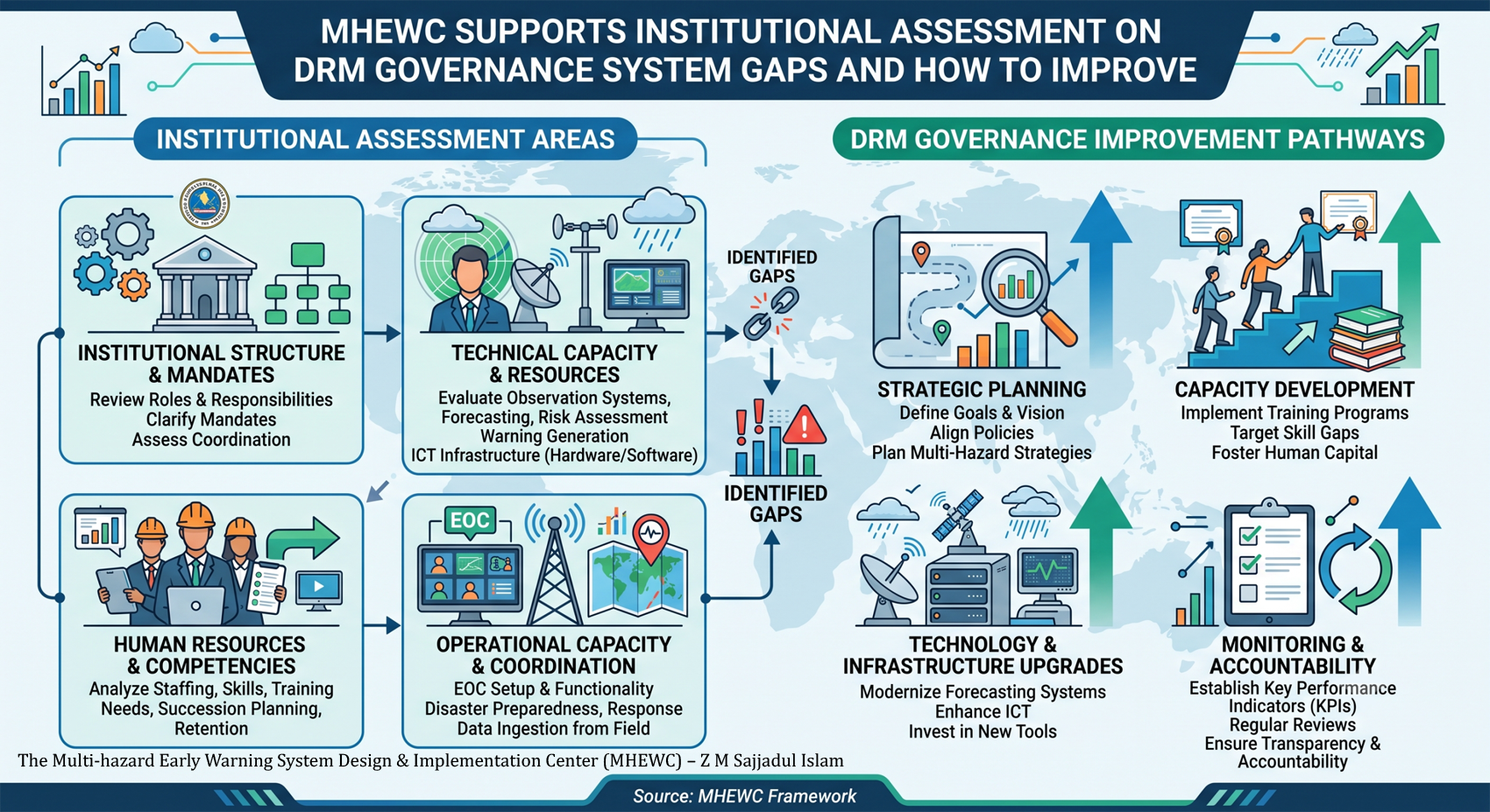
- Purpose of the Assessment
The purpose of the assessment is to determine whether existing DRM planning systems are:
- Risk-informed and evidence-based;
- Multi-hazard and climate-responsive;
- Integrated across sectors and administrative levels;
- Operationally actionable;
- Adequately financed;
- Inclusive and people-centred;
- Linked to early warning and anticipatory action;
- Supported by clearly defined institutional responsibilities;
- Regularly monitored, tested, reviewed, and updated; and
- Capable of reducing existing risks while preventing the creation or transfer of new risks.
The assessment will move beyond reviewing the existence of plans. It will determine whether the plans are institutionally owned, technically credible, adequately resourced, operationally understood, and consistently implemented.
- Key Assessment Objectives
The assessment will:
- Examine institutional capacity to develop and implement risk-informed preparedness, contingency, anticipatory-action, response, recovery, reconstruction, and resilience plans.
- Determine whether planning processes are informed by updated hazard, exposure, vulnerability, climate, infrastructure, livelihood, environmental, and socio-economic data.
- Assess the participation and integration of sector ministries, technical departments, local governments, civil society, the private sector, humanitarian organisations, and frontline communities.
- Review the mainstreaming of DRM into sectoral policies, strategies, programmes, investments, and budgets.
- Assess alignment among DRM, climate adaptation, development, humanitarian preparedness, public-investment, and local-development plans.
- Evaluate the quality, consistency, implementation status, financing, monitoring, accountability, and updating mechanisms of existing plans.
- Identify institutional, technical, human-resource, financial, ICT, coordination, and operational-capacity gaps.
- Develop a prioritised roadmap for strengthening integrated DRM planning and implementation.
Pillar 1: Data Integration and Risk-Informed Development Planning
- Institutional Capacity for Risk-Informed Planning
The assessment will examine whether responsible institutions possess the authority, organisational arrangements, technical capacity, human resources, data systems, and financing required to develop and implement risk-informed DRM plans.
Key assessment questions
- Is there a legally mandated institution responsible for leading national DRM planning?
- Are the responsibilities of sector ministries, technical agencies, local governments, and emergency services clearly defined?
- Are national and subnational planning responsibilities aligned?
- Are qualified planners, risk analysts, GIS specialists, economists, engineers, social-development specialists, and emergency-management professionals available?
- Are institutional planning teams permanent or created only during externally funded projects?
- Are planning institutions able to access and analyse relevant risk information?
- Are technical guidelines, planning templates, methodologies, and standard operating procedures available?
- Are institutional staff trained in multi-hazard risk assessment, climate-risk analysis, scenario planning, impact-based forecasting, anticipatory action, and recovery planning?
- Are plans supported by adequate operational and technical budgets?
- Are there mechanisms for involving technical institutions, sector agencies, local authorities, and communities throughout the planning process?
Institutional capacities to be assessed
- Legal and policy mandate;
- Organisational structure;
- Technical staffing;
- Human-resource competencies;
- Planning tools and methodologies;
- Data-management capacity;
- GIS and geospatial capability;
- Coordination mechanisms;
- Budgetary capacity;
- Monitoring and evaluation systems;
- Institutional learning arrangements; and
- Capacity to translate risk information into implementable actions.
- Risk Information Used in DRM Planning
The assessment will determine whether DRM plans are systematically informed by credible, updated, disaggregated, and geographically specific risk information.
4.1 Hazard Assessments
The assessment will review whether plans incorporate information on relevant hazards, including:
- Floods;
- Flash floods;
- Droughts;
- Cyclones and severe storms;
- Storm surges;
- Coastal erosion;
- Salinity intrusion;
- Landslides;
- Earthquakes;
- Tsunamis;
- Heatwaves;
- Wildfires;
- Epidemics and public-health emergencies;
- Technological and industrial hazards;
- Environmental degradation; and
- Compound and cascading hazards.
The review will determine whether hazard information includes frequency, magnitude, duration, seasonality, probability, spatial extent, historical trends, and projected future changes.
4.2 Exposure and Vulnerability Data
The assessment will examine whether planning processes use information on:
- Population distribution;
- Settlements;
- Housing;
- Critical infrastructure;
- Schools and health facilities;
- Agriculture and livestock;
- Fisheries;
- Water and sanitation systems;
- Energy and telecommunications;
- Transport networks;
- Markets and economic assets;
- Ecosystems and natural resources;
- Poverty and livelihood conditions;
- Gender inequality;
- Disability;
- Age;
- displacement;
- social exclusion; and
- other factors influencing vulnerability and coping capacity.
The assessment will also examine whether data are disaggregated by sex, age, disability, location, livelihood group, income level, and other relevant social characteristics.
4.3 Climate Projections
The assessment will review whether plans incorporate:
- Historical climate trends;
- Temperature projections;
- Rainfall variability;
- Changes in extreme precipitation;
- Sea-level rise;
- drought projections;
- cyclone and storm trends;
- heatwave projections;
- seasonal changes;
- glacier and snowmelt changes;
- coastal-risk projections; and
- climate scenarios over short-, medium-, and long-term planning horizons.
4.4 Historical Disaster-Loss Information
The assessment will determine whether planning processes use:
- Historical mortality data;
- numbers of affected and displaced people;
- damage to housing and infrastructure;
- agricultural and livelihood losses;
- service interruptions;
- environmental damage;
- public expenditure on response and recovery;
- sector-specific losses;
- indirect economic impacts; and
- lessons from previous emergencies.
The quality, completeness, consistency, and accessibility of national disaster-loss databases will also be assessed.
4.5 Multi-Hazard and Compound-Risk Scenarios
The review will examine whether plans consider:
- Simultaneous hazards;
- sequential hazards;
- cascading infrastructure failures;
- compound climate events;
- interconnected sectoral impacts;
- urban system disruption;
- supply-chain interruption;
- displacement;
- public-health emergencies;
- ecosystem degradation; and
- transboundary risk scenarios.
4.6 Impact-Based Forecasting
The assessment will determine whether forecasts are translated into expected impacts on:
- People and settlements;
- agriculture and food security;
- livestock and fisheries;
- roads and transport;
- water and sanitation;
- health;
- education;
- energy;
- telecommunications;
- markets;
- critical infrastructure;
- ecosystems; and
- essential public services.
It will also assess whether impact-based forecasts are linked to predefined actions, decision thresholds, institutional responsibilities, and financing.
4.7 Critical Infrastructure Analysis
The assessment will review whether DRM plans identify:
- Critical facilities and services;
- infrastructure exposure;
- structural vulnerability;
- system interdependencies;
- potential cascading failures;
- service-continuity requirements;
- backup arrangements;
- redundancy;
- emergency-access constraints; and
- restoration priorities.
4.8 Community Risk Assessments
The review will determine whether local and community knowledge is incorporated through:
- Participatory hazard mapping;
- seasonal calendars;
- historical timelines;
- community vulnerability assessments;
- evacuation mapping;
- local resource inventories;
- livelihood-risk analysis;
- traditional and Indigenous knowledge;
- community early-warning information; and
- identification of vulnerable households and groups.
4.9 Social, Economic, Environmental, and Gender Considerations
The assessment will examine whether plans address:
- Poverty and inequality;
- gender-differentiated impacts;
- disability inclusion;
- child and older-person protection;
- displacement;
- informal settlements;
- climate-sensitive livelihoods;
- food and water insecurity;
- ecosystem degradation;
- conflict and social tensions;
- cultural considerations;
- protection risks; and
- barriers affecting access to warnings, evacuation, assistance, and recovery support.
- Data Quality, Accessibility, and Interoperability
The assessment will determine whether risk information is:
- Current;
- reliable;
- quality-controlled;
- geographically detailed;
- interoperable;
- disaggregated;
- accessible to authorised institutions;
- available to local governments;
- compatible with GIS and planning systems;
- regularly updated; and
- linked to decision-making processes.
Specific areas of review
- Data ownership and custodianship;
- data-sharing agreements;
- metadata standards;
- quality-assurance protocols;
- common administrative and geographic identifiers;
- digital and paper-based data systems;
- interoperability between sector databases;
- open-data arrangements;
- cybersecurity;
- backup and recovery;
- data confidentiality; and
- public access to non-sensitive risk information.
Pillar 2: Sectoral Mainstreaming and Institutional Integration
- Sectoral Participation in DRM Planning
The assessment will examine whether sector ministries and departments formally participate in national and subnational DRM planning.
Participation will be assessed in relation to:
- Planning and prioritisation;
- risk assessment;
- scenario development;
- budgeting;
- contingency planning;
- early-warning interpretation;
- anticipatory action;
- emergency response;
- damage and needs assessment;
- recovery planning;
- monitoring; and
- plan revision.
Key institutional questions
- Are sector agencies formally represented in DRM planning committees?
- Are sectoral responsibilities defined by law, policy, or standard operating procedures?
- Are sector representatives authorised to make decisions?
- Do sectors allocate their own budgets for DRM?
- Are sectoral plans aligned with national DRM priorities?
- Are sector ministries involved in simulation exercises?
- Do sector agencies provide data to national DRM information systems?
- Are sector performance indicators included in the national DRM monitoring framework?
- Are sector agencies accountable for implementing agreed actions?
- Mainstreaming DRM into Sectoral Plans
The assessment will examine the extent to which DRM and climate risk are integrated into the following sectors.
7.1 Agriculture and Food Security
The assessment will review:
- Drought- and flood-resilient agriculture;
- climate-informed crop planning;
- agricultural early warning;
- livestock protection;
- seed and input reserves;
- crop and livestock insurance;
- food-security monitoring;
- anticipatory agricultural action;
- protection of storage and market systems; and
- post-disaster livelihood recovery.
7.2 Water Resources
The assessment will examine:
- Flood and drought management;
- integrated river-basin planning;
- reservoir-operation protocols;
- groundwater management;
- water-supply continuity;
- hydrological monitoring;
- watershed protection;
- environmental flows;
- transboundary cooperation; and
- climate-resilient water infrastructure.
7.3 Health
The review will examine:
- Emergency health preparedness;
- disease surveillance;
- climate-sensitive disease monitoring;
- health-facility resilience;
- emergency medical services;
- stockpiling of essential supplies;
- heat-health action plans;
- waterborne-disease preparedness;
- mental-health support; and
- continuity of critical health services.
7.4 Education
The assessment will review:
- School safety;
- resilient education infrastructure;
- emergency education plans;
- evacuation procedures;
- school-based early warning;
- continuity of learning;
- temporary learning spaces;
- protection of children; and
- integration of risk education into curricula.
7.5 Transport
The assessment will examine:
- Resilience of roads, bridges, ports, railways, and airports;
- hazard-resistant design standards;
- emergency-access routes;
- evacuation corridors;
- transport continuity;
- maintenance systems;
- landslide and flood protection; and
- post-disaster restoration priorities.
7.6 Energy
The review will cover:
- Exposure of power-generation and distribution systems;
- backup power;
- redundancy;
- fuel security;
- continuity of electricity supply;
- protection of renewable-energy infrastructure;
- emergency restoration; and
- cascading risks arising from energy disruption.
7.7 Housing
The assessment will review:
- Building codes;
- enforcement mechanisms;
- safe construction;
- settlement planning;
- housing vulnerability;
- retrofitting;
- informal housing;
- relocation policies;
- reconstruction standards; and
- Build Back Better measures.
7.8 Urban Development
The review will examine:
- Risk-sensitive land-use planning;
- urban flood management;
- drainage;
- heat-risk management;
- informal settlements;
- critical infrastructure;
- emergency access;
- open spaces;
- building-density controls; and
- resilient municipal services.
7.9 Environment and Ecosystems
The assessment will examine:
- Ecosystem-based disaster risk reduction;
- watershed management;
- wetland protection;
- mangrove and forest restoration;
- coastal buffers;
- biodiversity conservation;
- erosion control;
- environmental-impact assessment; and
- management of ecosystem-related cascading risks.
7.10 Social Protection
The review will determine whether social-protection systems are:
- Shock-responsive;
- linked to forecasts and triggers;
- able to scale up rapidly;
- connected to vulnerable-household databases;
- supported by digital payment systems;
- capable of providing emergency cash;
- inclusive of informal and displaced populations; and
- coordinated with anticipatory action and recovery programmes.
7.11 Telecommunications
The assessment will review:
- Resilience of communication networks;
- emergency communication capacity;
- cell-broadcast systems;
- redundancy;
- backup power;
- priority restoration;
- public warning dissemination;
- rural coverage;
- interoperability; and
- communication access for vulnerable groups.
7.12 Local Government
The review will examine whether local governments have:
- Legal authority;
- dedicated DRM staff;
- operational budgets;
- local risk information;
- GIS capacity;
- contingency plans;
- EOCs or coordination facilities;
- communication equipment;
- warning responsibilities;
- evacuation and shelter arrangements;
- emergency procurement authority; and
- accountability mechanisms.
7.13 Finance and Planning
The assessment will review whether finance and planning institutions incorporate risk into:
- National development plans;
- public-investment appraisal;
- annual budgets;
- medium-term expenditure frameworks;
- procurement systems;
- fiscal-risk analysis;
- contingency funds;
- climate-finance strategies;
- insurance and risk-transfer mechanisms; and
- recovery and reconstruction financing.
7.14 Critical Infrastructure
The review will examine whether critical infrastructure is:
- Identified and mapped;
- assessed for multi-hazard exposure;
- designed according to risk-informed standards;
- supported by continuity plans;
- equipped with backup systems;
- regularly inspected;
- included in emergency exercises; and
- prioritised for rapid restoration.
- Horizontal and Vertical Institutional Integration
The assessment will examine both:
Horizontal integration
Coordination among ministries, agencies, technical institutions, civil society, the private sector, and humanitarian partners at the same administrative level.
Vertical integration
Coordination among national, provincial, regional, district, municipal, community, and household levels.
Key elements to be assessed
- Institutional mandates;
- reporting lines;
- joint committees;
- sector working groups;
- data-sharing arrangements;
- planning calendars;
- common planning templates;
- joint budget processes;
- coordinated implementation;
- simulation exercises;
- emergency communication;
- local-to-national information flow; and
- feedback from communities to decision-makers.
Pillar 3: Plan Alignment, Quality, Implementation, and Accountability
- Alignment of DRM with Other Planning Frameworks
The assessment will review formal and operational linkages between DRM plans and other national and local frameworks.
9.1 Climate-Change Adaptation Plans
The review will determine whether DRM planning is aligned with:
- National Adaptation Plans;
- Nationally Determined Contributions;
- climate-change strategies;
- sector adaptation plans;
- local adaptation plans;
- climate-finance priorities; and
- climate-resilience indicators.
9.2 National and Sector Development Plans
The assessment will examine whether disaster and climate risks are reflected in:
- National development strategies;
- sector development plans;
- economic-growth strategies;
- poverty-reduction programmes;
- infrastructure plans;
- urban-development plans; and
- annual implementation programmes.
9.3 Humanitarian Preparedness Plans
The review will determine whether DRM plans are connected to:
- Humanitarian contingency plans;
- emergency-response arrangements;
- cluster or sector coordination;
- stockpiling;
- emergency logistics;
- humanitarian access;
- displacement planning; and
- protection arrangements.
9.4 Public-Investment Programmes
The assessment will examine whether public investments are subject to:
- Climate and disaster-risk screening;
- hazard and vulnerability assessment;
- resilient design standards;
- lifecycle costing;
- environmental and social safeguards;
- risk-transfer analysis;
- operation and maintenance planning; and
- post-project monitoring.
9.5 Local Development Plans
The review will assess whether local development plans include:
- Local risk profiles;
- risk-reduction priorities;
- community-identified needs;
- local early-warning measures;
- resilient infrastructure;
- preparedness activities;
- local financing;
- ecosystem protection; and
- implementation responsibilities.
- Operational Plan Review
The assessment will examine the quality and operational readiness of existing plans.
10.1 Preparedness Plans
Preparedness plans will be assessed for:
- Risk scenarios;
- institutional roles;
- readiness actions;
- training;
- simulation exercises;
- equipment;
- stockpiles;
- communication arrangements;
- public awareness;
- evacuation readiness;
- shelter preparedness; and
- continuity of essential services.
10.2 Contingency Plans
Contingency plans will be reviewed for:
- Hazard scenarios;
- planning assumptions;
- activation thresholds;
- response objectives;
- sector responsibilities;
- resource requirements;
- logistics;
- evacuation;
- shelter management;
- humanitarian assistance;
- communication; and
- coordination arrangements.
10.3 Emergency Response Plans
Response plans will be assessed for:
- Command and control;
- incident-management systems;
- EOC activation;
- emergency communication;
- search and rescue;
- medical response;
- logistics;
- resource mobilisation;
- situation reporting;
- public information;
- field coordination; and
- protection of vulnerable groups.
10.4 Recovery Plans
Recovery plans will be reviewed for:
- Institutional leadership;
- recovery priorities;
- livelihood restoration;
- housing;
- public services;
- social protection;
- ecosystem restoration;
- financing;
- community participation;
- risk reduction; and
- monitoring of recovery outcomes.
10.5 Reconstruction Plans
Reconstruction plans will be assessed for:
- Build Back Better principles;
- revised construction standards;
- risk-informed site selection;
- resilient infrastructure;
- safer housing;
- relocation where necessary;
- environmental safeguards;
- public participation;
- transparent procurement;
- financial oversight; and
- long-term maintenance.
- Plan Quality Assessment
Each plan will be assessed against the following quality criteria:
- Legal and institutional basis;
- use of credible risk information;
- clarity of objectives;
- consistency with other policies and plans;
- sector participation;
- local relevance;
- inclusion of vulnerable groups;
- operational feasibility;
- budget availability;
- technical quality;
- monitoring arrangements;
- accountability;
- review and updating;
- accessibility;
- and institutional ownership.
- Implementation Status
The assessment will distinguish between:
- Plans that exist only in draft form;
- plans formally approved but not financed;
- plans financed but partially implemented;
- plans operationally tested;
- plans activated during actual emergencies;
- plans reviewed after activation; and
- plans regularly updated based on lessons learned.
Evidence of implementation may include
- Budget releases;
- completed activities;
- procurement records;
- staff assignments;
- training records;
- simulation reports;
- EOC activation records;
- warning messages;
- situation reports;
- evacuation records;
- after-action reviews;
- audit reports; and
- monitoring results.
- Financing Arrangements
The assessment will examine whether plans include:
- Costed activities;
- identified funding sources;
- dedicated DRM budget lines;
- contingency reserves;
- anticipatory-action funds;
- local-government allocations;
- sector contributions;
- emergency procurement arrangements;
- donor or partner financing;
- climate-finance linkages;
- insurance or risk-transfer mechanisms; and
- expenditure tracking.
The assessment will also determine whether financing is available before, during, and after emergencies.
- Monitoring, Evaluation, and Updating
The assessment will review whether plans include:
- Baseline information;
- measurable indicators;
- annual targets;
- responsible monitoring institutions;
- reporting schedules;
- data-verification arrangements;
- public disclosure;
- independent review;
- community feedback;
- after-action reviews;
- simulation-based learning;
- corrective-action tracking; and
- regular updating procedures.
Plans should be updated following:
- Major disasters;
- significant changes in risk;
- new climate projections;
- infrastructure development;
- administrative restructuring;
- simulation exercises;
- institutional reviews; and
- changes in legislation or policy.
- Responsibilities and Institutional Clarity
The assessment will determine whether plans clearly identify:
- Lead institutions;
- supporting institutions;
- sector responsibilities;
- local-government responsibilities;
- technical-agency responsibilities;
- decision-making authority;
- warning-authorisation authority;
- financing authority;
- emergency procurement authority;
- reporting obligations;
- implementation responsibilities; and
- accountability for non-performance.
- Activation Thresholds and Triggers
The review will determine whether plans define:
- Hazard thresholds;
- impact thresholds;
- forecast triggers;
- alert levels;
- escalation procedures;
- EOC activation criteria;
- evacuation triggers;
- anticipatory-action triggers;
- social-protection scale-up triggers;
- emergency-fund release criteria; and
- deactivation and transition procedures.
Triggers should be scientifically credible, operationally understood, and connected to predefined actions and financing.
- Timelines and Sequencing
Plans will be assessed for clearly defined timelines covering:
- Preparedness actions;
- pre-season readiness;
- early warning;
- anticipatory action;
- emergency activation;
- evacuation;
- response deployment;
- rapid assessment;
- recovery planning;
- reconstruction; and
- monitoring and review.
- Resource Requirements
The assessment will determine whether plans identify requirements for:
- Personnel;
- technical expertise;
- equipment;
- transport;
- communications;
- shelters;
- emergency supplies;
- health services;
- water and sanitation;
- logistics;
- ICT;
- GIS;
- financial resources;
- security;
- and surge support.
- Operational Procedures
Plans should contain or reference:
- Standard operating procedures;
- activation protocols;
- incident-management arrangements;
- communication procedures;
- warning dissemination processes;
- evacuation procedures;
- shelter-management arrangements;
- logistics procedures;
- emergency procurement;
- public-information protocols;
- data-reporting formats;
- assessment procedures;
- coordination protocols; and
- transition arrangements from response to recovery.
- Coordination Arrangements
The assessment will review:
- Interministerial coordination;
- sector coordination;
- EOC coordination;
- humanitarian coordination;
- civil-military coordination;
- public-private coordination;
- national-subnational coordination;
- local-community coordination;
- cross-border coordination;
- coordination with scientific institutions; and
- arrangements for development partners.
- Accountability Mechanisms
Plans should establish mechanisms for:
- Performance reporting;
- public disclosure;
- financial audit;
- legislative oversight;
- independent review;
- grievance and redress;
- community feedback;
- after-action review;
- investigation of institutional failure;
- corrective-action planning;
- and consequences for non-compliance or neglect.
Accountability should apply both to actions taken and failures to act when credible information and reasonable opportunities for intervention were available.
- Proposed Assessment Methodology
MHEWC may apply a mixed-method assessment approach combining:
Document review
Review of legislation, policies, strategies, plans, budgets, guidelines, standard operating procedures, assessments, reports, databases, and monitoring documents.
Institutional consultations
Interviews and consultations with:
- Disaster-management authorities;
- sector ministries;
- National Meteorological and Hydrological Services;
- local governments;
- EOCs;
- planning and finance institutions;
- humanitarian organisations;
- development partners;
- civil society;
- private-sector actors;
- universities and research institutions; and
- frontline communities.
Capacity self-assessment
Structured questionnaires and institutional self-assessment tools.
Technical systems assessment
Review of:
- GIS platforms;
- risk databases;
- forecasting systems;
- dashboards;
- early-warning platforms;
- EOC systems;
- mobile data tools; and
- information-sharing mechanisms.
Field verification
Visits to national, subnational, local, and community institutions to validate operational capacity.
Simulation and functionality testing
Testing of:
- Warning dissemination;
- activation procedures;
- information flow;
- sector coordination;
- EOC operations;
- local response;
- evacuation;
- and decision-making.
Gap and needs analysis
Comparison of existing capacity against required institutional, technical, operational, and financial standards.
- Indicative Scoring Framework
Each assessment area may be scored using a five-level capacity scale:
Level 1 : Absent
No formal system, plan, mandate, capacity, or operational arrangement exists.
Level 2 : Initial
Some elements exist, but they are fragmented, informal, project-based, or inconsistently applied.
Level 3 : Developing
Formal arrangements and plans exist, but implementation, financing, coordination, and technical capacity remain incomplete.
Level 4 : Established
Systems are formally institutionalised, adequately resourced, operational, and generally implemented across relevant sectors and levels.
Level 5 : Advanced
Systems are fully integrated, risk-informed, regularly tested, independently reviewed, continuously improved, and capable of supporting anticipatory and accountable action.
Scoring should be supported by documentary and operational evidence rather than institutional self-reporting alone.
- Expected Outputs
The assessment is expected to produce:
- An Integrated DRM Planning Capacity Assessment Report;
- A national and subnational institutional-capacity profile;
- A risk-information and data-integration assessment;
- A sectoral mainstreaming and participation matrix;
- A DRM and climate-policy alignment analysis;
- A preparedness, contingency, response, recovery, and reconstruction plan review;
- A financing and resource-capacity assessment;
- A monitoring, evaluation, and accountability assessment;
- A technical and human-resource gap analysis;
- A plan-quality and implementation scorecard;
- A prioritised institutional-strengthening plan;
- A capacity-development and training programme;
- Recommendations for legal, policy, institutional, technical, and financial reforms; and
- A phased roadmap for strengthening integrated and risk-informed DRM planning.
- Proposed MHEWC Assessment Checklist
Pillar 1: Data Integration and Risk-Informed Development
Institutional Capacity
- Is there sufficient institutional capacity to develop and implement risk-informed preparedness, response, recovery, reconstruction, and resilience plans?
- Are institutional mandates clearly defined?
- Are qualified technical personnel available?
- Are planning methodologies and technical guidelines available?
- Are plans supported by adequate data systems and financing?
- Are national and local planning capacities connected?
Risk-Information Drivers
Are planning processes systematically informed by:
- Hazard assessments?
- Exposure data?
- Vulnerability assessments?
- Climate projections?
- Historical disaster-loss records?
- Multi-hazard and compound-risk scenarios?
- Impact-based forecasts?
- Critical infrastructure analysis?
- Community risk assessments?
- Social and economic considerations?
- Environmental and ecosystem considerations?
- Gender and disability considerations?
Pillar 2: Sectoral Mainstreaming and Integration
Sector Participation
- Are sector ministries formally represented in national DRM planning?
- Are sector departments involved at subnational and local levels?
- Are sector responsibilities legally or administratively defined?
- Do sectors allocate budgets for DRM?
- Do sectors participate in exercises and plan reviews?
- Are sector performance indicators monitored?
DRM Mainstreaming in Sectoral Plans
Is DRM integrated into plans for:
- Agriculture and food security?
- Water resources?
- Health?
- Education?
- Transport?
- Energy?
- Housing?
- Urban development?
- Environment?
- Social protection?
- Telecommunications?
- Local government?
- Finance and planning?
- Critical infrastructure?
Pillar 3: Plan Alignment, Quality, and Accountability
Integration and Linkages
Are formal and operational links established between DRM plans and:
- Climate-change adaptation plans?
- National development plans?
- Sector development plans?
- Humanitarian preparedness plans?
- Public-investment programmes?
- Local development plans?
- Social-protection systems?
- Climate-finance frameworks?
Operational Plan Review
Have the following plans been assessed for quality, consistency, implementation, financing, monitoring, and updating?
- Preparedness plans?
- Contingency plans?
- Anticipatory-action plans?
- Emergency-response plans?
- Recovery plans?
- Reconstruction plans?
- Business- and service-continuity plans?
- Sector emergency plans?
Accountability and Operational Clarity
Do plans clearly define:
- Institutional responsibilities?
- Decision-making authority?
- Activation thresholds?
- Forecast and impact triggers?
- Implementation timelines?
- Resource requirements?
- Financing sources?
- Operational procedures?
- Coordination arrangements?
- Monitoring indicators?
- Public-reporting requirements?
- Accountability mechanisms?
- Corrective-action procedures?
Contact MHEWC
Please engage MHEWC to conduct the assessment. For technical cooperation, institutional assessment, DRM planning support, multi-hazard early warning system design, impact-based forecasting, anticipatory action, and capacity development, please contact:
Z M Sajjadul Islam
Advisor, Multi-Hazard Early Warning System Design & Implementation Center (MHEWC)
Email: zmsajjad@gmail.com
WhatsApp: +88 01711 979179