Climate risk and vulnerabilities of Pakistan
Pakistan is highly vulnerable to climate change and multi-hazard risks because of its exposure to the Indus River system, monsoon variability, arid and semi-arid zones, rapidly warming mountain regions, glacier-fed river basins, long Arabian Sea coastline, high dependence on irrigated and rainfed agriculture, rapid urbanization, water scarcity, poverty, and climate-sensitive livelihoods. Its major hazards include riverine floods, flash floods, urban flooding, glacial lake outburst floods, heatwaves, drought, water scarcity, landslides, cyclones, storm surge, sea-level rise, coastal erosion, saltwater intrusion, crop failure, livestock losses, food insecurity, waterborne disease risks, infrastructure damage, and displacement. Pakistan’s National Adaptation Plan states that the country ranks among the world’s most climate-vulnerable countries and is already experiencing rising temperatures, more frequent and intense precipitation extremes, floods and droughts, glacier recession, and sea-level rise threats to coastal areas.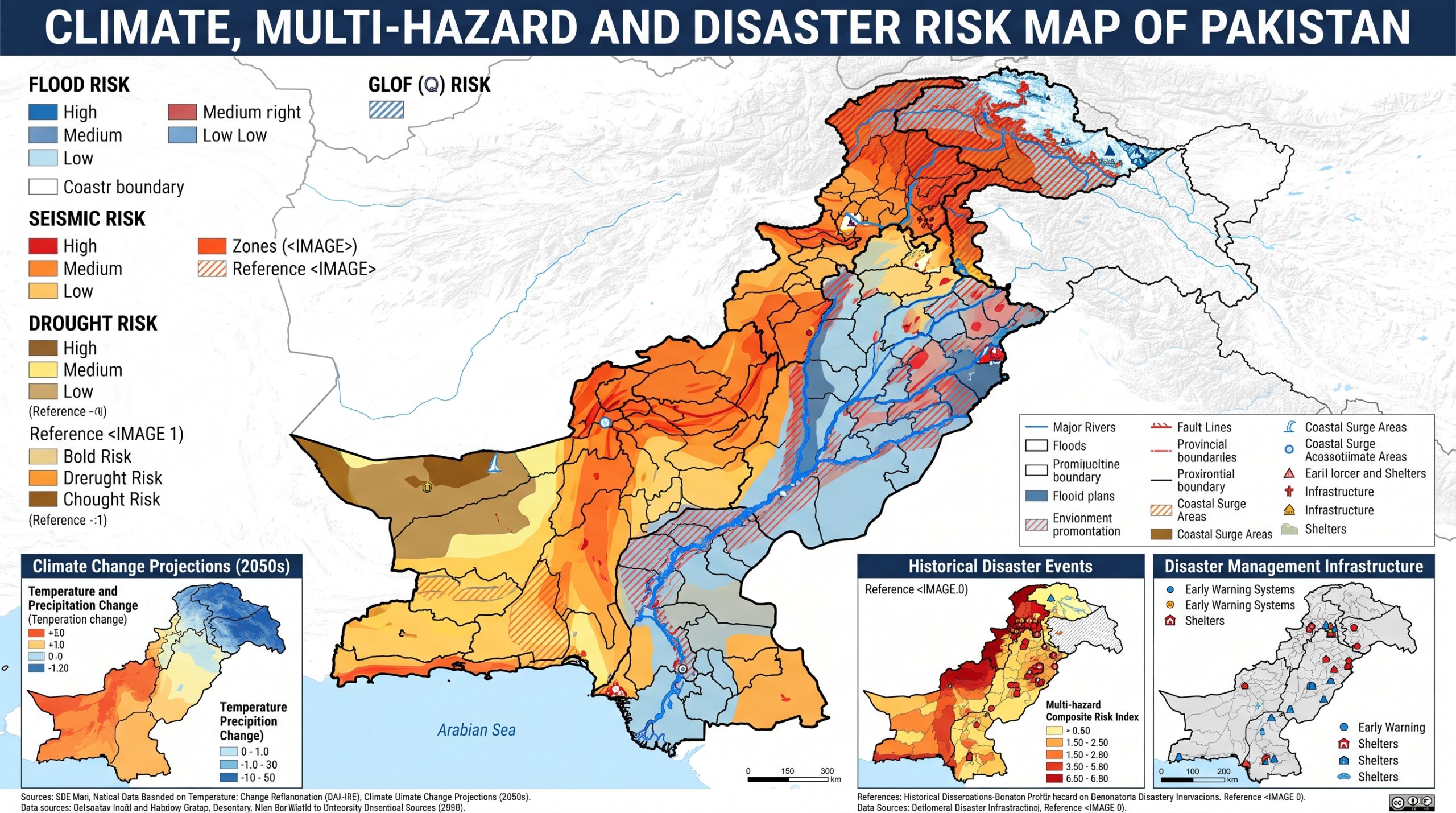
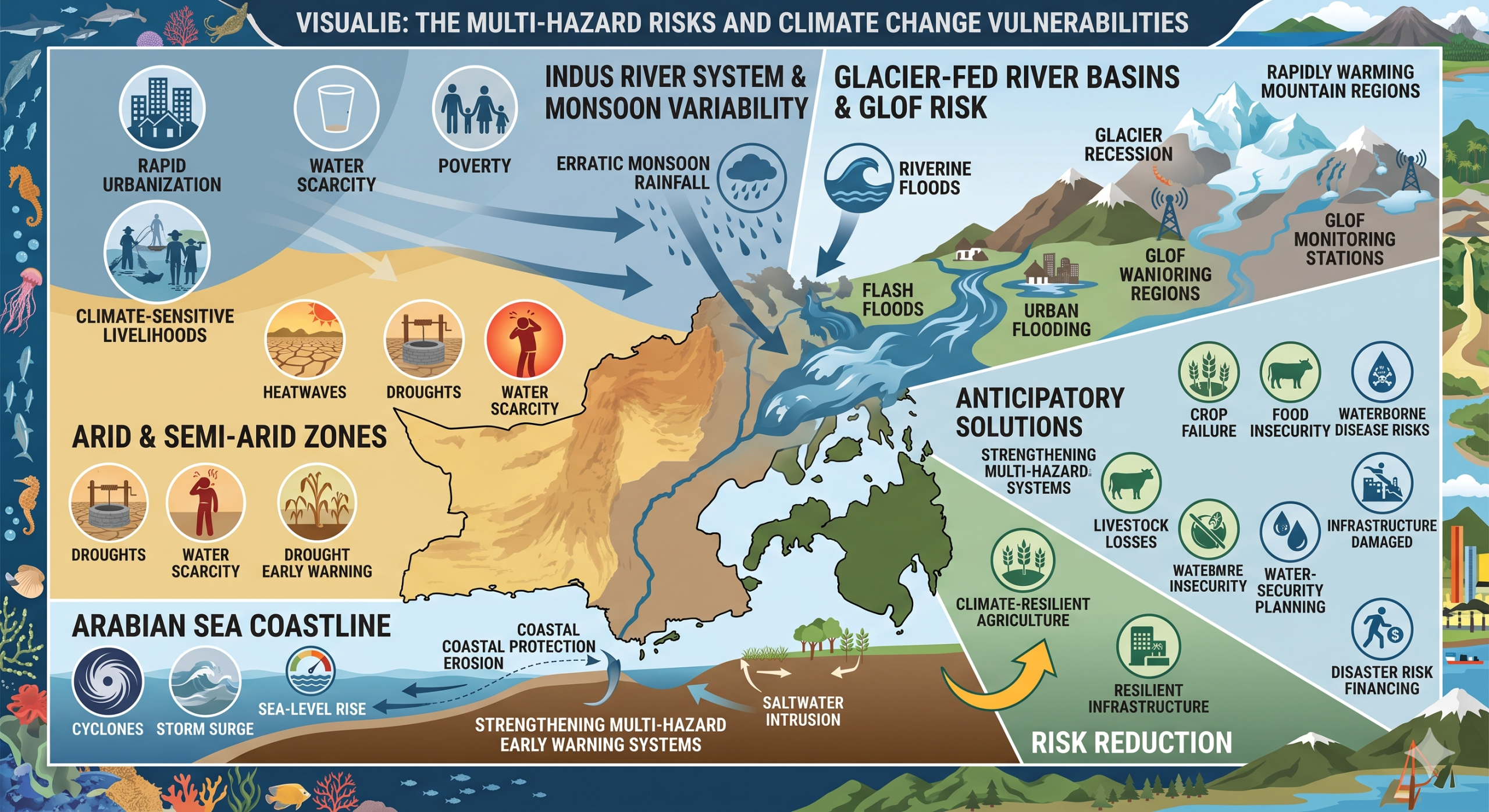
Pakistan is highly exposed and vulnerable to climate change and multi-hazard risks due to its dependence on the Indus River system, glacier-fed water resources, monsoon variability, arid and semi-arid regions, long Arabian Sea coastline, rapid urbanization, water scarcity, poverty, and strong reliance on climate-sensitive agriculture, livestock, fisheries and informal livelihoods. The country faces major risks from riverine floods, flash floods, urban flooding, glacial lake outburst floods, drought, water scarcity, heatwaves, erratic monsoon rainfall, landslides, cyclones, storm surge, sea-level rise, coastal erosion, saltwater intrusion, crop failure, livestock losses, food insecurity, disease outbreaks, infrastructure disruption and large-scale displacement. Climate change is expected to intensify these vulnerabilities through higher temperatures, more severe heatwaves, altered monsoon patterns, increased flood and drought extremes, accelerating glacier and snow melt, saline intrusion in coastal areas, declining water security, reduced agricultural productivity, worsening public-health risks and growing pressure on livelihoods, infrastructure and vulnerable rural, mountain, coastal and urban communities. Strengthening multi-hazard early warning systems, impact-based forecasting, flood forecasting, GLOF monitoring, drought early warning, heat-health action plans, climate-resilient agriculture, water-security planning, resilient infrastructure, coastal protection, WASH resilience, disaster risk financing and anticipatory action is essential to reduce losses and protect Pakistan’s development gains.

1. Multi-hazard exposure
Pakistan’s risk profile combines hydrometeorological, cryospheric, geophysical, coastal, and environmental hazards. Major hazards include monsoon floods, flash floods, droughts, heatwaves, landslides, GLOFs, earthquakes, cyclones, coastal flooding, salinity intrusion, desertification, forest fires, and climate-sensitive disease outbreaks. Pakistan’s National Adaptation Plan notes projected changes in the Indus River’s seasonal flow and increased formation and outburst of glacial lakes, confirming the importance of both water-system and mountain cryosphere risks. (UNFCCC)
The 2022 floods showed the scale of national exposure. The PDNA reported that about 33 million people were affected, nearly 8 million people were displaced, and more than 1,700 people died. Total damage was estimated at US$14.9 billion, losses at US$15.2 billion, and recovery and reconstruction needs at US$16.3 billion.
2. Climate change as a risk multiplier
Climate change is amplifying Pakistan’s existing hazard profile through higher temperatures, more frequent heat extremes, intense monsoon rainfall, glacier and snowpack changes, drought stress, sea-level rise, water insecurity, and ecosystem degradation. The CCDR frames Pakistan’s climate challenge as both a development and poverty-reduction challenge, stressing that climate risks affect lives, livelihoods, jobs, poverty, and distributional outcomes. (Open Knowledge Repository)
This creates cascading risk: extreme heat can reduce labour productivity and crop yields; glacier melt can temporarily increase river flows and GLOF hazards; intense monsoon rainfall can generate riverine, flash, and urban flooding; drought can reduce crop and livestock productivity; and water stress can affect agriculture, hydropower, drinking water, sanitation, health, and urban systems.
3. Flood, GLOF, and landslide vulnerability
Flooding is Pakistan’s most damaging recurrent hazard. Riverine flooding affects the Indus and its tributaries, flash floods affect hill torrents and steep catchments, and urban flooding affects major cities where drainage systems are overwhelmed by intense rainfall. The 2022 floods damaged housing, agriculture, livestock, transport, communications, irrigation, WASH systems, education, health, livelihoods, and public services across 94 calamity-hit districts.
Northern Pakistan, especially Gilgit-Baltistan and Khyber Pakhtunkhwa, faces increasing risks from GLOFs, landslides, avalanches, snowmelt variability, and slope instability. These hazards threaten mountain communities, roads, bridges, hydropower assets, irrigation channels, tourism infrastructure, and downstream settlements.
4. Drought, heatwaves, and water insecurity
Drought and heat are major threats in Sindh, Balochistan, southern Punjab, Tharparkar, Cholistan, and other arid or semi-arid regions. Rising temperatures increase evapotranspiration, water demand, crop stress, livestock mortality, heat-related illness, and electricity demand for cooling.
Water security is Pakistan’s central climate-development challenge. The country depends heavily on the Indus Basin irrigation system, while climate change affects glacier melt, snowpack, monsoon timing, drought frequency, groundwater recharge, and flood variability. Water scarcity directly affects agriculture, hydropower, cities, ecosystems, sanitation, and rural livelihoods.
5. Agriculture, food security, and rural livelihoods
Agriculture is one of Pakistan’s most climate-sensitive sectors. The 2022 floods caused severe damage and losses to agriculture, food, livestock, and fisheries; the PDNA estimated US$3.7 billion in damages and US$9.2 billion in losses in that sector, with crops contributing most of the damage and losses.
| Sub-sector | Main climate and hazard risks |
|---|---|
| Rice, wheat, cotton, sugarcane, maize | Floods, drought, heat stress, pests, crop-calendar disruption |
| Livestock | Heat stress, water scarcity, fodder shortage, disease, flood-related mortality |
| Irrigated agriculture | Canal damage, waterlogging, salinity, sedimentation, water competition |
| Rainfed agriculture | Drought, delayed rains, dry spells, crop failure |
| Fisheries and aquaculture | Flood damage, water-quality decline, heat stress, coastal ecosystem change |
| Rural labour | Lost workdays, income shocks, debt, migration pressure |
6. Coastal, urban, and infrastructure vulnerability
Pakistan’s coastal belt, especially Karachi, Thatta, Sujawal, Badin, and Gwadar, is exposed to sea-level rise, storm surge, cyclones, coastal erosion, saltwater intrusion, and mangrove degradation. These risks threaten ports, fisheries, coastal agriculture, drinking-water systems, informal settlements, tourism, and industrial zones.
Urban areas such as Karachi, Lahore, Rawalpindi, Islamabad, Peshawar, Quetta, Hyderabad, Multan, Faisalabad, and Sukkur face growing risks from urban flooding, heat stress, air pollution, poor drainage, water scarcity, informal settlement exposure, and infrastructure overload. The PDNA found major flood damage to transport, communications, WASH, municipal services, community infrastructure, irrigation systems, and flood-protection assets.
7. Health and social vulnerability
Climate change affects public health through heat stress, unsafe water, diarrhoeal disease, malaria, dengue, malnutrition, respiratory stress, flood-related injuries, and mental-health impacts after disasters. Vulnerability is highest among poor rural households, smallholder farmers, landless labourers, informal urban settlers, women-headed households, children, older persons, people with disabilities, pastoralists, coastal communities, and mountain communities exposed to GLOFs and landslides.
The National Adaptation Plan includes dedicated priorities for agriculture-water systems, natural capital, urban resilience, human capital, disaster risk management, gender, youth, and social inclusion, reflecting the need for integrated and socially inclusive adaptation. (UNFCCC)
8. Sector-specific vulnerability summary
| Sector | Main climate and multi-hazard risks |
|---|---|
| Water resources | Glacier melt variability, drought, floods, groundwater stress, salinity, water-quality decline |
| Agriculture and food security | Floods, droughts, heat stress, pests, crop loss, livestock mortality |
| Mountain regions | GLOFs, landslides, avalanches, flash floods, slope instability |
| Urban settlements | Urban flooding, heatwaves, drainage failure, informal settlement exposure |
| Coastal zones | Sea-level rise, storm surge, cyclones, coastal erosion, saltwater intrusion |
| Transport and infrastructure | Road washouts, bridge damage, slope failure, flood disruption, heat stress |
| Health | Heat illness, dengue, malaria, diarrhoeal disease, malnutrition, disaster trauma |
| Energy | Hydropower variability, heat-driven demand, flood damage, water constraints |
9. Priority resilience needs
Pakistan’s resilience agenda should prioritize multi-hazard early warning systems, impact-based forecasting, flood forecasting, GLOF monitoring, drought early warning, heat-health action planning, climate-resilient agriculture, integrated water-resource management, resilient urban drainage, coastal protection, earthquake-safe infrastructure, disaster risk financing, and shock-responsive social protection.
| Priority area | Key actions |
|---|---|
| Early warning and anticipatory action | Impact-based warnings for floods, heatwaves, droughts, GLOFs, landslides, cyclones, and disease outbreaks |
| Flood and GLOF risk management | Basin-scale forecasting, glacial lake monitoring, hill-torrent management, floodplain zoning |
| Water security | Groundwater regulation, water-use efficiency, reservoir and canal resilience, drought contingency planning |
| Climate-resilient agriculture | Heat-, drought-, flood-, and salinity-tolerant crops; agro-advisories; crop and livestock insurance |
| Urban resilience | Drainage upgrading, heat-risk planning, solid-waste management, resilient housing, risk-informed zoning |
| Coastal resilience | Mangrove restoration, coastal-risk mapping, salinity management, storm-surge preparedness |
| Risk financing | Contingency finance, forecast-based financing, insurance, scalable social protection, resilient recovery |
National Disaster Management Authority (NDMA)
Lead agency at the Federal level to deal with the whole spectrum of Disaster Management activities.It is the executive arm of the National Disaster Management Commission (NDMC) which has been established under the Chairmanship of the Prime Minister as the apex policy making body in the field of Disaster Management. In the event of a disaster, all stakeholders including Government Ministries/Departments/Organizations, Armed Forces, INGOs, NGOs, UN Agencies work through and form part of the NDMA to conduct one window operations.

About NEOC
Welcome to the National Emergencies Operation Center, a pioneering initiative of the National Disaster Management Authority of Pakistan under the visionary leadership of Chairman NDMA, Lt. General Inam Haider Malik HI (M). Established with a strategic vision to shift from reactive to proactive disaster management, NEOC is as a beacon of innovation and preparedness. NEOC boasts state-of-the-art facilities that rival the best globally. Conceptualized and realized in an unprecedented time frame, this center highlights NDMA’s commitment to safeguarding lives and livelihoods in Pakistan.
Equipped with the latest tools and technologies, including real-time satellite feeds, NEOC has the capability to anticipate disasters up to three months in advance. Our multidisciplinary team of experts harnesses the power of GIS, Remote Sensing, Climatology, Meteorology, Seismology, Hydrology, and Data Sciences to monitor and analyze both global and local hazards. At NEOC, we leave no stone unturned to anticipate and mitigate disaster risks. From tracking global oceanic and atmospheric oscillations to assessing local hazards and their likely impacts, our team remains vigilant round the clock. By analyzing emerging patterns and trends, we stay one step ahead, ensuring timely interventions and effective response strategies.
Climate change poses unprecedented challenges to Pakistan’s vulnerability to disasters. NEOC is committed to addressing this threat by integrating climate change adaptation and DRR measures into our operations. By aligning with international frameworks such as the Sendai Framework for Disaster Risk Reduction and Sustainable Development Goals, we strive to build resilience and enhance preparedness at all levels. NEOC invites collaboration and partnerships with national and international stakeholders to bolster our efforts in disaster management and climate resilience. Together, we can build a safer, more resilient future for generations to come.
Explore NEOC and join us in our mission to protect and empower communities in the face of adversity!
DM Plans

National Disaster Risk Reduction Strategy 2025 – 2030 Pakistan
Pakistan has long been vulnerable to a range of natural and human-induced disasters, including earthquakes, floods, droughts, and climate-related emerging hazards such as glacial lake outburst floods (GLOFs), heatwaves, forest fires and shifting monsoon patterns. These disasters disrupt lives, undermine economic stability, and set back development progress. The National Disaster Risk Reduction Strategy (NDRRS) 2025-2030 provides a comprehensive framework to mitigate these risks, enhance preparedness, and foster resilience through proactive planning, inclusive governance, and technological innovation.
Category: DRR Strategy

Monsoon Contingency Plan 2025
This document provides response guidelines for all disaster management stakeholders at National and Provincial / State levels for proactive and inclusive preparedness and effective response to any flood like situation as per contingencies based on Monsoon Seasonal Outlook 2025 and other likely emergencies in the country.
Category: Plans

NDMA – Summer Hazards Contingency Plan 2025
NDMA Summer Hazards Contingency Plan 2025 has been prepared in coordination with all disaster management stakeholders, both at federal and provincial levels based on analysis of seasonal outlook by the Pakistan Meteorological Department (PMD) and relevant technical input from NDMA Tech Team. In this Plan, guidelines have been outlined for all disaster management tiers and relevant stakeholders for adopting a proactive approach towards all aspects of mitigation, preparations against the most probable and against possible worst-case scenarios to coordinate a timely response.
Category: Plans

Integrated National Search & Rescue (INSaR)
The concept Paper on Integrated National Search & Rescue (INSaR), highlights the area specific and contingency based search and rescue teams, embedded with local resource, humanitarian partner/ philanthropist with futuristic outlook, organized, trained, equipment and structured for an effective, efficient and timely response.
Category: Plans
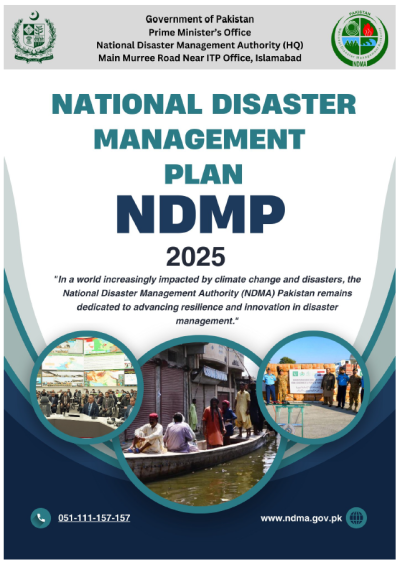
NATIONAL DISASTER MANAGEMENT PLAN (NDMP) 2025
This Plan succeeds the recently expired National Disaster Management Plan,which made significant strides between 2012 and 2024. The new National DisasterManagement Plan 2025 will serve as a comprehensive framework that adopts a proactive approach. The Plan emphasizes enhancing coping capacities, capabilities and learningfrom past experiences to improve disaster preparedness and response mechanisms.
Category: Plans
National Resources And Risk Financing
Pakistan faces growing challenges from both climate-induced and natural disasters such as floods, earthquakes, droughts, and cyclones. Despite these vulnerabilities, the country possesses vast untapped resources including natural, human, industrial, and institutional assets. If strategically mobilized, these resources can significantly enhance Disaster Risk Reduction (DRR) efforts and foster long-term resilience. Addressing these challenges requires a whole-of-society approach aimed at transforming potential into preparedness.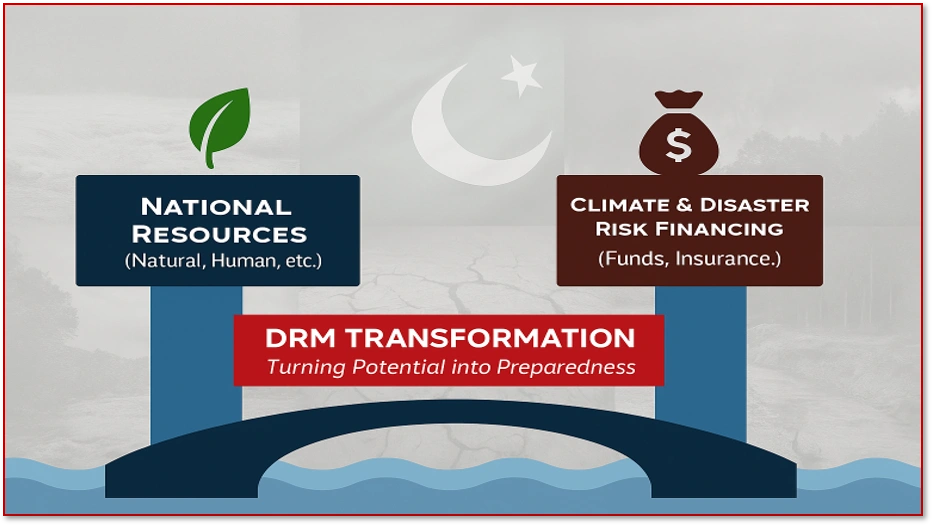
National Resources
Mobilizing Pakistan’s Resources for Resilient Disaster Management
Shape the national narrative on shared responsibility
Develop a National DRM-Private Sector Partnership Framework
Institutionalize MoUs and coordination platforms
Embed DRM in industrial planning policies & conduct simulations
Operationalize Diaspora for Resilience Initiative
Drive technology localization & innovation ecosystems
Mobilize philanthropy as catalytic funders
Launch a National DRM Showcase & Expo Series
Climate & Disaster Risk Financing
Building Financial Readiness to Withstand Climate and Disaster Risks
Develop a National Climate & Disaster Risk Financing Roadmap
Build a pipeline of bankable resilience projects
Strengthen engagement with global climate funds
Partner with financial institutions
Facilitate regional pooling & data sharing initiatives
Promote localized financing models
Create a Risk Financing Knowledge Platform
Develop enabling regulatory frameworks with State Bank & SECP
Prepare contingent financing instruments with multilateral IFIs