Automated Common Alerting Protocol (CAP) Alert Generation within an end-to-end Multi-Hazard Early Warning System(EWS): Draft Technical Concept
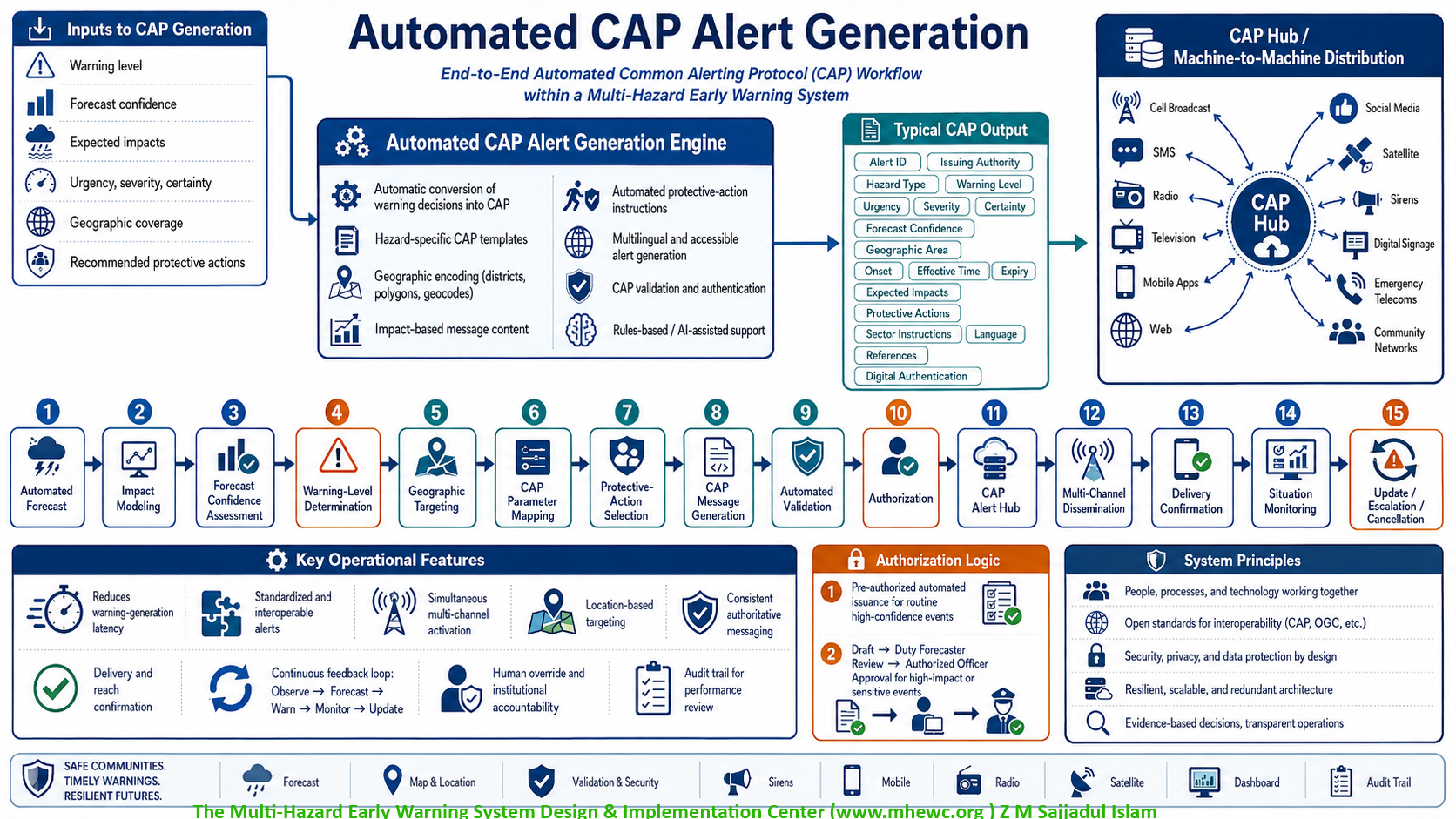
Once the system has determined the appropriate warning level, forecast confidence, expected impacts, urgency, severity, certainty, geographic coverage, and recommended protective actions, the warning decision should automatically be converted into a standardized Common Alerting Protocol (CAP) message. This creates a machine-readable, interoperable alert that can be transmitted simultaneously across multiple warning and communication systems without requiring the warning to be manually rewritten for each dissemination channel.
The Automated CAP Alert Generation Engine should therefore function as the digital bridge between the Warning Level Determination Engine and the multi-channel dissemination infrastructure, translating scientific forecasts and operational warning decisions into a standardized alert format that can be recognized and processed by telecommunications operators, broadcasters, emergency-management platforms, mobile applications, siren systems, web services, satellite networks, local-government systems, humanitarian platforms, and other CAP-enabled technologies.
The automated process may follow the sequence: Forecast & Impact Assessment > Warning-Level Determination > CAP Parameter Mapping > Geographic Encoding > Protective-Action Selection > Message Validation > Authorization > CAP Publication > Multi-Channel Dissemination.
- Automatic Conversion of Warning Decisions into CAP
Once the warning decision is finalized, the system should automatically extract the required information from the forecasting, impact-modeling, and warning-decision modules and populate the appropriate CAP fields. This may include: hazard or event type; issuing authority; warning identifier; date and time of issuance; alert status; message type; geographic scope; urgency; severity; certainty; effective time; expected onset; expiry time; affected areas; expected impacts; population at risk; protective instructions; response actions; information sources; contact details; relevant web resources; hazard-specific parameters; and references to previous or updated alerts. The objective is to eliminate unnecessary manual transcription between forecasting and alerting systems and substantially reduce warning-generation latency.
- Automatic assignment of urgency, severity, and certainty
Information already calculated during warning-level determination should automatically populate the corresponding CAP parameters. For example: Urgency describes how quickly action should be taken. Severity describes the expected seriousness of the consequences. Certainty describes the level of confidence that the event will occur or is already occurring. The automated architecture can therefore translate internal forecast and warning classifications into standardized CAP terminology according to the nationally approved CAP profile.
For example: High forecast confidence + severe expected impacts + imminent onset > Immediate Urgency + Severe Severity + Likely/Observed Certainty. This reduces subjective variation between warning messages and improves consistency across issuing authorities.
- Hazard-specific CAP templates
The system should maintain predefined and nationally approved CAP alert templates for different hazards and warning levels. Templates could be developed for: tropical cyclones; severe thunderstorms; extreme rainfall; river floods; flash floods; coastal flooding; storm surge; heatwaves; drought; landslides; wildfires; lightning; strong winds; marine hazards; and other nationally prioritized hazards.
Each template could contain predefined terminology, protective-action guidance, severity mappings, escalation procedures, and mandatory information fields.
The automated system would then populate dynamic information such as: Location + Timing + Hazard Intensity + Expected Impact + Warning Level + Protective Action while maintaining standardized warning language.
- Automated geographic encoding
One of the most important functions of CAP is its ability to specify precisely where the warning applies.
The automated system should therefore convert the forecast and impact footprint into CAP-compatible geographic information, potentially using: administrative area names; geocodes; GIS polygons; latitude/longitude coordinates; circles or radius-based areas; river basins; coastal zones; municipalities; districts; communities; or dynamically generated impact polygons.
For example, rather than issuing a general warning across an entire country, the CAP message could identify only those districts, communities, river corridors, coastal areas, or urban neighborhoods expected to experience significant impacts. This creates the foundation for location-based warning dissemination.
- Linking Impact forecasts to alert content
CAP generation should not merely communicate meteorological parameters. The system should automatically incorporate relevant outputs from the Impact Modeling Engine. Instead of stating only: “Heavy rainfall of 150–200 mm is expected,” the alert may communicate: “Heavy rainfall of 150–200 mm may cause severe flash flooding, inundation of low-lying settlements, disruption of roads and bridges, rapid river rises, and localized landslides.” The CAP generation engine should therefore translate scientific forecast information into impact-oriented and actionable warning messages. The alert should answer the essential public questions: What is happening? Where will it happen? When will it happen? How serious could it become? Who or what may be affected? What should people do?
- Automated protective-action instructions
The CAP system should automatically associate each hazard, impact category, and warning level with appropriate protective actions. For example, depending on the event, the CAP message could automatically recommend: monitor official warnings; avoid floodwater; move away from riverbanks; relocate livestock; secure boats; suspend fishing operations; avoid unnecessary travel; move to higher ground; prepare for evacuation; evacuate designated areas; activate emergency shelters; protect critical equipment; close vulnerable roads; suspend school activities; activate emergency operation centres; or initiate predefined anticipatory actions. These instructions should be specific, concise, geographically relevant, and linked directly to the expected impacts.
- Sector-specific CAP information
The system may generate different information blocks or targeted alerts for specific sectors. For example: General Public: evacuation and safety instructions. Agriculture: livestock relocation and crop-protection measures. Fisheries: return-to-port instructions. Health Sector: activate emergency medical preparedness. Transport Authorities: close high-risk roads and bridges. Energy Utilities: prepare for outages and infrastructure protection. Telecommunications: activate emergency network resilience procedures. Local Governments: activate emergency operation centres and shelters. Humanitarian Agencies: initiate anticipatory action and resource pre-positioning. This allows one authoritative hazard assessment to support multiple operational users without requiring separate manual warning-development processes.
- Multilingual and accessible alert generation
Where national systems require multiple languages, the CAP generation engine could automatically produce standardized versions of the warning in relevant national and local languages. AI-assisted language processing may support rapid translation; however, life-safety terminology, protective instructions, place names, and technical expressions should be based on pre-validated language libraries and nationally approved templates wherever possible. Alert information can also be structured to support accessibility requirements, including dissemination through: text; audio; text-to-speech; visual symbols; accessible mobile interfaces; and other formats appropriate for people with different communication needs.
- CAP Message validation
Before publication, the system should automatically validate the CAP message. Validation should check whether: mandatory CAP fields are completed; date and time formats are correct; urgency, severity, and certainty are valid; geographic polygons are technically correct; warning level matches the forecast decision; protective actions correspond to the hazard; expiry time is reasonable; the issuing authority is authenticated; message identifiers are unique; language fields are complete; links and references are valid; and update or cancellation messages correctly reference earlier alerts. If validation fails, the system should prevent dissemination or automatically route the message for correction.
- Automated authorization rules
Different warning categories may require different authorization procedures. For routine and high-confidence events, national authorities could establish pre-authorized automated CAP issuance rules. For example: Verified Threshold ; High Forecast Confidence ; Predefined Impact Level ; Warning Level Determined ; CAP Automatically Generated ; CAP Validated ; Immediate Dissemination. For higher-impact, uncertain, unprecedented, or institutionally sensitive events, the system could operate through: CAP Draft Generated Automatically → Duty Forecaster Review → Authorized Officer Approval; Dissemination. This enables countries to implement different levels of automation based on institutional mandates and risk tolerance.
- Automatic publication to a CAP alert hub
Following validation and authorization, the alert should automatically be transmitted to a centralized or distributed CAP Alert Hub. The CAP Hub can act as the authoritative source from which multiple dissemination systems automatically retrieve the same warning. The architecture could therefore operate as: National Warning Authority > CAP Server/Alert Hub > Telecom Operators + Radio + Television + Apps + Websites + Sirens + Satellite + Emergency Networks + Community Systems. This helps ensure that all communication channels receive a consistent authoritative warning message.
- Machine-to-machine dissemination
CAP enables warning information to move directly between machines. For example: Forecasting System > Warning Engine > CAP Server > Telecom Gateway > Cell Broadcast
or:
CAP Server > Broadcaster Automation System > Radio/Television Emergency Interruption
or:
CAP Server > Mobile Application API > Location-Based Push Alert
or:
CAP Server > Siren Controller > Automatic Siren Activation. This machine-to-machine integration is particularly important for rapidly developing hazards where manual communication between multiple institutions could consume critical warning lead time.
- Simultaneous multi-channel activation
A single validated CAP alert should be capable of activating several dissemination channels simultaneously. For example: CAP Alert = Cell Broadcast, SMS , Radio , Television , Mobile Apps , Web , Social Media , Satellite, Sirens, Digital Signage , Emergency Telecoms, Community Networks. Because every system receives the same authoritative CAP message, the risk of contradictory warnings across different communication channels is reduced.
- CAP Updates, escalations and cancellations
CAP generation should not be treated as a one-time process. As observations and forecasts change, the system should automatically determine whether an existing alert needs to be: Updated , Escalated , Downgraded, Extended, Geographically Modified, Corrected , Canceled.
For example: Watch > Warning > Extreme Warning
or:
Extreme Warning > Warning > Advisory > Cancellation/All Clear.
Updated CAP messages should maintain references to earlier messages so receiving systems can correctly identify the warning sequence.
- Integration with situation monitoring
Once an alert is issued, real-time situation monitoring should continue feeding the CAP engine. Updated information may come from: radar; satellites; automatic weather stations; river gauges; ocean buoys; IoT sensors; emergency operation centres; local authorities; community reports; mobile-network information; disaster-response teams; and remote sensing.
When conditions materially change, the system should automatically reassess the warning and determine whether a new CAP message is necessary.
This creates a continuous:
Observe > Forecast > Warn > Monitor > Update
feedback loop.
- CAP Audit trail and accountability
Every automatically generated alert should create a comprehensive digital record including: Forecast Input >Trigger Threshold > Impact Assessment > Warning Decision > CAP Content > Authorization > Publication Time > Dissemination Channels > Updates > Cancellation.
The audit record should document: who or which system generated the alert; which model outputs were used; which thresholds were exceeded; the warning level assigned; forecast confidence; impact classification; the authorization pathway; the CAP version; the dissemination time; subsequent modifications; and any human intervention or override. This is essential for accountability, post-event review, performance evaluation, system improvement, and institutional transparency.
- Delivery and dissemination feedback
The CAP platform should also connect to downstream systems that can provide delivery or transmission confirmation. The architecture can therefore track the following sequence: CAP Generated > CAP Published > Gateway Received > Channel Activated > Alert Transmitted > Delivery/Reach Confirmed. Where a dissemination channel fails, the system could automatically identify the problem and prioritize alternative channels.
- AI/ML support for CAP generation
AI and machine-learning components can support CAP generation by automatically interpreting forecast and impact information, selecting relevant warning templates, identifying affected areas, recommending protective actions, classifying warning severity, and generating concise impact-based message content.
However, AI-generated life-safety content should operate within predefined institutional rules, approved terminology, validated CAP profiles, and controlled templates, rather than allowing unconstrained generative systems to independently formulate authoritative emergency instructions.
The preferred architecture is therefore: AI/ML-supported analysis + Rules-based warning logic + Validated CAP templates + Authorized CAP publication. This combines automation speed with institutional accountability.
- Automated CAP generation output
The final automated CAP package may therefore contain: Alert Identifier > Issuing Authority > Hazard Type > Warning Level > Urgency > Severity > Certainty > Forecast Confidence > Geographic Area > Onset > Effective Time > Expiry > Expected Impacts > Protective Actions > Sector Instructions > Language > References > Digital Authentication. This structured alert then becomes immediately available to any CAP-compatible dissemination system.
Integrated Automated CAP Workflow: The overall workflow can be represented as: Automated Forecast > Impact Modeling > Forecast Confidence Assessment > Warning-Level Determination > Geographic Targeting > CAP Parameter Mapping > Protective-Action Selection > CAP Message Generation > Automated Validation > Authorization > CAP Alert Hub > Multi-Channel Dissemination > Delivery Confirmation > Situation Monitoring > CAP Update/Escalation/Cancellation.
The purpose of Automated CAP Alert Generation is therefore not simply to create an electronic warning message. It is to establish a standardized machine-to-machine operational interface through which hazard intelligence can be transformed rapidly into an authoritative, geographically targeted, interoperable, and actionable public warning.
Within a fully automated Multi-Hazard Early Warning System, CAP serves as a critical interoperability layer that connects forecasting systems, impact models, warning authorities, disaster-management platforms, telecommunications operators, broadcasters, emergency services, digital platforms, and last-mile warning infrastructure.
The ultimate objective is to ensure that once scientifically validated hazard and impact thresholds are reached, an authoritative warning can progress from forecast to standardized CAP alert and onward to multiple dissemination channels within seconds or minutes, while maintaining validation, authorization, cybersecurity, auditability, institutional accountability, and human override mechanisms where required.
Way Forward: What we can do, what we are currently doing, and what we plan to do. Please share progress, ongoing initiatives, and future plans:
This heading is broad enough to cover immediate actions, ongoing R&D, institutional collaboration, automation priorities, CAP implementation, interoperability, validation, and future development. The CAP material, for example, emphasizes an integrated pathway from automated forecasting and impact modelling through warning-level determination, CAP generation, validation, dissemination, delivery confirmation, monitoring, and updating. The objective of MHEWC’s automation initiative extends far beyond automating forecasting alone. It is intended to stimulate intensive international research, innovation, and technology development among universities, research institutions, technical agencies, private-sector technology providers, and early warning practitioners, while advancing the establishment of a fully integrated, intelligent, interoperable, and end-to-end Multi-Hazard Early Warning System (MHEWS) and CAP automation.
MHEWC therefore envisages this initiative not merely as a technological automation programme, but as a platform for international research and development, scientific collaboration, AI and machine-learning innovation, interoperability, and operational transformation across the entire early warning CAP automation value chain. Let’s schedule a technical call to discuss developing a partnership for innovation and system deployment.