POLICY DISCUSSION PAPER: Integrating Multi-Hazard Risk Governance: A Pathway to Interoperable, Data-Informed, and Inclusive Anticipatory Action
Multi-Hazard Early Warning System Design & Implementation Center (MHEWC)
September 2026
Developed by : Z M Sajjadul Islam, Advisor- Multi-Hazard Early Warning System Design & Implementation Center (MHEWC)
[NB: This paper presents a country-neutral framework. Its recommendations should be adapted to each country’s constitutional arrangements, legislation, institutional mandates, fiscal system, data-protection requirements, and local-government structure. ]
[ The copyright © 2026 Z M Sajjadul Islam, Advisor, Multi-Hazard Early Warning System Design and Implementation Center (MHEWC – www.mhewc.org ). All rights reserved. Any material quoted, reproduced, adapted, or extracted from this proposal must be properly cited and attributed to the author. Please call at +8801711979179, Email: zmsajjad@gmail.com ]
Contents
1.1 Climate and Multi-Hazard Risk as a Governance Challenge. 8
- Establishing National Custodianship and Institutional Accountability. 15
- Correcting the Distortions of Short Political Cycles. 19
- Building a Comprehensive National Risk and Vulnerability System.. 23
4.1 The Core Data Architecture: Interoperable Risk Intelligence. 24
4.2 Strategic Implementation Roadmap. 26
4.3 Building a Comprehensive National Risk and Vulnerability System.. 27
4.4 Multi-hazard assessment needs to examine interactions and service dependencies. 30
- Creating an Inclusive and Continuous Decision-Making Process. 32
- Using Technology as Enabling Infrastructure. 36
- Establishing a National Risk Information and Data-Driven Decision Hub(Risk Data Center). 39
- Localizing Risk Governance and Last-Mile Climate Finance. 43
- Treating Media and Communication as Risk Infrastructure. 53
- Moving International Cooperation from Projects to Transformation. 56
10.1 Potential Contribution of MHEWC. 57
- Aligning Fiscal Policy and Public Investment with Climate Security. 58
- Strengthening Loss-and-Damage Assessment. 59
- Holding Emitters and Polluters Accountable. 59
- Implementation Roadmap. 60
14.1 Immediate First-Year Priorities. 61
- Institutional Roles and Responsibilities. 62
- Measuring Progress in National Climate and Disaster Risk Governance. 62
16.1 How to Measure Progress in National Climate and Disaster Risk Governance. 63
17. Conclusion: From Information to Decisions and Action 70
Executive Summary
Climate change and disaster risk are often treated as environmental or technical subjects. In practice, they are fundamentally questions of governance, public investment, social justice, information management, and accountability. A country may possess hazard maps, climate projections, early warning equipment, development plans, and several externally financed projects, yet still remain highly vulnerable if those assets are fragmented, outdated, inaccessible, or disconnected from public decisions.
The central challenge is therefore the absence of onboarded latest sensors, AI-programmable satellite observation technology to track and on-the-fly process and detect multi-hazards, deployment, and utilization of the latest AI-drone technology. The absence of an integrated national system that answers several basic questions, such as: At the LCD and developing-country level, which is the lead agency responsible for climate and multi-hazard risk management and governance systems? Who would be the custodian of climate and multi-hazard risk information? Who determines national and local needs? How are risks assessed, compared, and prioritized? Which institution converts evidence into policy and investment decisions? How are local governments and frontline communities included? How are public and private resources allocated, tracked, and held accountable? How does information move from international and national sources to the last mile, and how does local evidence move back into national decision-making?
In many countries, these responsibilities are distributed among ministries, disaster-management authorities, meteorological and hydrological services, planning bodies, local governments, research institutions, and development partners without an effective mechanism for integration. Short political cycles can further distort priorities. Governments may favour highly visible infrastructure or prestige projects while underinvesting in drainage, ecosystem restoration, risk reduction, resilient public services, early warning, maintenance, local adaptation, and the protection of vulnerable households. This creates development gains that can be repeatedly eroded by climate and disaster impacts.
A new governance model is required. It should combine clear national custodianship with distributed responsibility; whole-of-government coordination with whole-of-society participation; national standards with local ownership; advanced technology with community knowledge; and public investment with transparent accountability. It should also ensure that national development, fiscal policy, public financial management, climate action, disaster risk reduction, food security, livelihood security, and human security are treated as mutually reinforcing priorities.
The proposed model has eight mutually dependent pillars:
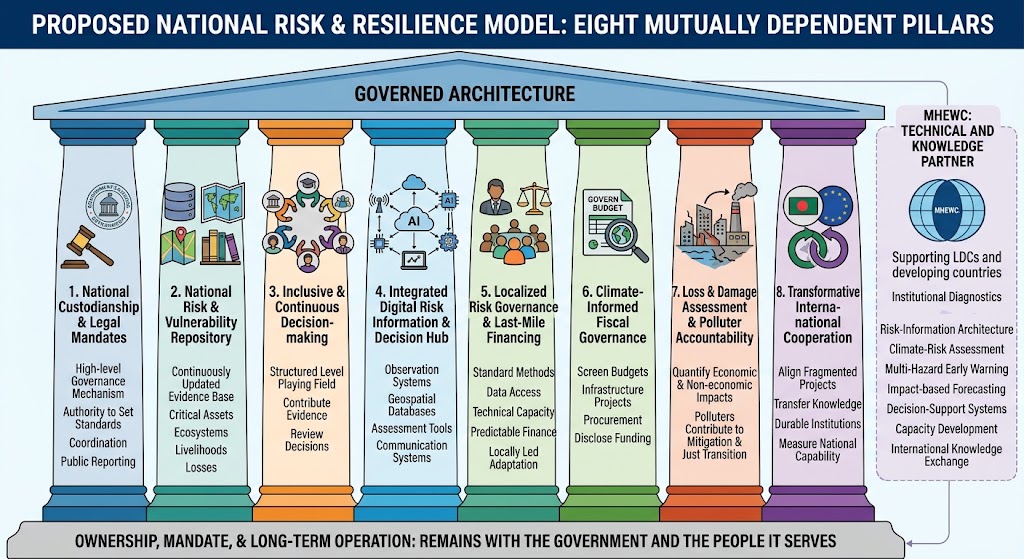
- Clear national custodianship and legal mandates: Establish a high-level national governance mechanism, supported by a permanent technical secretariat, with authority to set standards, coordinate institutions, maintain the national risk system, and report publicly on progress.
- A comprehensive national risk and vulnerability repository: Develop a continuously updated, multi-scale evidence base covering hazards, exposure, vulnerability, capacity, critical assets, ecosystems, infrastructure, livelihoods, and direct, indirect, and non-economic losses.
- Inclusive and continuous decision-making: Create a structured level playing field for government agencies, local authorities, academia, research organisations, civil society, the private sector, professional bodies, media, communities, and individual specialists to contribute evidence and review decisions.
- An integrated digital Risk Information and Decision Hub: Connect observation systems, geospatial databases, assessment tools, artificial intelligence, policy libraries, project pipelines, public dashboards, application programming interfaces, and multi-channel communication systems within one governed architecture.
- Localized risk governance and last-mile financing: Equip local governments and communities with standard methods, data access, technical capacity, predictable finance, and decision authority to conduct local assessments and implement locally led adaptation and risk-reduction measures.
- Climate-informed fiscal governance: Screen budgets, development plans, infrastructure projects, procurement, and public investments for climate and disaster risk; protect resources for operation and maintenance; and disclose how funding reaches high-risk sectors, territories, and population groups.
- Systematic loss-and-damage assessment and polluter accountability: Improve the ability to quantify and document economic and non-economic impacts while developing fair, lawful, and transparent mechanisms through which major emitters and polluters contribute to mitigation, adaptation, loss reduction, remediation, and a just transition.
- Transformative international cooperation: Require international organisations and development partners to align fragmented projects with a government-owned national architecture, transfer knowledge and technology, build durable institutions, and measure changes in national capability rather than only project outputs.
The Multi-Hazard Early Warning System Design & Implementation Center (MHEWC) can contribute as a technical and knowledge partner by supporting LDCs and developing countries in institutional diagnostics, risk-information architecture, climate-risk and vulnerability assessment, multi-hazard early warning, impact-based forecasting, decision-support systems, capacity development, and international knowledge exchange. The ownership, mandate, and long-term operation of the national system, however, must remain with the government and the people it serves.
1.0 Why do institutional diagnostics matter most to promote risk management and governance systems?
An institutional diagnostic matters because effective risk management depends on whether institutions can turn risk information into timely, funded, coordinated and accountable action. It establishes who is responsible, who has decision-making authority, what capacities and resources are available, where implementation breaks down, and which changes are needed to protect people, livelihoods and public services.
A country may have hazard maps, forecasting equipment, disaster-management policies and development projects while still experiencing serious gaps in implementation. An institutional diagnostic examines how these assets function together, including the formal rules and everyday practices that influence decisions. It is a foundation for reform, alongside sound risk assessments, political commitment and sustained financing.
This is consistent with the Sendai Framework’s second priority: strengthening disaster risk governance to manage disaster risk. UNDRR identifies leadership, clear responsibilities, coordination, resources, monitoring and accountability as essential elements of a strong governance system.
The diagnostic’s value lies in answering practical questions across the system. Drawing on UNDRR’s guidance on risk assessment and WMO’s approach to assessing early warning capabilities, the following provides a useful structure.
Area to examine | Essential diagnostic questions | Why it matters |
Leadership and institutional mandates | Who leads, who decides, and who implements? Where do responsibilities overlap or remain unassigned? | Establishes clear ownership of prevention, preparedness, warning, response and recovery functions. |
Coordination and decision-making | How do technical agencies, sector ministries, finance authorities and local governments exchange information and make joint decisions? Where do approvals stall? | Helps resolve delays and conflicting instructions across institutions and government levels. |
Risk information and data governance | Who maintains hazard, exposure, vulnerability and loss datasets? Are they current, quality-controlled, accessible and used in decisions? | Establishes responsibility for producing and applying credible risk information. |
Technical and operational capacity | Are sufficient qualified staff, equipment, operating procedures, maintenance arrangements and service continuity measures available? | Tests whether institutions can deliver their assigned functions consistently. |
Planning, investment and financing | Do risk assessments influence land use, infrastructure design, sector plans and budgets? Can approved resources reach implementing institutions promptly? | Connects risk knowledge with investment choices and implementation. |
Local authority and inclusive participation | Do local governments have adequate authority and resources? Can communities, women, persons with disabilities and other affected groups influence priorities? | Makes risk management responsive to local conditions and barriers to protection. |
Accountability and institutional incentives | Who reviews performance, explains failures and follows up corrective actions? Do incentives encourage prevention and information sharing? | Identifies why agreed responsibilities may remain unfulfilled and how accountability can improve delivery. |
Sustainability and learning | Who will operate systems after project funding ends? Are exercises, disaster reviews and recovery lessons used to update arrangements? | Supports continuity, institutional learning and improvements over time. |
What matters most is whether the diagnostic identifies the specific institutional barriers preventing protective action and leads to their correction.
For example, consider a hypothetical flood warning that reaches a district too late for effective evacuation. A useful diagnostic would trace the entire process: when the forecast became available, who interpreted the likely impacts, who authorized the warning, how it reached local authorities, when resources became available, and whether exposed households could act. This could reveal several different problems, each requiring a different response:
- Delayed data exchange calls for clearer responsibilities and operational information-sharing arrangements.
- Slow approval calls for an agreed decision process and designated alternates.
- Insufficient evacuation resources call for accessible financing, transport and shelter arrangements.
- Warnings that people cannot understand or act upon call for accessible communication and community involvement.
WMO’s assessment approach similarly examines legal, institutional, financial and technological conditions alongside forecasting and warning capabilities, using the findings to inform national roadmaps and targeted investment.
The quality of the diagnostic also matters. It would recommend checking institutional self-assessments against budgets, staffing records, maintenance logs, actual decisions, warning records, exercises and community feedback. This helps establish whether arrangements work in practice and exposes gaps that policy documents alone may miss.
The resulting reform plan should assign every priority improvement a responsible institution, specific corrective action, resource requirement, financing arrangement, deadline and verifiable performance indicator. Suitable indicators might include warning approval time, maintenance completion, access to local preparedness funding, or the proportion of priority investments screened for disaster risk. UNDRR’s recovery-readiness approach likewise connects assessment findings with prioritized improvements and measurable progress.
Success should be demonstrated through better decisions, functioning services, timely early action and stronger protection for exposed communities. The diagnostic provides the evidence and direction; implementation delivers those results.
1.1 Climate and Multi-Hazard Risk as a Governance Challenge
Climate and multi-hazard risk management is a fundamental responsibility of governance because public decisions shape exposure, determine whose vulnerabilities receive attention, and establish what protection is available before, during, and after a hazardous event. In least developed countries (LDCs) and other developing countries, this responsibility can be undermined when political influence, administrative authority, and public investment are concentrated among powerful groups, while communities on the climate frontline have limited influence over decisions affecting their safety and livelihoods.
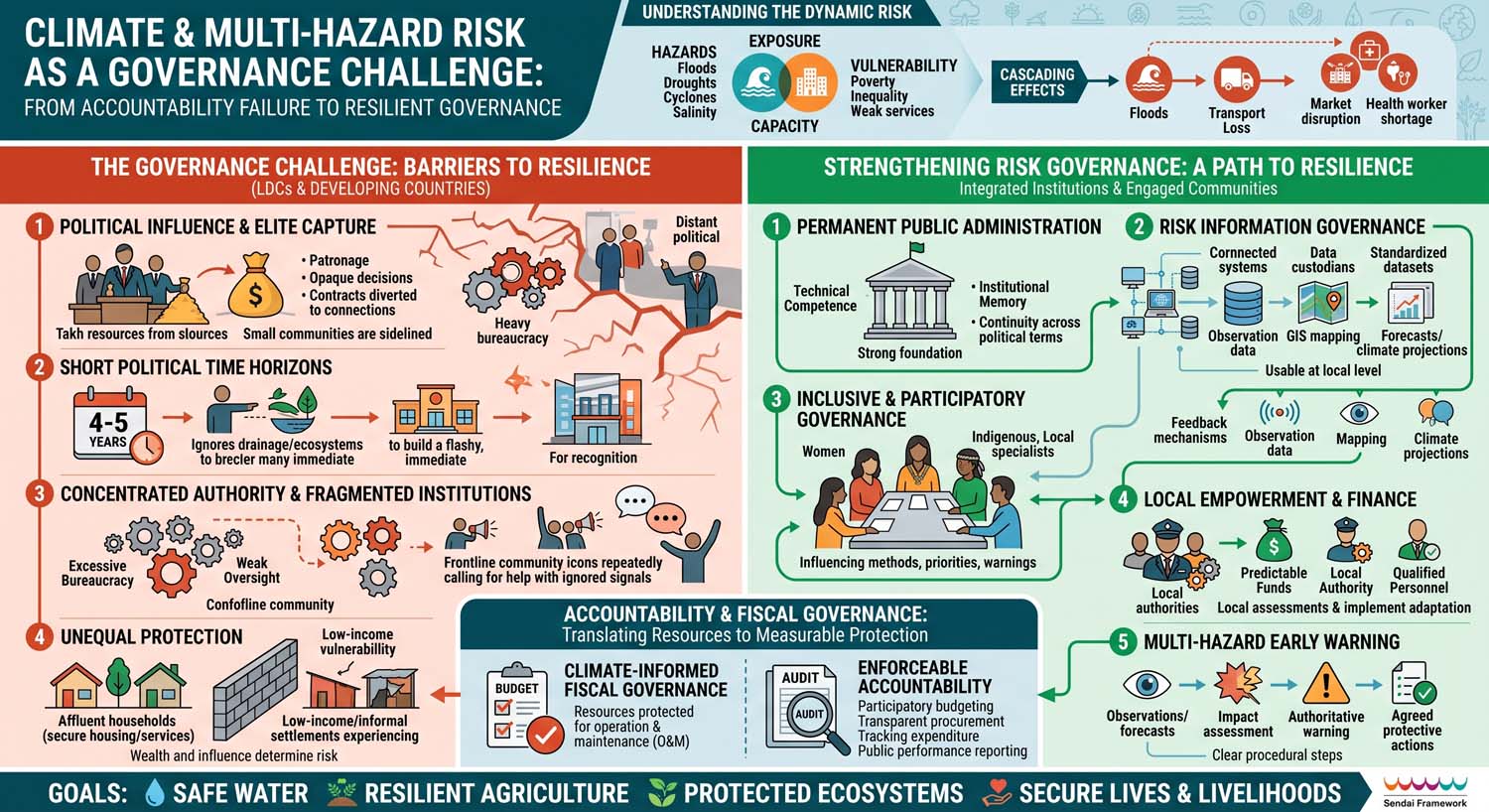
Short political cycles can deepen this imbalance. Where governments work within four- or five-year electoral terms, incentives may favour highly visible projects that generate immediate political recognition, while sustained investments in drainage maintenance, ecosystem protection, resilient livelihoods, and local preparedness receive less attention. Climate resilience requires continuity across successive administrations, supported by institutions that protect long-term public priorities. The IPCC identifies short political time horizons, fragmented institutions, complex bureaucratic structures, and elite influence as barriers to effective adaptation in its assessment of Africa.
- The governance problem becomes particularly serious when public institutions serve as channels for patronage, exclusion, or the capture of resources by influential groups:
Opaque decisions over land, project selection, contracts, and adaptation funding can direct benefits towards those with political connections while leaving highly exposed populations inadequately protected. These concerns also apply to projects presented as climate action. The IPCC documents cases in which adaptation interventions have excluded poorer people from decisions, restricted their access to resources, or reinforced existing inequalities. Such outcomes demonstrate why the distribution of benefits and burdens must be examined throughout project design and implementation.
Permanent public administrations should provide technical competence, institutional memory, and continuity across political terms. Where authority is excessively concentrated and oversight is weak, however, bureaucratic procedures can distance institutions from the people they serve. Frontline communities may repeatedly report erosion, water scarcity, damaged embankments, unsafe settlements, or livelihood losses without obtaining a timely response. Citizens and local specialists may struggle to access information, challenge investment priorities, or identify which institution is responsible for corrective action. In these circumstances, the absence of an effective response becomes an accountability failure with direct consequences for public safety.
Frontline populations also sustain economic activities on which the wider country depends. Smallholder farmers, fishers, pastoralists, agricultural workers, and other resource-dependent communities contribute to food supplies, employment, and local economies while facing uncertain rainfall, extreme heat, flooding, salinity, and other pressures. Limited savings, insecure access to productive assets, and inadequate services can restrict their ability to recover or adapt. FAO’s research across low- and middle-income countries shows that climate-related income losses and adaptive capacity differ substantially according to wealth, gender, and age, with disadvantaged rural households facing particular constraints. These findings support investment that responds to differentiated needs.
Affluent households and influential decision makers may be relatively insulated from these hardships through secure housing, savings, reliable services, and access to assistance. This distance can weaken recognition of the daily consequences of climate disruption for exposed producers and workers. Within urban areas, low-income residents, informal workers, and people living in poorly serviced settlements also experience severe vulnerability. A credible critique of unequal protection should therefore examine how wealth, political influence, housing, services, and access to institutions shape risk across both rural and urban communities. The IPCC identifies these inequalities as central to differences in climate vulnerability.
Frontline communities can also make valuable contributions to environmental protection and climate action. Where livelihoods incorporate agroforestry, soil conservation, sustainable resource management, and ecosystem restoration, they can strengthen resilience, protect biodiversity, and increase carbon storage. The scale of these benefits depends on the practices used and local conditions. Recognizing these contributions requires secure resource rights, practical support, fair economic opportunities, and meaningful participation in decisions affecting land and ecosystems. Claims about specific carbon benefits should be supported by credible assessment.
- Public revenue and climate finance should translate into measurable protection for communities facing the greatest risks and the weakest capacity to cope:
Allocations should be guided by transparent assessments of exposure, vulnerability, service deficits, and livelihood insecurity. Priority investments should include accessible early warning, safe water, resilient agriculture, ecosystem protection, essential infrastructure maintenance, anticipatory action, and social protection. Local governments need predictable funding, qualified personnel, usable information, and sufficient authority to implement these measures.
Accountability must make these commitments enforceable in practice. Participatory budgeting, transparent procurement, independent audits, legislative oversight, accessible complaints procedures, and public tracking of expenditure can help communities examine whether promised resources reach them. Performance reporting should show which risks were addressed, who received protection, whose needs remain unmet, and what corrective action will follow. Communities experiencing repeated losses should have a meaningful role in setting priorities and reviewing delivery. Public institutions should be required to explain how their decisions respond to those needs and to act when credible evidence reveals avoidable gaps in protection.
Climate risk emerges from the interaction of hazards with exposed people, assets, services, and ecosystems, influenced by their vulnerability and capacity to respond. Development policies, investment choices, institutional arrangements, and social conditions continually alter these relationships. Risk therefore changes as settlements expand, infrastructure ages, ecosystems deteriorate, and governments either strengthen or neglect protective measures. The IPCC recognizes these dynamic interactions, including the influence of responses themselves on risk.
Floods, droughts, cyclones, heatwaves, landslides, wildfires, severe storms, coastal inundation, salinity, and erosion operate within interconnected environmental and social systems. Their consequences depend on topography, rainfall and temperature patterns, river flows, coastal processes, drainage capacity, land cover, settlement patterns, and infrastructure condition. They can also interact with disease outbreaks and other public health pressures. Understanding these relationships requires attention to both sudden events and slower processes, such as persistent water scarcity, shoreline retreat, and declining ecosystem health, which can progressively undermine livelihoods and essential services.
This creates a multi-hazard and multi-asset governance problem. Hazards may occur simultaneously, follow one another, or produce secondary consequences that spread across sectors. For example, extreme rainfall combined with high river levels and coastal storm surge can create interacting sources of flooding. A power failure can then interrupt water pumping, telecommunications, health services, and emergency coordination. The IPCC identifies such infrastructure interdependencies as important pathways through which climate impacts can cascade across systems and places. The practical implication is that risk assessments should examine how essential systems depend on one another, alongside the vulnerability of individual assets.
The assets and values at risk extend beyond roads, bridges, buildings, and utilities. They include lives, health, agricultural production, drinking water, schools, hospitals, markets, digital networks, ecosystems, cultural heritage, livelihoods, and social cohesion. Consider a flood that damages a transport corridor: farmers may lose market access, food deliveries may be delayed, health workers may struggle to reach facilities, and households may lose income. These consequences can continue after the floodwater recedes. A governance assessment should therefore consider service disruption, recovery time, livelihood insecurity, and losses that cannot be adequately represented by the replacement cost of physical infrastructure.
Development choices can also create or intensify exposure. Expanding settlements into floodplains, removing vegetation from unstable slopes, obstructing natural drainage, or locating essential facilities in hazardous areas can increase the consequences of future events. Where affordable housing, secure land tenure, and basic services are unavailable, households may have little practical choice about where they live. Effective risk reduction should therefore connect land-use regulation with viable housing, livelihood, and service alternatives. Assessments of urban climate risk recognize that settlement expansion and changing development patterns can place additional people and assets in exposed locations.
- These relationships justify treating climate and disaster risk management as a permanent national governance function:
comparable in continuity and institutional importance to fiscal management or public health. Its responsibilities should extend across prevention, preparedness, anticipatory action, response, recovery, and long-term adaptation. The Sendai Framework recognizes the State’s primary responsibility for disaster risk reduction, alongside shared responsibilities involving local authorities, businesses, civil society, and other stakeholders. It also places risk understanding, governance, investment, and preparedness within a common framework for protecting development.
A practical institutional arrangement should identify who coordinates national policy, who produces and maintains different categories of risk information, who approves development decisions, who issues official warnings, and who implements protective action. Meteorological and hydrological services, disaster management institutions, planning and finance ministries, sector agencies, and local governments need clearly defined responsibilities and procedures for working together. A designated coordinating institution should have sufficient authority to resolve gaps and overlapping mandates, while technical agencies retain responsibility for their specialist functions. The arrangement should make the path from evidence to decision, funding, and implementation visible and reviewable.
Risk information should influence routine development decisions throughout the life of an investment. It should inform where settlements are permitted, how roads and bridges are designed, where schools and hospitals are located, which water systems and agricultural practices receive support, and how ecosystems are protected. Appraisal should consider future conditions, maintenance requirements, service continuity, and the distribution of benefits and risks. For example, flood protection should be assessed for its possible effects on neighbouring settlements and downstream areas. This approach helps identify maladaptation, including interventions that protect one location while increasing vulnerability elsewhere. The IPCC emphasizes integrated decision-making and attention to equity as conditions for climate-resilient development.
The quality of these decisions depends on sustained governance of risk information. A national approach should establish data custodians, common definitions, quality standards, update schedules, sharing arrangements, and responsibilities for correcting errors. Historical disaster records, observations, forecasts, climate projections, satellite information, asset inventories, and local assessments should be connected through systems that institutions can maintain and use. Geographic information systems can support this integration when datasets have compatible locations, classifications, and metadata. UNDRR’s work on disaster loss and damage tracking similarly emphasizes institutional roles, collaboration, and the maintenance of information systems over time.
Data should also be usable at the level where decisions are made. National averages may conceal differences between districts, settlements, livelihood groups, and households. Local authorities need information at an appropriate scale, accompanied by explanations of its reliability, limitations, and practical implications. A useful system should identify missing information and uncertainty, establish priorities for improvement, and support proportionate decisions using the evidence available. Budgets should cover staff, equipment maintenance, connectivity, data updates, and user support so that information remains operational between projects and emergencies.
- Inclusive participation is essential to both the quality and legitimacy of risk governance:
Women, persons with disabilities, Indigenous Peoples, minorities, young people, older persons, displaced populations, and local technical specialists can identify risks and barriers that formal assessments overlook. Their participation should influence assessment methods, priorities, investment choices, warning arrangements, and evaluation. Accessible consultation, local languages, appropriate representation, and feedback mechanisms help make that influence practical. The IPCC identifies inclusive governance and the integration of Indigenous and local knowledge as important conditions for effective adaptation and equitable climate risk management.
Local responsibility must be supported by corresponding authority, finance, personnel, and access to information. Municipalities and district administrations should have the means to maintain drainage, inspect vulnerable facilities, organize preparedness, communicate warnings, and support people who require assistance. Community organizations also need reliable channels for reporting emerging hazards and obtaining responses from public institutions. Assigning responsibilities without providing the resources to fulfil them creates an implementation gap. The Sendai Framework explicitly calls for empowering local authorities through regulatory and financial means to coordinate disaster risk management.
Early warning provides a direct test of whether these governance arrangements function. Observations and forecasts should connect to assessments of likely impacts, authoritative warnings, and agreed protective actions. Operational procedures should specify who evaluates the evidence, who approves and communicates warnings, which actions are triggered, and how resources become available within the relevant lead time. Messages should explain the affected locations, expected consequences, timing, and practical steps people can take. UNDRR identifies risk knowledge, monitoring and forecasting, warning communication, and preparedness as interdependent elements, with coordination and feedback necessary for the system to work.
Public financing should support this continuity. Governments should assess how disaster losses could affect revenue, expenditure, essential services, and recovery needs, then provide for prevention, maintenance, preparedness, and residual risk within budget planning. Funding arrangements for anticipatory action and emergencies should establish clear release conditions and implementation responsibilities. International partners should align their assistance with nationally agreed priorities, strengthen institutions responsible for delivery, and provide realistic arrangements for operational handover and recurrent costs.
Accountability should follow the entire decision process. Public institutions should document how risk evidence influenced investment approvals, how resources were allocated, whether agreed actions occurred, and whose needs remained unmet. Independent technical review, public reporting, accessible complaints mechanisms, and reviews after events can support correction and learning. Performance assessment should examine warning accessibility, service continuity, implementation of preventive measures, and recovery outcomes, taking account of hazard severity and changing exposure.
When evidence is fragmented, responsibilities are unclear, local institutions lack resources, and affected communities cannot influence decisions, risk management becomes vulnerable to delay, short-term priorities, and unequal protection. Where institutions repeatedly fail to act on credible information or address known vulnerabilities, the resulting gap is a structural failure of governance and accountability. Addressing it requires sustained arrangements through which risk knowledge shapes public decisions, responsibilities are funded and exercised, and frontline communities can see and influence the protection delivered.
2. Establishing National Custodianship and Institutional Accountability
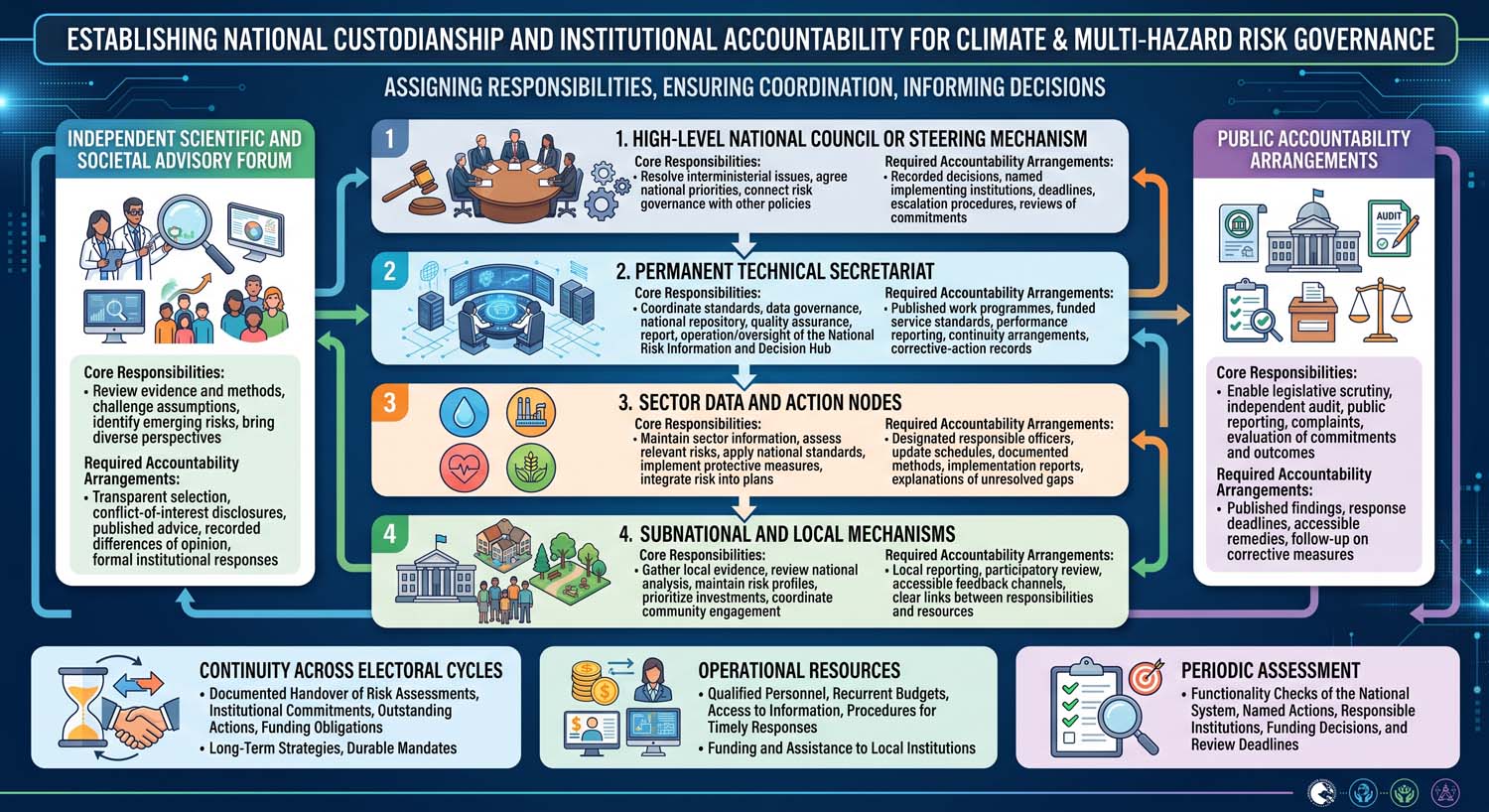
Every country needs an identifiable institution or formally mandated mechanism that is accountable for the overall functioning of its climate and multi-hazard risk-governance system. National custodianship should ensure that responsibilities are assigned, information remains usable and current, institutions coordinate their actions, and risk evidence informs public decisions. It should also make unresolved gaps visible and establish procedures for addressing them. The public, local authorities, and oversight bodies should be able to identify who is responsible for the system and how its performance can be examined.
Custodianship should connect the responsibilities of institutions that produce information, regulate development, deliver services, issue warnings, manage public finance, and implement protective measures. Each institution should retain accountability for its assigned functions. The national custodian should oversee the connections between those functions, identify omissions and conflicting mandates, and ensure that problems reach an authority capable of resolving them.
The institutional arrangement should reflect each country’s constitutional structure, administrative system, existing capacities, and risk profile. These functions may be assigned to established institutions through strengthened mandates and coordination arrangements. UNDRR’s guidance on national focal points and national and local disaster-risk-reduction platforms provides a relevant reference for organizing coordination across institutions and levels of government.
A proposed national model should include the following complementary components:
Institutional component | Core responsibilities | Required accountability arrangements |
High-level national council or steering mechanism | Resolve interministerial issues within its authority; agree national priorities; connect risk governance with planning, finance, infrastructure, local government, social protection, and economic policy. | Recorded decisions, named implementing institutions, deadlines, escalation procedures, and reviews of outstanding commitments. |
Permanent technical secretariat | Coordinate standards, data governance, the national repository, quality assurance, reporting, and operation or oversight of the National Risk Information and Decision Hub. | Published work programmes, funded service standards, performance reporting, continuity arrangements, and corrective-action records. |
Sector data and action nodes | Maintain sector information, assess relevant risks, apply national standards, implement protective measures, and integrate risk into sector plans and budgets. | Designated responsible officers, update schedules, documented methods, implementation reports, and explanations of unresolved gaps. |
Subnational and local mechanisms | Gather local evidence, review national analysis against local conditions, maintain risk profiles, prioritize investments, and coordinate implementation and community engagement. | Local reporting, participatory review, accessible feedback channels, and clear links between assigned responsibilities and available resources. |
Independent scientific and societal advisory forum | Review evidence and methods, challenge assumptions, identify emerging risks, and bring scientific, professional, community, civil-society, private-sector, and media perspectives into deliberations. | Transparent selection, conflict-of-interest disclosures, published advice, recorded differences of opinion, and formal institutional responses. |
Public accountability arrangements | Enable legislative scrutiny, independent audit, public reporting, complaints, and evaluation of commitments and outcomes. | Published findings, response deadlines, accessible remedies, and follow-up on corrective measures. |
These arrangements need a durable legal and administrative foundation. Legislation, regulations, cabinet decisions, and other instruments should be selected according to the country’s legal system and the powers required. Their provisions should be consistent with existing responsibilities for planning, public finance, environmental management, local government, infrastructure, and emergency operations. IFRC’s disaster-law guidance emphasizes reviewing these instruments comprehensively and inclusively to identify gaps, clarify responsibilities, and strengthen implementation.
The mandate should translate into a published responsibility framework. For every major function, it should identify the accountable institution, implementing units, required outputs, technical validation arrangements, decision authority, reporting schedule, and escalation process. It should specify who maintains exposure inventories, updates risk assessments, validates forecasts, approves official risk classifications, issues warnings, authorizes early action, and mobilizes resources. Technical validation, policy approval, and operational implementation should each leave a clear record.
For example, an agreed flood-warning workflow should identify responsibilities for observations and forecasts, impact assessment, official warning issuance, local preparedness, communication, and activation of eligible financing. It should also establish fallback arrangements when data, communications, or key personnel are unavailable. The custodian should monitor whether these interfaces function and ensure that failures are addressed by the responsible institutions.
Authority must be accompanied by operational resources. The technical secretariat and participating institutions need qualified personnel, recurrent budgets, access to information, and procedures for obtaining timely responses from other agencies. Service expectations should address data updates, system availability, technical review, incident reporting, and correction of errors. Local institutions should receive funding and assistance proportionate to their responsibilities. Performance reviews should examine whether institutions had the authority, information, and resources required to deliver.
Independent scientific and societal scrutiny should have a defined place in decision-making. Universities, research organizations, professional bodies, civil society, community representatives, private-sector specialists, media, and individual experts should have transparent opportunities to contribute. Appointment procedures should make relevant expertise, representation, terms of service, and conflicts of interest visible. The advisory forum should have access to the evidence needed for its work, subject to appropriate protections for sensitive information.
Its findings should receive documented responses from the responsible institutions. Where recommendations are accepted, the response should identify actions and timelines. Where they are declined, the reasons and supporting evidence should be recorded. Scientifically credible disagreement should remain visible, allowing decision-makers and the public to understand uncertainty and competing interpretations. Protected reporting channels should support staff and stakeholders who raise concerns about inaccurate information, interference, or failures to fulfil assigned duties.
Public accountability should examine decisions, implementation, expenditure, and results. Parliamentary or legislative committees should be able to review national risk assessments, budget priorities, institutional performance, and significant unresolved issues. Independent audits and evaluations should examine financial management alongside delivery and effectiveness. UNDRR’s guidance for parliamentarians identifies legislation, budget allocation, oversight, access to information, and follow-up on evaluations as important responsibilities for strengthening disaster risk governance.
The framework should define a proportionate response when obligations are not fulfilled. A missed update, unresolved technical defect, or delayed implementation should trigger notification, an explanation, and a time-bound corrective plan. Persistent failure should be escalated to the appropriate supervisory or oversight authority. Suspected misconduct should be referred through applicable investigative procedures, with due process. Reviews should consider the evidence available at the time, resource constraints, forecast uncertainty, and event severity when assessing institutional decisions.
Accountability must also reach affected communities. People should be able to request explanations, challenge inaccurate records, report failures, and track the response to their concerns. Public dashboards and reports should identify responsible institutions and unresolved actions, while offline and assisted channels should support those unable to use digital services. Findings from complaints and local monitoring should influence institutional reviews and subsequent planning.
National custodianship must provide continuity across electoral cycles while allowing policies to improve through evidence and lawful review. Infrastructure, settlement patterns, ecosystem degradation, and climate-related development choices can shape risk well beyond a government’s term. Long-term strategies should therefore be supported by durable mandates, multi-year financing frameworks integrated into annual budgets, permanent professional capacity, and scheduled review requirements. The IPCC finds that clear institutional responsibilities and the integration of adaptation into budget, policy, statutory planning, and monitoring processes help sustain action.
Changes in political leadership should be accompanied by documented handover of risk assessments, institutional commitments, outstanding actions, funding obligations, and operational responsibilities. Proposed changes to strategies or institutions should explain their evidence base, fiscal implications, effects on exposed populations, and arrangements for maintaining essential services. Consultation, legislative scrutiny where applicable, and publication of reasons should make significant changes transparent and reviewable.
Periodic assessments should examine whether the national system remains functional: whether information is current, responsibilities are exercised, local institutions receive support, warnings connect to action, investments address identified risks, and corrective measures are completed. The findings should lead to named actions, responsible institutions, funding decisions, and deadlines that can be reviewed in the next accountability cycle.
3. Correcting the Distortions of Short Political Cycles
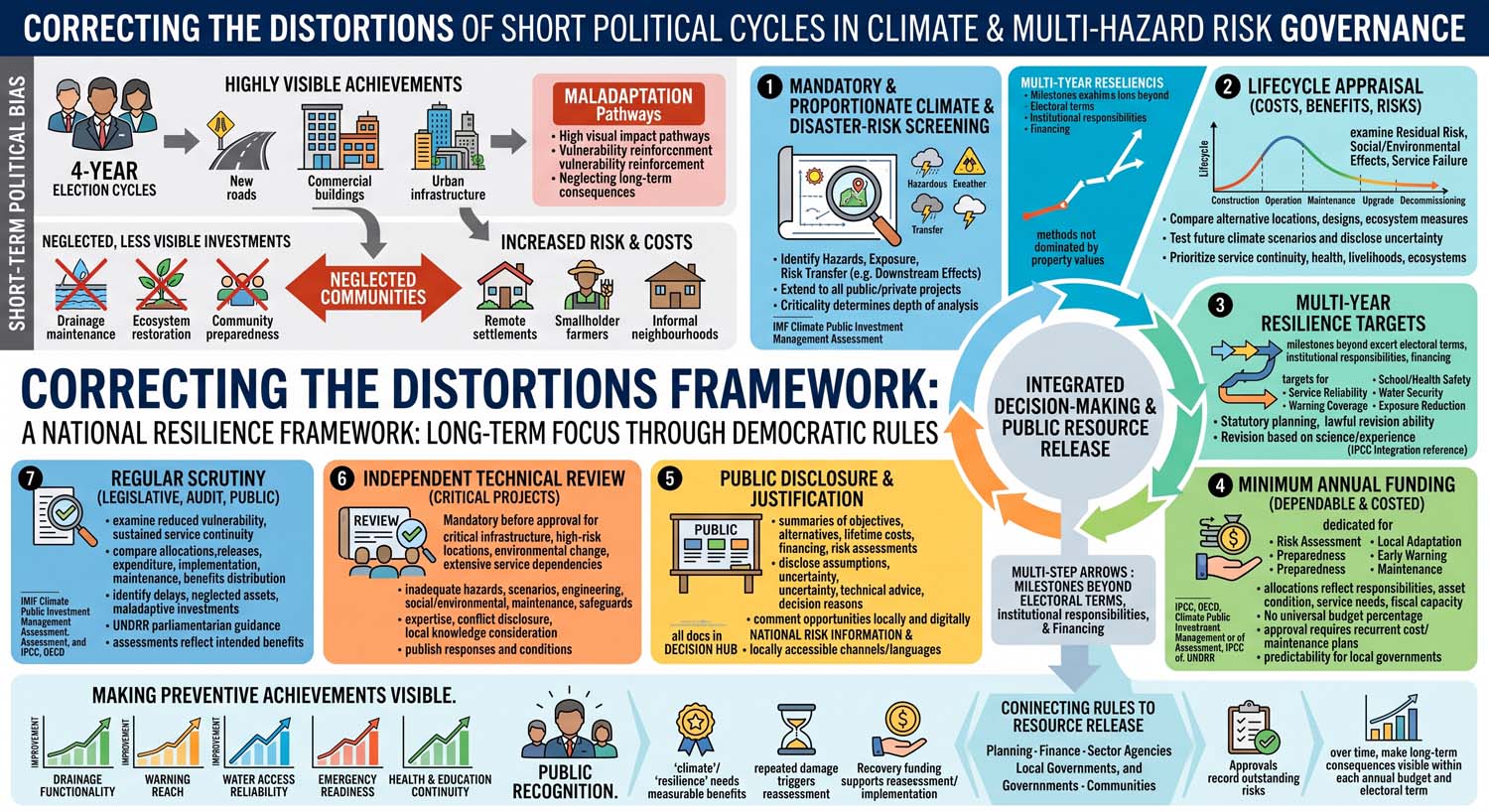
Climate and multi-hazard risk governance requires public decisions to account for consequences that extend beyond the term of any government. Political leaders understandably seek visible achievements within their electoral mandates. New roads, bridges, commercial developments, and major urban infrastructure can demonstrate progress, support economic activity, and respond to legitimate public needs. However, their immediate visibility can give them an advantage over investments whose benefits are expressed through losses avoided, services maintained, ecosystems protected, and communities better prepared.
This difference in visibility can distort development priorities. Maintaining drainage, strengthening health facilities, restoring watersheds, protecting drinking-water sources, and supporting local preparedness may attract limited political recognition even when they address urgent needs. Meanwhile, a poorly located or inadequately maintained asset can create exposure and recurring public costs for decades. The IPCC identifies planning that prioritizes short-term gains while overlooking longer-term consequences as a pathway to maladaptation, including investments that reinforce vulnerability and narrow future options.
The distribution of these consequences also matters. Investments selected primarily for their political prominence or commercial value may overlook communities with limited influence over national decisions. Remote settlements, informal urban neighbourhoods, coastal communities, smallholder farmers, and other exposed groups need their protection assessed explicitly. Their claims should be evaluated through evidence of vulnerability, service deprivation, and potential harm, alongside their own priorities.
Democratic choice should therefore operate within transparent rules that connect development decisions to their long-term consequences. These rules should be embedded in ordinary planning, project approval, budgeting, and oversight. The IMF’s Climate Public Investment Management Assessment provides a relevant institutional reference through its coverage of climate-aware planning, coordination, project appraisal and selection, budgeting and portfolio management, and fiscal risk management.
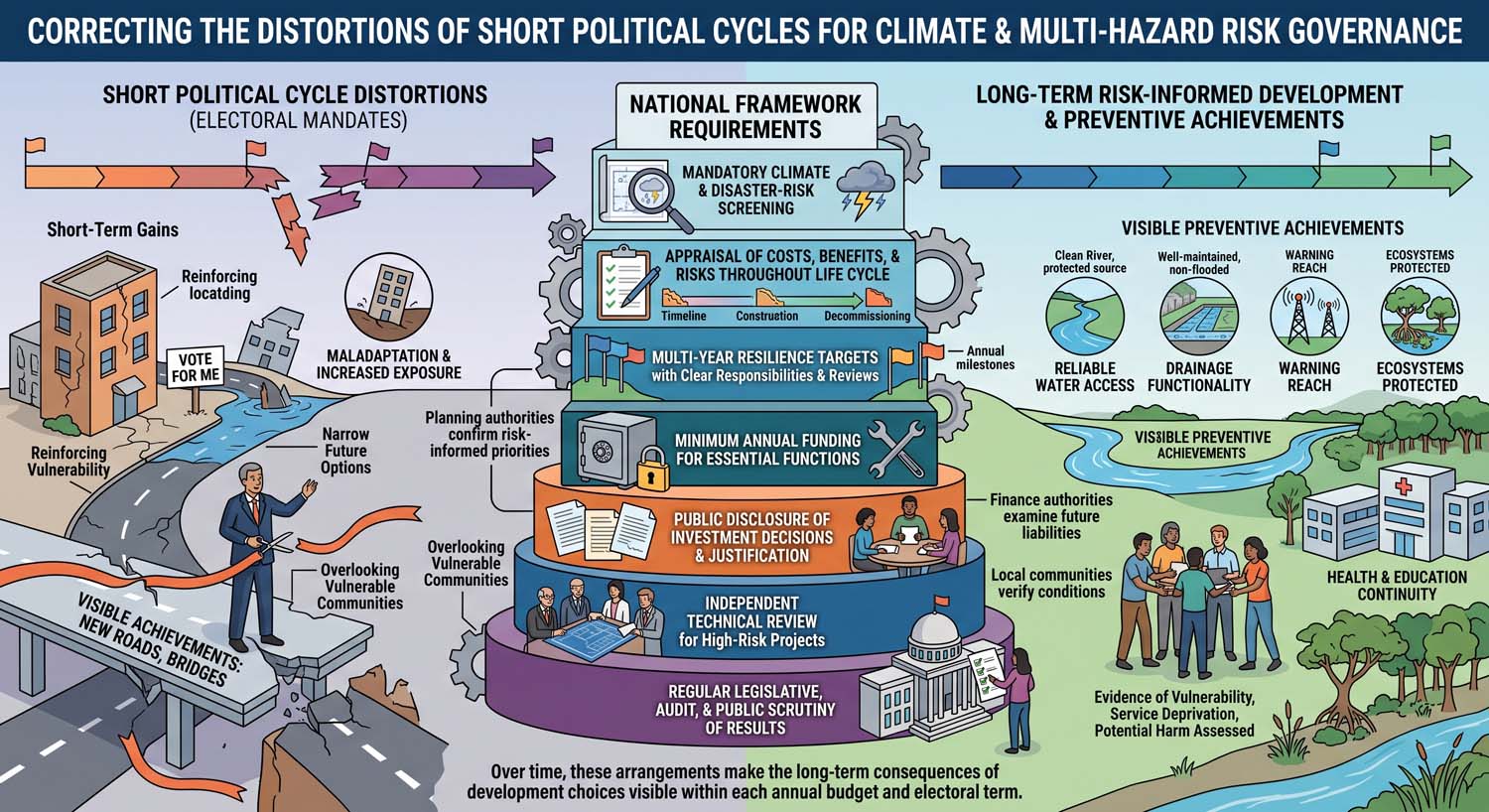
A national framework should establish the following requirements:
- Mandatory and proportionate climate and disaster-risk screening. Public policies, programmes, investment proposals, and relevant budget decisions should undergo screening before major commitments are made. Screening should identify the hazards affecting an intervention, the people and systems it could expose, and whether it could transfer risk elsewhere. For example, a flood-protection project should consider downstream effects, while a road should consider its influence on drainage and settlement expansion. Requirements should extend to public enterprises and externally financed investments, with major private developments assessed through applicable planning and approval processes. Assessment should be proportionate: critical infrastructure and projects with potentially severe consequences require deeper analysis than routine, low-risk activities.
- Appraisal of costs, benefits, and risks throughout the investment’s life. Appraisal should cover construction, operation, maintenance, future upgrading, and eventual replacement or decommissioning. It should examine residual risk, environmental and social effects, maladaptation, and the consequences of failure for connected services. Decision-makers should compare alternative locations, designs, maintenance strategies, ecosystem-based measures, and other ways of meeting the same public need. Analysis should test plausible future climate conditions and disclose uncertainty. Benefits should include service continuity, health, livelihoods, and ecosystem functions, with explicit attention to their distribution. Otherwise, methods dominated by property values or revenue can undervalue protection for poorer communities. OECD guidance supports incorporating climate impacts and uncertainty into appraisal and managing infrastructure performance throughout its life cycle.
- Multi-year resilience targets with clear responsibilities and review arrangements. National and local plans should establish targets extending beyond individual electoral terms, supported by annual milestones, responsible institutions, and financing requirements. Targets could address the reliability of essential services, the safety of schools and health facilities, warning coverage, water security, and reductions in exposure. Continuity should be supported through statutory planning, medium-term expenditure frameworks, and published implementation schedules. Successive governments should retain the ability to revise priorities through lawful processes. Substantial changes should explain the evidence, financing implications, and consequences for affected communities. Scheduled review should also allow targets to respond to new science, changing conditions, and implementation experience.
- Minimum annual funding for essential resilience functions. Governments should establish dependable funding for risk assessment, local adaptation, preparedness, early warning, maintenance, and other essential functions. Minimum allocations should reflect costed responsibilities, asset condition, service needs, and fiscal capacity. A universal budget percentage would not capture these differences. Approval of new infrastructure should include a credible plan for recurrent expenditure, staffing, maintenance, and periodic upgrading. Local governments should receive predictable resources sufficient to perform their assigned duties. Where fiscal pressures require reductions or reallocations, the government should disclose which services will be affected, the additional risks created, and the measures proposed to manage them. Unspent allocations and delayed transfers should receive the same scrutiny as inadequate budgets.
- Public disclosure of investment decisions and their justification. Major proposals should publish accessible summaries of their objectives, alternatives, expected beneficiaries, lifetime costs, financing arrangements, and risk assessments. Disclosure should identify important assumptions, unresolved uncertainties, technical advice, and the reasons for the final decision. Affected communities should have meaningful opportunities to comment while alternatives remain open. Information should be available through locally accessible channels and languages, alongside digital publication. The National Risk Information and Decision Hub should preserve appraisal documents, consultation responses, approval conditions, and subsequent changes. Disclosure should protect legitimately sensitive information while providing sufficient evidence for the public to assess how decisions were reached.
- Independent technical review where potential consequences are greatest. Projects involving critical infrastructure, high-risk locations, major environmental changes, or extensive service dependencies should receive independent review before approval. Reviewers should examine the adequacy of hazard information, scenarios, engineering assumptions, social and environmental assessments, maintenance arrangements, and proposed safeguards. Independence requires transparent appointment, appropriate expertise, and disclosure of conflicts of interest. Review should also consider relevant local knowledge and the concerns of affected communities. The approving authority should publish its response to material findings and identify any conditions that must be satisfied. Technical review should strengthen compliance with applicable requirements, while leaving final responsibility clearly assigned to the authorized decision-maker.
- Regular legislative, audit, and public scrutiny of results. Oversight should examine whether spending reduces vulnerability and sustains essential services, alongside whether funds were spent as authorized. Reviews should compare allocations, releases, expenditure, implementation progress, maintenance performance, and the distribution of benefits. They should identify delayed corrective measures, neglected assets, and investments that have increased exposure. UNDRR’s guidance for parliamentarians emphasizes legislative responsibility for disaster-risk-reduction laws, budgets, oversight, and assessment of whether expenditure achieves intended benefits. Findings should lead to named responsibilities and deadlines for action. Evaluations should account for hazard severity and changing exposure: losses alone do not establish institutional failure, but ignored evidence and repeated non-compliance require investigation.
Implementation requires a clear connection between these rules and the decisions that release public resources. Planning authorities should confirm that proposals align with risk-informed development priorities. Finance authorities should examine affordability and future liabilities. Sector agencies should demonstrate technical readiness and maintenance provision. Local governments and communities should help verify whether proposed investments address actual conditions. Each approval stage should record outstanding risks, conditions, responsible institutions, and follow-up dates.
Governments should also make preventive achievements visible. Public reporting can show improvements in drainage functionality, warning reach, reliable water access, emergency readiness, and continuity of health and education services. These measures help elected leaders receive recognition for protection delivered during their terms. Expenditure labelled as “climate” or “resilience” should still be assessed against measurable benefits and the quality of implementation.
Repeated damage to the same assets should trigger reassessment of location, design, maintenance, protective measures, and feasible alternatives, with affected communities involved in the decision. Recovery funding should support that reassessment and its implementation. Over time, these arrangements would make the long-term consequences of development choices visible within each annual budget and electoral term, while giving frontline communities stronger means to influence how public protection is provided.
4. Building a Comprehensive National Risk and Vulnerability System
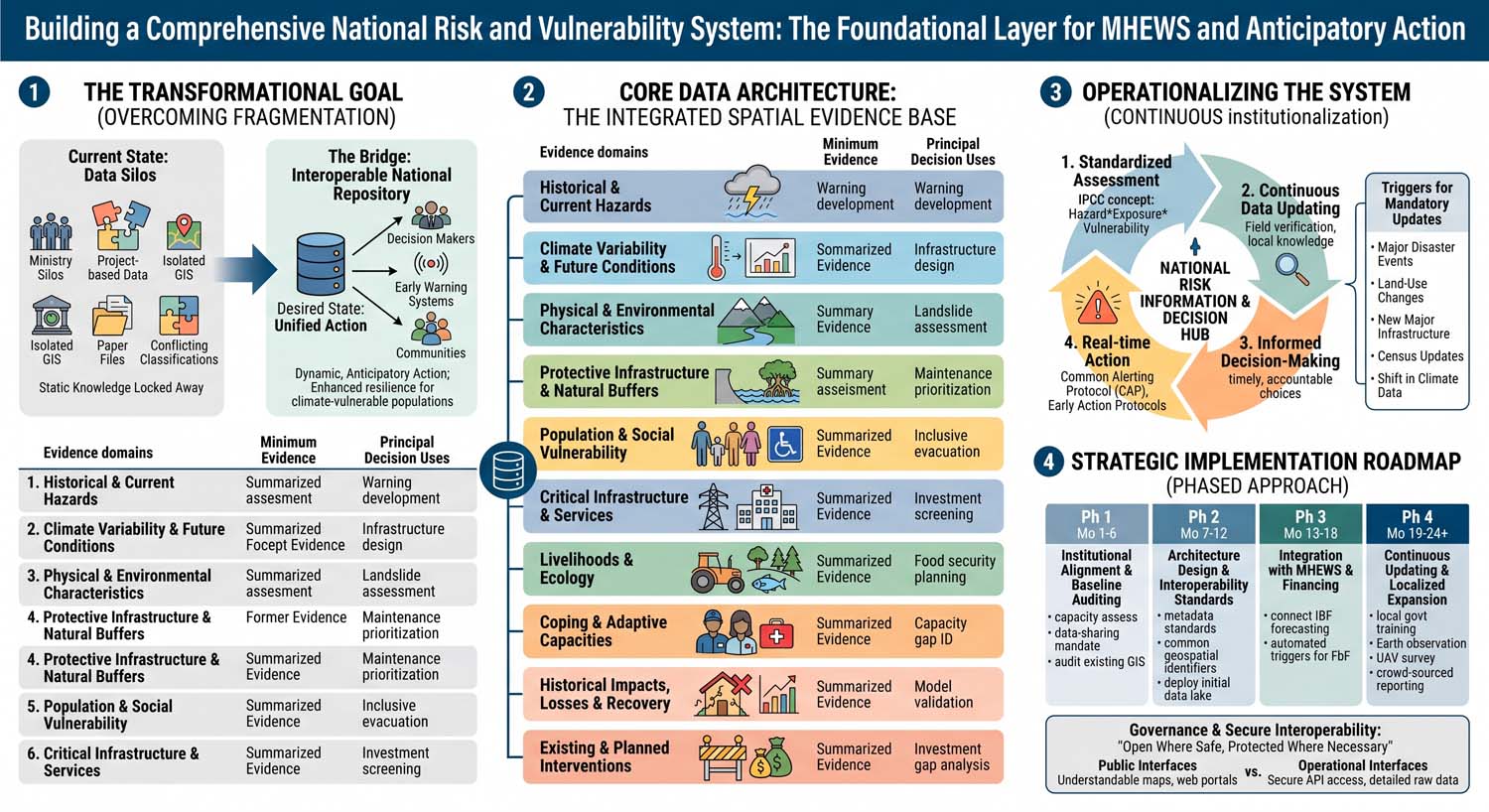
Building a Comprehensive National Risk and Vulnerability System is the foundational layer for an effective, end-to-end Multi-Hazard Early Warning System (MHEWS). For climate-vulnerable populations across the Global South, this system bridges the critical gap between static risk knowledge and dynamic, anticipatory action.
The primary barrier to establishing this repository is rarely the cost of technology, which remains highly accessible; rather, the persistent challenge is cultivating the deep government ownership required to unify disparate silos. Governments already possess highly useful datasets, but very few have a complete, current, and interoperable national repository that supports decision-making from the national executive down to the community level. Information is routinely trapped in separate ministries, donor-funded project cycles, consultant reports, isolated Geographic Information Systems (GIS), or paper files. Compounding this, different agencies utilize conflicting hazard classifications, mismatched administrative boundaries, incompatible temporal scales, and unrelated vulnerability indicators. Consequently, the state cannot efficiently determine where systemic risk is compounding, which infrastructure assets are most critically exposed, which marginalized communities are being left behind, or which interventionssuch as forecast-based financing (FbF)offer the highest return on resilience.
To overcome this fragmentation, national governments must strengthen existing institutional mandates rather than duplicate them, deploying open standards and APIs to build an ecosystem free from vendor lock-in.
4.1 The Core Data Architecture: Interoperable Risk Intelligence
A sovereign, interoperable multi-hazard risk and vulnerability system must function as a dynamic geospatial database. At a minimum, the architecture requires the integration of the following foundational layers:
Intelligence Layer | Minimum Evidence and Data Requirements | Application in Resilience & MHEWS |
Hazard & Climate Dynamics | Historical and near-real-time hazard observations; climate variability, localized trends, IPCC-aligned projections, and downscaled scenario information. | Feeds into impact-based forecasting and triggers for Early Action Protocols (EAPs). |
Topography & Geomorphology | High-resolution elevation models (DEMs), watersheds, riverine systems, coastal bathymetry, soil compositions, geology, land cover, and active land-use zoning. | Informs physical exposure modeling, flood routing, and spatial vulnerability assessments. |
Protective & Critical Infrastructure | Drainage networks, embankments, Nature-based Solutions (natural buffers), transport nodes, energy grids, water systems, telecommunications, schools, hospitals, markets, shelters, and emergency operations facilities. | Highlights systemic bottlenecks, cascading failure risks, and safe evacuation corridors. |
Socio-Economic Vulnerability | Disaggregated population data, settlements, poverty indices, health metrics, disability prevalence, age, gender, ethnicity, displacement status, and related demographic contours. | Ensures inclusive, multilingual delivery of warnings and prioritizes vulnerable groups for anticipatory action. |
Livelihoods & Ecology | Agriculture yields, fisheries, livestock inventories, forest cover, critical ecosystems, supply chains, employment statistics, and household economic baselines. | Underpins post-disaster needs assessments (PDNA) and the quantification of non-economic Loss and Damage. |
Capacities & Financing | Institutional readiness, community coping mechanisms, adaptive capacity indices, historical disaster loss and recovery cost ledgers, and existing/planned mitigation or risk-reduction investments. | Informs costed project pipelines and directs climate adaptation finance to local-level implementation. |
Multi-Tiered Assessment Methodologies
Assessment methodologies must be universally standardized to allow for national aggregation, yet flexible enough to reflect highly localized realities. They must move beyond deterministic modeling to examine the full spectrum of risk: hazard probability and intensity, granular exposure, underlying sensitivity, baseline vulnerability, coping capacity, adaptive capacity, cascading risks, and inherent uncertainty.
Crucially, AI and machine learning should complement, not replace, physics-based forecasting, functioning as a hybrid modeling system. These assessments must operate synchronously at the national, regional, district, municipal, community, and household levels. National models are essential for macro-level comparisons, donor engagement, and resource allocation. However, localized assessments incorporating UAV mapping, ground-truthing, and community participation are paramount to identifying the actual people, physical assets, behaviors, and localized capacities at risk.
Sustaining the Cycle: Operationalization over Projectization
The risk assessment cycle must be fundamentally re-engineered to be continuous and institutionalized rather than episodic and project-based. Baseline risk profiles must be updated on a legally defined, continuous schedule. Triggers for mandatory updates should include major disaster events, significant land-use changes, the commissioning of major infrastructure, national census updates, or material shifts in downscaled climate information.
To guarantee institutional credibility, every dataset must be governed by stringent metadata standards detailing its source, temporal validity, spatial scale, methodology, limitations, institutional custodian, and validation status. Quality assurance must be a multifaceted process combining rigorous scientific review, continuous field verification, the integration of indigenous and local knowledge, and transparent documentation of model uncertainty.
Governance, Sovereignty, and Secure Interoperability
Data governance is the linchpin of system trust and sustainability. Not all operational information can or should be completely open. Personal demographic data, security-sensitive critical infrastructure, and confidential commercial information demand rigorous cybersecurity and privacy safeguards under strict civilian authority.
The governing principle must be “open where safe, protected where necessary.”
- Public Interfaces: Citizens and local communities must have low-bandwidth access to understandable risk maps, multi-hazard summaries, vulnerability indicators, and actionable decisions via accessible web portals and community networks.
- Operational Interfaces: Authorized institutions, responding agencies, and disaster management authorities require secure, controlled API access to highly detailed, raw operational data to drive real-time impact analysis, Common Alerting Protocol (CAP) message generation, and emergency resource deployment.
4.2 Strategic Implementation Roadmap
To transition from disparate datasets to an operational, end-to-end repository, governments and supporting partners should follow a phased institutionalization framework:
- Phase 1: Institutional Alignment & Baseline Auditing (Months 1–6)
- Conduct a sovereign capacity assessment of existing GIS and DRM institutions.
- Draft a national data-sharing mandate legally requiring ministries to expose specific datasets via open APIs.
- Identify existing platforms to upgrade rather than procuring parallel, duplicative software.
- Phase 2: Architecture Design & Interoperability Standards (Months 7–12)
- Define national metadata standards and common geospatial identifiers (e.g., standardizing administrative boundary polygons).
- Establish the physical and cloud infrastructure with high-availability, localized servers for resilience, integrating low-bandwidth optimization.
- Deploy the initial data lake and API gateways for the minimum evidence layers.
- Phase 3: Integration with MHEWS & Financing (Months 13–18)
- Connect the consolidated vulnerability data directly to hydro-meteorological forecasting systems to enable impact-based forecasting.
- Establish data pipelines that automatically populate the impact thresholds required for anticipatory action and Forecast-based Financing (FbF).
- Phase 4: Continuous Updating & Localized Expansion (Months 19–24+)
- Roll out training for decentralized local government entities to input near-real-time community vulnerability updates.
- Integrate Earth observation telemetry, UAV survey data, and crowd-sourced reporting to dynamically adjust risk contours.
4.3 Building a Comprehensive National Risk and Vulnerability System
A comprehensive national climate and multi-hazard risk and vulnerability system should enable government institutions and communities to understand where risk exists, how it is changing, who and what may be affected, and which measures can reduce harm. It should provide a maintained evidence base for development planning, public investment, early warning, anticipatory action, preparedness, social protection, and recovery. Its effectiveness should be judged by whether institutions can use that evidence to make timely, accountable decisions.
A country may possess extensive information while still lacking this capability. Data held in ministries, local authorities, research institutions, infrastructure operators, donor projects, and consultant reports may describe different periods, locations, or definitions. A flood map may use outdated settlement data; an infrastructure inventory may omit asset condition; a vulnerability assessment may exclude displaced populations. Combining these datasets without examining their compatibility can produce misleading conclusions.
The national system should therefore establish a governed, interoperable evidence base connected to the National Risk Information and Decision Hub. Source institutions should maintain responsibility for their datasets, while the national custodian coordinates common standards, access arrangements, quality assurance, and updates. The minimum evidence framework should cover the following domains.
Evidence domain | Minimum information to maintain | Principal decision uses |
Historical and current hazards | Observations and event records describing location, timing, intensity, duration, extent, and relevant thresholds; near-real-time monitoring where available; observation gaps and quality flags. | Hazard assessment, situational awareness, warning development, preparedness, and validation of models. |
Climate variability and future conditions | Historical variability and trends; climate projections covering relevant scenarios and time horizons; model assumptions, baseline periods, and uncertainty. | Infrastructure design, adaptation pathways, agricultural planning, water management, and assessment of future exposure. |
Physical and environmental characteristics | Topography, elevation, watersheds, rivers, coastlines, soils, geology, land cover, land use, and relevant changes over time. | Flood and landslide assessment, coastal planning, watershed management, and identification of environmentally sensitive locations. |
Protective infrastructure and natural buffers | Drainage systems, embankments, retention areas, coastal protection, wetlands, mangroves, and other protective ecosystems, including condition, maintenance needs, and limitations. | Maintenance prioritization, protection-gap analysis, restoration planning, and assessment of failure consequences. |
Population and social vulnerability | Settlement patterns, poverty, health, sex, age, disability, gender-related barriers, displacement, and access to services; ethnicity and other sensitive characteristics where necessary and appropriately safeguarded. | Inclusive evacuation, targeted assistance, social protection, accessible communication, and equitable allocation of resources. |
Critical infrastructure and services | Locations, condition, capacity, service areas, dependencies, and accessibility of transport, energy, water, telecommunications, schools, health facilities, markets, shelters, and emergency facilities. | Service-continuity planning, investment screening, emergency logistics, and protection of essential networks. |
Livelihoods and ecosystems | Agriculture, fisheries, livestock, forests, ecosystem services, employment, household income sources, seasonal livelihood patterns, and supply-chain dependencies. | Livelihood protection, food-security planning, ecosystem management, and adaptation investment. |
Coping and adaptive capacities | Institutional staffing and resources; warning access; evacuation assistance; household resources; social networks; financial access; community organizations; and the availability of alternative services or livelihoods. | Identification of practical capability gaps and measures needed to enable protective action. |
Historical impacts, losses, and recovery | Deaths, injuries, displacement, physical damage, economic losses, service interruptions, recovery needs, and non-economic losses, with locations, dates, methods, and validation status. | Model validation, recovery planning, monitoring of recurring impacts, and assessment of unmet protection needs. |
Existing and planned interventions | Locations, objectives, financing, implementation status, beneficiaries, maintenance responsibilities, and measured results of adaptation, mitigation, preparedness, and risk-reduction investments. | Identification of investment gaps, duplication, potential maladaptation, and opportunities for coordinated action. |
- Interoperability should begin with common definitions and identifiers. Institutions should agree on hazard terminology, administrative codes, geographic reference systems, measurement units, reporting periods, and identifiers for facilities, infrastructure, and events. Changes to administrative boundaries should be documented so that historical comparisons remain interpretable. The UNDRR-International Science Council Hazard Information Profiles provide a reference for standardized hazard descriptions and recognition of interactions among hazards. National classifications should retain the detail needed for local decisions while remaining compatible with shared definitions.
- Assessment methods should explain how risk is generated. They should examine hazard likelihood and intensity, exposure, vulnerability, and the capacities that influence outcomes. The IPCC describes climate risk through dynamic interactions among hazards, exposure, and vulnerability, including the effects of responses. This requires assessments to consider changes in settlements, infrastructure, livelihoods, and protective measures alongside changing climatic conditions. A future-risk assessment that updates rainfall projections while holding every other condition unchanged should clearly disclose that assumption.
Methods should use probabilistic analysis where the evidence supports it and transparent scenarios where probabilities cannot be estimated reliably. Composite indices should disclose indicator selection, weighting, missing-data treatment, and sensitivity to assumptions. The relationship between vulnerability, coping capacity, and adaptive capacity should be defined to avoid counting the same characteristic repeatedly. An overall national or district score should retain access to its underlying components so that severe disadvantages affecting particular communities remain visible.
4.4 Multi-hazard assessment needs to examine interactions and service dependencies
A sovereign, interoperable multi-hazard risk and vulnerability system cannot treat hazards or infrastructure assets as isolated variables. In climate-vulnerable environments across the Global South, systemic risk is defined by cascading hazard interactions and critical service dependencies.
When an assessment focuses purely on the direct, static impact of a primary hazard (e.g., flood depth at a specific coordinate), it fails to capture the true operational reality: disasters propagate through interconnected infrastructure networks, creating compounding shocks that paralyze emergency response, cut off early warning communications, and exponentially increase recovery costs.
To build an effective, end-to-end Multi-Hazard Early Warning System (MHEWS), national risk architectures must analytically map these interdependencies to support genuine impact-based forecasting and anticipatory action.
- The Dynamics of Hazard Interactions
Multi-hazard environments demand an assessment framework that goes beyond simple overlays of independent risk maps. Risk intelligence must account for:
- Cascading Hazards: Where a primary event triggers a sequential chain of secondary hazards. For instance, torrential rainfall triggers a landslide, which dams a river, leading to a catastrophic flash flood downstream.
- Compounding Hazards: Where multiple events occur concurrently or sequentially in the same geography, exhausting coping capacities. An example is an extreme heatwave combined with drought, followed immediately by severe cyclonic rainfall, leading to drastically increased runoff and flash flooding due to soil desiccation.
AI-driven parallel modeling, running in tandem with traditional physics-based forecasting, is highly effective here. It allows Early Warning Centers to identify hidden spatial correlations and forecast the probability of these combined events, shifting the governance model from reactive crisis management to proactive risk mitigation.
- Critical Service Dependencies and Systemic Risk
An inclusive vulnerability assessment must map the topology of critical infrastructure and identify single points of failure. The loss of one utility inevitably degrades the operational capacity of others, deeply impacting climate-vulnerable populations.
Key dependency chains that must be continuously modeled include:
- Energy-Telecommunications Nexus: The most critical dependency for MHEWS. If the power grid fails, telecommunications hubs (cell towers, VHF/UHF repeaters, National CAP Hub servers) rely on localized backup generators. If fuel supply chains are blocked by damaged transport infrastructure, the warning communication channels including cell broadcast, internet, and SMS fail, silencing the early warning network when it is needed most.
- WASH and Health Interdependencies: Hospitals and Emergency Operations Centers (EOCs) require uninterrupted power and clean water. Flooding that overwhelms drainage networks and contaminates water treatment plants directly degrades public health capacities, accelerating the spread of waterborne diseases in the aftermath of a disaster.
- Logistics and Anticipatory Action: The transportation network underpins all physical response. An assessment must identify not just the exposure of roads, but the downstream impact of a blocked artery on pre-positioning relief supplies, executing Early Action Protocols (EAPs), and conducting Post-Disaster Needs Assessments (PDNAs).
- Re-engineering Assessments for Interoperability
To capture these complex interdependencies, the national risk and vulnerability repository must move away from static, siloed documents and towards dynamic, open-API architectures.
- Graph Databases and Topological Mapping: Governments should transition from flat GIS layers to geospatial graph databases that map infrastructure mathematically as connected nodes and edges, allowing algorithms to instantly simulate the cascading “domino effect” of a localized failure.
- Impact-Based Forecasting Integration: By linking these dependency models to near-real-time hydro-meteorological data, Early Warning Centers can issue alerts based on impact rather than mere phenomena. Instead of warning, “Expect 150mm of rain,” the system warns, “Expect inundation of the central substation, resulting in a 48-hour telecom outage in three districts.”
- Costed Project Pipelines: Identifying these systemic bottlenecks allows national authorities to translate vulnerability data directly into climate-adaptation financing. Interventions can be rigorously justified to donors based on their ability to protect the broader systemic network, ensuring maximum resilience return on investment.
5. Creating an Inclusive and Continuous Decision-Making Process
Government has a responsibility to establish fair, accessible, and sustained opportunities for institutions and individuals to influence climate and multi-hazard risk decisions. These decisions determine whose settlements receive protection, which services remain operational, how public resources are distributed, and whose livelihoods face additional pressure. People affected by these choices should have meaningful opportunities to help define the problems, examine alternatives, and scrutinize implementation.
A consultation process centred on a single workshop provides limited opportunity to fulfil this responsibility. Participants may receive documents too late, encounter technical language they cannot readily interpret, or be invited after priorities have already been settled. Important knowledge may remain outside the discussion when participation depends on official invitations, institutional status, professional networks, or the ability to travel to the capital.
An inclusive national framework should establish participation throughout the decision cycle. This approach is consistent with UNFCCC guidance for national adaptation planning, which emphasizes country-driven, participatory, transparent processes that consider vulnerable groups, communities, and ecosystems and draw on scientific, Indigenous, and traditional knowledge.
The framework should systematically involve:
- Central government institutions: ministries, specialised departments, public authorities, regulators, and state-owned enterprises responsible for policies, investment, regulation, and service delivery.
- Subnational and local institutions: regional, district, municipal, subdistrict, and community-level authorities responsible for local planning, implementation, and public services.
- Risk-information and coordinating agencies: meteorological and hydrological services, disaster-management authorities, environmental agencies, planning commissions, and finance ministries.
- Scientific and professional organizations: universities, technical institutes, think tanks, research organizations, and professional associations capable of reviewing evidence and developing solutions.
- Civil society and community organizations: non-governmental, humanitarian, development, and faith-based organizations, including groups representing people who face barriers to public participation.
- Private-sector and livelihood organizations: businesses, financial institutions, insurers, utilities, telecommunications operators, farmers’ organizations, cooperatives, and business associations.
- Media organizations: national and local media, public broadcasters, community radio, and news agencies supporting public understanding and independent scrutiny.
- People experiencing differentiated risks: women, young people, older people, persons with disabilities, Indigenous Peoples, ethnic and linguistic minorities, displaced people, urban poor communities, and other affected groups.
- Individual contributors: independent specialists, practitioners, innovators, diaspora professionals, and community knowledge holders, including those without formal institutional affiliations.
UNDRR’s Stakeholder Engagement Mechanism offers a relevant example of structured engagement that includes both organizations and individuals and seeks to strengthen participation, policy influence, and social accountability. National arrangements should adapt these principles to their own institutions and communities.
Representation should be transparent and accountable to the people represented: Standing committees and advisory groups should publish their selection criteria, membership, responsibilities, terms, and procedures for declaring conflicts of interest. Community representatives should be selected through processes recognized by their constituencies and supported to report back. Open submission channels should remain available alongside representative bodies so that individuals can contribute without depending on a designated intermediary.
Participation arrangements should address unequal influence. A well-resourced company, a national professional association, and a remote community may have very different capacities to prepare submissions or attend meetings. Decision rules should prevent financial resources, political connections, institutional prestige, or the volume of online comments from determining whose concerns receive attention. Evidence should be assessed for its relevance and credibility, while decisions should explicitly consider rights, vulnerability, and the distribution of benefits and burdens.
Access requires practical support: Participation budgets should cover accessible venues, interpretation, sign-language services, appropriate document formats, transport assistance, and reasonable participation costs. Meeting times should account for livelihood activities and care responsibilities. Facilitated community discussions, oral submissions, telephone interviews, and assisted map reviews can enable contributions from people who cannot prepare formal written comments. Organizations led by persons with disabilities and other affected groups should help design these arrangements.
Engagement with Indigenous Peoples should respect their own representative institutions and decision-making processes. The United Nations Declaration on the Rights of Indigenous Peoples calls for good-faith consultation and cooperation through those institutions to obtain free, prior, and informed consent before adopting legislative or administrative measures that may affect them. General public consultation should not be presented as completion of a distinct consent process.
Each participation process should begin with a clear mandate: Authorities should explain the decision under consideration, which options remain open, what constraints apply, who will make the final decision, and how contributions will be used. Participants should receive understandable evidence and adequate response time. OECD guidance emphasizes organizing participation where meaningful influence is possible and defining its expected contribution from the outset.
A national framework should establish participation at the following stages.
Decision stage | Meaningful contribution | Record demonstrating follow-through |
Problem definition | Identify locally important hazards, service failures, livelihood pressures, and groups whose needs have been overlooked. | Published problem statement showing issues raised and the agreed scope. |
Assessment design | Review proposed indicators, geographic coverage, data sources, assumptions, and methods. | Assessment plan documenting agreed changes and unresolved concerns. |
Validation | Check maps, inventories, vulnerability findings, and model outputs against field conditions and experience. | Validation record identifying corrections, disputed findings, and remaining uncertainty. |
Priority setting | Compare interventions, distributional effects, feasibility, and consequences of delayed action. | Prioritized options with transparent criteria and explanations of trade-offs. |
Budgeting | Review proposed allocations, local funding gaps, recurrent costs, and affordability. | Published allocation decisions showing how priorities were considered. |
Implementation | Review delivery arrangements, accessibility, construction impacts, maintenance responsibilities, and emerging problems. | Implementation updates and a tracked corrective-action register. |
Monitoring | Report service performance, exclusion, unintended impacts, and whether intended benefits reach affected people. | Monitoring findings linked to institutional responses and corrective measures. |
Evaluation and revision | Assess results, identify lessons, and propose changes to policies, investments, and operating arrangements. | Evaluation report and a time-bound management response. |
Participation methods should match the decision. Community mapping may help identify drainage obstructions or inaccessible evacuation routes. Technical panels may examine modelling assumptions. Public hearings may support scrutiny of major investments. Participatory budgeting can allow communities to influence defined funding envelopes where the governing arrangements permit it. These methods should connect to an identifiable decision, responsible institution, and follow-up process.
The digital platform should provide a continuous route into this process: Through the National Risk Information and Decision Hub, contributors should be able to submit evidence, comment on specific policy provisions, annotate maps, identify missing information, propose interventions, and follow the status of their contributions. Each consultation should display its purpose, documents, deadlines, responsible institution, and subsequent decision. Version control should allow users to see how a proposal changed.
Interfaces should support local languages, assistive technologies, low-bandwidth connections, and simple submission formats. Account requirements should be proportionate to the function: verified institutional submissions may require authentication, while public feedback should remain accessible through simpler channels. In-person, paper, telephone, and facilitated submissions should enter the same tracking process, with appropriate privacy protections and confirmation of what was recorded.
Moderation and verification should operate under published rules. Factual claims should be checked according to their nature and potential consequences. Unverified field observations should be labelled and referred for assessment. Lawful criticism, disagreement over priorities, and inconvenient findings should remain part of the record.
6. Using Technology as Enabling Infrastructure
Technology should provide the operational infrastructure through which governments observe hazards, understand exposure and vulnerability, and translate evidence into timely decisions and protective action. Comprehensive risk assessment can draw on an expanding range of accessible tools, including mobile survey applications, global navigation satellite systems, geographic information systems, satellite imagery, drones, automatic weather stations, river and rainfall gauges, connected sensors, hydrological and climate models, participatory mapping, community observations, and digital asset inventories. Open datasets, software, and modelling resources create opportunities to strengthen national capabilities. UNDRR and the Global Facility for Disaster Reduction and Recovery recognize these digital public goods as important resources for disaster risk reduction and climate adaptation.
Technology selection should begin with the decisions the system must support. Governments need to identify priority hazards, exposed populations, critical services, responsible institutions, and the time available for action. A system supporting flash-flood warnings requires different observation frequencies, processing speeds, and communication arrangements from one supporting seasonal drought planning or long-term coastal adaptation. Procurement specifications should therefore describe the required service, its users, accuracy, geographic coverage, update frequency, and operational responsibilities. This helps ensure that equipment and software address an identified public need.
The resulting system should connect data collection, quality assurance, storage, analysis, interpretation, communication, and action through documented institutional workflows. For example, a flood-warning service may combine rainfall observations and forecasts, river measurements, terrain information, hydrological modelling, and mapped exposure to assess potential impacts. Those assessments should inform products that authorized institutions can interpret and use to prepare communities, protect facilities, or mobilize assistance. Observations collected during and after events should then help improve models, thresholds, exposure records, and operating procedures.
Interoperability requires institutions to exchange information with a shared understanding of what the data mean: Agencies should agree on geographic reference systems, measurement units, timestamps, hazard classifications, administrative boundaries, asset identifiers, and essential metadata. Standard interfaces and exchange formats should allow compatible systems to share information without repeated manual conversion. A mapped school, health facility, bridge, or water point should be identifiable across relevant inventories and assessments. These arrangements can reduce duplication and help agencies combine their evidence. UNDRR identifies data interoperability and standardization as important challenges in applying risk information across institutions.
Quality assurance must cover the full information chain. Sensors require appropriate siting, calibration, inspection, and maintenance. Survey applications need clear definitions, validation rules, and procedures for correcting records. Satellite-derived classifications should be checked against suitable reference information, while models should be evaluated against independent observations where available. Missing data, outdated asset records, uncertainty, and limitations in geographic coverage should remain visible to users. Automated checks should flag suspicious observations for investigation, recognizing that an extreme measurement may represent a real event. WMO identifies maintenance, calibration, quality control, and sustained staffing as continuing requirements for effective observing systems.
Institutional ownership should be established from the beginning. Agreements should specify who owns or licenses the data, who maintains each dataset, who authorizes access, and who is responsible for updates. Consultancy and procurement contracts should require usable handover packages, including datasets, metadata, model configurations, documentation, relevant code or maintenance rights, and practical training. Nationally managed repositories or connected institutional systems should make these resources available to authorized users. UNDRR’s assessment of disaster data systems emphasizes government leadership, local relevance, staff capabilities, procedures, and financial resources as conditions for sustained operation.
Operational financing should cover the full service life of the system. Costs include connectivity, hosting, software licences where required, equipment replacement, spare parts, field visits, calibration, technical support, cybersecurity, and staff retention. Institutions also need training that enables personnel to interpret outputs, diagnose problems, update information, and explain uncertainty to decision makers. Procurement should assess data portability, access to technical support, and the institution’s ability to maintain or transfer the service over time. Handover should include a demonstration that designated staff can perform essential tasks independently.
Artificial intelligence can strengthen selected stages of this system. Potential applications include detecting anomalies in observations, classifying satellite imagery, identifying changes in land cover or flood extent, supporting forecasting and impact assessment, and prioritizing locations for inspection. AI can also assist with multilingual communication and the integration of hazard, exposure, and vulnerability information. Its usefulness depends on the quality of the supporting observations, scientific methods, and operational arrangements. WMO emphasizes that AI functions within a wider forecasting system supported by established infrastructure and human expertise.
AI products should be evaluated for the specific hazards, locations, populations, and decisions they are intended to support. Testing should examine missed events, false alarms, geographic errors, processing delays, and performance under conditions poorly represented in the training data. Rare extremes deserve particular attention because good average performance may conceal consequential failures. Model versions, input datasets, evaluation results, known limitations, and significant changes should be documented. Monitoring should continue after deployment so that declining reliability can trigger investigation, correction, or suspension. These practices align with NIST’s emphasis on validity, reliability, contextual evaluation, and ongoing monitoring.
Natural-language interfaces require additional controls. Officials and communities may benefit from being able to ask questions about approved risk assessments, plans, warning procedures, or eligibility requirements. Responses should identify their sources, show relevant dates, and distinguish documented information from interpretation. Systems should make uncertainty and missing evidence explicit. Translations of warnings and protective instructions should be checked for meaning, local terminology, and accessibility. Generated text should enter official communication through a defined review and approval process.
Accountable human authority must remain clear wherever technology informs decisions with serious consequences : Institutions should specify who reviews analytical outputs, approves warnings, authorizes protective measures, and can intervene when a system behaves unexpectedly. Review procedures should be designed around operational lead times so that responsibility and timely action work together. People affected by model-informed decisions should have accessible routes to correct inaccurate information and request reconsideration. NIST’s AI Risk Management Framework provides a basis for documenting human oversight, practitioner competence, and responsibilities throughout the system’s operation.
Cybersecurity, privacy, data sovereignty, and service continuity should be incorporated into system design. Practical provisions include controlled access, secure communications, audit records, protected backups, tested restoration procedures, and clear rules for sharing sensitive information. Essential functions should have workable arrangements for power and internet outages. Mobile applications may need offline collection and later synchronization; local teams may need cached maps and instructions; warning services need backup communication channels and rehearsed manual procedures. Displays should clearly identify the age of information so that outdated data are not mistaken for current conditions.
Implementation should proceed through manageable stages, beginning with priority services and expanding as institutions demonstrate operational readiness. Pilots should test the complete path from observation to action, including field maintenance, data exchange, interpretation, communication, and community response. Evaluations should examine whether information arrives in time, whether users understand it, whether excluded groups can access the service, and whether agencies act on the results. These findings should guide subsequent investment, technical improvements, staffing, and recurrent budgets.
7. Establishing a National Risk Information and Data-Driven Decision Hub(Risk Data Center)
A National Climate and Multi-Hazard Risk Information and Decision Hub should function as permanent, shared public infrastructure that connects risk knowledge with public decisions, financing, implementation, and accountability. It should bring together data producers, government decision-makers, local authorities, researchers, communities, development partners, infrastructure operators, and communication services within an agreed institutional and technical framework. Its purpose should be to make reliable information available to the people and institutions responsible for preventing losses, protecting essential services, and strengthening resilience.
The Hub should build on existing national capabilities and connect the systems maintained by participating institutions. A shared catalogue, common standards, and agreed access arrangements can allow agencies to retain their authoritative datasets while contributing to a coherent national service. The design should reflect national priorities, institutional mandates, local capacity, and available resources. UNDRR’s work on disaster data systems emphasizes government leadership, context-specific design, technical skills, procedures, and sustained financing as foundations for effective operation.
The following proposed architecture organizes the Hub into seven connected functional layers. Governance, quality assurance, security, inclusion, and operational sustainability should apply across all of them.
System layer | Primary function | Illustrative outputs |
Observation and source systems | Collect information from hydrometeorological networks, satellites, field surveys, administrative systems, community observations, infrastructure operators, and regional and international sources. | Timestamped observations, historical records, asset inventories, community reports, remote-sensing products, and disaster-impact records. |
Integration and interoperability | Harmonize identifiers, geographic references, classifications, metadata, and exchange formats; apply validation rules and manage connections between systems. | Quality-checked data feeds, common administrative boundaries, compatible sector datasets, data-quality flags, and processing logs. |
National data repository and catalogue | Store or provide governed access to geospatial, statistical, documentary, model, and loss-and-damage information, with version control and appropriate access permissions. | National risk atlas, sector databases, local risk profiles, model registry, disaster-loss database, and policy and project library. |
Analytics and artificial intelligence | Apply validated methods to assess hazards, exposure, vulnerability, coping capacity, potential impacts, and alternative intervention scenarios. | Impact forecasts, scenario maps, vulnerability profiles, documented risk indices, investment options, and uncertainty statements. |
Policy and decision support | Integrate evidence into planning, budgeting, project appraisal, anticipatory action, emergency operations, social protection, and recovery workflows. | Decision dashboards, proposed triggers, screening results, action plans, budget recommendations, approval records, and implementation tracking. |
Participation and knowledge exchange | Enable institutions, researchers, and communities to submit evidence, review proposals, contribute knowledge, and receive responses. | Consultation records, reviewed local observations, expert assessments, learning products, innovation proposals, and grievance records. |
Dissemination and feedback | Distribute risk information and authorized warnings through accessible channels; collect delivery information, situation updates, and user feedback. | Official bulletins, broadcast products, web and mobile alerts, accessible messages, local situation reports, and after-action findings. |
The Hub requires a clear institutional mandate and an accountable operating arrangement:
A designated national custodian should coordinate shared services, interoperability, security, and system performance. Participating institutions should appoint data stewards responsible for the quality, documentation, and updating of their source information. Institutions producing derived analyses should remain accountable for their methods and outputs. A cross-government oversight arrangement should resolve gaps and competing requirements, with meaningful participation from local authorities, technical experts, and representatives of affected communities.
Data-sharing agreements should define ownership, custodianship, licensing, permitted uses, update schedules, retention periods, and procedures for correction. Access should distinguish between public information, controlled operational information, and sensitive personal or security-related records. Each dataset should identify its source, collection date, geographic coverage, methodology, limitations, and responsible institution. These arrangements should enable authorized users to understand whether information is suitable for a particular decision and whom to contact when problems arise.
The Hub should preserve distinctions between observed measurements, community reports, modelled estimates, forecasts, and scenarios. Quality checks and subsequent corrections should leave a traceable record. Maps should indicate missing information and the age of their underlying datasets. Risk indices and investment rankings should disclose their criteria, assumptions, and weighting so that users can examine how priorities were derived. UNDRR’s Global Framework for Disaster-Related Statistics highlights the importance of consistent statistical foundations for comparing risk across places and time, understanding unequal impacts, and informing prevention.
Decision support should establish an explicit connection between evidence and institutional action:
For each priority use case, the Hub should identify the decision-maker, supporting evidence, approval process, implementation responsibility, and relevant timeframe. A proposed flood trigger, for example, should connect to defined preparedness measures, an authorized decision process, and arrangements for mobilizing resources. Public warning issuance should follow the country’s designated institutional authority. The Hub should record how analytical recommendations progress through review, approval, funding, implementation, and evaluation.
Interoperability should support both data discovery and practical reuse. Users need to find relevant information, understand its meaning, determine access conditions, and retrieve it in usable formats. Recognized standards can support these functions. For example, OGC API – Records is an Open Geospatial Consortium standard for publishing, finding, and retrieving metadata about datasets and related resources. It provides a consistent way for people and software to search a catalogue of geospatial datasets, services, models, and other information resources. National Climate and Multi-Hazard Risk Information and Decision Hub could provide the catalogue through which users discover flood maps, climate projections, vulnerability assessments, infrastructure inventories, and associated services maintained by different institutions. OGC API – Records provides standardized discovery and access to metadata catalogues, offering a basis for finding geospatial resources across participating systems. National implementation should select standards according to the services required and the capabilities of the institutions expected to maintain them.
The Hub should connect with appropriate regional and international services through secure, documented interfaces and other reliable exchange arrangements. Relevant inputs may include satellite products, forecasts, climate projections, humanitarian datasets, scientific research, and technical guidance. Each external source should have documented licensing conditions, update expectations, known limitations, and procedures for handling interruptions. The WMO Information System 2.0 provides an established framework for international exchange of weather, climate, and related Earth-system data using open standards and web technologies.
International exchange should also make verified national and local evidence available for appropriate regional and global uses. Observations, disaster-loss records, documented adaptation outcomes, and operational lessons can strengthen scientific analysis, technical cooperation, reporting, and climate-finance discussions. Sharing should follow agreed permissions and quality requirements, with aggregation or other protections where needed. National institutions should retain the ability to explain how their information was produced and how it may appropriately be interpreted.
Participation should be embedded in routine operations. Local authorities and communities should be able to report emerging risks, identify missing assets, challenge inaccurate records, and comment on proposed interventions. Submissions should receive acknowledgement, a visible review status, and a response within a defined period. Verification procedures should accommodate different forms of evidence, including documented community observations and local knowledge. Assisted submission, local-language services, and offline channels should support people who cannot use the digital platform directly.
An open Policy and Decision Library should preserve institutional knowledge and make public commitments traceable:
It should contain publicly shareable laws, policies, standards, strategies, assessment methods, approved plans, project information, budget allocations, evaluation findings, and lessons learned. Records should identify the issuing institution, jurisdiction, publication date, effective date where applicable, version, and status. Draft, adopted, superseded, and withdrawn documents should be clearly labelled. Searchable text, accessible formats, summaries, and links between related documents would help officials and the public locate relevant information.
The Library should connect policies and plans to implementation records. A user examining a resilience commitment should be able to identify the responsible institution, intended beneficiaries, approved allocation, funds released, reported expenditure, implementation progress, and evaluation findings, where these are publicly disclosable. Documented amendments should explain how commitments changed. This would support continuity when personnel or governments change and allow oversight bodies and communities to examine delivery.
Implementation should proceed through a funded, phased programme. Initial work should establish mandates, priority use cases, a data inventory, sharing agreements, core catalogues, and selected operational workflows. Expansion should follow evidence that participating institutions can maintain the services and use their outputs. Recurrent budgets should cover staffing, maintenance, hosting, data updates, technical support, security, backups, and tested recovery arrangements.
Performance monitoring should assess data completeness and timeliness, service availability, correction response times, local access, participation, and the use of evidence in actual decisions. Reviews should also examine whether warnings prompted timely action, whether investment choices addressed identified vulnerabilities, and whether communities received the protection or services promised. Findings should inform improvements to the Hub’s data, workflows, institutional arrangements, and financing.
8. Localizing Risk Governance and Last-Mile Climate Finance
Local governments need the authority, information, institutional capacity, and predictable financing required to protect communities from climate and multi-hazard risks. These requirements should be embedded in national governance and fiscal arrangements, with clearly assigned responsibilities, continuing technical support, meaningful public participation, and enforceable accountability. Local institutions should be able to use risk evidence when deciding where development takes place, how essential services operate, which investments receive priority, and when protective action begins.
Localization should connect national commitments with decisions made in districts, municipalities, subdistricts, and communities. The Sendai Framework calls for local authorities to be empowered through regulatory and financial arrangements that enable them to coordinate disaster risk management with relevant stakeholders[1]. [1] A national framework should translate this commitment into a funded minimum package of local functions, supported by standards that reflect different levels of responsibility and capacity.
Last-mile climate finance should be assessed by whether resources arrive in time, respond to locally identified risks, and provide intended beneficiaries with useful and lasting protection. Tracking expenditure within a locality is insufficient to establish local ownership. Financing arrangements should also identify who selected the intervention, who controlled the budget, whose priorities influenced its design, and who can require corrective action when delivery fails.
Establish clear mandates and assess institutional capacity
National and subnational institutions should agree on the responsibilities assigned to each level of government before introducing new planning, reporting, or financing requirements. An institutional diagnostic should examine mandates, coordination arrangements, staffing, technical capabilities, fiscal authority, procurement systems, information access, and accountability mechanisms. It should identify both formal responsibilities and the arrangements through which decisions are actually made.
The assessment should clarify who maintains risk information, approves investments, issues official warnings, authorizes anticipatory action, manages emergency expenditure, and operates completed infrastructure. Where mandates overlap, the responsible institutions should agree on a lead agency and supporting roles. Where responsibilities are unfunded, the national financing framework should specify the resources and powers required to fulfil them.
Requirements should accommodate differences in population, geography, hazard exposure, service responsibilities, and existing capacity. A small rural authority may need shared engineering and geospatial services, while a large municipality may require specialist teams for drainage, public health, infrastructure, and informal settlements. National institutions should provide access to common datasets, technical standards, specialist advice, and escalation procedures for decisions beyond local authority. Implementation arrangements should remain workable where connectivity is weak or administrative access is disrupted.
Fund a minimum package of local risk governance functions
Every local government should have access to the personnel, operating resources, technical assistance, and decision-making authority needed to perform the following functions within its mandate.
Maintain an updated local risk profile. Document priority hazards, exposed people and assets, vulnerability, coping capacity, historical impacts, and plausible future conditions. Include interacting hazards and disruptions that can spread between services, such as flooding that interrupts electricity, water supply, health care, and transport. Establish a regular review cycle and update the profile after major events or significant changes in settlement patterns, infrastructure, ecosystems, or livelihoods.
Maintain usable maps and asset information. Map vulnerable settlements, livelihood areas, ecosystems, critical infrastructure, essential facilities, evacuation routes, and safe locations. Record asset condition, accessibility, service coverage, ownership, and maintenance responsibilities. Link maps to asset registers and planning records so that risk information can inform inspections, investment appraisal, and service continuity. Use household information only where necessary for authorized assistance, with appropriate access controls and public disclosure limited to information that protects individuals.
Combine scientific and community evidence. Integrate observations, official forecasts, climate projections, technical assessments, participatory mapping, and Indigenous or local knowledge. Validate locally reported conditions with relevant technical institutions where feasible. Record data sources, dates, limitations, uncertainty, and differing interpretations. Mapping should be detailed enough for the intended decision; a national map may support screening while a specific infrastructure design requires additional site assessment.
Integrate risk into routine public decisions. Apply risk information to land-use planning, building control, infrastructure design, agriculture, water management, public health, social protection, and other assigned services. Planning and budget submissions should explain how relevant risks were considered and how proposed measures could affect neighbouring communities. Decisions involving relocation, land access, or restrictions on livelihoods require appropriate consultation, safeguards, and lawful procedures.
Prepare a prioritized investment pipeline. Develop proposals that identify the problem, intended beneficiaries, expected benefits, estimated costs, implementation arrangements, and maintenance requirements. Establish the adaptation or disaster-risk-reduction rationale, compare feasible options, and identify financing eligibility. Record outstanding preparation needs, including designs, permits, technical reviews, and community agreements, so that support can move priority proposals towards implementation.
Operate warning and preparedness arrangements. Define procedures for receiving official warnings, interpreting likely local impacts, communicating accessible messages, initiating authorized early actions, assisting vulnerable residents, and organizing evacuation. Confirm contact lists, safe routes, shelter arrangements, backup communications, and responsibilities for essential services. Test these arrangements through exercises and use community feedback to identify people who remain unreached or unable to act.
Budget for continuing operations. Provide recurrent funding for staffing, equipment maintenance, data updates, drills, community outreach, technical support, and the upkeep of protective infrastructure and ecosystems. Each funded asset should have an identified operator, a maintenance schedule, and a realistic financing arrangement. Investment approval should consider these continuing costs alongside construction or installation costs.
Monitor implementation and results. Record expenditure, procurement, physical progress, service performance, emerging risks, and results. Reporting should be proportionate to local capacity and linked to existing government systems wherever feasible. Name the officials responsible for checking information, addressing delays, and confirming that completed works provide the intended service.
Provide accessible public accountability. Establish consultation, feedback, grievance, and social-audit arrangements with clear response responsibilities. Residents should be able to ask why an investment was selected, report exclusion or poor workmanship, and receive a documented response. Channels should include options for people without internet access and confidential routes for sensitive complaints.
Give communities influence over decisions
Local ownership requires communities to influence priorities, resource allocation, implementation, and evaluation. The Principles for Locally Led Adaptation support devolved decisions, attention to structural inequalities, more accessible and predictable funding, stronger local capabilities, and accountability to local stakeholders[2]. [2] These principles provide a basis for reviewing whether participation changes decisions and whether institutions can sustain the resulting responsibilities.
Participation should extend across the planning and budget cycle. Communities should help identify risks, compare investment options, review proposed allocations, monitor delivery, and assess whether services meet their needs. Local authorities should explain how community recommendations affected decisions and provide reasons when proposals cannot be adopted.
Participation arrangements should include women, persons with disabilities, Indigenous Peoples, young people, displaced populations, minority groups, and residents of informal or remote settlements. Accessible venues, local languages, convenient meeting times, transport support, and childcare where needed can reduce barriers. Separate discussions may help groups raise concerns that would otherwise be suppressed, while representative forums should have transparent selection procedures and meaningful influence over final priorities.
Attention is also needed to inequalities within communities. Authorities should examine who controls land, water, information, local organizations, and access to decision-makers. Public selection criteria, disclosure of conflicts of interest, and independent channels for complaints can help prevent influential groups from capturing investments. Community knowledge and unpaid participation should not become substitutes for funded public responsibilities.
Connect risk evidence with investment decisions
Local investment planning should follow a documented sequence from risk identification to appraisal, selection, budgeting, implementation, and maintenance. The process should show why a proposed intervention is a priority and what evidence supports its expected contribution. Technical institutions should help authorities work with incomplete information, identify important uncertainties, and determine when additional assessment is necessary.
Appraisal should consider the severity and frequency of relevant hazards, the vulnerability of intended users, essential service needs, affordability, and the durability of benefits. Options may include improved maintenance, ecosystem restoration, livelihood support, revised operating procedures, protective infrastructure, or combinations of these measures. For example, a flood-management proposal should consider downstream effects and drainage maintenance, while a water-supply proposal should examine seasonal availability, water quality, energy needs, and operating costs.
Project preparation should test whether an intervention could transfer risk, increase long-term exposure, or impose costs that intended users cannot afford. Designs should consider plausible future conditions and identify circumstances that would require adjustment. Public investment decisions should also explain how beneficiaries were identified and how access will be maintained for groups facing social, physical, or economic barriers.
Local priorities should inform sector plans and national budget negotiations. A common project identifier should connect each approved proposal with its risk evidence, budget, procurement records, implementing institution, and results. This would allow national and local authorities to identify overlapping projects, unfunded priorities, and opportunities for joint investment.
Establish predictable local financing
Local financing should cover both continuing governance functions and investments that reduce risk. Sources may include formula-based intergovernmental transfers, earmarked sector allocations, appropriate local revenue, and eligible national or international climate-finance mechanisms. Multi-year indicative allocations and published release schedules should allow authorities to prepare investments, retain personnel, and plan maintenance, while remaining subject to applicable budget approvals.
A possible national financing package could combine four complementary components.
Financing component | Primary purpose | Allocation and management approach |
Minimum operating support | Maintain essential coordination, risk information, preparedness, community engagement, and access to technical assistance. | Provide a dependable foundation adjusted for assigned functions, geography, service costs, and fiscal capacity. |
Risk-based investment allocation | Finance prioritized adaptation and risk-reduction measures, including eligible community initiatives and project preparation. | Reflect exposure, vulnerability, poverty, population, service deficits, and the cost of reaching underserved areas. |
Performance-based additions | Encourage verified improvements in planning, financial management, participation, maintenance, and implementation. | Apply transparent standards, recognize starting conditions, and provide assistance to authorities facing capacity constraints. |
Contingency and anticipatory-action finance | Enable timely protective measures and eligible emergency expenditure. | Define separate pre-event and emergency activation arrangements, approval authority, release procedures, eligible uses, expenditure tracking, and replenishment. |
Financing arrangements should distinguish the purposes and eligibility requirements of different funding sources. A comprehensive local risk programme may address climate-related and other hazards, but expenditure charged to a climate-finance mechanism should meet that mechanism’s requirements. Project budgets should distinguish ordinary service costs, adaptation-related costs where required, and contributions from different funders. The same expenditure should not be claimed against multiple grants.
Access to international climate finance should be organized through the relevant eligible institutions and national arrangements. Local authorities should receive support with project preparation, fiduciary requirements, and reporting. A country’s financing design should specify which decisions can be made locally, which require national approval, and how external resources enter local budgets.
Allocate resources fairly and strengthen local capabilities
Allocation formulas should be published with their indicators, weights, data sources, calculation methods, and review procedures. Population should be considered alongside vulnerability, service deficits, fiscal capacity, and delivery costs so that sparsely populated, high-risk areas receive appropriate attention. Formula design should examine whether correlated indicators unintentionally count the same disadvantage more than once and whether historical records omit places with weak reporting.
Missing information should trigger support to improve the evidence base. It should not be interpreted as an absence of risk. National authorities should permit documented provisional estimates where necessary, establish a timetable for verification, and provide a process for local authorities to challenge material errors. Allocation methods should be reviewed as better information becomes available, with transitional arrangements that help maintain essential services.
Performance requirements should strengthen institutions while protecting equitable access to essential functions. Basic support and performance additions should have clearly defined purposes. Assessments should recognize starting conditions and reward credible improvements within an authority’s control. Local co-financing requirements should reflect fiscal capacity and household affordability, and essential services should have a protected delivery arrangement where an authority needs assistance to meet financial controls.
Technical support should address the actual causes of weak delivery. It may include shared engineering teams, geospatial services, procurement assistance, financial-management support, project preparation, and peer learning. Time-bound corrective plans should identify responsibilities, milestones, and arrangements for verification. Performance review should lead to practical support and corrective action, with transparent treatment of serious misuse or persistent failure.
Risk finance mobilization and access can be encouraged so stakeholders can demonstrate performance in the following categories;
- Climate and multi-hazard risk assessment, repository development, GIS-based risk analytics and informed planning and budgeting capacity
- Operational local risk data management, EOC setup, end-to-end multi-hazard early warning system
- administrative process, local revenue mobilization, climate-resilient project design and implementation capacity
- Technical human resources for climate and multi-hazard risk management and governance system
- Own-source revenue mobilization for climate resilience building
- Intervention monitoring, oversight, evaluation
- Transparency and accountability; implementation performance/expenditure targeting Sendai Framework Disaster Risk Reduction, EW4All, SDG targets
Evaluating all those categories and combining scores would designate stakeholders and the amount of performance-based climate resilience grants with technical and capacity-building support and channel grants through existing government fiscal-transfer systems. Its grants support the additional costs of making investments climate resilient. Countries can draw on this approach when connecting adaptation finance to local planning and public financial management, while adapting institutional roles and access requirements to their own arrangements.
Make community grants accessible and accountable
Community microgrants can support locally identified measures where community organizations have an appropriate implementation role. Eligible activities, grant limits, selection criteria, and financing conditions should be public and understandable. Application procedures should allow assisted submissions, local-language support, and proportionate documentation for organizations with limited administrative experience.
Selection processes should record conflicts of interest and explain why proposals were accepted or declined. Funding agreements should define intended benefits, ownership, procurement arrangements, disbursement conditions, maintenance responsibilities, and reporting. Where an organization cannot directly receive public funds, an authorized intermediary arrangement may be needed, with responsibilities disclosed to applicants and beneficiaries.
Communities should be able to request adjustments when conditions change. Review procedures should distinguish reasonable adaptation from changes that undermine agreed benefits, financial controls, or safeguards. Verification should combine appropriate financial records with checks that the activity was completed and remains accessible to intended users. Requirements should reflect the grant’s size and risk while preserving an auditable record of public expenditure.
Finance early action before impacts escalate
Anticipatory-action funding should connect an agreed forecast or observed condition with an approved package of protective measures. Arrangements should specify the evidence used, the activation decision, expected lead time, eligible actions, intended recipients, and the institution authorized to release funds. Actions should be feasible within the available time and supported by practical procurement or payment arrangements.
Local procedures should operate within official warning and emergency-management mandates. Receipt of a warning, authorization of an action, and release of finance may involve different institutions; their responsibilities and deadlines should therefore be agreed in advance. Backup arrangements should address communication failures, unavailable officials, and delays in transfers without bypassing applicable controls.
Early-action finance and post-impact contingency funding should be tracked separately even where they share a financing facility. Activation rules should be tested through exercises and reviewed after events, including cases where a forecast did not lead to the expected impact or an event occurred without timely activation. Reviews should examine forecast performance, operational delays, missed groups, costs, and the value of the protective actions. Findings should inform revised procedures and replenishment arrangements.
Track finance and respond to public scrutiny
Financial transparency should follow resources from approved allocation through disbursement, procurement, expenditure, delivery, and maintenance. Public information should distinguish amounts committed from amounts transferred, and expenditure from verified completion. Where funds pass through intermediaries, reporting should identify the amount reaching local institutions, the amount supporting community activities, and relevant administration and technical-support costs.
A national information platform should connect financial records with risk evidence, project locations, responsible institutions, implementation schedules, and community feedback. For each intervention, users should be able to identify the risk addressed, intended beneficiaries, financing sources, progress, maintenance arrangements, and reported results. National standards for project identifiers, locations, metadata, and updates should help institutions exchange information and reduce duplicate reporting.
Public dashboards should be complemented by noticeboards, community meetings, radio, and accessible reports. Information about beneficiaries should be disaggregated where appropriate and safe, while protecting personal details. Authorities should publish explanations for delays, material budget changes, incomplete works, and corrective measures in formats that affected residents can understand.
Grievance arrangements should identify who receives complaints, how they are acknowledged, expected response times, escalation options, and how closure is verified. Technical findings and community reports should produce documented decisions and follow-up. Independent verification and social audits should examine workmanship, functionality, accessibility, and maintenance as well as financial compliance. Oversight findings should inform subsequent planning, procurement, and institutional support.
Coordinate across sectors and administrative boundaries :
National institutions should provide the mandates, standards, climate information, fiscal arrangements, quality assurance, and specialist support needed for consistent implementation. Local institutions should contribute detailed evidence, community priorities, implementation experience, and feedback. Sector agencies should coordinate their investments and operating procedures within each locality so that measures in one service support the functioning of others.
Neighbouring authorities should cooperate where risks extend across river basins, coastlines, transport networks, or shared ecosystems. Joint arrangements should specify decision-making roles, cost sharing, information exchange, maintenance duties, and dispute resolution. A locality should be able to refer decisions with wider consequences to the competent regional or national institution.
Development partners should align assistance with agreed national and local systems, coordinate technical support, and make transition arrangements for externally financed activities. Support agreements should identify who will retain staff functions, maintain equipment, update datasets, and meet recurrent costs when project financing ends.
Measure lasting protection and improve implementation :
Implementation should begin with institutional diagnostics and an agreed minimum service package, followed by testing of financing, reporting, and technical-support arrangements. Initial implementation areas should represent different risk conditions and administrative capacities. Expansion should use evidence about whether institutions can perform assigned functions, funds arrive when needed, communities influence decisions, and services continue operating.
Monitoring should examine whether water systems remain usable during dry periods, drainage and protective works function during heavy rainfall, warnings reach people in accessible forms, and schools, health facilities, and transport links can sustain essential services. It should also assess who remains excluded and whether interventions create new burdens or transfer risk elsewhere.
A manageable set of indicators could track transfer predictability, the share of priority investments with funded maintenance arrangements, warning reach and timely action, duration of service disruptions, and the resolution of verified complaints. Indicators should have an agreed baseline, definition, data source, responsible institution, and reporting frequency. Communities should help define what satisfactory protection and service quality mean in their locality.
Claims about avoided losses require particular care. Observed changes in disaster losses are influenced by event severity, exposure, reporting quality, and other interventions. Evaluation should distinguish measured results from modelled estimates and explain the assumptions behind comparisons. Periods without a major event can still provide useful evidence through inspections, drills, maintenance records, service tests, and community assessment.
Review findings should lead to revised budgets, designs, procedures, and support arrangements. Where protection is inadequate or benefits are uneven, the responsible institutions should agree on corrective measures and disclose progress. The measure of effective localization is whether local institutions can sustain risk-informed decisions and whether communities experience reliable, accessible protection over time.
[1] United Nations Office for Disaster Risk Reduction. Local authorities. Explanation of local empowerment under the Sendai Framework.
[2] World Resources Institute. Principles for Locally Led Adaptation
9. Treating Media and Communication as Risk Infrastructure
Media and communication should be recognized as essential components of national risk governance, with sustained responsibilities for public understanding, preparedness, warning dissemination, and accountability. National broadcasters, news agencies, private media, community radio, digital platforms, and telecommunications operators connect scientific institutions and public authorities with the people whose decisions determine whether warnings lead to protective action. Their contribution extends across prevention, preparedness, response, and recovery. UNDRR’s risk-communication programme recognizes the roles of media, scientists, governments, and community communicators in improving risk understanding, reaching exposed populations, and encouraging investment in prevention.
These partnerships should preserve editorial independence. Official warning products need clear authorization and verification procedures, while journalists must remain able to investigate institutional performance, examine public expenditure, question development decisions, and report community concerns. Access to risk information should support informed public scrutiny. UNESCO emphasizes that crisis communication and independent journalism have complementary functions and that emergencies should not compromise professional ethics, freedom of expression, or the protection of journalistic sources.
A national communication framework should define responsibilities before an emergency occurs. It should identify authorized warning sources, institutional spokespersons, media contact points, translation responsibilities, dissemination partners, and escalation arrangements. Procedures for issuing, updating, correcting, and cancelling official messages should specify who acts and within what timeframe. Pre-agreed templates and trained duty teams can support timely communication. Broadcasters, telecommunications operators, local authorities, and community networks should rehearse these procedures together so that operational gaps are identified in advance.
The National Risk Information and Decision Hub should provide a dependable information service for communication partners. Products should include timestamped bulletins, understandable maps, impact summaries, explanatory graphics, accessible datasets, frequently asked questions, and contact details for technical clarification. Each product should identify its source, geographic coverage, validity period, and important uncertainties. A clearly maintained archive should distinguish current information from superseded material, helping journalists and the public recognize outdated screenshots, maps, or messages circulating during an evolving event.
Public warnings should communicate a consistent set of essential information:
- The source and time: the issuing authority, publication time, and period for which the information applies.
- The hazard and location: what is happening or expected, using recognizable place names and sufficiently precise geographic targeting.
- The timing and uncertainty: when impacts may begin, how conditions may develop, and the relevant confidence or likelihood.
- The expected consequences: potential effects on people, livelihoods, infrastructure, ecosystems, and essential services.
- The required action: practical steps, available assistance, and verified information on protective arrangements.
- The next update: where to obtain authoritative information and how changes, corrections, or cancellations will be communicated.
The Common Alerting Protocol (CAP) can support consistency across different warning systems. CAP provides a standardized format through which an authorized warning can be distributed across compatible broadcast, telecommunications, web, and other services. Its use should be accompanied by reliable source authentication, operating procedures, and arrangements for maintaining message versions. Technical standardization must also be supported by clear wording and appropriate adaptation to each channel. ITU identifies CAP as a means of distributing consistent, all-hazard warning information through multiple communication systems.
Communication coverage should be designed around how people actually receive and use information. Depending on national and local conditions, the system may combine television, radio, cell broadcast, SMS, mobile applications, websites, social media, email, sirens, public-address systems, satellite-supported links, and face-to-face communication. Community volunteers, religious institutions, schools, health facilities, and local government networks can extend coverage. Channel selection should consider connectivity, power reliability, device access, language, mobility, and public trust. ITU promotes this multichannel approach because warning dissemination must accommodate different settings and populations.
Accessibility should be established through consultation and testing with intended users. Depending on audience needs, products may require plain language, local-language audio, captions, sign-language interpretation, screen-reader-compatible text, clear visual symbols, or assisted communication. Colour-coded maps should include explanations that remain understandable without colour. Sirens and other signals require advance public education about their meaning and expected actions. UNDRR’s inclusive early-warning guidance treats gender responsiveness and disability inclusion as requirements across governance, risk knowledge, forecasting, communication, and preparedness.
Messages must also reflect people’s ability to act. A warning should connect to practical arrangements for transport, accessible shelter, assistance to dependent household members, and continuity of essential services where these are relevant. Communication teams should work with local authorities and community organizations to identify barriers that a message alone cannot resolve. Drills and community discussions can reveal whether proposed instructions are understandable, feasible, and appropriate to local conditions.
Communication should operate in both directions. Journalists, community reporters, volunteers, and residents can provide information about local flooding, service failures, inaccessible routes, warning gaps, or emerging needs. The Hub should record the location, time, source, and verification status of incoming reports. Urgent reports should reach the responsible operational institution promptly, with uncertainty clearly indicated while verification continues. Feedback on what people heard, understood, or could not act upon should inform updates to both the situation assessment and the communication strategy.
Misinformation management should focus on maintaining a trustworthy information environment. Institutions need to explain what is known, acknowledge uncertainty, respond to consequential errors, and publish corrections through the channels used for the original message. Corrections should identify what changed and what people should do with the revised information. Responses should remain evidence-based and open to legitimate scrutiny. UNDRR’s guidance on harmful information in disasters emphasizes preparation, communication under uncertainty, assessment of emerging misleading narratives, and learning after a crisis.
Communication infrastructure requires operational protection and recurrent financing. Broadcasters and warning-service partners need appropriate backup power, alternative communication links, equipment maintenance, staff arrangements, and tested continuity procedures. Agreements should cover urgent message relay and service restoration. Community radio and local communication networks need resources for training, translation, outreach, and operational readiness. Support for public-interest media should use transparent criteria that protect professional independence.
Risk communication should remain active between emergencies. Regular broadcasting, school education, seasonal preparedness campaigns, community exercises, and accessible public dashboards can build familiarity with hazards, warning terminology, and protective measures. Investigative journalism can examine how land-use decisions, infrastructure maintenance, environmental degradation, and public spending affect exposure and vulnerability. Reporting should also document practical improvements and community knowledge, helping audiences understand how risk can be reduced through everyday decisions.
Performance assessment should examine whether communication reaches people in time and enables appropriate action. Delivery records should be complemented by community checks, surveys, exercises, and reviews after events. Evaluation should identify which groups were missed, which messages were misunderstood, where conflicting information circulated, and what prevented people from following advice. Findings should lead to documented improvements in wording, translation, channel coverage, institutional coordination, infrastructure reliability, and local assistance.
10. Moving International Cooperation from Projects to Transformation
United Nations agencies, international financial institutions, bilateral partners, international non-governmental organizations, and think tanks have introduced valuable technologies, methodologies, and pilot initiatives. Yet these contributions often remain fragmented. A project may establish a database that is not connected to government systems, conduct an assessment that is not updated, train a small group of officials who are later transferred, or pilot a technology without financing its operation and maintenance.
International cooperation should therefore be judged by whether it changes the capability of the national system, not only by whether it delivers activities within a project period. All major climate and disaster-risk programmes should align with a government-owned national architecture and meet the following requirements:
- use national or interoperable data standards and avoid closed, inaccessible systems;
- deposit validated data, methods, software documentation, and learning products in the national repository;
- build institutional roles and recurring government processes rather than parallel project structures;
- include realistic operation, maintenance, cybersecurity, staffing, and financing plans;
- transfer knowledge through coaching, professional development, communities of practice, and training-of-trainers;
- include local governments, communities, national academia, and local technology providers from design through evaluation;
- publish what worked, what failed, what it cost, and what is required for scale;
- define a transition and ownership plan from the beginning; and
- measure improvements in decision quality, service reach, risk reduction, and institutional performance.
International oversight should not take the form of arbitrary external policing. A more legitimate approach is a country-owned but independently reviewed mechanism combining transparent indicators, voluntary or treaty-based commitments, peer review, public disclosure, fiduciary safeguards, and technical support. International partners can help governments screen fiscal and development policies, compare performance, identify gaps, and mobilise resources while respecting constitutional authority and national ownership.
10.1 Potential Contribution of MHEWC
The Multi-Hazard Early Warning System Design & Implementation Center can serve as a technical and knowledge partner within this architecture. Potential areas of support include institutional and technical assessments; national risk-information architecture; climate-risk and vulnerability assessment; multi-hazard early warning; impact-based forecasting and anticipatory action; geospatial decision-support systems; data interoperability; standard operating procedures; capacity development; local risk governance; and the transfer of knowledge among countries.
MHEWC’s contribution should be designed to strengthen national institutions, not substitute for them. Government would retain custodianship, authorisation, regulatory authority, and operational responsibility. MHEWC could support diagnosis, co-design, prototyping, quality assurance, learning, and capacity transfer under government leadership.
11. Aligning Fiscal Policy and Public Investment with Climate Security
Climate policy will remain marginal unless it shapes fiscal policy. Ministries of finance, planning commissions, public-investment authorities, procurement bodies, audit institutions, sector ministries, and local governments must jointly determine how public resources reduce or create risk.
A climate- and disaster-informed fiscal framework should include:
- climate and disaster-risk screening of policies, budgets, public-investment proposals, public-private partnerships, and major procurement decisions;
- budget tagging that distinguishes mitigation, adaptation, preparedness, response, recovery, and potentially maladaptive expenditure;
- project appraisal that considers lifecycle cost, avoided loss, resilience benefits, distributional impacts, uncertainty, and residual risk;
- explicit provision for operation and maintenance of protective infrastructure, monitoring networks, shelters, communication systems, and digital platforms;
- multi-year funding for local adaptation, disaster risk reduction, resilient public services, and ecosystem-based measures;
- contingency reserves, scalable social protection, anticipatory finance, contingent credit, insurance, and other risk-financing instruments selected through a risk-layering approach;
- incentives for private investment in resilient infrastructure, clean technology, adaptation services, and low-carbon development;
- transparent criteria for allocating resources across sectors, territories, and vulnerable groups; and
- independent audit and public reporting on expenditure, results, and beneficiaries.
Budget screening should ask whether an expenditure is climate-informed, whether it reduces existing risk, whether it creates new exposure, whether it transfers risk to another place or group, whether it remains functional under plausible future conditions, and whether sufficient resources exist for maintenance. These questions should apply to both capital and recurrent expenditure.
National fiscal reviews can be supported by international organizations and think tanks, but they should be embedded within domestic planning, budgeting, auditing, and legislative systems. The objective is not to impose identical spending ratios on every country. Resource allocation should reflect national risk, development needs, fiscal capacity, landscape, population vulnerability, and existing infrastructure. The common requirement is transparency: governments should be able to demonstrate how their development choices contribute to climate security, disaster-risk reduction, food security, livelihood security, and human security.
12. Strengthening Loss-and-Damage Assessment
Many governments still lack the inclusive tools, baseline data, and institutional capacity needed to quantify the full consequences of climate and disaster impacts. Conventional damage assessments often focus on visible physical destruction while underestimating interrupted services, lost income, ecosystem degradation, displacement, health effects, cultural loss, unpaid care work, educational disruption, psychological harm, and long-term effects on poverty and inequality.
A national loss-and-damage system should establish common definitions, sector methods, baseline data, event identifiers, geospatial recording, and institutional responsibilities. It should document:
- direct physical damage to public, private, household, productive, and environmental assets;
- indirect economic loss arising from disrupted production, trade, transport, services, employment, and supply chains;
- fiscal impacts, including emergency expenditure, revenue loss, reconstruction liabilities, and contingent liabilities;
- non-economic loss involving life, health, mobility, culture, heritage, biodiversity, territory, identity, and social cohesion;
- differentiated impacts by gender, age, disability, livelihood, income, ethnicity, displacement status, and location; and
- recovery needs, residual risk, and opportunities to build back better and avoid recreating vulnerability.
Pre-event exposure and asset information is essential. Without a reliable baseline, post-event figures become inconsistent and difficult to verify. Mobile assessments, satellite analysis, administrative records, insurance information, community reporting, and field verification should be combined within the national platform. Methods and assumptions should be published so that estimates can support recovery planning, budget decisions, risk financing, international assistance, and accountability.
13. Holding Emitters and Polluters Accountable
Climate and environmental governance must recognise that the costs of pollution and greenhouse-gas emissions are often transferred to people and places that contributed least to the problem. Accountability should therefore reflect the polluter-pays principle and the broader need for equity between countries, companies, communities, and generations.
At the national level, governments can develop lawful and predictable combinations of emissions reporting, environmental taxation, carbon pricing or levies, regulatory standards, extended producer responsibility, remediation requirements, climate-related financial disclosure, penalties for non-compliance, and civil or administrative liability. The appropriate instrument will depend on national law, economic structure, administrative capacity, and social impacts.
Revenue raised through climate and pollution-related instruments should be governed transparently. A defined share may support emissions reduction, adaptation, local resilience, loss-and-damage response, ecosystem restoration, clean technology, and a just transition for affected workers and communities. Safeguards are needed to prevent regressive costs from falling on low-income households, small producers, or communities with few alternatives. Public reporting should show who paid, how much was collected, how funds were allocated, and what outcomes were achieved.
At the international level, stronger rules-based cooperation is needed to mobilise contributions consistent with responsibility, capability, and agreed climate obligations. This may include public finance, private-sector contributions, innovative levies, technology transfer, concessional finance, and support for loss and damage. International mechanisms should be transparent, legally sound, fair to developing countries, and accessible to frontline communities.
Attributing a particular local loss to a single emitter can be scientifically and legally complex. Accountability systems should therefore avoid arbitrary claims and rely on credible emissions data, accepted methodologies, due process, and clearly defined legal obligations. The purpose is to make climate and environmental costs visible and internalised, not to create unpredictable or politically selective punishment.
14. Implementation Roadmap
Transformation should proceed in phases, beginning with mandates and standards before scaling technology. The exact timeline will depend on national readiness, but the following sequence provides a practical starting point.
Timeframe | Strategic focus | Core actions and expected outputs |
0-6 months | Mandate, mobilisation, and system design | Establish the national steering mechanism and technical secretariat; map institutions and stakeholders; inventory data, platforms, laws, finance, and capacity; agree minimum standards; identify priority pilot areas; approve a costed national implementation plan. |
6-18 months | Build and test the core system | Develop the first operational version of the National Risk Information and Decision Hub; harmonise assessment methods; connect priority datasets; prepare pilot local risk profiles; launch the participation portal; introduce public-investment screening and initial budget tagging; train national and local teams. |
18-36 months | Scale, integrate, and finance | Extend interoperable data and risk assessments nationwide; integrate the Hub with planning, budgeting, early warning, emergency operations, social protection, and recovery systems; establish predictable local resilience finance; operationalise loss-and-damage recording; publish performance dashboards and annual risk-governance reports. |
36-60 months and continuing | Institutionalise, evaluate, and improve | Embed recurring finance and staffing; update legislation and standards as needed; conduct independent evaluations and peer review; expand international data connections; test system continuity and cybersecurity; refine AI tools; document avoided losses and learning; maintain continuous public engagement. |
14.1 Immediate First-Year Priorities
During the first year, government should focus on a limited number of foundations that unlock later scale:
- Issue a formal decision identifying the national custodian, governance structure, and institutional responsibilities.
- Complete a national inventory of risk data, assessment methods, digital platforms, projects, legal mandates, and technical capacity.
- Approve shared data, metadata, geospatial, privacy, cybersecurity, and interoperability standards.
- Select representative pilot areas covering different hazards, landscapes, population groups, and local-government capacities.
- Develop a minimum viable National Risk Information and Decision Hub using existing systems wherever possible.
- Introduce mandatory climate and disaster-risk screening for selected high-value or high-risk public investments.
- Prepare standard local risk-assessment and planning guidance linked to budget and financing procedures.
- Establish a continuous national stakeholder forum and public digital consultation mechanism.
- Define an operation, maintenance, staffing, and financing plan before purchasing major new technology.
- Publish a baseline performance report against which future institutional improvement can be measured.
15. Institutional Roles and Responsibilities
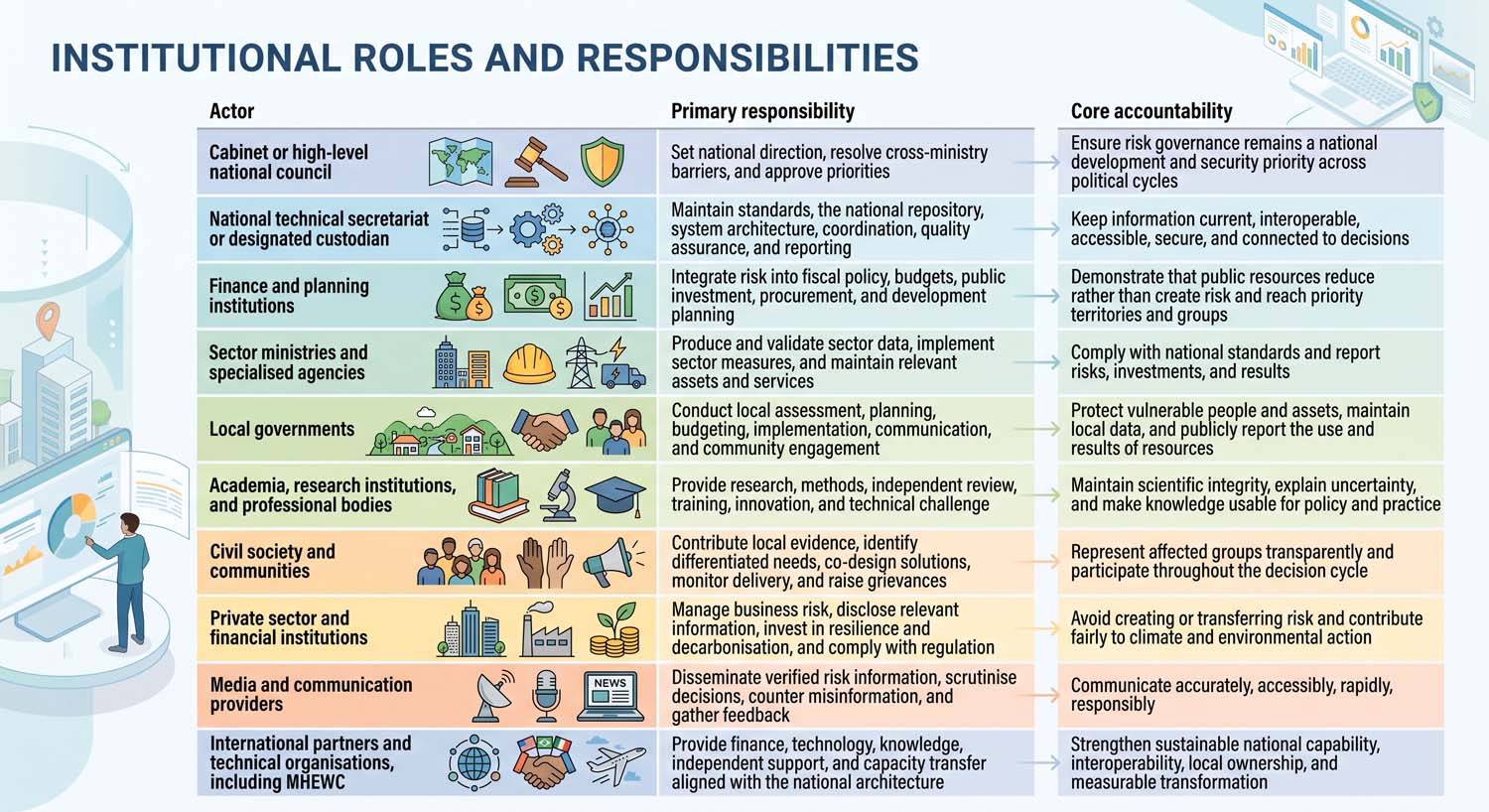
Actor | Primary responsibility | Core accountability |
Cabinet or high-level national council | Set national direction, resolve cross-ministry barriers, and approve priorities. | Ensure risk governance remains a national development and security priority across political cycles. |
National technical secretariat or designated custodian | Maintain standards, the national repository, system architecture, coordination, quality assurance, and reporting. | Keep information current, interoperable, accessible, secure, and connected to decisions. |
Finance and planning institutions | Integrate risk into fiscal policy, budgets, public investment, procurement, and development planning. | Demonstrate that public resources reduce rather than create risk and reach priority territories and groups. |
Sector ministries and specialised agencies | Produce and validate sector data, implement sector measures, and maintain relevant assets and services. | Comply with national standards and report risks, investments, and results. |
Local governments | Conduct local assessment, planning, budgeting, implementation, communication, and community engagement. | Protect vulnerable people and assets, maintain local data, and publicly report the use and results of resources. |
Academia, research institutions, and professional bodies | Provide research, methods, independent review, training, innovation, and technical challenge. | Maintain scientific integrity, explain uncertainty, and make knowledge usable for policy and practice. |
Civil society and communities | Contribute local evidence, identify differentiated needs, co-design solutions, monitor delivery, and raise grievances. | Represent affected groups transparently and participate throughout the decision cycle. |
Private sector and financial institutions | Manage business risk, disclose relevant information, invest in resilience and decarbonisation, and comply with regulation. | Avoid creating or transferring risk and contribute fairly to climate and environmental action. |
Media and communication providers | Disseminate verified risk information, scrutinise decisions, counter misinformation, and gather feedback. | Communicate accurately, accessibly, rapidly, and responsibly. |
International partners and technical organisations, including MHEWC | Provide finance, technology, knowledge, independent support, and capacity transfer aligned with the national architecture. | Strengthen sustainable national capability, interoperability, local ownership, and measurable transformation. |
16. Measuring Progress in National Climate and Disaster Risk Governance
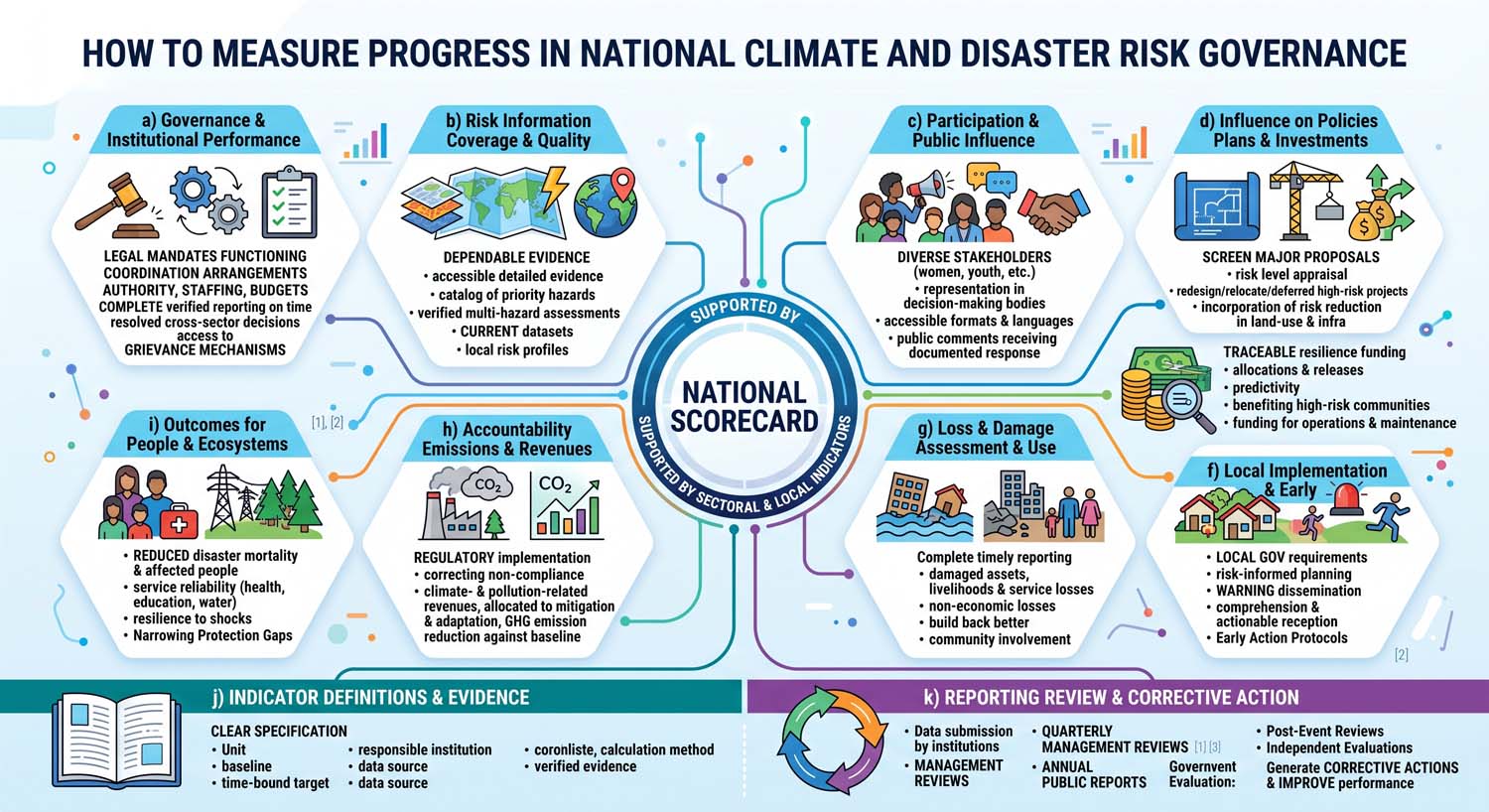
16.1 How to Measure Progress in National Climate and Disaster Risk Governance
The national framework should establish a concise results system that measures whether institutions fulfil their responsibilities, risk information improves public decisions, and interventions reduce harm to people, livelihoods, infrastructure and ecosystems. Meetings, reports, databases and training should be recorded as implementation outputs, with their value assessed through demonstrated changes in institutional performance and risk management.
Monitoring should connect resources and activities to the services delivered, decisions changed and outcomes achieved. This requires a manageable national scorecard, supported by more detailed sectoral and local indicators. Each indicator should have a clear definition, baseline, time-bound target, responsible institution, reporting frequency and verifiable source of evidence. Targets should reflect assessed needs and implementation capacity, while identifying the additional resources required to close significant protection gaps.
Population-related indicators should be disaggregated, where relevant and feasible, by geography, sex and gender as appropriate, age, disability, income and other nationally relevant dimensions, including displacement status and livelihood. Institutional and financial indicators should be broken down by administrative level, sector and location. Analysis should examine overlapping disadvantages, protect personal information and identify groups missing from the evidence. National averages should be accompanied by results for the most exposed and underserved communities.
- Governance and institutional performance
Governance indicators should establish whether legal mandates and coordination arrangements function in practice. Assessment should examine the authority, staffing, budgets and operating procedures available to responsible institutions, together with their ability to implement decisions across sectors and levels of government.
Track establishment and implementation of the legal mandate, including assignment of lead and supporting responsibilities and resolution of material overlaps or gaps.
Measure the proportion of institutions submitting complete, verified reports on time and the proportion of cross-sector decisions due for implementation that are completed to the agreed standard.
Record independent reviews completed, recommendations acted upon, overdue corrective actions and recurring institutional failures.
Monitor access to grievance mechanisms, response times, and resolution through documented remedies and an opportunity for complainants to respond. Administrative closure alone should not count as satisfactory resolution.
Evidence should draw on formal decisions, implementation records, audits and feedback from service users. Where performance falls short, the results should identify the responsible institution, the cause and the corrective action required.
- Risk information coverage and quality
Risk information indicators should measure whether decision-makers have dependable, accessible and sufficiently detailed evidence for their responsibilities. Coverage should be assessed against an agreed catalogue of priority hazards, datasets, sectors and locations, with validation criteria and update intervals appropriate to each type of information.
Measure the percentage of priority datasets that meet agreed quality requirements, are current within their specified update cycle, and can be accessed or exchanged by authorised users.
Report the territory and population covered by validated multi-hazard assessments, identifying hazard coverage, spatial resolution, assessment date and significant uncertainty.
Track local risk profiles updated after material changes in hazards, exposure, vulnerability or infrastructure, and the proportion suitable for local planning and early action.
Measure resolution of data-quality issues, continuity of critical data services, and the availability of metadata describing sources, limitations and responsible custodians.
Maps and databases should be assessed through practical use, including whether local institutions can interpret the information and apply it to identifiable decisions.
- Participation and public influence
Participation indicators should establish who contributes, whose knowledge influences decisions, and whether people can engage without avoidable barriers. Stakeholder counts should be accompanied by evidence on representation, accessibility and influence throughout policy design, implementation and review.
Track the number and diversity of contributing stakeholders, including frontline communities, women, young people, older people, persons with disabilities and other nationally identified marginalised groups.
Measure representation in decision-making bodies and working groups, together with access to relevant information, appropriate languages, accessible formats and channels for people without internet access.
Report the proportion of substantive public comments receiving a documented response, including reasons for accepting, modifying or declining proposals.
Assess satisfaction with access, usability and opportunities to influence decisions through surveys and community feedback that also reach non-users and excluded groups.
Participation records should document changes made in response to community evidence. Regular feedback should show contributors how their input was considered and what action followed.
- Influence on policies plans and investments
Decision indicators should test whether risk evidence changes development choices before approval and remains influential during implementation. Screening should use defined criteria and cover the relevant pipeline of policies, plans, budgets and investments, so that reported percentages have a clear denominator.
Measure the proportion of major proposals screened before approval and the proportion of high-risk proposals receiving the additional appraisal their risk level requires.
Record proposals redesigned, relocated, deferred or rejected because of assessed risk, with the reasons, alternatives considered and expected implications documented.
Track incorporation and delivery of risk-reduction measures in land-use decisions, infrastructure specifications, public services and social-protection arrangements.
Verify whether conditions attached to approval are funded, implemented and maintained, and whether decisions create or transfer risk to other communities or ecosystems.
The number of rejected proposals should be interpreted alongside appraisal quality and the portfolio considered. It should not become a numerical target that rewards rejection regardless of merit. Decision records should identify the evidence used and the resulting change.
- Financing and expenditure performance
Financial monitoring should distinguish allocations, releases, expenditure and verified delivery. It should assess whether national and local institutions receive resources in time to implement priorities and sustain essential functions, including staffing, equipment, data services and maintenance.
Track the level and predictability of resilience funding, including planned and actual releases, delays, expenditure and the balance between national and local delivery.
Measure the share of spending demonstrably benefiting high-risk and underserved communities, using transparent allocation criteria and documented beneficiary coverage.
Assess whether operation-and-maintenance requirements are costed, budgeted, released and spent, including the resources needed after external project funding ends.
Monitor publication of expenditure, procurement and audit findings, completion of audits, and implementation of corrective recommendations.
Funds should be traceable across transfers to prevent double-counting. Changes in funding should be interpreted alongside inflation, assessed needs, implementation capacity and the quality of completed interventions. High expenditure alone does not demonstrate effective protection.
- Local implementation and early action
Local indicators should assess whether national arrangements translate into reliable protection where people live and work. Minimum standards should be nationally agreed and supported with resources. Reporting should identify service gaps and the support needed by local governments with limited capacity.
Measure the proportion of local governments meeting defined requirements for risk-informed planning, assigned personnel, financing, warning dissemination, preparedness and continuity of essential services.
Track priority interventions completed to specification, functioning as intended and maintained, supported by site verification and feedback from intended users.
Assess early action protocols through exercises and actual events, including trigger recognition, decision and financing delays, operational lead time and completion of agreed actions.
Measure whether people at risk receive accessible warnings in time, understand the expected impacts and protective actions, and have the means to act, including assistance with evacuation where required.
Warning reception, comprehension and action should be assessed separately. Monitoring should also examine missed events, false alarms and access barriers, using the findings to improve warning credibility and response arrangements.
- Loss and damage assessment and use
Loss and damage indicators should assess the completeness, timeliness and practical use of information on sudden events and slow-onset impacts. Non-economic losses can include harm to life and health, displacement-related losses, cultural heritage, local knowledge, biodiversity and ecosystem services. UNFCCC technical guidance recognises that these require approaches extending beyond market valuation[1]. Track the coverage and reporting timeliness of events and affected areas against defined recording criteria, distinguishing preliminary assessments from validated records and subsequent revisions.
Assess coverage of damaged assets, livelihood and service losses, indirect effects and non-economic losses, with methods that avoid double-counting across categories.
Record the involvement of affected communities in identifying losses, especially impacts on informal livelihoods and values that administrative records may overlook.
Measure how assessment findings inform recovery priorities, risk-financing decisions, reconstruction standards and funded measures to build back better.
Observed disaster impacts and estimates of the contribution of human-induced climate change should be recorded distinctly. Any attribution claim should state its evidence and uncertainty. Follow-up should assess whether recovery reduces vulnerability and restores essential functions fairly.
- Accountability emissions and use of revenues
This area should track regulatory implementation, revenue management and environmental results through distinct measures. The framework should identify applicable reporting duties and regulatory requirements, the institutions responsible for enforcement, and the procedures for correcting non-compliance.
Measure timely and complete reporting by covered institutions and entities, verification of submissions, and correction of confirmed non-compliance.
Track climate- and pollution-related revenues assessed, collected and outstanding under applicable national arrangements, with exemptions and collection costs disclosed where relevant.
Report the amounts and shares allocated and spent on mitigation, adaptation, loss reduction and just-transition measures, consistent with national budget rules and commitments.
Assess greenhouse gas emissions and relevant pollutants against clearly defined baselines, accounting boundaries and targets, identifying measured and estimated changes and the distribution of benefits and costs.
Revenue collection should be interpreted separately from environmental performance: increased receipts do not by themselves demonstrate reduced emissions or pollution. Just-transition monitoring should examine whether affected workers and vulnerable households receive the intended support.
- Outcomes for people services and ecosystems
Outcome indicators should assess changes in safety, exposure, vulnerability, service reliability and recovery. They should combine national trends with evidence from priority locations and population groups, enabling assessment of whether protection gaps are narrowing.
Track disaster-related mortality, people affected, displacement, livelihood disruption and economic losses, presenting absolute values and appropriate population or economic reference measures.
Measure the duration and reach of interruptions to health care, education, water, electricity, transport and communications, together with the time required to restore acceptable service levels.
Assess changes in the exposure and vulnerability of critical assets and households, and in the condition and protective functions of relevant ecosystems.
Examine household recovery, resilience to repeated shocks and differences in impacts and recovery times between income groups, locations and other relevant population categories.
Avoided losses should be reported only where a credible comparison can be constructed, with assumptions and uncertainty disclosed. Where modelling is used, compare conditions with and without the intervention under the same hazard scenario, allowing for changes in exposure and vulnerability caused by the intervention. Observed trends should be interpreted alongside event severity, changing exposure, inflation and improvements in reporting. A quiet disaster year alone cannot establish that underlying risk has declined.
- Indicator definitions and evidence
Every headline indicator should have a short specification explaining exactly what is measured. It should identify the unit, numerator and denominator where applicable, baseline period, target date, disaggregation, source, calculation method, responsible institution and verification procedure. Definitions should also explain exclusions, missing data and revisions.
For example, the implementation rate for cross-sector decisions should divide decisions completed and verified by all decisions due within the reporting scope, using an explicit rule for overdue decisions. Dataset currency should be assessed against each dataset’s agreed update cycle. Warning-access indicators should define the relevant population at risk and the period or event being assessed.
Related national indicators should use compatible definitions and data standards for Sendai Framework and Sustainable Development Goal reporting. UNDRR provides technical guidance on methodologies, terminology and data standards for monitoring progress against the Sendai Framework’s global targets. Additional national measures should address priorities that these global measures do not capture[2]. [2]
Where a baseline is unavailable, the results register should show it as missing and assign an owner and deadline for establishing it. Missing values should not be recorded as zero or presented as satisfactory performance. Administrative records should be checked against surveys, technical assessments, inspections, community evidence or independent reviews appropriate to the indicator.
- Reporting review and corrective action
The designated coordinating institution should consolidate results while sector ministries, local governments, regulators and data custodians remain accountable for their submissions. The national statistical office should support consistent methods, and finance institutions should help connect performance findings to planning and budgets. Data collection and verification require explicit funding and assigned staff.
Quarterly management reviews can track implementation and resolve delays. An annual public report should compare results with baselines and targets, explain differences between places and population groups, and disclose data gaps and uncertainty. Reviews after major events should examine warning performance, decision delays, service failures and recovery needs. Periodic independent evaluations should assess whether interventions contributed to observed outcomes and whether the framework remains appropriate as risks change.
Each review should produce a record of corrective actions with an institutional owner, deadline, resource requirement and verification method. Subsequent reports should show whether those actions were completed and whether performance improved. Public reporting should be accessible through suitable digital and offline channels, with a means to question findings and request corrections.
Performance assessments should examine the reasons for weak results before assigning remedies, distinguishing resource shortages and data limitations from failures to fulfil agreed responsibilities. Honest reporting of losses, near misses and institutional weaknesses should be supported, so that the measurement system improves decisions and accountability without encouraging concealment.
17. Conclusion: From Information to Decisions and Action
The defining failure of climate and multi-hazard risk governance is not a complete absence of knowledge. It is the inability to organise knowledge, institutions, finance, participation, and accountability into a coherent decision system. Valuable information remains dispersed. Projects operate in isolation. Local governments are asked to act without adequate resources. Communities are consulted too late. Budgets favour visible construction over long-term resilience. Polluters externalise costs. International partners deliver activities that do not always become permanent national capability.
These weaknesses can be corrected. Governments can establish clear custodianship, maintain a comprehensive national risk repository, open decision-making to society, connect national and international information through interoperable digital infrastructure, and give local governments the authority and finance needed to act. Fiscal policy can require development to be climate-informed and disaster-resilient. Loss and damage can be measured more comprehensively. Emitters and polluters can contribute through fair and enforceable systems. International cooperation can focus on lasting institutional transformation.
The required technologies already exist. The more difficult task is political and institutional: creating the mandate, incentives, standards, trust, and public accountability necessary to use them. Climate security must therefore become a permanent responsibility of the state, shared across society and sustained beyond individual projects or electoral terms.
The goal is a continuous national cycle in which observation becomes trusted evidence, evidence informs inclusive decisions, decisions mobilise resources, resources enable local action, and results generate new learning. When that cycle functions, climate and disaster-risk governance becomes more than a collection of plans. It becomes a practical system for protecting lives, livelihoods, public assets, ecosystems, development gains, and future generations.
- Diagnosing the Implementation Gap
The conclusion correctly identifies that “valuable information remains dispersed.” In practice, this manifests as isolated telemetry networks, siloed geospatial databases, and projectized donor interventions that duplicate efforts rather than strengthening existing national mandates.
When hazard monitoring is disconnected from impact analysis, and when risk knowledge is not linked to Forecast-based Financing (FbF) or Anticipatory Action protocols, the system breaks. Local governments are left with unfunded mandates, and vulnerable populations receive warnings too late, through channels that lack resilience or inclusivity.
- The Target Architecture: A Continuous Intelligence Cycle
To visualize how these fragmented pieces must unify, consider the end-to-end architectural flow of a fully interoperable governance cycle.
Strategic takeaway: An effective system requires open standards and APIs to ensure that the output of one phase (e.g., forecasting) automatically becomes the input for the next (e.g., impact-based decision support) without vendor lock-in.
- The Core Transition: From Projects to Systems
Translating the conclusion’s vision into a structured technical framework requires moving from ad-hoc activities to a permanent national capability.
Governance Pillar | Current Baseline (Fragmented) | Target State (Coherent System) |
Risk Knowledge | Dispersed datasets; static vulnerability assessments. | A centralized, dynamic national risk repository; inclusive, localized vulnerability data. |
Monitoring & Forecasting | Isolated hazard monitoring; over-reliance on single models. | Interoperable telemetry; hybrid modelling (AI complementing physics-based forecasting). |
Warning Communication | Single-channel alerts; late consultation with communities. | CAP-compliant, multi-channel dissemination (AM/FM, cell broadcast, satellite, community networks). |
Financing & Action | Post-disaster response bias; unfunded local mandates. | Pre-arranged Forecast-based Financing; empowered and resourced local governments. |
International Cooperation | Parallel structures; project-based delivery. | Direct strengthening of existing institutional frameworks; costed national project pipelines. |
- The Institutional Imperative: Ownership Over Technology
The conclusion notes, “The required technologies already exist. The more difficult task is political and institutional.”
This is the critical bottleneck. Implementing automated APIs, deploying geospatial dashboards, or configuring Common Alerting Protocol (CAP) servers is highly cost-effective. The true barrier is the government’s sense of ownership.
Technology cannot substitute for a legal framework that designates clear custodianship of risk data. It cannot replace the civilian authority required to trigger an Early Action Protocol (EAP). Establishing climate security as a permanent state responsibility means moving beyond electoral cycles and embedding multi-hazard risk governance into national development plans, NAP/NDC implementation, and fiscal policy.
- The Operational Cycle
The final paragraph outlines a continuous national cycle. Operationally, this translates into a strict sequence of accountability:
- Observation becomes trusted evidence: Ground-truth telemetry, satellite imagery, and localized citizen-science data are synthesized into a single source of truth through open data standards.
- Evidence informs inclusive decisions: Impact-based forecasting translates complex meteorological data into clear socio-economic impacts, enabling decision-makers to understand what the weather will do, not just what the weather will be.
- Decisions mobilize resources: Pre-agreed thresholds automatically trigger risk-financing mechanisms and release funds before the hazard peaks.
- Resources enable local action: Capital bypasses bureaucratic bottlenecks, flowing directly to local governments and frontline communities to execute predefined anticipatory actions.
- Results generate new learning: Post-Disaster Needs Assessments (PDNA) and Loss & Damage accounting feed directly back into the national risk repository, recalibrating the baseline for the next cycle.
When governments and international partners commit to this interoperable, institutionally rooted framework, early warning systems cease to be theoretical architectures. They become resilient, continuous engines for protecting lives, ecosystems, and development gains.
[1] UNFCCC. Non-economic losses in the context of the work programme on loss and damage. 2013.
[2] UNDRR. Technical guidance for monitoring and reporting on progress in achieving the global targets of the Sendai Framework for Disaster Risk Reduction. 2017.