Issues are under construction………………………
What are the challenges, gaps, and barriers of the African Climate, Multi-Hazard & Disaster Risk Management (DRM) System ???
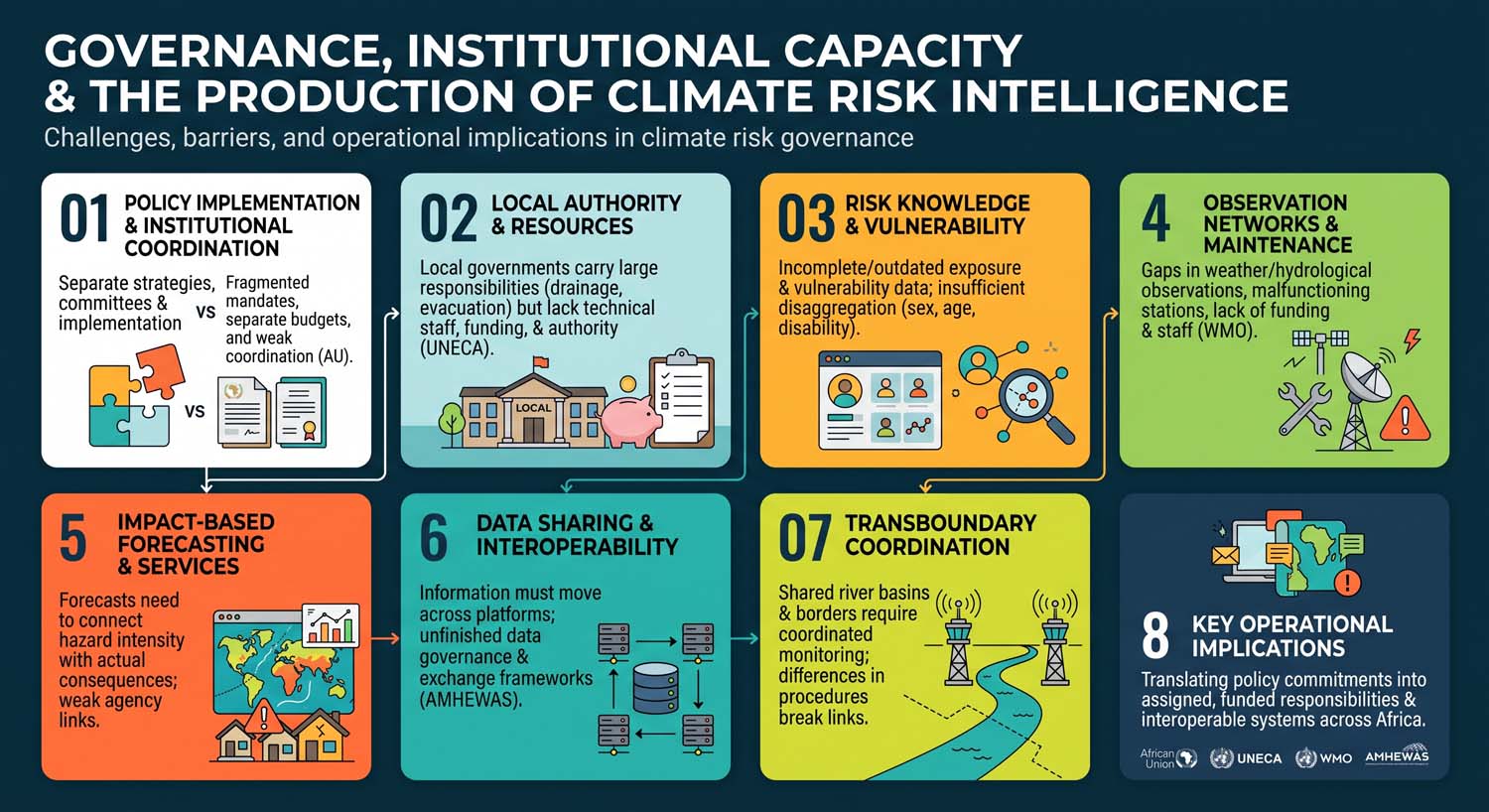
Governance, institutional capacity and the production of climate risk intelligence:
System area | Main challenges and gaps | Underlying barriers and operational implications |
1. Policy implementation and institutional coordination | DRM, climate adaptation, development planning and sector programmes can operate through separate strategies, committees and implementation arrangements. Responsibilities for prevention, warning, early action and recovery may be insufficiently connected. | Fragmented mandates, separate budgets and weak implementation mechanisms make coordination difficult. The AU’s 2025 Common Position explicitly identifies limited implementation of DRR policies and fragmented approaches to DRR and climate initiatives. The practical gap is translating policy commitments into assigned, funded responsibilities. (au.int) |
2. Local government authority and resources | Local authorities may carry substantial responsibilities for drainage, land use, preparedness, evacuation and recovery while lacking adequate technical personnel, predictable funding and decision-making authority. | Weak fiscal decentralization, limited local revenue and fragmented institutions constrain delivery. UNECA identifies these as persistent municipal financing barriers. A DRM assessment should therefore examine whether each local responsibility is matched by authority, staffing and accessible resources. (United Nations Economic Commission for Africa) |
3. Risk knowledge and vulnerability information | Incomplete or outdated information on exposed households, infrastructure, livelihoods, ecosystems and coping capacity weakens risk assessment. Insufficient disaggregation can obscure differences by sex, age, disability, income and location. | Limited data collection and updating capacity, inconsistent methods and weak reporting undermine investment decisions. The AU identifies insufficient risk knowledge and disaggregated data as major constraints. The operational requirement is a maintained risk information system that supports specific decisions at appropriate geographic scales. (au.int) |
4. Observation networks, staffing and maintenance | Gaps in weather and hydrological observations, malfunctioning stations, data transmission problems and shortages of qualified personnel reduce service reliability. Maintaining continuous operations can be as difficult as installing equipment. | Inadequate recurrent funding, maintenance capacity, connectivity and staffing weaken the observation-to-forecast process. WMO’s 2024 Hydromet Gap Report documents these problems in its sample of 20 least developed countries and small island developing States, while identifying particularly significant observation-sharing gaps over Africa. (wmo.int) |
5. Impact-based forecasting and actionable climate services | Forecasts need to connect hazard intensity and probability with likely consequences for people, assets and services. Important assessment questions include local forecast skill, uncertainty communication, short-lead-time capability and the availability of sector-specific impact thresholds. | Weak links between forecasting agencies, sector specialists and risk-data custodians impede impact-based services. WMO identifies limitations in impact-based forecasting, standard alerting procedures and continuous service availability among assessed services; its Africa assessment also highlights training and coordination constraints. (wmo.int) |
6. Data sharing and system interoperability | Hazard, exposure, vulnerability and socioeconomic information must move between institutions and platforms in usable formats. Separate systems can leave analysts without the information needed to assess impacts and recommend action. | Data governance and exchange arrangements remain unfinished priorities. In 2026, the AMHEWAS Steering Committee recommended developing a continental data-sharing and interoperability framework and strengthening impact-based forecasting. Operational assessments should examine permissions, standards, update schedules and institutional responsibility for each data exchange. (African Union) |
7. Transboundary coordination | Shared river basins, pastoral corridors and cross-border hazards require coordinated monitoring, interpretation, warning and preparedness. Continental or regional advisories must connect effectively with national and local decision processes. | Different procedures, capacities and information-sharing arrangements can interrupt this connection. The 2026 AMHEWAS coordination meeting called for stronger integration of continental advisories, improved data sharing, revised situation-room procedures and better feedback mechanisms. These are essential for operational cooperation across borders. (African Union) |
Climate risk intelligence also needs to accommodate changing conditions:
A practical assessment should test whether risk models and planning assumptions account for changing hazards, settlement expansion, ecosystem degradation and infrastructure dependencies. A historical hazard map has limited decision value if the population, land use or drainage system has subsequently changed.
Technology introduces an additional implementation challenge. AI can improve analytical speed and forecasting capacity, but operational use requires reliable observations, human expertise, accountable decision-making and sustainable financing. The joint 2026 UNDRR-WMO-ITU-IFRC assessment emphasizes these dependencies, alongside interoperability and compatibility with multilingual and low-connectivity settings.
The second set concerns whether risk intelligence reaches people, enables action and reduces losses.
| System area | Main challenges and gaps | Underlying barriers and operational implications |
|---|---|---|
| 1. Last-mile communication, understanding and trust | Warnings must reach people in accessible languages and formats, explain likely impacts and specify feasible protective actions. Digital coverage alone cannot establish effective warning coverage. | Connectivity gaps, inaccessible messages and insufficient community engagement can interrupt communication. ITU promotes multiple dissemination channels, while IFRC emphasizes reaching people without digital connections and ensuring messages are trusted and understood. Local assessment should measure reception, comprehension and action separately. |
| 2. Warning-to-action procedures and preparedness | A warning needs an agreed trigger, responsible decision-maker, financing mechanism and executable action plan. Preparedness must include trained responders, evacuation assistance, exercises and arrangements for people unable to move independently. | Unclear authority, incomplete procedures and unavailable early-action funding can consume the available lead time. IFRC’s Africa guidance identifies the need to establish responsibilities, triggers, coordination arrangements, financing and regular drills through appropriate domestic instruments. |
| 3. Gender equality, disability inclusion and community influence | Assessment must examine who shapes decisions, receives information, controls resources and can access evacuation and assistance. Representation needs to translate into influence over priorities, budgets and operational arrangements. | Gender inequality and weak stakeholder participation constrain adaptation governance. Practical accessibility gaps also persist: IFRC’s 2026 Madagascar cyclone case identified needs to strengthen disability inclusion, accessible information and awareness of complaint mechanisms. Participation, protection and accountability therefore require explicit operational provision. |
| 4. Adequate, accessible and sustained financing | Financing is needed for prevention, observation, staffing, maintenance, preparedness, early action and recovery. Investment must reach institutions and communities with high exposure and limited resources. | Limited domestic fiscal capacity, dependence on external flows and uneven allocation constrain delivery. CPI’s 2024 assessment estimated that tracked finance in 2021/22 met only 20% of assessed African adaptation needs and found climate finance remained predominantly debt-based. This estimate concerns adaptation finance and uses 2021/22 data. |
| 5. Risk-informed development and resilient livelihoods | Unsafe settlement patterns, inadequate basic services and vulnerable infrastructure increase the burden on emergency systems. DRM must influence land-use decisions, infrastructure investment, ecosystem management and livelihood development. | Poverty, limited service provision and weak integration of risk into investment decisions perpetuate exposure. IPCC identifies growing informal settlements without basic services as a major source of vulnerability in Africa. UNDRR’s GAR 2025 emphasizes land-use planning, risk analysis in project approvals and resilient infrastructure investment. |
| 6. Multi-hazard and cascading-risk integration | Assessments must cover relevant hydrometeorological, geological, biological and technological hazards, including their interactions. For example, flooding can disrupt water supply, health services, transport and communications simultaneously. | Sector-specific information systems can leave interconnected risks insufficiently assessed. WHO’s 2026 Africa reporting identifies fragmented climate alerts, laboratory signals and community reports as a constraint on timely health action. The operational need is joint analysis and continuity planning across essential services. |
| 7. Fragility, conflict and population mobility | Fragile and conflict-affected settings require warning and action arrangements that function despite insecurity and institutional constraints. Displaced people, migrants and mobile populations may face changing exposure and difficulties accessing established services. | Poverty, insecurity and displacement can restrict both access to information and the ability to move to safety. UNDRR guidance calls for locally grounded cooperation and warning processes that accommodate movement, uncertainty and constrained mobility. |
| 8. Loss assessment and resilient recovery | Recovery requires reliable information on damage, economic losses, service disruption, livelihood effects and differentiated recovery needs. Assessments should also examine ecological, cultural and other non-economic losses. | Limited capacity to collect, analyse and use detailed, disaggregated disaster data weakens recovery planning. The Africa Regional Platform identifies these constraints despite progress in loss databases and assessments. Operational implications include poorly evidenced priorities and difficulty connecting recovery programmes with longer-term risk reduction. |
| 9. Performance measurement and institutional learning | System performance must be assessed across monitoring, forecasting, warning dissemination, coordination and protective action. Reviews need to identify where delays, exclusions or failures occurred and track corrective measures. | Systematic review methods and institutional arrangements remain uneven internationally. The joint 2026 after-event review guidance addresses this gap through structured assessment and learning. For African systems, an essential diagnostic question is whether reviews lead to funded improvements with responsible institutions and completion dates. |
The deeper barriers concern how responsibility, resources and incentives are organized.
The IPCC’s Africa assessment identifies slow implementation, fragmented governance, hierarchical bureaucracy, weak subnational institutions, gender inequality and elite capture among adaptation barriers. These findings indicate that technical capacity building must be accompanied by institutional and governance reforms. Their importance varies by national and local context.
The interpretation of the evidence is that five relationships deserve particular scrutiny:
- Responsibility and authority: Institutions assigned DRM duties need the authority to carry them out.
- Authority and resources: Decision-making powers need corresponding staff, equipment and accessible budgets.
- Information and decisions: Each risk product needs a clearly identified user, decision, and action.
- National commitments and local delivery: Strategies need to translate into funded arrangements at the locations where impacts occur.
- Participation and influence: Communities need meaningful opportunities to shape priorities, implementation and evaluation.
A practical institutional assessment should therefore examine the following responsibilities at each level. These are proposed assessment priorities, rather than a description of uniform arrangements across Africa.
| Level | Priority gaps to investigate |
|---|---|
| Continental | Sustainable support for AMHEWAS; common data and interoperability arrangements; coordination of transboundary risk intelligence; comparable performance reporting. |
| Regional and shared-basin | Cross-border observation and information exchange; joint scenarios; compatibility of warning procedures; exercises and mutual assistance arrangements. |
| National | Clear institutional mandates; integration of DRM and adaptation into sector planning; maintained risk databases; operational forecasting and warning services; financing for early action. |
| Local government | Adequate authority and staffing; predictable budgets; risk-informed land-use and infrastructure decisions; evacuation and service-continuity plans; accountable recovery arrangements. |
| Community | Accessible warnings; understanding and trust; feasible protective actions; resources and assistance to act; representation and functioning feedback channels. |
This capability remains uneven across Africa:
The African Union’s 2025 Common Position identifies limited risk knowledge, insufficient disaggregated data and weaknesses in disaster reporting as continuing constraints on risk-informed development and investment. These findings establish a continental priority; individual countries and localities require their own assessment.
A functioning risk-knowledge system should connect hazards, exposed people and assets, vulnerability, available capacities and potential consequences. That information should support forecasting, warning communication, anticipatory-action triggers and preparedness. UNDRR’s risk-knowledge handbook emphasizes using these connections throughout the early warning process.
The following is a proposed diagnostic framework for examining this capability.
| Assessment component | What the system should establish | Gaps and barriers to investigate |
|---|---|---|
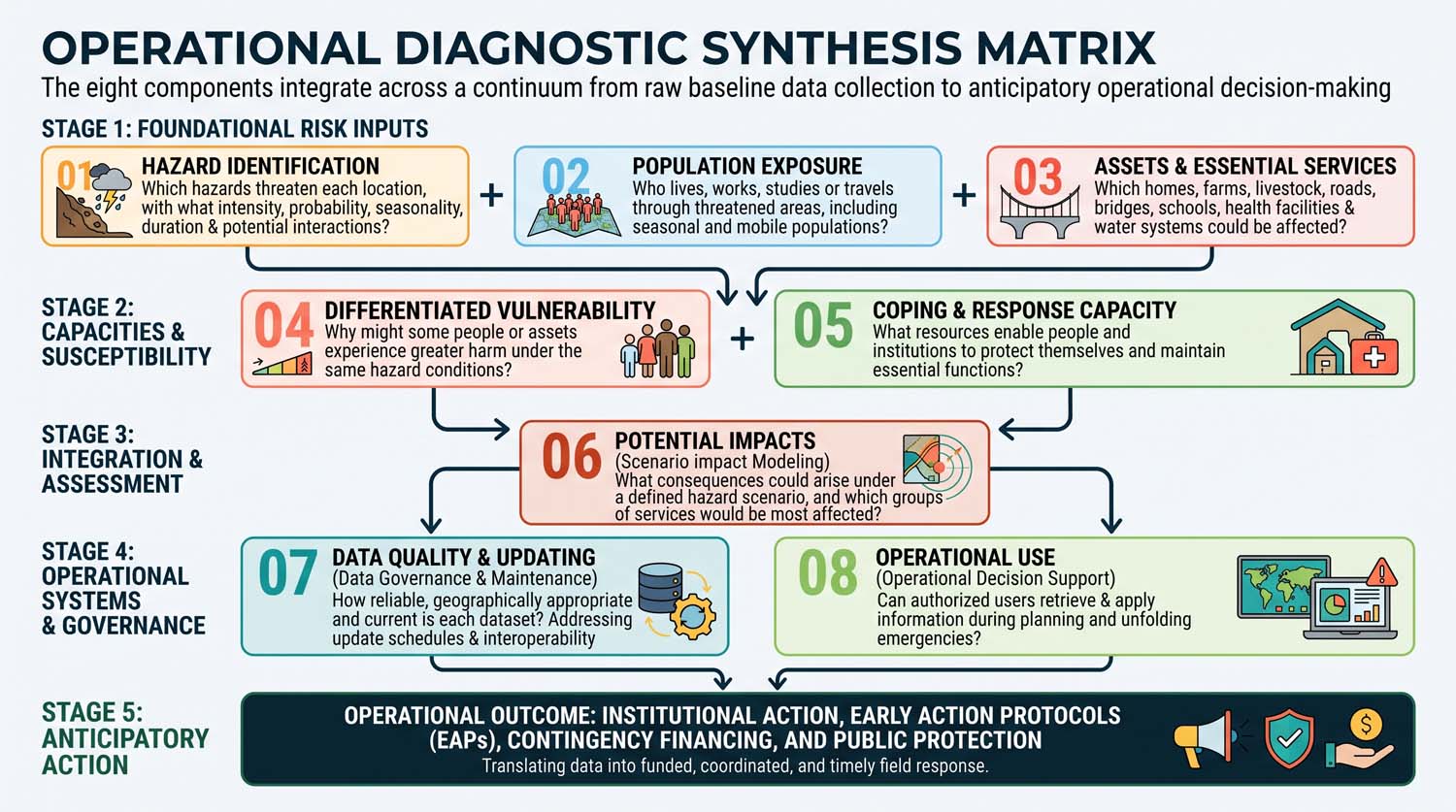
| 1. Hazard identification | Which hazards threaten each location, with what intensity, probability, seasonality, duration and potential interactions? | Missing hazard assessments; insufficient observation records; separate assessments that overlook compound and cascading events. |
| 2. Population exposure | Who lives, works, studies or travels through threatened areas, including seasonal and mobile populations? | Outdated population information; incomplete mapping of informal settlements; limited information on displacement and changing population distribution. |
| 3. Assets and essential services | Which homes, farms, livestock, roads, bridges, schools, health facilities, water systems and telecommunications assets could be affected? | Incomplete asset registers; missing location information; limited understanding of dependencies between essential services. |
| 4. Differentiated vulnerability | Why might some people or assets experience greater harm under the same hazard conditions? | Insufficient information on poverty, housing quality, disability, age, gender-related constraints, livelihood dependence and access to services. |
| 5. Coping and response capacity | What resources enable people and institutions to protect themselves and maintain essential functions? | Limited information on accessible shelters, transport, emergency teams, community organizations, alternative water supplies and household capacity to act. |
| 6. Potential impacts | What consequences could arise under a defined hazard scenario, and which groups or services would be most affected? | Hazard information insufficiently connected to exposure and vulnerability; impact assumptions that have not been checked against past events or local experience. |
| 7. Data quality and updating | How reliable, geographically appropriate and current is each dataset? | Unclear sources; incompatible geographic boundaries; missing uncertainty information; no designated custodian or funded updating process. |
| 8. Operational use | Can authorized users retrieve and apply the information during planning and an unfolding emergency? | Difficult access; disconnected databases; limited analytical skills; risk assessments without clear links to warning, budgeting or investment decisions. |
UNDRR’s Risk Knowledge Resource Package supports assessing data governance and selecting hazard- and sector-specific exposure and vulnerability indicators. Its national disaster risk assessment guidance also emphasizes an iterative process adapted to national and local decision needs.
The underlying barriers should be examined separately from missing datasets. For example, an outdated exposure database could reflect several different problems:
- Institutional ownership: No institution has an agreed responsibility to maintain it.
- Financing: Initial mapping was funded, but subsequent updates and verification were omitted from recurrent budgets.
- Coordination: Sector agencies hold relevant information but lack workable exchange arrangements.
- Technical capacity: Staff lack the time, skills or systems needed to integrate and analyse information.
- Community participation: Local knowledge and changes in vulnerability are insufficiently incorporated.
These are diagnostic hypotheses to verify through institutional interviews, budget reviews, data inspection and field validation.
An illustrative flood scenario shows the required level of decision support. A district receiving a heavy-rainfall forecast should be able to establish:
| Decision question | Required risk information |
|---|---|
| Which settlements could flood? | Forecast conditions combined with flood scenarios, terrain and settlement locations. |
| Who may need evacuation assistance? | Appropriately protected information on mobility limitations, support needs and available transport. |
| Which essential services could fail? | Exposed facilities, access routes, electricity and water dependencies, and backup arrangements. |
| Which livelihoods require early protection? | Crop calendars, livestock locations, storage facilities and livelihood vulnerability. |
| Where can people move safely? | Shelter locations, accessibility, usable capacity and evacuation-route conditions. |

Multi-Hazard Risk Knowledge Diagnostic & Assessment Framework (MHEWS Pillar 1)
This technical assessment framework establishes an institutional diagnostic protocol to evaluate, calibrate, and upgrade disaster risk knowledge. Designed for national disaster management authorities (NDMAs), national meteorological and hydrological services (NMHSs), sectoral ministries, and development partners, this matrix operationalizes the identification of hazard dynamics, exposure parameters, differentiated vulnerabilities, and operational bottlenecks across eight core analytical components.
Component 1: Multi-Hazard Identification & Compound Risk Dynamics
Core Analytical Standard (What the System Must Establish):
Spatially explicit, probabilistic hazard footprints across multiple return periods ($1\text{ in }5$, $1\text{ in }10$, $1\text{ in }50$, $1\text{ in }100\text{ years}$) and short-to-medium-range operational forecast horizons.
Baseline climatological, hydrological, geological, and biological hazard characterization, including onset speed (rapid vs. slow onset), intensity thresholds, spatial coverage, seasonal periodicity, and recurrence intervals.
Identification of compound, consecutive, and cascading hazard triggers—such as tropical cyclones inducing storm surges and riverine flooding, followed by landslides, water-supply contamination, and vector-borne disease outbreaks, or drought compounded by heatwaves and rangeland degradation.
Structural Gaps & Diagnostic Barriers to Investigate:
Fragmented & Siloed Hazard Baselines: Separate hazard maps produced by disparate agencies (e.g., water resources evaluating fluvial flooding in isolation from coastal authorities assessing storm surges) that neglect compounding interactions.
Observation & Modeling Gaps: Truncated or fragmented historical hydrometeorological and geophysical observation records; sparse automatic weather station (AWS) and stream-gauge networks; uncalibrated remote sensing products.
Static vs. Dynamic Deficits: Over-reliance on static historical hazard atlases that fail to integrate non-stationary climate trends, land-use land-cover (LULC) transformations, or environmental degradation.
Institutional Diagnostic Checklist & Field Inquiries:
Are hazard methodologies standardized and harmonized across hydrometeorological, seismic, geological, and agricultural authorities, or do definitions of hazard severity diverge across sectoral silos?
What is the spatial resolution of hazard modeling relative to municipal and local operational decision-making needs?
Does the national risk catalog formally incorporate cascading impact pathways, secondary hazard triggers, and critical tipping points?
Data Interoperability & Custodianship:
Required Layers: Probabilistic flood inundation depths/extents, seismic hazard zoning, drought indices (e.g., SPEI, NDVI anomalies), cyclone track density, landslide susceptibility layers.
Lead Custodians: NMHSs, Geological Surveys, River Basin Authorities, Satellite Remote Sensing Agencies.
Component 2: Population Exposure Dynamics & Human Mobility
Core Analytical Standard (What the System Must Establish):
Spatially disaggregated, geo-referenced baseline population distributions intersected directly with hazard zones down to local administrative levels.
Temporal and seasonal population dynamics, capturing daily commuting flows, market-day shifts, seasonal labor migration patterns, transhumance and pastoralist movements, tourism influxes, and displacement dynamics (IDPs and refugees).
Explicit delineation of high-density, hazard-prone settlements, informal urban growth corridors, precarious hill-slope communities, and peri-urban expansion zones.
Structural Gaps & Diagnostic Barriers to Investigate:
Static Census Obsolescence: Reliance on decennial census data that fails to reflect rapid informal urbanization, rural-to-urban drift, or post-conflict/post-disaster demographic reshuffling.
Unmapped Informal Settlements: Institutional blind spots where informal settlements or displaced populations are omitted from official cadastral maps and municipal base registers.
Transient & Mobile Blind Spots: Inability to account for non-resident, mobile, or unregistered populations within warning and evacuation planning parameters.
Institutional Diagnostic Checklist & Field Inquiries:
How frequently are exposure databases updated, and do they integrate dynamic data sources (e.g., anonymized mobile network big data, high-resolution Earth observation settlement footprints)?
Are pastoralist transit corridors, transhumance routes, and temporary camps mapped against real-time drought and flash-flood monitoring envelopes?
Does the cadastral or demographic system capture household density variances between day and night cycles for rapid-onset impact estimation?
Data Interoperability & Custodianship:
Required Layers: High-resolution gridded population surfaces (e.g., High-Resolution Settlement Layer, WorldPop), displacement tracking matrices (DTM), municipal informal settlement boundaries, transhumance routes.
Lead Custodians: National Statistics Offices (NSOs), Municipal Planning Authorities, Ministries of Interior/Immigration, Humanitarian Coordination Bodies (IOM/UNHCR).
Component 3: Critical Assets, Infrastructure & Essential Service Dependencies
Core Analytical Standard (What the System Must Establish):
Comprehensive geospatial inventories of physical assets, including structural attributes (construction material, foundation height, elevation relative to flood datum, building age, design code compliance).
Geo-located mapping of lifeline networks: critical transport links (bridges, arterial roads, culverts, rail lines, ports, runways), power transmission and sub-stations, potable water treatment and distribution networks, and telecommunication towers.
Systemic mapping of secondary and tertiary interdependencies—determining how the loss of an electrical sub-station cascades into water pumping station shutdowns, hospital generator dependencies, and cell-tower outages.
Structural Gaps & Diagnostic Barriers to Investigate:
Asset Register Fragmentation: Sectoral line ministries (Health, Education, Transport, Energy, Water) maintaining uncoordinated, proprietary asset databases with incompatible attribute schemes.
Missing Spatial and Elevation Attributes: Asset inventories that capture financial valuation or administrative names but lack precise geo-coordinates, elevation data, or structural vulnerability parameters.
Failure to Model Network Interdependencies: Linear risk assessments that evaluate a bridge or health clinic in isolation without analyzing supply chain continuity or network flow disruption.
Institutional Diagnostic Checklist & Field Inquiries:
Are single-point-of-failure assets identified across transport, power, and telecommunication lifelines within active hazard zones?
Do asset inventories record structural resilience parameters (e.g., whether schools designated as emergency evacuation shelters possess reinforced roofing or elevated sanitation facilities)?
Is there a formal protocol across utility providers (public and private) to share asset-condition and operational-status data with the NDMA?
Data Interoperability & Custodianship:
Required Layers: National Infrastructure Geodatabases, OpenStreetMap/critical infrastructure layers, power and water distribution schematics, telecommunication coverage footprints.
Lead Custodians: Ministries of Public Works, Transport, Energy, Water Resources, Health, Telecommunications Regulatory Authorities.
Component 4: Differentiated Vulnerability & Intersectionality Profiling
Core Analytical Standard (What the System Must Establish):
Multi-dimensional vulnerability baselines that isolate the socioeconomic, physical, and environmental drivers of susceptibility to injury, death, displacement, and livelihood collapse.
Rigorous disaggregation of demographic and household data by sex, age, disability (using Washington Group Short Set questions), socio-economic status, legal status, and female/child-headed household structures.
Identification of institutional and systemic vulnerability drivers, including land tenure insecurity, lack of access to formal financial safety nets, language barriers in minority populations, and cultural restrictions on mobility.
Structural Gaps & Diagnostic Barriers to Investigate:
Aggregate Blindness: Assessments treating communities as homogenous units, hiding hyper-vulnerable pockets behind municipal or district averages.
Qualitative-Quantitative Disconnect: Inability to translate social science, gender, and protection assessments into spatially explicit layers actionable for early warning workflows.
Exclusion of Structural Barriers: Overlooking non-physical constraints, such as women lacking independent mobile phone access or cultural norms preventing unaccompanied evacuation.
Institutional Diagnostic Checklist & Field Inquiries:
Are vulnerability data layers disaggregated to identify specific pockets of physical disability, elderly isolation, and extreme poverty in relation to evacuation pathways?
How are livelihood dependencies (e.g., rain-fed subsistence farming, daily wage urban labor, artisanal fisheries) quantified in relation to specific hazard shock thresholds?
What legal or institutional barriers (e.g., lack of national identity documentation) prevent vulnerable populations from accessing official early warnings and relief allocations?
Data Interoperability & Custodianship:
Required Layers: Socio-economic vulnerability indices, social protection registries, disability mapping, multidimensional poverty index (MPI) spatial distributions, gender-disaggregated household metrics.
Lead Custodians: Ministries of Social Welfare/Development, Gender Affairs, National Statistics Offices, Academic Research Institutes.
Component 5: Coping Capacities, Local Resilience & Response Readiness
Core Analytical Standard (What the System Must Establish):
Spatially explicit catalog of operational response resources: safe evacuation shelters, verified evacuation route capacities, prepositioned food and medical stockpiles, search-and-rescue (SAR) assets, and emergency water treatment units.
Quantification of community-level and autonomous coping capacities, including local mutual-aid networks, traditional/indigenous early warning indicators, and community disaster management committee (CDMC) operational readiness.
Financial coping mechanisms, including household savings access, contingency cash lines, index-based insurance penetration, and responsive shock-sensitive social safety net systems.
Structural Gaps & Diagnostic Barriers to Investigate:
Paper Plans vs. Functional Realities: Evacuation shelters listed in contingency plans that lack running water, backup generators, gender-segregated sanitation, or disability accessibility.
Overestimating Autonomous Coping Capacity: Assuming rural or peri-urban households can endure repeated, back-to-back climatic shocks without immediate external liquidity or nutritional support.
Neglect of Local and Indigenous Knowledge: Failure to integrate traditional observation systems and hyper-local communication hierarchies into formal response structures.
Institutional Diagnostic Checklist & Field Inquiries:
What is the verified, accessible capacity of designated safe shelters relative to the exposed population footprint in high-risk zones?
How quickly can pre-arranged contingency financing or shock-responsive social protection cash transfers reach targeted households following a verified warning trigger?
Are local emergency response personnel, volunteers, and municipal teams trained, equipped, and provisioned with operable, resilient communication equipment?
Data Interoperability & Custodianship:
Required Layers: Emergency shelter registries with capacity/facility attributes, relief logistics warehouse locations, municipal emergency service coverage buffers, civil protection fleet registers.
Lead Custodians: NDMAs, Civil Protection Directorates, National Red Cross/Red Crescent Societies, Municipal Fire and Rescue Services.
Component 6: Scenario-Based Impact Analysis & Threshold Calibration
Core Analytical Standard (What the System Must Establish):
Dynamic intersection of hazard probability/intensity with exposure and vulnerability layers to forecast explicit consequences (e.g., “50 mm/hour rainfall will inundate 450 homes, sever Bridge A, isolate 3,000 people, and disrupt drinking water for 72 hours”).
Sector-specific impact thresholds established jointly between forecasters, hydrologists, engineers, agriculturalists, and health specialists (calibrated against historical loss matrices).
Multi-tiered trigger mechanisms embedded within Early Action Protocols (EAPs) and Standard Operating Procedures (SOPs) linking modeled impacts directly to pre-allocated financing.
Structural Gaps & Diagnostic Barriers to Investigate:
Meteorological Siloing: National forecasts remaining strictly hazard-centric (“200 mm of rain expected”) without translating weather data into actionable sector impacts.
Uncalibrated Impact Thresholds: Warning trigger levels set arbitrarily without empirical validation against historical disaster loss inventories (e.g., DesInventar databases) or local experiential knowledge.
Absence of Probabilistic Impact Envelopes: Inability to communicate uncertainty ranges to decision-makers, leading to risk aversion or paralysis during low-probability, high-consequence events.
Institutional Diagnostic Checklist & Field Inquiries:
Are impact thresholds co-developed between NMHSs and key sector departments (Transport, Agriculture, Health), and are they formally documented in institutional SOPs?
Has the system undergone back-testing or hindcasting against recent extreme events to verify whether projected impacts matched actual loss and damage patterns?
Does the forecasting workflow support differentiated lead times (e.g., 5-day seasonal readiness trigger vs. 48-hour operational early action mobilization trigger)?
Data Interoperability & Custodianship:
Required Layers: Historical loss and damage databases (PDNA records, DesInventar), empirically derived vulnerability curves / stage-damage functions, validated sector impact matrix registers.
Lead Custodians: NDMAs, NMHSs, Sectoral Planning Units, Anticipatory Action Technical Working Groups.
Component 7: Geospatial Data Governance, Provenance & Dynamic Maintenance
Core Analytical Standard (What the System Must Establish):
National spatial data infrastructure (NSDI) compliance with standardized metadata schemas (ISO 19115/19139), common administrative coding (P-codes), unified geodetic datums, and common scale resolutions.
Legally binding data-sharing protocols, open-data mandates, and inter-institutional service level agreements (SLAs) across public agencies and private telecommunication/utility providers.
Institutionalized, financed updating cycles ensuring that vulnerability, exposure, and asset databases reflect changing ground realities rather than remaining static project-bound deliverables.
Structural Gaps & Diagnostic Barriers to Investigate:
Data Hoarding & Cost Recovery: Agencies withholding baseline geospatial or hydromet data behind prohibitive administrative fees or restrictive intellectual property firewalls.
Spatial Incompatibility: Conflicting administrative boundary boundaries, mismatched spatial scales, uncalibrated projection coordinates, and lack of standardized data dictionaries across line ministries.
Project-Driven Atrophy: Risk databases developed via external donor funding that become obsolete once project funding ends, due to absent recurrent budget allocations for system maintenance.
Institutional Diagnostic Checklist & Field Inquiries:
Is there an enacted national data-sharing policy that mandates free, unrestricted exchange of core risk and hydromet data among all early warning actors?
Who is the legally designated institutional custodian responsible for maintaining and certifying the baseline exposure and vulnerability layers?
Does the national risk database log complete metadata, including source lineage, spatial uncertainty boundaries, and collection timestamps?
Data Interoperability & Custodianship:
Required Layers: National Fundamental Geospatial Datasets (NFGD), standardized administrative boundaries (P-codes), national metadata clearinghouse.
Lead Custodians: National Mapping Agencies, Geospatial Information Authorities, National ICT/Digital Ministries.
Component 8: Operational Decision-Support Integration & Actionability
Core Analytical Standard (What the System Must Establish):
Real-time interoperability between risk knowledge platforms, common operating pictures (COPs), situation rooms, and Common Alerting Protocol (CAP) authoring systems.
User-tailored decision-support interfaces delivering actionable, intuitive, and map-based operational outputs to municipal directors, emergency responders, and high-level national leadership.
Direct structural connections between risk intelligence outputs, national disaster risk financing instruments (contingency funds, CAT-DDOs, African Risk Capacity payouts), and local contingency budgeting.
Structural Gaps & Diagnostic Barriers to Investigate:
Platform Fragmentation: Parallel situation rooms and proprietary web dashboards that cannot communicate via open APIs or exchange data in standardized formats.
Cognitive Overload & Non-Actionable Formats: Presenting complex probabilistic outputs in dense technical formats that confuse non-technical municipal planners or political leadership during emergency crises.
Decoupled Financing Mechanisms: Generating sophisticated risk advisories that fail to trigger actual early action because municipal and national contingency funds remain locked behind bureaucratic post-disaster declarations.
Institutional Diagnostic Checklist & Field Inquiries:
Does the risk intelligence system output alerts in standard machine-readable formats (e.g., Common Alerting Protocol – ITU-T X.1303) capable of directly triggering multi-channel dissemination?
Are municipal authorities and local operational commanders trained to translate risk intelligence dashboard outputs into immediate field actions (e.g., clearing culverts, mobilizing SAR assets, opening shelters)?
Is the risk assessment legally integrated into the statutory national planning, capital investment, and annual public budgeting cycles?
Data Interoperability & Custodianship:
Required Layers: Real-time situational feeds, Common Alerting Protocol (CAP) brokers, automated anticipatory action trigger engines, emergency operations center (EOC) incident command software.
Lead Custodians: National Disaster Management Authorities, Emergency Operations Centers (EOCs), Ministries of Finance, Central Planning Commissions.
Operational Diagnostic Synthesis Matrix
The eight components integrate across a continuum from raw baseline data collection to anticipatory operational decision-making:
Institutional Maturity & Readiness Diagnostic Rubric
| Maturity Level | Analytical Scope (Hazard, Exposure, Vulnerability) | Operational Integration (Impact Forecasting & SOPs) | Institutional & Financial Sustainability |
| Level 1: Latent / Fragmented | Single-hazard, historical hazard maps. Exposure limited to coarse national census figures. Vulnerability treated as uniform or unmeasured. | Raw weather warnings issued (hazard intensity only). No formal impact thresholds. Evacuation and response initiated only after impact occurs. | Fragmented mandates; project-funded datasets that atrophy after grant closure; no spatial data infrastructure (NSDI) or inter-agency sharing. |
| Level 2: Emerging / Developing | Multi-hazard maps exist in silos. Asset layers digitized for major public infrastructure. Socio-demographic data partially disaggregated at district level. | Forecasters manually communicate with sector specialists. Qualitative impact matrices used ad-hoc. Sectoral SOPs exist but lack legal mandates. | Bilateral data-sharing agreements exist between selected agencies; recurrent maintenance budgets remain severely constrained; limited local capacity. |
| Level 3: Functioning / Interoperable | Multi-hazard layers modeled probabilistically. Detailed asset registers geo-referenced. Vulnerability disaggregated by gender, age, and disability at municipal scale. | Impact-based forecasting operational for primary hazards. Formal thresholds trigger pre-agreed early actions. Warning alerts formatted via CAP standards. | National spatial data infrastructure operational; institutional custodians formally assigned; municipal authorities maintain dedicated DRM staff. |
| Level 4: Integrated / Dynamic | Dynamic, compound, and cascading hazard modeling. Real-time exposure mapping integrating mobility data. High-resolution intersectional vulnerability mapping. | Fully automated impact-forecasting engines linked to anticipatory action triggers, parametric risk financing, and shock-responsive social protection. | Legally mandated, multi-sector open data governance; sustained national budgetary lines for continuous observation and database maintenance; end-to-end institutional accountability. |
Strategic Implementation Roadmap for System Upgrades
Immediate Term (Months 1–6): Legal & Governance Frameworks
Promulgate inter-institutional Data Sharing Protocols and Memoranda of Understanding (MoUs) among NMHSs, NDMAs, NSOs, and line ministries, mandating the adoption of open APIs, common P-codes, and standardized metadata.
Establish a Multi-Sectoral Risk Assessment Task Force under the civilian NDMA to oversee the harmonization of hazard catalogs and vulnerability indicators.
Medium Term (Months 7–18): Analytical Harmonization & Impact Calibration
Transition national hazard forecasting from intensity-based reporting to impact-based forecasting (IbF) by co-developing and validating sector-specific impact matrices and thresholds for top-tier hazards.
Digitize and spatially attribute critical infrastructure and lifeline networks, focusing on single-point-of-failure dependencies across water, health, energy, and road corridors.
Conduct systematic local-level vulnerability and capacity assessments in high-risk informal settlements and rural climate-vulnerable zones, integrating disaggregated gender, age, and disability metrics.
Long Term (Months 19–36): Full Operational Integration & Sustainable Financing
Institutionalize an interoperable National Multi-Hazard Risk Information Platform linked directly to the Common Operating Picture (COP) of National and Sub-National Emergency Operations Centers.
Integrate risk intelligence metrics directly into Early Action Protocols (EAPs) with pre-arranged contingent financing mechanisms (e.g., Forecast-based Financing, national disaster contingency reserves).
Secure dedicated, recurrent national budget lines for the operation, maintenance, and technical staffing of geospatial, observational, and computational risk infrastructure to prevent system degradation.
African Climate, Multi-Hazard & Disaster Risk Management (DRM) System: A Strategic Framework
The accelerating frequency of climate-induced shocks across the Global South demands a paradigm shift in how early warnings are generated, communicated, and financed. While the technological components of an end-to-end Multi-Hazard Early Warning System (MHEWS) are highly accessible, the definitive barrier to sustained resilience remains institutional ownership.
This strategic framework outlines an interoperable, sovereign, and highly resilient architecture designed to strengthen existing national institutions rather than duplicate them.
1. The Core Philosophy: Sovereignty and Inclusive Resilience
A sustainable risk intelligence ecosystem must be anchored in civilian authority and driven by national priorities.
National Ownership: Technology is inherently cost-effective; genuine adoption requires embedding DRM into municipal structures and localized development plans.
Institutional Strengthening: Build upon and modernize existing meteorological and civil protection mandates, ensuring interoperability across all administrative levels.
Targeted Protection: System design must explicitly serve climate-vulnerable and hard-to-reach populations through inclusive, multilingual delivery mechanisms that function reliably in low-bandwidth environments.
2. End-to-End System Architecture
An effective risk intelligence ecosystem requires unbroken linkages across four operational pillars.
Risk Knowledge & Impact Analysis
Transitioning from standard meteorological outputs to Impact-Based Forecasting (IBF). This involves overlaying dynamic hazard mapping with socioeconomic vulnerability data (e.g., post-disaster baselines, gender-differentiated climate risk data, and geospatial exposure metrics) to anticipate localized human and economic impacts before a shock occurs.
Monitoring & Hybrid Forecasting
Fusing traditional numerical weather prediction with advanced analytical methods. The deployment of hybrid modelling—where Artificial Intelligence complements, rather than replaces, physics-based forecasting—optimizes the detection of complex weather patterns while retaining the verifiable scientific rigor of deterministic models.
CAP-Based Omnichannel Dissemination
Alerting mechanisms must survive infrastructure failures. This framework champions a multi-modal Common Alerting Protocol (CAP) Hub that routes standardized warnings across a highly redundant matrix.
A resilient dissemination strategy must integrate:
Legacy & High-Resilience Channels: Retaining and restoring AM radio as a deeply penetrative, weather-resilient medium, alongside FM/TV broadcasting and VHF/UHF networks.
Digital & Mobile Alerting: Utilizing Cell Broadcast and SMPP-based SMS for targeted geographical alerting, bypassing network congestion.
Last-Mile & Community Interfaces: Deploying satellite links, physical sirens, localized community networks, internet gateways, and UAV/drone radio relays for isolated or severed terrains.
Anticipatory Action & Forecast-Based Financing
Connecting early warnings directly to pre-arranged financial triggers. Anticipatory action protocols must be embedded within the national DRM governance structure, authorizing the release of funds and mobilization of resources prior to impact, drastically reducing subsequent Loss and Damage.
3. Technology Governance & Institutional Safeguards
System sovereignty depends on robust governance standards.
| Governance Pillar | Strategic Requirement |
| Open Architecture | Mandate open standards and APIs to eliminate vendor lock-in and enable cross-border data interoperability. |
| Data Security | Enforce rigorous cybersecurity protocols, privacy safeguards, and citizen consent frameworks within the national data catalog. |
| Civilian Control | Maintain civilian authority over domestic alerting hubs and emergency telecommunication networks. |
4. Implementation Roadmap
Transitioning from institutional assessment to a fully operational, costed project pipeline requires a structured, multi-phase approach.