DISASTER RISK MANAGEMENT AT OSIPTEL

Aim
The objective of Disaster Risk Management (DRM) is to prevent or reduce risk factors, avoid the generation of new risks, and carry out adequate preparation, response, rehabilitation, and reconstruction in disaster situations, as well as minimize adverse effects on the population, the economy, and the environment.
Importance
Risk management allows for the prevention of internal or external threats that may affect the organization, and subsequently, the creation of strategies that minimize risks.
Disaster risk management at OSIPTEL
The Working Group for Disaster Risk Management has been formed, which is an internal space for coordination in the formulation of standards and plans, evaluation and organization of processes for Disaster Risk Management within the scope of competence of OSIPTEL.
Designation of the Technical Team for the preparation of the OSIPTEL Disaster Risk Prevention and Reduction Plan – Resolution 337-2023-GG/OSIPTEL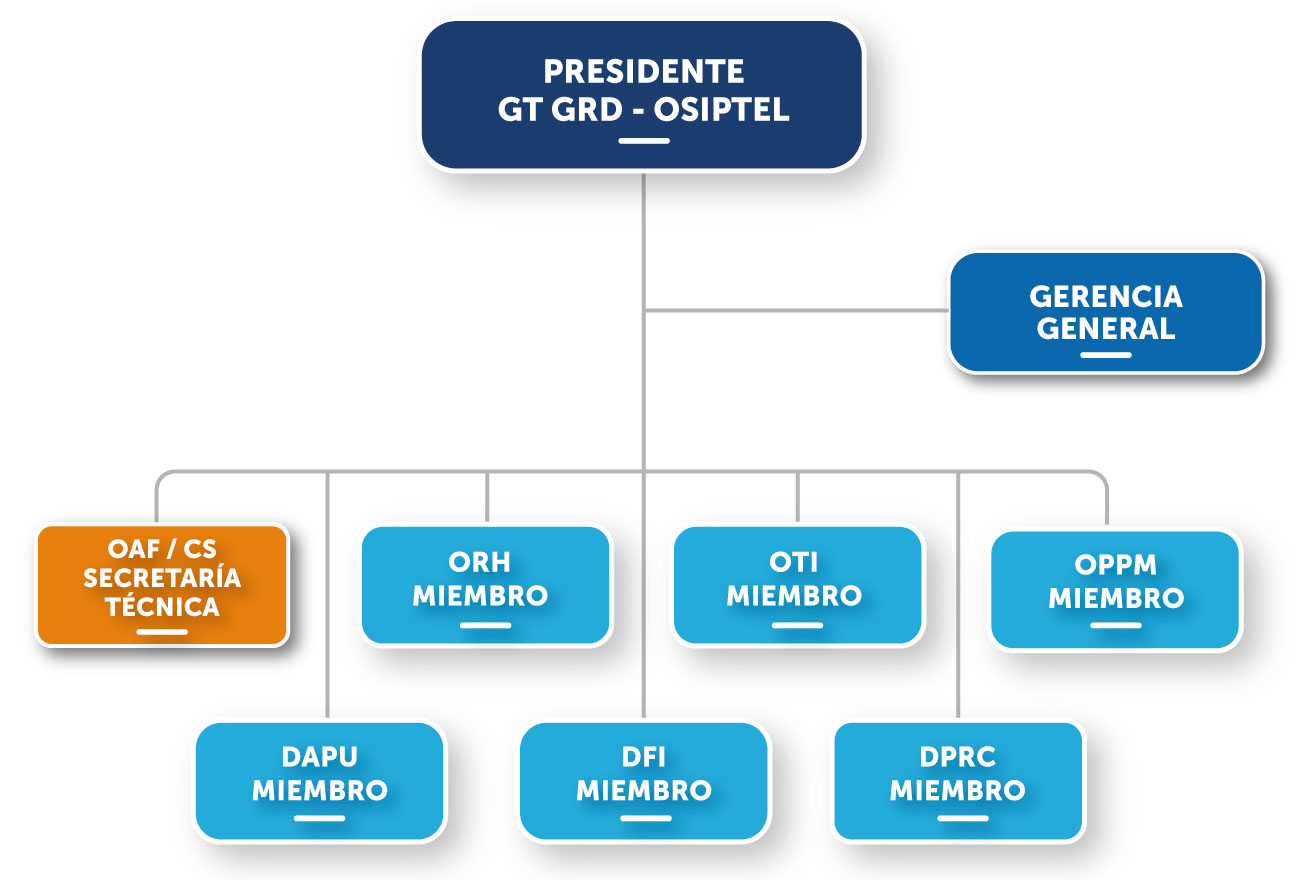
Marco Normativo
- Ley Nº 29664, Ley que crea el Sistema Nacional de Gestión del Riesgo de Desastres (SINAGERD) y su Reglamento (Decreto Supremo Nº 048-2011-PCM).
- Decreto Supremo Nº 034-2014-PCM, que aprueba el Plan Nacional de Gestión del Riesgo de Desastres – PLANAGERD 2014 – 2021.
- Resolución Ministerial Nº 276-2012-PCM, que aprueba la Directiva Nº 001-2012-PCM/SINAGERD “Lineamientos para la Constitución y Funcionamiento de los Grupos de Trabajo de la Gestión del Riesgo de Desastres en los Tres Niveles de Gobierno”.
- Resolución Ministerial Nº 059-2015-PCM, que aprueba los “Lineamientos para la Organización y Funcionamiento de los Centros de Operaciones de Emergencia – COE”.
- Resolución Ministerial Nº 185-2015-PCM, que aprueba los “Lineamientos para la Implementación de los Procesos de la Gestión Reactiva”.
- Resolución Ministerial Nº 136-2020-PCM, que aprueba los “Lineamientos para la formulación y aprobación de los planes de operaciones de emergencia”.
- Resolución de Presidencia Nº 0083-2019-PD/OSIPTEL, que constituye el Grupo de Trabajo para la Gestión del Riesgo de Desastres del OSIPTEL.
- Resolución de Presidencia Nº 00115-2021-PD/OSIPTEL, que reconforma el Grupo de Trabajo para la Gestión del Riesgo de Desastres del OSIPTEL, con la inclusión de la Oficina de Recursos Humanos.
Specific Plans
Public entities must formulate, approve and implement the following plans:
Disaster Risk Prevention and Reduction Plan.
The National Disaster Risk Management System is an inter-institutional, synergistic, decentralized, cross-cutting and participatory system, created with the purpose of identifying and reducing risks associated with hazards or minimizing their effects and preventing the generation of new risks, as well as preparing for and responding to disaster situations, through the establishment of principles, policy guidelines, components, processes and instruments of DRM.
Preparation Plan.
It consists of the set of actions of planning, capacity development, organization and efficient operation of the institution, and resource management, to anticipate and respond efficiently and effectively in case of disaster (Security Plan, Awareness and Dissemination Plan, drills).
Emergency Operations Plan.
Cross-cutting activities aimed at leading and coordinating disaster response, generating decisions that are transformed into response actions.
Rehabilitation Plan.
A set of actions and activities carried out by OSIPTEL in the event of an emergency or disaster, immediately after it occurs; as well as the procedures to monitor the continuity of service provision by the operating companies and/or its restoration in the most expeditious way possible, in addition to keeping users informed.
Contingency Plan.
Planning of coordination actions that allow articulating the response capacity established in OSIPTEL (Response Protocols).
Escenarios de riesgo por inundaciones y movimientos en masa en el marco del Plan Multisectorial 2025-2027
El presente informe tiene por objetivo desarrollar el escenario de riesgo por inundaciones y movimientos en masa a nivel nacional frente a la ocurrencia de anomalías porcentuales de lluvias asociadas a eventos El Niño / La Niña de mayor impacto en el Perú.
Basic Concepts
What is SINAGERD?
The National Disaster Risk Management System is an inter-institutional, synergistic, decentralized, cross-cutting and participatory system, created with the purpose of identifying and reducing risks associated with hazards or minimizing their effects and preventing the generation of new risks, as well as preparing for and responding to disaster situations, through the establishment of principles, policy guidelines, components, processes and instruments of DRM.
What is the composition of SINAGERD?
Presidency of the Council of Ministers – PCM.
National Council for Disaster Risk Reduction – CONAGERD.
National Center for Strategic Planning – CEPLAN.
National Center for Disaster Risk Estimation, Prevention and Reduction – CENEPRED.
National Institute of Civil Defense – INDECI.
Regional and Local Governments.
Armed Forces and National Police.
Public, Private and Civil Society Entities.
Disaster Risk Management Processes
- Risk assessment: Includes actions to generate knowledge of hazards, analyze vulnerability, and establish risk levels.
- Risk prevention: Includes actions aimed at preventing the generation of new risks.
- Risk reduction: These are actions aimed at reducing existing vulnerabilities and risks.
- Preparedness: Actions taken to ensure an optimal response from society in the event of disasters.
- Answer: These are actions that are carried out in the face of a disaster (immediately after it occurs, or in the proximity of it).
- Rehabilitation: These are actions carried out to restore essential basic services, allowing activities in the affected area to return to normal.
- Reconstruction: These are actions that are carried out to establish sustainable development conditions in the affected areas, reducing the risk prior to the disaster and ensuring recovery.
Disaster
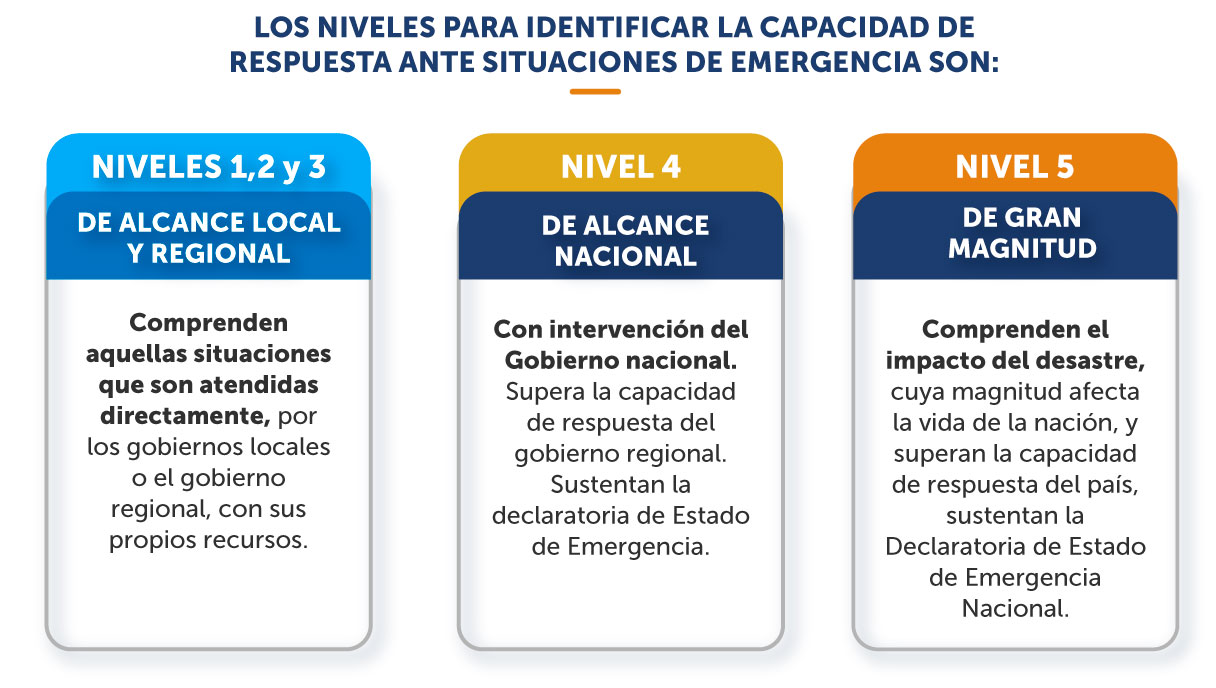
A set of damages and losses in health, livelihoods, physical habitat, infrastructure, economic activity and the environment, which occurs as a consequence of the impact of a hazard or threat whose intensity generates serious alterations in the functioning of social units, exceeding the local response capacity to effectively address its consequences, and which may be of natural origin or induced by human action.
Emergency
State of damage to life, property and the environment caused by the occurrence of a natural phenomenon or induced by human action that alters the normal development of activities in the affected area.
Danger
Probability that a potentially harmful physical phenomenon, of natural origin or induced by human action, will occur in a specific place, with a certain intensity and in a defined period of time and frequency.
Disaster risk
It is the probability that the population and their livelihoods will suffer damage and losses as a result of their vulnerability and the impact of a hazard.
Vulnerability
It is the susceptibility of the population, the physical structure or the socio-economic activities to suffer damage from the action of a hazard or threat.