El Servicio Nacional de Prevención y Respuesta ante Desastres, SENAPRED (www.senapred.cl )
El Servicio Nacional de Prevención y Respuesta ante Desastres queda a cargo de un Director Nacional, quien será su jefe superior. Existirá en cada región una Dirección Regional del Servicio Nacional de Prevención y Respuesta ante Desastres, a cargo de un Director Regional. (The National Disaster Prevention and Response Service is headed by a National Director, who will be its highest-ranking official . Each region will have a Regional Directorate of the National Disaster Prevention and Response Service, headed by a Regional Director.)
HISTORY
The National Service for Disaster Prevention and Response, SENAPRED, is the technical body of the State established by Law 21.364 , originally created as the National Emergency Office of the Ministry of the Interior and Public Security – ONEMI, through Decree Law No. 369 of 1974; in charge of planning and coordinating public and private resources destined for the prevention and attention of emergencies and disasters of natural origin or caused by human action, providing to the ministries, delegations, regional governments, municipalities and Civil Protection agencies at the national, regional, provincial and communal level, permanent management models and plans for the prevention and management of emergencies, disasters and catastrophes.
Likewise, in order to fulfill its legal mandate, SENAPRED will be responsible for mobilizing, within the parameters established by the State, the available resources from both the public and private sectors to avoid or mitigate the potential impact of a risk situation, emergency or catastrophe.
MISSION
To lead a continuous, collaborative and participatory process together with the members of the National System for Disaster Prevention and Response and the communities, to promote Disaster Risk Management throughout the population and the national territory.
VISION
To be by 2030 a recognized and trusted institution that territorially promotes the comprehensive approach to disaster risk management to make Chile a more prepared, safe and resilient country.
SERVICE OBJECTIVES
- Strategic ( SEE FORM A1 ).
Improve monitoring capabilities through institutional and resource strengthening to provide timely alerts to the public.
Increase joint actions with technical agencies of SINAPRED aimed at improving inter-institutional coordination during the mitigation, preparedness, response, and recovery phases.
Increase the participation of municipalities, citizens and social organizations in planning, education and preparedness instances to reduce disaster risk, incorporating the gender and rights approach.
- Institutional Management
Improve institutional capacity by adopting an approach focused on innovation, technology, specialized training, and knowledge networks with academia, in order to modernize service management and meet the challenges of the environment.
Increase SENAPRED’s participation in national and international coordination forums, as well as with the private sector, aimed at strengthening its strategic role in disaster risk management.
STRATEGIC FOCUS AND OBJECTIVES
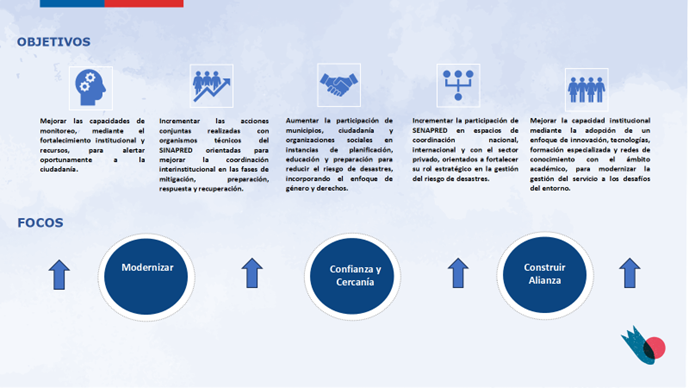
IDENTIFICATION OF GOODS AND/OR SERVICES TO THE NATIONAL DISASTER PREVENTION AND RESPONSE SYSTEM (citizens and/or users):
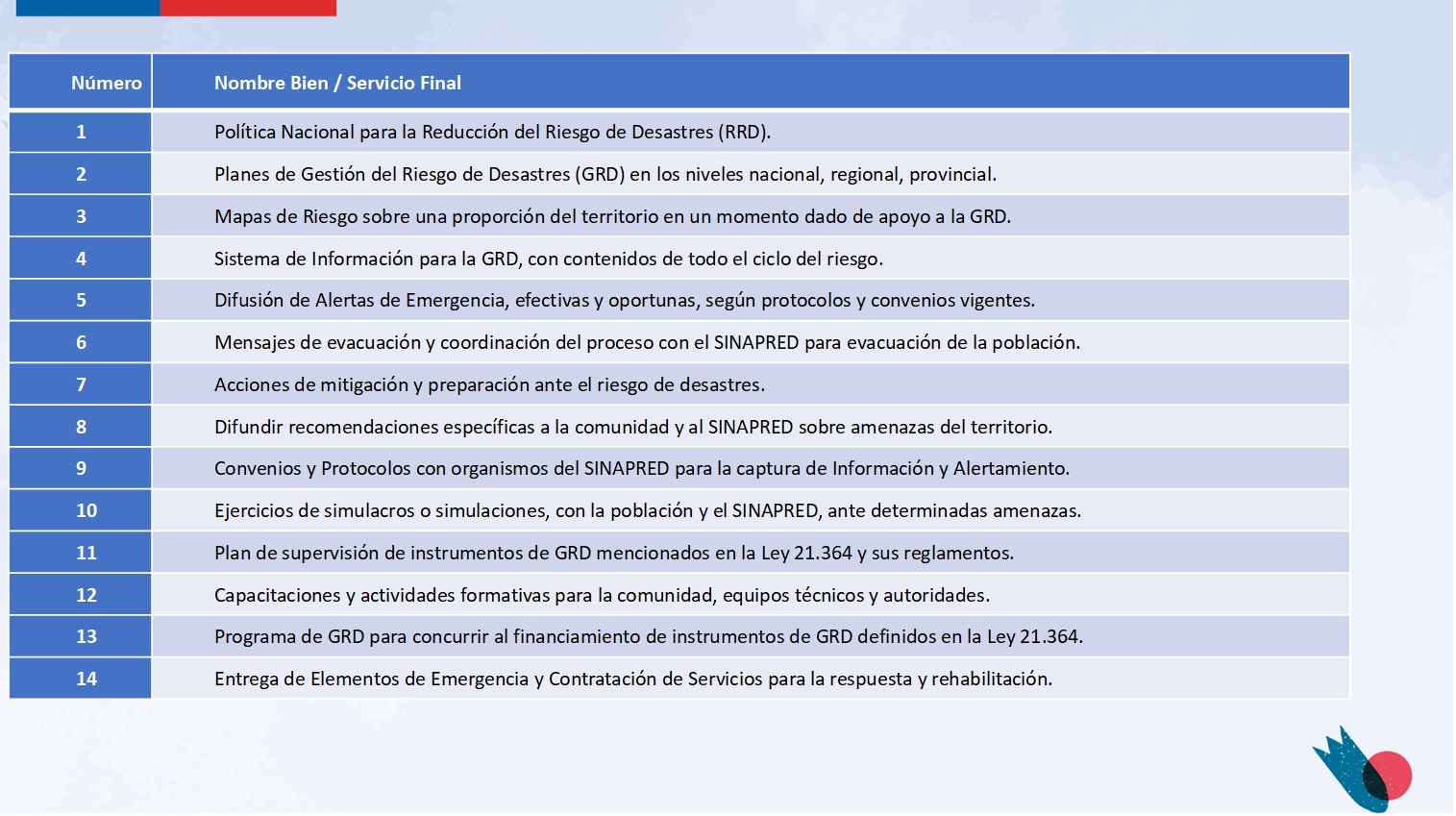
*This definition does not exclude the other activities, goods and services that SENAPRED develops and provides as part of its functions.
NATIONAL POLICY FOR DRR
The National Policy for Disaster Risk Reduction (PNRRD) is in accordance with the international commitments made by the State of Chile and the need to establish the guiding framework that strengthens Disaster Risk Management (DRM) in the country by 2030, being defined as the instrument that guides political actions and decisions, through guidelines and directives from an integral perspective, that contribute to the sustainable development of the country in the short, medium and long term.
It is composed of a set of principles, cross-cutting approaches, priority axes and strategic objectives, implemented through its respective National Strategic Plan for Disaster Risk Reduction (PENRRD, 2020-2030), which addresses gaps identified from previous processes and considers the territorial particularities and diversity of the communities, through the execution of priority actions stemming from the guidelines established in said policy.
Mid-term evaluation of the National Policy for DRR
In accordance with the provisions of Law No. 21,364, the evaluation of the progress status of the National Policy for DRR five years after implementation is made available. This work was carried out through a public competition, conducted by an evaluation entity during the first half of 2025, through the Regional Technical Cooperation (RGT4252) of the Inter-American Development Bank (IDB) “Support for the implementation of decarbonization strategies”.
To view the document, click here.
ORGANIZATION CHART
DIRECCION DE GESTION DE RIESGOS DE DESASTRES
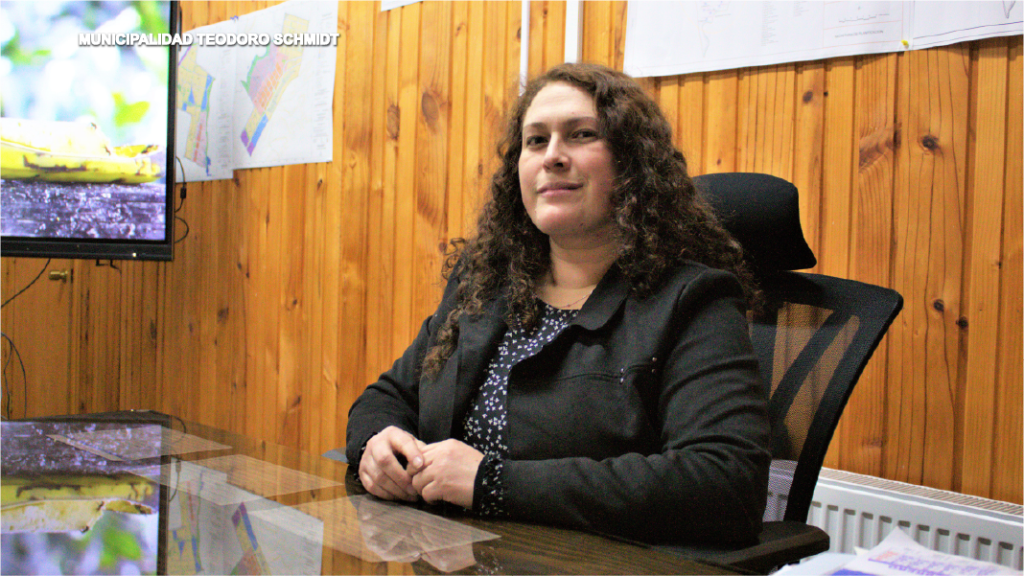
– National Director: Alicia Cebrián López
Alicia Cebrián López is a social worker from the Metropolitan Technological University and holds a diploma in Climate Change and Disaster Risk Reduction from the Pontifical Catholic University of Valparaíso and in Gender Theories, Development and Public Policies from the University of Chile.
She has more than 15 years of experience in Disaster Risk Management at the Ministry of the Interior and Public Security, having served as Head of the Risk and Emergency Management Unit and National Coordinator of Firefighters, in addition to having participated in various emergencies such as the eruption of the Chaitén volcano in 2008 and the floods in the Atacama Region in 2015.
At the time of her appointment as National Director, she held the position of Deputy Director of Disaster Risk Reduction, after having joined ONEMI in 2020 as Head of the Civil Protection Division through a Public Senior Management process.
EMERGENCY OPERATIONS OFFICE
The Emergency Operations office will be responsible for keeping the response prepared and coordinating municipal action in the event of emergencies and/or disasters in the commune in an efficient and effective manner.
The Emergency Operations office will have the following functions:
1. Keep the directives and procedures for managing emergency situations at the community level up to date.
2. Keep the municipality’s risk maps updated for different destructive events
3. To coordinate municipal operations or actions in the event of emergencies and/or natural or man-made disasters
4. To prevent and mitigate adverse or destructive effects in emergencies and disasters
5. Coordinate and direct preventive and corrective actions, anticipating foreseeable emergency situations
6. To provide a swift and efficient response to emergency and relief situations caused by climatic phenomena, earthquakes and/or terrestrial disturbances that may affect the community in general or population groups within it.
7. Investigate the causes of each disaster or adverse event and the severity of its impact in order to correct or mitigate any unsafe actions or conditions detected.
8. Keep up-to-date records of items that make up the emergency stockpile
9. Keep the contact register of the entities that make up the Civil Protection and Emergency System up to date.
10. Keep the Shelter Plan updated and prepare the premises for sheltering victims, providing food and heating, and ensuring their health and hygiene.
11. Establish protocols to control the entry and exit of materials and assets from the facilities designated for this purpose
12. Maintain an operational emergency communications system for the transmission of information from entities that make up the Civil Protection System
13. Collaborate in the updating and/or development of the Community Emergency Plans for specific events
14. Collect, maintain and report statistics on different destructive events at the community level
15. Coordinate with response agencies during emergencies
16. Perform other functions entrusted to him/her by the Mayor or the head of the Directorate