Climate and multi-hazard risk and vulnerabilities of Kyrgyzstan
Kyrgyzstan, officially the Kyrgyz Republic, is a highly climate-sensitive mountain country exposed to glacier retreat, glacial lake outburst floods, mudflows, landslides, avalanches, river floods, drought, heatwaves, cold waves, earthquakes, pasture degradation, water scarcity, and climate-sensitive health risks. Its vulnerability is strongly shaped by mountainous terrain: nearly 94% of the country lies above 1,000 metres, and about 40% lies above 3,000 metres, making settlements, roads, hydropower systems, irrigation networks and mountain livelihoods highly exposed to slope instability, snowmelt dynamics and extreme weather. (ESCAP Repository)
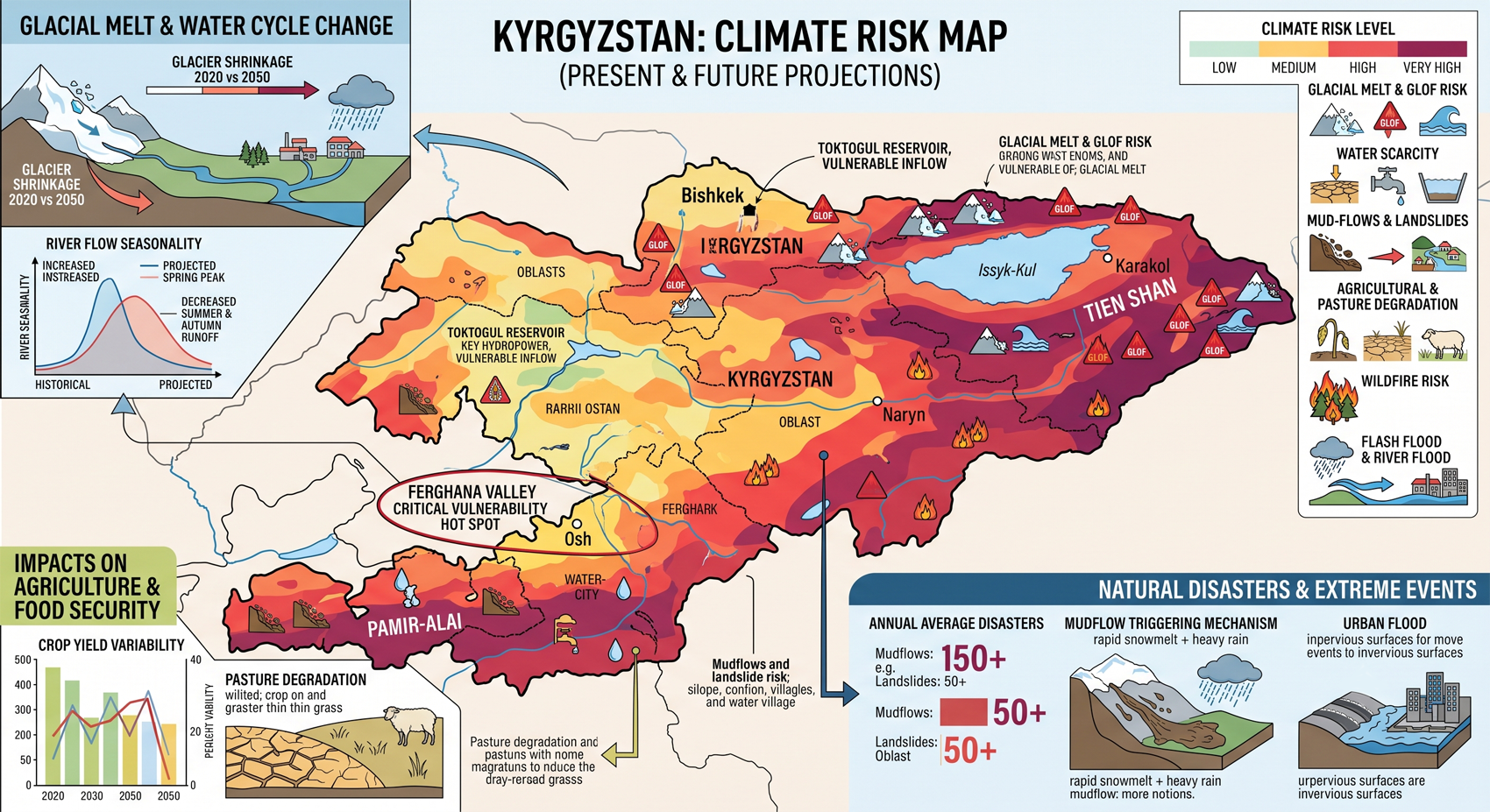
The country’s disaster-risk profile is defined by the interaction of climate change and complex mountain hazards. GFDRR’s country profile notes that Kyrgyzstan experiences frequent emergencies and that historical losses have been driven largely by flash floods, debris flows, avalanches, fires, storms and landslides. It also warns that glacier melt is expected to increase winter flooding while reducing summer water flows, creating seasonal water-security risks.
Key hazard profile
| Hazard | Main risk pathway | Highly exposed systems / areas |
|---|---|---|
| Glacier retreat and GLOFs | Sudden lake outburst floods, downstream debris flows, damage to settlements, roads, bridges and irrigation systems | High mountain valleys, Issyk-Kul, Naryn, Osh, Jalal-Abad, Batken and glacier-fed catchments |
| Mudflows and flash floods | Rapid damage to houses, roads, bridges, schools, irrigation channels and farmland | Mountain foothills, narrow valleys, river channels, settlements below unstable slopes |
| Landslides | Loss of life, displacement, road blockage, damage to villages and infrastructure | Osh, Jalal-Abad, Batken and other steep, geologically unstable regions |
| Avalanches and snow hazards | Transport disruption, casualties, isolation of communities, infrastructure damage | High mountain roads, passes, remote settlements |
| Drought and heatwaves | Crop losses, pasture stress, reduced livestock productivity, irrigation demand increase | Rain-fed agriculture areas, pasturelands, southern and lowland zones |
| Earthquakes | Structural collapse, infrastructure damage, cascading landslide risk | Nationally significant; high-risk mountain and urban areas |
| Water scarcity | Reduced irrigation supply, hydropower stress, domestic water shortages, transboundary water tension | Glacier-fed basins, irrigation command areas, hydropower-dependent systems |
Sector-specific vulnerability
1. Water resources, glaciers and hydropower
Kyrgyzstan functions as an important water tower of Central Asia. Its rivers, snowpack and glaciers support domestic water supply, irrigation, hydropower generation, ecosystems and downstream transboundary flows. Climate change threatens this system through glacier retreat, altered snowmelt timing, higher evapotranspiration, and more variable seasonal runoff.
The most serious long-term risk is that climate warming may initially increase meltwater and flood hazards, but later reduce dry-season water availability as glacier storage declines. This creates a compound risk for irrigated agriculture, hydropower reliability, rural drinking water, pasture systems and regional water allocation. UNICEF notes that high dependence on glacial meltwater for agriculture and energy exposes children and communities to risks affecting health, education, nutrition and protection. (UNICEF)
Hydropower is particularly sensitive because energy security depends heavily on river flows. Drought, reduced summer runoff and competing irrigation demands can affect electricity generation, while floods, debris flows and landslides can damage power infrastructure and transmission routes.
2. Glacial lake outburst floods, mudflows and mountain hazards
Glacial lake outburst floods are one of Kyrgyzstan’s most critical climate-amplified hazards. UNDP reported in 2024 that Kyrgyzstan faces the threat of more than 2,000 glacial lakes experiencing outbursts, with nearly 20% posing high risk because of unstable natural dams and melting ice. UNDP also supported a new IT-based GLOF monitoring module that uses machine-learning approaches for lake-area calculation, threat detection and risk assessment. (UNDP)
GLOFs can trigger cascading disasters: sudden lake breach → high-energy flood wave → debris flow → bridge/road failure → isolation of communities → damage to irrigation, drinking-water and power systems. This makes GLOF risk management a priority for remote sensing, automatic monitoring, lake inventories, community evacuation protocols, early warning sirens and local contingency planning.
3. Agriculture, irrigation and food security
Agriculture is highly vulnerable to climate variability because much of the sector depends on irrigation, pasture resources and predictable seasonal water availability. Drought, heatwaves, late frosts, hailstorms, mudflows, pasture degradation and changing pest/disease patterns affect crop yields, livestock productivity and household income.
The World Bank’s 2025 Kyrgyz Republic Country Climate and Development Report identifies agriculture as one of the key sectors exposed to more frequent storms, landslides, heatwaves and droughts. It estimates that policy inaction could result in 5–10% annual agricultural revenue losses, while up to 24% of irrigation demand could go unmet by mid-century because of rising temperatures and increased crop water requirements. (World Bank)
Smallholder farmers, livestock herders, women farmers, poorer rural households and remote mountain communities are especially sensitive because they often have limited access to irrigation modernization, climate information, finance, insurance, veterinary services, storage, market access and mechanization.
4. Transport, settlements and infrastructure
Kyrgyzstan’s mountainous topography makes infrastructure highly exposed. Roads, bridges, tunnels, power lines, schools, health facilities and irrigation canals are frequently located along valleys, slopes and river corridors where floods, avalanches, rockfalls, mudflows and landslides can cause severe disruption.
The World Bank CCDR recommends resilient transport infrastructure, vulnerability assessments, upgraded building standards, nature-based solutions, and roads and bridges able to withstand floods. It also highlights the need for disaster-risk monitoring, smarter master planning and rapid financing mechanisms for emergencies. (World Bank)
The infrastructure risk is not only physical; it is also economic and social. When a mountain road or bridge fails, isolated communities may lose access to markets, schools, hospitals, emergency services, fuel, food and agricultural inputs.
5. Public health and social vulnerability
Climate change affects health through heat stress, cold-weather extremes, air pollution, flood-related injuries, water contamination, diarrhoeal disease, vector-borne disease risks, undernutrition and disruption of health services. UNICEF identifies children, newborns and pregnant women as particularly vulnerable, especially where climate risks combine with air pollution, underfunded services and rural/peri-urban infrastructure gaps. (UNICEF)
Climate impacts also affect education and child protection. Floods, landslides, avalanches and extreme weather can damage schools, interrupt learning, increase travel risks, and deepen household poverty. Rural children in remote mountain areas are particularly vulnerable because access to services is already constrained.
6. Ecosystems, biodiversity and pasturelands
Kyrgyzstan’s mountain ecosystems are sensitive to warming, glacier retreat, drought, pasture degradation, erosion, biodiversity loss and land-use pressure. Pasture degradation is a major livelihood concern because livestock is central to rural income and food security. Drought and irregular precipitation reduce pasture regeneration, increase feed costs and may intensify conflict over grazing and water resources.
Biodiversity and ecosystem services are also critical for disaster-risk reduction. Healthy forests, wetlands, rangelands and mountain vegetation help regulate runoff, stabilize slopes, reduce erosion and support livelihoods. Degraded landscapes increase sedimentation, mudflow risk and downstream flood impacts.
Exposure, sensitivity and adaptive capacity
Exposure
Kyrgyzstan is exposed to both geophysical hazards and climate-amplified hazards. Earthquakes remain a major structural risk, while climate change is intensifying or altering the risk profile of floods, mudflows, landslides, GLOFs, droughts, heatwaves and snow-related hazards. The World Bank CCDR notes that the country is experiencing more frequent and intense storms and landslides, severe heatwaves and droughts. (World Bank)
Sensitivity
Sensitivity is high because rural livelihoods depend heavily on agriculture, livestock, pasturelands, irrigation and natural resources. ESCAP notes that about 66% of the population lives in rural areas, while agriculture is affected by small-scale family farming, land degradation and food-security pressures. (ESCAP Repository)
Adaptive capacity
Kyrgyzstan has made progress in disaster-risk governance, hydrometeorological services and climate adaptation planning, but gaps remain in observation coverage, local implementation capacity, resilient infrastructure financing, risk-informed land-use planning, early warning dissemination and forecast-based early action.
The National Adaptation Plan process has advanced with support from UNDP and the Green Climate Fund. Earlier NAP work prioritized disaster and emergency management, health, biodiversity conservation, and agriculture and irrigation water. (Adaptation UNDP) In 2025, UNDP reported that the draft NAP included measures for six sectors: agriculture and irrigation, health, emergency management, biodiversity conservation, energy, and climate-resilient green cities. (UNDP)
Economic and poverty impacts
Climate risks have direct development consequences. The World Bank CCDR estimates that without stronger action, climate impacts could reduce real GDP by 2–3% by 2040 and 2–4% by mid-century, push an additional 170,000 people into poverty by 2040, increase the number of people exposed to flooding by 24–38%, and create significant job and income losses among the poorest households. (World Bank)
These impacts are especially important because climate shocks affect the same systems that support poverty reduction: agriculture, livestock, water, energy, transport, health, education and local markets.
Priority adaptation and early warning needs
Kyrgyzstan’s resilience strategy should prioritize an end-to-end, impact-based, multi-hazard early warning system designed specifically for mountain risk environments.
Key priorities include:
Strengthen GLOF monitoring and early warning, including satellite-based lake inventories, automatic lake-level sensors, dam-stability monitoring, downstream exposure mapping and community evacuation protocols.
Upgrade mudflow, flash-flood and landslide forecasting using rainfall thresholds, snowmelt models, slope susceptibility maps, soil moisture, river gauges and real-time local observations.
Modernize hydrometeorological observation networks, including automatic weather stations, snowpack monitoring, river gauges, glacier monitoring, radar where feasible, and telemetry in remote basins.
Develop impact-based forecasting for agriculture, transport, schools, health facilities, hydropower, irrigation and vulnerable mountain settlements.
Expand drought early warning using precipitation, soil moisture, vegetation condition, pasture biomass, irrigation demand, reservoir levels and market-price indicators.
Strengthen climate-smart agriculture and irrigation, including efficient irrigation technologies, drought-tolerant crops, pasture restoration, livestock advisory services and climate-informed extension.
Improve resilient infrastructure standards for roads, bridges, schools, clinics, hydropower facilities, irrigation canals and rural water systems.
Link early warning with forecast-based financing and anticipatory action, including pre-positioned supplies, cash assistance, evacuation support, livestock feed, temporary bridges and emergency road clearance.
Integrate health and education risk data into early warning, especially for children, pregnant women, elderly people and remote rural populations.
Build a national geospatial Decision Support System integrating hazard maps, glacier lake risk, river basins, landslide susceptibility, exposure databases, infrastructure assets, evacuation routes, social vulnerability and local disaster-management plans.
Overall, Kyrgyzstan’s climate-risk profile is defined by mountain fragility, glacier retreat, high exposure to flash floods, mudflows, landslides and avalanches, strong dependence on glacier-fed water systems, climate-sensitive agriculture and hydropower, and uneven local adaptive capacity. Its adaptation pathway should combine glacier and hydromet monitoring, mountain-specific impact-based forecasting, resilient infrastructure, climate-smart agriculture, ecosystem restoration, social protection and forecast-based early action.
Ministry of Emergency Situations of the Kyrgyz Republic
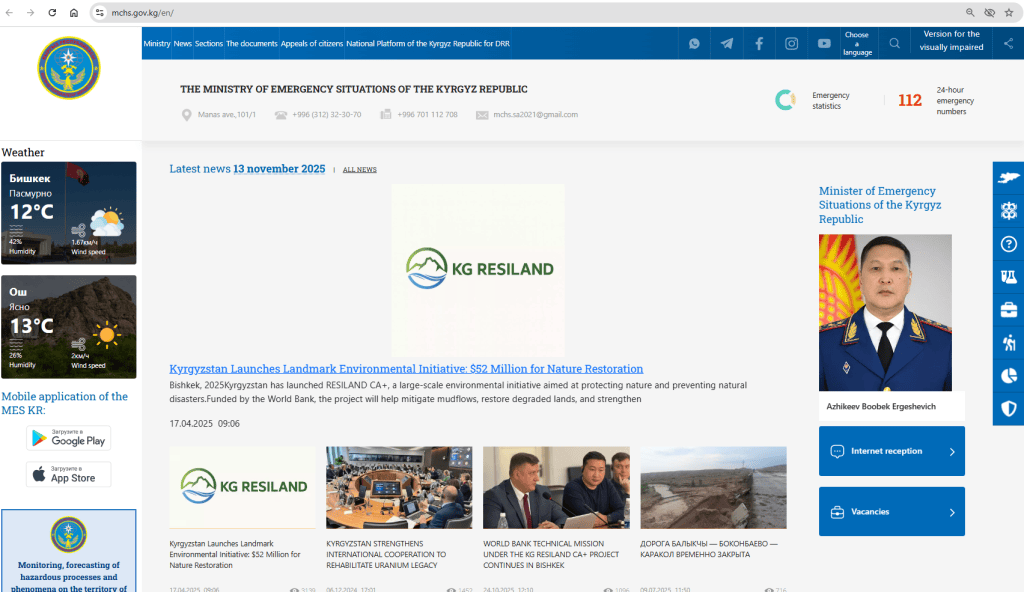
The Ministry of Emergency Situations of the Kyrgyz Republic is a state executive body that is responsible for developing and implementing state policies, carrying out normative-legal regulations, as well as supervising and controlling activities in the field of civil defense, protection of the population and territories from natural and man-made emergencies, ensuring fire safety, and promoting human safety on waterbodies.
The Ministry of Emergency Situations of the Kyrgyz Republic carries out its activities directly and through its constituent territorial bodies, as well as bodies specifically authorized to solve problems of civil defense and to prevent and respond to emergencies in all regions of the country. The state body is responsible for supervising and providing assistance to fire departments, rescue military units, the state inspectorate for small vessels, emergency rescue units, search and rescue units, paramilitary mountain rescue units, educational, scientific, medical,sanatorium, and other institutions and organizations, as well as representatives of the Ministry in the representative offices of the Kyrgyz Republic to international organizations.
In its activities, the Ministry is guided by the Constitution of the Kyrgyz Republic, the laws of the Kyrgyz Republic, the acts of the President of the Kyrgyz Republic and the Government of the Kyrgyz Republic, international treaties with Kyrgyzstan, and these Regulations. The Ministry reviews the application of the legislation of the Kyrgyz Republic in its sphere of activity, develops proposals for its improvement, and submits them for consideration to the President of the Kyrgyz Republic and the Government of the Kyrgyz Republic.
The Ministry of Emergency Situations of the Kyrgyz Republic carries out its activities in cooperation with other state executive bodies of the Kyrgyz Republic, local self-government bodies,as well as public associations and organizations.
Important dates in the transformation of the Ministry of Emergency Situations of the KyrgyzRepublic:
On December 15, 1990, the Council of Ministers of the USSR adopted a resolution titled “On the creation of a State All-Union system for preventing emergency situations and emergency response.”
In furtherance of this resolution, on July 1, 1991, the Cabinet of Ministers of the Republic of Kyrgyzstan (then part of theUSSR) adopted a resolution on the establishment of a permanentbody of the Cabinet of Ministers of the Republicof Kyrgyzstan on emergency situations.
By the Order of the Prime Minister of the Republic of Kyrgyzstan No. 271-р dated August 8, 1991, the State Commission for Emergency Situations of the Cabinet of Ministers of the Republicof Kyrgyzstan was established.
On January 6, 1992, by Decree of the President of the Kyrgyz Republic No. 4, the State Commission of the Cabinetof Ministers of the Republic of Kyrgyzstan for emergency situations was reorganized into the State Commission for Emergency Situations of the Republic of Kyrgyzstan.
On May 27, 1993, by Decree of the President of the Kyrgyz Republic No. VII-153, the Department of Civil Defensebecame a part of the State Commission of the KyrgyzRepublic, which was later reorganized into the State Commission for Emergency Situations and Civil Defense.
On March 4, 1996, by Decree of the President of the Kyrgyz Republic No. UP-45, the State Commission for Emergency Situations and Civil Defense under the Government of the Kyrgyz Republic was transformed into the Ministry of Emergency Situations and Civil Defense.
On December 28, 2000, by Decree of the President of the Kyrgyz Republic No. 363, the Ministry of Ecology and Emergency Situations of the Kyrgyz Republic was established by merging the Ministry of Environmental Protection of the Kyrgyz Republic, the Ministry of Emergency Situations and Civil Defense of the Kyrgyz Republic, the Hydrometeorological Agency (KyrgyzHydromet), and the State Agency for Forestry under the Government of the KyrgyzRepublic.
On October 15, 2005, by Decree of the President of the Kyrgyz Republic No. 462, it was reorganized into theMinistry of Emergency Situations of the Kyrgyz Republic.
The Ministry of Emergency Situations of the Kyrgyz Republic and UNDP, with financial support from the European Union, have launched the modernization of Kyrgyzstan’s early warning alert and emergency response system. This is more than just delivering equipment — it’s about saving lives, protecting communities, and building the nation’s resilience to natural and climate-induced hazards.
In the face of growing climate volatility and increasingly frequent and destructive disasters, every minute counts. The new equipment, installed at the Crisis Management Center of the Ministry of Emergency Situations, gives the country a crucial edge: timely data collection, processing, and transmission — enabling faster response and reduced losses. Enhanced server systems, multiplex modules, and upgraded communication tools now make the Center a cornerstone of Kyrgyzstan’s national resilience infrastructure.
“Disaster resilience begins with preparedness. Today, we are strengthening our capacity to protect the lives and property of our citizens, especially in the most vulnerable regions. The new technologies at the Crisis Management Center will help us respond faster, coordinate better, and engage more effectively with local communities,” said Boobek Azhikeev, Minister of Emergency Situations of the Kyrgyz Republic.

UNDP and the European Union remain strong and trusted partners of Kyrgyzstan in advancing sustainable development and enhancing national crisis preparedness. This partnership is built on shared responsibility, mutual trust, and a vision for a future where every life matters.
“The European Union is proud to partner with Kyrgyzstan on such a vital initiative. Early warning systems are investments in safety, resilience, and the future. They help save lives and strengthen trust between the government and the people. We support Kyrgyzstan’s commitment to building a more resilient, inclusive, and prepared nation for the challenges of tomorrow,” said Mr. Hans Farnhammer, Head of Cooperation Unit, EU Delegation to the Kyrgyz Republic.

UNDP assists the Kyrgyz Republic in strengthening climate resilience and reducing the vulnerability of the population, based on national priorities reflected in the National Development Programme 2030, and other regional and sectoral frameworks aimed at enhancing climate resilience and reducing the vulnerability of communities.
“UNDP remains a reliable partner of Kyrgyzstan in the areas of sustainable development, adaptation to climate change and building a safer future. We are grateful for long lasting partnership that ensures sustainability in the face of growing climate challenges,” emphasized Alexandra Solovieva, UNDP Resident Representative in the Kyrgyz Republic.

The initiative is implemented under the EU-funded regional project “Climate Change and Resilience in Central Asia.” Its impact is already being felt on the ground:
- In the most climate-vulnerable parts of the Fergana Valley, four automated meteorological stations and water radars have been installed, protecting more than 150,000 people;
- In Osh city, a comprehensive emergency alert system has been launched, with 29 sirens and 87 loudspeakers enabling rapid communication of warnings to strategic social infrastructure;
- Work is ongoing to expand early warning and monitoring systems to hard-to-reach and mountainous regions where climate risks are most severe.
UNDP is the leading United Nations organization in fighting to end the injustice of poverty, inequality, and climate change. Working with our broad network of experts and partners in 170 countries, we help nations to build integrated, lasting solutions for people and planet. Learn more at undp.org or follow at @UNDPKG.
Тема: Кыргыз Республикасынын Өзгөчө кырдаалдар министрлигине көп кырдуу коркунучтарды алдын ала эскертүү системасын иштеп чыгууда жана ишке ашырууда колдоо көрсөтүү
Урматтуу мырза/айым,
Көп кырдуу коркунучтарды алдын ала эскертүү системасын иштеп чыгуу жана ишке ашыруу борборунан (MHEWC) салам.
MHEWC кырсыктардын тобокелдигин башкаруу (DRM) башкаруу системаларын, көп кырдуу коркунучтарды алдын ала эскертүү системаларын, тобокелдиктерге негизделген пландаштырууну жана климаттын өзгөрүшүнө туруктуулукту күчөтүү үчүн техникалык чечимдерди сунуштайт. Биз Кыргыз Республикасынын Өзгөчө кырдаалдар министрлигине төмөнкү багыттар боюнча анын институционалдык, техникалык жана операциялык мүмкүнчүлүктөрүн чыңдоодо техникалык колдоо көрсөткүбүз келет:
Кырсыктардын тобокелдигин башкаруу жана эрте эскертүүнү башкаруу үчүн учурдагы веб-порталды геомейкиндиктик, маалымат базасына негизделген жана тиркемелерге негизделген чечимдерди колдоо системасына (DSS) жаңыртуу.
Көп кырдуу коркунучтарды баалоону жүргүзүү, геомейкиндиктик коркунучтарды жана тобокелдик карталарын түзүү жана коркунучтар, таасирлер, аялуулук жана тобокелдиктер жөнүндө маалымат үчүн борборлоштурулган сактоочу жайды жана маалымат базасын башкаруу системасын түзүү.
Учурдагы мониторинг жана байкоо мүмкүнчүлүктөрүн баалоо жана БИМге байкоо тармактарын орнотууда, өркүндөтүүдө жана интеграциялоодо, анын ичинде Автоматташтырылган метеорологиялык станцияларды (AWS), гибриддик аба ырайын жана кырсыктарды мониторингдөө системаларын, реалдуу убакыттагы сенсордук маалыматтарды кабыл алууну, МКТны иштетүүнү жана маалыматтарды башкаруучу коркунучтарды аныктоо жана эскертүү механизмдерин улуттук деңгээлден акыркы миляга чейин орнотууда колдоо көрсөтүү.
Аба ырайын алдын ала кабарлоо, коркунучтарды алдын ала кабарлоо, таасирди болжолдоо, болжолдоого негизделген алдын ала эрте аракеттерди көрүү, өзгөчө кырдаалдарга даярдыкты жана жооп кайтарууну башкаруу, болжолдоого негизделген каржылоо, алгачкы аракет протоколдору жана DSS тарабынан колдоого алынган кырсыктар жана стандарттык операциялык жол-жоболор боюнча туруктуу буйруктарды камтыган комплекстүү көп коркунучтуу эрте эскертүү системасын (MHEWS) иштеп чыгуу жана ишке киргизүү.
Толугу менен автоматташтырылган коркунучтарды аныктоо, мониторинг жүргүзүү, божомолдоо, көп коркунучтуу жана кырсыктуу кырдаалдар боюнча операциялар борборунун (EOC) иштеп чыгуусун, ишке ашыруусун жана ишке киргизүүсүн колдоо.
Административдик деңгээлдерде жана артыкчылыктуу секторлордо көп коркунучтуу даярдык, жооп кайтаруу жана калыбына келтирүү пландарын карап чыгуу жана жаңыртуу.
Тобокелдиктерге негизделген саясатты, пландаштырууну жана инвестициялык чечимдерди колдоо үчүн климаттык жана көп коркунучтуу тобокелдиктерди жана аялуу жактарды баалоону жүргүзүү.
ГИС карталарын, маалымат базаларын, аналитикалык куралдарды жана жергиликтүү өз алдынча башкаруу органдарынын жана сектордук деңгээлдеги тобокелдиктерге негизделген пландаштыруу жана бюджеттөө механизмдерин камтыган DRM башкаруу үчүн геомейкиндик платформасына негизделген чечимдерди колдоо системасын иштеп чыгуу.
БИМдин талабы боюнча кошумча техникалык жардам, консультациялык колдоо жана потенциалды жогорулатуу кызматтарын көрсөтүү.
БИМдин артыкчылыктарын талкуулоо жана Кыргыз Республикасынын көп кырдуу коркунучтарды эрте эскертүү, кырсыктарга даярдык жана тобокелдиктерди башкаруу системаларын чыңдоо үчүн практикалык ишке ашыруу жол картасын биргелешип изилдөө мүмкүнчүлүгүн кубануу менен кабыл алабыз.
Сиздин жылуу пикириңизди күтөбүз.
Урматтоо менен,
З.М. Саджадул Ислам
Көп кырдуу коркунучтарды эрте эскертүү системасын долбоорлоо жана ишке ашыруу борборунун (MHEWC) директору
Веб: www.mhewc.org
Телефон жана WhatsApp: +88 01711 979179
Электрондук почта: zmsajjad@gmail.com , sajjad@mhewc.org
Subject: Supporting the Ministry of Emergency Situations of the Kyrgyz Republic in Multi-Hazard Early Warning System Design and Implementation
Dear Sir/Madam,
Greetings from the Multi-Hazard Early Warning System Design and Implementation Center (MHEWC).
MHEWC provides technical solutions to strengthen Disaster Risk Management (DRM) governance systems, multi-hazard early warning systems, risk-informed planning, and climate resilience. We would like to offer our technical support to the Ministry of Emergency Situations of the Kyrgyz Republic in strengthening its institutional, technical, and operational capacities in the following areas:
- Upgrading the existing web portal into a geospatial, database-driven, and app-enabled Decision Support System (DSS) for disaster risk governance and early warning management.
- Conducting multi-hazard risk assessments, producing geospatial hazard and risk maps, and establishing a centralized repository and database management system for hazard, exposure, vulnerability, and risk information.
- Assessing existing monitoring and observation capacities and supporting MoES in the installation, enhancement, and integration of observation networks, including Automated Weather Stations (AWS), hybrid weather and hazard monitoring systems, real-time sensor data ingestion, ICT enablement, and data-driven hazard detection and warning mechanisms from national to last-mile levels.
- Designing and operationalizing an end-to-end Multi-Hazard Early Warning System (MHEWS), including weather nowcasting, hazard nowcasting, impact forecasting, forecast-based anticipatory early action, emergency preparedness and response management, forecast-based financing, Early Action Protocols, and DSS-supported Standing Orders on Disaster and Standard Operating Procedures.
- Supporting the design, implementation, and operationalization of a fully automated Hazard Detection, Monitoring, Prediction, Multi-Hazard and Disaster Emergency Operations Center (EOC).
- Reviewing and upgrading multi-hazard preparedness, response, and recovery plans across administrative levels and priority sectors.
- Conducting climate and multi-hazard risk and vulnerability assessments to support risk-informed policy, planning, and investment decisions.
- Developing a geospatial platform-driven Decision Support System for DRM governance, including GIS maps, databases, analytical tools, and local government and sector-level risk-informed planning and budgeting mechanisms.
- Providing additional technical assistance, advisory support, and capacity-building services as required by MoES.
We would welcome the opportunity to discuss MoES’s priorities and jointly explore a practical implementation roadmap to strengthen the Kyrgyz Republic’s multi-hazard early warning, disaster preparedness, and risk governance systems.
We look forward to your kind response.
Sincerely,
Z M Sajjadul Islam
Director
Multi-Hazard Early Warning System Design and Implementation Center (MHEWC)
Web: www.mhewc.org
Phone & WhatsApp: +88 01711 979179
Email: zmsajjad@gmail.com , sajjad@mhewc.org