Climate risk and vulnerabilities of Togo Évaluation des risques et de la vulnérabilité liés au climat et aux aléas multiples au Togo
Togo is highly exposed and vulnerable to climate change and multi-hazard risks due to its low-lying Atlantic coastal zone, recurrent floods, drought-prone rural areas, rainfall variability, coastal erosion, land degradation, poverty, and dependence on rainfed agriculture and natural-resource-based livelihoods. The country faces major risks from floods, droughts, strong winds, coastal erosion, sea-level rise, heat stress, soil erosion, deforestation, bush fires, water stress, crop losses, and climate-sensitive health risks. Climate change is expected to intensify these vulnerabilities through rising temperatures, more extreme heat, shifting rainfall patterns, more intense rainfall events, increased flood and landslide risks, sea-level rise, coastal ecosystem degradation, and growing pressure on agriculture, water resources, health, housing, infrastructure, and vulnerable communities. Strengthening multi-hazard early warning systems, flood management, coastal protection, climate-resilient agriculture, water security, ecosystem restoration, disaster risk financing, and locally led adaptation is essential to reduce losses and protect Togo’s development gains.
Togo is highly vulnerable to climate change and multi-hazard risks due to its exposure to recurrent floods, droughts, coastal erosion, strong winds, rainfall variability, late rainfall onset, heat stress, land degradation, deforestation, and climate-sensitive disease risks. Its vulnerability is shaped by a narrow but highly exposed Atlantic coastline, flood-prone urban areas such as Lomé, dependence on rainfed agriculture, rural poverty, pressure on water resources, fragile ecosystems, and limited adaptive capacity. The main climate risks identified for Togo include violent winds, coastal erosion, poor distribution of rainfall, late rains, flooding, and drought. (UNDP Adaptation)

1. Multi-hazard exposure
Togo’s major climate and disaster risks include floods, droughts, coastal erosion, strong winds, landslides, soil erosion, bush fires, deforestation, and climate-sensitive disease risks. GFDRR notes that recurrent floods in Togo have negative socio-economic effects on the population, environment, and economy, while soil erosion, coastal erosion, and deforestation further exacerbate flood impacts.
Flooding is one of the country’s most recurrent and damaging hazards. Togo experiences flooding almost every year, and major events have caused significant impacts: the 2007 floods affected more than 127,000 people and caused 23 deaths, while the 2010 floods affected about 83,000 people and caused more than US$38 million in damages and losses.
2. Climate change as a risk multiplier
Climate change is increasing Togo’s exposure to heat, rainfall variability, extreme rainfall, drought stress, flooding, coastal hazards, and ecosystem degradation. The 2025 Climate Risk Country Profile for Togo reports that temperatures have risen by up to 0.34°C per decade since 1991, and that the number of extremely hot days could nearly triple by mid-century. It also highlights expected increases in tropical nights and humid heat days, exposing the population to dangerous heat stress. (PreventionWeb)
Rainfall patterns are also changing. Although some projections indicate modest overall increases in rainfall, the larger risk comes from higher variability and more intense extreme rainfall events, which can raise flood and landslide risks. Rising sea-surface temperatures and sea levels also threaten coastal communities and marine ecosystems, while drought and rainfall variability undermine rainfed agriculture. (PreventionWeb)
3. Coastal erosion, sea-level rise, and coastal vulnerability
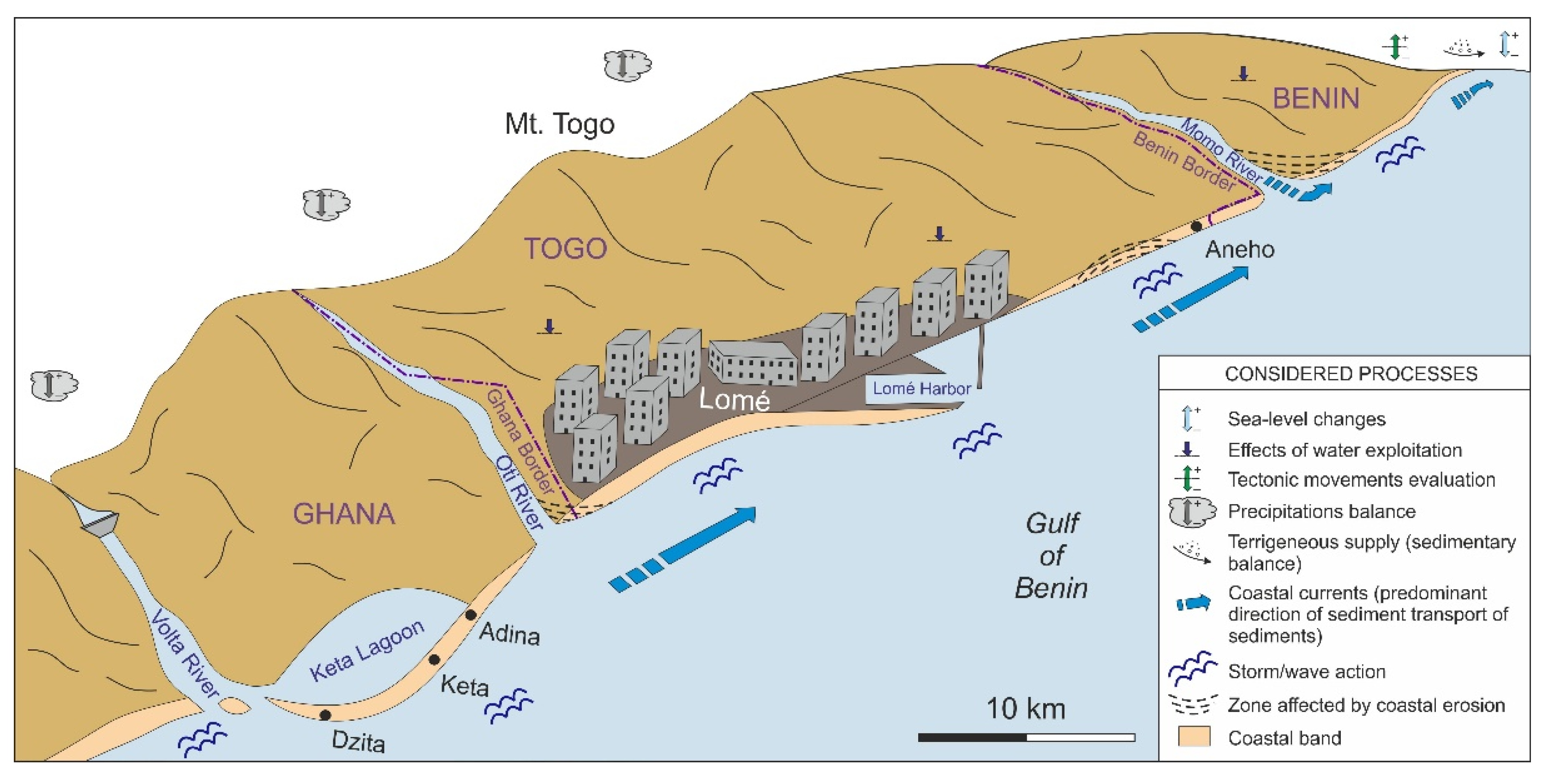
Togo’s coastline is short but highly strategic and highly vulnerable. The country has roughly 50 km of coastline, which is already affected by coastal erosion and sea-level rise. Coastal risks are particularly serious because population, transport corridors, fishing livelihoods, tourism assets, port-related infrastructure, settlements, and economic activities are concentrated near the coast. (napcentral.org)
Coastal erosion is among Togo’s most visible climate and development risks. The World Bank reports that Benin and Togo lose about 15 meters of coastline each year, and in some locations 20–30 meters, with consequences for lives, housing, investment, and coastal livelihoods. (World Bank)
The coastal zone around Lomé, Aného, Agbodrafo, Kpémé, Baguida, and nearby communities is especially exposed to erosion, coastal flooding, tidal impacts, saline intrusion, and infrastructure damage. Coastal erosion threatens housing, roads, fishing activities, coastal ecosystems, and cultural heritage. Strengthening coastal protection, restoring beaches, improving coastal-zone planning, and protecting mangroves and lagoons are therefore central to Togo’s adaptation agenda. (World Bank)
4. Agriculture and food-security vulnerability
Agriculture is one of Togo’s most climate-sensitive sectors. UNDP’s summary of Togo’s National Adaptation Programme of Action reports that agriculture represents about 40% of GDP, accounts for around 50% of export earnings, and employs about 70% of the population. This makes drought, erratic rainfall, late onset of rains, floods, crop pests, soil erosion, and heat stress major risks for livelihoods and food security. (UNDP Adaptation)
Climate variability affects cropping calendars, planting decisions, yields, household income, food prices, and rural migration pressures. NAP Central notes that temperature increases and rainfall decreases observed over 1961–2012 have had damaging impacts on cropping calendars and crop production. (napcentral.org)
Key agricultural vulnerabilities include:
| Sub-sector | Main climate risks |
|---|---|
| Rainfed crops | Late rains, erratic rainfall, drought, heat stress, crop failure |
| Coffee, cocoa, and cotton | Rainfall variability, pests, heat, production instability |
| Lowland agriculture | Flooding, waterlogging, erosion, sedimentation |
| Livestock | Heat stress, water scarcity, pasture degradation, disease risk |
| Fishing livelihoods | Coastal erosion, lagoon degradation, reduced fish habitat, storm impacts |
| Rural labour | Reduced farm income, seasonal food insecurity, distress migration |
5. Flood, drainage, and urban vulnerability
Urban flood risk is a major concern, especially in Lomé and other rapidly growing settlements. Flooding is driven by intense rainfall, poor drainage, blocked canals, low-lying settlements, inadequate stormwater infrastructure, informal urban expansion, land degradation, and insufficient land-use control. GFDRR has supported flood-risk management in the greater Lomé area, including cartography, topography, early warning systems, and flood response mechanisms.
The 2010 Lomé floods show how severe urban flooding can become. Research on the event found that intense rainfall affected large areas of Lomé, including 20–35% of areas not usually flooded, particularly the lower town between the lagoon and the sea, where a large share of the population lives. (Frontiers)
6. Water resources, health, and ecosystem vulnerability
Water resources are vulnerable to drought, erratic rainfall, flood contamination, erosion, sedimentation, and increasing demand from households, agriculture, energy, and urban growth. Togo’s adaptation priorities include water resources, coastal-zone management, health, energy, and agriculture, confirming that water and climate-sensitive public services are central to national adaptation planning. (UNDP Adaptation)
Climate-sensitive health risks include malaria and other vector-borne diseases, waterborne diseases after floods, heat-related illness, poor sanitation during flood events, and health-system disruption during disasters. Togo’s urgent adaptation needs include support for rural communities in Savannah and Kara regions to prevent and combat vector-borne diseases. (UNDP Adaptation)
Ecosystem vulnerability is also significant. Soil erosion, coastal erosion, deforestation, bush fires, and land degradation reduce natural protection, worsen flooding, undermine agricultural productivity, and weaken watershed resilience.
7. Sector-specific vulnerability summary
| Sector | Main climate and multi-hazard risks |
|---|---|
| Agriculture and food security | Drought, late rains, erratic rainfall, floods, heat stress, pests, crop losses |
| Water resources | Drought stress, flood contamination, sedimentation, poor recharge, water scarcity |
| Coastal zones | Coastal erosion, sea-level rise, coastal flooding, saline intrusion, infrastructure loss |
| Urban settlements | Flooding, poor drainage, informal settlement exposure, sanitation risks |
| Health | Heat stress, vector-borne disease, waterborne disease, flood-related health risks |
| Housing and infrastructure | Flood damage, coastal erosion, strong winds, drainage failure, road disruption |
| Forests and ecosystems | Deforestation, bush fires, land degradation, biodiversity loss, erosion |
| Energy | Climate stress on biomass resources, hydrological variability, infrastructure exposure |
8. Social vulnerability
The most vulnerable groups include smallholder farmers, fishing communities, poor urban households, informal settlers, women-headed households, children, older persons, people with disabilities, rural communities in drought-prone areas, and coastal communities exposed to erosion and flooding. Vulnerability is highest where climate exposure overlaps with poverty, weak housing, limited access to safe water, low insurance coverage, limited savings, weak drainage, and inadequate access to timely early warning.
Climate risk also has a strong territorial dimension. Coastal communities face erosion and sea-level-rise risks, Lomé and other urban areas face flooding and drainage stress, while northern and central regions face drought, heat, water scarcity, and agricultural production risks. (napcentral.org)
9. Priority resilience needs
Togo’s resilience agenda should prioritize multi-hazard early warning systems, flood forecasting, coastal erosion control, climate-resilient agriculture, agro-meteorological information services, drought monitoring, water-resource management, drainage upgrading, risk-informed urban planning, ecosystem restoration, disaster risk financing, and community-based preparedness.
A practical resilience package for Togo should include:
| Priority area | Key actions |
|---|---|
| Early warning and anticipatory action | Flood, drought, heat, strong-wind, and coastal-hazard warnings with last-mile dissemination |
| Flood-risk management | Urban drainage improvement, flood mapping, canal cleaning, retention areas, community preparedness |
| Coastal resilience | Coastal protection, beach nourishment, mangrove and lagoon protection, erosion monitoring |
| Climate-smart agriculture | Agro-meteorological advisories, drought-tolerant crops, water harvesting, soil conservation |
| Water security | Small-scale irrigation, hillside water catchments, drought planning, flood-safe water systems |
| Health resilience | Vector-borne disease surveillance, heat-health preparedness, flood-related WASH protection |
| Land and ecosystem restoration | Reforestation, bush-fire control, watershed restoration, soil erosion management |
| Risk governance and financing | Local risk planning, risk-informed public investment, contingency finance, disaster risk financing |
National Civil Protection Agency (ANPC) ANPC TOGO | Agence Nationale de la Protection Civile
In an effort to protect populations from the increasing frequency of disasters caused by
human and natural factors, and to effectively combat climate change, Togo has established
an efficient management system aligned with international standards and mechanisms, as
well as the recommendations of sub-regional organizations. The Togolese government
created the National Civil Protection Agency (ANPC) by Decree No. 2017-011 of
January 31, 2017. Under the supervision of the Ministry of Security, the ANPC has a
Supervisory Board chaired by Ambassador Calixte Batossie Madjoulba , a Board of
Directors, and a General Directorate headed by Lieutenant Colonel Baka Yoma, assisted by
his Deputy, Ouro Salim Rahim. The ANPC comprises three central directorates, two regional
directorates, and eight prefectural offices. These include: the Directorate of Administrative
and Financial Affairs, the Directorate of Operations and Emergency Planning, the
Directorate of Prevention, Cooperation, and Humanitarian Affairs; the Southern Regional
Directorate in Atakpame and the Northern Regional Directorate in Kara. Prefectural offices
are located in Dapaong, Mango, Guerin Kouka, Sokodé, Sotouboua, Notsè, Kpalimé, and
Aneho. The Agency works with the national disaster risk reduction platform, which
comprises the sanitation, health, security, assistance, emergency services,
communications, logistics, administration, and finance departments. All these actors are
organized into clusters and operate under the agency’s coordination. The ANPC’s role is to
ensure disaster prevention and management with a view to significantly reducing the loss
of life and material damage caused by hazards. Since its creation, the ANPC has worked
tirelessly to protect populations through actions carried out within the framework of the
various missions entrusted to it in its founding decree. The tasks awaiting the ANPC to
increase our country’s resilience are enormous, and the contribution of the population is
essential to maintain vigilance in support of the government’s multifaceted efforts. For
coordinated and measured action to meet the challenges of civil protection, “TOGETHER,
LET’S PROTECT OUR POPULATIONS AGAINST THE RISKS OF DISASTERS . “
Please download the files on Togo
https://drive.google.com/drive/folders/1YaQA-xWFMNWI2YUe3b6-rXJdYhTD3j6y?usp=drive_link