Climate risk and vulnerabilities of Nepal
Please access this latest Article on Continuous Monitoring and Early Warning for Avalanche-Induced GLOF Originating in Tibet and Affecting the Nepal-China Border Corridor : A Multi-Sensor Framework Informed by the Nepal-China(Tibet) Border Disaster ( 26 August 2026) and Proposed Robust Early Warning System
https://www.mhewc.org/monitoring-and-early-warning-for-outburst-floods-caused-by-avalanche-glof/
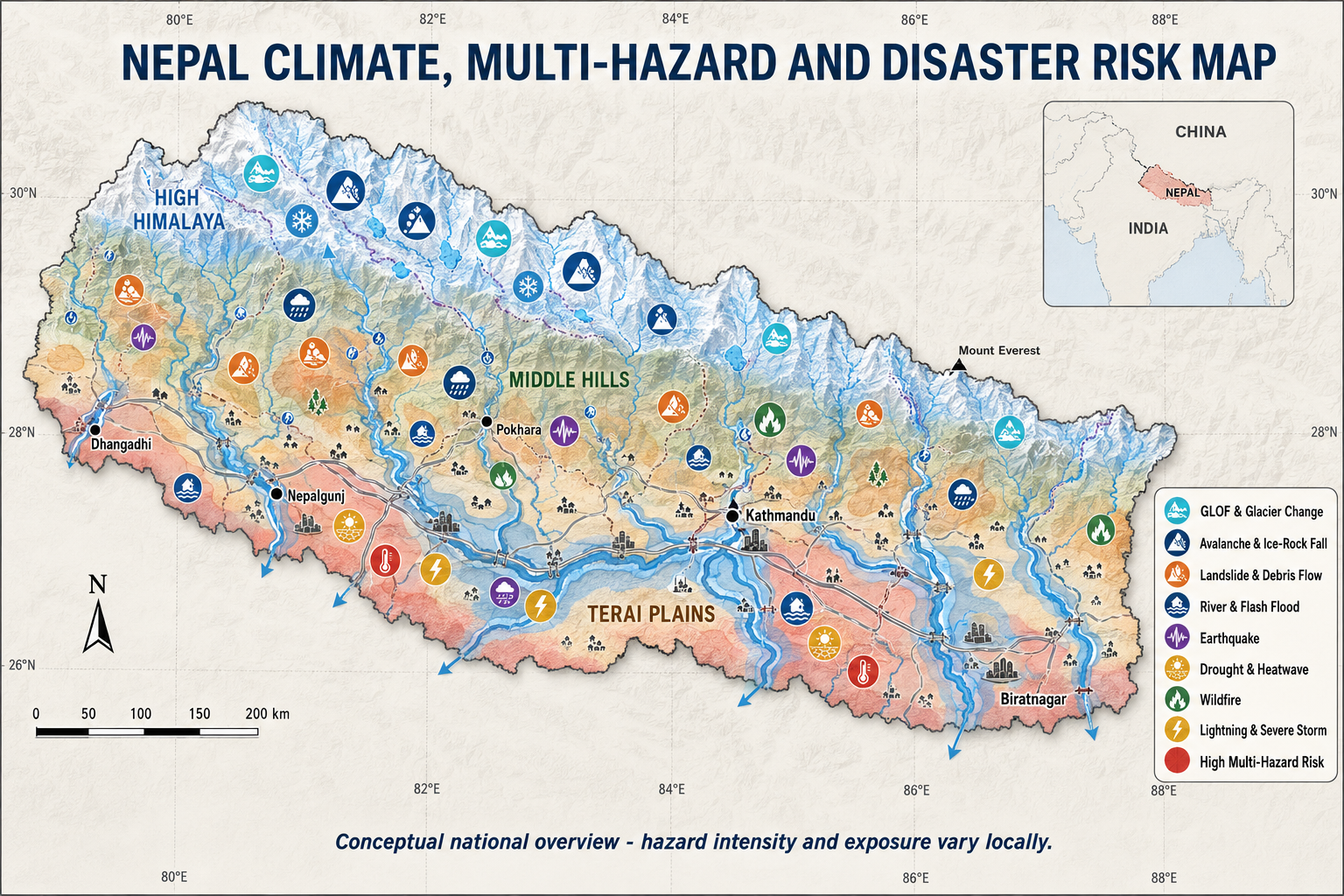
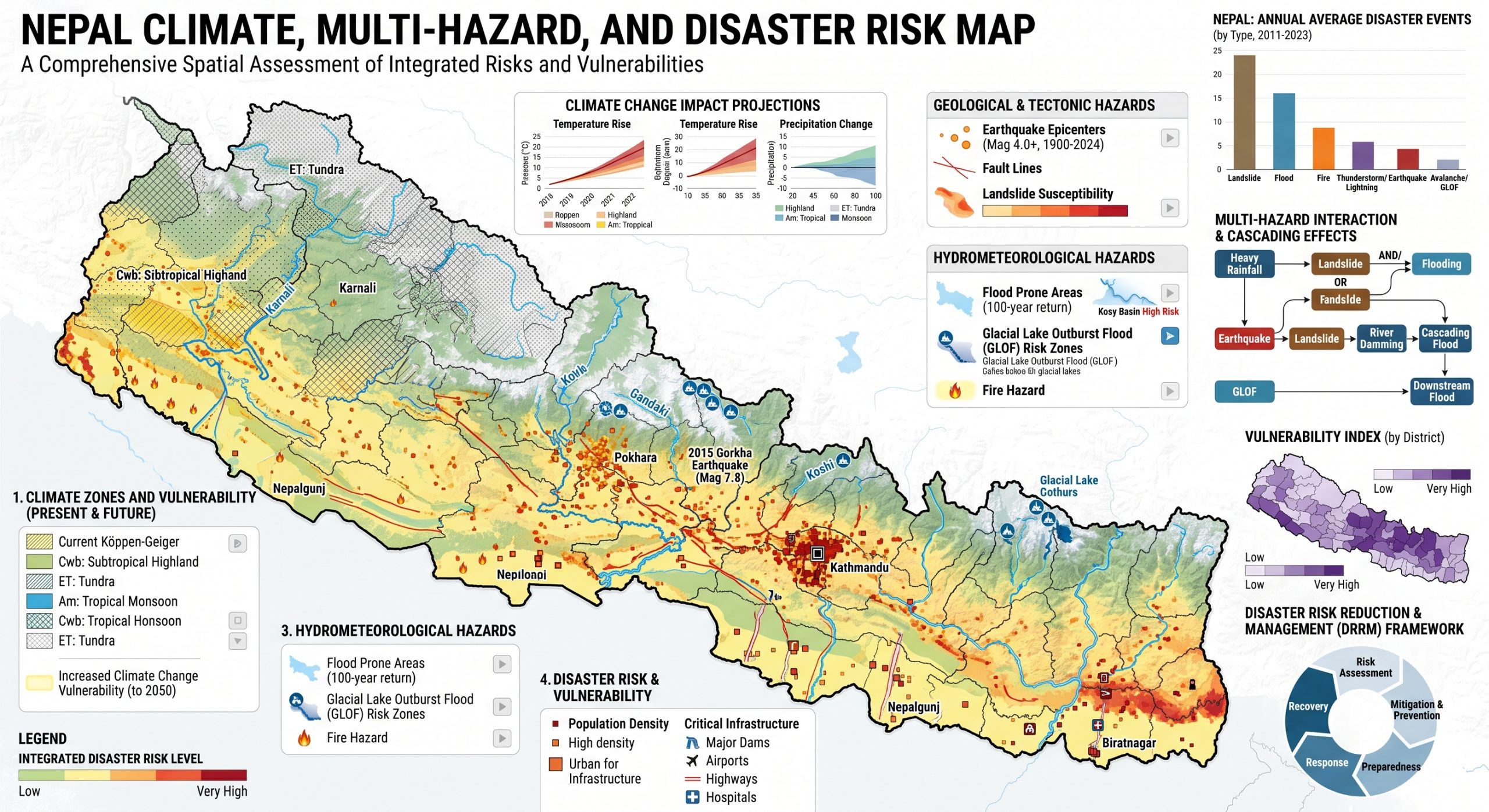
Nepal is highly vulnerable to climate change and multi-hazard risks due to its steep Himalayan terrain, fragile geology, active seismic setting, monsoon-driven rainfall, glacier-fed river systems, flood-prone Terai plains, and dependence on climate-sensitive sectors such as agriculture, water resources, hydropower, tourism, forests, and rural livelihoods. Major hazards include earthquakes, riverine floods, flash floods, landslides, glacial lake outburst floods, droughts, avalanches, heat stress, cold waves, wildfires, soil erosion, and climate-sensitive health risks. More than 80% of Nepal’s population is exposed to natural-hazard risk, including earthquakes, floods, droughts, and landslides. (PreventionWeb).


Nepal is highly exposed and vulnerable to climate change and multi-hazard risks due to its steep Himalayan terrain, fragile geology, active seismic setting, monsoon rainfall variability, glacier-fed river systems, flood-prone Terai plains, and dependence on climate-sensitive agriculture, water resources, hydropower, tourism, and rural livelihoods. The country faces recurrent and severe risks from earthquakes, floods, flash floods, landslides, glacial lake outburst floods, droughts, avalanches, heat stress, cold waves, wildfires, soil erosion, and climate-sensitive health impacts. Climate change is expected to intensify these vulnerabilities through rising temperatures, glacier retreat, changing snow and meltwater regimes, extreme rainfall, increased flood and landslide risk, higher GLOF potential, drought stress, water insecurity, and growing pressure on livelihoods, infrastructure, public health, ecosystems, and vulnerable mountain, hill, and Terai communities. Strengthening multi-hazard early warning systems, impact-based forecasting, flood and landslide risk reduction, GLOF monitoring, earthquake preparedness, climate-resilient agriculture, water security, resilient infrastructure, disaster risk financing, and locally led adaptation is essential to reduce losses and protect Nepal’s development gains.
1. Multi-hazard exposure
Nepal’s risk profile combines hydrometeorological, cryospheric, geophysical, and environmental hazards. Floods and landslides are among the most frequent hazards, while earthquakes remain a major catastrophic risk because Nepal lies in an active Himalayan seismic zone. The World Bank’s Nepal CCDR notes that floods and landslides have been the most frequent hazards over the past 40 years and are expected to increase as climate change accelerates. (IFC)
Floods affect the Terai plains, river valleys, urban settlements, and downstream communities, while landslides and debris flows are concentrated in the mid-hills, mountain slopes, road corridors, and fragile watersheds. Earthquakes can trigger cascading hazards such as landslides, avalanches, road blockages, dam or hydropower damage, and disruption to schools, health facilities, water systems, and transport networks. (PMC)
2. Climate change as a risk multiplier
Climate change is increasing Nepal’s exposure to compound and cascading hazards. Rising temperatures are accelerating glacier retreat and altering snowmelt patterns, while more intense rainfall increases the likelihood of flash floods, slope failure, debris flows, landslides, riverbank erosion, and urban flooding. Nepal’s National Adaptation Plan 2021–2050 prioritizes adaptation across agriculture and food security, forests and biodiversity, water resources and energy, health, urban settlements and infrastructure, tourism, and disaster risk reduction. (UNFCCC)
Recent events demonstrate how intense rainfall can quickly become a national disaster. In September 2024, severe rains triggered floods and landslides that killed at least 192 people, damaged homes, hospitals, roads, and markets, and severely affected the Kathmandu Valley and other areas. (Reuters)
3. Flood, landslide, and GLOF vulnerability
Flooding is one of Nepal’s most damaging recurrent hazards. The Terai plains face riverine flooding, inundation, drainage congestion, and riverbank erosion, while the hill and mountain regions face flash floods, cloudburst-driven runoff, debris flows, and landslides. These hazards damage roads, bridges, hydropower facilities, irrigation canals, farmland, settlements, schools, health posts, and local markets.
Landslide risk is especially high where intense rainfall interacts with fragile geology, steep slopes, deforestation, road cutting, poorly engineered hill roads, quarrying, settlement expansion, and weak drainage. This makes landslides not only a natural hazard but also a development-planning and infrastructure-governance challenge.
Glacial lake outburst floods (GLOFs) are a critical high-mountain hazard. As glaciers retreat and glacial lakes expand, downstream valleys, hydropower infrastructure, bridges, trails, roads, tourism areas, and settlements may face sudden, high-energy flood waves. GFDRR’s work on glacial lakes and GLOFs in Nepal highlights the importance of systematic glacial-lake monitoring, risk assessment, and early warning.
4. Earthquake and cascading-risk vulnerability
Earthquake risk remains central to Nepal’s multi-hazard profile. The 2015 Gorkha earthquake demonstrated how seismic hazards can trigger building collapse, landslides, avalanches, road blockages, and long-term reconstruction challenges. In Nepal’s mountain setting, earthquake risk cannot be treated separately from landslide, transport, hydropower, and settlement risk. (PMC)
Priority exposed systems include rural housing, schools, hospitals, bridges, roads, hydropower assets, water systems, historical sites, and dense urban settlements. Earthquake-safe construction, retrofitting, slope-risk screening, and emergency preparedness remain essential for national resilience.
5. Agriculture, water, and livelihood vulnerability
Agriculture is highly climate-sensitive because many rural households depend on rainfed farming, small landholdings, livestock, springs, irrigation canals, forests, and seasonal labour. Nepal’s NAP identifies reduced crop productivity and production associated with heat and drought stress, extreme precipitation, inundation, flooding, landslides, hailstorms, and other climate hazards. (UNFCCC)
Water resources are also increasingly exposed. Glacier retreat, snowpack changes, erratic monsoon rainfall, drought, spring drying, flood contamination, and sedimentation affect drinking water, irrigation, hydropower, ecosystems, and downstream river-basin management. Hydropower, a major economic priority for Nepal, is vulnerable to GLOFs, sediment loads, landslides, flood damage, low dry-season flows, and climate-driven hydrological variability. (World Bank)
6. Sector-specific vulnerability summary
| Sector | Main climate and multi-hazard risks |
|---|---|
| Agriculture and food security | Drought, erratic monsoon rainfall, floods, landslides, hailstorms, pests, crop failure |
| Water resources | Glacier retreat, snowmelt change, spring drying, flood contamination, drought, river-flow variability |
| Hydropower and energy | GLOFs, sedimentation, landslides, flood damage, low dry-season flows |
| Transport infrastructure | Landslides, road washouts, bridge damage, slope failure, earthquake impacts |
| Urban settlements | Flooding, drainage failure, earthquakes, heat stress, informal settlement exposure |
| Mountain communities | GLOFs, avalanches, landslides, isolation, water stress, tourism disruption |
| Terai communities | Riverine floods, inundation, riverbank erosion, heat stress, waterborne diseases |
| Health | Heat stress, cold waves, vector-borne disease, waterborne disease, disaster-related service disruption |
7. Social vulnerability
The most vulnerable groups include smallholder farmers, landless households, mountain communities, Terai floodplain communities, women-headed households, children, older persons, people with disabilities, informal urban settlers, migrant-worker households, Indigenous peoples, and communities living along rivers, unstable slopes, glacial-lake downstream areas, or earthquake-prone settlements.
Vulnerability is highest where exposure overlaps with poverty, weak housing, difficult road access, low savings, limited insurance, fragile livelihoods, weak drainage, and limited last-mile early warning. Unplanned road construction, riverbank settlement, and expansion into hazard-prone slopes can further increase risk.
8. Priority resilience needs
Nepal’s resilience agenda should prioritize multi-hazard early warning systems, impact-based forecasting, flood and landslide forecasting, GLOF monitoring, earthquake preparedness, climate-resilient agriculture, watershed management, resilient roads and bridges, spring-source protection, hydropower risk screening, urban drainage improvement, disaster risk financing, and locally led adaptation.
| Priority area | Key actions |
|---|---|
| Early warning and anticipatory action | Impact-based warnings for floods, landslides, GLOFs, drought, heat, cold waves, and earthquakes |
| Flood and landslide risk reduction | Basin forecasting, landslide susceptibility mapping, slope stabilization, drainage improvement |
| GLOF and mountain-risk management | Glacial-lake monitoring, downstream hazard mapping, sirens, evacuation routes, remote sensing |
| Earthquake resilience | Safer construction, retrofitting schools and hospitals, seismic risk mapping, preparedness drills |
| Climate-resilient agriculture | Drought-, flood-, and heat-tolerant crops; agro-advisories; crop insurance; soil conservation |
| Water security | Spring protection, rainwater harvesting, watershed restoration, drought contingency planning |
| Infrastructure resilience | Climate- and seismic-resilient roads, bridges, hydropower, schools, clinics, and water systems |
National Disaster Risk Reduction and Management Authority
National Disaster Risk Reduction and Management Authority
Section 10 of the Disaster Risk Reduction and Management Act, 2074 provides for the National Disaster Risk Reduction and Management Authority. The authority was established on 29/07/2076 with the appointment of the executive head. This authority acts as a central resource body related to disaster risk reduction and management. Currently, its office is located in Singha Darbar, Kathmandu, the authority’s work, duties and powers are as follows.
The authority’s work, duties and rights are as follows:
(a) To implement and execute plans, programs and decisions approved by the Council and Executive Committee,
(b) To act as a central resource body related to disaster risk reduction and management,
(c) To study, investigate, conduct studies on river control, floods, landslides, earthquakes, global temperature rise, climate change, land use and possible causes and mitigation measures of various disasters and calamities,
(d) To provide financial and technical support to the provincial and local levels as needed to prepare periodical plans related to disaster management,
(e) Involving non-governmental organizations, private sector and local communities in disaster management activities, coordinating and facilitating their activities,
(f) Formation and capacity building of search and rescue teams at federal, state and local levels to provide effective search, rescue and relief.
(g) Upon the occurrence of a disaster, to rescue the people in the areas that may be affected by such incidents, and coordinate with the relevant agencies to arrange a reliable security system for the livelihood of the residents affected by the disaster,
(h) To mobilize the security agencies, search and rescue groups, flying squads, local communities, Nepal Red Cross Society, Nepal Scouts, volunteers, experts and other related organizations for the search and rescue of disaster victims,
(i) To arrange and arrange the national and international search and rescue teams and the cash and relief materials received for humanitarian aid after the disaster.
(j) Keeping integrated records of international, bilateral and multilateral aid received in the field of disaster management,
(k) Collecting, analyzing, storing and communicating information and data related to disaster management by developing and operating the National Disaster Management Information System,
(l) Providing advice and suggestions to various agencies of the Government of Nepal and other organizations on matters related to disaster risk reduction and management,
(m) To determine the subject and criteria of basic orientation training related to disaster management to be given by public institutions and commercial establishments to their employees and workers,
(n) In relation to disaster management, the federal, state and local level administrative and security systems should be put in place so that they can be immediately mobilized.
(o) To increase public awareness regarding disaster risk reduction,
(p) To study, investigate, conduct and use appropriate technology for disaster risk reduction, such as geology, seismology, water and meteorology, geographic information system, remote sensing system, early warning system, etc. , causing,
(q) To provide advance information to all concerned about the possible occurrence of a disaster, to collect, analyze and communicate immediate information and to operate and manage the National Emergency Operation Center to coordinate and mobilize search, rescue and relief work,
(r) formation of flying squads for immediate deployment in times of calamity;
(s) Establishing volunteer bureaus for immediate mobilization for search, rescue and relief operations during disasters;
(t) mobilizing local charities and volunteers for the construction of temporary rehabilitation and learning centers for the citizens of disaster-affected areas,
(u) Coordinating and mobilizing private and non-governmental organizations, local communities and other stakeholders in disaster response,
(v) To operate an emergency warehouse for disasters and to manage the relief materials received,
(w) To provide psychosocial counseling services for people affected by disasters,
(x) To monitor whether the ministries, departments and other agencies of the Government of Nepal have fulfilled the roles and responsibilities determined by the Executive Committee in relation to disaster management and submit a report to the Executive Committee.
(y) To perform other tasks related to disaster management as specified.
https://ndrrma.gov.np/en/plan/205
Contact Details
National Disaster Risk Reduction and Management Authority
Singha Durbar, Kathmandu
P.O. Box no. 213213
NEOC Toll Free: 1149
Telephone: 01-4211535, 01-4211197, 01-4211553
Email: info@bipad.gov.np, ndrrma@gmail.com
Web Link: www.ndrrma.gov.np
Useful Documents on Climate and Multi-Hazard Risk in Nepal
https://drive.google.com/drive/folders/1pD81-qqEpx_xlhu3NL6LFs5QXyQiRY52?usp=sharing