Still under construction
Climate risk and vulnerabilities of Sri Lanka
Sri Lanka is highly vulnerable to climate change and multi-hazard risks because of its island geography, monsoon-driven rainfall variability, exposed coastal belt, mountainous central highlands, flood-prone river basins, dependence on climate-sensitive agriculture and water resources, and concentration of people, infrastructure, and economic activity in hazard-prone urban and coastal areas. The country faces recurrent risks from floods, flash floods, landslides, droughts, cyclones and storm events, coastal erosion, sea-level rise, saltwater intrusion, lightning, high winds, heat stress, and climate-sensitive health risks. Sri Lanka’s National Adaptation Plan identifies prolonged droughts, flash floods, and landslides as major climate-related threats affecting lives, livelihoods, infrastructure, and development. (UNFCCC)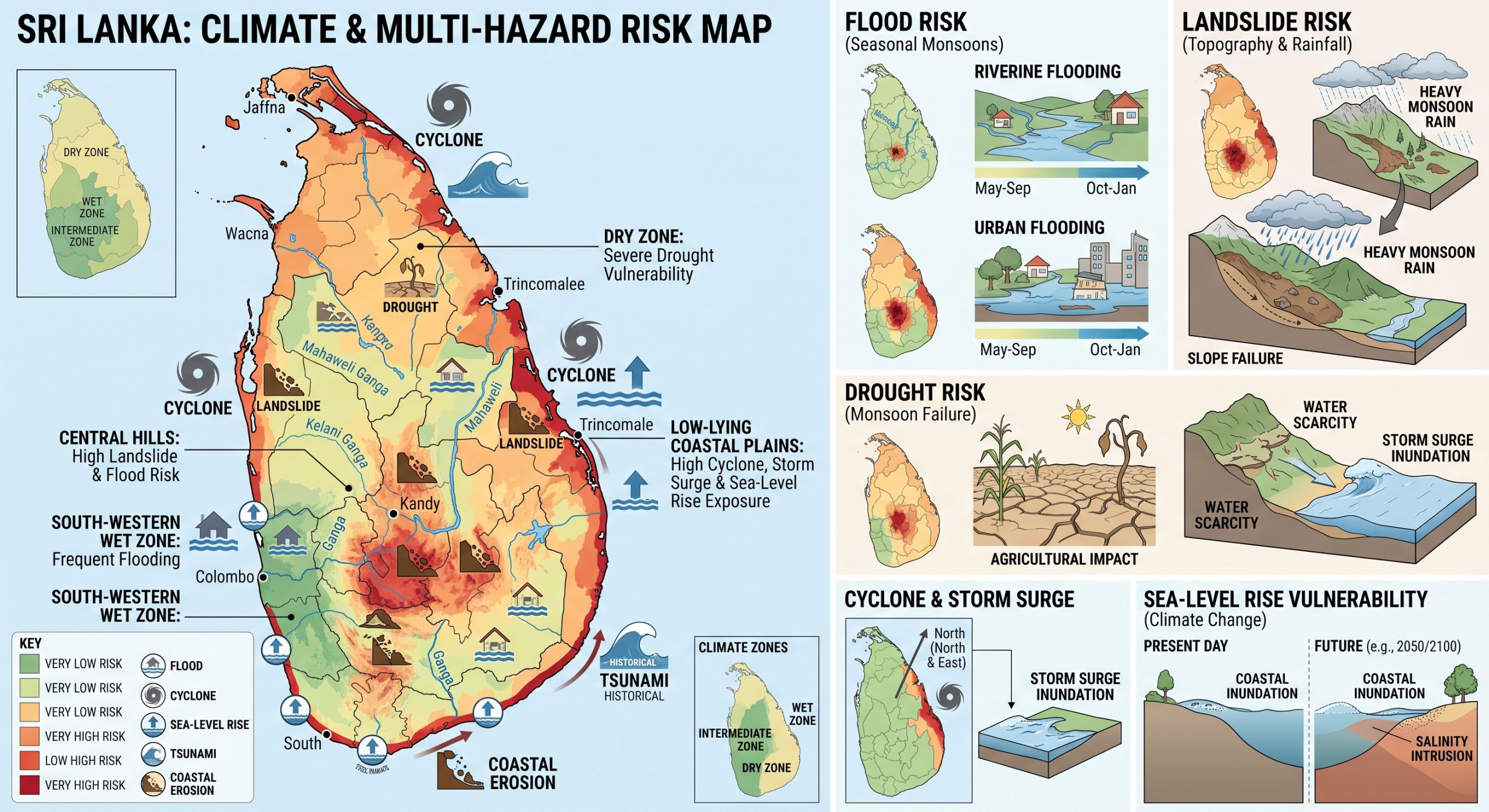
Sri Lanka is highly exposed and vulnerable to climate change and multi-hazard risks due to its monsoon climate, island geography, steep central highlands, flood-prone river basins, exposed coastal belt, rapid urbanization, and dependence on climate-sensitive agriculture, water resources, fisheries, tourism, and infrastructure. The country faces recurrent risks from floods, flash floods, landslides, droughts, cyclones and storm-related extreme rainfall, coastal erosion, sea-level rise, saltwater intrusion, high winds, heat stress, and climate-sensitive disease outbreaks. Climate change is expected to intensify these vulnerabilities through rising temperatures, more variable rainfall, heavier rainfall extremes, prolonged dry spells, increased flood and landslide risk, coastal inundation, water insecurity, crop losses, and growing pressure on health, livelihoods, infrastructure, ecosystems, and vulnerable communities. Strengthening multi-hazard early warning systems, impact-based forecasting, flood and landslide risk reduction, drought and water-security planning, climate-resilient agriculture, coastal adaptation, resilient urban drainage, disaster risk financing, and locally led adaptation is essential to reduce losses and protect Sri Lanka’s development gains.

1. Multi-hazard exposure
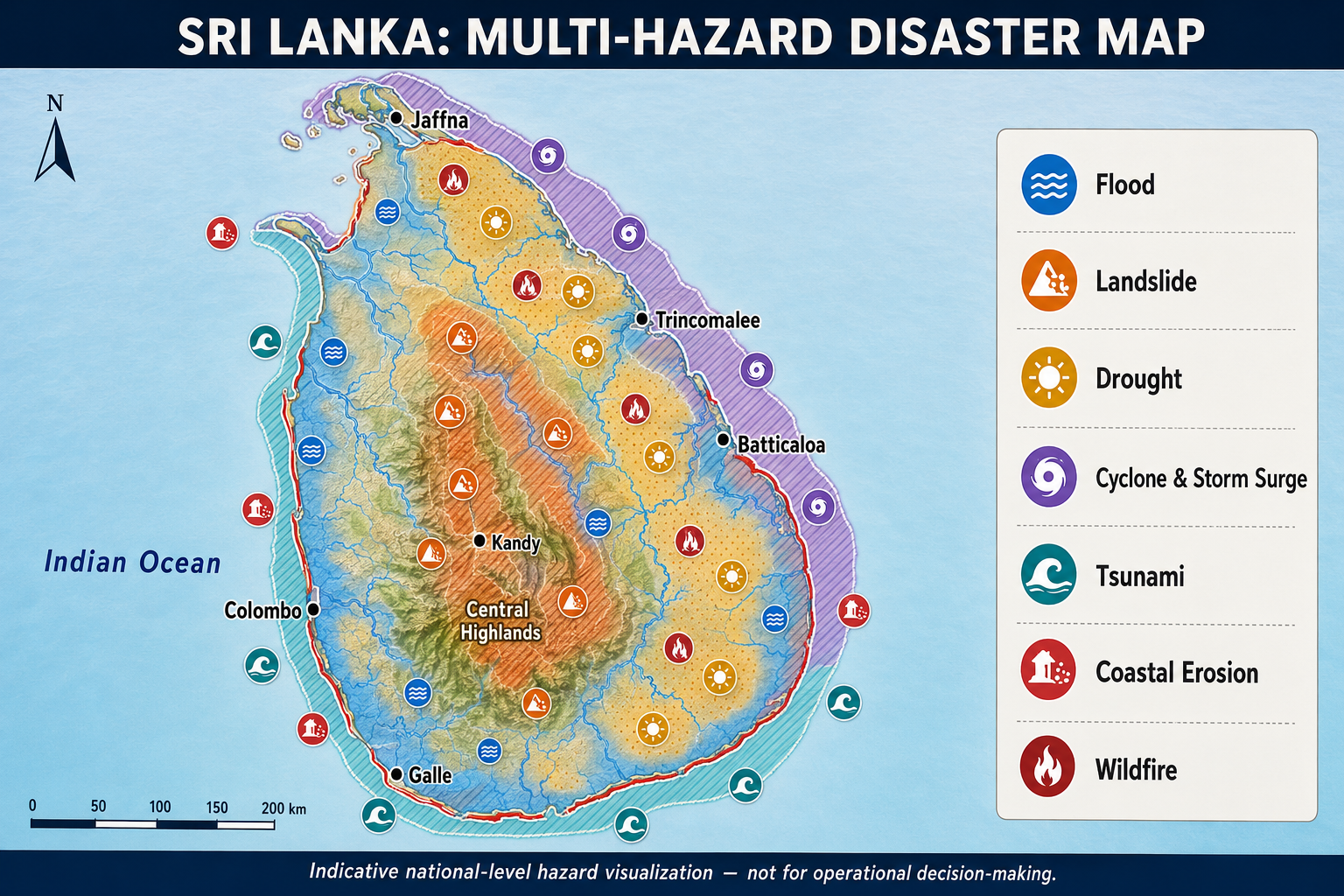
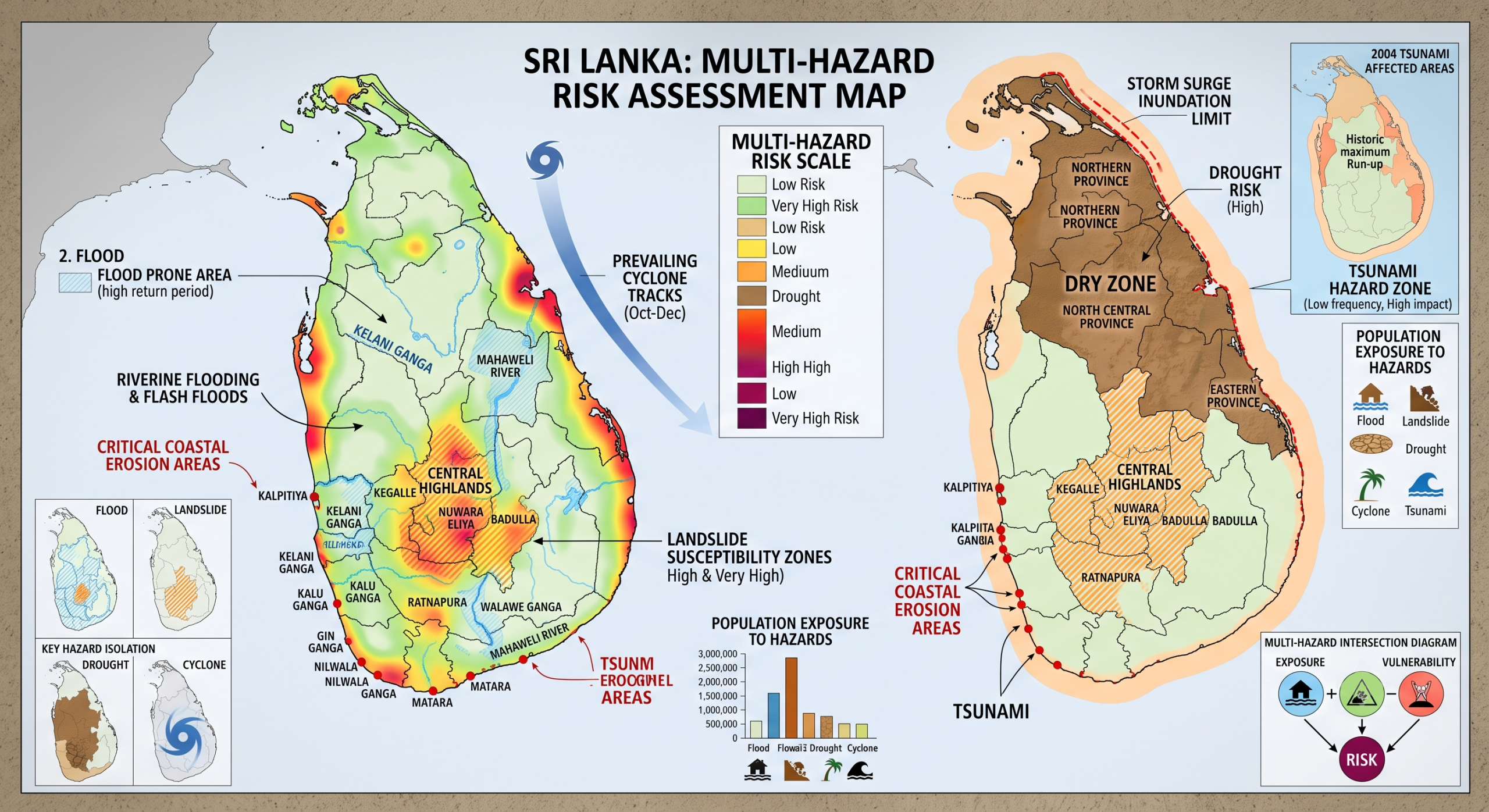
Sri Lanka’s main climate and disaster risks are floods, landslides, droughts, cyclones, high winds, coastal erosion, sea-level rise, and lightning-related hazards. The World Bank Climate Change Knowledge Portal identifies Sri Lanka as exposed to flooding, drought, landslides, cyclones, and coastal hazards, with flooding also increasing disease-transmission risks after extreme rainfall events. (Climate Change Knowledge Portal)
The country’s risk profile is strongly seasonal. The southwest and northeast monsoons drive much of the annual rainfall, while intense rainfall over steep terrain can rapidly trigger flash floods, landslides, slope failures, river overflow, road damage, and reservoir-management challenges. Drought risk is more prominent in the dry zone, where rainfall deficits affect agriculture, drinking water, irrigation, livestock, and rural livelihoods.
2. Flood and landslide vulnerability
Floods and landslides are among Sri Lanka’s most recurrent and damaging hazards. Heavy monsoon rainfall can trigger riverine flooding, flash floods, urban floods, landslides, debris flows, and slope failures, particularly in the central highlands, western and southwestern wet-zone districts, and densely settled urban areas. A GFDRR assessment of Sri Lanka’s 2017 floods and landslides reported that heavy rain and high winds affected 879,778 people and caused 219 deaths, illustrating the scale of disaster impacts from extreme rainfall events. (gfdrr.org)
Landslide risk is especially high in hilly and mountainous districts such as Kandy, Nuwara Eliya, Badulla, Ratnapura, Kegalle, Matale, Kalutara, Galle, and Matara, where steep slopes, intense rainfall, road cuts, settlement expansion, deforestation, poor drainage, and land-use changes increase slope instability. The National Building Research Organisation maintains landslide hazard zonation mapping, reflecting the importance of landslide risk in national planning and early warning.
3. Drought, water security, and agriculture
Drought is a major climate risk in Sri Lanka, especially in the dry and intermediate zones, where agriculture, irrigation, rural water supply, livestock, and household livelihoods depend heavily on seasonal rainfall and reservoir storage. UNDP notes that around one-third of the population faces vulnerability related to water sources, with dry-zone communities and the Northern region particularly affected by water scarcity and uneven water access. (UNDP Adaptation)
Agriculture is highly climate-sensitive. Rice, tea, coconut, rubber, vegetables, spices, livestock, and fisheries are exposed to drought, floods, rainfall variability, heat stress, pests, diseases, soil erosion, and salinity intrusion. Climate shocks can disrupt planting calendars, reduce crop yields, damage irrigation systems, increase food prices, and weaken rural livelihoods.
4. Coastal vulnerability and sea-level rise
Sri Lanka’s coastal belt is exposed to sea-level rise, coastal erosion, storm surge, saltwater intrusion, coastal flooding, and marine ecosystem degradation. These risks matter because many settlements, roads, ports, fishing communities, tourism assets, wetlands, lagoons, and urban centres are located close to the coast. Sri Lanka’s adaptation planning includes measures to minimize sea-level-rise impacts on water resources, coastal areas, wetlands, and monitoring systems. (Asia Pacific Energy Policy)
Coastal erosion and salinity intrusion can affect drinking-water sources, coastal agriculture, fisheries, tourism, housing, and transport corridors. Coastal cities and towns such as Colombo, Galle, Matara, Trincomalee, Batticaloa, Jaffna, Negombo, Kalutara, and Hambantota face different combinations of coastal flooding, erosion, drainage stress, and infrastructure exposure.
5. Climate change as a risk multiplier
Climate change is expected to intensify Sri Lanka’s hazard profile by increasing temperatures, altering rainfall patterns, increasing rainfall extremes, worsening drought stress, amplifying flood and landslide risks, and increasing coastal exposure through sea-level rise. The ADB climate risk profile for Sri Lanka synthesizes risks across natural hazards, sectoral climate impacts, and adaptation priorities, confirming that climate change has implications for water, agriculture, health, coastal zones, biodiversity, and infrastructure. (Asian Development Bank)
Recent disasters illustrate the scale of compound risk. In 2025, Cyclone Ditwah brought torrential rain, floods, and landslides to Sri Lanka; Reuters reported major casualties, displacement, damaged infrastructure, and serious disruption to rice and tea production, with reconstruction needs estimated at around US$7 billion. (Reuters)
6. Sector-specific vulnerability summary
| Sector | Main climate and multi-hazard risks |
|---|---|
| Agriculture and food security | Drought, floods, erratic rainfall, heat stress, pests, crop loss, irrigation stress |
| Water resources | Drought, flood contamination, reservoir stress, groundwater pressure, salinity intrusion |
| Coastal zones | Sea-level rise, erosion, storm surge, coastal flooding, saltwater intrusion |
| Urban settlements | Flash floods, drainage congestion, heat stress, informal settlement exposure |
| Transport infrastructure | Road washouts, landslides, bridge damage, coastal road erosion, railway disruption |
| Tourism | Coastal erosion, storms, flood damage, water scarcity, ecosystem degradation |
| Health | Dengue and vector-borne disease, waterborne disease after floods, heat stress |
| Ecosystems | Forest degradation, watershed erosion, coral reef stress, wetland degradation |
7. Social vulnerability
The most vulnerable groups include smallholder farmers, fishing communities, tea estate workers, rural dry-zone households, low-income urban residents, informal settlers, coastal communities, women-headed households, children, older persons, people with disabilities, and communities living in flood-prone, drought-prone, landslide-prone, or coastal-risk areas.
Vulnerability is highest where exposure overlaps with poverty, weak housing, limited savings, insecure livelihoods, poor drainage, limited insurance coverage, restricted access to timely early warning, and repeated disaster losses.
8. Priority resilience needs
Sri Lanka’s resilience agenda should prioritize multi-hazard early warning systems, impact-based forecasting, flood and landslide risk mapping, drought monitoring, climate-resilient agriculture, water-resource management, coastal-zone protection, urban drainage improvement, slope stabilization, heat-health planning, disaster risk financing, and locally led adaptation.
A practical resilience package should include:
| Priority area | Key actions |
|---|---|
| Early warning and anticipatory action | Impact-based warnings for floods, landslides, drought, cyclones, heat, lightning, and coastal hazards |
| Flood and landslide risk reduction | River-basin forecasting, slope monitoring, hazard zonation, drainage upgrading, settlement risk reduction |
| Drought and water security | Reservoir management, groundwater monitoring, rainwater harvesting, drought contingency planning |
| Climate-resilient agriculture | Drought-, flood-, heat-, and salinity-tolerant crops; agro-climate advisories; crop insurance |
| Coastal resilience | Shoreline monitoring, mangrove and wetland restoration, coastal zoning, erosion control |
| Urban resilience | Stormwater drainage, flood-retention areas, heat-risk planning, risk-informed land-use planning |
| Risk financing | Contingency finance, forecast-based financing, insurance, scalable social protection |
Disaster Management Centre (DMC) https://www.dmc.gov.lk

National Council
The Sri Lanka Disaster Management Act No. 13 of 2005 was enacted on 13.05.2005 and Disaster Management Centre (DMC) was established with effect from 01.08.2005 as provided by the Act. The Act required establishing two important Institutions, namely The National Council for Disaster Management (NCDM) and The Disaster Management Centre (DMC) under the National Council for Disaster Management (NCDM) as the lead agency on disaster risk management in the country in implementing the directives of NCDM. In January 2006, the above Ministry was renamed as the Ministry of Disaster Management & Human Rights.

DMC Profile
Introduction
Disaster Management Centre (DMC) is the leading agency for disaster management in Sri Lanka. It is mandated with the responsibility of implementing and coordinating national and sub-national level programmes for reducing the risk of disasters with the participation of all relevant stakeholders.
DMC was established as per the provisions of the Sri Lanka Disaster Management Act No. 13 of 2005 as the executing agency of the National Council for Disaster Management (NCDM).
The main activities of the Disaster Management Centre (DMC) are Research and Development, Mitigation, Planning Preparedness, Dissemination of Early Warning for the vulnerable population, Emergency Response, Coordination of Relief and Post Disaster Activities in collaboration with other key agencies.
In order to facilitate the coordination and implement all DMC activities, Disaster Management Committees were established at District, Divisional, Grama Niladhari Wasams, across the country. Also District Disaster Management Coordination Units (DDMCU) were established in all districts to carry out Disaster Risk Reduction (DRR) activities at the sub national level.
Vision
Safer communities and sustainable development in Sri Lanka.
Mission
To create a culture of safety among communities and the nation at large through systematic management of natural, technological, and manmade disaster risks.
The principal functions of the DMC under the said Act are to
Assisting the Council in the preparation of the National Disaster Management Plan and the National Emergency Operation Plan and proposals for upgrading the same when it becomes necessary
Taking responsibility for the implementation of the National Disaster Management Plan and the National Emergency Operation Plan, and upon the declaration of a state of disaster to direct and coordinate the implementation of the National Emergency Operation plan
- Ensuring that the various Disaster Management Plans prepared by Ministries, Government Departments or public corporations conforms to the National Disaster Management Plan
- Based on Disaster Management Plans prepared by various Ministries, Government Departments and public corporations under section 10, preparing and implementing programmes and plans for disaster preparedness, mitigation, prevention, relief, rehabilitation and reconstruction activities and coordinating of organizations which implement such programmes and plans and obtain financial assistance form the Treasury for such activities and release the same to the relevant regions and monitor and evaluate these activities
- Issuing instructions and guidelines to appropriate organizations, non-governmental organizations, district secretaries and divisional secretaries on activities relating to disaster management and initiating and implementing work programmes in co-ordination with such organizations and secretaries
- Promoting research and development programmes in relation to disaster management and setting up and maintaining a data base on disaster management
- Submitting reports to the Council from time to time and whenever required by the Council in regard to its activities.
This Act also provides for a framework for disaster risk management in Sri Lanka and addresses disaster management (DM) holistically, leading to a policy shift from response based mechanisms to a proactive approach towards Disaster Risk Management.
In terms of the Act following hazards come under the purview of Disaster Management:
- Floods
- Landslides
- Industrial Hazards
- Tsunami (Seismic Wave)
- Earthquakes
- Air Hazards
- Fire
- Epidemics
- Explosions
- Air Raids
- Civil or Internal Strife
- Chemical Accidents
- Radiological Emergency
- Oil Spills
- Nuclear Disaster
- Urban and Forest Fire
- Coastal Erosion
In July 2005 the Disaster Management Centre (DMC) was established under the National Council for Disaster Management (NCDM) to be functional under H.E. the President.
In December 2005 a separate Ministry for Disaster Management was established under the Hon. Prime Minister. In February 2006 the Ministry for Disaster Management and Human Rights (M/DM&HR) was established with the subject of Human Rights listed under its purview. As per the gazette notification of February 2006 National Disaster Management Council, Disaster Management Centre and Department of Meteorology were placed within the purview of M/DM&HR. In 2010 National relief services Center was amalgamated with the Ministry of Disaster Management and Ministry was named as the Ministry of Disaster Management.
The DM functions implemented through the DMC according to gazette notification are as follows:
- Initiate and coordinate foreign aided projects for disaster mitigation, response and recovery
- Liaising with Ministries, Government authorities and agencies, private sector agencies, NGOs and INGOs and all other relevant agencies to ensure timely execution of such responsibility.
- Coordination and Management of relief activities pertaining to natural and man-made disasters.
- Coordinating awareness programs on natural disasters and man-made disasters
- Early warning systems
- Supervision of the activities of non-governmental organizations and social welfare voluntary agencies in relation to disaster management, provisions of relief and promotion of human rights
- Facilitation of and assistance to non-governmental organizations and social welfare voluntary agencies, in the fields of disaster management and human rights through countrywide Ministries, Departments and Public Corporations, Provincial Council, Local Authority Administration; and District, Division and Grama Niladhari administration; to enforce coordinate and monitor activities related to
- Hazard Mapping and Risk Assessment
- Information Management
- Disaster mitigation
- Early warning dissemination
- Preparedness for effective response at disaster situations
- Emergency Operations Management
- Management of the post-disaster activities after a disaster
Preparedness Planning
Main activities:
- Preparation, reviewing and updating National Disaster Management Plan and National emergency Operation Plan
- Coordinating, directing and monitoring of preparation of disaster preparedness and response plans at provincial, district, local authority, divisional and Grama Niladhari levels
- Coordinate and assist health authorities on preparation of preparedness plans for emergency response for hospitals
- Coordinate and assist Ministry of Education for implementing the School Disaster Safety Programme
- Strengthening Local Authorities for emergency response
- Development of response plans for different hazards such as cyclone, floods, landslides etc
- Identification of vulnerable communities for different hazards and implement preparedness activities to ensure the safety of people during disasters
- Formation of disaster management committees and sub committees\
- Awareness on disaster management, hazards, vulnerability
- Preparation of hazard map for the village showing safe locations, safe routes, etc
- Conducting mock drills
- Distribution of equipment such as megaphones for early warning dissemination within the village
- Distribution of equipment such as boats, anguls for emergency response
Sri Lanka launched the Landslide risk information online geospatial portal powered by ESRI GIS Suite ( Licensed online ArcGIS Pro )

https://lrip.nbro.gov.lk/portal/apps/webappviewer/index.html?id=7524ad70c98e4124a6f4dfed6ea615fe
DMC Profile
Introduction
Disaster Management Centre (DMC) is the leading agency for disaster management in Sri Lanka. It is mandated with the responsibility of implementing and coordinating national and sub-national level programmes for reducing the risk of disasters with the participation of all relevant stakeholders.
DMC was established as per the provisions of the Sri Lanka Disaster Management Act No. 13 of 2005 as the executing agency of the National Council for Disaster Management (NCDM).
The main activities of the Disaster Management Centre (DMC) are Research and Development, Mitigation, Planning Preparedness, Dissemination of Early Warning for the vulnerable population, Emergency Response, Coordination of Relief and Post Disaster Activities in collaboration with other key agencies.
In order to facilitate the coordination and implement all DMC activities, Disaster Management Committees were established at District, Divisional, Grama Niladhari Wasams, across the country. Also District Disaster Management Coordination Units (DDMCU) were established in all districts to carry out Disaster Risk Reduction (DRR) activities at the sub national level.
Vision
Safer communities and sustainable development in Sri Lanka.
Mission
To create a culture of safety among communities and the nation at large through systematic management of natural, technological, and manmade disaster risks.
The principal functions of the DMC under the said Act are to
Assisting the Council in the preparation of the National Disaster Management Plan and the National Emergency Operation Plan and proposals for upgrading the same when it becomes necessary
Taking responsibility for the implementation of the National Disaster Management Plan and the National Emergency Operation Plan, and upon the declaration of a state of disaster to direct and coordinate the implementation of the National Emergency Operation plan
- Ensuring that the various Disaster Management Plans prepared by Ministries, Government Departments or public corporations conforms to the National Disaster Management Plan
- Based on Disaster Management Plans prepared by various Ministries, Government Departments and public corporations under section 10, preparing and implementing programmes and plans for disaster preparedness, mitigation, prevention, relief, rehabilitation and reconstruction activities and coordinating of organizations which implement such programmes and plans and obtain financial assistance form the Treasury for such activities and release the same to the relevant regions and monitor and evaluate these activities
- Issuing instructions and guidelines to appropriate organizations, non-governmental organizations, district secretaries and divisional secretaries on activities relating to disaster management and initiating and implementing work programmes in co-ordination with such organizations and secretaries
- Promoting research and development programmes in relation to disaster management and setting up and maintaining a data base on disaster management
- Submitting reports to the Council from time to time and whenever required by the Council in regard to its activities.
This Act also provides for a framework for disaster risk management in Sri Lanka and addresses disaster management (DM) holistically, leading to a policy shift from response based mechanisms to a proactive approach towards Disaster Risk Management.
In terms of the Act following hazards come under the purview of Disaster Management:
- Floods
- Landslides
- Industrial Hazards
- Tsunami (Seismic Wave)
- Earthquakes
- Air Hazards
- Fire
- Epidemics
- Explosions
- Air Raids
- Civil or Internal Strife
- Chemical Accidents
- Radiological Emergency
- Oil Spills
- Nuclear Disaster
- Urban and Forest Fire
- Coastal Erosion
In July 2005 the Disaster Management Centre (DMC) was established under the National Council for Disaster Management (NCDM) to be functional under H.E. the President.
In December 2005 a separate Ministry for Disaster Management was established under the Hon. Prime Minister. In February 2006 the Ministry for Disaster Management and Human Rights (M/DM&HR) was established with the subject of Human Rights listed under its purview. As per the gazette notification of February 2006 National Disaster Management Council, Disaster Management Centre and Department of Meteorology were placed within the purview of M/DM&HR. In 2010 National relief services Center was amalgamated with the Ministry of Disaster Management and Ministry was named as the Ministry of Disaster Management.
The DM functions implemented through the DMC according to gazette notification are as follows:
- Initiate and coordinate foreign aided projects for disaster mitigation, response and recovery
- Liaising with Ministries, Government authorities and agencies, private sector agencies, NGOs and INGOs and all other relevant agencies to ensure timely execution of such responsibility.
- Coordination and Management of relief activities pertaining to natural and man-made disasters.
- Coordinating awareness programs on natural disasters and man-made disasters
- Early warning systems
- Supervision of the activities of non-governmental organizations and social welfare voluntary agencies in relation to disaster management, provisions of relief and promotion of human rights
- Facilitation of and assistance to non-governmental organizations and social welfare voluntary agencies, in the fields of disaster management and human rights through countrywide Ministries, Departments and Public Corporations, Provincial Council, Local Authority Administration; and District, Division and Grama Niladhari administration; to enforce coordinate and monitor activities related to
- Hazard Mapping and Risk Assessment
- Information Management
- Disaster mitigation
- Early warning dissemination
- Preparedness for effective response at disaster situations
- Emergency Operations Management
- Management of the post-disaster activities after a disaster
Download Documents
https://drive.google.com/drive/folders/1CFuQON9nuEtJOrrcyRZxS-NCbL8tLLly?usp=drive_link