Post Date
A Call for a Unified Global Commitment to Climate De-Risking: Advancing a Whole-of-Earth, Whole-of-Society Framework for Collective Climate Security and Reforming United Nations Roles in Climate Risk Management and Governance (Draft Proposal)
This proposal is protected by copyright. © 2026 Z M Sajjadul Islam, Advisor, Multi-Hazard Early Warning System Design and Implementation Center (MHEWC). All rights reserved. Any material quoted, reproduced, adapted, or extracted from this proposal must be properly cited and attributed to the author.
Introduction :
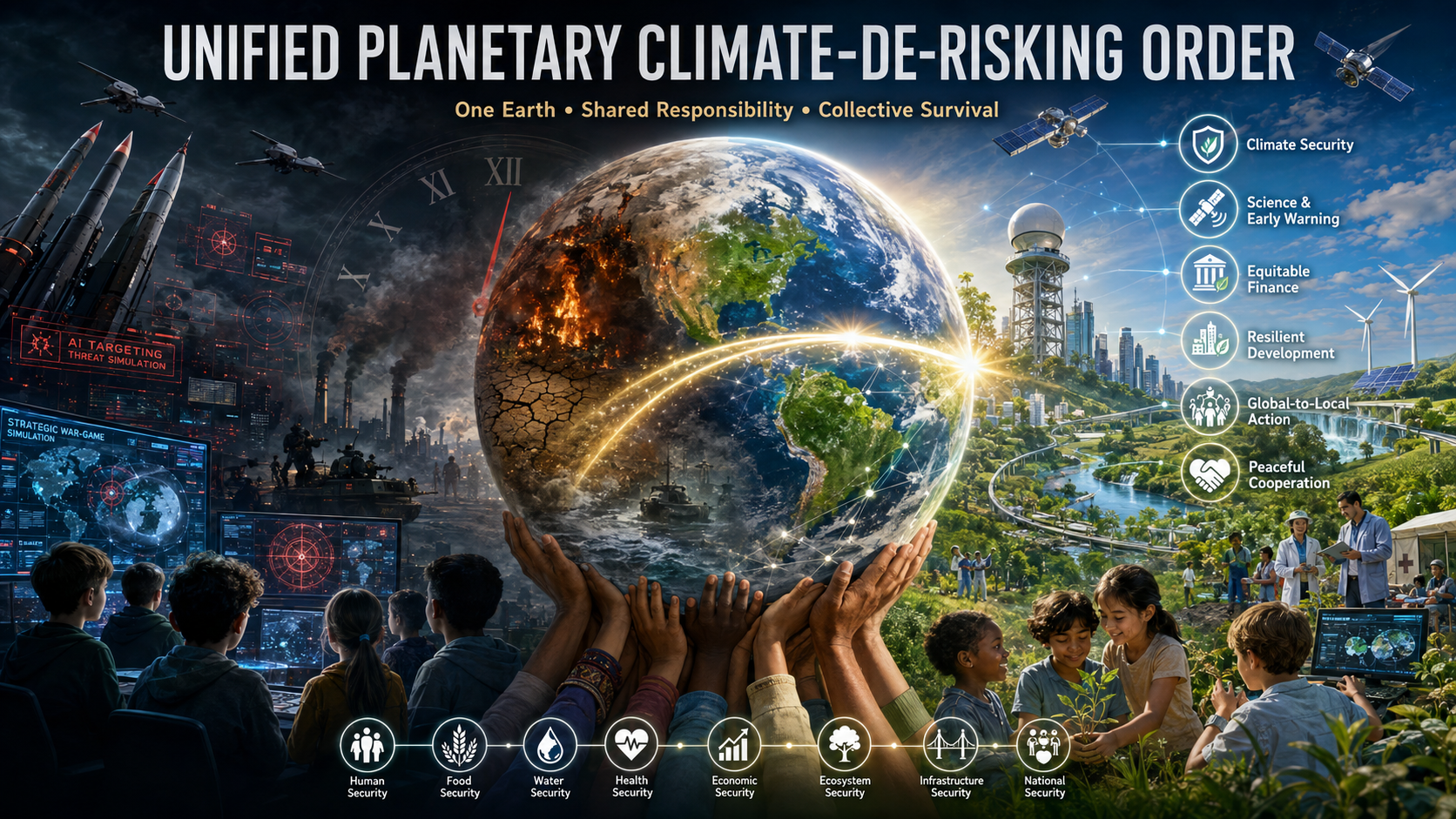
The world, including its youngest generations, is becoming increasingly captivated, gripped & consumed by the continuous development and modernization of destructive strategic weaponry, AI-driven military power, AI-simulation-driven war games, and escalating combat readiness. Children are increasingly exposed to AI-powered simulations, virtual warfare, and narratives of dominance trends that risk normalizing aggression, encouraging irrational and controlling behavior, and weakening the values of empathy, inclusion, compassion, and peaceful coexistence, while bypassing other impending existential threats out of the human-induced geopolitical power domains that are approaching catastrophe.
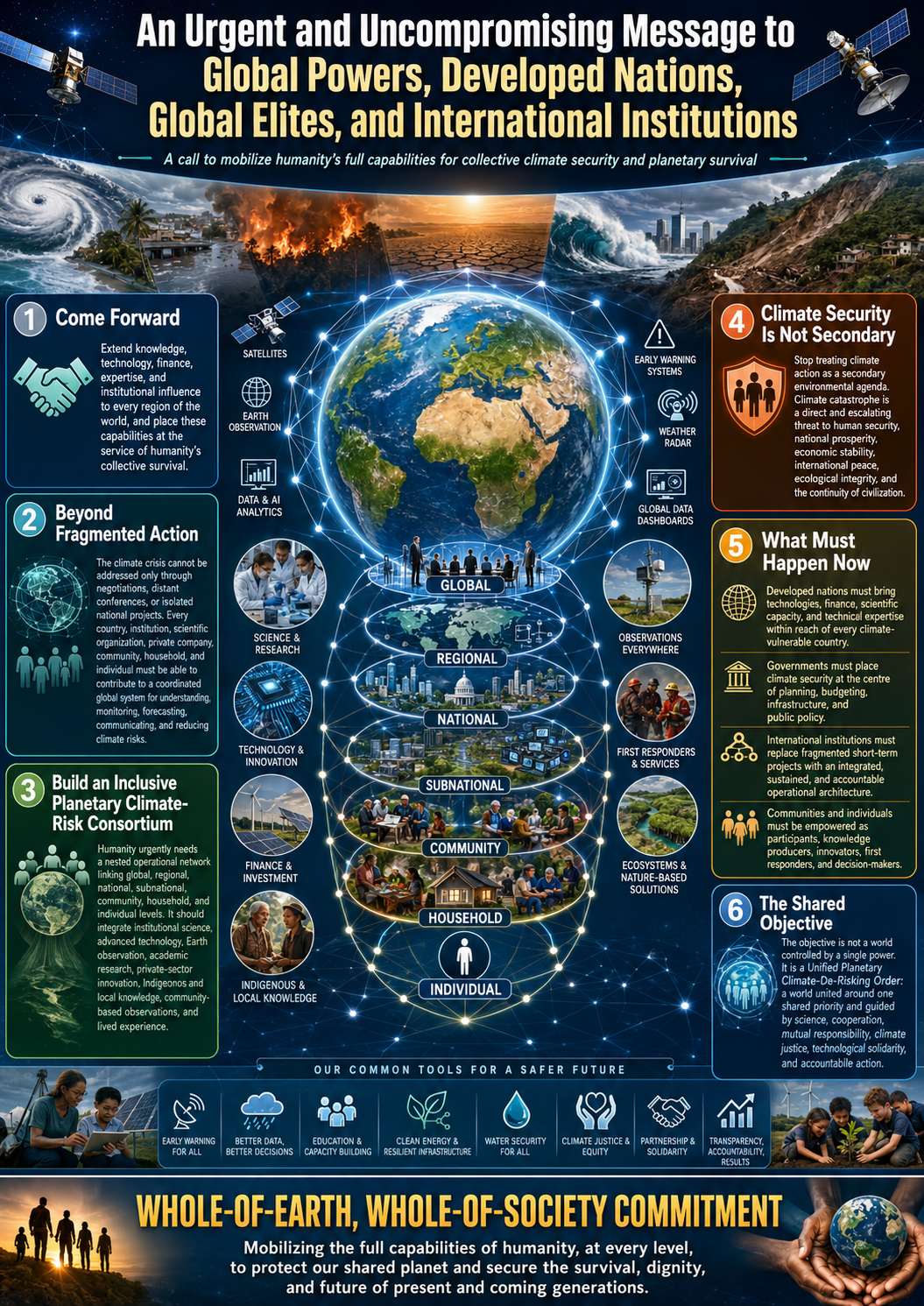
At this critical moment, humanity must instead cultivate a whole-of-society and whole-of-Earth mindset recognizing that we share one planet, must live together peacefully, and must work collectively to confront the escalating climate crisis. The world now stands on the brink of climate catastrophes that could affect every person, every society, and every element of the living Earth. Yet through relentless exploitation and prolonged neglect, humanity has effectively transformed our planet into a ticking time bomb.
The expression “unipolar climate-de-risking world” should not be interpreted as support for a world governed by any single dominant power-bloc, geopolitical bloc, military alliance, or totalitarian political ideology. Nor should it imply the concentration of global authority in one country or institution. Such an interpretation would reproduce the very inequalities, rivalries, and power imbalances that have weakened international cooperation and diverted attention from the escalating climate emergency.
In this context, the term should instead refer to a world aligned around one overriding planetary priority: protecting Earth, ecosystems, economies, infrastructure, and future generations from increasingly severe and interconnected climate catastrophes. The intended “unipolarity” is therefore not political, military, or ideological. It is a unity of purpose, a common global orientation toward tackling climate catastrophes, reducing disaster risk, advancing resilient development, and ensuring planetary survival.
A clearer and more appropriate policy formulation would be to establish a “Unified Planetary Climate-De-Risking Order”. This would represent a cooperative international framework in which all countries, institutions, sectors, and societies work to reduce climate-related risks through shared principles, coordinated responsibilities, interoperable systems, equitable financing, scientific cooperation, and collective accountability. Such an order would strengthen the capacity of states and neighboring cross-border countries, building trust and de facto technical relationships to protect their populations while recognizing that catastrophic climate risks frequently extend beyond national borders. Tropical storms, droughts, floods, heatwaves, wildfires, ecosystem degradation, sea-level rise, food-system disruption, disease outbreaks, and climate-induced displacement cannot be managed effectively through isolated national action but rather through collective international action, whole-of-the-earth and whole-of-society initiatives. They require cooperation across political boundaries, shared natural systems, regional institutions, technical agencies, scientific networks, global security intelligence, financial mechanisms, and frontline communities, etc.
Purpose and scope
This proposal asks the United Nations to establish a Unified Planetary Climate-De-Risking Order: a cooperative international framework in which all countries, institutions, sectors and societies reduce climate-related risk through shared principles, coordinated responsibilities, interoperable systems, equitable financing, scientific cooperation and collective accountability.
The term “unipolar” carries no geopolitical meaning here. It does not endorse a dominant power bloc, military alliance, political ideology, or the concentration of global authority in one country or institution. Such an arrangement would reproduce the rivalries that have weakened international cooperation. What is proposed is a unity of purpose: a common global orientation toward tackling climate catastrophes, reducing disaster risk, advancing resilient development and ensuring planetary survival.
The proposal is addressed to the UN Secretary-General and Under-Secretaries-General, to relevant policy bureaus and hubs, and to geopolitical powers, regional organisations, international financial institutions, major industries and national governments.
It is written against a specific backdrop. Public attention, capital and technical talent are being absorbed by strategic weaponry, AI-driven military power and simulated warfare, with children increasingly exposed to narratives of dominance that normalise aggression and erode empathy, inclusion and peaceful coexistence. Meanwhile the existential threat accumulating outside the geopolitical arena goes unaddressed.
The problem: a misallocated definition of security
Governments devote more political attention, public expenditure and technological capacity to conventional military security than to the catastrophic threats posed by climate change, ecosystem disruption and large-scale disasters. Defence budgets are routinely protected from reduction while climate adaptation, disaster-risk reduction, early warning, social protection and resilient infrastructure remain chronically underfunded.
The imbalance is sharpest in technology. States can field high-resolution military surveillance, missile tracking, cyber-intelligence and battlefield command systems, yet many cannot provide weather radar coverage, hydrological monitoring, lightning detection, flood forecasting or last-mile warning to exposed populations. Climate-vulnerable countries remain dependent on fragmented external projects rather than nationally owned, interoperable and sustainable systems.
Climate risk also differs in kind from the threats these budgets are built for. Political and military conflicts can be de-escalated through diplomacy, mediation and compromise. The drivers of climate catastrophe accumulate across decades, transcend political boundaries, and may become irreversible once critical thresholds are crossed. Rising greenhouse-gas concentrations, sea-level rise, biodiversity loss and land degradation cannot be reversed by a single agreement or an overnight decision.
Delay therefore compounds. Every year of inadequate action deepens the concentration of future risk and raises the eventual cost of preparedness, emergency response, recovery and reconstruction.
No country is shielded. Climate shocks transmit through insurance markets, energy systems, food prices, transport networks, supply chains, financial stability, public health and migration. Developing countries carry disproportionate impacts because of historical inequalities, limited fiscal capacity and climate-sensitive livelihoods, but the crisis threatens every society.
Six principles of the proposed order
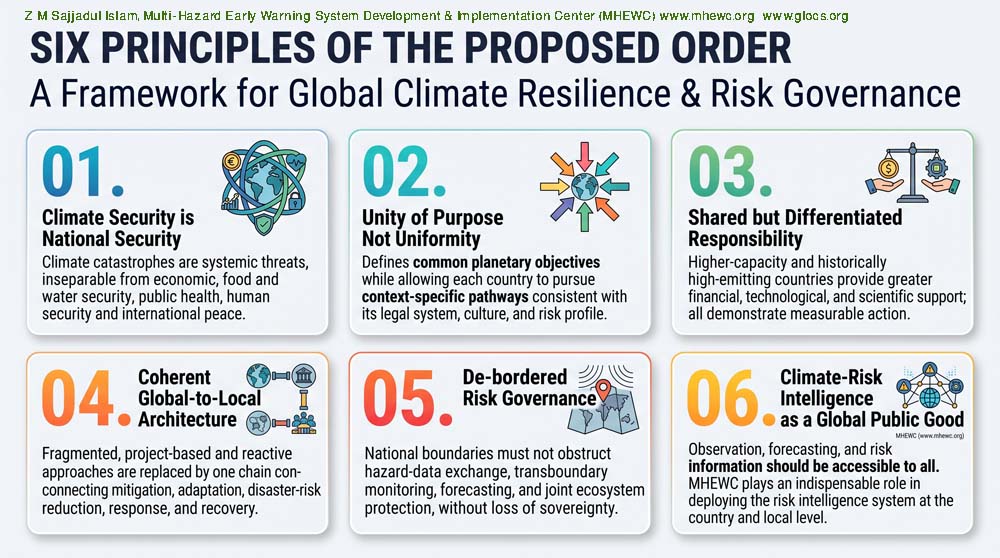
- Climate security is national security. It is inseparable from economic security, food and water security, public health, human security and international peace. Climate catastrophes are systemic threats, not secondary environmental concerns or occasional humanitarian emergencies.
- Unity of purpose, not uniformity. The framework defines common planetary objectives while allowing each country to pursue context-specific pathways consistent with its legal system, culture, development priorities and risk profile.
- Shared but differentiated responsibility. Higher-capacity and historically high-emitting countries provide greater financial, technological and scientific support; all countries demonstrate measurable action, transparent reporting and accountability for protecting vulnerable populations.
- A coherent global-to-local architecture, owned at the last mile. Fragmented, project-based and reactive approaches are replaced by one chain connecting mitigation, adaptation, disaster-risk reduction, early warning, anticipatory action, resilient infrastructure, response, recovery and loss-and-damage financing.
- De-bordered risk governance without loss of sovereignty. National boundaries must not obstruct hazard-data exchange, transboundary monitoring and forecasting, emergency communication, joint ecosystem protection or the timely delivery of actionable warnings.
- Climate-risk intelligence as a global public good. Observation, forecasting and risk information should be accessible to every country and community rather than concentrated in a few advanced institutions.
The proposed framework – Advancing a Whole-of-Earth, Whole-of-Society Framework for Collective Climate Security
The proposed framework should therefore bring countries together around a common understanding that climate security is inseparable from national security, economic security, food and water security, public health, human security, and international peace. Climate catastrophes should no longer be treated as secondary environmental concerns or occasional humanitarian emergencies. They should be recognized as systemic threats capable of destabilizing global ecosystem orders, damaging built-up human civilization, causing unrecoverable loss of life and property, displacing populations, and generating competition over increasingly scarce resources.
A “Unified Planetary Climate-De-Risking Order” would require the international community to move beyond fragmented, project-based, and reactive approaches. Climate action should be organized through a coherent global-to-local, last-mile-owned architecture that connects climate mitigation, adaptation, disaster-risk reduction, early warning, anticipatory action, environmental protection, resilient infrastructure, humanitarian response, recovery, reconstruction, and loss-and-damage financing.
At the global level, the framework should establish common policy principles and scientific standards; a global climate risk intelligence data-sharing platform (data center); Universities for researching and working on de-risking climate catastrophes; business call-to-action financing responsibilities; accountability mechanisms; and many other actions. At the regional level, it should strengthen transboundary climate-risk hubs (connecting with the global data center oversight and dispute resolution), integrated forecasting centers and networks up to the community level, river-basin institutions, shared-resource governance mechanisms, and cooperative emergency arrangements. At the national level, it should support integrated climate-risk governance systems, interoperable data platforms synchronized with the global data center, risk-informed planning at every local government sphere, reforming country-level fiscal budgetary allocations to more climate-responsive budgeting, and accountable institutional mandates. At the subnational and community levels, it should ensure that risk information, early warnings, financing, technology, and decision-making authority reach those most exposed to climate threats.
The framework should also correct the profound imbalance in global investment priorities. Vast financial, scientific, and technological resources continue to be directed toward national defense buildup, strategic rivalry, weapons development, and geopolitical competition, while many countries remain unable to finance basic climate observation networks, hydrological monitoring, weather radar, forecasting systems, resilient infrastructure, ecosystem restoration, local preparedness, and anticipatory action. A planetary climate-de-risking order should promote the progressive redirection of public and international investment toward climate-action-oriented measures.
Scientific and technological cooperation would be one of its central foundations. Countries should have equitable access to meteorological satellites, Earth observation data, climate modeling, artificial intelligence, high-performance computing, forecasting technologies, risk databases, geospatial platforms, and impact-based early warning systems. Climate-vulnerable and developing countries should not remain dependent on inaccessible technologies or fragmented external projects. They should be supported to develop sustainable national capacities, qualified institutions, operational infrastructure, and long-term technical ownership.
The proposed order should further establish a principle of shared yet differentiated responsibility for climate risk reduction. All countries face climate threats, but their historical contributions, financial capacities, technological resources, institutional strengths, and levels of exposure differ substantially. Responsibilities should therefore be distributed equitably. Higher-capacity and historically high-emitting countries should provide greater financial, technological, and scientific support, while governments of all LDCs and developing countries should demonstrate measurable national climate action, transparent reporting, and accountability in protecting vulnerable populations.
A unified framework must also remain politically inclusive. It should not impose a single development model, governance ideology, or institutional structure on all countries. Instead, it should define common planetary objectives while allowing countries to develop context-specific pathways consistent with their legal systems, cultures, development priorities, risk profiles, and institutional capacities. Unity should be achieved through shared outcomes and cooperative obligations, not through political domination or uniformity.
The ultimate objective is to build a world in which international cooperation is organized not around competition for dominance but around the collective reduction of existential risk. Under such an order, diplomacy would prevent conflict and facilitate climate cooperation; science would guide public policy; finance would be directed toward resilience and human security; technology would support early action; and global institutions would be assessed by their capacity to reduce measurable risks and protect vulnerable populations.
The central policy message is therefore clear: humanity does not need a geopolitically unipolar world. It needs a unified planetary climate-de-risking order built around one-world shared responsibility safeguarding the Earth’s life-support systems and ensuring the survival, security, dignity, and prosperity of present and future generations.
The following strategic propositions outline the pathway toward establishing a “Unified Planetary Climate-De-Risking Order”.
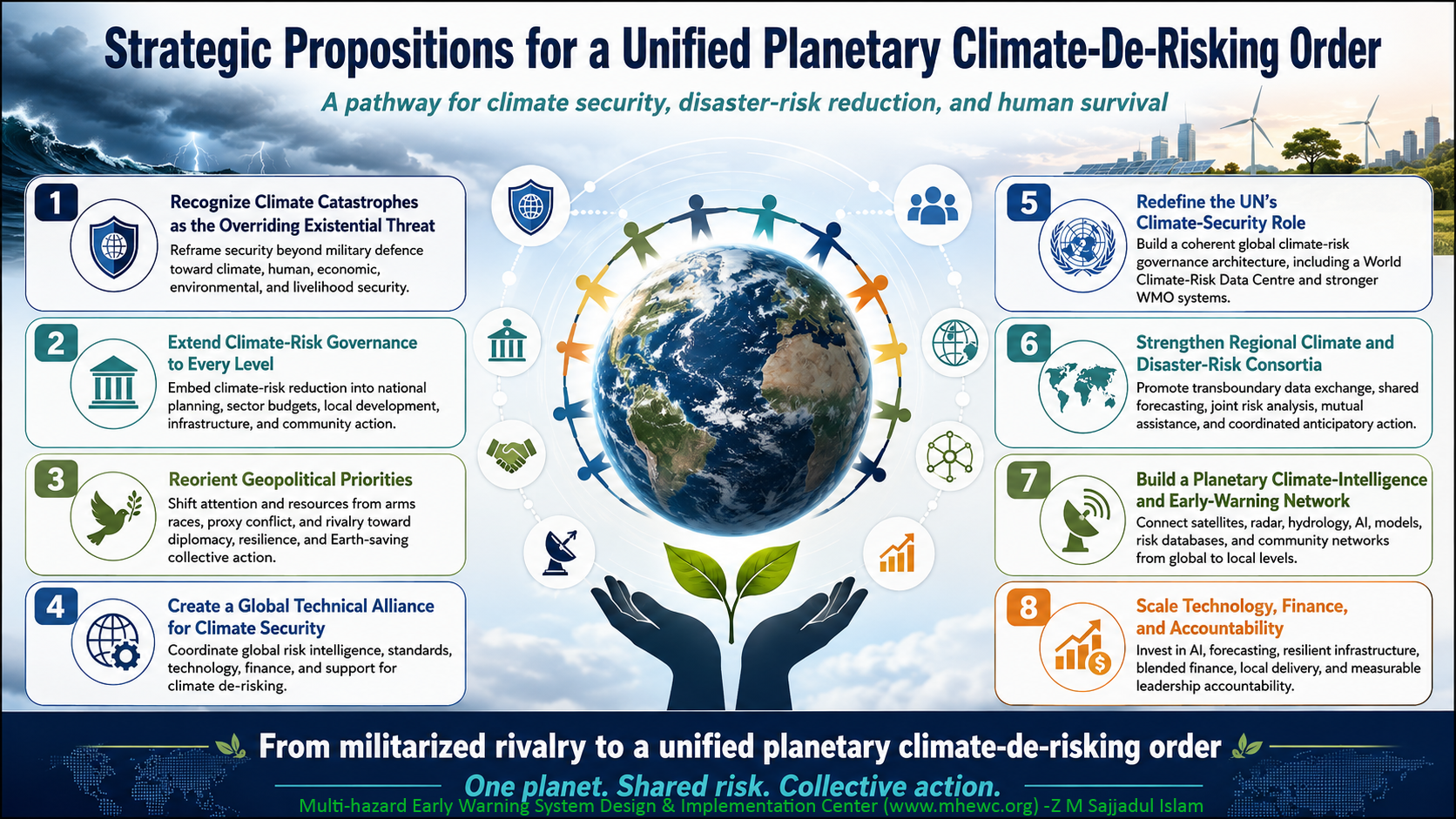
1) Climate catastrophes must become a global existential threat rather than nuclear warfare
Climate risks at national, regional, subnational, and community levels have remained persistently underprioritized. Governments frequently devote greater political attention, public expenditure, technological investment, and institutional capacity to conventional military security than to the catastrophic threats posed by climate change, environmental degradation, ecosystem disruption, and colossal-scale disasters.
National-security policies continue to focus primarily on territorial defense, military modernization, border control, strategic influence, and defense alliances. Meanwhile, investment in climate observation, weather forecasting, hydrological monitoring, ecosystem protection, disaster preparedness, multi-hazard early warning, anticipatory action, resilient infrastructure, and community-based adaptation remains inadequate in many countries, but why?
National-security doctrines must therefore evolve from predominantly territorial defense-centered approaches toward a broader framework of climate, human, economic, environmental, and livelihood security. Because climate change threatens all these foundations simultaneously, it must be treated as a planetary survival issue, not a marginal environmental concern. It must be recognized as central to human security, food security, sustainable development, and human existence on this earth.
These imbalanced global geopolitical and regional conflicts continue to encourage power players to invest largely in defense technology and military might, and build up a narrow understanding of the persistent ideology of what actual security means to the landscape and human existence as a whole!. A country cannot be considered genuinely secure until climate catastrophes are addressed alongside the development of advanced military technology and surveillance, command, and control. Its security also depends on its capacity to protect people’s lives, livelihoods, productive assets, essential services, critical infrastructure, natural resources, ecosystems, and long-term development from climate-related shocks and stresses.
Persistent geopolitical tensions and regional conflicts continue to drive major powers to invest heavily in defense technologies, military expansion, surveillance, and command-and-control systems. This imbalance reflects a narrow and outdated understanding of what genuine security means for human existence, national development, and the wider environment. A country cannot be considered truly secure merely because it possesses advanced military capabilities to combat one-dimensional threats to country security. Genuine national security also requires the capacity to anticipate, withstand, and respond effectively to climate-related catastrophes. It depends on protecting human lives, livelihoods, productive assets, essential services, critical infrastructure, natural resources, ecosystems, and long-term development from escalating climate shocks and stresses. Climate resilience must therefore be treated as an integral pillar of national, human, economic well-being, environmental, and strategic security.
2) Climate-risk governance must reach every level
Climate-risk management is frequently discussed at international conferences and incorporated into national policies, but international actors have not yet propagated its operational priority at the subnational and community levels. National commitments may remain disconnected from local development plans, sectoral budgets, infrastructure investments, early-warning services, and the daily realities of climate-vulnerable populations.
Climate-risk reduction must become part of national planning, public investment, land-use management, agriculture, water management, infrastructure development, social protection, health, education, urban governance, and environmental conservation. It cannot remain the isolated responsibility of environment ministries or disaster-management agencies.
3) Burning questions to geopolitical actors, Global Alliances and Regional Powers
The architects of geopolitical competition who continue to channel public revenues into weapons of mass destruction, military expansion, armed confrontation, proxy wars, resource domination, and strategic rivalry must recognize that such expenditures do not constitute a sustainable investment in genuine security. Instead, they consume vast financial resources, place additional burdens on taxpayers, weaken economic resilience, and divert critical investment away from human development and long-term stability.
By contrast, climate catastrophe represents a systemic, escalating, and existential threat that no country, military alliance, or geopolitical bloc can confront in isolation. It is a whole-of-Earth security challenge, characterized by increasingly frequent, severe, interconnected, and cascading disasters that threaten lives, livelihoods, infrastructure, ecosystems, and the foundations of human civilization.
Political and military conflicts can potentially be de-escalated through diplomacy, negotiation, mediation, confidence-building measures, agreeing on a security treaty and peaceful coexistence, and political compromise. However, the climate-induced multi-hazard risks are fundamentally different: their drivers and consequences accumulate across decades, transcend political boundaries, and may become irreversible once critical thresholds are crossed. Rising greenhouse-gas concentrations, ecosystem degradation, sea-level rise, biodiversity loss, land degradation, and shifting weather and climate regimes cannot be reversed through a single agreement or an overnight policy decision.
They demand a debordered whole-of-the-earth-as-whole-of-society approach, integrated international cooperation, openness in technology innovation and R&D, and abolishing military-block-based geopolitical frontiers that work together (forgetting past conflicts) and diverting defense budgets to earth-saving collective actions and geopolitical commitment, earth-saving collective financing, technological collaboration, and coordinated action across countries, institutions, sectors, and societies. Now the question is: is this not possible at all??
At the country level, every year of inappropriate & delayed climate risk-averting action is quite inevitable to in terms of adaptation, mitigation, net-zero and decarbonized development practices; as a result, it deepens future risk concentration, and it is far from risk-mitigation realities; it continues to increase the cost of adaptation, recovery, and reconstruction. Further delay in earth-saving collective actions can also push natural and human systems toward thresholds beyond which restoration becomes extremely difficult or impossible.
At the national level, every year of delayed or inadequate climate-risk reduction deepens the concentration of future risks and widens the gap between policy commitments and practical implementation. Insufficient progress on adaptation, mitigation, net-zero transitions, and decarbonized development increases exposure and vulnerability while raising the future costs of preparedness, emergency response, recovery, rehabilitation, and reconstruction. Continued delay in coordination and Earth-protective action may also push natural and human systems beyond critical thresholds, after which restoration, recovery, or adaptation could become prohibitively difficult or, in some cases, impossible.
a) Geopolitical rivalry and distorted security priorities
- Why are vast public revenues, scientific capabilities, and technological resources being directed toward defense intelligence, weapons development, military expansion, and strategic confrontation when many political disputes could be addressed through diplomacy, mediation, international law, equitable resource-sharing, and confidence-building ? Why, concurrently, have colossal-level devastating climate catastrophes not equally concerned us?
- Why are middle-income and developing countries being drawn into costly arms races and military competition with neighboring states while they remain inadequately prepared for floods, droughts, cyclones, heatwaves, wildfires, food insecurity, water scarcity, ecosystem collapse, and climate-induced displacement? Why are fiscal budgetary allocations less prioritized for climate risk management?
- Why is military preparedness still treated as the primary measure of national security when climate catastrophes can simultaneously destroy infrastructure, livelihoods, public finances, ecosystems, food systems, health services, and social stability?
- Why do governments continue to invest in preparing for avoidable geopolitical confrontations while underinvesting in preventing foreseeable climate-related disasters?
- Why are political influence, territorial control, strategic dominance, and geopolitical alignment prioritized over the more immediate responsibility of protecting people, livelihoods, ecosystems, and future generations?
- Why do geopolitical powers continue to cultivate spheres of influence, proxy competition, and strategic dependency rather than building a whole-of-Earth, whole-of-society framework for climate security and human survival?
- Why are defense expenditures frequently protected from budget reductions while climate adaptation, disaster-risk reduction, early warning, social protection, and resilient infrastructure remain chronically underfunded?
- How much public revenue is being lost through military rivalry, and what proportion of that expenditure could instead finance renewable energy, resilient infrastructure, universal early warning, ecosystem restoration, public health, education, and climate-resilient livelihoods?
b) The imbalance between defense technology and climate-risk technology
- Why are sophisticated defense technologies advancing more rapidly than technologies for climate-risk intelligence, hazard detection, impact forecasting, disaster prevention, anticipatory action, and community-level warning?
- Why can governments develop high-resolution military surveillance, missile-tracking, cyber-intelligence, and battlefield command systems, yet fail to provide high-resolution weather radar, hydrological monitoring, lightning detection, flood forecasting, drought monitoring, and last-mile warning services to vulnerable populations?
- Why are satellite systems, artificial intelligence, high-performance computing, autonomous platforms, telecommunications, and geospatial technologies more readily mobilized for military purposes than for climate observation, ecosystem monitoring, disaster-risk reduction, and humanitarian protection?
- Why does the world possess the technological capacity to detect and track military threats across continents but still fail to identify, forecast, and communicate localized climate hazards with sufficient precision and lead time?
- Why are climate-vulnerable countries still dependent on fragmented external projects for essential forecasting and observation technologies rather than being supported to establish nationally owned, interoperable, and sustainable systems?
- Why is there no globally coordinated programme to eliminate meteorological, hydrological, radar, oceanographic, and telecommunications blind spots across the Global South?
- Why are research institutions not receiving funding at a scale comparable to defense research for the development of climate-risk models, impact-based forecasting, anticipatory-action triggers, resilient infrastructure, climate-resilient agriculture, and ecosystem-restoration technologies?
- Why are advanced climate technologies protected by commercial, financial, or technical barriers when they are essential for safeguarding lives and planetary stability?
c) The role and accountability of the United Nations
- Why has the United Nations not yet been sufficiently empowered, financed, and operationally equipped to lead a whole-of-Earth, whole-of-society effort to de-risk climate catastrophes?
- Why does the UN system continue to implement fragmented, short-term, and project-based climate interventions rather than establishing a coherent global-to-local climate-risk governance architecture?
- Why has the United Nations not established a global climate-risk data centre linked to regional hubs, national risk data banks, subnational monitoring platforms, and community early-warning networks?
- Why is there still no unified global repository integrating climate, weather, hydrological, oceanographic, environmental, exposure, vulnerability, impact, loss-and-damage, and anticipatory-action data?
- Why has the UN not mobilized financing at the scale required to support universities, scientific institutions, national meteorological and hydrological services, and research centres in developing countries?
- Why are global climate commitments not accompanied by stronger accountability mechanisms requiring countries to demonstrate measurable investments in adaptation, mitigation, early warning, resilient infrastructure, anticipatory financing, and local institutional capacity?
- Why are international institutions not assessed according to whether their interventions produce measurable reductions in mortality, economic loss, service disruption, ecosystem degradation, and climate vulnerability?
- Why has the UN system not created a standing global mechanism for coordinating climate diplomacy, climate-risk intelligence, anticipatory action, resilient recovery, and loss-and-damage support?
- Why are the World Meteorological Organization and national meteorological and hydrological services not receiving the sustained financing, technology, staffing, and political authority required to protect every exposed population?
- Why is universal access to actionable early warning still treated primarily as a development aspiration rather than as a fundamental human-security obligation?
d) Industrial emissions, corporate responsibility, and decarbonization
- Why are major greenhouse-gas-emitting industries not being held accountable and required to adopt credible, measurable, and independently verified decarbonization pathways, mitigation, risk reduction, CSR, business call to action, community-level DRR, CCA, NbS action funding?
- Why are we still not holding greenhouse-gas-emitting industries accountable for providing fixed amounts of funding/incentives for decarbonized development and action at the national, sub-national, and community levels: mitigation, risk reduction, CSR, business call to action, community-level DRR, CCA, NbS?
- Why are industries permitted to externalize the environmental, health, economic, and social costs of their emissions onto communities, governments, ecosystems, and future generations?
- Why are high-emitting enterprises not required to install appropriate emissions-control systems, improve process efficiency, reduce fossil-fuel dependence, and adopt low-carbon or zero-carbon production technologies?
- Why are corporate climate commitments often voluntary, weakly monitored, or disconnected from enforceable emissions-reduction targets?
- Why are financial incentives, tax benefits, procurement preferences, and concessional financing not more systematically directed toward enterprises that demonstrate verified decarbonization, resource efficiency, circular production, and climate-resilient investment?
- Why are communities affected by industrial pollution and climate impacts not receiving a fair share of corporate climate financing, adaptation support, livelihood restoration, well-being, and health protection?
- Why are the largest emitters not contributing more directly to local adaptation, ecosystem restoration, early-warning infrastructure, anticipatory action, and loss-and-damage financing?
- Why is climate-related corporate disclosure not consistently linked to legal accountability, investment decisions, taxation, and access to public contracts?
- Why are industries allowed to make net-zero claims without transparent accounting of direct emissions, supply-chain emissions, offsets, residual emissions, and implementation timelines?
e) Research, innovation, and emission-reduction technologies
- Why does investment in research and development for emissions reduction, carbon-free industrial processes, energy storage, low-carbon construction, climate-smart agriculture, and negative-emissions technologies remain inadequate relative to the scale of the climate threat?
- Why are climate and clean energy innovations frequently developed as commercial products that remain unaffordable or inaccessible to low-income countries and communities?
- Why is there no global public-interest technology mechanism to accelerate the development, testing, transfer, and deployment of essential climate risk reduction and mitigation technologies?
- Why are research priorities often determined by commercial profitability rather than by the needs of the most climate-exposed countries, sectors, and populations?
- Why are universities and research institutions in developing countries underfunded despite their critical role in generating locally calibrated climate models, vulnerability assessments, adaptation technologies, and indigenous solutions?
- Why are climate-risk research findings frequently disconnected from government planning, public investment, infrastructure design, land-use regulation, and community action?
- Why are countries not required to allocate a defined proportion of their national research budgets to climate science, disaster-risk reduction, resilient development, and decarbonization?
f) Renewable energy, energy efficiency, and a just transition
- Why do governments invest more heavily in military expansion and fossil-fuel security than in renewable energy, energy efficiency, storage systems, decentralized power, and climate-resilient energy infrastructure?
- Why do biomass energy, wind power, micro-hydropower, solar photovoltaic systems, solar thermal energy, geothermal energy, tidal power, and other low-carbon technologies remain financially or technically inaccessible to many developing countries?
- Why are energy-efficiency technologies still unaffordable for low-income households, small businesses, public institutions, and local governments despite their potential to reduce costs, emissions, and energy insecurity?
- Why do fossil-fuel subsidies continue while renewable-energy systems, clean cooking technologies, public transport, building retrofits, and community energy projects struggle to obtain financing?
- Why are decentralized and off-grid energy systems not being deployed more rapidly in remote, disaster-prone, and underserved areas?
- Why is the transition to clean energy not being linked systematically to employment generation, skills development, local manufacturing, energy access, and poverty reduction?
- Why are vulnerable workers and communities not adequately protected from the social and economic consequences of the energy transition?
- Why are countries not developing diversified and context-appropriate energy portfolios rather than relying excessively on imported fuels or a single technology?
g) Shared natural resources and transboundary climate security
- Why are shared rivers, forests, wetlands, oceans, aquifers, minerals, fisheries, and ecosystems treated as instruments of geopolitical control rather than as foundations of collective survival?
- Why are upstream and more powerful states permitted to make unilateral decisions that increase flood, drought, water-security, ecosystem, or livelihood risks for downstream and neighboring countries?
- Why are transboundary resources managed primarily through political bargaining rather than shared scientific evidence, ecosystem-based planning, equitable benefit-sharing, and legally enforceable safeguards?
- Why are river-basin organizations and transboundary environmental institutions often too weak, underfunded, or politically constrained to manage shared risks effectively?
- Why is climate-risk information concerning shared watersheds, storms, droughts, wildfires, ecosystems, and pollution not exchanged openly and in real time?
- Why are countries still reluctant to share meteorological, hydrological, oceanographic, environmental, and disaster-impact data when such information can save lives across borders?
- Why are transboundary ecosystems not recognized as shared protective infrastructure requiring joint investment, restoration, monitoring, and governance?
- Why are resource-development agreements not required to include climate-risk assessments, downstream-impact assessments, community consultation, environmental safeguards, and equitable benefit-sharing?
h) Climate finance and the redirection of global resources
- Why does global climate finance remain substantially below the level required to address present and future risks?
- Why is climate finance often difficult to access, administratively burdensome, fragmented across institutions, and delivered too slowly for the countries facing the greatest risks?
- Why are vulnerable countries expected to borrow for adaptation to climate impacts they did little to create?
- Why is a greater share of climate finance not provided as grants, particularly for least-developed countries, small island states, fragile states, and highly indebted climate-vulnerable countries?
- Why are large amounts of public and private capital still financing fossil-fuel expansion, environmentally destructive development, and climate-vulnerable infrastructure?
- Why are adaptation, disaster-risk reduction, early warning, anticipatory action, and resilient recovery not financed with the same urgency as post-disaster humanitarian response?
- Why is pre-arranged financing not universally available to enable governments and communities to act before forecast hazards become disasters?
- Why are local governments, community organizations, women’s organizations, organizations of persons with disabilities, and frontline populations receiving only a small proportion of global climate finance?
- Why are military expenditures not subject to a global climate-security contribution that could help finance adaptation, early warning, resilient infrastructure, and loss-and-damage responses?
i) National governance and accountability
- Why do climate policies frequently remain disconnected from national budgets, public investment, infrastructure planning, sectoral development, land-use regulation, and local-government responsibilities?
- Why are ministries of finance, planning, infrastructure, agriculture, water, health, energy, education, defense, and local government not jointly accountable for climate-risk reduction?
- Why are critical public and private investments approved without comprehensive climate-risk screening?
- Why are governments still responding reactively after disasters rather than institutionalizing prevention, preparedness, anticipatory action, and risk-informed development?
- Why do national meteorological agencies, disaster-management authorities, planning institutions, sector ministries, and local governments continue to operate through fragmented mandates and incompatible data systems?
- Why are climate-risk reduction targets not incorporated into the performance assessments of ministries, public agencies, state-owned enterprises, and local authorities?
- Why are vulnerable communities frequently consulted only after policies and projects have already been designed?
- Why are climate-risk decisions not consistently grounded in disaggregated information on gender, age, disability, poverty, displacement, livelihood dependence, and geographic exposure?
k) Moral, political, and intergenerational responsibility
- What definition of security justifies protecting borders while leaving populations exposed to preventable climate catastrophes?
- What form of economic progress can be considered successful if it destroys ecosystems, increases emissions, concentrates risk, and transfers irreversible costs to future generations?
- Why should taxpayers finance geopolitical rivalry while remaining unprotected from floods, heatwaves, droughts, food insecurity, disease outbreaks, and displacement?
- What responsibility do present political and corporate leaders bear when delayed action knowingly increases future loss, suffering, adaptation costs, and irreversible environmental damage?
- How many disasters, deaths, displacement events, ecosystem losses, and development reversals must occur before climate security receives the same political priority as military security?
- Can any country claim to be secure when its people lack reliable early warnings, safe water, resilient infrastructure, food security, healthcare, social protection, and protection from climate shocks?
- Will future generations regard current global leadership as having protected humanity or as having knowingly prioritized rivalry, profit, and short-term power over planetary survival?
- Most importantly, when will the international community move from declarations and voluntary commitments to a binding, adequately financed, technologically enabled, and accountable Unified Planetary Climate-De-Risking Order?
No country should assume that its wealth, strategic defense strength, geographic location, infrastructure, or technological capacity will permanently shield it from climate disruption. Climate-related shocks can affect insurance markets, energy systems, food prices, transportation networks, international supply chains, financial stability, public health, migration, and political cohesion. Impacts originating in one region can be transmitted across the global economy. Climate vulnerability is therefore not confined to the Global South. Developing countries experience disproportionate impacts due to historical inequalities, limited fiscal capacity, infrastructure gaps, and heavy reliance on climate-sensitive livelihoods, but the wider crisis threatens every society.
4) Moving Beyond Costly Bloc-Based Defense Alliances and Extractive Geopolitics Towards Collective Climate De-Risking Initiatives
The international community must progressively move away from policies shaped by military intimidation, geopolitical polarisation, colonial legacies, monopolistic control of natural resources, and the extraction of wealth from less powerful nations. Global priorities must shift from costly, militarised, and extractive geopolitical campaigns towards establishing a unified climate-de-risking framework at national, regional, transboundary, and whole-of-Earth levels.
Transboundary natural resources must no longer be regarded merely as strategic commodities to be controlled by powerful states, corporations, or political alliances. Rivers, forests, wetlands, aquifers, coastlines, oceans, ecosystems, biodiversity corridors, and atmospheric systems are interconnected natural assets that extend across political boundaries. Their effective and sustainable governance requires shared scientific evidence, transparent and enforceable agreements, environmental safeguards, mutual accountability, inclusive decision-making, and the equitable distribution of responsibilities and benefits.
The objective should therefore be de-bordered climate and disaster-risk governance, not the elimination of political borders or national sovereignty. National boundaries must not obstruct the exchange of climate and hazard data, transboundary monitoring and forecasting, emergency communication, humanitarian assistance, joint ecosystem protection, cooperative river-basin and watershed management, coordinated responses to wildfires and droughts, regional disaster preparedness, or the timely delivery of understandable and actionable warnings to populations at risk.
This approach would enable countries to retain their sovereignty while cooperating across borders to protect shared ecosystems, reduce systemic climate risks, safeguard vulnerable populations, and strengthen collective climate security.
5) The United Nations must advance climate diplomacy and Climate-De-Risking Diplomacy
The world may not require another standalone institution that competes with or duplicates the functions of the United Nations. Instead, it needs a stronger and more operational climate-de-risking mechanism established within or formally linked to the UN system. Such a mechanism should unite national governments, regional organisations, scientific and technical institutions, international financial institutions, civil society, the private sector, Indigenous Peoples, vulnerable communities, and development and humanitarian partners around a shared climate-de-risking mission.
This mechanism should facilitate climate diplomacy, transboundary risk governance, scientific cooperation, technology and data sharing, pre-arranged climate and disaster-risk financing, anticipatory action, ecosystem protection, and coordinated responses to cascading and cross-border climate threats. Through this approach, the United Nations can help position climate security as a foundation for international cooperation, sustainable development, human security, and lasting peace.
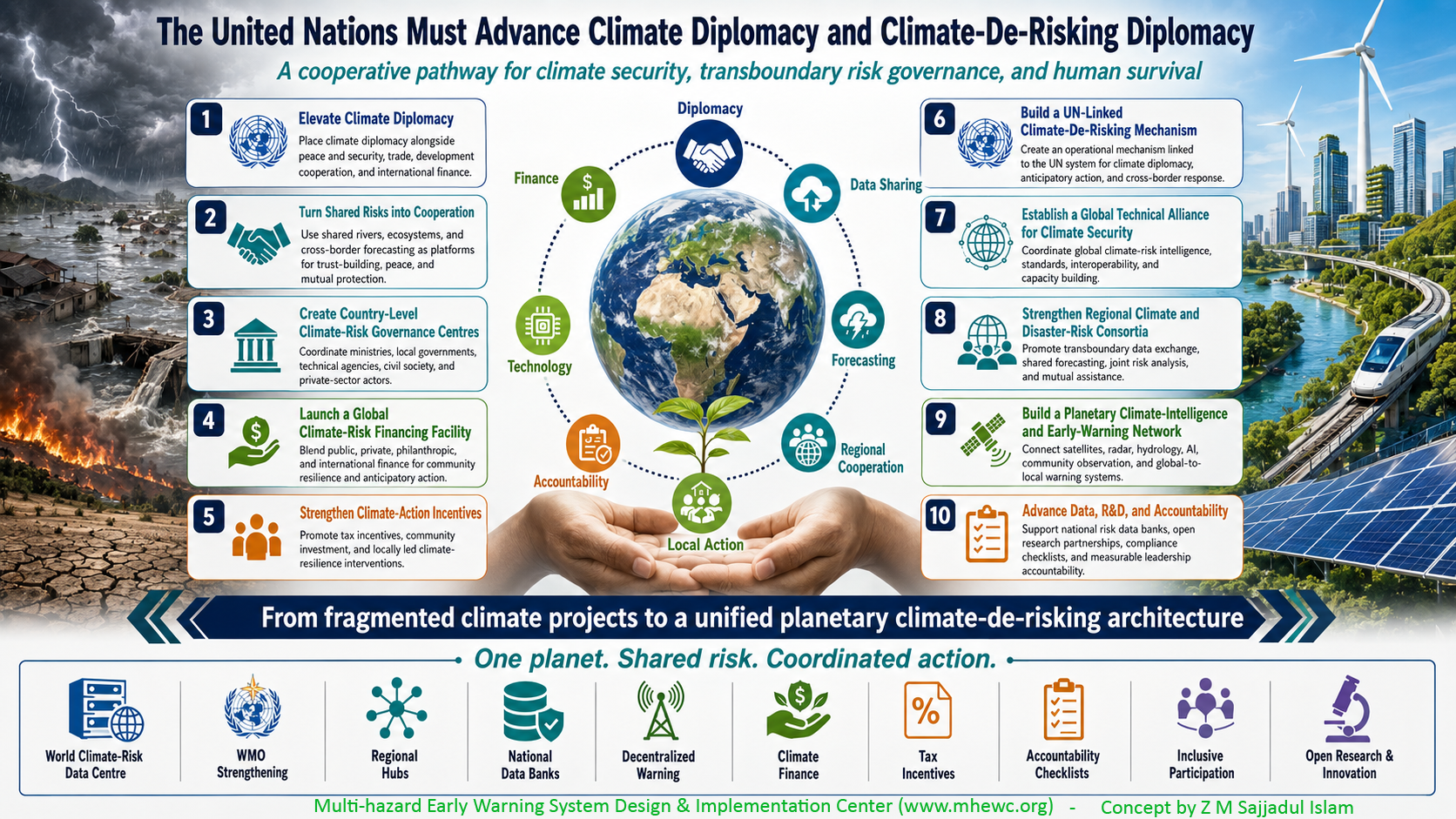
Such a mechanism could be established through the following institutional, financial, and policy measures:
- Establish dedicated country-level climate-risk governance mechanisms, such as national Climate-Risk Management and Governance Centres, to coordinate sectoral ministries, technical agencies, local governments, private-sector actors, civil society organizations, research institutions, development partners, and other relevant stakeholders.
- Create a specialized Global Climate-Risk Financing Bank or financing facility to mobilize, pool, leverage, and channel public, private, philanthropic, and international climate finance toward Business Call to Action (BCtA) initiatives and other locally led climate-resilience interventions at the community level.
- Introduce targeted tax exemptions and fiscal incentives for climate-action duty bearers, responsible enterprises, value-chain actors, technology providers, community organizations, and frontline individuals that invest in verified mitigation, adaptation, resilience-building, decarbonization, ecosystem restoration, and disaster-risk reduction measures.
- Develop a comprehensive climate-action assessment and compliance checklist covering National Adaptation Plans (NAPs), Nationally Determined Contributions (NDCs), LAMA initiatives, Nature-based Solutions (NbS), Locally Led Adaptation (LLA), and other relevant climate and disaster-risk frameworks.
- Prepare sector-specific checklist modules for climate-vulnerable sectors, including agriculture, water, health, infrastructure, energy, settlements, transport, ecosystems, coastal resources, social protection, education, and local economic development.
- Apply the checklist as an accountability and investment-screening instrument to assess institutional readiness, policy alignment, financing, implementation progress, risk reduction outcomes, inclusion, and compliance with national and international climate commitments.
- The items listed above constitute a preliminary checklist. A more comprehensive checklist is under development, with additional modules covering NAPs, NDCs, LAMA, Nature-based Solutions (NbS), Locally Led Adaptation (LLA), and other climate-vulnerable sectors.
5.1 ) Global Technical Alliance for Climate Security and Planetary De-Risking
A Global Technical Alliance for Climate Security and Planetary De-Risking should be established to complement and strengthen existing United Nations bodies, international institutions, regional organizations, and national mechanisms. The Alliance would not replace or duplicate their mandates; it would connect their capabilities, close critical operational gaps, and overcome institutional fragmentation, sectoral silos, and weaknesses in international coordination.
The Alliance would bring climate mitigation and adaptation, environmental and ecosystem protection, climate-risk intelligence, multi-hazard early-warning systems, disaster-risk reduction, anticipatory action, humanitarian response, resilient recovery, and loss-and-damage financing together within a coherent and coordinated operational framework.
Its core responsibilities could include:
- maintaining a continuously updated global picture of climate, environmental, and multi-hazard risks, including emerging, compound, cascading, systemic, and transboundary threats;
- coordinating international climate-security and planetary de-risking diplomacy;
- promoting cooperation and information exchange among governments, United Nations bodies, regional organizations, scientific institutions, civil society, communities, and the private sector;
- developing common standards for risk data, information exchange, system interoperability, impact terminology, ethical artificial-intelligence use, and responsible technology deployment;
- establishing and supporting regional and transboundary climate- and disaster-risk consortia;
- strengthening institutional, scientific, technical, financial, and operational capacities at national and subnational levels;
- mobilizing, coordinating, and strategically blending domestic and international public finance, climate funds, development-bank resources, philanthropic contributions, and responsible private investment;
- facilitating equitable access to climate technologies, Earth-observation systems, scientific expertise, risk data, forecasting capabilities, and decision-support tools;
- strengthening end-to-end and people-centred early-warning systems, anticipatory-action mechanisms, emergency preparedness, and resilient recovery;
- monitoring progress against national, regional, and international climate-security and planetary de-risking commitments;
- providing targeted technical and financial support to countries and communities facing extreme, compound, cascading, systemic, or transboundary risks; and
- publishing an independent annual assessment of the state of global climate security, emerging planetary risks, implementation gaps, financing needs, and priority actions.
The Alliance should operate through transparent, inclusive, and accountable governance, with equitable representation from developed and developing countries, particularly least developed countries, small island developing states, landlocked developing countries, and other highly climate-vulnerable nations. Scientific institutions, local governments, Indigenous Peoples, frontline communities, women, youth, persons with disabilities, civil-society organizations, and responsible private-sector actors should also have meaningful roles in its governance and operations.
Through these functions, the Alliance would help transform international commitments into coordinated, adequately financed, scientifically grounded, technologically enabled, and locally actionable measures for climate security and planetary de-risking.
5.2) Redefining the Roles and Responsibilities of the United Nations in De-Risking Climate Catastrophes
Alongside its mandate to maintain international peace and security, the United Nations should recognize climate security as one of its highest institutional and operational priorities. The UN system should bring countries together under an inclusive, science-based, and cooperative global framework for de-risking climate catastrophes without imposing a single political ideology or governance model. UN should open a parallel climate risk management governance at the country level. UN must defuse geopolitical tensions, reduce defense expenditures, and mobilize global finances for the “A Whole-of-Earth, Whole-of-Society Approach”, de-bordering climate actions. UN must develop a charter for a transcontinental power grid and net-zero industrial and entrepreneurial sectors.
To fulfill this responsibility, the United Nations must move beyond fragmented, short-term, and project-based interventions toward a coherent, integrated, and accountable global climate-risk governance architecture. Such an architecture should connect global, regional, national, and local institutions through common standards, interoperable systems, shared data, coordinated financing, and clearly defined responsibilities for risk assessment, preparedness, early warning, anticipatory action, resilience-building, and recovery.
This transformation should include the establishment of a World Climate-Risk Data Centre to consolidate, harmonize, analyse, and disseminate climate, hazard, exposure, vulnerability, impact, and loss-and-damage information. It should also expand equitable access to advanced global meteorological satellite systems, Earth-observation technologies, high-performance computing, climate modeling, and real-time forecasting services, particularly for developing and climate-vulnerable countries.
The United Nations should further strengthen the technical, institutional, financial, and operational capacity of the World Meteorological Organization and its global network of national and regional institutions. Priority should be given to modernizing surface-based and upper-air observation networks; improving hydrological, oceanographic, radar, lightning, and environmental monitoring systems; and strengthening the WMO Information System, Data Processing and Forecasting System, and Regional Specialized Meteorological Centres.
These systems should be upgraded through the application of advanced information and communication technologies, artificial intelligence, machine learning, cloud computing, interoperable data platforms, automated analytics, impact-based forecasting, and real-time decision-support technologies. The objective should be to ensure that every country regardless of income, geography, or technical capacity can access reliable climate-risk information, generate precise and actionable warnings, anticipate cascading impacts, and take timely measures to protect lives, livelihoods, infrastructure, ecosystems, and development gains.
5.3) Establishing a Planetary Climate-Intelligence and Multi-Hazard Early-Warning Network
A unified climate-de-risking world requires a comprehensive, interoperable, and continuously updated observation and intelligence system capable of monitoring climate and multi-hazard threats across every landscape, watershed, river basin, coastal zone, settlement, ecosystem, infrastructure system, and productive sector.
A Global Climate-Risk Information and Intelligence Centre should be established and connected to corresponding continental, regional, national, and subnational centres. Rather than operating as isolated databases, these centres should form a federated global network through which participating institutions retain responsibility for their data while sharing standardized and authorized information across geographic and institutional boundaries.
The network should maintain comprehensive archives of historical climate conditions, multi-hazard events, disaster impacts, exposure, vulnerability, losses and damages, early actions, emergency responses, and recovery outcomes. These records should be integrated into an interactive geospatial data platform comparable in accessibility and visualization capability to Google Earth through which users can explore risk information, hazard forecasts, satellite observations, infrastructure, ecosystems, exposed populations, and projected impacts across multiple spatial and temporal scales.
The system should integrate Earth observations, weather and hydrological monitoring, satellite and radar data, oceanographic information, ecosystem observations, community-generated data, socioeconomic indicators, climate projections, artificial intelligence, and impact-based forecasting. Common data standards, interoperable systems, open interfaces, quality-control procedures, cybersecurity safeguards, and clearly defined data-sharing protocols should enable timely and responsible information exchange.
This architecture should function as a nested Planetary Climate-Intelligence and Multi-Hazard Early-Warning Network, connecting observation, forecasting, risk analysis, warning communication, anticipatory action, emergency response, and long-term planning from the planetary level to continents, regions, countries, subnational authorities, communities, households, and individuals. Its ultimate purpose should be to transform scientific and community-generated information into timely, understandable, location-specific, and actionable intelligence ensuring that every decision-maker and every person at risk can understand what may happen, where and when it may occur, who and what could be affected, how severe the impacts may be, and what actions should be taken before disaster occurs.
5.4) A planetary climate-intelligence and early-warning network
Develop a unified data center for climate risk information management, with archives of past multi-hazards and disasters and a geospatial data platform (like Google Earth). Develop a continental. climate risk information management data center and at the country level. A unified climate-de-risking world requires a comprehensive observation and intelligence system capable of monitoring threats across every landscape, watershed, coastal zone, settlement, ecosystem, and productive sector.
This should function as a nested global climate-intelligence and multi-hazard early-warning network, connecting observation and decision-making from the planetary level to individual communities.
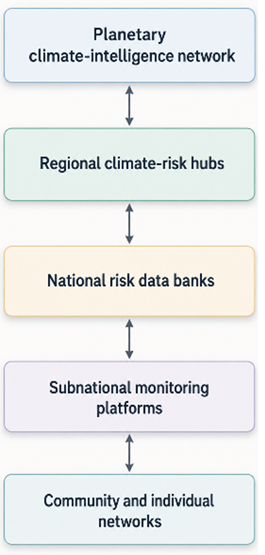
The network should integrate: satellite Earth observation; weather and climate satellites; weather-radar networks; lightning-detection systems; ocean buoys and coastal sensors; automated weather stations; river-level and hydrological stations; groundwater and soil-moisture monitoring; glacier, snow and permafrost observations; air-quality and greenhouse-gas monitoring; ecosystem and biodiversity observations; seismic, volcanic and landslide-monitoring systems; drones and other remotely operated platforms; community observations and crowdsourced information; geographic information systems; artificial intelligence and machine learning; numerical weather and climate models; hydrological and impact models; and interoperable risk, exposure, vulnerability and loss databases.
This global multi-hazard risk governance system should provide sufficient intelligence to answer six essential questions:
- What hazard is developing?
- Where will it occur?
- When will it occur?
- How severe could it become?
- Who, what, and which elements will be affected/impacted?
- What actions must be taken before impact?
The system must produce actionable information at national, district, municipal, catchment, neighborhood, and community levels. Global monitoring without effective last-mile communication cannot protect people.
5.5) Greater Investment in Technology, Artificial Intelligence, Machine Learning, and Robotics for Climate and Multi-Hazard Disaster-Risk Management
Technological innovation should be recognized as a global public good and a critical foundation of climate security and disaster resilience. Governments, international institutions, research organizations, and technology companies should substantially increase investment in the research, development, testing, and responsible deployment of advanced technologies for climate and multi-hazard disaster-risk management.
Priority areas should include high-resolution weather and climate modelling; convection-permitting numerical weather prediction; impact-based forecasting; compound and cascading-risk analysis; subseasonal-to-seasonal prediction; flood, drought, cyclone, wildfire, landslide, and extreme-weather forecasting; coastal-inundation and storm-surge modelling; dynamic climate-risk mapping; AI and machine-learning-assisted hazard detection and prediction; digital twins of climate-sensitive landscapes and infrastructure; automated alert generation and dissemination through the Common Alerting Protocol; decision-support systems for anticipatory action and emergency response; robotics and autonomous systems for environmental monitoring, damage assessment, search and rescue, and humanitarian assistance; and climate-resilient infrastructure planning and design. Artificial intelligence, machine learning, robotics, and automated systems should enhance human capability and decision-making without replacing professional judgment, institutional responsibility, local knowledge, or community participation. Their development and application must be governed by transparent scientific, ethical, legal, security, and accountability standards. Models and automated systems should be validated against reliable local observations, historical hazard and impact data, and real-world operating conditions. Their assumptions, uncertainties, limitations, potential biases, and levels of confidence must be clearly communicated to decision-makers and affected communities. Technology must ultimately strengthen inclusive and accountable climate-risk governance, improve the accuracy and timeliness of early warnings, accelerate anticipatory action, reduce disaster losses, and ensure that climate-vulnerable countries and communities are not left behind by technological progress.
5.6) Financing a climate-de-risking transition :
Every country should mobilize adequate domestic resources for climate security in accordance with its capabilities, risk profile, and responsibilities. Domestic finance should be complemented by international public finance, multilateral and regional development-bank resources, dedicated climate funds, philanthropic contributions, responsible private investment, insurance, contingency financing, and other risk-transfer mechanisms. These resources should be strategically blended to close identified financing gaps while avoiding unsustainable debt burdens for climate-vulnerable countries.
Priority investments should strengthen the institutional, technological, and physical infrastructure required for effective climate and disaster-risk governance. This includes climate and hazard-observation networks, forecasting systems, multi-hazard early-warning services, risk-information platforms, emergency operations centres, resilient infrastructure, anticipatory-action mechanisms, social-protection systems, ecosystem-based solutions, and the technical capacity of responsible institutions.
Climate-risk financing must be predictable, accessible, equitable, and sustained over the long term. Funding should be guided by transparent risk assessments, clearly defined investment priorities, measurable outcomes, and robust accountability mechanisms.
A substantially greater share of financing should reach subnational governments, local institutions, frontline organizations, and at-risk communities directly. Resources must not remain concentrated within central institutions, international intermediaries, or fragmented short-term projects. Local actors should be empowered to plan, manage, implement, monitor, and sustain climate-risk reduction measures in accordance with their specific needs and local risk contexts.
5.7) Develop Leadership, accountability and policy integration :
Political leaders must be held accountable for reducing the climate risks faced by their populations. National climate commitments should be translated into measurable responsibilities, dedicated budgets, implementation schedules, publicly accessible risk information, and independent performance monitoring. A unified climate-de-risking system should integrate the full-scale implementation of all perspective plans, NAP, NDC, NAPA, NAMA, LAMA, NbS, LLA, etc. These instruments should be supported by a common risk-information foundation so that mitigation, adaptation, preparedness, development, and investment decisions are informed by the same scientific understanding of present and future risks.
The world must stop treating climate change as a secondary policy portfolio while directing its greatest political attention, financial resources, and technological capabilities toward geopolitical confrontation. Military conflicts can sometimes be prevented or de-escalated through diplomacy. Climate disruption cannot be suspended while governments negotiate. Its impacts are accumulating continuously.
Humanity therefore needs a new global compact based on one shared commitment: to de-risk the Earth from climate catastrophe and secure a livable future for present and future generations.
This requires countries to move beyond geopolitical polarization, colonial attitudes, resource domination, and militarized competition. Governments must work across political, geographic, economic, and ideological boundaries through climate diplomacy, shared science, equitable finance, interoperable technology, transboundary governance, and collective accountability.
The climate crisis should not be framed as an enemy that can be defeated through force. It is a human-induced planetary emergency that must be mitigated, managed, and progressively reduced through cooperation. Under a whole-of-Earth and whole-of-society approach, every country, institution, sector, community, and individual must become part of a unified global solution.
5.8) Democratizing climate-risk intelligence/ planetary climate-risk consortium and access to tailored information
Climate information must no longer remain concentrated within a small number of technologically advanced countries, international institutions, private corporations, or specialized scientific centres. Climate-risk intelligence should be treated as a global public good that is accessible to every country and community.
The world already possesses powerful technologies, including satellites, weather radar, automated sensors, artificial intelligence, cloud computing, mobile telecommunications, geospatial systems, drones, numerical models, and high-performance computing. However, access to these technologies remains highly unequal.
Many developed countries operate sophisticated observation and forecasting systems, while vulnerable countries continue to experience: weather-radar blind zones; inadequate surface-observation networks; insufficient hydrological monitoring; limited access to high-resolution satellite data; dependence on low-resolution global forecast products; weak computing and data-storage infrastructure; fragmented national risk databases; limited technical personnel; incomplete last-mile communication systems; and insufficient financing for operation and maintenance. This technological inequality has direct consequences for human safety. Populations in highly exposed areas may receive warnings that are too general, too late, or insufficiently connected to actionable instructions. The places facing some of the most severe climate risks frequently possess the least capacity to monitor and forecast them.
Developed countries and global centres of excellence should therefore open their scientific and technological capabilities to the wider world. They should support joint research, technology transfer, open data, shared modelling, institutional capacity development, and the establishment of sustainable observation and warning systems in developing and climate-vulnerable countries.
5.9 ) Empowering Every Person to Contribute to Planetary Climate De-Risking through a Whole-of-Earth, Whole-of-Society Framework
Using GSM networks, mobile applications, cell broadcasting, SMS, community radio, satellite communication, internet platforms, and other telecommunications technologies, individuals should be able to: report local rainfall, flooding, landslides, drought conditions, wildfire, erosion and environmental change; submit photographs, videos, geographic coordinates and field observations; receive location-specific warnings; confirm whether a warning has reached the intended population; report impacts on people, infrastructure, livelihoods and ecosystems; identify vulnerable individuals requiring assistance; communicate urgent local needs; contribute Indigenous and locally developed knowledge; participate in citizen-science initiatives; and evaluate the effectiveness of forecasts, warnings and early actions.
These contributions should feed into properly governed national and global knowledge systems. Community-generated data must be scientifically validated, ethically managed and protected by appropriate privacy, security and informed-consent safeguards. When combined responsibly with institutional observations, such information can help fill data gaps, verify emerging conditions, improve models, and support more inclusive decisions.
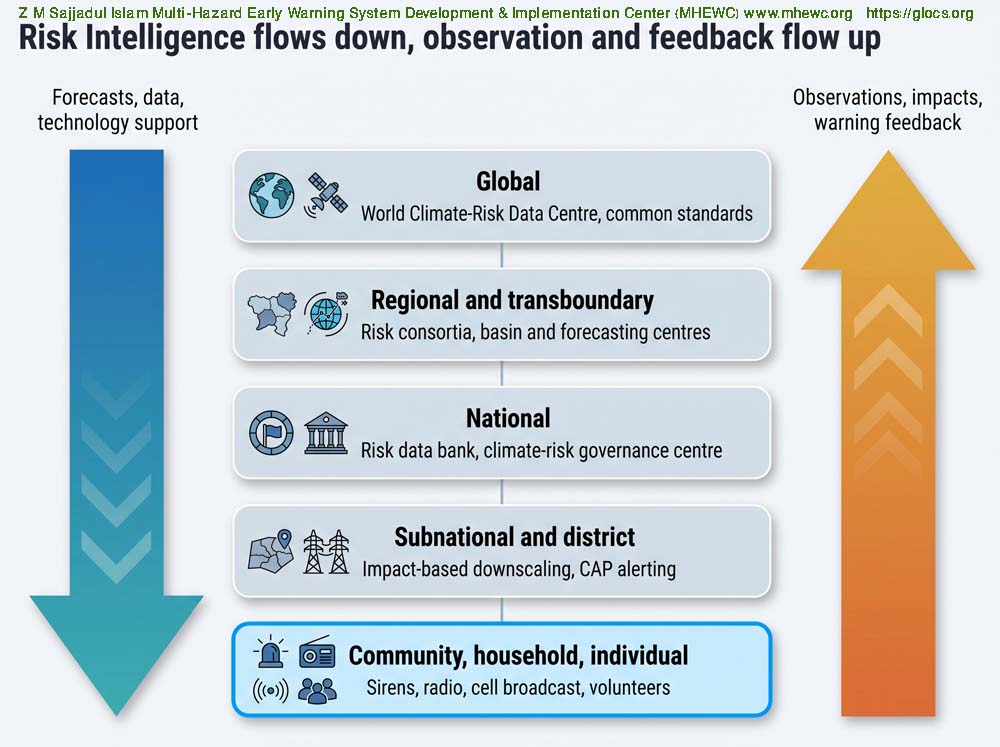
5.10) Establishing a nested planetary climate risk intelligence gathering network ( Online Datacenter )
A global climate-risk system should operate through an interconnected architecture rather than a single centralized institution. Each level should generate, verify, exchange, and apply information according to its responsibilities. Information should move in both directions. Global and regional institutions should provide forecasts, scientific analysis, satellite products and technological support to countries and communities. Local actors should return field observations, impact information, community knowledge and feedback on warning effectiveness. Such a network would enable the world to develop a continuously updated understanding of what is happening across the Earth, from planetary climate anomalies to localized flooding within a particular neighborhood or catchment.
5.11 ) Decentralizing early-warning services
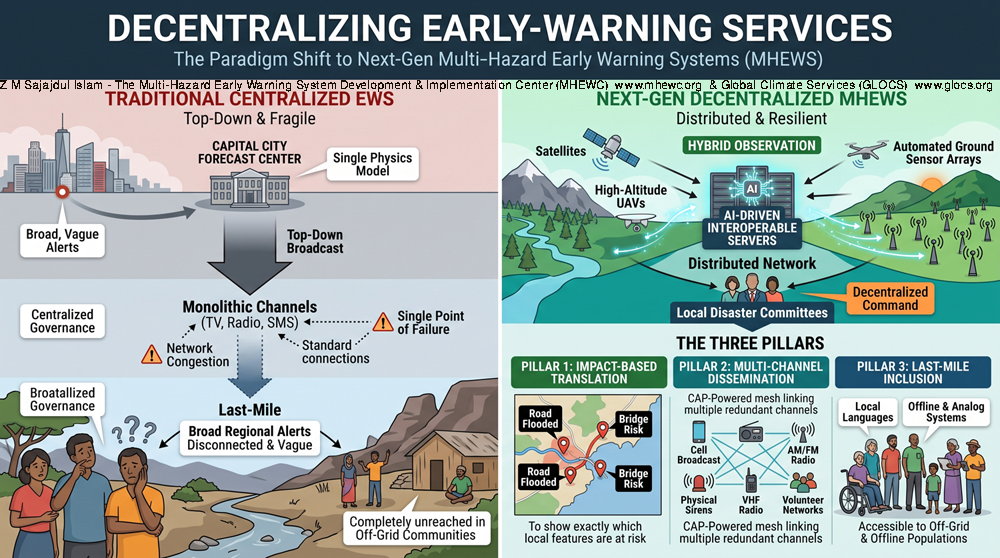
Traditional Multi-Hazard Early Warning Systems (MHEWS), which rely heavily on legacy weather models and centralized forecast analysis, are increasingly insufficient. They struggle to detect, track, and predict the rapidly developing, micro-climatic anomalies that characterize today’s climate crisis.
To confront these compounding hazards, we must transition to a hybrid observational ecosystem. This requires fusing high-altitude telemetry (satellite and UAV atmospheric tracking) with high-density, automated ground sensors, all unified by AI-driven data ingestion into interoperable servers.
However, advanced observation is only half the solution; the true frontier of climate resilience lies in decentralization. Because extreme weather anomalies interact with local landscapes to produce unprecedented, unmeasurable trails of destruction, risk governance can no longer remain solely in the capital city. We require a real-time, sensor-based, last-mile surveillance network that empowers decentralized command and control for immediate frontline safeguarding.
5.11.1) The Paradigm Shift: Traditional Forecast Generation does not leverage/garrantee equal protection. We need ICT-AI-driven EWS
The fundamental principle of this decentralized architecture is that a warning system is not effective merely because a forecast has been generated at the national level. A true end-to-end MHEWS is only successful if understandable, accessible, and actionable intelligence reaches every exposed person in sufficient time to trigger anticipatory action.
To achieve this, the decentralized framework operates on three core pillars:
a) Granular, Impact-Based Translation
National meteorological data must be dynamically downscaled. Forecasts of atmospheric phenomena must be translated into expected, highly localized impacts across provincial, district, municipal, catchment, neighborhood, and community levels. This ensures that a community doesn’t just receive a generic rainfall prediction, but a precise warning about which specific local access road or medical facility is at risk of flooding.
b) CAP-Powered Multi-Channel Dissemination
Single points of communication failure cost lives. Warning messages must be routed through a Common Alerting Protocol (CAP) infrastructure that simultaneously triggers a redundant multi-channel matrix. This matrix must combine modern digital networks (mobile alerts, cell broadcasts, social media, satellite communication) with resilient analog and community systems (physical sirens, VHF/AM radio, television, religious institutions, schools, and local volunteer networks).
c)Uncompromising Last-Mile Inclusion
Technology must bridge the gap, not widen it. The dissemination architecture must be explicitly designed to serve populations experiencing digital or communication poverty. Systems must be accessible to people with disabilities, delivered in minority and local languages, and capable of reaching off-grid communities and those without smartphones.
d) Architectural Comparison: Centralized vs. Decentralized
| Feature | Traditional Centralized EWS | Next-Generation Decentralized MHEWS |
| Observation & Modeling | Single physics-based meteorological model. | Hybrid (AI-driven pattern recognition + traditional physics) with UAV/satellite integration. |
| Data Flow & Governance | Top-down broadcast; local authorities act as passive receivers. | Distributed network; local disaster management committees own ground-sensor telemetry and trigger thresholds. |
| Warning Dissemination | Monolithic channels (e.g., national TV/Radio, SMS) prone to network congestion. | CAP-triggered multi-channel redundancy (including Cell Broadcast, AM radio, and community sirens). |
| Impact Resolution | Broad regional alerts lacking localized context. | Hyper-local impact-based forecasting tailored to community-specific vulnerabilities. |
5.12) Creating national climate-risk data banks
Every country should establish a secure, interoperable and continuously updated National Climate and Multi-Hazard Risk Data Bank. It should consolidate information that is currently scattered across government ministries, universities, humanitarian organizations, development partners, local authorities, research institutions and private companies.
Each national data bank should contain: historical and real-time hazard data; weather, climate and hydrological observations; satellite and remote-sensing products; exposure and vulnerability information; population and socioeconomic data; critical-infrastructure inventories; sector-specific risk assessments; ecosystem and biodiversity information; disaster-impact and loss-and-damage records; climate projections and scenario models; early-warning thresholds and triggers; anticipatory-action protocols; emergency resources and response capacities; and recovery, adaptation and resilience investments.
These data banks should use common standards and interoperable formats while respecting national sovereignty, cybersecurity, data protection and legitimate confidentiality requirements. They should support national planning while also contributing agreed datasets to regional and global climate-intelligence networks.
5.13) Building a Global Climate Intelligence Network
National risk data banks should be connected through regional hubs to a Global Climate Intelligence and Risk-Governance Network. This network should integrate Earth observation, surface monitoring, climate science, artificial intelligence, risk modelling and locally generated information.
Its purpose would be to produce increasingly precise and actionable intelligence about impending climate and disaster risks. It should connect: satellite Earth-observation systems; weather- and climate-monitoring satellites; automated weather stations; weather-radar and lightning-detection networks; river, groundwater and soil-moisture sensors; ocean buoys and coastal monitoring systems; glacier, snow and permafrost observations; air-quality and greenhouse-gas monitoring; ecosystem and land-degradation indicators; artificial-intelligence-supported forecasting; climate, weather, hydrological and impact models; geospatial exposure and vulnerability databases; and community-based observation networks.
Artificial intelligence could support the detection of emerging patterns, quality control of large datasets, rapid impact estimation, identification of vulnerable locations, and automatic generation of customized warnings. However, AI-supported decisions must remain transparent, scientifically validated and subject to human oversight.
5.14) Opening global research and development
Leading universities, climate centres, space agencies, meteorological institutions, technology companies and research laboratories in developed countries must treat climate-risk research as an international responsibility. They should establish equitable partnerships with institutions in the Global South by: providing access to high-performance computing; sharing satellite and radar products; supporting locally calibrated forecasting models; jointly developing open-source technologies; financing research led by developing-country institutions; upporting postgraduate education and technical fellowships; establishing regional laboratories and innovation hubs; enabling long-term exchange of scientists and practitioners; sharing data-processing and modeling methodologies; and strengthening local capacity to operate and maintain technology.
Research partnerships must move beyond the extraction of data from vulnerable countries for the benefit of external institutions. Developing-country scientists and communities should be recognized as equal intellectual partners, co-designers and owners of the knowledge produced.
The accumulated knowledge of individuals and communities should form part of an inclusive global climate knowledge bank. This would allow scientific knowledge, technological innovation and practical experience to be combined into a common resource for improving climate policy, early warning and risk-informed decision-making.
5.15) United Nations system to hold the member state Governments accountable for developing the infrastructure required to de-risk climate catastrophes
The United Nations has the international legitimacy, convening power and technical network required to advance this agenda. However, its climate, disaster-risk, development, humanitarian, environmental and technological initiatives remain institutionally fragmented. The UN system must demonstrate that it can establish a global climate & multi-hazard risk data center and more at the continental level and support at the country level. It must design, develop and establish an integrated planetary climate-risk action plan; harmonize climate, disaster and environmental policies; promote compatible technologies and data standards; coordinate research and development; facilitate equitable technology transfer; mobilize predictable climate and disaster-risk financing; connect global systems with local implementation; hold governments accountable for agreed commitments; and ensure that vulnerable countries and communities are not left behind.
The United Nations should not merely encourage countries to act. It should help create the operational architecture through which collective action becomes possible. Its agencies should work through a common climate-risk framework rather than implementing disconnected mandates, databases, pilots and short-term projects. Climate-risk governance should be positioned alongside international peace and security as one of the UN’s highest priorities. This requires measurable targets, clearly assigned institutional responsibilities, transparent performance reporting, and sustained financing. Do we need to create another Global Alliance to combat climate catastrophes? If the existing international system cannot produce an integrated, technically credible and adequately financed climate-risk action plan, then the world should consider establishing a Global Alliance for Climate Intelligence, Risk Governance and Early Warning.
Such an alliance should not become another bureaucratic structure or duplicate the work of existing institutions. It should provide the technical leadership and operational coordination currently missing between global policy commitments and national or local implementation. Its mission would be to: propagate a unified vision for planetary climate security; influence international and national policy; coordinate scientific and technological cooperation; mobilize and blend financial resources; establish a global climate-intelligence architecture; support national climate-risk data banks; strengthen end-to-end early-warning systems; promote impact-based forecasting and anticipatory action; connect global centres of excellence with vulnerable countries; support locally led adaptation and nature-based solutions; facilitate loss-and-damage assessment; and monitor governments’ climate-risk governance performance.
The preferred approach would be to establish this alliance within, or formally associated with, the United Nations. However, its governance must be inclusive, scientifically independent and operationally focused. Developing countries, frontline communities, women, youth, Indigenous Peoples, persons with disabilities, local governments and civil-society organizations must have meaningful representation, not merely observer status.
Strong Message to UN, International Risk management policy domains:
An urgent and uncompromising message to Global Powers, Developed Nations, Global Elites, and International Institutions
- Global leadership must no longer be measured only by economic size, military strength, technological dominance, or geopolitical influence. It must also be measured by the willingness and ability to protect humanity, restore the Earth, reduce shared risks, support vulnerable countries, and safeguard future generations.
- Let us prepare this planet to confront climate catastrophes before they become unmanageable.
Advancing a United Nations Global Action Framework for Integrated Climate and Multi-Hazard Risk Governance ( Click to access – New dimension of UN Reform proposal in improving global risk management and governance system)
- Let us direct public finance, private investment, science, technology, and international cooperation toward greening and restoring the Earth, not toward building national defenses/military.
- Let us replace fragmented and reactive interventions with coordinated, preventive, and anticipatory action.
- Let us build a unified global commitment in which every country, institution, sector, community, household, and individual has a meaningful role.
- The Earth must be protected as a single interconnected system, and humanity must act as a single society. Climate security is not the responsibility of a few; it is the shared responsibility of all.
- Let us prepare the planet before climate catastrophes overwhelm our capacity to respond. Let us invest in greening, restoring, and protecting the Earth. Let us act together not as competing nations confronting isolated threats, but as one human society defending our shared planetary home.