Climate catastrophe is a ticking time bomb, and time is running out
The science, systemic risks, climate injustice, and a whole-of-Earth action agenda
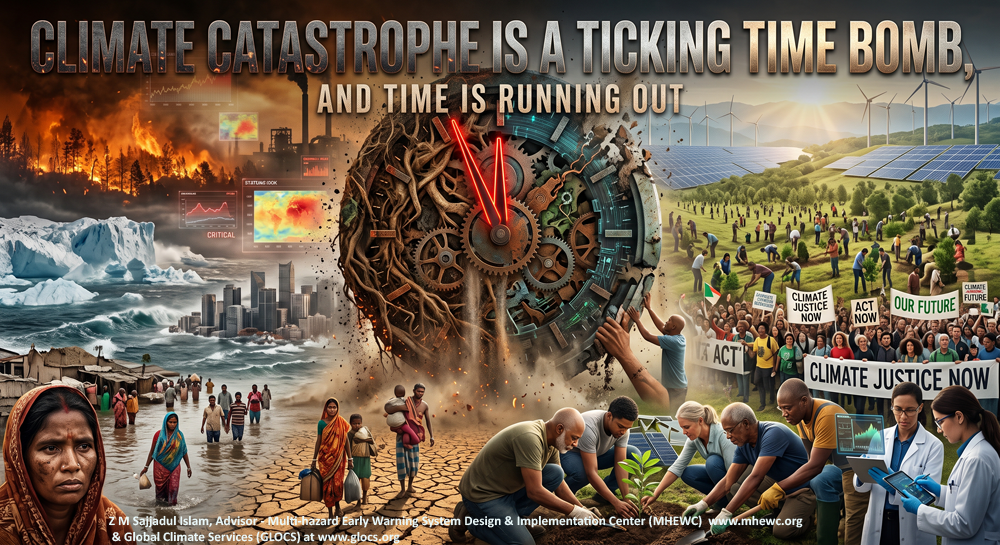
Global-to-local policy analysis with a Global South focus
[Source: Synthesis of authoritative scientific assessments, UN reports, and peer-reviewed global indicators]
Developed by : Z M Sajjadul Islam
Advisor – Multi-hazard Early Warning System Design & Implementation Center (MHEWC) www.mhewc.org & Global Climate Services (GLOCS) at www.glocs.org
Contents
1.3 World strategic proposition to combat climate catastrophe. 6
2.0 Introduction: what the metaphor means. 6
2.1 Research scope and method. 7
2.2 Questions guiding the analysis. 7
3.0 The scientific state of the climate emergency. 8
3.1 A rapidly warming planet. 8
3.2 The carbon budget is nearly exhausted. 8
3.3 Current policies remain far from a safe pathway. 9
3.4 Ocean, ice, and sea level: the slow-moving fuse. 9
3.5 Extremes are becoming more dangerous. 9
4.0 Why the clock is running out. 10
4.1 Tipping points and irreversibility. 10
5.0 From climate hazard to climate catastrophe. 16
5.1 The climate-risk equation. 16
5.2 Compound and cascading risk. 16
6.0 Human, economic, and ecological consequences. 17
6.1 Health and human survival 17
6.2 Food, water, and livelihood security. 17
6.3 Displacement and mobility. 17
6.4 Cities, infrastructure, and economies. 18
6.5 Ecosystems and irreversible loss. 18
7.0 Climate injustice and the Global South. 18
7.1 Frontline groups and differentiated vulnerability. 22
8.0 Economic and non-economic loss and damage. 25
8.1 A complete accounting framework. 26
8.1 The adaptation-finance gap. 26
8.2 The Fund for responding to Loss and Damage. 26
9.0 Early warning and anticipatory action. 27
9.1 Four operational pillars. 27
9.2 From warning to anticipatory action. 27
10.0 A global-to-local climate-risk intelligence architecture. 28
10.1 Essential capabilities. 28
11.0 Defusing the bomb through rapid mitigation. 29
11.1 Priority mitigation levers. 29
11.2 The economic opportunity. 29
12.0 Reducing the blast radius through adaptation and resilience. 30
12.1 Priority adaptation systems. 30
12.2 Avoiding maladaptation. 31
13.0 Finance, governance, and international cooperation. 31
13.1 Reforming climate finance. 31
13.2 A climate solidarity and security compact. 31
13.3 Governance essentials. 32
14.0 Implementation roadmap: 2026-2035. 32
14.0 A minimum global performance dashboard. 33
15.0 Recommendations by stakeholder group. 33
15.1 G20 and other major emitters. 33
15.2 Developed countries, multilateral banks, and climate funds. 33
15.3 Global South national governments. 34
15.4 Meteorological, hydrological, disaster, and sector agencies. 34
15.5 Private sector and financial institutions. 34
Science, technology, and space communities. 34
15.6 Local governments and frontline communities. 34
15.7 Media, civil society, and individuals. 35
Note : The report first establishes the scientific and risk evidence, then examines unequal impacts and loss and damage, and finally sets out an operational agenda linking mitigation, adaptation, early warning, anticipatory action, finance, and accountability.
1.0 Executive summary
“Climate catastrophe is a ticking time bomb and time is running out.” These warning signals are already visible across the planet: record-breaking temperatures, intensifying heatwaves, rapidly melting glaciers, rising sea levels, prolonged droughts, destructive wildfires, extreme rainfall, devastating floods, and increasingly unpredictable weather patterns. These events are not isolated natural disasters; they are interconnected symptoms of a climate system being pushed towards dangerous and potentially irreversible limits.
For billions of people, particularly across the Global South, climate catastrophe is not a distant possibility; it is an unfolding daily reality. Families are losing their homes, farmers are watching crops and livestock perish, coastal communities are being displaced, and vulnerable populations are facing worsening food insecurity, water scarcity, disease, poverty, and forced migration. In a matter of hours, a single extreme event can destroy infrastructure, livelihoods, ecosystems, cultural heritage, and decades of hard-won development progress.
The injustice is profound. Those who have contributed the least to global greenhouse-gas emissions often suffer the greatest consequences while possessing the fewest resources to prepare, adapt, recover, and rebuild. Women, children, older persons, persons with disabilities, Indigenous Peoples, displaced populations, and low-income communities are disproportionately exposed to climate risks. Without urgent and inclusive action, climate change will continue to deepen inequality, intensify humanitarian crises, and undermine peace, security, and sustainable development.
Every year of delayed action increases economic and non-economic loss and damage, raises the cost of adaptation, and reduces the options available to future generations. Roads, bridges, homes, and public facilities may eventually be reconstructed, but lost lives cannot be restored. Extinct species cannot be recovered, disappearing cultures cannot be fully replaced, and communities uprooted from their ancestral lands may never regain what they have lost. Once critical climatic tipping points are crossed, some consequences could become permanent, regardless of how much money or technology is mobilized afterward.
Yet the future is not predetermined. The world still has an opportunity to slow the countdown, but that opportunity is rapidly narrowing. Governments, businesses, development partners, scientific institutions, civil society, and communities must act collectively to reduce greenhouse-gas emissions, accelerate the transition to clean energy, protect and restore ecosystems, strengthen climate-resilient infrastructure, and transform vulnerable food, water, health, and urban systems.
At the same time, investments must be urgently expanded in multi-hazard early-warning systems, impact-based forecasting, anticipatory action, disaster preparedness, climate-risk financing, and locally led adaptation. Adequate, predictable, and accessible climate finance must reach the countries and communities facing the greatest risks, while effective arrangements must address unavoidable economic and non-economic loss and damage.
The alarm is already sounding. What remains uncertain is not whether climate change will affect humanity- it already does but how severe its consequences will become and how courageously the world will respond. The choices made today will determine whether future generations inherit a resilient and liveable planet or a world defined by escalating disasters, irreversible losses, and diminishing possibilities. The time for incremental promises has passed; the time for decisive, coordinated, and transformative action is now.
Central finding. The climate emergency is not a single future explosion. It is a set of accelerating, interacting risks whose probability and severity rise with every increment of warming and every year of delayed action. The fuse is cumulative greenhouse-gas emissions; the explosive force is amplified by exposure, inequality, ecosystem degradation, fragile infrastructure, weak institutions, and inadequate finance.
1.1 Current phenomena
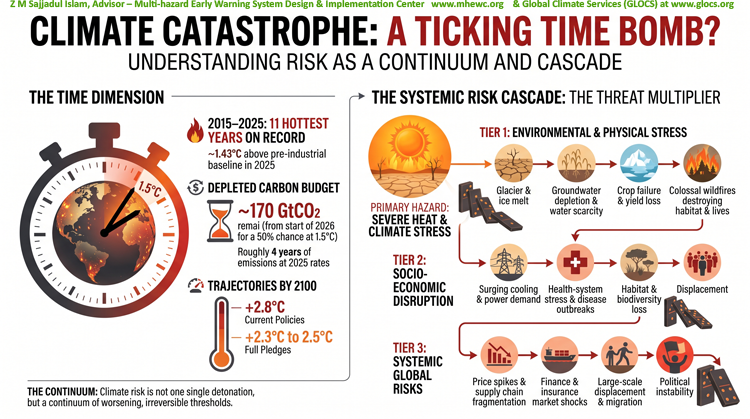
The phrase “climate catastrophe is a ticking time bomb” is scientifically defensible when used carefully. It communicates urgency, delayed consequences, path dependency, and the possibility of irreversible change. It should not be interpreted as a claim that the world faces one predetermined date of detonation. Climate risk is better understood as a continuum: some losses are already occurring, additional warming increases the likelihood of severe and compound extremes, and crossing ecological or cryospheric thresholds can lock in consequences for centuries.
The latest evidence makes the time dimension concrete. The World Meteorological Organization (WMO) reports that 2015-2025 were the eleven hottest years on record and that 2025 was about 1.43°C above the 1850-1900 baseline. The Global Carbon Budget 2025 estimates that only about 170 gigatonnes of CO2 remained from the start of 2026 for a 50 % chance of limiting warming to 1.5°C – roughly four years of emissions at the 2025 rate. UNEP finds that current policies point to about 2.8°C of warming this century, while full implementation of national pledges would still imply 2.3-2.5°C[1] [2] [3].
The danger is not extreme temperature alone. Rising heat rapidly alters the water cycle, intensifies extreme events, melts glaciers and ice sheets, raises sea level, warms and acidifies the ocean, degrades ecosystems, and increases the likelihood of simultaneous or cascading shocks. A heatwave is already triggering crop failure(significant yield loss) , mounting demand for electricity for cooling systems, increased disease outbreaks due to health-system stress, surface waterbody drying, groundwater table depletion and tremendous water scarcity, colossal-level wildfires destroying vegetation, crops, and lives( human and wildlife) , and habitat, price spikes, displacement, and political instability and dispacement. These impacts travel through trade, finance, migration, supply chains, public budgets, and insurance markets, turning local hazards into systemic risks
1.2 Headline findings
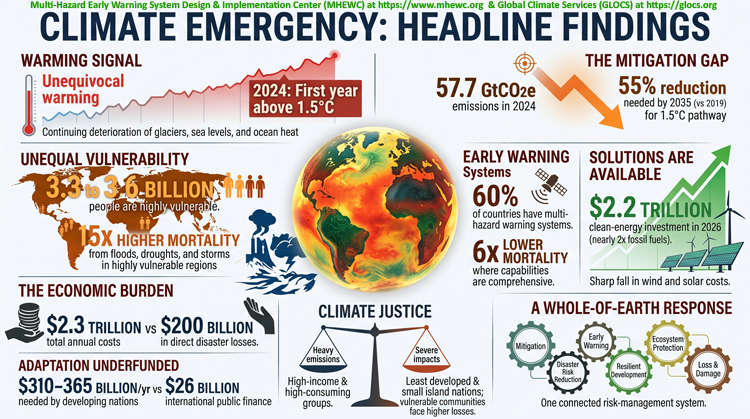
- The world is already in a climate emergency. The warming signal is unequivocal, atmospheric CO2 concentrations remain at record levels, and ocean heat, sea-level rise, glacier loss, and extreme events show continuing deterioration[4] [5]. The Paris Agreement’s 1.5°C threshold concerns long-term warming, not one unusually hot year. Even so, the first calendar year above 1.5°C in 2024 and WMO’s forecast of a high probability that the 2025-2029 five-year average will exceed 1.5°C are grave warning signs [6] [7]
- The mitigation gap remains large. Global greenhouse-gas emissions reached 57.7 GtCO2e in 2024, and 2035 emissions would need to fall 55 % below 2019 levels for a 1.5°C-aligned pathway [8].
- Vulnerability is radically unequal. Approximately 3.3-3.6 billion people live in contexts highly vulnerable to climate change, and mortality from floods, droughts, and storms during 2010-2020 was fifteen times higher in highly vulnerable regions than in very low-vulnerability regions[9].
- The economic burden is systematically underestimated. UNDRR estimates annual direct disaster losses above $200 billion, but total costs exceed $2.3 trillion when indirect, cascading, and ecosystem impacts are considered[10]. Adaptation is underfunded. Developing-country adaptation needs in 2035 are estimated at $310-365 billion per year, compared with only $26 billion in international public adaptation finance in 2023[11].
- Early warning is among the highest-value protective investments. In 2025, about 60 % of countries reported having multi-hazard early warning systems; mortality is nearly six times lower where capabilities are more comprehensive[12].
- Climate justice is central, not peripheral. High-income and high-consuming groups are responsible for a disproportionate share of historical and present emissions, while least developed countries, small island developing States, and vulnerable communities face higher losses and more limited fiscal capacity[13].
- Solutions are available and increasingly economical. Clean-energy investment is expected to reach $2.2 trillion in 2026, nearly twice fossil-fuel investment, while the costs of solar and wind have fallen sharply. Technology is no longer the principal constraint; political economy, finance, institutional capacity, and implementation speed are[14] [15]
- A whole-of-Earth and whole-of-society response is required. Mitigation, adaptation, disaster risk reduction, early warning, anticipatory action, resilient development, ecosystem protection, and loss-and-damage arrangements must operate as one connected risk-management system.
1.3 World strategic proposition to combat climate catastrophe
The world should treat climate-risk intelligence as a global public good and build a nested global-regional-national-subnational-community system that connects Earth observation, open and interoperable data, risk and vulnerability analysis, impact-based forecasting, precision-level weather warnings and alerting, weather-informed pre-agreed anticipatory actions, event situation & hazard & disaster impact based emergency response, recovery, and standardized loss-and-damage accounting. Governance must precede technology: institutions need clear mandates, data custodianship, decision authority, financing, accountability, and meaningful participation by frontline communities.
2.0 Introduction: what the metaphor means
In March 2023, United Nations Secretary-General António Guterres used the words “the climate time-bomb is ticking” when launching the Intergovernmental Panel on Climate Change (IPCC) Sixth Assessment Report synthesis. He paired the warning with a second message: the IPCC report was a practical guide to defusing the threat. The metaphor therefore contains both danger and agency. It is a warning against delay, not an argument for fatalism[16].
A time bomb has four defining characteristics that map onto climate risk. First, an initiating process has already begun: greenhouse gases emitted by human activity are trapping additional heat. Second, there is a delay between cause and full consequence: carbon dioxide persists, oceans accumulate heat, infrastructure locks in emissions, and ice-sheet and ecosystem responses unfold over long periods. Third, the damage potential grows if the process is not interrupted. Fourth, defusing becomes more difficult as time passes because options narrow, costs rise, and some changes become irreversible on human time scales.
The analogy also has limits. Climate catastrophe will not arrive everywhere at the same moment, nor will it affect all people equally. Some communities are already living through catastrophic heat, flood, drought, wildfire, coastal erosion, glacier loss, and displacement. Others are buffered by wealth, insurance, infrastructure, technology, and political power. The climate emergency is therefore a distributional and governance crisis as well as a physical one.
Working definition. Climate catastrophe is a condition in which climate-related hazards interact with high exposure, vulnerability, and weak coping capacity to cause severe, widespread, cascading, or irreversible harm to people, economies, ecosystems, institutions, and development pathways.
This definition avoids treating every climate impact as a catastrophe while recognizing that repeated moderate shocks can accumulate into catastrophic outcomes. A succession of crop failures, salinity intrusion, heat stress, debt-financed recovery, and livelihood loss may be as destructive as one dramatic cyclone. Slow-onset processes and non-economic losses must therefore be considered alongside sudden disasters.
2.1 Research scope and method
This report is a structured synthesis of evidence rather than a new climate model or an original empirical study. It combines current global indicators, major scientific assessments, disaster-risk evidence, climate-finance analyses, and operational guidance available up to 25 August 2026. Priority is given to the IPCC, WMO, UNEP, UNDRR, UNFCCC, WHO, the World Bank, the International Energy Agency (IEA), the International Renewable Energy Agency (IRENA), and peer-reviewed global carbon-budget research.
The analysis uses a risk lens in which impacts emerge from the interaction of hazard, exposure, vulnerability, and response capacity. It assesses both probability and consequence, distinguishes sudden and slow-onset events, and treats compound and cascading risks as central. It also separates mitigation, adaptation, disaster risk reduction, anticipatory action, response, recovery, and loss and damage while emphasizing their operational interdependence.
2.2 Questions guiding the analysis
- What does current scientific evidence reveal about the pace, scale, and projected catastrophic trajectory of climate change?
- Why does delayed action increase the likelihood and severity of climate impacts and the risk of irreversible harm?
- How do exposure, vulnerability, inequality and weaknesses in institutional capacity interact to turn climate hazards into catastrophes?
- Why do countries in the Global South and frontline communities bear a disproportionate share of climate risks and impacts?
- Which actions can still reduce emissions, prevent avoidable losses, safeguard development gains and address unavoidable loss and damage?
- What institutional arrangements, coordination mechanisms and interoperable data systems are needed across global, regional, national and local levels to support effective implementation?
2.3 Important limitations
Global averages conceal large regional and local differences. Economic-loss estimates omit or undervalue informal livelihoods, unpaid care work, ecosystem services, cultural heritage, mental health, and displacement. Scenario results are conditional on assumptions about technology, policy, behavior, climate sensitivity, and socioeconomic development. Tipping-point thresholds remain uncertain, but uncertainty is not reassurance: when consequences are potentially irreversible, uncertainty strengthens the case for precaution and resilience.
3.0 The scientific state of the climate emergency
3.1 A rapidly warming planet
Human influence on the climate system is unequivocal. The IPCC concludes that human activities, principally greenhouse-gas emissions, caused global warming, with global surface temperature reaching about 1.1°C above 1850-1900 in 2011-2020. Subsequent annual records have moved higher. WMO reports that 2024 reached 1.55 ± 0.13°C above the pre-industrial baseline, likely the first calendar year above 1.5°C, while 2025 was approximately 1.43°C above the baseline and the second or third warmest year on record [17] [18] [19].
The distinction between annual and long-term warming is essential. The Paris temperature goal is assessed over multi-decadal periods, so one year above 1.5°C does not mean the long-term limit has formally been crossed. However, annual exceedance is not a statistical curiosity. It demonstrates how close the underlying climate state is to the threshold and how natural variability can temporarily amplify human-caused warming into more dangerous conditions.
WMO’s 2025-2029 decadal outlook assigns a 70 % chance that the five-year average will exceed 1.5°C and an 86 % chance that at least one year in the period will exceed it. This is a probability forecast, not certainty, but it shows that the remaining margin is extremely small [20].
3.2 The carbon budget is nearly exhausted
Climate change is driven by cumulative emissions. The Global Carbon Budget 2025 estimates total anthropogenic CO2 emissions of about 42.2 GtCO2 in 2025 and an atmospheric concentration of about 425.6 parts per million, 53 % above the pre-industrial level. From the start of 2026, the central estimate of the remaining budget for a 50 % chance of limiting warming to 1.5°C was about 170 GtCO2 – approximately four years at the 2025 emissions rate. The estimate carries substantial uncertainty, especially near the threshold, but every plausible interpretation points to extreme urgency [21].
Why the budget matters. At current emissions, the world consumes a finite risk allowance every year. Delayed reductions require faster future cuts, greater dependence on uncertain carbon removal, or acceptance of higher warming and damage.
3.3 Current policies remain far from a safe pathway
UNEP’s 2025 assessment projects approximately 2.8°C of warming over this century under current policies. Full implementation of national climate pledges would reduce the projection to 2.3-2.5°C, still far above the Paris ambition. To align with pathways limiting warming to 1.5°C, annual global emissions in 2035 would need to be about 55 % below 2019 levels. The gap is therefore not merely an ambition gap; it is an implementation, investment, institutional, and international-cooperation gap[22].
Figure 1. End-century warming benchmarks and projections.
3.4 Ocean, ice, and sea level: the slow-moving fuse
The ocean absorbs most of the excess heat in the climate system and a substantial share of human CO2 emissions. WMO’s 2025 assessment reports that the ocean has absorbed the equivalent of about eighteen times annual human energy use each year over the past two decades. Ocean warming raises sea level through thermal expansion, intensifies marine heatwaves, reduces oxygen, damages coral reefs and fisheries, and can weaken the ocean’s capacity to absorb carbon. [3]
Glaciers continue to lose mass, Arctic sea ice remains exceptionally low, Antarctic sea ice has experienced very low extents, and sea level continues to rise. These changes are especially consequential for mountain and coastal communities. Glacier retreat initially increases meltwater and glacial-lake hazards, including glacial lake outburst floods, but can later reduce dry-season water availability. Sea-level rise amplifies storm surge, salinity intrusion, erosion, infrastructure damage, displacement, and the risk of permanent land loss.
3.5 Extremes are becoming more dangerous
A warmer atmosphere holds more moisture and changes circulation, making heavy precipitation more intense in many regions while also increasing evaporative demand and drought severity elsewhere. Heatwaves become more frequent, longer, and hotter. Fire weather worsens in many landscapes. Tropical-cyclone rainfall increases, and compound coastal flooding becomes more damaging as storm surge rides on a higher sea level. Climate change does not create every event, but it changes the probability, intensity, duration, spatial extent, or impact of many extremes.
The most serious threats often arise from combinations: heat plus humidity; drought plus heat plus wildfire; cyclone wind plus rainfall plus storm surge; extreme rainfall plus landslide; glacier melt plus unstable moraine dams; or simultaneous crop failures in several producing regions. Risk assessments built around single hazards and historical averages systematically underestimate this emerging reality.
4.0 Why the clock is running out
The phrase “time is running out” refers to several clocks operating simultaneously. None produces a single universal deadline, but together they narrow the safe and feasible space for action.
Clock | Why delay matters |
Carbon clock | Every tonne of CO2 adds to cumulative warming. Continued high emissions rapidly consume the remaining budget and increase the scale of future removals that would be required. |
Infrastructure clock | Power plants, roads, buildings, cities, industrial systems, and land-use choices can lock in emissions and exposure for decades. Today’s investments create tomorrow’s risk profile. |
Adaptation clock | Adaptation takes time: data systems, institutions, resilient infrastructure, ecosystem restoration, social protection, and community trust cannot be built instantly after a threshold is crossed. |
Ecosystem clock | Repeated heat, drought, fire, acidification, and habitat fragmentation reduce ecological resilience. Recovery becomes less likely as shocks arrive faster than systems can regenerate. |
Fiscal clock | Repeated disasters erode revenue, increase debt, raise borrowing and insurance costs, and divert development budgets toward emergency response and reconstruction. |
Human-development clock | Malnutrition, interrupted education, displacement, lost livelihoods, ill health, and poverty can create lifelong and intergenerational harm. |
Political clock | Policy windows, public trust, and international cooperation can weaken as impacts intensify, misinformation spreads, and geopolitical competition diverts finance and attention. |
Table 1. Multiple interacting clocks make climate delay progressively more dangerous and costly.
4.1 Tipping points and irreversibility
A tipping point is a threshold beyond which a system reorganizes through self-reinforcing processes, sometimes abruptly and often with limited reversibility. Candidate tipping elements include warm-water coral reefs, ice sheets, permafrost, the Atlantic Meridional Overturning Circulation, the Amazon rainforest, and boreal forests. Thresholds and time scales are uncertain, and individual studies use different definitions. Nevertheless, the risk of triggering multiple tipping elements increases with warming.
The 2025 Global Tipping Points Report concluded that warm-water coral reefs are already crossing their thermal tipping range under current warming, with unprecedented dieback and grave implications for biodiversity, food, coastal protection, tourism, and livelihoods. This assessment should be understood as a multi-institution scientific synthesis rather than a formal IPCC consensus finding, but it reinforces the IPCC’s conclusion that risks escalate with every increment of warming. [10]
A climate tipping point is a critical threshold beyond which part of the Earth system reorganizes into a substantially different state. After the threshold is crossed, self-reinforcing feedbacks may become strong enough to sustain the change even if the original external pressure stops increasing. The transition may be abrupt, but it can also unfold over decades, centuries, or millennia. The defining feature is therefore not simply speed; it is the loss of stability and the possibility that the system will continue changing with limited human control.
The IPCC defines a tipping point as a critical threshold beyond which a system reorganizes, often abruptly or irreversibly. It also distinguishes tipping points from other abrupt changes: not every rapid change represents a self-sustaining transition, and not every tipping process becomes immediately visible. A threshold may be crossed today while the full consequences—such as major ice-sheet loss and sea-level rise—develop over centuries. IPCC AR6, Working Group I
Threshold crossing, committed change and realized impact
Three related concepts should be distinguished:
- Threshold crossing: The point at which the existing state of a system loses stability and self-reinforcing change begins.
- Committed change: The long-term transformation that becomes unavoidable after the threshold has been crossed, even though the full consequences have not yet occurred.
- Realized impact: The portion of the committed change that has already become observable, such as coral mortality, forest degradation, glacier retreat or rising sea level.
This distinction is important because the absence of immediate system collapse does not prove that the threshold has not been crossed. An ice sheet, for example, may be committed to long-term retreat while retaining much of its present mass for decades or centuries. Conversely, an extreme event may cause severe and abrupt damage without producing a permanent tipping transition.
What irreversibility means
“Irreversible” does not always mean irreversible for all geological time. In climate science, it often means that recovery would take much longer than the time horizons relevant to human societies, ecosystems and public policy. A change that persists for centuries or millennia is effectively irreversible for present and future generations.
Irreversibility can arise through several processes:
- Hysteresis: Returning the climate to the temperature at which the system tipped may not restore its previous state. Temperatures or pressures may need to fall substantially further before recovery becomes possible.
- Physical commitment: Ice-sheet retreat, deep-ocean warming and sea-level rise continue because large physical systems respond slowly after destabilization.
- Biological loss: Extinct species, destroyed reef structures, lost genetic diversity and fragmented ecosystems cannot simply be recreated by lowering temperatures.
- Carbon-cycle feedbacks: Thawing permafrost, forest dieback and wildfire can release additional greenhouse gases, reinforcing warming.
- Social and cultural permanence: Lost lives, ancestral territories, sacred places, cultural heritage and community cohesion cannot be fully restored through financial compensation.
Some climate variables may respond relatively quickly if warming is reversed, while others will not. The IPCC finds that certain surface-ocean conditions and Arctic sea ice could respond within years or decades under sustained cooling, but deep-ocean warming, global sea-level rise and some ecological transformations may persist for centuries or longer. IPCC assessment of oceans, coastal ecosystems and overshoot
Major Earth-system tipping elements
Tipping element | Principal self-reinforcing processes | Potential consequences | Indicative reversibility |
Warm-water coral reefs | Repeated marine heatwaves cause bleaching and mortality; structural degradation reduces habitat complexity and recovery capacity; warming interacts with acidification, pollution and overfishing | Collapse of reef biodiversity, fisheries and tourism; declining food security; weakened coastal protection; cultural and livelihood losses | Ecological phase shifts may persist for decades or longer; extinction and loss of complex reef structures can be permanent |
Greenland Ice Sheet | Melting lowers the ice surface into warmer air; reduced snow and ice cover lowers reflectivity and increases heat absorption | Long-term commitment to substantial sea-level rise, altered freshwater input and disruption of coastal settlements and ecosystems | Largely irreversible on centuries-to-millennia timescales once major retreat becomes self-sustaining |
West Antarctic Ice Sheet | Warmer ocean water melts floating ice shelves; loss of buttressing accelerates inland ice flow; retreat into deeper basins can become self-sustaining | Multi-metre long-term sea-level-rise commitment and severe risks to deltas, coastal cities and small islands | Potentially irreversible for centuries or millennia after destabilization |
Permafrost | Warming thaws frozen soils, allowing decomposition of organic matter and releasing carbon dioxide and methane, which contribute to further warming | Additional greenhouse-gas emissions, ground collapse, damaged infrastructure, disrupted ecosystems and risks to Arctic communities | Much thaw and associated carbon release are effectively irreversible on centennial timescales |
Atlantic Meridional Overturning Circulation | Ocean warming and freshwater input reduce seawater density and weaken deep-water formation, potentially reinforcing circulation decline | Major changes in regional temperatures, rainfall, monsoons, sea level, marine ecosystems and global food and water security | Recovery after collapse could be extremely slow and may require forcing to fall far below the level at which collapse occurred |
Amazon rainforest | Warming, drought, deforestation and fire reduce rainfall recycling; forest loss produces hotter and drier conditions, increasing further fire and dieback | Biodiversity loss, carbon emissions, altered regional rainfall, reduced water security and impacts on Indigenous Peoples and agriculture | Some degraded areas may be restored, but large-scale biome shifts, extinction and soil degradation may be difficult or impossible to reverse |
Boreal forests | Heat, drought, wildfire, pests and disease cause tree mortality; vegetation shifts can alter carbon storage, soils and surface reflectivity | Carbon release, biodiversity change, disrupted livelihoods, increased wildfire and transformation of northern ecosystems | Regional transitions may persist for decades or centuries; some ecosystem and species losses may be permanent |
Thresholds for these systems remain uncertain. Different studies use different definitions, models, evidence bases and confidence levels. Some tipping thresholds are expressed as temperature ranges rather than precise points, while local pressures such as deforestation, pollution, overfishing, groundwater depletion and habitat fragmentation may lower the level of warming at which a system becomes unstable.
Uncertainty should not be interpreted as evidence of safety. When potential consequences are enormous and recovery may be impossible, uncertainty strengthens the case for precautionary action.
Warm-water coral reefs: a present warning
The Global Tipping Points Report 2025, prepared by 160 contributors from 87 institutions in 23 countries, concludes that warm-water coral reefs are crossing their thermal tipping range under current warming and experiencing unprecedented dieback. The report identifies a central threshold estimate of approximately 1.2°C, within a wider estimated range of 1–1.5°C above pre-industrial levels. It warns that reef deterioration threatens biodiversity, fisheries, food security, tourism, cultural values, and natural coastal protection for hundreds of millions of people. Global Tipping Points Report 2025
This conclusion is consistent with a 2025 scientific assessment that found warm-water coral reefs to be in an overshoot state, while emphasizing uncertainty arising from interacting pressures, regional differences, adaptation potential and incomplete understanding of cascading impacts. Earth System Dynamics: Warm-water coral-reef tipping points
The 2025 report is an extensive multi-institution scientific synthesis, but it should not be presented as a formal IPCC consensus finding. The IPCC nevertheless reaches a closely related conclusion: marine heatwaves can push coral reefs and other habitat-forming coastal ecosystems through irreversible phase shifts, and risks become extremely high as warming approaches and exceeds 1.5°C. The IPCC projects a further 70–90% decline in coral reefs at 1.5°C of global warming. IPCC AR6 Synthesis Report
Some individual coral species or isolated refuges may persist, particularly where local stressors are reduced. However, the survival of fragments should not be confused with preservation of the diverse, structurally complex and geographically extensive reef ecosystems upon which marine life and coastal communities depend.
Cascading and interacting tipping risks
Earth-system tipping elements do not operate independently. Changes in one system may increase pressure on another:
- Ice-sheet melting adds freshwater to the North Atlantic and may contribute to weakening ocean circulation.
- Forest dieback and permafrost thaw release additional greenhouse gases, intensifying global warming.
- Loss of snow and ice reduces the Earth’s reflectivity, increasing the absorption of solar energy.
- Ocean-circulation changes can alter rainfall, monsoon behaviour, marine productivity and regional temperature patterns.
- Coral-reef collapse weakens coastal protection, increasing the effects of sea-level rise and storms.
- Ecosystem degradation can undermine food, water and livelihood security, increasing displacement, conflict risk and political instability.
The strength and timing of many interactions remain uncertain. It would therefore be inaccurate to claim that crossing one tipping point will automatically trigger a predetermined chain of global collapse. Nevertheless, multiple tipping elements exposed simultaneously to increasing warming create the possibility of compound and cascading changes that are difficult to forecast and potentially impossible to control.
Overshoot is not harmless
Temporarily exceeding 1.5°C and later reducing temperatures is not equivalent to never exceeding the threshold. The magnitude and duration of an overshoot matter. During the period above 1.5°C, ecosystems may experience repeated extreme heat, coral bleaching, wildfire, drought, glacier loss and species decline. Some systems may recover if temperatures fall quickly, but others may cross thresholds or sustain irreversible losses before cooling occurs.
Every fraction of a degree and every additional year of elevated warming therefore affects the probability of crossing uncertain thresholds. Temperature reduction after an overshoot remains valuable it can reduce further harm and improve recovery prospects—but it cannot guarantee restoration of everything lost during the period of excessive warming.
Implications for the Global South
Tipping-point consequences will be distributed unequally. Small island developing States, coastal and delta communities, Indigenous Peoples, smallholder farmers, pastoralists, fishers, mountain communities and residents of climate-sensitive regions may experience the most severe impacts despite contributing relatively little to historical emissions.
Coral-reef loss threatens fisheries, tourism and natural coastal defence. Ice-sheet instability creates long-term sea-level-rise commitments affecting low-lying islands, deltas and coastal cities. Amazon dieback would directly affect Indigenous territories, rainfall, agriculture and water security across South America. Glacier retreat threatens downstream water supplies, hydropower and food production, while increasing risks from glacial-lake outburst floods. Changes in ocean circulation could disrupt monsoons and agricultural systems far beyond the North Atlantic.
These risks reinforce the need for climate justice. Countries facing the greatest exposure require predictable grant-based adaptation finance, loss-and-damage support, technology transfer, observation systems, scientific cooperation, resilient infrastructure and meaningful participation in global climate governance.
Governance under deep uncertainty
Tipping risks cannot be managed through forecasting alone. Some thresholds may only be recognized confidently after they have been crossed. Governance must therefore apply the precautionary principle and combine prevention, preparedness and transformation.
Priority actions include:
- Rapidly reducing greenhouse-gas emissions to limit the magnitude and duration of temperature overshoot.
- Accelerating methane reduction and protecting major natural carbon stores.
- Halting deforestation, ecosystem fragmentation, destructive fishing, pollution and other non-climate pressures that reduce ecological resilience.
- Expanding Earth-observation networks for oceans, ice sheets, forests, permafrost, glaciers and carbon-cycle feedbacks.
- Developing indicators and monitoring systems capable of detecting declining resilience and early-warning signals.
- Integrating low-probability, high-impact scenarios into national risk assessments, development plans, infrastructure standards and financial stress testing.
- Strengthening multi-hazard early-warning systems and anticipatory action for the human consequences of tipping-related changes.
- Establishing long-term adaptation and managed-mobility strategies for places where some impacts may become unavoidable.
- Financing economic and non-economic loss and damage, particularly in vulnerable Global South countries.
- Protecting Indigenous rights and incorporating local and traditional knowledge into ecosystem governance.
The same concept of self-reinforcing change can also be applied positively. Falling renewable-energy costs, expanding electricity access, ecosystem restoration, climate litigation, community-led conservation and changing social expectations can generate beneficial feedbacks that accelerate transformation. The policy objective should therefore be twofold: prevent dangerous Earth-system tipping points while deliberately enabling positive social, technological and economic tipping points.
Tipping-point science does not mean that a single predetermined moment will suddenly end the possibility of action. It means that delay progressively narrows human choices, raises the probability of irreversible change and transfers greater risks to future generations. Every fraction of avoided warming, every year of reduced overshoot and every ecosystem protected still matters. The appropriate response is neither fatalism nor complacency, but urgent, precautionary and equitable action before more of the Earth system moves beyond the range in which recovery remains possible.
Risk-management implication. Uncertainty about the exact threshold is not a reason to wait. When potential consequences are severe, cascading, and irreversible, precaution, rapid emissions reduction, and resilience-building are economically and ethically rational.
5.0 From climate hazard to climate catastrophe
A hazard becomes a disaster only when it intersects with exposed people and assets, underlying vulnerability, and inadequate capacity to anticipate, withstand, respond, and recover. Climate policy therefore fails when it focuses only on physical hazards or only on emissions. The same cyclone can produce limited disruption in a well-prepared setting and catastrophic mortality, displacement, and fiscal crisis where housing is unsafe, warnings are not trusted, evacuation is inaccessible, and recovery finance is absent.
5.1 The climate-risk equation
Conceptual model. Climate risk is a function of hazard x exposure x vulnerability, moderated by coping, adaptive, and transformative capacity. This is not a literal multiplication formula; it is a decision framework showing where prevention is possible.
Risk component | What it includes | Primary intervention levers |
Hazard | Heat, flood, drought, storm, wildfire, sea-level rise, glacier and ecosystem change | Mitigation, ecosystem protection, forecasting, hazard management |
Exposure | People, settlements, infrastructure, services, assets, supply chains, ecosystems | Land-use planning, relocation where necessary, resilient siting and design |
Vulnerability | Poverty, inequality, unsafe construction, poor health, ecosystem degradation, exclusion | Social protection, resilient services, rights, livelihood diversification, inclusion |
Capacity | Risk knowledge, observation, institutions, finance, warnings, preparedness, response, recovery | Governance, data, early warning, anticipatory action, contingency finance, learning |
Table 2. A systems view of how climate hazards become catastrophic outcomes.
5.2 Compound and cascading risk
Modern societies depend on interconnected infrastructure, markets, ecosystems, and institutions. Failure in one system can propagate through others. Flooding can disable electricity and telecommunications, interrupt hospitals and water treatment, isolate markets, close schools, disrupt digital payments, and halt supply chains. A drought can reduce hydropower, irrigation, food production, and industrial output while raising prices and fiscal pressure. The direct physical loss may be only a fraction of the full social and economic consequence.
Risk assessments should therefore trace service dependencies and failure pathways, not merely map hazard footprints. Critical questions include: Which hospitals depend on a single substation? Which communities have only one evacuation road? Which irrigation systems depend on glacier-fed dry-season flows? Which warning channels fail when power or mobile networks are down? Which households cannot act because they lack transport, savings, legal status, disability-accessible communication, or trust in authorities?
6.0 Human, economic, and ecological consequences
6.1 Health and human survival
Climate change affects health through direct heat exposure, injury and death from extremes, air pollution and wildfire smoke, food and water insecurity, infectious disease, interrupted health services, mental-health stress, and displacement. WHO estimates that climate change could cause approximately 250,000 additional deaths per year between 2030 and 2050 from undernutrition, malaria, diarrhoeal disease, and heat stress alone. The estimate is intentionally conservative and excludes many pathways [23].
Extreme heat is especially dangerous because it can exceed the body’s ability to cool itself, reduce labour productivity, raise electricity demand, and interact with humidity, air pollution, chronic disease, age, pregnancy, and occupational exposure. Informal workers, farmers, construction workers, people without cooling, and residents of dense urban heat islands face disproportionate risk.
6.2 Food, water, and livelihood security
Climate variability and extremes affect crop yields, livestock health, fisheries, soil moisture, irrigation, pollination, post-harvest storage, transport, and food prices. The danger is not only lower average production but synchronized shocks across producing regions. Poor households are hit twice: they may lose income from climate-sensitive livelihoods while paying more for food and water.
Water risks include drought, flood contamination, salinity intrusion, glacier and snowpack change, groundwater stress, damage to supply infrastructure, and competition among agriculture, energy, ecosystems, industry, and households. Water insecurity can increase unpaid care burdens, disease risk, school absence, livelihood loss, and social tension. Integrated watershed management and climate-resilient water services are therefore core adaptation measures.
6.3 Displacement and mobility
Climate change influences mobility through sudden disasters, livelihood erosion, sea-level rise, water scarcity, heat, and ecosystem decline. The World Bank’s Groundswell analysis projects that up to 216 million people across six regions could move within their countries by 2050 under a high-impact scenario, while decisive climate and development action could reduce the scale of such migration by as much as 80 %. These are scenario-based estimates, not a deterministic forecast, and mobility decisions are shaped by economic, political, demographic, and social factors. [9]
Policy should support three rights simultaneously: the right to remain safely where adaptation is feasible; the right to move with dignity and protection; and the right of displaced people to restore livelihoods, identity, services, and social networks. Planned relocation must be participatory, adequately financed, culturally sensitive, and used only when risk cannot be reduced to acceptable levels.
6.4 Cities, infrastructure, and economies
Cities concentrate people, assets, services, and economic activity. Unplanned expansion, informal settlements, impermeable surfaces, heat islands, drainage constraints, and coastal exposure can turn climate hazards into mass-casualty and high-loss events. Infrastructure designed using historical climate statistics may fail under future conditions. Climate-resilient standards must account for changing return periods, compound hazards, maintenance, service interdependencies, and equitable access.
UNDRR’s Global Assessment Report 2025 estimates direct disaster losses above $200 billion per year and total annual costs above $2.3 trillion when indirect, cascading, and ecosystem impacts are included. Repeated shocks reduce household consumption and investment, shrink tax revenue, increase public borrowing, raise insurance costs, and redirect budgets from development toward relief and reconstruction[24].
6.5 Ecosystems and irreversible loss
Ecosystems provide food, water regulation, carbon storage, coastal protection, pollination, disease regulation, cultural meaning, and livelihoods. Climate change interacts with habitat destruction, pollution, overexploitation, and invasive species, reducing resilience. Coral reefs, mangroves, forests, wetlands, peatlands, grasslands, and mountain ecosystems can protect communities, but they cannot substitute for emissions reduction and may themselves fail beyond climatic limits.
Biodiversity loss can be irreversible and difficult to value in monetary terms. The extinction of a species, loss of an ancestral landscape, disappearance of a sacred site, or severing of Indigenous ecological knowledge cannot be fully compensated by rebuilding infrastructure. These are central elements of non-economic loss and damage.
7.0 Climate injustice and the Global South
Climate change is a universal threat with unequal causes, capacities, and consequences. UNEP’s 2023 assessment found that the richest 10% of the global population accounted for about 48% of consumption-based emissions, while the poorest 50% contributed about 12%. Nearly 80% of historical cumulative fossil-fuel and land-use CO2 emissions originated from G20 countries, while least developed countries contributed roughly 4% [25].
The IPCC estimates that approximately 3.3-3.6 billion people live in contexts highly vulnerable to climate change. During 2010-2020, mortality from floods, droughts, and storms was fifteen times higher in highly vulnerable regions than in regions with very low vulnerability. This difference reflects development conditions, governance, inequality, ecosystem health, public services, infrastructure, conflict and fragility, access to finance, and early-warning capacity [26] . Global South countries frequently face a climate-investment trap: high risk increases the cost of capital; high borrowing costs constrain resilience investment; limited resilience magnifies disaster losses; disaster losses increase debt; and debt further reduces fiscal space. Small island developing States, least developed countries, landlocked developing countries, fragile states, and climate-vulnerable middle-income countries can suffer losses representing large shares of GDP even when absolute losses appear small by global standards.
Climate change is not only an environmental crisis; it is also a profound crisis of justice. Its causes, consequences, and available responses are distributed deeply unevenly. Countries and high-consuming populations that benefited most from fossil-fuel-driven industrialization are responsible for a disproportionate share of historical and present greenhouse-gas emissions. Yet many countries and communities across the Global South, despite contributing comparatively little to the crisis, experience its earliest, most severe, and most persistent consequences.
The term Global South does not describe a single or uniform group. It includes least developed countries, small island developing States, lower- and middle-income countries, climate-vulnerable regions within emerging economies, fragile and conflict-affected settings, and marginalized communities within and across national borders. Their circumstances differ significantly, but many share common structural disadvantages: limited fiscal space, high debt burdens, dependence on climate-sensitive livelihoods, infrastructure deficits, restricted access to technology and insurance, and insufficient influence over international financial and political decisions.
Unequal responsibility and unequal consequences
Climate injustice begins with the imbalance between responsibility and impact. Wealthier economies accumulated economic power through carbon-intensive industrialization, resource extraction, land-use change, and consumption. Meanwhile, many countries in the Global South continue to face development deficits while being asked to adapt to a crisis they did little to create and to pursue low-carbon development without receiving adequate finance, technology, or institutional support.
This inequality is visible in the human consequences of climate-related hazards. Floods, cyclones, droughts, heatwaves, wildfires, sea-level rise, glacier retreat, salinity intrusion, and ecosystem degradation do not affect everyone equally. Their impacts are magnified where people live in fragile housing, depend on rain-fed agriculture or natural resources, lack access to healthcare and social protection, or are excluded from planning and decision-making.
A similar hazard may therefore produce radically different outcomes. A powerful storm in a well-resourced country may cause serious damage but be followed by insurance payments, emergency assistance, functioning public services, and rapid reconstruction. The same type of event in a low-income or fragile setting may destroy livelihoods, interrupt education and healthcare, increase public debt, displace communities, and reverse decades of development progress.
Frontline communities face overlapping risks
Within the Global South, climate impacts are also unevenly distributed. Women and girls, children, older persons, persons with disabilities, Indigenous Peoples, smallholder farmers, pastoralists, fishers, informal workers, displaced people, and residents of informal settlements often experience overlapping forms of disadvantage.
These groups may receive warnings later, have fewer resources to evacuate, lack safe shelter, lose access to medication or assistive devices, or be excluded from compensation because they do not possess formal land titles or identification documents. Climate shocks can increase unpaid care responsibilities, food insecurity, school interruption, child marriage, gender-based violence, trafficking, unemployment, indebtedness, forced migration, and competition over scarce resources.
These outcomes are not caused by climate hazards alone. They emerge from the interaction of hazards with poverty, inequality, discrimination, weak governance, inadequate infrastructure, insecure land rights, limited public services, and exclusion from decision-making. Vulnerability should therefore not be treated as an inherent characteristic of people. It is produced and reinforced by social, political, economic, and institutional systems.
Loss and damage exceed monetary valuation
Climate injustice is also reflected in the growing burden of economic and non-economic loss and damage. Economic losses include destroyed housing, roads, bridges, schools, hospitals, crops, livestock, businesses, irrigation systems, energy facilities, and public infrastructure. Indirect losses arise from disrupted supply chains, interrupted services, declining productivity, reduced tourism, unemployment, additional transport costs, and lost government revenue.
However, many consequences cannot be adequately expressed in monetary terms. Climate change can result in deaths, illness, displacement, psychosocial trauma, loss of biodiversity, destruction of sacred places, erosion of Indigenous knowledge, disappearance of languages, fragmentation of communities, and loss of cultural identity. Financial compensation may support recovery, but it cannot fully restore a lost homeland, extinct species, destroyed heritage, or lives that have been taken.
Loss-and-damage arrangements must therefore recognize both economic and non-economic impacts. Support should be accessible, predictable, grant-based, and responsive to nationally and locally identified needs. It should not increase the debt burden of countries already paying for a crisis they did not create.
The adaptation and finance divide
Many Global South countries have developed climate policies, national adaptation plans, early-warning strategies, and locally led resilience initiatives. Their implementation is frequently constrained by fragmented and project-based finance, complex accreditation procedures, limited direct access to international funds, inadequate institutional capacity, and an imbalance between mitigation and adaptation investment.
Climate finance is sometimes provided as loans, compelling vulnerable countries to borrow money to recover from disasters or protect themselves from externally generated climate risks. This can create a cycle in which climate shocks increase debt, debt reduces investment in resilience, and insufficient resilience magnifies the effects of the next disaster.
Climate justice requires substantially greater grant-based and highly concessional finance, simplified access procedures, direct financing for national and local institutions, and predictable support for long-term capacity development. Funding must reach frontline communities rather than being absorbed primarily by international intermediaries and short-term projects.
Technology, information and data justice
Access to climate technology is another important justice issue. Satellites, weather radars, hydrological stations, ocean observations, glacier-monitoring systems, forecasting models, digital platforms, artificial intelligence, telecommunications, and geospatial databases can substantially improve risk management. However, technology alone cannot protect people if institutions lack the authority, staffing, financing, maintenance systems, interoperability standards, or community trust needed to use it effectively.
Technology transfer should therefore include equipment, open data, technical knowledge, software access, training, maintenance, institutional strengthening, and long-term operational financing. Countries should retain meaningful control over their climate and disaster-risk data. Local and Indigenous knowledge must be recognized alongside scientific information, and communities should participate in determining how data are collected, interpreted, shared, and applied.
Early warning as a climate-justice intervention
People-centered multi-hazard early-warning systems are among the most practical ways to reduce climate injustice. A warning system is equitable only when it reaches everyone including people in remote locations, informal settlements, conflict-affected areas, and those facing language, mobility, sensory, literacy, or digital barriers.
Effective systems must connect risk knowledge, observation, forecasting, warning communication, preparedness, anticipatory action, and community response. Warnings must be understandable, trusted, accessible, geographically specific, and linked to predefined actions and financing. Communities should not merely receive warnings; they should participate in hazard mapping, threshold setting, communication design, simulation exercises, feedback, and system governance.
Early warning must also be connected to anticipatory finance. Information without the resources to act can transfer responsibility to exposed communities without increasing their capacity to protect themselves. Households and local authorities need timely access to cash, transport, safe shelter, livestock protection, emergency water, healthcare, and livelihood assistance before hazards become disasters.
What climate justice requires
A just climate response must address four interconnected dimensions:
- Distributive justice: Climate finance, technology, protection, and recovery support must be allocated according to vulnerability, need, responsibility, and capacity.
- Procedural justice: Global South countries and frontline communities must have meaningful influence over decisions that affect them, rather than being consulted only after priorities have been established.
- Recognition justice: Policies must recognize different identities, knowledge systems, rights, vulnerabilities, capabilities, and non-economic values.
- Restorative justice: Those most responsible for climate change should contribute fairly to preventing harm, addressing loss and damage, restoring ecosystems, and supporting affected societies.
Climate justice also requires rapid emissions reductions by major emitters, fulfillment of climate-finance commitments, debt-sensitive financing, technology transfer, locally led adaptation, universal early-warning coverage, protection of ecosystems, stronger social-protection systems, and a just transition that creates decent work without transferring environmental costs to poorer countries and communities.
The central principle is straightforward: those who contributed least to climate change must not be abandoned to bear its greatest costs. The Global South should not be treated merely as a recipient of assistance. Its governments, institutions, scientists, Indigenous Peoples, civil-society organizations, and frontline communities are essential leaders, knowledge holders, innovators, and decision-makers. Climate action will be neither effective nor legitimate unless it is built on equity, solidarity, shared responsibility, and the meaningful participation of those already living on the front lines of the crisis.
7.1 Frontline groups and differentiated vulnerability
Climate hazards do not affect all people equally. The severity of their impacts is shaped not only by the intensity of floods, cyclones, droughts, heatwaves, wildfires, landslides, glacial-lake outburst floods, and sea-level rise, but also by where people live, how they earn their livelihoods, the resources and services available to them, and their ability to anticipate, withstand, recover from, and adapt to climate shocks.
Frontline groups are not inherently vulnerable. Their vulnerability is often created or intensified by poverty, discrimination, insecure land tenure, weak infrastructure, inaccessible information, limited political representation, inadequate social protection, and unequal access to finance, technology, healthcare, education, and decision-making. Climate change magnifies these existing inequalities and can create new forms of exclusion, displacement, and insecurity.
SL | Frontline community or group | Major climate threats | Factors increasing vulnerability | Principal impacts | Priority protective actions |
1 | Coastal and delta communities | Sea-level rise, cyclones, storm surges, erosion and salinity intrusion | Low elevation, fragile housing, dependence on coastal resources and limited freshwater | Loss of homes and land, contaminated drinking water, crop failure, damaged infrastructure and repeated displacement | Coastal protection, ecosystem restoration, cyclone shelters, accessible early warnings, resilient housing and planned relocation where unavoidable |
2 | Small-island communities | Sea-level rise, extreme storms, ocean warming and water scarcity | Geographic isolation, limited land, high import dependence and narrow economic base | Loss of territory, freshwater shortages, infrastructure damage, fisheries decline and threats to sovereignty and cultural identity | International climate finance, resilient infrastructure, water security, ecosystem protection and mobility arrangements based on dignity and rights |
3 | Smallholder farmers and agricultural labourers | Drought, floods, heat stress, changing rainfall, pests and crop diseases | Dependence on rain-fed agriculture, limited savings, irrigation, insurance and market access | Crop and livestock losses, falling income, debt, food insecurity and distress migration | Climate services, resilient agriculture, water management, anticipatory finance, crop diversification, storage and shock-responsive social protection |
4 | Fishers, pastoralists and forest-dependent communities | Marine warming, storms, drought, wildfire and ecosystem degradation | Dependence on climate-sensitive natural resources and insecure resource rights | Declining fish stocks, livestock deaths, loss of grazing areas, reduced forest products, malnutrition and livelihood displacement | Ecosystem-based adaptation, mobile climate information, livelihood diversification, resource-right protection and inclusive natural-resource governance |
5 | Urban poor and informal-settlement residents | Urban flooding, extreme heat, landslides, water scarcity and disease outbreaks | Unsafe housing, overcrowding, inadequate drainage, insecure tenure and poor access to essential services | Housing and asset losses, heat illness, waterborne disease, livelihood interruption, eviction and exclusion from compensation | Settlement upgrading, resilient drainage, heat-action plans, secure tenure, accessible services and community-based preparedness |
6 | Women, girls and gender-diverse people | Floods, droughts, cyclones, heatwaves, food insecurity and displacement | Unequal access to land, finance, education, technology, mobility and decision-making | Increased unpaid care work, livelihood losses, maternal-health risks, gender-based violence, trafficking and early marriage | Gender-responsive warnings, safe shelters, protection services, reproductive healthcare, direct finance and meaningful participation in decision-making |
7 | Children and young people | Heatwaves, floods, storms, droughts, disease and displacement | Physical sensitivity, dependence on caregivers and limited influence over decisions | Injury, malnutrition, disease, psychological trauma, interrupted education, child labour and reduced future opportunities | Child-sensitive warnings, safe schools, education-continuity plans, nutrition, healthcare, psychosocial support and youth participation |
8 | Older persons | Extreme heat and cold, floods, cyclones, wildfire and disease outbreaks | Limited mobility, chronic illness, dependence on medication, social isolation and digital exclusion | Heat-related illness, interrupted treatment, evacuation difficulties, loss of support networks and increased mortality | Accessible warnings, assisted evacuation, continuity of medication, age-friendly shelters and neighbourhood support systems |
9 | Persons with disabilities and chronic illnesses | Rapid- and slow-onset climate hazards | Inaccessible warnings, transport, evacuation routes, shelters, sanitation and healthcare | Delayed evacuation, injury, interrupted treatment, loss of assistive devices and exclusion from relief | Disability-inclusive risk assessments, warnings in accessible formats, assisted evacuation, inclusive shelters and participation of representative organizations |
10 | Indigenous Peoples and traditional communities | Forest loss, drought, wildfire, glacier retreat, sea-level rise and ecosystem disruption | Dependence on ancestral territories, insecure land rights and political marginalization | Loss of livelihoods, biodiversity, sacred places, cultural heritage, language, identity and Indigenous knowledge | Recognition of land rights, Indigenous-led adaptation, culturally appropriate warnings and free, prior and informed participation |
11 | Mountain and downstream communities | Glacier retreat, glacial-lake outburst floods, flash floods, landslides and avalanches | Remote locations, limited monitoring, fragile infrastructure and narrow evacuation windows | Death and injury, destruction of settlements, roads, bridges and hydropower facilities, river-course changes and isolation | Glacier and lake monitoring, impact-based forecasting, GLOF early-warning systems, evacuation routes, safe shelters and transboundary data-sharing |
12 | Displaced people, refugees and migrants | Floods, droughts, extreme heat, storms and conflict intensified by resource scarcity | Insecure shelter, limited legal protection, restricted mobility and weak access to services | Repeated displacement, exploitation, documentation loss, health risks and exclusion from assistance | Inclusive warning systems, legal protection, safe mobility pathways, resilient settlements and access to healthcare and social protection |
13 | Low-income workers and informal-sector workers | Extreme heat, floods, storms, air pollution and infrastructure disruption | Outdoor work, unsafe workplaces, daily-wage dependence and limited insurance or labour protection | Heat illness, injury, lost income, unemployment, reduced productivity and household debt | Heat-safe working hours, occupational protection, income support, insurance, accessible forecasts and business-continuity planning |
14 | Remote and underserved communities | Droughts, floods, storms, wildfire and disease outbreaks | Weak communication networks, limited roads, healthcare, markets and emergency services | Delayed warnings and assistance, service interruption, isolation, preventable losses and prolonged recovery | Last-mile warning systems, community responders, resilient communications, pre-positioned supplies and locally led contingency planning |
15 | People living in fragile and conflict-affected settings | Drought, floods, heatwaves, resource scarcity and ecosystem degradation | Insecurity, displacement, damaged institutions, restricted humanitarian access and weak public services | Competition over resources, food insecurity, disease, forced migration and increased protection risks | Conflict-sensitive climate action, locally trusted warnings, anticipatory humanitarian action, protected access and flexible financing |
Intersectional vulnerability
These categories frequently overlap. A low-income woman with a disability living in a remote, flood-prone settlement may face multiple and mutually reinforcing disadvantages. Similarly, an older Indigenous farmer displaced by drought may experience livelihood loss, cultural disconnection, poor access to healthcare, and exclusion from formal assistance at the same time. Vulnerability assessments must therefore examine intersecting characteristics rather than treating each group as uniform or analyzing gender, age, disability, poverty, geography, and displacement separately.
Differentiated vulnerability also changes over time. A household that initially copes with a climate shock may become increasingly vulnerable after selling productive assets, withdrawing children from school, accumulating debt, reducing food consumption, or experiencing repeated displacement. Successive and compound hazards can gradually exhaust coping capacity and transform temporary hardship into chronic poverty and irreversible loss and damage.
Implications for climate-risk management
Effective climate action must place frontline groups at the centre of risk assessment, planning, financing, implementation, and monitoring. This requires:
- Collecting appropriately disaggregated data on sex, age, disability, income, livelihood, location, displacement status, and other relevant social characteristics while protecting privacy and preventing misuse.
- Engaging frontline communities and their representative organizations directly in vulnerability assessments, scenario planning, programme design, budgeting, implementation, and evaluation.
- Providing accessible, multilingual, location-specific, and actionable early warnings through multiple communication channels, including formats suitable for people with visual, hearing, intellectual, or mobility-related disabilities.
- Linking forecasts and warnings to anticipatory action, evacuation assistance, shock-responsive social protection, emergency finance, healthcare, food and water support, livelihood protection, and safe shelter.
- Ensuring that adaptation, recovery, relocation, and loss-and-damage financing reaches affected people directly and does not reinforce existing inequalities, discrimination, debt burdens, or insecure land arrangements.
- Recognizing non-economic losses, including loss of life, health, identity, dignity, cultural heritage, traditional knowledge, biodiversity, social cohesion, ancestral land, and sense of place.
A climate-resilient future cannot be achieved through infrastructure and technology alone. It requires confronting the structural inequalities that determine who receives warnings, who can act on them, who is protected, who receives financial support, and who is left behind. Climate justice therefore demands that frontline groups be recognized not merely as beneficiaries, but as rights-holders, knowledge-holders, decision-makers, and essential partners in building resilience.
- Women and girls may face unequal access to land, finance, information, mobility, services, and decision-making, while care burdens and gender-based violence can increase during crises.
- Children face lifelong consequences from malnutrition, disrupted education, disease, displacement, and trauma.
- Older persons and people with disabilities may be excluded by inaccessible warnings, evacuation routes, shelters, transport, and health services.
- Indigenous Peoples and local communities often protect critical ecosystems yet face dispossession, cultural loss, and exclusion from decisions affecting their territories.
- Informal workers, migrants, displaced people, and residents of informal settlements may lack documentation, insurance, savings, legal protection, or access to public assistance.
Justice principle. Those who contributed least to the problem should not be forced to borrow at high cost to survive impacts created largely by others. Climate finance should be adequate, predictable, accessible, additional, and responsive to nationally and locally determined priorities.
8.0 Economic and non-economic loss and damage
Loss and damage refers to adverse climate impacts that are not avoided through mitigation or adaptation. It includes sudden disasters and slow-onset processes, and it can be economic or non-economic. The concept does not imply that adaptation is futile; it recognizes that adaptation has financial, institutional, technological, ecological, and physical limits and that residual risks remain even under strong action.
8.1 A complete accounting framework
Account | Illustrative components |
Direct physical damage | Destroyed or damaged homes, roads, bridges, schools, hospitals, irrigation, energy systems, equipment, crops, livestock, and inventories |
Economic-flow losses | Interrupted production, services, income, trade, tourism, transport, electricity, employment, and tax revenue during the recovery period |
Additional costs | Emergency shelter, temporary services, debris removal, alternative transport or energy, disease control, and social protection |
Indirect and cascading effects | Supply-chain disruption, price changes, financial stress, debt, credit downgrades, migration, and loss of market access |
Non-economic loss and damage | Death, injury, displacement, health, identity, cultural heritage, biodiversity, ecosystem services, territory, social cohesion, and Indigenous knowledge |
Recovery and resilience needs | Resources to restore services, livelihoods, infrastructure, ecosystems, and institutions while building back safer |
Table 3. Core accounts for comprehensive climate-related loss-and-damage assessment. Recovery needs should be reported separately to avoid double counting.
8.1 The adaptation-finance gap
UNEP estimates that developing countries will require approximately $310 billion per year in adaptation finance by 2035 based on modelled costs, rising to $365 billion when extrapolated from needs expressed in national plans and pledges. International public adaptation finance was only $26 billion in 2023, making assessed needs twelve to fourteen times current flows. [12]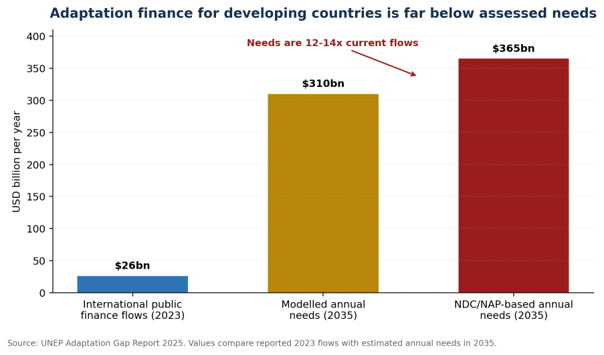
Figure 2. International public adaptation finance compared with assessed developing-country needs.
8.2 The Fund for responding to Loss and Damage
The Fund for responding to Loss and Damage was operationalized under the UN climate regime to assist developing countries that are particularly vulnerable to climate impacts. Its Board established the Barbados Implementation Modalities for an initial $250 million set of interventions in 2025-2026, using grants and country-led approaches. This is an important institutional advance, but the scale of available finance remains small relative to growing losses[27]. [16]
Effective loss-and-damage finance should support rapid access, direct access where feasible, anticipatory measures, recovery, relocation, social protection, and non-economic loss. It should complement rather than substitute for mitigation and adaptation finance. Standardized national loss-and-damage databases, post-disaster needs assessments, remote sensing, geospatial exposure data, household and business surveys, and community validation are essential for credible needs assessment and equitable allocation.
9.0 Early warning and anticipatory action
Mitigation determines how severe future climate change becomes; adaptation and disaster risk reduction determine how much harm occurs at a given level of hazard. Multi-hazard early warning systems are among the most practical and cost-effective tools for protecting lives and livelihoods now. UNDRR reports that more than 60 % of countries had reported the existence of a multi-hazard early warning system by 2025, but critical coverage and capability gaps remain. Disaster-related mortality is nearly six times lower in countries with more comprehensive capabilities. [13]
An effective early-warning system is not a sensor, forecast, siren, mobile application, or control room in isolation. It is an end-to-end, people-centred chain linking risk knowledge; observations and monitoring; forecasting and impact analysis; authoritative warning decisions; accessible communication; preparedness; early action; response; feedback; and continuous improvement. A failure at any link can neutralize the entire investment.
9.1 Four operational pillars
Risk knowledge: Dynamic hazard, exposure, vulnerability, capacity, impact, and loss data; inclusive risk profiling; historical and future scenarios.
Observation and forecasting: Hydrometeorological networks, satellites, radar, gauges, sensors, data quality, models, thresholds, uncertainty, and expert judgement.
Warning communication: Clear authority, Common Alerting Protocol, multilingual and accessible messages, multiple channels, trusted messengers, redundancy, and feedback.
Preparedness and response: Pre-agreed actions, evacuation, shelters, sector plans, drills, social protection, logistics, contingency finance, and post-event learning.
9.2 From warning to anticipatory action
A warning saves lives only when it triggers action. Anticipatory action links forecasts or observed thresholds to pre-agreed measures and pre-arranged finance before peak impact. Examples include cash transfers, livestock protection, evacuation support, reservoir management, pre-positioning supplies, reinforcing health services, adjusting school or work schedules, and protecting water systems.
Impact-based forecasting improves decisions by translating “what the weather will be” into “what the weather may do, to whom, where, and when.” This requires real-time hazard data combined with geospatial exposure, vulnerability, and critical-infrastructure information. Trigger design must balance false alarms, missed events, lead time, uncertainty, action cost, and risk tolerance. Triggers should be tested, documented, governed, and updated after each activation.
Last-mile principle. Warnings must be received, understood, trusted, and actionable by everyone, including women, children, older persons, persons with disabilities, Indigenous Peoples, migrants, remote populations, and people without reliable internet or smartphones.
10.0 A global-to-local climate-risk intelligence architecture
The climate emergency cannot be managed through fragmented projects, disconnected databases, proprietary models, and isolated warning channels. Climate-risk intelligence should be treated as a global public good: scientifically credible, interoperable, accessible, locally relevant, and linked directly to decisions and finance.
The recommended architecture is nested rather than centralized. Global systems provide Earth observation, reanalysis, climate models, standards, and shared digital public infrastructure. Regional institutions translate transboundary hazards and provide specialized forecasting and technical support. National systems establish authoritative data governance, risk databanks, forecast and warning services, and planning links. Subnational authorities contextualize risk, operate local services, and coordinate action. Communities contribute observations, local and Indigenous knowledge, trusted communication, feedback, and accountability.
Layer | Core functions | Principal actors |
Global | Satellites, climate models, ocean and atmospheric observing, open standards, global datasets, finance norms | WMO, UN agencies, research consortia, space agencies, multilateral funds |
Regional | Transboundary forecasting, river-basin and ocean services, regional climate outlooks, technical backstopping | Regional centres, river-basin organizations, economic communities, universities |
National | Mandates, national risk databank, observations, models, official warnings, NAP/NDC/DRR integration, finance | Government, NMHS, disaster authority, planning and finance ministries, sector agencies |
Subnational | Local risk profiles, land-use and investment decisions, service continuity, evacuation, social protection | Provincial/state and local governments, EOCs, utilities, health and education systems |
Community | Participatory mapping, local observation, trusted dissemination, preparedness, early action, feedback | Community organizations, volunteers, traditional leaders, women, youth, Indigenous and marginalized groups |
Table 4. Nested climate-risk intelligence: common standards with nationally owned and locally grounded decisions.
10.1 Essential capabilities
- Governance before ICT: legal mandates, decision authority, data custodianship, accountability, privacy, ethics, maintenance responsibility, and sustainable financing.
- Federated and interoperable data: common geospatial standards, metadata, APIs, quality controls, versioning, open data where appropriate, and secure access for sensitive information.
- Dynamic risk information: climate projections, multi-hazard scenarios, exposure inventories, vulnerability indicators, critical-infrastructure dependencies, and economic and non-economic loss records.
- Decision support: impact-based forecasts, thresholds, scenario analysis, dashboards, risk-informed budgeting, investment screening, and sector-specific early-action protocols.
- Inclusive communication: multilingual, accessible, multi-channel warnings and risk communication designed with users, not merely delivered to them.
- Learning and accountability: after-action reviews, community feedback, forecast verification, public performance indicators, independent review, and continuous capacity development.
Artificial intelligence can support forecasting, downscaling, pattern recognition, damage mapping, translation, and decision support, but it does not replace observations, domain expertise, local knowledge, public authority, or accountability. Models can reproduce bias, fail under unprecedented conditions, or create false confidence. AI use should therefore be transparent, validated, human-supervised, and proportionate to the decision risk.
11.0 Defusing the bomb through rapid mitigation
Adaptation can reduce harm but cannot prevent unlimited warming. Rapid, sustained, and equitable emissions reduction is the only way to stabilize temperature and reduce the probability of crossing additional thresholds. The near-term objective is not simply a distant net-zero date; it is a steep decline in gross emissions during this decade, supported by protection and expansion of natural carbon sinks and carefully governed removal of residual emissions.
11.1 Priority mitigation levers
- Electricity: accelerate renewable and other low-emissions generation, grids, storage, demand response, efficiency, and universal access while retiring unabated fossil capacity on a just and orderly timetable.
- Methane and short-lived pollutants: rapidly reduce emissions from fossil-energy systems, waste, agriculture, and biomass burning to slow near-term warming and improve air quality.
- Buildings and cities: improve efficiency, passive cooling, clean cooking, electrification, compact urban form, public transport, walking, cycling, and urban green-blue infrastructure.
- Industry: expand material efficiency, circularity, electrification, low-carbon heat, green hydrogen for appropriate uses, and low-emissions steel, cement, and chemicals.
- Land and food systems: halt deforestation, restore degraded ecosystems, improve soil and livestock management, reduce food loss and waste, and support healthy sustainable diets while protecting food security and land rights.
- Demand and equity: focus on high-emitting consumption while expanding energy and service access for low-income populations; a just transition must protect workers and communities.
11.2 The economic opportunity
The transition is already changing investment and technology costs. The IEA expects approximately $2.2 trillion of clean-energy investment in 2026, compared with about $1.2 trillion in fossil fuels. IRENA reports 2025 global levelized costs around $44 per megawatt-hour for solar photovoltaic power and $33 for onshore wind, following long-term cost reductions of 89 % and 71 % respectively since 2010 [28] [29].
These trends demonstrate feasibility but not inevitability. Investment remains geographically concentrated, grid and storage constraints are serious, and emerging and developing economies face higher capital costs. Technology transfer, concessional finance, local manufacturing, skills, stable policy, and access to critical minerals under strong environmental and labour safeguards are necessary for an equitable transition.
Mitigation principle. Every fraction of a degree avoided reduces losses, adaptation pressure, ecosystem damage, and dependence on uncertain future carbon removal. Overshoot is not a licence for delay; it increases the value of faster cuts.
12.0 Reducing the blast radius through adaptation and resilience
Adaptation reduces exposure and vulnerability to present and future hazards. It should be anticipatory, risk-informed, inclusive, locally led, and integrated into development planning rather than treated as a collection of isolated projects. Because climate conditions are changing, adaptation must use scenarios, flexible pathways, safety margins, and regular review instead of optimizing for the historical climate.
12.1 Priority adaptation systems
Climate-resilient infrastructure: Update design standards; assess interdependencies; prioritize maintenance; protect hospitals, schools, water, energy, transport, and communications; use nature-based and engineered measures together.
Water security: Integrated basin management, drought and flood plans, groundwater governance, storage, demand management, leakage control, ecosystem restoration, climate-resilient WASH, and transboundary cooperation.
Food and livelihoods security services: Climate services, stress-tolerant crops, agroecology, irrigation efficiency, livestock protection, fisheries management, storage, insurance, social protection, and market access.
Health: Heat-health action plans, surveillance, climate-resilient facilities, clean air, cooling access, vector control, mental-health support, and occupational protections.
Cities and settlements: Risk-sensitive land use, drainage, heat action, green-blue networks, resilient housing, informal-settlement upgrading, coastal planning, and dignified relocation where unavoidable.
Ecosystems: Protect and restore forests, wetlands, mangroves, reefs, grasslands, peatlands, and watersheds while safeguarding local and Indigenous rights.
Finance and social protection: Shock-responsive safety nets, contingency funds, forecast-based finance, risk layering, insurance where appropriate, and grants for the poorest and most exposed.
12.2 Avoiding maladaptation
Adaptation can increase risk when it protects one place by transferring harm elsewhere, locks communities into unsafe locations, increases debt, excludes vulnerable groups, damages ecosystems, or assumes that future hazards will resemble the past. Sea walls may shift erosion; irrigation can deplete aquifers; air conditioning can increase emissions and exclude poor households; poorly designed resettlement can destroy livelihoods and culture.
Every major adaptation investment should therefore be screened for distributional effects, lifecycle emissions, ecological impact, future climate performance, residual risk, maintenance capacity, and exit options. Community participation must influence objectives, design, implementation, monitoring, and grievance mechanisms.
13.0 Finance, governance, and international cooperation
Climate action is constrained less by a lack of individual technologies than by fragmented governance, short political cycles, unequal finance, weak implementation capacity, vested interests, and geopolitical rivalry. A whole-of-Earth response requires cooperation that treats climate stability, resilient infrastructure, observing systems, risk data, and early warning as shared foundations of human security.
13.1 Reforming climate finance
COP29 established a goal for developed countries to lead in mobilizing at least $300 billion per year for developing countries by 2035 and called on all actors to work toward at least $1.3 trillion per year from public and private sources. The goal is an important step, but needs remain much larger, and the quality of finance matters: grants, concessionality, additionality, predictability, direct access, debt sustainability, and local ownership determine whether finance actually reduces risk [30].
- Scale grant and highly concessional finance for adaptation, early warning, fragile contexts, small islands, least developed countries, and non-economic loss and damage.
- Reform multilateral development banks to reduce the cost of capital, expand guarantees, finance preparedness, and integrate climate and disaster risk into all investments.
- Use climate-resilient debt clauses, debt swaps where appropriate, disaster liquidity, contingency credit, sovereign risk pools, and social-protection finance as part of layered risk financing.
- Align public budgets, procurement, subsidies, financial regulation, insurance, credit ratings, and private capital with climate-resilient and low-emissions development.
- Make access simpler and faster while strengthening fiduciary safeguards, transparency, results monitoring, community accountability, and protection against corruption and elite capture.
13.2 A climate solidarity and security compact
Climate action should take precedence over zero-sum geopolitical competition and militarized resource rivalry. A climate solidarity compact would require major emitters to reduce emissions faster, wealthy countries to mobilize finance and technology, and all countries to strengthen transparent implementation. It should support open climate data, shared satellite and modelling capacity, regional forecasting, resilient supply chains, fair critical-mineral governance, and nationally owned systems in the Global South.
This is not an argument for one-power unipolarity or for transferring control of national data and infrastructure to external actors. It is an argument for interoperable cooperation with sovereignty, reciprocity, equity, and accountability: common standards and public goods combined with nationally governed systems and locally grounded decisions.
13.3 Governance essentials
- Place climate risk within core national planning, finance, development, security, and public-investment systems rather than isolating it in environment ministries.
- Clarify institutional mandates, warning authority, data custodianship, coordination, and accountability across national, subnational, and local levels.
- Connect NDCs, National Adaptation Plans, disaster risk reduction strategies, sector plans, spatial plans, budgets, and loss-and-damage systems through shared risk information and indicators.
- Require transparent climate- and disaster-risk screening for public and private investments, including supply-chain and service-dependency analysis.
- Institutionalize participation by women, youth, Indigenous Peoples, persons with disabilities, civil society, scientists, workers, the private sector, and frontline communities.
14.0 Implementation roadmap: 2026-2035
The climate emergency requires simultaneous action, but sequencing still matters. Governance, risk knowledge, and financing arrangements should be established early so that technology and infrastructure investments are decision-centred, interoperable, maintainable, and publicly accountable.
Phase | Strategic objective | Priority actions |
Immediate: 2026-2027 | Stabilize the trajectory and close life-saving gaps | Strengthen 2035 climate plans and near-term delivery; halt high-carbon lock-in; map critical and cascading risks; clarify mandates; establish national risk and loss databases; expand observation networks; finance Early Warnings for All; approve anticipatory-action protocols; protect fiscal space and frontline services. |
Acceleration: 2028-2030 | Scale proven systems and transform investment | Deliver steep emissions reductions; modernize grids and resilient infrastructure; mainstream climate risk in budgets and procurement; achieve universal multi-hazard warning coverage; scale social protection and forecast-based finance; restore ecosystems; implement sector adaptation pathways; expand direct-access climate finance. |
Consolidation: 2031-2035 | Lock in resilient, low-emissions development | Reach and sustain declining global emissions; retire remaining high-risk and high-carbon assets on a just timetable; update adaptation pathways using observed change; finance unavoidable loss and damage at scale; maintain universal warnings; institutionalize continuous learning, accountability, and cross-border cooperation. |
Table 5. A phased but overlapping action pathway. Immediate protection and structural transformation must proceed together.
14.0 A minimum global performance dashboard
Domain | Illustrative indicators | Primary reporting home |
Mitigation | Annual GHG and CO2 emissions; fossil-fuel phase-down; renewable, grid, storage, efficiency, methane, and land-use indicators | UNFCCC reporting, energy and land systems |
Risk knowledge | Countries with interoperable risk databanks; current exposure and vulnerability datasets; coverage of compound and cascading risk | National and regional risk platforms |
Early warning | MHEWS coverage and quality by pillar; population reached; accessible channels; warning lead time; action and false-alarm performance | Sendai Target G, EW4All |
Anticipatory action | Hazards and sectors with agreed triggers; pre-arranged finance; activation speed; households reached; avoided losses | Government and humanitarian systems |
Adaptation | Implementation and effectiveness of NAP priorities; resilient infrastructure and services; ecosystem condition; avoided vulnerability | National M&E and Global Goal on Adaptation |
Finance | Mitigation, adaptation, DRR, and loss-and-damage flows by instrument, recipient, accessibility, gender and local share; debt implications | UNFCCC, funds, MDBs, national budgets |
Loss and damage | Event and slow-onset economic and non-economic losses; recovery needs; displacement; finance received; distributional outcomes | National L&D systems, PDNA, FRLD |
Justice and inclusion | Benefits and residual risks by income, gender, age, disability, location, Indigenous status, livelihood, and displacement status | Disaggregated national and local monitoring |
Table 6. Indicators should measure capability, coverage, action, effectiveness, equity, and learning – not only the installation of technology.
15.0 Recommendations by stakeholder group
15.1 G20 and other major emitters
- Deliver absolute emissions reductions consistent with 1.5°C-aligned pathways, strengthen 2035 targets, remove contradictory fossil-fuel incentives, and publish credible implementation plans.
- Finance the transition and resilience of emerging and developing economies without transferring unsustainable debt or constraining development rights.
- Protect international scientific cooperation, climate observations, and open data from geopolitical fragmentation.
15.2 Developed countries, multilateral banks, and climate funds
- Meet and exceed climate-finance commitments with a higher share of grants and concessional resources for adaptation, early warning, fragile contexts, and loss and damage.
- Lower the cost of capital through guarantees, currency-risk instruments, capitalization, debt clauses, and simplified direct access.
- Finance long-term operations, maintenance, staffing, and local capacity – not only equipment procurement and short project cycles.
15.3 Global South national governments
- Establish nationally owned, interoperable climate-risk information and decision-support systems linked to planning, budgeting, NAPs, NDCs, DRR strategies, and public investment.
- Clarify institutional mandates and create accountable coordination across meteorological, hydrological, disaster, planning, finance, sector, and subnational institutions.
- Prioritize no-regret and locally led measures while developing adaptation pathways for thresholds, relocation, and residual risk.
15.4 Meteorological, hydrological, disaster, and sector agencies
- Modernize observations and forecasting while strengthening data quality, interoperability, impact models, warning authority, Standard Operating Procedures, drills, and user feedback.
- Move from hazard-only bulletins toward impact-based forecasts and pre-agreed anticipatory actions backed by finance.
- Maintain redundant, multilingual, accessible communication channels and verify that warnings reach and are understood by at-risk groups.
15.5 Private sector and financial institutions
- Disclose and manage physical, transition, and nature-related risks across operations, investments, lending, insurance, and supply chains.
- Align capital expenditure and innovation with resilient, low-emissions development; stop financing assets incompatible with credible transition pathways.
- Share relevant risk data and capabilities under public-interest safeguards and support resilient infrastructure, services, and local enterprises.
Science, technology, and space communities
- Provide open, interoperable observations and models; support regional and national capacity; document uncertainty; and design tools with decision-makers and communities.
- Use AI transparently and responsibly, with validation, human oversight, bias assessment, cyber security, and fallback systems.
- Co-produce research with Global South institutions and recognize local and Indigenous knowledge, authorship, data sovereignty, and intellectual contribution.
15.6 Local governments and frontline communities
- Lead participatory risk mapping, local preparedness, inclusive communication, service-continuity planning, ecosystem stewardship, and after-action learning.
- Demand accessible budgets, risk information, grievance mechanisms, and representation in decisions over infrastructure, land, relocation, finance, and recovery.
- Strengthen trusted networks of volunteers, health workers, educators, community organizations, and local media for warnings and early action.
15.7 Media, civil society, and individuals
- Communicate climate risk accurately without fatalism; distinguish weather from climate, annual from long-term warming, and uncertainty from ignorance.
- Hold institutions and companies accountable for targets, finance, implementation, greenwashing, and distributional outcomes.
- Support civic and consumer choices that reinforce structural change while recognizing that individual action cannot substitute for government and corporate responsibility.
16.0 Conclusion
Climate catastrophe is a ticking time bomb because the forces driving danger are cumulative, delayed, and increasingly difficult to reverse. The fuse is already burning: greenhouse-gas concentrations and emissions remain high; the remaining carbon budget is small; oceans and ice are responding; severe and compound extremes are intensifying; and vulnerable communities are losing lives, livelihoods, territory, culture, and development gains.
Yet the outcome is not predetermined. There is no single cliff after which action becomes meaningless. Every tonne of avoided emissions, every fraction of a degree prevented, every ecosystem protected, every resilient investment, every trusted warning, and every pre-financed early action reduces harm. The narrowing window is a reason for speed and scale, not despair.
The necessary response is larger than an environmental programme. It is a whole-of-Earth and whole-of-society transformation of energy, land, cities, infrastructure, finance, technology, governance, and international cooperation. It must connect mitigation with adaptation; observation with decisions; forecasts with anticipatory finance; national plans with local action; recovery with resilience; and climate responsibility with justice.
Final message. The alarm is already sounding. The decisive question is whether humanity will use its remaining time to defuse the drivers of catastrophe, protect those already in danger, and build a safer, fairer, and more resilient future – or allow delay to turn preventable risks into irreversible loss.
17.0 References
The sources below were selected for authority, methodological transparency, and relevance. Figures and headline quantitative claims in the report are linked to these references by bracketed numbers.
IPCC (2023). Climate Change 2023: Synthesis Report.
WMO (2026). State of the Global Climate 2025.
WMO (2025). Global Annual to Decadal Climate Update 2025-2029.
UNEP (2025). Emissions Gap Report 2025: Off Target.
IPCC (2022). Climate Change 2022: Impacts, Adaptation and Vulnerability – Summary for Policymakers.
World Health Organization (2023). Climate change and health fact sheet.
World Bank (2021). Groundswell Part 2: Acting on Internal Climate Migration.
Global Tipping Points Report (2025). Understanding risks and positive tipping opportunities.
UNDRR (2025). Global Assessment Report on Disaster Risk Reduction 2025: Resilience Pays.
UNEP (2025). Adaptation Gap Report 2025: Running on Empty.
UNDRR and WMO (2025). Global Status of Multi-Hazard Early Warning Systems 2025.
WMO. Early Warnings for All initiative.
UNFCCC (2024). COP29 agreement on the New Collective Quantified Goal on Climate Finance.
UNFCCC. Fund for responding to Loss and Damage: institutional status and Board reports.
International Energy Agency (2026). World Energy Investment 2026.
IRENA (2026). Renewable Power Generation Costs in 2025.
IPCC (2022). Climate Change 2022: Mitigation of Climate Change – Summary for Policymakers.
UNFCCC (2023). COP28 UAE Consensus and the first Global Stocktake outcome.
WMO (2025). State of the Global Climate 2024.
UNFCCC (2015). Paris Agreement.
……………………………………………………………………………………End…………………………………………………………………………………..
Z M Sajjadul Islam , Advisor Multi-Hazard Early Warning System Design & Implementation Center (MHEWC) at https://www.mhewc.org & Global Climate Services (GLOCS) at https://glocs.org . Please email at zmasjjad@gmai.com , +8801711 979179
[1] WMO (2026). State of the Global Climate 2025.
[2] Friedlingstein, P. et al. (2026). Global Carbon Budget 2025. Earth System Science Data, 18, 3211-3274.
[3] UNEP (2025). Emissions Gap Report 2025: Off Target.
[4] IPCC (2023). Climate Change 2023: Synthesis Report.
[5]/[5] IPCC (2023). Climate Change 2023: Synthesis Report. Friedlingstein, P. et al. (2026). Global Carbon Budget 2025. Earth System Science Data, 18, 3211-3274.
[6] WMO (2025). Global Annual to Decadal Climate Update 2025-2029.
[7] WMO (2025). State of the Global Climate 2024.
[8] UNEP (2025). Emissions Gap Report 2025: Off Target.
[9] World Bank (2021). Groundswell Part 2: Acting on Internal Climate Migration.
[10] UNDRR (2025). Global Assessment Report on Disaster Risk Reduction 2025: Resilience Pays.
[11] UNEP (2025). Adaptation Gap Report 2025: Running on Empty.
[12] UNDRR and WMO (2025). Global Status of Multi-Hazard Early Warning Systems 2025.
[13] UNEP (2023). Emissions Gap Report 2023: Broken Record – emissions inequality and historical responsibility.
[14] International Energy Agency (2026). World Energy Investment 2026.
[15] IRENA (2026). Renewable Power Generation Costs in 2025.
[16] United Nations Secretary-General (2023). Message at the launch of the IPCC Synthesis Report: the climate time-bomb is ticking.
[17] IPCC (2023). Climate Change 2023: Synthesis Report.
[18] WMO (2026). State of the Global Climate 2025.
[19] WMO (2025). State of the Global Climate 2024.
[20] WMO (2025). Global Annual to Decadal Climate Update 2025-2029.
[21] Friedlingstein, P. et al. (2026). Global Carbon Budget 2025. Earth System Science Data, 18, 3211-3274.
[22] UNEP (2025). Emissions Gap Report 2025: Off Target.
[23] World Health Organization (2023). Climate change and health fact sheet.
[24] UNDRR (2025). Global Assessment Report on Disaster Risk Reduction 2025: Resilience Pays.
[25] UNEP (2023). Emissions Gap Report 2023: Broken Record – emissions inequality and historical responsibility.
[26] IPCC (2022). Climate Change 2022: Impacts, Adaptation and Vulnerability – Summary for Policymakers.
[27] UNFCCC. Fund for responding to Loss and Damage: institutional status and Board reports.
[28] International Energy Agency (2026). World Energy Investment 2026.
[29] IRENA (2026). Renewable Power Generation Costs in 2025.
[30] UNFCCC (2024). COP29 agreement on the New Collective Quantified Goal on Climate Finance.