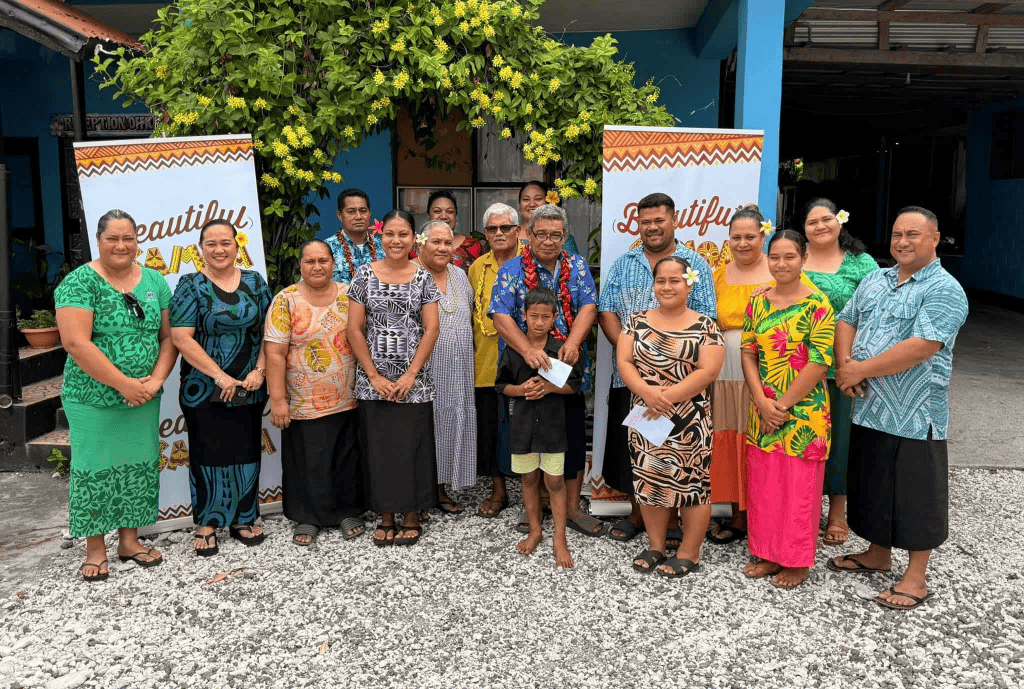
MHEWC intends to support the National Emergency Operations Centre (NEOC), Samoa
To,
The Director, National Emergency Operations Centre (NEOC), Samoa
Subject: Proposal for Technical Cooperation and Partnership to Strengthen Multi-Hazard Early Warning Systems, Disaster Risk Governance, and Emergency Management Capacities in Samoa
Dear Sir,
Greetings from the Multi-Hazard Early Warning System Development and Implementation Center (MHEWC).
MHEWC is a specialized technical knowledge and solutions platform dedicated to strengthening climate and multi-hazard risk governance, disaster risk management, and the design and operationalization of integrated, end-to-end, people-centered early warning systems. Our technical expertise encompasses institutional capacity assessments, hydro-meteorological observation and monitoring networks, geospatial risk intelligence, ICT- and AI-enabled Decision Support Systems (DSS), impact-based forecasting, anticipatory action, and disaster preparedness, response, and recovery management.
Recognizing the critical importance of strengthening the national disaster risk management capabilities, MHEWC would welcome the opportunity to establish technical cooperation and a strategic working partnership with the NEOC .
In collaboration with NEOC’s relevant national hydro-meteorological institutions, sectoral ministries, local authorities, and other stakeholders, MHEWC is prepared to provide specialized technical assistance in the following priority areas:
1) Assessment and Modernization of Hydro-Meteorological Observation and Monitoring Networks
Conduct comprehensive technical diagnostics of existing hydro-meteorological observation stations and monitoring infrastructure, identify institutional and technological gaps, and develop a phased modernization and investment plan. This may include the technical design, installation, calibration, and integration of Automated Weather Stations (AWS), Internet of Things (IoT) sensors, and real-time environmental and hazard-monitoring technologies to strengthen the detection, tracking, and forecasting of potentially hazardous conditions.
2) Strengthening Integrated Multi-Hazard Monitoring and Early Warning Capacities
Assess existing monitoring, observation, forecasting, and early warning capabilities and support NDMC and relevant national meteorological and hydrological services in upgrading and integrating observation networks. This includes hybrid weather and hazard-monitoring systems, interoperable sensor networks, real-time data acquisition and transmission, and automated data ingestion into operational Decision Support Systems for multi-hazard monitoring, forecasting, and warning dissemination.
3) Modernization and Operationalization of the National Emergency Operations Center (EOC)
Undertake a comprehensive technical and institutional assessment of existing Emergency Operations Center facilities, operational procedures, communication systems, and information management infrastructure. Based on the findings, develop an EOC modernization roadmap and support the technical design, upgrading, and operationalization of an integrated National Emergency Operations Center and Situation Room.
The proposed EOC architecture would incorporate real-time hydro-meteorological observations, IoT-enabled monitoring networks, geospatial risk information, automated hazard tracking, impact-based forecasting, early warning dissemination, anticipatory action advisories, and coordinated emergency response management.
4) Development of ICT- and AI-Enabled Emergency Management and Decision Support Applications
Design and develop customized ICT- and AI-enabled applications to support automated hazard identification, real-time monitoring, predictive analytics, impact forecasting, emergency information management, and operational decision-making.
These solutions may include automated data processing, geospatial visualization, scenario-based impact analysis, threshold-based alert generation, emergency resource tracking, incident management, and decision-support workflows. AI-assisted outputs would be subject to appropriate technical validation and oversight by authorized national institutions.
5) Transformation of NEOC’s Web Portal into an Integrated Geospatial Decision Support Platform
Provide technical assistance to assess and upgrade NEOC’s existing web-based information systems into an integrated, geospatial, database-driven, and application-enabled Disaster Risk Information and Decision Support System (DRI-DSS).
The platform would support real-time hazard monitoring, climate and multi-hazard risk information management, institutional coordination, preparedness planning, anticipatory action, emergency response, recovery management, and evidence-based decision-making across national and subnational administrative levels.
6) Development of National Climate and Multi-Hazard Risk Assessment Frameworks and Risk Information Repositories
Develop standardized methodologies, analytical frameworks, technical tools, and operational guidelines for conducting climate and multi-hazard risk and vulnerability assessments.
Technical assistance would include the preparation of GIS-based hazard, exposure, vulnerability, and risk maps; multi-sectoral risk profiles; climate and disaster risk scenarios; and the establishment of a centralized, interoperable national risk information repository and geospatial database management system.
7) Design and Operationalization of End-to-End, People-Centered Multi-Hazard Early Warning Systems
Support NEOC and relevant technical institutions in designing and implementing integrated, end-to-end Multi-Hazard Early Warning Systems (MHEWS), aligned with the four pillars of the Early Warnings for All (EW4All) initiative.
Priority interventions may include:
- Hazard detection, monitoring, weather nowcasting, and forecasting services.
- Impact-Based Forecasting (IBF) and Impact-Based Warning (IBW) systems.
- Forecast-Based Financing (FbF) and anticipatory action mechanisms.
- Development of hazard-specific triggers, Early Action Protocols (EAPs), and anticipatory response plans.
- Common Alerting Protocol (CAP)-enabled warning generation and dissemination.
- DSS-supported emergency preparedness, contingency planning, and response management.
- Development of operational guidelines, Standing Orders on Disaster, and institutional Standard Operating Procedures (SOPs).
- Strengthening last-mile warning communication, community preparedness, and coordinated early action.\
8) Integration of Climate and Disaster Risk Intelligence into Sectoral and Local Development Planning
Develop GIS-enabled databases, digital planning tools, and sector-specific risk information systems to support national ministries, government departments, municipalities, and local authorities in integrating climate and disaster risk considerations into development planning, public investment, and budgeting processes.
Technical assistance would focus on strengthening Disaster Risk Reduction (DRR), Climate Change Adaptation (CCA), Nature-Based Solutions (NbS), Locally Led Adaptation (LLA), resilient infrastructure planning, and climate-informed sectoral investment strategies.
9) Review and Strengthening of Multi-Hazard Preparedness, Emergency Response, and Recovery Plans
Review existing disaster preparedness, emergency response, contingency, and recovery plans at national, regional, municipal, and sectoral levels.
Support the development and upgrading of hazard-specific and multi-hazard operational plans, institutional coordination mechanisms, emergency communication protocols, resource mobilization procedures, and risk-informed recovery strategies consistent with NEOC’s mandate and national disaster management priorities.
10) Strengthening National-to-Local Disaster Risk Governance and Institutional Capacities
Provide specialized technical assistance to strengthen the institutional, regulatory, organizational, and operational foundations of disaster risk governance.
This may include institutional assessments, capacity development, stakeholder coordination frameworks, interagency information-sharing protocols, technical training, knowledge transfer, and the preparation of phased, costed implementation roadmaps to improve national and local emergency management capabilities.
11) Technical Support to Climate Change, Meteorological, Hydrological, and Disaster Management Institutions
Provide targeted technical support to NEOC, relevant climate change institutions, National Meteorological and Hydrological Services (NMHS), and other designated government agencies to strengthen climate information services, weather and climate monitoring, multi-hazard risk assessments, forecasting, early warning operations, climate resilience planning, and institutional technical capacities.
Such cooperation would be tailored to institutional requirements, existing technical infrastructure, priority hazards, and national development objectives.
Proposed Way Forward
MHEWC proposes initiating the cooperation through a joint technical consultation with NEOC to identify priority institutional and technological needs, review existing capacities, and determine potential areas for collaboration.
Based on NEOC priorities, we would welcome the opportunity to conduct an initial technical scoping and institutional capacity assessment, followed by preparing a practical, phased, costed technical cooperation and implementation roadmap.
Our approach emphasizes national ownership, technology transfer, institutional sustainability, interoperability, and the development of operational systems that connect hazard observation and risk intelligence with timely warnings, informed decisions, and effective anticipatory action.
We would be pleased to arrange a virtual meeting with your technical and management teams at a mutually convenient time to discuss potential collaboration and identify immediate opportunities for technical support.
We look forward to your favorable consideration and the opportunity to contribute to strengthening national disaster risk governance, multi-hazard early warning, and emergency management systems.
Yours sincerely,
Z M Sajjadul Islam
Director & Advisor
Multi-Hazard Early Warning System Development and Implementation Center (MHEWC)
Website: https://www.mhewc.org/brunei http://www.glocs.org
Email: zmsajjad@gmail.com | sajjad@mhewc.org
Phone & WhatsApp: +88 01711 979179
———————————————————————————————————–
Climate risk and vulnerabilities of Samoa
Samoa is highly exposed and vulnerable to climate change and multi-hazard risks due to its small-island geography, low-lying coastal settlements, steep volcanic catchments, fragile freshwater systems, dependence on agriculture, fisheries and tourism, and exposure to cyclones, floods, tsunamis and other geophysical hazards. The country faces major risks from tropical cyclones, storm surge, coastal flooding, sea-level rise, coastal erosion, saltwater intrusion, flash floods, landslides, drought, heat stress, earthquakes, tsunamis, coral reef degradation, fisheries decline, agricultural losses, infrastructure damage and climate-sensitive health impacts. Climate change is expected to intensify these vulnerabilities through rising temperatures, rising seas, heavier rainfall events, stronger coastal inundation, increased flood and landslide risk, drought stress, water contamination, ecosystem degradation and growing pressure on food security, water security, infrastructure, public health, livelihoods and vulnerable island communities. Strengthening multi-hazard early warning systems, impact-based forecasting, cyclone preparedness, coastal protection, tsunami readiness, flood and landslide risk reduction, resilient water systems, climate-resilient agriculture, fisheries and reef resilience, disaster risk financing and locally led village adaptation is essential to reduce losses and protect Samoa’s development gains.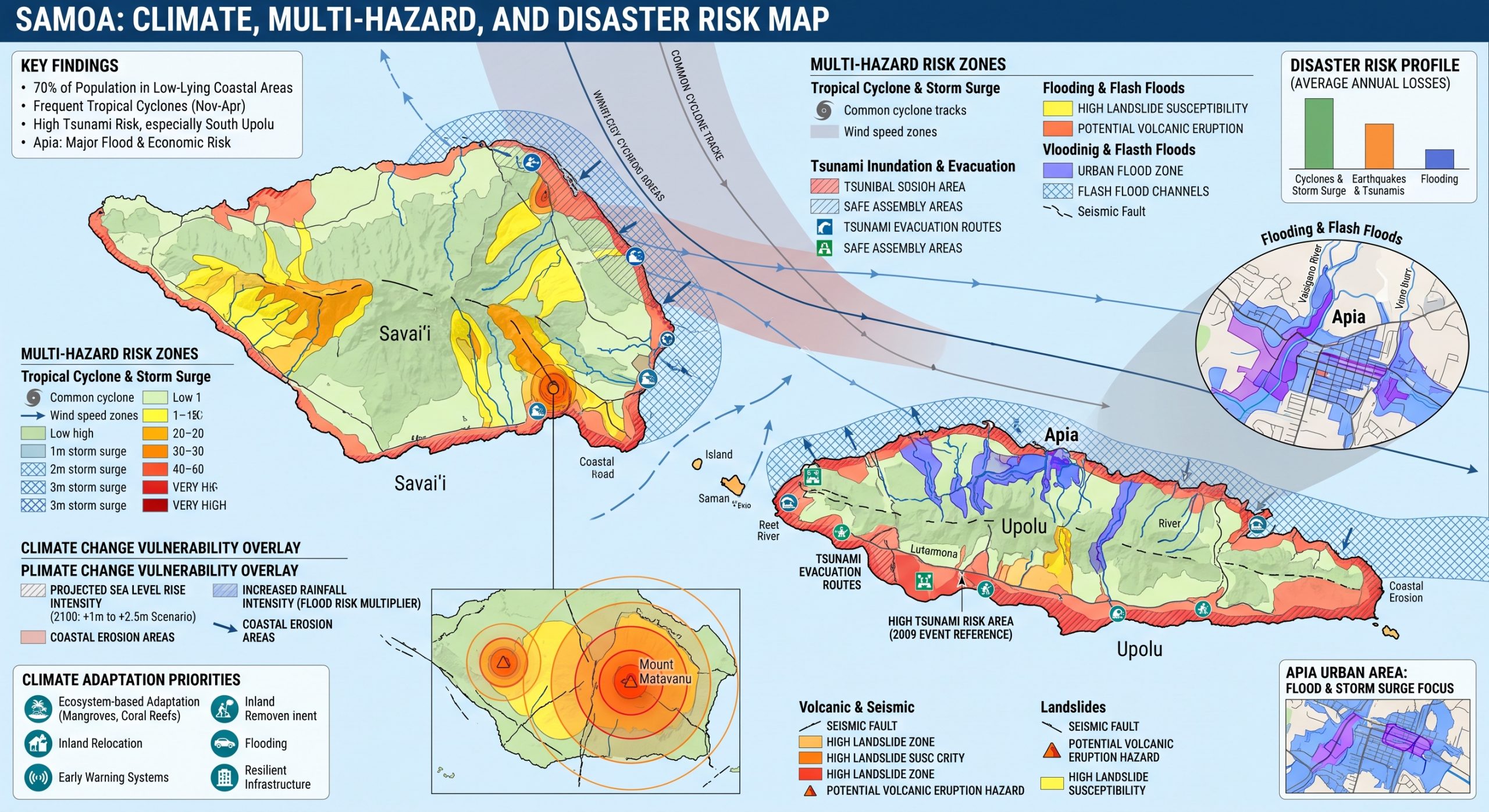
Samoa is highly vulnerable to climate change and multi-hazard risks because of its small-island geography, low-lying coastal settlements, cyclone exposure, steep volcanic catchments, fragile freshwater systems, dependence on climate-sensitive agriculture, fisheries and tourism, and exposure to both hydrometeorological and geophysical hazards. Samoa’s key hazards include tropical cyclones, storm surge, coastal flooding, sea-level rise, coastal erosion, flash floods, landslides, drought, heat stress, earthquakes, tsunamis, volcanic hazards, coral reef degradation, and climate-sensitive health risks. Samoa is also highly coastal: the World Bank notes that more than 70% of Samoans live in low-lying coastal areas, making climate and disaster risk a direct threat to people, livelihoods, infrastructure, and development gains. (World Bank)

1. Multi-hazard exposure
Samoa’s risk profile combines coastal, hydrometeorological, geophysical and ecosystem-related hazards. Tropical cyclones and intense rainfall can generate destructive winds, river flooding, storm surge, coastal inundation, landslides and major damage to homes, roads, bridges, water systems, crops and public services. Samoa is also exposed to earthquakes and tsunamis, with the 2009 earthquake and tsunami causing 143 fatalities and economic losses equivalent to around 20% of GDP. (Open Knowledge Repository)
The disaster-risk finance profile for Samoa estimates average annual losses of about US$10 million from earthquakes and tropical cyclones, with a 50% chance over 50 years of losses exceeding US$130 million and casualties above 325 people. This demonstrates that even a single major event can create severe national fiscal, social and recovery impacts. (GFDRR)
2. Climate change as a development risk multiplier
Climate change is a major development risk for Samoa because it affects coastal settlements, water security, agriculture, fisheries, tourism, health, transport, public finance and cultural heritage. Samoa’s National Adaptation Programme of Action identifies the main climate concerns as changes in the frequency and intensity of extreme weather events, coastal erosion and sea-level rise. (Adaptation UNDP)
Samoa’s NDC 3.0 also identifies major climate impacts across electricity, agriculture and fisheries, biodiversity and mangrove forestry, and transport, confirming that adaptation is a cross-sector development priority rather than a single environmental issue. (UNFCCC)
3. Tropical cyclone, storm surge and wind-damage vulnerability
Tropical cyclones are among Samoa’s most damaging hazards. Cyclones can bring destructive winds, intense rainfall, storm surge, landslides, river flooding, coastal erosion, water contamination, crop losses, road damage, power disruption and damage to schools, health facilities, ports and tourism assets.
Tropical Cyclone Evan in 2012 showed the scale of cyclone risk: it destroyed more than 600 homes, killed 14 people, displaced more than 7,500 people, and caused damages and production losses exceeding US$210 million, equivalent to about 30% of Samoa’s 2011 GDP. (World Bank)
4. Flood, flash-flood and landslide vulnerability
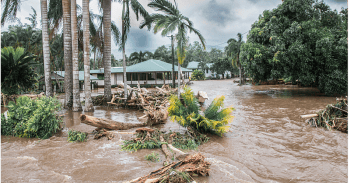
Flooding is a major recurrent hazard, particularly in Apia and the Vaisigano River catchment, as well as other river valleys and steep catchments on Upolu and Savaiʻi. Heavy rainfall can rapidly generate flash floods because short, steep watersheds move water quickly from upland areas to coastal settlements. Floods can damage roads, bridges, homes, water systems, schools, markets, electricity assets, crops and sanitation infrastructure.
Landslide risk is highest where intense rainfall interacts with steep volcanic terrain, road cuts, deforestation, unstable slopes, poorly drained settlements and degraded catchments. Flood and landslide risks are therefore closely linked to watershed management, land-use planning, drainage design, riverbank protection and road resilience.
5. Sea-level rise, coastal erosion and saltwater intrusion
Sea-level rise is one of Samoa’s most strategic long-term climate threats. Low-lying coastal villages, roads, schools, health facilities, churches, cemeteries, ports, tourism assets, water systems and cultural sites are exposed to storm surge, wave overtopping, coastal erosion and saltwater intrusion. Samoa’s Climate Change Policy reports that sea level is expected to continue rising, with projected rise by 2030 under a very high emissions scenario in the range of 7–17 cm. (FAOLEX Database)
Disaster-risk reduction analysis for Samoa projects sea-level rise of about 29–43 cm by 2060 and 55–110 cm by the end of the century, increasing coastal flooding, erosion and saltwater contamination risks. (PreventionWeb) These risks are especially serious because coastal land is central to Samoan settlement patterns, identity, livelihoods, burial sites, customary land systems and village governance.
6. Water security and drought vulnerability
Freshwater security is highly climate-sensitive in Samoa. Many communities depend on rainfall, rivers, springs, groundwater and local storage systems. Drought can reduce water availability, while cyclones, floods and storm surge can contaminate water sources with sediment, saltwater, debris and pathogens. Water-system damage can quickly affect schools, health facilities, households, tourism, agriculture and emergency response.
Drought risk is especially important where households have limited storage, where groundwater is vulnerable to saltwater intrusion, and where agriculture depends on predictable rainfall. Water security therefore requires stronger catchment protection, rainwater harvesting, drought contingency planning, leakage reduction, resilient water infrastructure and flood-safe WASH systems.
7. Agriculture, fisheries and livelihood vulnerability
Agriculture and fisheries are central to Samoa’s livelihoods, food security, culture and rural economy. Climate risks include cyclones, drought, saltwater intrusion, flooding, landslides, pests, plant disease, soil erosion, coral reef decline and changing fish distribution. Samoa’s NDC 3.0 explicitly recognizes agriculture and fisheries as climate-sensitive sectors. (UNFCCC)
| Sub-sector | Main climate and hazard risks |
|---|---|
| Root crops and food gardens | Cyclone wind damage, flooding, drought, pests, soil erosion, saltwater intrusion |
| Coconut, breadfruit and tree crops | Cyclone damage, salt spray, drought stress, heat stress |
| Livestock | Heat stress, water shortages, feed scarcity, disease risk |
| Coastal fisheries | Coral bleaching, storm damage, marine warming, ocean acidification, reef degradation |
| Tourism livelihoods | Beach erosion, reef decline, cyclone damage, water shortages, infrastructure disruption |
| Rural households | Crop losses, reduced income, market disruption, recovery-cost burden |
8. Earthquake, tsunami and volcanic-risk vulnerability
Samoa’s geophysical risk is significant because of regional tectonic and volcanic processes. The 2009 tsunami demonstrated how quickly a geophysical event can become a national disaster, damaging coastal communities, roads, communications and social infrastructure. The World Bank reported that the tsunami left about 5,300 people, or 2.5% of Samoa’s population, homeless and caused extensive infrastructure damage. (World Bank)
Tsunami vulnerability is highest for low-lying coastal villages, schools, churches, tourism areas, roads and public facilities with limited evacuation time. Earthquake and tsunami preparedness therefore needs to be integrated with coastal warning systems, evacuation routes, drills, resilient communications, school safety and community-based disaster preparedness.
9. Health and social vulnerability
Climate change can worsen public-health risks through heat stress, diarrhoeal disease, waterborne disease, vector-borne disease, malnutrition, flood-related injuries, respiratory stress, trauma and disruption of health services. Floods and cyclones can contaminate water and damage sanitation systems, while drought can reduce hygiene and increase household stress.
The most vulnerable groups include coastal communities, low-income households, subsistence farmers, fishing households, women-headed households, children, older persons, people with disabilities, people with chronic illness, outer-village communities, and households living in flood-prone, landslide-prone, tsunami-prone or erosion-prone areas. Vulnerability is highest where exposure overlaps with weak housing, limited savings, limited insurance, poor drainage, water insecurity and restricted access to timely early warning.
10. Sector-specific vulnerability summary
| Sector | Main climate and multi-hazard risks |
|---|---|
| Coastal settlements | Sea-level rise, storm surge, coastal flooding, erosion, tsunami exposure, saltwater intrusion |
| Water and WASH | Drought, flood contamination, saline intrusion, damaged water infrastructure, limited storage |
| Agriculture and food security | Cyclones, floods, drought, pests, soil erosion, saltwater intrusion, crop losses |
| Fisheries and marine ecosystems | Coral bleaching, ocean warming, acidification, storm damage, reef degradation |
| Transport infrastructure | Flooded roads, bridge damage, coastal-road erosion, landslides, port disruption |
| Health | Heat stress, waterborne disease, vector-borne disease, injury, nutrition stress |
| Tourism | Beach erosion, cyclone damage, reef decline, water shortages, business interruption |
| Education and public services | School flooding, service disruption, evacuation pressure, damaged public buildings |
| Geophysical risk | Earthquakes, tsunamis, volcanic hazards, emergency-access disruption |
11. Priority resilience needs
Samoa’s resilience agenda should prioritize multi-hazard early warning systems, impact-based forecasting, cyclone preparedness, tsunami readiness, coastal protection, flood and landslide risk reduction, drought preparedness, water-security planning, resilient roads and bridges, climate-resilient agriculture, fisheries and reef resilience, climate-health surveillance, disaster risk financing and locally led village adaptation.
| Priority area | Key actions |
|---|---|
| Early warning and anticipatory action | Impact-based warnings for cyclones, floods, landslides, drought, coastal inundation, heat, tsunami and health risks |
| Cyclone and coastal resilience | Cyclone-safe housing, coastal-risk mapping, nature-based buffers, shoreline monitoring, safe evacuation routes |
| Flood and landslide management | Watershed restoration, riverbank protection, drainage upgrading, slope-risk mapping, floodplain zoning |
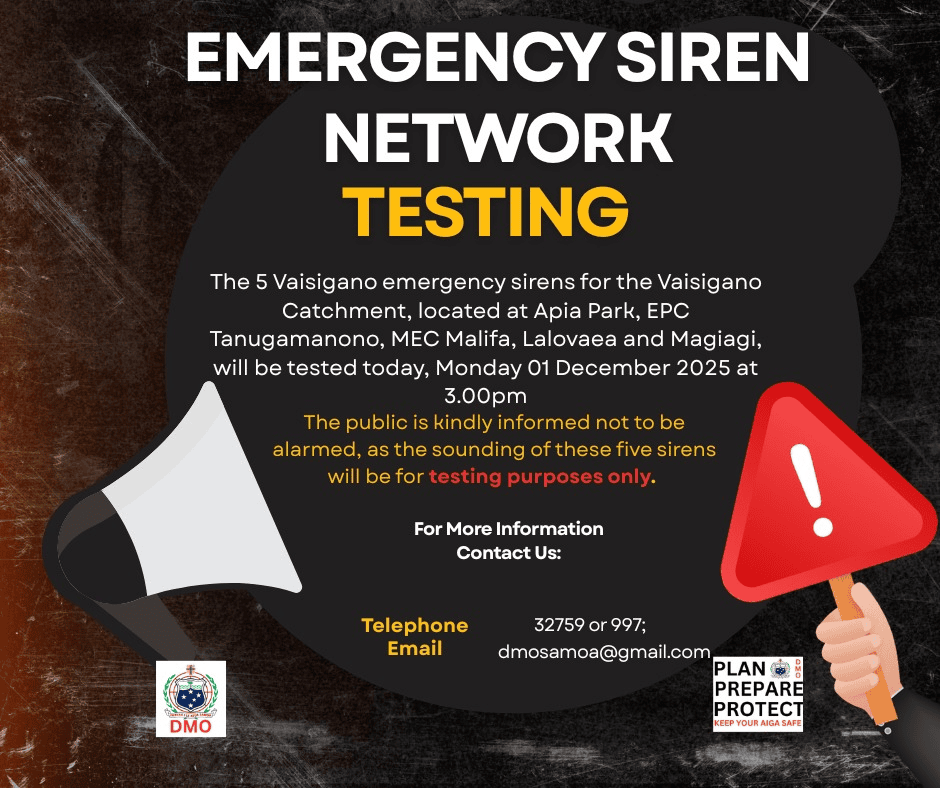
| Tsunami preparedness | Evacuation routes, sirens, drills, school-based preparedness, resilient emergency communications |
| Water security | Rainwater harvesting, catchment protection, leakage reduction, drought planning, salinity monitoring, flood-safe WASH |
| Climate-resilient agriculture | Cyclone- and drought-resilient crops, agroforestry, soil conservation, seed banks, pest surveillance |
| Fisheries and reef resilience | Coral reef protection, sustainable fisheries, marine protected areas, safe harbours, livelihood diversification |
| Risk financing and recovery | Contingency finance, insurance, forecast-based financing, resilient reconstruction, local recovery funds |
Samoa National Action Plan for Disaster Risk Management
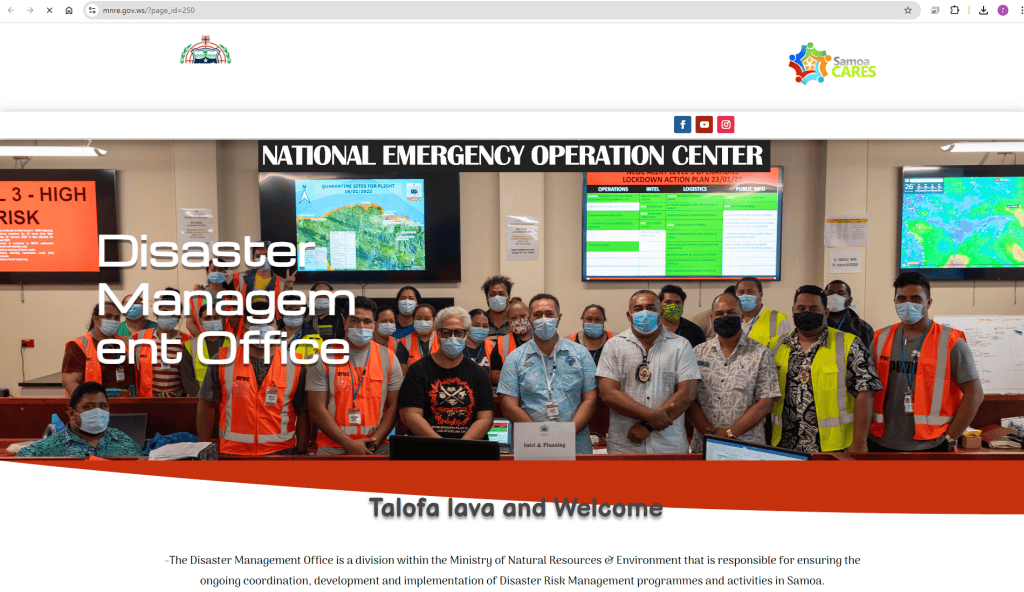
-The Disaster Management Office is a division within the Ministry of Natural Resources Environment that is responsible for ensuring the
ongoing coordination, development and implementation of Disaster Risk Management programmes and activities in Samoa.
-We believe that information sharing helps reduce the harmful effects of any natural disaster to our people and environment. This webpage
provides another means of disseminating information about our role through Disaster Risk Management.
-Our staff is situated at the National Emergency Operations Centre (NEOC) in Tuana’imato and our Disaster Risk Reduction (DRR) team is
located within the Meteorology Compound – Mulinu’u.
DISASTER MANAGEMENT SECTION
The Disaster Management section focuses to provide an overall assurance of effective coordination and
management of programmes to prepare for, respond to and recover from natural and human induced disasters.
Its functions include the following:
. Lead the implementation of the Preparedness, Response and Early Recovery components of the National Disaster Management Framework.
. Facilitation of national response agencies, associate member agencies of DAC, schools, stakeholders and partners, sectors in developing, maintenance
and testing of disaster management/response plans.
. Establish and maintain communications systems to strengthen emergency response coordination and for early warning dissemination.
. Maintain communication with all agencies, partners and sectors before, during and after a disaster.
. Promote, initiate and support recovery activities by government ministries, sectors and other agencies that build resilience to future disasters and
ensure that measures to strengthen preparedness for response are incorporated as a requirement of recovery programming and implementation.
. Monitor and evaluate progress of implementation and effectiveness of disaster management programmes at all levels.
COMMUNITY DISASTER PREPAREDNESS SECTION
The Disaster Management Office in partnership with other governmental authorities and local NGOs has
provided a unified system to approach DRR in the Samoan communities. CDCRM aims to encourage villages to
take responsibility for their own protection on the threat of disasters. Its main activities include:
. Facilitating a community driven process to identify the hazards and risks villages are exposed to and to identify and implement actions to mitigate
these risks and lessen the impacts of future events
. Organizing villages into disaster committees and response teams, ensuring teams are trained and prepared for collective action.
. Organizing a community profiling process to generate sufficient and accurate information; arranging necessary technical support to village committees;
and
. Targeting the most vulnerable based gender, age, disabilities, socio-economic status, and ensuring their needs and capacities are integrated into the
village planning process.
DISASTER RISK REDUCTION
The Disaster Risk Reduction is one of the sections under the Disaster Management Office with its primary
objective in ensuring effective coordination and management of programmes that reduces the risk of being
adversely affected by natural and human induced disasters. The roles and responsibilities of the Disaster Risk
Reduction Section in accordance with the Disaster Emergency Management Act 2007 includes;
. Conduct hazards assessment and vulnerability analysis which determines appropriate prevention and or mitigation, preparedness and response
measures.
. Assist technical Ministries to Design structural (hard solutions) and or non-structural (soft solutions) to prevent and mitigate risks for all high risk areas
in consultation with relevant experts.
. Coordinate the planning and execution of the national DRM platform and as well as identifying capability building needs for staff and sectors in relation
to risk reduction and coordinate relevant training programs.
. Promote, initiate and support recovery activities by sectors, agencies and community that build resilience to future disasters and ensure that risk
reduction measures are incorporated as a requirement of recovery programming and implementation.
. Monitor and evaluate progress of implementation and effectiveness of risk reduction measures at all levels.
Samoa is highly vulnerable to both natural and human-induced hazards due to its geographic location, volcanic origins, and status as a Small Island Developing State (SIDS). While these characteristics contribute to Samoa’s natural beauty, they also expose the country to significant disaster risks, including earthquakes, tsunamis, cyclones, and anthropogenic hazards.
The National Action Plan (NAP) for Disaster Risk Management serves as an operational framework to support the implementation of the National Disaster Management Plan (NDMP) 2017–2020. It provides practical, day-to-day guidance for disaster risk management (DRM) operations and establishes a Monitoring, Evaluation, and Learning (MEL) framework to assess performance and strengthen accountability within the Disaster Management Office (DMO).
The NAP was developed following a comprehensive review of the NDMP 2011–2015 and the DRM NAP 2011–2016, informed by stakeholder consultations involving DMO staff and key agencies, including the Ministry of Natural Resources and Environment (MNRE). Initiated in 2016, the development process focused on identifying implementation gaps and addressing operational challenges identified in previous DRM frameworks.
Strategically, the NAP aligns with national development and legislative priorities, including the Strategy for the Development of Samoa (SDS), the National Environment Sector Plan (NESP), and the Disaster and Emergency Management Act (2007). It also reflects Samoa’s commitments to global and regional frameworks, notably the Sendai Framework for Disaster Risk Reduction, the SAMOA Pathway, and the United Nations Sustainable Development Goals (SDGs). Lessons learned from major disasters—particularly the 2009 tsunami and Tropical Cyclone Evan (2012)—have significantly informed the NAP, highlighting both institutional strengths and areas requiring improvement.
A central focus of the NAP is the mainstreaming of disaster risk management across all sectors. Fourteen sectors are identified, including education, health, infrastructure, environment, finance, and tourism. The NAP addresses all phases of DRM and emphasizes integrating risk considerations into sectoral planning, implementation, monitoring, and evaluation. This approach promotes shared responsibility among government agencies, civil society, communities, the private sector, and development partners, recognizing that effective DRM requires coordinated and sustained collaboration across all stakeholders.