Climate risk and vulnerabilities of Burkina Faso
Burkina Faso is highly exposed and vulnerable to climate change and multi-hazard risks due to its Sahelian location, recurrent droughts, extreme heat, erratic rainfall, water scarcity, degraded soils, desertification, dependence on rainfed agriculture and pastoralism, and compounding insecurity and displacement. The country faces major risks from drought, flash floods, windstorms, heatwaves, land degradation, soil erosion, dust storms, crop failure, livestock losses, food insecurity, malnutrition, waterborne and vector-borne diseases, and pressure on rural and urban livelihoods. Climate change is expected to intensify these vulnerabilities through rising temperatures, more frequent heat extremes, more severe dry spells, more intense rainfall events, declining per-capita water availability, worsening land degradation, and increasing pressure on food security, water security, public health, infrastructure, ecosystems, and vulnerable Sahelian communities. Strengthening multi-hazard early warning systems, impact-based forecasting, drought and flood risk management, climate-resilient agriculture, pastoralist resilience, water security, land restoration, heat-health action planning, shock-responsive social protection, disaster risk financing, and locally led adaptation is essential to reduce losses and protect Burkina Faso’s development gains.
Burkina Faso is highly vulnerable to climate change and multi-hazard risks because of its Sahelian location, landlocked geography, high rainfall variability, recurrent drought, chronic food insecurity, land degradation, water stress, dependence on rainfed agriculture and pastoralism, and compounding insecurity and displacement. The country is prone to chronic drought, flash floods, wind storms, heat stress, disease outbreaks, desertification, dust storms, crop failure, livestock losses, water scarcity, and climate-sensitive health risks. GFDRR’s climate-risk profile notes that Burkina Faso is highly dependent on agriculture, with roughly 80% of employment linked to subsistence farming, while poor soils, low water-holding capacity, declining rainfall, dust storms, and temperature spikes directly affect food yields and livelihoods. (PreventionWeb)
1. Multi-hazard exposure
Burkina Faso’s climate-risk profile is dominated by drought, heat, floods, land degradation, and food-security shocks. The country lies between the Sahara Desert to the north and more humid West African zones to the south, creating strong north–south gradients in rainfall, vegetation, agricultural potential, and livelihood systems. The north and Sahelian zones face the highest exposure to drought, pasture decline, desertification, livestock stress, and water scarcity, while central and southern areas also face floods, soil erosion, crop losses, and pressure from population growth and displacement. (PreventionWeb)
Burkina Faso’s Updated National Adaptation Plan was published by UNFCCC in March 2025, showing that climate adaptation remains a current national planning priority. (UNFCCC) The country’s adaptation challenge is not only about individual hazards; it is about the interaction of climate stress with poverty, insecurity, land degradation, weak infrastructure, water scarcity, food insecurity, and constrained service delivery.
2. Climate change as a risk multiplier
Climate projections indicate that Burkina Faso will become significantly hotter. A climate-risk profile projects temperature increases of about 1.9°C to 4.2°C by 2080 compared with pre-industrial levels, with more temperature extremes, more very hot days, and a projected rise in the population exposed to at least one heatwave per year from 1.7% in 2000 to 10% in 2080 under a medium-to-high emissions scenario.
Rainfall projections are more uncertain, but future dry and wet periods are expected to become more extreme. This means Burkina Faso may face both longer or harsher dry spells and more damaging short-duration heavy rainfall, increasing the likelihood of drought, flash floods, erosion, crop losses, water contamination, infrastructure damage, and disease outbreaks.
3. Drought, desertification, and land degradation vulnerability
Drought is Burkina Faso’s most important slow-onset climate hazard. It affects crop production, livestock, pasture, groundwater recharge, surface-water availability, nutrition, household income, and rural coping capacity. Drought risk is especially severe in the Sahel, Nord, Centre-Nord, Est, Boucle du Mouhoun, and other dryland regions, where livelihoods depend heavily on rainfall, rangelands, shallow water points, and seasonal migration.
Land degradation further magnifies drought risk. About one-third of Burkina Faso’s territory, roughly 9 million hectares of productive land, is degraded, with an estimated degradation rate of 360,000 hectares per year reported in FAO-linked analysis cited by The Guardian. (The Guardian) Degraded soils reduce infiltration, water retention, crop productivity, and pasture regeneration, while increasing runoff, erosion, dust generation, and vulnerability to both drought and floods.
4. Flood, flash-flood, and urban vulnerability
Although Burkina Faso is drought-prone, it is also highly exposed to flash floods and urban flooding. Flood risk often increases when intense rainfall follows prolonged dry periods: hard, degraded, or bare soils generate rapid runoff, while blocked drainage, informal settlements, poor solid-waste management, and inadequate urban stormwater systems worsen damage.
The north and centre of the country are especially vulnerable to floods after successive drought periods followed by extreme rainfall events. Floods can damage houses, roads, bridges, schools, health facilities, markets, water systems, latrines, crops, livestock assets, and food stocks. In cities such as Ouagadougou, Bobo-Dioulasso, Kaya, Ouahigouya, Fada N’Gourma, and Dori, flood risk is closely linked to drainage capacity, urban growth, settlement location, and maintenance of water channels.
5. Agriculture, livestock, and food-security vulnerability
Agriculture is Burkina Faso’s most climate-sensitive sector. Most agricultural production is subsistence-based and rainfed, with smallholder farms often below 5 hectares and major crops including sorghum, millet, maize, and rice. Smallholder farmers are highly exposed because climate variability directly affects food availability, income, nutrition, seed systems, livestock feed, and market access.
Climate change is expected to increase cropland exposure to drought, while heat- and drought-sensitive crops such as maize are projected to face declining yields under some scenarios. Livestock systems are also vulnerable to pasture degradation, water-point stress, disease, heat stress, and conflict over scarce resources, particularly where pastoral routes, croplands, protected areas, and displaced populations overlap.
| Sub-sector | Main climate and hazard risks |
|---|---|
| Rainfed cereals | Drought, delayed rains, false onset, dry spells, flood damage, yield decline |
| Smallholder farms | Soil degradation, low water retention, crop failure, pest outbreaks, limited irrigation |
| Livestock and pastoralism | Pasture decline, water scarcity, heat stress, disease, livestock mortality |
| Rangelands | Overgrazing, land degradation, desertification, bushfire risk, invasive species |
| Rural markets | Road disruption, price shocks, insecurity, reduced purchasing power |
| Food security | Crop losses, livestock losses, malnutrition, displacement, import and market dependence |
6. Water security and WASH vulnerability
Water scarcity is a core climate vulnerability in Burkina Faso. Higher temperatures, drought, population growth, limited groundwater resources, poor water infrastructure, and flood contamination increase pressure on drinking water, sanitation, agriculture, livestock, and health services. The Red Cross Red Crescent Climate Centre notes that climate change, drought, population growth, and limited groundwater resources are likely to reduce per-capita water availability and exacerbate existing water crises.
Water insecurity has strong gender and protection dimensions because women and girls often carry primary responsibility for household water collection. In drought-affected and displacement-affected areas, longer water-collection distances can increase time poverty, reduce schooling opportunities, raise protection risks, and intensify pressure on host communities.
7. Heat, health, and nutrition vulnerability
Extreme heat is an increasing public-health risk. Heat affects outdoor workers, farmers, herders, construction workers, market traders, children, older persons, pregnant women, people with chronic diseases, and displaced households living in overcrowded or poorly ventilated shelters. The climate-risk profile projects that heat-related mortality could increase substantially by 2080 without adaptation.
Climate change also threatens health through more frequent heatwaves, floods, droughts, storms, malaria, diarrhoeal disease, respiratory disease, malnutrition, and reduced food and water security. The climate-risk profile identifies malaria, waterborne disease linked to floods, respiratory diseases, malnutrition, and child health impacts as key concerns.
8. Conflict, displacement, and climate vulnerability
Burkina Faso’s climate vulnerability is strongly compounded by insecurity and displacement. The EU reports that 4.5 million people are estimated to need humanitarian assistance in 2026, while 1.6 million people are estimated to need emergency food assistance. It also notes that population displacement remains significant, with around 400,000 new internally displaced persons registered in 2025, and that conflict has disrupted access to fields, markets, education, health care, and humanitarian assistance. (ECHO)
This matters for climate adaptation because insecurity reduces access to farmland, pasture, water points, markets, veterinary services, health facilities, schools, and extension services. Climate shocks can also deepen humanitarian vulnerability where displaced households and host communities already face livelihood losses, food insecurity, weak shelter, poor WASH conditions, and limited assets for recovery.
9. Urban climate vulnerability
Urban climate risk is increasing in Ouagadougou and other towns due to rapid growth, heat stress, water demand, informal settlements, limited drainage, and food-system pressure. Ouagadougou’s green belt has been highlighted as an urban adaptation measure designed to counter desert encroachment, reduce heat, and support urban agriculture; renewed attention followed a severe heatwave in 2024 when temperatures reportedly exceeded 42.3°C for three consecutive days. (The Guardian)
Urban adaptation is therefore central to Burkina Faso’s resilience agenda. Key needs include shaded public spaces, urban greening, drainage improvement, flood-safe settlements, water-sensitive urban planning, heat-health warning systems, and food production systems that reduce both heat and livelihood vulnerability.
10. Sector-specific vulnerability summary
| Sector | Main climate and multi-hazard risks |
|---|---|
| Agriculture and food security | Drought, erratic rainfall, crop failure, floods, pests, heat stress, soil degradation |
| Livestock and pastoralism | Pasture decline, water scarcity, livestock disease, heat stress, resource conflict |
| Water and WASH | Drought, groundwater stress, declining per-capita water availability, flood contamination |
| Health and nutrition | Heat illness, malaria, diarrhoeal disease, respiratory disease, malnutrition, service disruption |
| Urban settlements | Heat stress, flash flooding, drainage failure, water demand, informal settlement exposure |
| Transport infrastructure | Flood damage, road washouts, bridge damage, market-access disruption |
| Ecosystems and forests | Desertification, land degradation, biodiversity loss, fuelwood pressure, soil erosion |
| Humanitarian systems | Displacement, food insecurity, blocked access, pressure on host communities and services |
11. Priority resilience needs
Burkina Faso’s resilience agenda should prioritize multi-hazard early warning systems, impact-based forecasting, drought monitoring, flood forecasting, heat-health action planning, climate-resilient agriculture, pastoralist resilience, water security, land restoration, urban drainage, climate-sensitive health surveillance, social protection, disaster risk financing, and locally led adaptation.
| Priority area | Key actions |
|---|---|
| Early warning and anticipatory action | Impact-based warnings for drought, floods, heatwaves, food insecurity, livestock stress, disease outbreaks, and windstorms |
| Drought and food-security resilience | Seasonal forecasts, drought contingency planning, shock-responsive social protection, grain and fodder reserves |
| Climate-resilient agriculture | Drought-tolerant crops, agro-climate advisories, soil and water conservation, zai pits, contour bunds, agroforestry |
| Pastoralist resilience | Rangeland restoration, water-point rehabilitation, fodder systems, livestock health, negotiated mobility corridors |
| Water security and WASH | Borehole rehabilitation, water harvesting, groundwater monitoring, flood-safe WASH, solar pumping, demand management |
| Flood-risk management | Urban drainage, flood-risk mapping, retention basins, settlement zoning, community evacuation planning |
| Land restoration | Farmer-managed natural regeneration, reforestation, watershed restoration, erosion control, anti-desertification measures |
| Health resilience | Heat-health plans, malaria surveillance, nutrition screening, diarrhoeal disease prevention, climate-informed health alerts |
| Risk financing and governance | Contingency finance, forecast-based financing, adaptive safety nets, local disaster planning, resilient recovery |
Burkinabe General Directorate for Civil Protection (DGPC)
Burkina Faso adopts its first comprehensive disaster management act
By Mireille Le-Ngoc
In April 2014, Burkina Faso adopted a new disaster management act designed to prevent and manage risks, humanitarian crisis and disasters in the country. According to Oussimane Ouédraogo, Chief of Studies and Planning Department of the Permanent Secretariat of the Conseil National de Secours d’Urgence et de Réhabilitation (CONASUR), a main reason for developing a comprehensive DM act is that the 2009 flooding exposed the shortcomings of the previous scattered legal framework composed of various legislative texts on the matter.
Together, the Burkinabe Red Cross Society and the IFRC’s Disaster Law Programme (DLP) were involved in supporting the drafting process, as the National Society advocated for the consideration of the IDRL Guidelines and offered comments to a draft version of the law.
The new law establishes an institutional framework for disaster management and sets out the expected roles of different key actors, including communities, the private sector and civil society. Ouédraogo explains that the law will “put an end to improvisation in disaster management” and will improve prevention as well as relief and recovery operations, thus minimizing the impacts of natural hazards on populations and the environment.
Chapter 10 of the law sets out procedures for international cooperation. It mentions modalities related to facilitation and regulation of international operations stating that the State will be the actor in charge of defining them.
The new law also provides, among other things, for a national strategy, contingency planning, national funding, pre-positioned stockpiling, the declaration of state of disaster, requisition procedures, insurance schemes, displacement and reestablishment of populations, and the promotion of research on the topic.
To complement the new disaster management act, various decrees are currently being adopted. The decree establishing the responsibilities, composition and functioning of CONASUR is particularly important as it reinforces the position of the Burkinabé Red Cross Society by providing for a seat for the National Society within the Council and its various divisions.
Romain Kima, Disaster Management Officer at the Burkinabé Red Cross Society, praised the adoption of the new law. He explains, “The law will reinforce the ability of our National Society in providing assistance to all victims without any discrimination. Moreover, some of the ideas integrated in the law fully adhere to the fundamental principles of the International Red Cross and Red Crescent Movement.”
Stratégie nationale de protection civile 2023-2027 : Les Termes de référence du document en validation
19/10/2022actualité
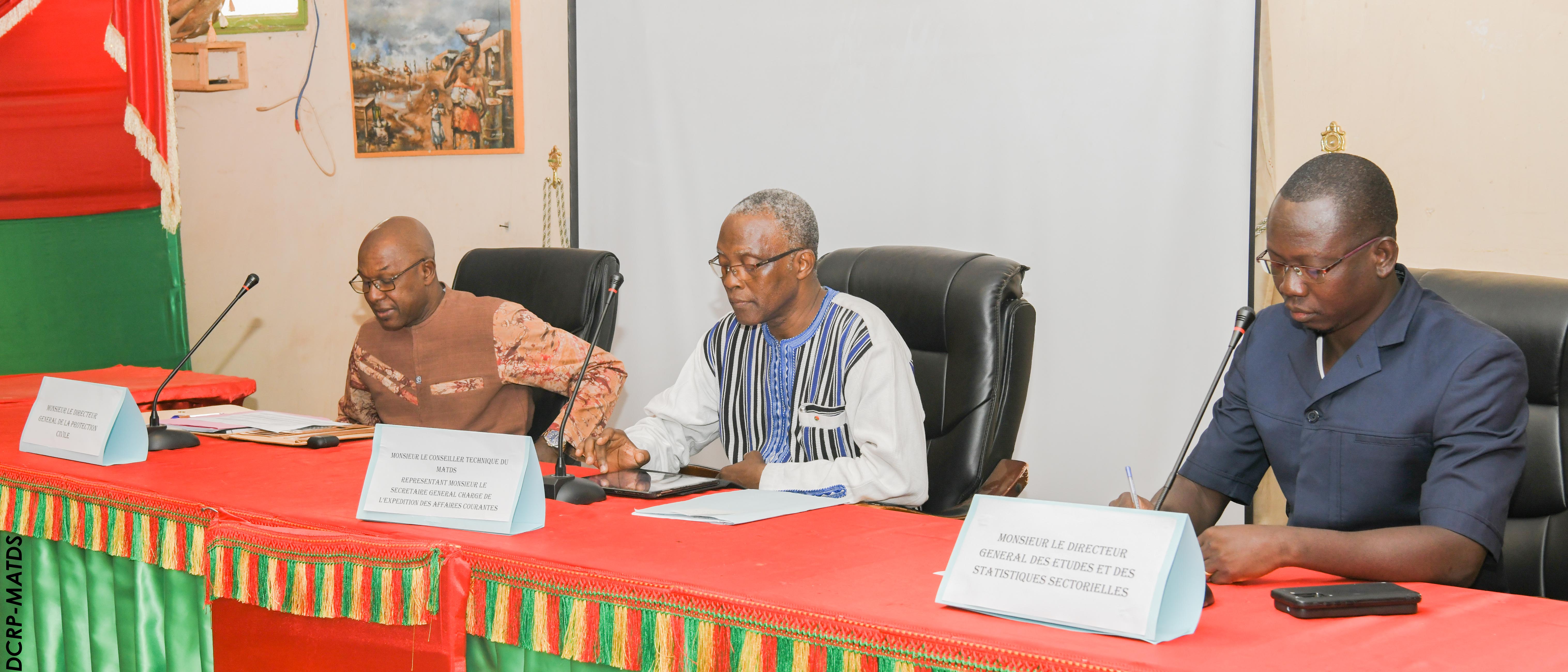
Le Ministère de l’Administration Territoriale, de la Décentralisation et de la sécurité, a lancé le mardi 18 octobre 2022, le processus d’élaboration de la Stratégie nationale de protection civile (SNPC-2023-2027).
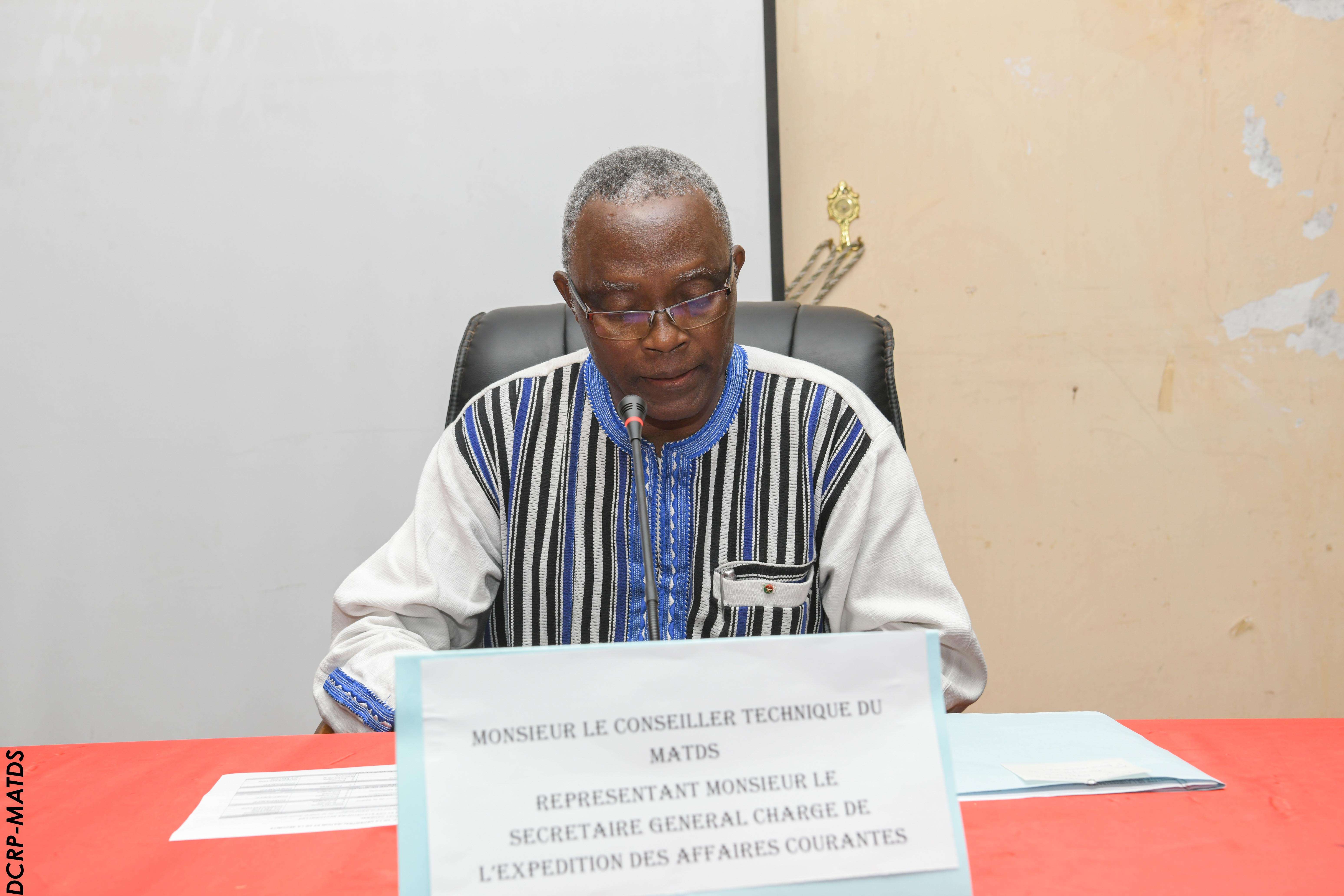
Le Conseiller technique, Idrissa SAWADOGO, qui a procédé au lancement du processus, au nom du Secrétaire Général, Chargé de l’expédition des affaires courantes, a soutenu que la démarche s’est voulue inclusive au regard de l’importance que revêt la SNPC et du difficile contexte sécuritaire actuel. « Fort de votre diversité, à travers l’implication de tous les sectoriels et autres structures concernées, je ne doute point de l’heureux aboutissement du processus entamé. Je vous exhorte donc à des échanges fructueux et constructifs », a-t-il souhaité.
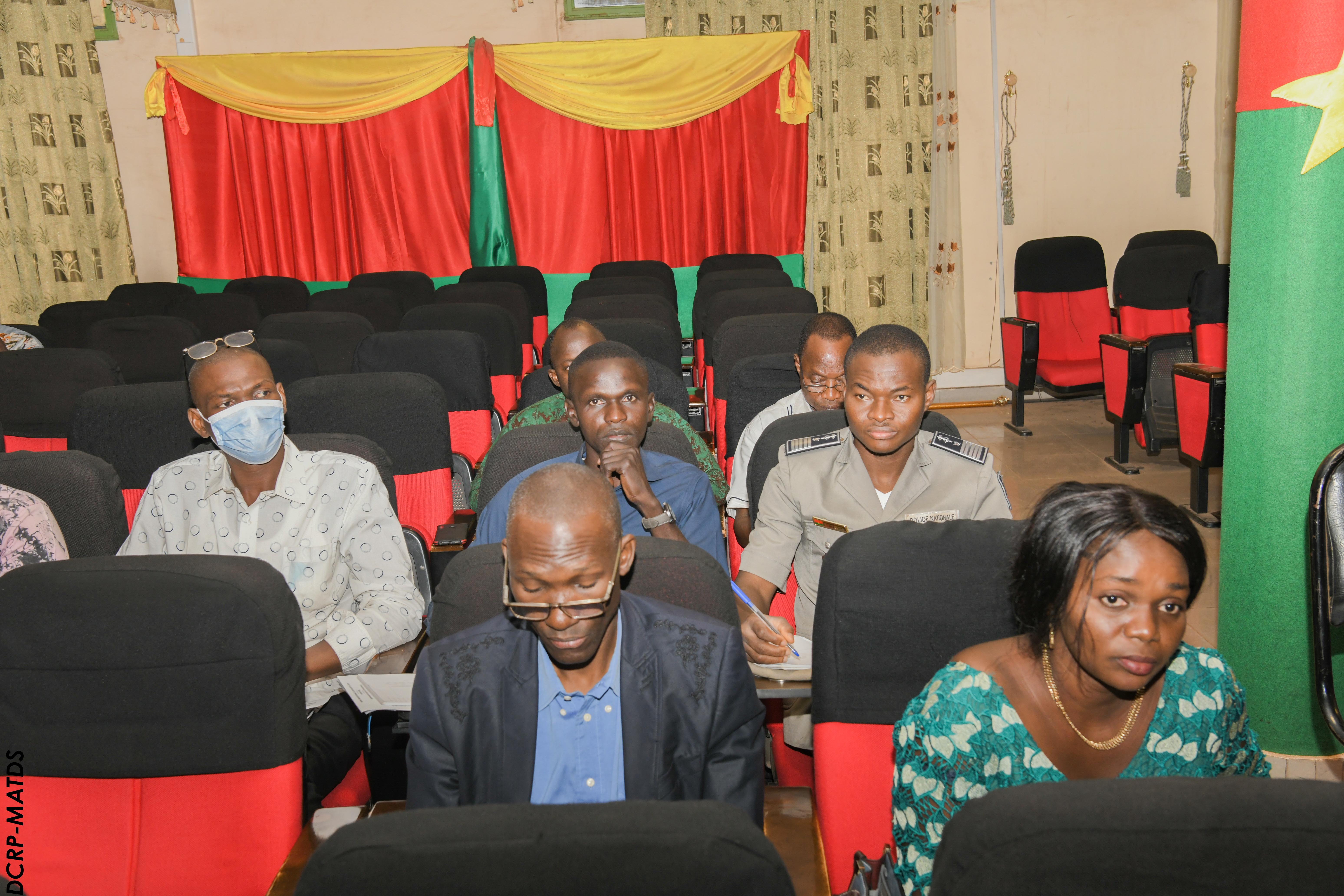
En effet, durant deux jours, les participants à l’atelier procéderont à la validation des Termes de références et des instances d’élaboration dudit document, à la présentation du cadre légal du système national de planification.
Ce nouveau document se veut être le nouveau référentiel d’assistance aux victimes de catastrophes et de crises au Burkina Faso, en remplacement de la Politique nationale de protection civile 2010-2020 échue.
En rappel, la gestion des risques liés aux catastrophes naturelles et aux crises incombe au Conseil national de secours d’urgence et de réhabilitation (CONASUR), à la Direction Générale de la protection civile (DGPC), à la Brigade nationale des Sapeurs-Pompiers (BNSP) et à l’Institut supérieur d’études de protection civile (ISEPC).
Climate change is likely to cause severe damage to the infrastructure sector in Burkina Faso.
Especially transport infrastructure is vulnerable to extreme weather events, yet essential for trading agricultural goods. Investments will need to be made into climate- resilient roads and other infrastructure.
Système d’alerte précoce et de réponse aux catastrophes naturelles au Burkina Faso : les livrables finaux de l’étude sur la conception d’une plateforme intégratrice validés
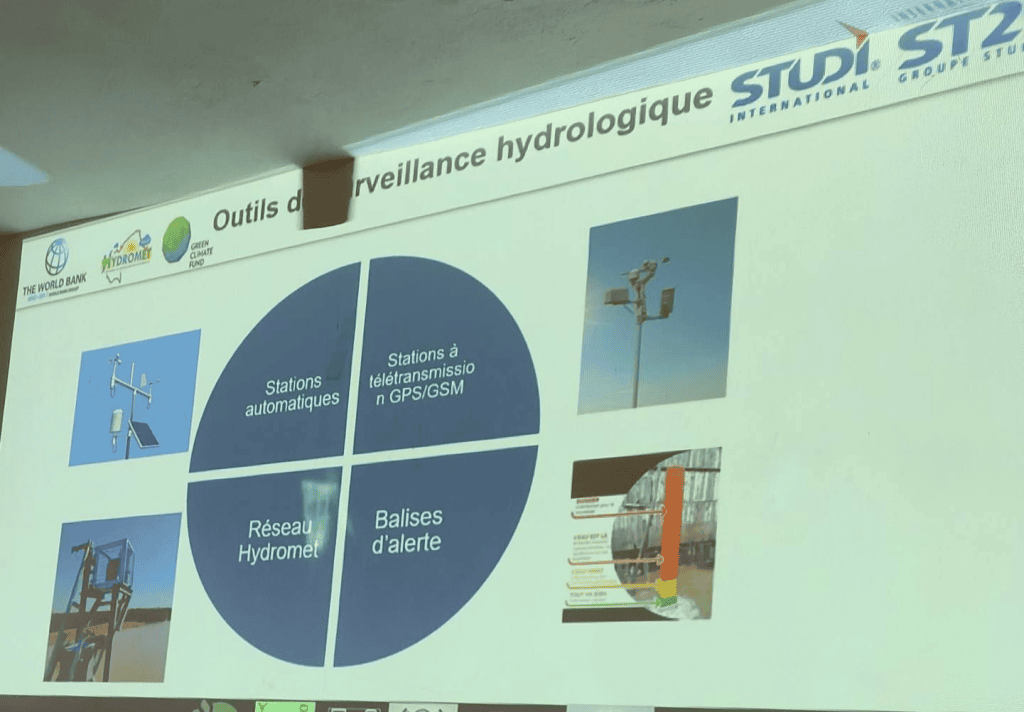
Le jeudi 20 mars 2025, s’est tenue dans la salle de réunion de l’Agence Nationale de la Météorologie (ANAM), l’atelier de validation des livrables de l’étude sur la conception d’une plateforme intégratrice d’alerte précoce liées au climat et à la gestion des catastrophes naturelles et aux crises alimentaires au Burkina Faso.
L’étude commanditée par le projet de renforcement de la résilience climatique au Burkina Faso (HYDROMET-BF) avait pour le but de permettre au Burkina Faso de disposer d’une plateforme fédératrice pour la prévention et la gestion des risques et catastrophes naturelles. Cette initiative du projet HYDROMET a été conduite par le cabinet tunisien STUDI International.
Il s’est agi pour le cabinet STUDI International en charge de l’étude de réaliser un diagnostic général des processus et méthodes de gestion des risques de catastrophes naturelles et des alertes précoces à l’échelle du pays, de collecter l’ensemble des informations en vue de produire et de proposer un processus optimal et efficace pour la prévention et la gestion des risques de catastrophes naturelles et des crises humanitaires au Burkina Faso.
L’étude a aussi permis de définir les outils appropriés de collecte et d’exploitation des informations par les cinq agences d’exécution du projet associées aux structures partenaires du domaine thématique et de proposer un modèle de plateforme web de concertation d’informations hydrométéorologiques et cartographiques, de prévention et de gestion des risques de catastrophes naturelles et de prévention des phénomènes hydrométéorologique et climatiques.
Pour le Coordonnateur du HYDROMET_BF, monsieur Sidbewindin Simon Kaboré, l’opérationnalisation de cette plateforme digitale permettra au pays de se préparer et d’agir rapidement en cas de catastrophes naturelles pour minimiser les risques de dommages ou de pertes liés à ces phénomènes.
L’atelier a permis aux responsables du projet et les parties prenantes après des échanges nourris avec le Cabinet STUDI International de valider l’étude sous réserve de la prise en compte des amendements.
Il faut noter que le Projet HYDAROMET_BF a pour objectif de renforcer la résilience climatique en améliorant l’accès aux services hydrométéorologiques, climatiques et d’alerte précoce pour les secteurs et communautés concernés. La mise en place de cette plateforme intégratrice destinée à aider les communautés et les organisations à se préparer et à agir rapidement pour minimiser les risques participe à son objectif de développement.
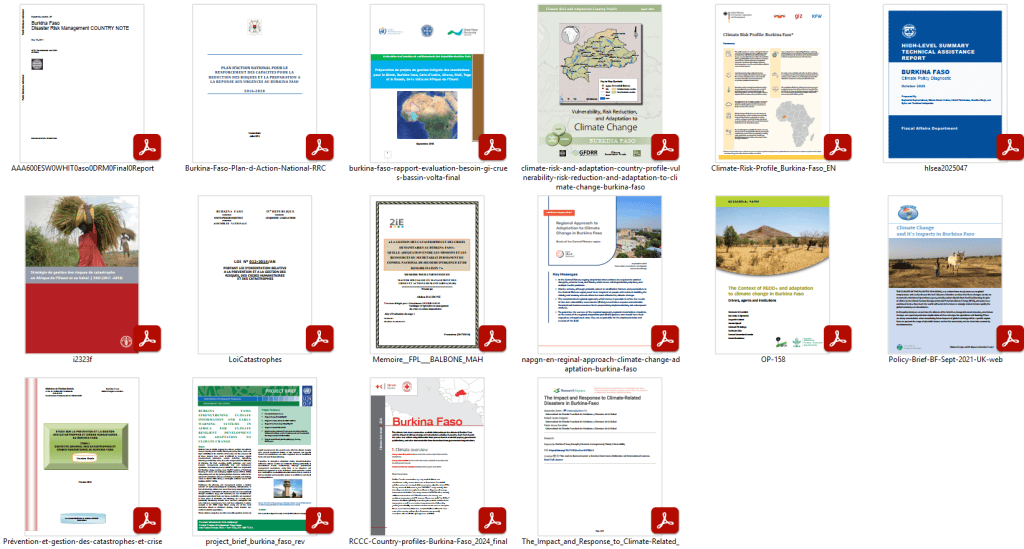
Please download from …………………
https://drive.google.com/drive/folders/1tSBJDefouQK7ngf1mCZ0TrtnztI4iiUY?usp=drive_link