Климатические риски и уязвимости Казахстана (Climate risk and vulnerabilities of Kazakhstan)
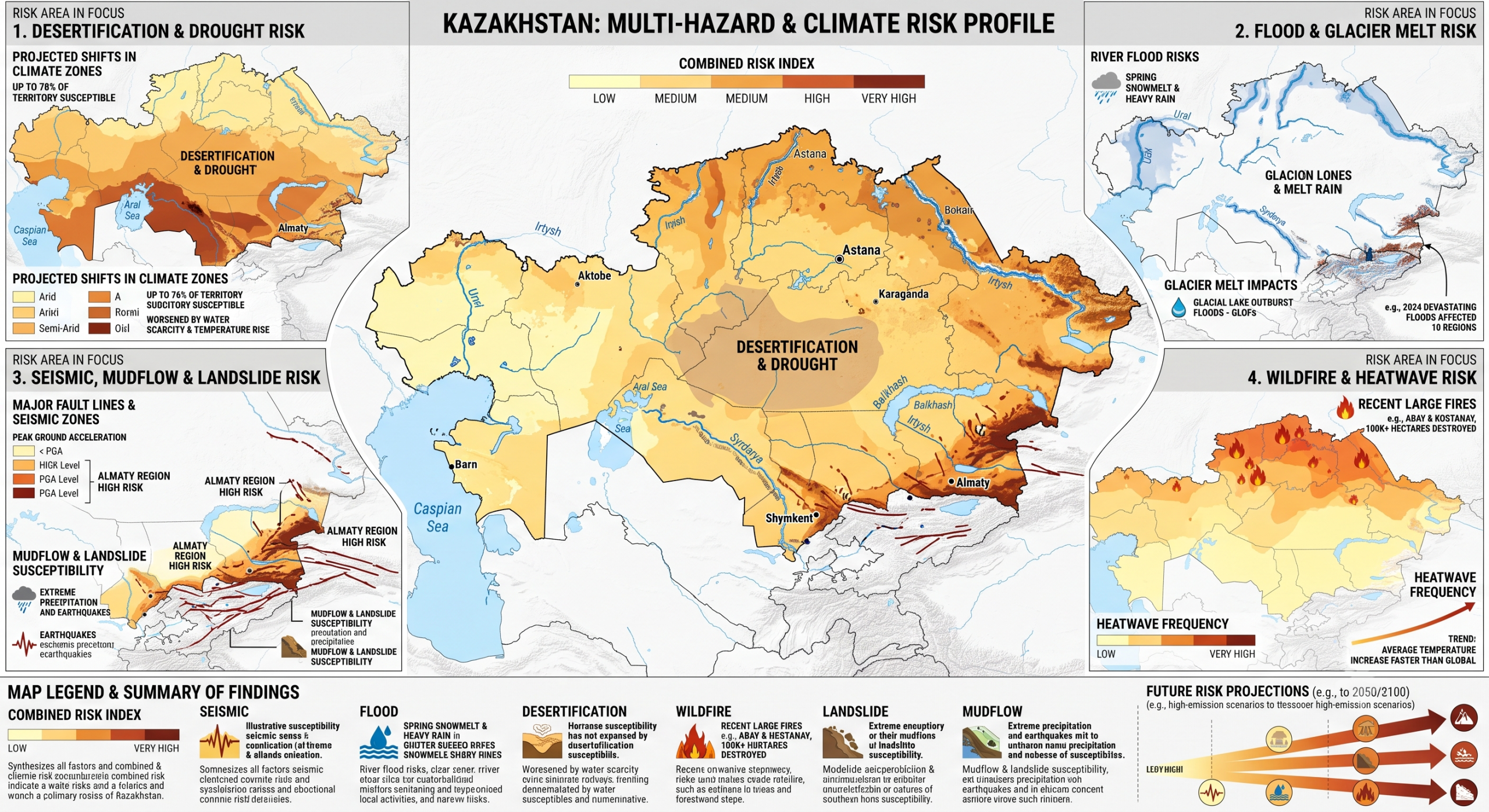
Kazakhstan is highly exposed and vulnerable to climate change and multi-hazard risks due to its sharply continental climate, vast arid and semi-arid landscapes, flood-prone river basins, glacier-fed mountain catchments, earthquake-prone southern and southeastern regions, water-resource constraints, dependence on agriculture and livestock, and exposure of infrastructure, settlements, ecosystems, and rural livelihoods to recurrent shocks. The country faces major risks from floods, spring snowmelt floods, droughts, heatwaves, water scarcity, earthquakes, mudflows, landslides, avalanches, steppe and forest fires, dust storms, desertification, land degradation, agricultural losses, and climate-sensitive health impacts. Climate change is expected to intensify these vulnerabilities through rising temperatures, more frequent heat extremes, drought and land degradation, extreme precipitation, glacier retreat, declining long-term water availability, higher irrigation demand, greater flood and mudflow risk, and increasing pressure on agriculture, water security, health, infrastructure, ecosystems, and vulnerable rural and mountain communities. Strengthening multi-hazard early warning systems, impact-based forecasting, flood and snowmelt forecasting, drought monitoring, water security, irrigation modernization, climate-resilient agriculture, pasture restoration, mountain-risk monitoring, earthquake-safe infrastructure, wildfire preparedness, disaster risk financing, and locally led adaptation is essential to reduce losses and protect Kazakhstan’s development gains.
Kazakhstan is highly exposed to climate change and multi-hazard risks due to its vast landlocked geography, sharply continental climate, extensive steppe and semi-arid zones, water-stressed river basins, glacier-fed mountain catchments, earthquake-prone south and southeast, flood-prone northern and western regions, and dependence on climate-sensitive agriculture, livestock, water resources, transport corridors, mining, energy, and rural livelihoods. The country faces major risks from floods, spring snowmelt floods, droughts, heatwaves, water scarcity, earthquakes, mudflows, landslides, avalanches, steppe and forest fires, dust storms, land degradation, desertification, and climate-sensitive health risks. UNICEF notes that around 75% of Kazakhstan’s territory is subject to high natural-disaster risk, including floods, hurricanes, landslides, mudflows, extreme temperatures, earthquakes, forest and steppe fires, and epidemics. (UNICEF)
1. Multi-hazard exposure
Kazakhstan’s risk profile combines hydrometeorological, geophysical, cryospheric, ecological, and slow-onset climate hazards. GFDRR’s disaster-risk profile identifies Kazakhstan’s population and economy as exposed to both earthquakes and floods, with floods posing the greater present-day modeled risk. (PreventionWeb) The country’s disaster-risk profile also highlights exposure to earthquakes, floods, hurricanes, landslides, mudflows, epidemics, extreme temperatures, and wildfires across large parts of the national territory. (PreventionWeb)
Hazard exposure is geographically differentiated. Northern and western Kazakhstan are highly exposed to spring snowmelt floods, river overflow, and waterlogging; southern and southeastern Kazakhstan face mudflows, landslides, earthquakes, drought, glacier retreat, and irrigation-water stress; central and western arid regions face drought, desertification, heat stress, and water scarcity; and mountain areas near Almaty and the Tien Shan face earthquakes, landslides, avalanches, glacier-lake and mudflow hazards.
2. Climate change as a risk multiplier
Climate change is increasing Kazakhstan’s exposure to heat, drought, land degradation, extreme precipitation, water stress, and glacier-related risks. The World Bank and ADB climate-risk profile reports that Kazakhstan is projected to experience warming well above the global average under high-emissions pathways, with the projected rise in average daily maximum temperature reaching about 5.8°C by the 2090s under RCP8.5. (Climate Change Knowledge Portal)
The Central Asia Climate Portal identifies heat, extreme precipitation, drought, and land degradation as the main hazards expected to increase in Kazakhstan, with heat, drought, and land degradation expected to impose the highest economic costs. It also notes that northwestern provinces are expected to be most affected by drought, while southeastern provinces are expected to be most affected by extreme precipitation. (centralasiaclimateportal.org)
3. Flood, snowmelt flood, and river-basin vulnerability
Flooding is one of Kazakhstan’s most damaging recurrent hazards. Spring floods are often driven by rapid snowmelt, frozen or saturated soils, heavy rainfall, river ice processes, reservoir stress, and drainage constraints. The 2024 floods demonstrated the scale of this risk: ACAPS reported that flooding beginning on 27 March 2024 became Kazakhstan’s largest flood event in 80 years, leading the government to declare a state of emergency in multiple regions. (ReliefWeb) Reuters reported that almost 117,000 people had been evacuated by mid-April 2024. (Reuters)
Flood vulnerability is especially important in river systems such as the Ural, Tobol, Ishim, Irtysh, Syr Darya, Ili, Nura, and other basins, where settlements, farmland, roads, bridges, industrial assets, livestock systems, and water infrastructure may be exposed. Floods can damage houses, roads, schools, health facilities, farms, pastureland, livestock assets, power systems, and drinking-water infrastructure, while also increasing waterborne disease and sanitation risks.
4. Drought, water scarcity, and transboundary water vulnerability
Water scarcity is one of Kazakhstan’s most strategic climate vulnerabilities. Water resources are unevenly distributed across the country, with southern and western regions facing significant water stress, while agriculture, industry, mining, energy, cities, ecosystems, and rural settlements all compete for limited resources. Kazakhstan is also highly dependent on transboundary rivers and upstream flows, making water security sensitive to both climate change and regional water-management dynamics.
UNCTAD’s climate adaptation assessment notes that increasing air temperature is expected to accelerate glacier melt, reduce mountain-river runoff by the end of the century, reduce lowland runoff because of higher evaporation, and increase water consumption because of rising temperatures and expanded irrigated land. It also reports that around 10–15% of water is lost during transport because of old water infrastructure and low-cost water services, and that water consumption could rise by more than 60% by 2030. (UN Trade and Development (UNCTAD))
5. Agriculture, livestock, and food-security vulnerability
Agriculture is highly climate-sensitive, especially rainfed wheat production, irrigated agriculture in the south, livestock systems, pastures, and rural livelihoods. Rising temperatures, drought, water scarcity, heat stress, dry winds, soil degradation, pests, floods, and snowmelt variability can reduce crop yields, damage pasture, reduce livestock productivity, and increase rural income insecurity. The World Bank/ADB climate-risk profile states that rising temperatures could threaten agricultural output and affect income and employment in poorer rural areas. (Open Knowledge Repository)
Kazakhstan’s agriculture is particularly exposed because large areas of arable land are drought-prone, while southern irrigation systems depend on reliable river flows, reservoirs, canals, and transboundary water allocation. Drought and heat can reduce wheat yields in northern grain-producing regions, while water scarcity, soil salinity, and irrigation inefficiency can affect cotton, rice, vegetables, orchards, and fodder production in southern regions.
6. Glacier retreat, mudflows, landslides, and mountain risk
Kazakhstan’s southeastern mountain regions are exposed to glacier retreat, snowpack change, mudflows, landslides, avalanches, flash floods, and earthquakes. Climate change can increase short- to medium-term risks by accelerating glacier melt and increasing unstable runoff, while longer-term glacier retreat may reduce dry-season river flows and water availability. UNICEF’s climate landscape analysis warns that accelerated melting of Tien Shan glaciers may increase water volumes, flooding, and mudslides in the short to medium term, but later reduce water volumes in many major rivers after 2050. (UNICEF)
Mudflow and landslide risk is particularly important for Almaty, mountain valleys, road corridors, hydropower facilities, reservoirs, tourism areas, rural settlements, and downstream urban infrastructure. These hazards are often triggered by intense rainfall, rapid snowmelt, unstable slopes, glacial lake conditions, seismic activity, and poorly managed land use.
7. Earthquake and cascading-risk vulnerability
Earthquake risk is a major component of Kazakhstan’s multi-hazard profile, particularly in the south and southeast, including areas around Almaty, Shymkent, Taraz, Zhambyl, Turkestan, and mountain-border regions. GFDRR’s disaster-risk profile identifies both flood and earthquake exposure as nationally significant. (PreventionWeb)
Earthquakes can cause direct damage to housing, schools, hospitals, roads, bridges, dams, pipelines, energy systems, communication networks, and public buildings. In mountain terrain, earthquakes can also trigger cascading impacts such as landslides, rockfalls, avalanches, mudflows, reservoir damage, and disruption to emergency access.
8. Steppe fires, land degradation, desertification, and ecosystem vulnerability
Kazakhstan’s steppe, semi-desert, desert, forest, wetland, and mountain ecosystems are vulnerable to warming, drought, wildfire, overgrazing, salinization, and land degradation. The country’s adaptation priorities include combating land degradation, desertification, and biodiversity loss, alongside water security, agricultural resilience, resilient infrastructure, climate-informed health systems, disaster risk reduction, and early warning. (NDC Partnership)
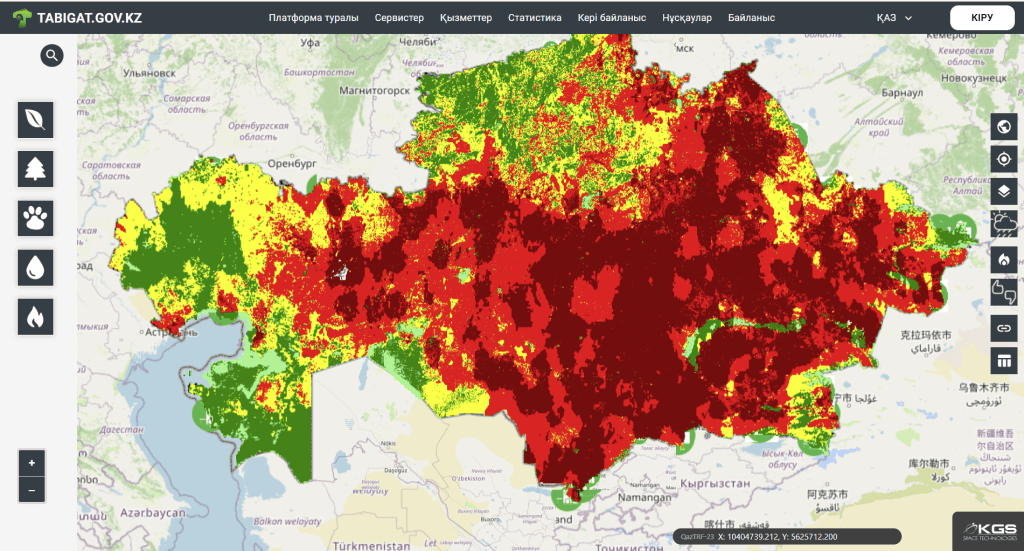
Steppe and forest fires can damage ecosystems, settlements, livestock, pasture, transport corridors, protected areas, and public health through smoke exposure. Land degradation and desertification can reduce pasture productivity, intensify dust storms, lower soil fertility, reduce crop yields, and increase vulnerability among rural and pastoral communities.
9. Health and social vulnerability
Climate change can worsen public-health risks through heat stress, respiratory illness from dust and wildfire smoke, waterborne disease after floods, food insecurity, malnutrition risk, vector sensitivity, injury from disasters, and mental-health stress after displacement or livelihood loss. UNICEF’s climate landscape analysis identifies water availability, safe drinking-water access, agriculture, and child vulnerability as key climate-risk concerns for Kazakhstan. (UNICEF)
The most vulnerable groups include smallholder farmers, livestock-dependent households, rural communities in drought-prone regions, households in flood-prone northern and western river basins, mountain communities exposed to mudflows and landslides, low-income urban residents, children, older persons, people with disabilities, outdoor workers, and communities dependent on irrigation, pastures, forests, and local water sources.
10. Sector-specific vulnerability summary
| Sector | Main climate and multi-hazard risks |
|---|---|
| Agriculture and food security | Drought, heat stress, rainfall variability, flood damage, pests, soil degradation, yield losses |
| Livestock and pasturelands | Pasture degradation, drought, water scarcity, heat stress, steppe fires, livestock disease |
| Water resources | Glacier retreat, reduced runoff, transboundary water stress, irrigation demand, evaporation, infrastructure losses |
| Urban settlements | Heatwaves, flooding, drainage stress, air-quality impacts, earthquake exposure |
| Mountain regions | Earthquakes, mudflows, landslides, avalanches, glacier retreat, flash floods |
| Transport infrastructure | Flooded roads, bridge damage, mudflows, landslides, snow and ice hazards, heat impacts |
| Health | Heat stress, waterborne disease, respiratory illness from dust and smoke, disaster-related injuries |
| Energy and industry | Water stress, flood disruption, heat impacts, earthquake exposure, infrastructure risk |
| Ecosystems | Steppe fires, desertification, land degradation, wetland stress, biodiversity loss |
11. Priority resilience needs
Kazakhstan’s resilience agenda should prioritize multi-hazard early warning systems, impact-based forecasting, flood and snowmelt forecasting, drought monitoring, heat-health action planning, glacier and mudflow monitoring, earthquake preparedness, climate-resilient agriculture, irrigation modernization, water accounting, transboundary water cooperation, pasture restoration, wildfire preparedness, resilient infrastructure, disaster risk financing, and locally led adaptation.
The Government of Kazakhstan is developing a National Adaptation Plan to strengthen climate resilience and integrate climate risks into national and subnational development planning. (Adaptation UNDP) UNDP also describes the NAP as a key tool for protecting sustainable development from climate risks. (UNDP)
| Priority area | Key actions |
|---|---|
| Early warning and anticipatory action | Impact-based warnings for floods, droughts, heatwaves, mudflows, landslides, avalanches, wildfires, dust storms, and earthquakes |
| Flood-risk management | Snowmelt forecasting, river-basin monitoring, reservoir operation, floodplain zoning, drainage improvement, evacuation planning |
| Drought and water security | Drought monitoring, water accounting, canal rehabilitation, irrigation efficiency, groundwater monitoring, transboundary cooperation |
| Climate-resilient agriculture | Drought- and heat-tolerant crops, agro-climate advisories, soil-moisture conservation, crop insurance, climate-smart irrigation |
| Pasture and livestock resilience | Rotational grazing, pasture restoration, fodder reserves, livestock health services, water-point rehabilitation |
| Mountain risk management | Glacier monitoring, mudflow and landslide mapping, early warning sirens, slope stabilization, safe mountain tourism planning |
| Earthquake resilience | Seismic-safe construction, retrofitting schools and hospitals, lifeline infrastructure protection, emergency drills |
| Ecosystem and fire resilience | Steppe-fire monitoring, wildfire preparedness, afforestation, wetland protection, desertification control |
| Risk financing and governance | Contingency finance, disaster insurance, forecast-based financing, resilient recovery, climate-risk screening of public investments |
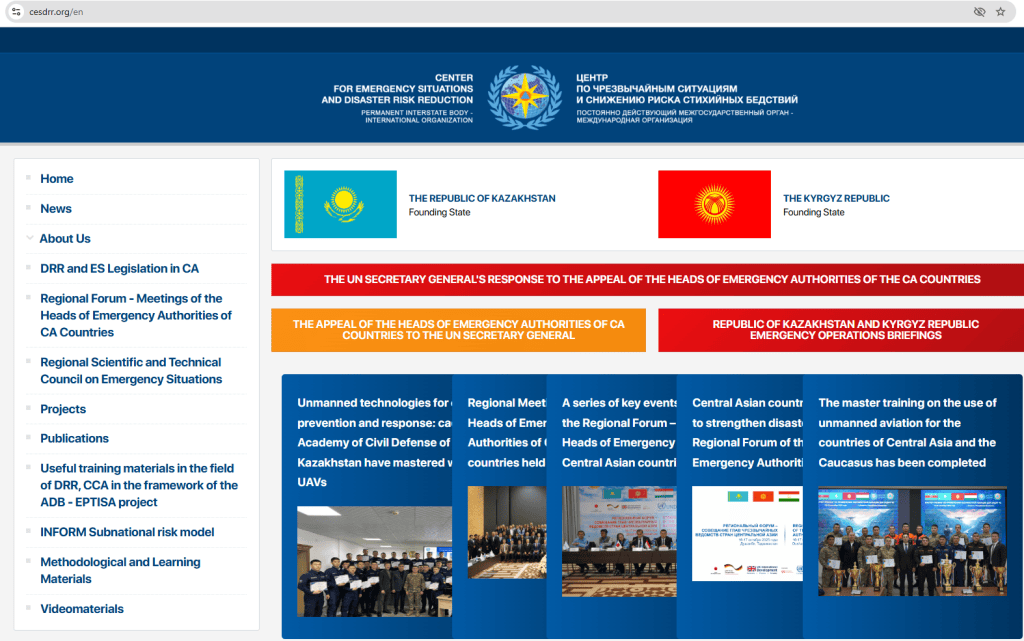
The Ministry of Emergency Situations of the Republic of Kazakhstan ( Kazakh: Қазақстан Республикасы Төтенше жағдайлар Минстерлігі ) is the central executive body responsible for the formation of state policy in the field of prevention and liquidation of emergency situations of natural and man-made nature, civil defense, intersectoral coordination in the field of fire and industrial safety, the formation and development of the state material reserve, ensuring the functioning and further development of the state system of prevention and liquidation of emergency situations, organization of fire prevention and extinguishing.
- Каталог современной адаптивной технологии управления чрезвычайными ситуациями в рамках Инициативы «Один пояс и один путь» (1-я версия)
- Сборник тезисов и докладов XIII Международной научно-практической конференции адъюнктов, магистрантов, курсантов и студентов
- Переосмысление городов Центральной Азии в интересах устойчивого к изменению климата и низкоуглеродного будущего
- Предварительная структура системы раннего предупреждения о множественных опасных явлениях и дополнительные меры в экономическом коридоре Алматы-Бишкек
- Отчет о реализации Плана действий на 2023-2024 годы по внедрению ИКТ в ЦА
- Проект ОБСЕ по созданию подсистем «Цифровой паспорт безопасности» и «Интерактивная карта» в Республике Казахстан
- Обзорный документ о состоянии систем раннего оповещения в странах Центральной Азии
- Сравнительный анализ способов тушения пожаров электромобилей
- Сравнительный анализ пожарной опасности электромобилей
- Актуальные проблемы пожарной безопасности, предупреждения и ликвидации чрезвычайных ситуаций
- Концепция комплексного подхода по управлению рисками трансграничных бедствий с учетом климатических изменений
- Ситуационно-аналитическая справка моренного озера №5
- Селевая безопасность, 50 лет деятельности Казселезащиты
- Методические рекомендации по привитию детям навыков действий в чрезвычайных ситуациях
- План подготовленности Республики Казахстана к чрезвычайным ситуациям природного характера
- План подготовленности Алматинской области к чрезвычайным ситуациям природного характера
- Рекомендации по внесению изменений и дополнений в Закон Республики Казахстан «О гражданской защите» от 11 апреля 2014 года
- Руководство по охране психического здоровья для специалистов неспециализированных медицинских учреждений Республики Казахстан
- Анализ техногенных аварий и природных бедствий в Центральной Азии
- Обзорная информация о чрезвычайных ситуациях природного и техногенного характера, происшедших на территории Республики Казахстан за шесть месяцев 2021 года
- Обзорная информация о чрезвычайных ситуациях природного и техногенного характера, происшедших на территории Республики Казахстан за 2020 год
- Методика анализа рисков бедствий на местном уровне с особым вниманием на потребности и уязвимость детей
- Национальный ситуационный анализ безопасности территории Республики Казахстан от природных и техногенных бедствий (методические основы)
- Ситуационный анализ Алматинской области – 2015 год
- Атлас природных и техногенных опасностей и рисков чрезвычайных ситуаций в Республике Казахстан – 2009 г.
Subject: Looking forward to the scope of work and partnership opportunity with the Ministry of Emergency Situations of the Republic of Kazakhstan ( Kazakh: Қазақстан Республикасы Төтенше жағдайлар Минстерлігі )
To,
The Ministry of Emergency Situations of the Republic of Kazakhstan ( Kazakh: Қазақстан Республикасы Төтенше жағдайлар Минстерлігі )
Dear Sir,
Greetings from the Multi-Hazard Early Warning System Design and Implementation Center (MHEWC).
MHEWC provides technical solutions to strengthen Disaster Risk Management (DRM) governance systems, climate and multi-hazard risk management, and end-to-end early warning system design and implementation. We would be pleased to offer technical support to the Ministry of Emergency Situations of the Republic of Kazakhstan ( Kazakh: Қазақстан Республикасы Төтенше жағдайлар Минстерлігі ) in the following areas:
a) Upgrading the existing web portal into a geospatial, database-driven, and app-enabled Decision Support System (DSS) to support real-time disaster risk governance, planning, preparedness, response, and recovery management.
b) Conducting climate and multi-hazard risk and vulnerability assessments, including the preparation of geospatial hazard, exposure, vulnerability, and risk maps, and the establishment of a centralized risk information repository and database management system.
c) Assessing existing monitoring, observation, and early warning capacities and supporting RS in the installation, enhancement, and integration of observation networks, including Automated Weather Stations (AWS), hybrid weather and hazard monitoring systems, and sensor-ingested real-time data systems linked to a functional DSS.
d) Designing and operationalizing end-to-end multi-hazard early warning systems, including weather and hazard nowcasting services, impact-based forecasting, forecast-based anticipatory early action, forecast-based emergency preparedness and response management, forecast-based financing, Early Action Protocol development, and DSS-supported Standing Orders on Disaster and Standard Operating Procedures.
e) Supporting automated hazard detection, monitoring, prediction, and emergency operations management, including the design, implementation, and operationalization of a Multi-Hazard and Disaster Emergency Operations Center (EOC).
f) Developing GIS, database, and information tool-driven local government and productive sector-level risk-informed planning and budgeting systems to strengthen disaster risk reduction, climate change adaptation, nature-based solutions, locally led adaptation, and resilience planning.
g) Reviewing and upgrading multi-hazard preparedness, response, and recovery plans across administrative levels and relevant priority sectors, in alignment with institutional mandate and national disaster management priorities.
h) Providing any additional technical assistance as may be required by The Ministry of Emergency Situations of the Republic of Kazakhstan ( Kazakh: Қазақстан Республикасы Төтенше жағдайлар Минстерлігі ) to strengthen national-to-last-mile disaster risk governance and early warning capacities.
We would welcome the opportunity to discuss The Ministry of Emergency Situations of the Republic of Kazakhstan ( Kazakh: Қазақстан Республикасы Төтенше жағдайлар Минстерлігі ) priorities and explore how MHEWC can support the development of a practical implementation roadmap for strengthening multi-hazard early warning, risk information, and disaster risk governance systems.
We look forward to your kind response.
Sincerely,
Z M Sajjadul Islam
Director & Advisor
Multi-Hazard Early Warning System Design and Implementation Center (MHEWC)
Web: mhewc.org
Email: [ sajjad@mhewc.org ] [ zmsajjad@gmail.com ]
Phone & WhatsApp: +88 01711 979179